


UAE New Tax Rules 2026: VAT & Corporate Tax Changes


Table of contents:
- Key Summary
- What Are the Main UAE Tax Rule Changes in 2026?
- Did the UAE Introduce Personal Income Tax in 2026?
- New VAT Rules in UAE 2026
- What Changed in UAE Tax Procedures in 2026?
- New Refund and Credit Balance Rules Businesses Should Know
- Voluntary Disclosures and Error Corrections Under the 2026 Rules
- FTA Service Fee Changes Effective from January 2026
- New Excise Tax Rules for Sweetened Beverages in 2026
- Did Corporate Tax Rules Change in 2026?
- How the 2026 Tax Rules Affect UAE Businesses
- What Should Businesses Do to Prepare for the UAE Tax Rules in 2026?
- How Daftra Helps UAE Businesses Stay Compliant With New Tax Rules
- FAQs About UAE New Tax Rules 2026
- Conclusion
The UAE has introduced significant tax reforms through Federal Decree-Law No. 16 of 2025 and Federal Decree-Law No. 17 of 2025, which amend the VAT Law and Tax Procedures Law, effective from 1 January 2026. In addition, Cabinet Decision No. 17 of 2026, effective from 1 April 2026, updated the Executive Regulations to provide greater clarity on tax procedures and improve compliance.
These changes aim to enhance transparency, simplify tax processes, protect taxpayers’ rights, and strengthen the efficiency of the UAE tax system. The new rules include important updates to VAT procedures, invoicing requirements, input tax recovery, and compliance obligations for businesses operating in the UAE.
What Are the Main UAE Tax Rule Changes in 2026?
The UAE introduced several major tax reforms in 2026 to strengthen compliance, simplify procedures, and align the tax system with international standards. The updates affect VAT, tax procedures, corporate tax compliance, excise tax, and FTA administrative services.
Key changes include:
VAT Law Amendments Effective 1 January 2026
The UAE updated the VAT framework through Federal Decree-Law No. 16 of 2025, introducing changes including the removal of self-invoicing under the reverse charge, a five-year deadline for VAT refund claims, and stricter anti-tax evasion measures.
Tax Procedures Law Amendments Effective 1 January 2026
Federal Decree-Law No. 17 of 2025 introduced broader procedural reforms, including updated limitation periods, revised rules for refund and credit balances, stronger audit procedures, and clearer compliance obligations across federal taxes.
Tax Procedures Executive Regulation Changes Effective 1 April 2026
Cabinet Decision No. 17 of 2026 updated the Executive Regulations to clarify voluntary disclosures, record retention rules, refund procedures, and FTA investigation powers.
Stricter Corporate Tax Compliance Monitoring
While Corporate Tax rates remain unchanged, businesses may face increased post-filing reviews, reconciliation checks, and greater scrutiny of financial records and transfer pricing documentation. Learn more about Corporate Tax in the UAE.
More Automated and Data-Driven VAT Audits
The Federal Tax Authority is increasing invoice matching, customs cross-checking, and digital compliance monitoring to improve audit efficiency and detect inconsistencies faster. Learn more about the Federal Tax Authority and its role in tax administration.
FTA Service-Fee Updates Effective 1 January 2026
New service fees now apply to certain Advance Pricing Agreement (APA) applications, while paper Tax Registration Certificate fees have been removed and replaced with free electronic certificates with QR-code verification.
Excise Tax Amendments for Sweetened Beverages Effective 1 January 2026
The UAE introduced a new sugar-based excise tax model for sweetened beverages, applying different tax rates based on sugar content. Learn more about the Excise Tax in the UAE.
These reforms primarily focus on improving transparency, strengthening enforcement, reducing administrative burdens, and accelerating the UAE’s transition to a more digital, compliance-driven tax environment.
Did the UAE Introduce Personal Income Tax in 2026?
No, the UAE did not introduce personal income tax in 2026. The UAE continues to apply a 0% personal income tax policy on salaries, wages, and most individual earnings, meaning employees and individuals do not pay federal income tax on their employment income and are not subject to payroll withholding deductions.
However, this does not mean the UAE is completely “tax-free.” The UAE now operates a broader tax system that applies to businesses, goods, and certain products rather than personal employment income.
Here is the difference between the main types of taxes in the UAE:
- Personal salary income: Individuals do not pay income tax on salaries, wages, or most personal earnings.
- Corporate Tax on business profits: Businesses are subject to Corporate Tax at:
- 0% on taxable profits up to AED 375,000
- 9% on profits above AED 375,000
- VAT (Value Added Tax): A 5% VAT applies to most goods and services purchased in the UAE. This is a consumption tax paid by consumers at the point of purchase.
- Excise Tax: Excise Tax applies to selected products considered harmful to health, such as tobacco products, sugary drinks, energy drinks, and certain electronic smoking devices.
- Customs duties and government fees: Businesses and individuals may also pay customs duties, licensing fees, visa fees, municipality charges, and other regulatory service fees, depending on their activities.
So, while the UAE remains highly attractive from a personal income tax perspective, it is more accurate to describe the country as having low personal taxation with an expanding business and indirect tax system, rather than being completely tax-free.
New VAT Rules in UAE 2026
The UAE introduced significant VAT reforms under Federal Decree-Law No. 16 of 2025, with the new rules taking effect from 1 January 2026. These amendments are designed to simplify VAT compliance, reduce administrative burdens, strengthen anti-evasion measures, and improve the overall efficiency of the UAE tax system.
The changes mainly affect the following:
1. Removal of Self-Invoicing Under Reverse Charge
One of the most important changes is the removal of the requirement to issue self-invoices when applying the reverse charge mechanism.
Previously, businesses importing goods or services were often required to create internal self-invoices to account for VAT. From 2026 onward, taxable persons only need to retain supporting documents such as:
- Supplier invoices
- Contracts
- Customs documentation
- Payment records
This change reduces unnecessary paperwork while maintaining proper audit evidence.
What Businesses Should Do:
- Stop generating self-invoices for reverse charge transactions
- Update accounting systems and ERP workflows
- Maintain organized supporting documentation for audits
2. New Five-Year Deadline for VAT Refund Claims
The amendments introduce a strict five-year time limit for claiming excess refundable VAT or using VAT credit balances.
The five-year period starts from the end of the relevant tax period. Any unused VAT credits that are not refunded or offset within that timeframe may expire and become unrecoverable.
A transitional relief period applies to certain historical balances, allowing eligible businesses to submit older refund claims until 31 December 2026.
What Businesses Should Do:
- Review historic VAT balances and refund positions
- Identify old unused VAT credits
- Submit outstanding refund applications before expiry deadlines
3. Stronger Anti-Tax Evasion Measures
The Federal Tax Authority (FTA) now has broader authority to deny input VAT recovery where transactions are connected to tax evasion arrangements.
Input tax deductions may be rejected if the business:
- Knew about the evasion arrangement, or
- “Should have known” that the transaction involved incorrect VAT treatment
This places greater responsibility on businesses to verify suppliers and the legitimacy of transactions.
What Businesses Should Do:
- Strengthen supplier due diligence procedures
- Verify VAT registration details of suppliers
- Retain contracts, invoices, delivery records, and payment evidence
- Train procurement and finance teams to identify VAT risks
4. Increased Documentation and Audit Focus
Although some procedures are simplified, documentation requirements remain critical under the new rules.
Businesses must maintain accurate electronic records and ensure VAT documentation is easily accessible during audits. The FTA also continues to expand its audit and compliance monitoring powers.
What Businesses Should Do:
- Improve electronic recordkeeping systems
- Maintain clear audit trails for VAT transactions
- Store records securely for at least five years
5. VAT Rate and Core Rules Remain Unchanged
While the 2026 amendments introduce procedural and compliance changes, the UAE’s core VAT structure remains the same:
- Standard VAT rate remains 5%
- Zero-rated and exempt supply rules remain unchanged
- VAT grouping rules continue to apply
The reforms mainly focus on improving administration, compliance, and fraud prevention rather than changing VAT rates or introducing new VAT categories.
The UAE VAT rule changes in 2026 represent one of the most significant updates to the VAT system since its introduction in 2018. The amendments simplify some compliance processes while imposing stricter controls around documentation, refund claims, and supplier verification.
Businesses should begin reviewing their accounting systems, VAT recovery positions, and internal compliance procedures early to avoid penalties and ensure smooth adaptation to the new VAT framework.
What Changed in UAE Tax Procedures in 2026?
The UAE introduced important amendments to the Tax Procedures Executive Regulation through Cabinet Decision No. 17 of 2026, effective from 1 April 2026. The changes aim to improve transparency, simplify compliance, and strengthen tax administration procedures.
Extended Record Retention Period
Businesses must retain records for an additional two years if a refund claim remains pending and the FTA has not yet issued a decision.
Updated Voluntary Disclosure Rules
Incorrect refund claims linked to incorrect corporate tax returns or assessments may require voluntary disclosure, particularly where the adjustment exceeds AED 10,000.
Refund Rules Expanded to Credit Balances
The updated rules confirm that refund procedures apply to any credit balance in the taxpayer's favor.
Stronger FTA Audit and Seizure Powers
The FTA may extend the period for preserving or seizing documents and assets during tax audits or investigations.
Enhanced Data Protection and Information Sharing Rules
The amendments revise how taxpayer information may be shared with government authorities while strengthening confidentiality and data protection requirements.
Greater Focus on Compliance and Audit Readiness
Businesses are expected to maintain stronger documentation, improve internal controls, and ensure timely correction of tax errors under the updated framework.
New Refund and Credit Balance Rules Businesses Should Know
The UAE introduced important updates to VAT refund and credit balance procedures as part of the 2026 tax reforms. These changes aim to create clearer timelines for refund claims, improve tax administration, and reduce the accumulation of old, unresolved VAT balances.
The new rules mainly affect how businesses manage VAT refunds, carry forward excess VAT credits, maintain records, and respond to tax authority reviews.
read more: VAT Return Form 201 UAE
1- Five-Year Deadline for VAT Refund Claims
From 1 January 2026, businesses must submit VAT refund claims within five years from the end of the relevant tax period in which the credit balance arose.
If a refund claim is not submitted within this period, the right to recover the amount may expire. This applies to excess input VAT, overpayments, and carried-forward VAT credits.
The new deadline gives businesses clearer guidance on refund eligibility while encouraging faster reconciliation of VAT balances.
2- Transitional Relief for Older VAT Credits
To help businesses transition into the new system, the UAE introduced a one-year grace period ending on 31 December 2026.
This relief applies to:
- VAT credits where the five-year period already expired before 1 January 2026
- VAT credits due to expire within one year from that date
Eligible businesses may still submit refund claims during this transition window before the balances become unrecoverable.
3- Refund Procedures Now Apply to Credit Balances
The updated rules confirm that refund procedures apply to any credit balance in favor of the taxpayer.
Previously, many businesses carried forward excess VAT balances against future liabilities. Under the revised framework, businesses have clearer procedures for requesting refunds of those balances where eligible.
This change may improve cash flow management, especially for businesses with large accumulated input VAT credits.
4- Special Exceptions Under the New Rules
The amendments also include limited exceptions in certain situations.
For example, a refund request may still be accepted:
- If a new credit balance arises after the five-year period
- If the refund relates to balances generated during the final 90 days of the limitation period
These cases remain subject to conditions outlined by the Federal Tax Authority (FTA).
5- Extended Record Retention Requirements
Businesses with pending refund applications may now need to retain records for an additional two years if the FTA has not yet issued a decision on the claim.
This means supporting documents related to refund claims should remain accessible for longer periods, especially during audits or ongoing reviews.
6- FTA Audit Authority Beyond the Limitation Period
The updated framework also allows the FTA to continue audits or issue tax assessments in certain cases even after the standard limitation period has expired, particularly where refund claims were submitted near the end of the five-year window.
Voluntary Disclosures and Error Corrections Under the 2026 Rules
The UAE introduced important updates to the voluntary disclosure and error correction rules under Cabinet Decision No. 17 of 2026 and the amended Tax Procedures framework. The changes, effective from 1 April 2026, aim to simplify compliance, clarify correction procedures, and encourage businesses to identify and fix tax errors promptly.
New Threshold Rules for Voluntary Disclosures
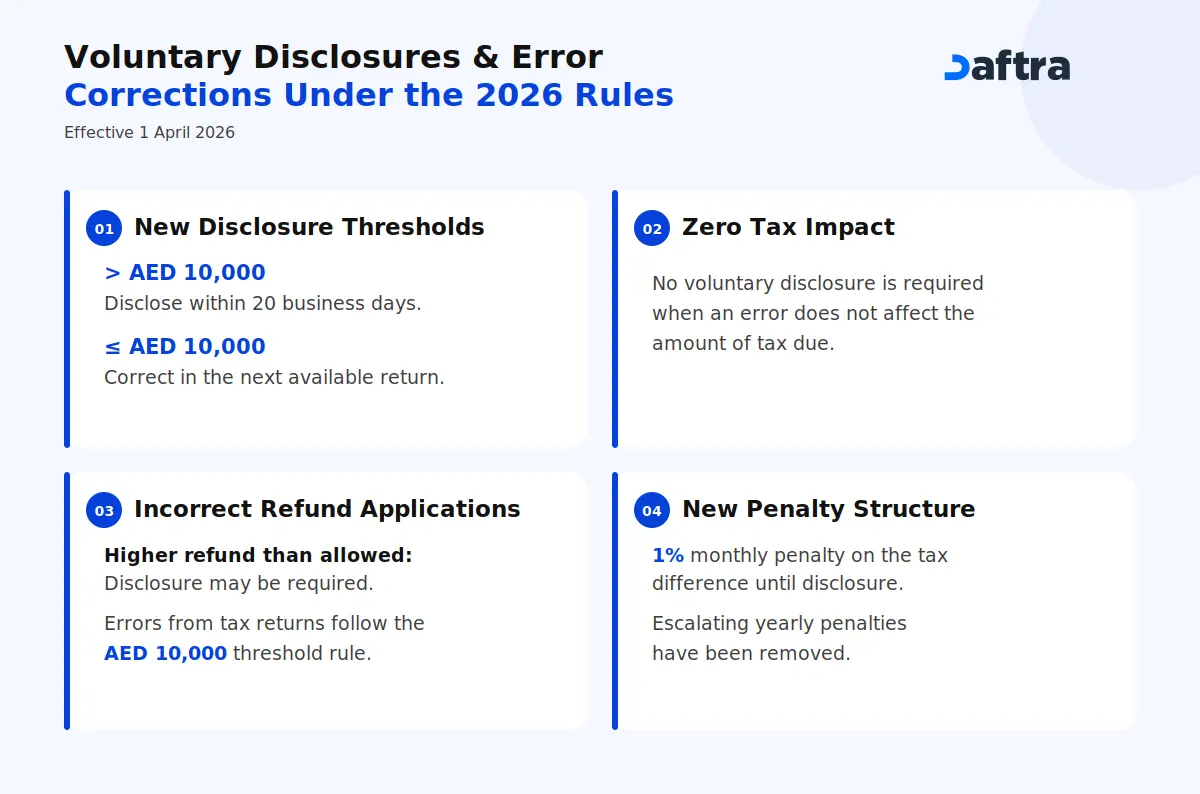
Under the updated rules, the treatment of tax errors now depends on the value of the error:
- If the tax difference exceeds AED 10,000, the taxpayer must submit a voluntary disclosure within 20 business days from becoming aware of the error.
- If the error is AED 10,000 or less, it may be corrected in the next available tax return instead of filing a separate voluntary disclosure.
- If no upcoming tax return is available, a voluntary disclosure must still be submitted within 20 business days.
This applies to VAT returns, corporate tax returns, tax assessments, and certain refund-related corrections.
No Voluntary Disclosure Required Where No Tax Difference Exists
One of the major simplifications introduced in 2026 is the removal of the requirement to file a voluntary disclosure when an error does not affect the amount of tax due.
Previously, businesses often had to submit voluntary disclosures even for administrative or reporting errors that resulted in no change to the payable tax. Under the new rules, taxpayers may correct such errors without filing a voluntary disclosure, reducing unnecessary compliance burdens.
Updated Rules for Incorrect Refund Applications
The amendments also clarify how businesses should handle incorrect tax refund applications.
- If a refund claim resulted in a higher refund amount than allowed, the taxpayer may need to submit a voluntary disclosure.
- Where the refund error originates from an incorrect tax return or tax assessment, the AED 10,000 threshold rules apply.
- Businesses must act within the specified correction timelines once the error is identified.
These changes are intended to align refund corrections with the broader voluntary disclosure framework.
New Penalty Structure for Voluntary Disclosures
The UAE also revised the penalty regime related to voluntary disclosures and tax errors.
Under the updated system:
- A monthly penalty of 1% may apply on the tax difference from the original due date until the voluntary disclosure is submitted.
- The previous escalating percentage penalties based on the number of years have been removed.
- Failure to correct errors before an FTA audit notice may trigger additional fixed penalties.
The revised structure creates a more standardized penalty approach while increasing the importance of early error detection.
FTA Service Fee Changes Effective from January 2026
The Federal Tax Authority (FTA) introduced updates to its service fee structure, effective 1 January 2026, amending the existing framework for tax service fees in the UAE.
Introduction of new fees for Advance Pricing Agreements (APAs)
The updated schedule adds two new chargeable services:
- Application for entering into a Unilateral Advance Pricing Agreement (APA) for the first time
- Application for renewal or amendment of a Unilateral APA
These fees are part of the FTA’s efforts to improve procedural efficiency and strengthen tax compliance mechanisms for complex transfer pricing arrangements.
Removal of fees for paper tax certificates
In line with the UAE’s digital transformation strategy, the FTA has canceled fees previously charged for issuing paper-based certificates, including:
- Certified paper Tax Registration Certificates (new or replacement)
- Certified paper Warehouse Keeper Registration Certificates (new or replacement)
Shift to free digital registration certificates
The FTA will now issue electronic registration certificates free of charge for all registrants. These certificates will:
- Be provided digitally instead of in paper format
- Include a QR code for instant verification of registration status
- Improve accessibility and reduce administrative processing steps
New Excise Tax Rules for Sweetened Beverages in 2026
The UAE Ministry of Finance issued Cabinet Decision No. (197) of 2025 introducing key amendments to excise tax rules for sweetened beverages, effective from 1 January 2026. The new framework replaces the previous system under Cabinet Resolution No. (52) of 2019 and introduces a tiered volumetric model based on sugar content.
Introduction of a tiered sugar-based tax system
Under the updated rules, excise tax on sweetened beverages will no longer apply at a single flat rate. Instead, it will be calculated based on sugar content per 100 milliliters:
- AED 0.79 per liter for beverages containing 5g to less than 8g of sugar per 100ml
- AED 1.09 per liter for beverages containing 8g or more of sugar per 100ml
- Beverages with less than 5g of sugar per 100ml or containing only artificial sweeteners are exempt
New classification and compliance requirements
The Federal Tax Authority (FTA) will classify products according to sugar content and include them in the official excise tax price list. Taxable persons must provide valid laboratory reports and supporting documentation to confirm classification.
If the required documents are not submitted in the excise tax registration, the FTA will apply the highest applicable tax category until proper verification is provided.
Did Corporate Tax Rules Change in 2026?
The UAE Corporate Tax rate did not change in 2026. The standard rate remains 0% on taxable income up to AED 375,000 and 9% on taxable income above that threshold.
However, many businesses searching for “UAE tax changes 2026” are mainly referring to corporate tax compliance requirements rather than changes in tax rates. In practice, corporate tax remains one of the most important compliance areas for UAE businesses in 2026.
Businesses must continue focusing on core obligations such as:
- registering for Corporate Tax with the Federal Tax Authority (FTA)
- filing tax returns within the required deadlines
- maintaining accurate accounting records and supporting documents
- understanding whether businesses qualify for preferential free zone tax treatment and meet the required free zone tax conditions
- reviewing available reliefs and exemptions
- ensuring accurate tax calculations, reconciliations, and submissions
Although the corporate tax framework itself remains largely unchanged, enforcement and compliance monitoring are becoming stricter in 2026, with more frequent reviews, more clarification requests, and greater cross-checking between tax filings and financial statements.
Large multinational groups should also continue to monitor the Domestic Minimum Top-Up Tax (DMTT) framework, which applies to financial years starting on or after 1 January 2025 and remains relevant for 2026 tax planning and compliance.
According to EY, the UAE DMTT applies to multinational enterprise (MNE) groups with consolidated annual revenues of at least €750 million in two of the previous four fiscal years.
How the 2026 Tax Rules Affect UAE Businesses
The 2026 tax reforms significantly increase the importance of compliance, documentation, and tax governance for UAE businesses.
Businesses will need to:
- Monitor VAT and tax credit balances carefully.
- improve accounting and record-keeping systems.
- Reconcile VAT and Corporate Tax filings.
- strengthen transfer pricing documentation.
- Review supplier VAT compliance.
- and ensure audit readiness.
The new rules also increase FTA enforcement powers while creating stricter deadlines and more structured compliance requirements.
What Should Businesses Do to Prepare for the UAE Tax Rules in 2026?
To prepare for the 2026 UAE tax changes, businesses should:
- Review all historical VAT and tax credit balances before expiry deadlines.
- Update compliance calendars for new filing, refund, and limitation periods.
- Improve internal accounting records and audit documentation.
- Reconcile Corporate Tax, VAT, and Excise Tax filings regularly.
- Review supplier verification and VAT due diligence procedures.
- Update transfer pricing documentation where applicable.
- Monitor FTA guidance, binding clarifications, and future tax updates.
- Consider obtaining professional tax advice for audits, disclosures, or complex tax structures.
- Consider adopting tax management or accounting software to automate reporting, reduce manual errors, and improve accuracy in filings and reconciliations.
For streamlined financial management and compliance tracking, businesses can also use Daftra accounting software to simplify bookkeeping, invoicing, and tax reporting processes.
Early preparation will help businesses reduce compliance risks, avoid penalties, and adapt more efficiently to the UAE’s evolving tax framework.
How Daftra Helps UAE Businesses Stay Compliant With New Tax Rules
Daftra supports UAE businesses in meeting the 2026 tax requirements by automating VAT processes, improving accuracy, and ensuring alignment with Federal Tax Authority (FTA) standards, as compliance becomes increasingly stringent and data-driven.
- Automated VAT calculations and invoicing: to reduce errors and ensure correct tax treatment
- E-invoicing readiness: generating structured digital invoices aligned with upcoming FTA requirements
- Real-time VAT reporting: helping businesses prepare accurate returns and track liabilities
- Audit-ready records: with organized transaction histories and FTA-compliant documentation
- Reduced manual errors: improving consistency between accounting and tax filings
- Continuous regulatory updates: keeping the system aligned with changing UAE tax laws
Daftra helps businesses stay compliant in 2026 by simplifying VAT management, supporting e-invoicing adoption, and improving overall tax accuracy—making it easier to adapt to the UAE’s stricter enforcement environment.
FAQs About UAE New Tax Rules 2026
What is the income tax rate in UAE 2026?
There is no personal income tax in the UAE in 2026. Salaries, wages, and most individual earnings remain subject to a 0% personal income tax rate, meaning individuals do not pay federal income tax on employment income.
For companies, Corporate Tax remains unchanged:
- 0% on taxable income up to AED 375,000
- 9% on taxable income above AED 375,000
Are there any tax changes in 2026?
Yes. The UAE introduced several important tax updates effective in 2026, mainly focusing on compliance and administration rather than changing tax rates. Key changes include:
- Stricter VAT and Corporate Tax compliance monitoring
- A 5-year limit for VAT refund and tax credit claims
- Removal of self-invoicing under the reverse charge mechanism
- Stronger FTA audit and enforcement powers
- More data-driven VAT audits and invoice matching
- Tighter rules for free zone tax eligibility (economic substance requirements)
- Updated voluntary disclosure rules with clearer correction thresholds
- Introduction of e-invoicing requirements and digital compliance systems
What is the new VAT rule in UAE 2026?
The 2026 VAT changes introduce several major updates aimed at simplifying compliance and improving enforcement:
- No more self-invoicing under reverse charge: businesses must keep supplier invoices and supporting documents instead
- 5-year deadline for VAT refund claims: expired VAT credits can no longer be recovered after this period
- Stricter input tax rules: VAT recovery can be denied if transactions are linked to tax evasion or lack proper due diligence
- Simplified correction process: minor VAT errors can be corrected in the next return instead of filing a separate disclosure
- Stronger audit and documentation requirements: businesses must maintain accurate records for at least 5 years, with increased FTA review powers
Overall, VAT remains at 5%, but compliance requirements and enforcement have become significantly stricter.
Conclusion
The 2026 UAE tax reforms reflect a shift toward a stricter and more transparent system, with a stronger focus on compliance, audits, and data-driven tax administration, while keeping core tax rates unchanged.
Business success in this new environment depends on strong tax governance, accurate accounting records, and continuous monitoring of regulatory updates rather than reactive filing practices.
Digital transformation has also become essential, especially with the rollout of e-invoicing and increased reliance on automated compliance checks.
Ultimately, early preparation and the use of the right accounting tools will help businesses ensure smoother compliance and reduce risks in the UAE’s evolving tax landscape.













 Invoicing
 POS
POS Offers
 Installments
 Sales Commission
 KSA E-Invoice Software
 EGY E-Invoice Software
 JO E-Invoice Software
 E-Invoice Software
 Chart of Accounts
 Asset Management
 Cost Centers
 Expenses
 Cheque Cycle
 UAE VAT-Tax
 Product Management
 Purchases
 Purchase Cycle
 Suppliers
 Requisitions
 Stocktaking
 Organizational Structure
 Personnel Management
 Attendance and Leave
 Contracts
 Payroll
 Requests
 Work Orders
 Booking Management
 Rental and Unit Management
 Time Tracking
 Work Flow
 Lease Contracts
 Manufacturing Management
  Client Follow-Up
 Loyalty Points
 Points and Credits
 Memberships
 Insurance Management
 Daftra ERP Full App
 Point of Sales App
 Point of Sales for Desktop – Support Offline Mode
 AI Expenses Scanner App
 Employee Attendance, Sign & ESS App
 E-invoice Reader App
 Inventory Stocktaking App