


VAT Return Form 201 UAE: Sections, Fields & Filing Guide


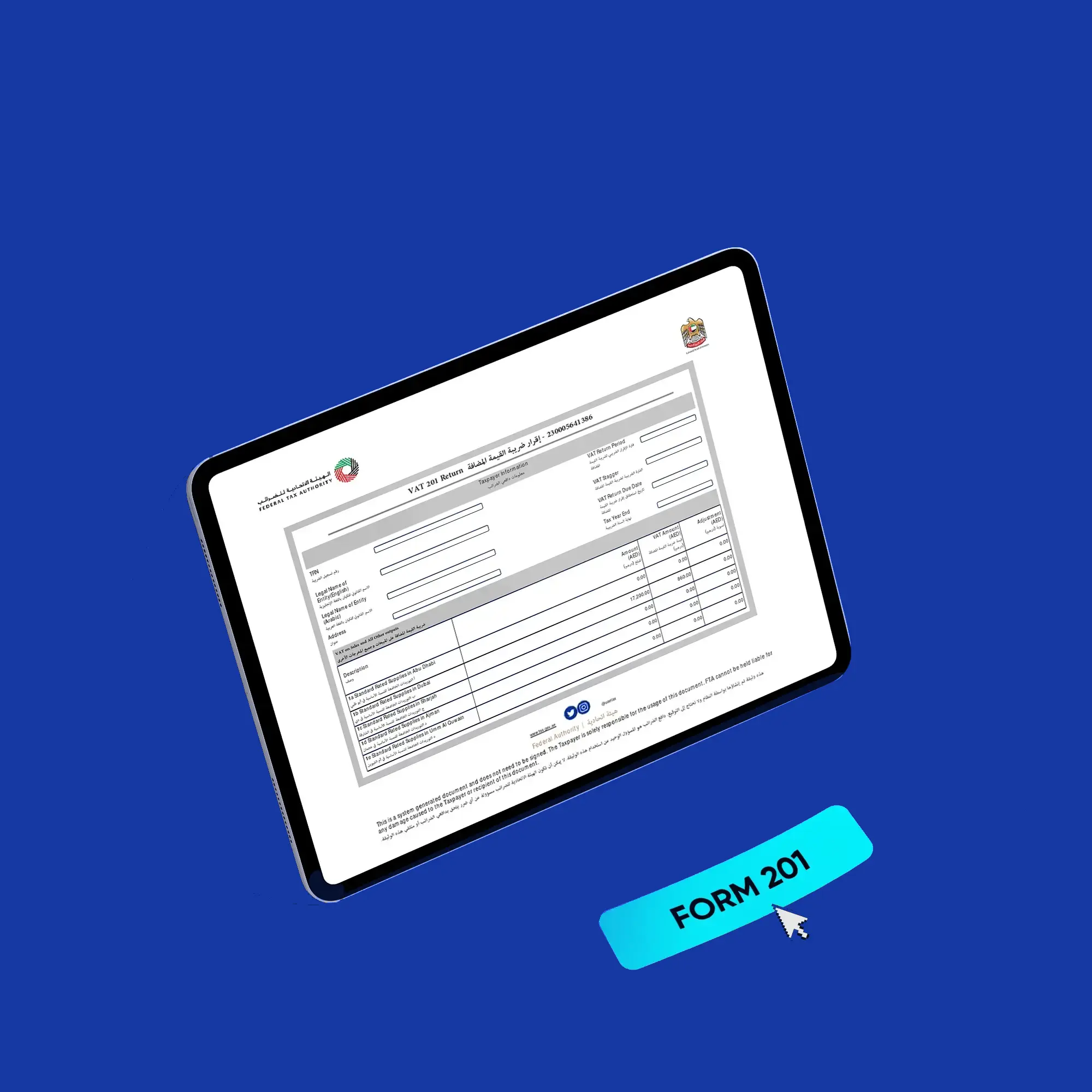
Table of contents:
- Key Summary
- Before You Fill Form 201
- What Is VAT Return Form 201?
- Structure of VAT Return Form 201
- Sales & Output VAT Section Explained
- Expenses & Input VAT Section Explained
- Adjustments & Reverse Charge Mechanism (RCM)
- How to Fill VAT Return Form 201 Step-by-Step
- Common Mistakes When Completing Form 201
- Can VAT Return Form 201 Be Amended?
- VAT Form 201 Final Review Checklist
- FAQs About VAT Form 201 in UAE
If your business is eligible for VAT in the UAE, filing the VAT Return Form 201 is one of the most crucial steps to compliance with the Federal Tax Authority. Form 201 is the official VAT return issued by the FTA, and it is meant to report the VAT you have collected from sales (Output VAT), the VAT you have paid on business purchases (Input VAT), and any adjustments for a specific tax period. The VAT return must be submitted electronically through the EmaraTax portal.
Form 201 differs from the tax invoice, as it does not list every transaction; instead, it summarizes your VAT activity for the reporting period to determine whether you owe VAT to the FTA or have a recoverable VAT balance. All VAT-registered businesses in the UAE, including companies, sole establishments, free zone entities, and tax groups, are required to submit this return according to their assigned filing period. Follow this guide to learn what VAT Return Form 201 is and when it's used, how to complete the form correctly, and how you can prepare your VAT records before submission.
Before You Fill Form 201
To make the filing process smoother and faster, prepare your records before you start completing VAT Return Form 201; this will reduce the risk of missing transactions or entering incorrect figures.
Here is a list of what you should prepare for filing the VAT Return Form 201:
Sales Records
Collect all sales invoices, credit notes, and debit notes issued during the tax period, and ensure every taxable transaction is recorded in your accounting software.
Purchase Documents
Gather supplier invoices and expense records that support any input VAT you need to recover, and ensure each document is complete and includes all required tax information.
Cross-Border Transactions
Separate imports and purchases from overseas suppliers that may be subject to the Reverse Charge Mechanism for easier reporting.
Accounting & VAT Reports
Generate your sales, purchases, and VAT summary reports from your accounting system to use the totals in these reports when completing Form 201.
Supporting Documentation
Keep import documents, adjustment records, and customs declarations readily available in case you need to verify any figure while preparing the return.
Organizing your records before filing Form 201 reduces the likelihood of overlooking transactions or reporting inconsistent figures. It makes it easier to reconcile your VAT return with your accounting records before submission.
What Is VAT Return Form 201?
VAT Return Form 201 is the official tool that registered businesses use to report their VAT position to the FTA for a specific tax period. The VAT Return Form 201 is submitted electronically through the EmaraTax portal and serves as a summary of your VAT activities rather than a record for individual invoices.
The sole purpose of VAT Return Form 201 is to determine whether you owe money to the FTA or you have recoverable input VAT that may be carried forward or, in certain cases, refunded. The Return Form brings together the VAT charged on taxable sales, VAT paid on business purchases, and any required adjustments.
Here is what Form 201 typically includes:
- Output VAT collected on taxable sales.
- Input VAT incurred on eligible business expenses and purchases.
- VAT adjustments such as credit notes, debit notes, and transactions under the Reverse Charge Mechanism (RCM).
- Net VAT position for the reporting period, identifying whether the VAT is payable or recoverable.
Each VAT Return Form 201 covers only one assigned tax period, which means all figures entered in the return must relate exclusively to that reporting period.
Important Note: Filing Form 201 and paying your VAT are two separate compliance obligations; this means submitting a VAT Return does not settle your VAT liability; you still need to pay by the applicable deadline.
Read also: how to register for vat in uae
Structure of VAT Return Form 201
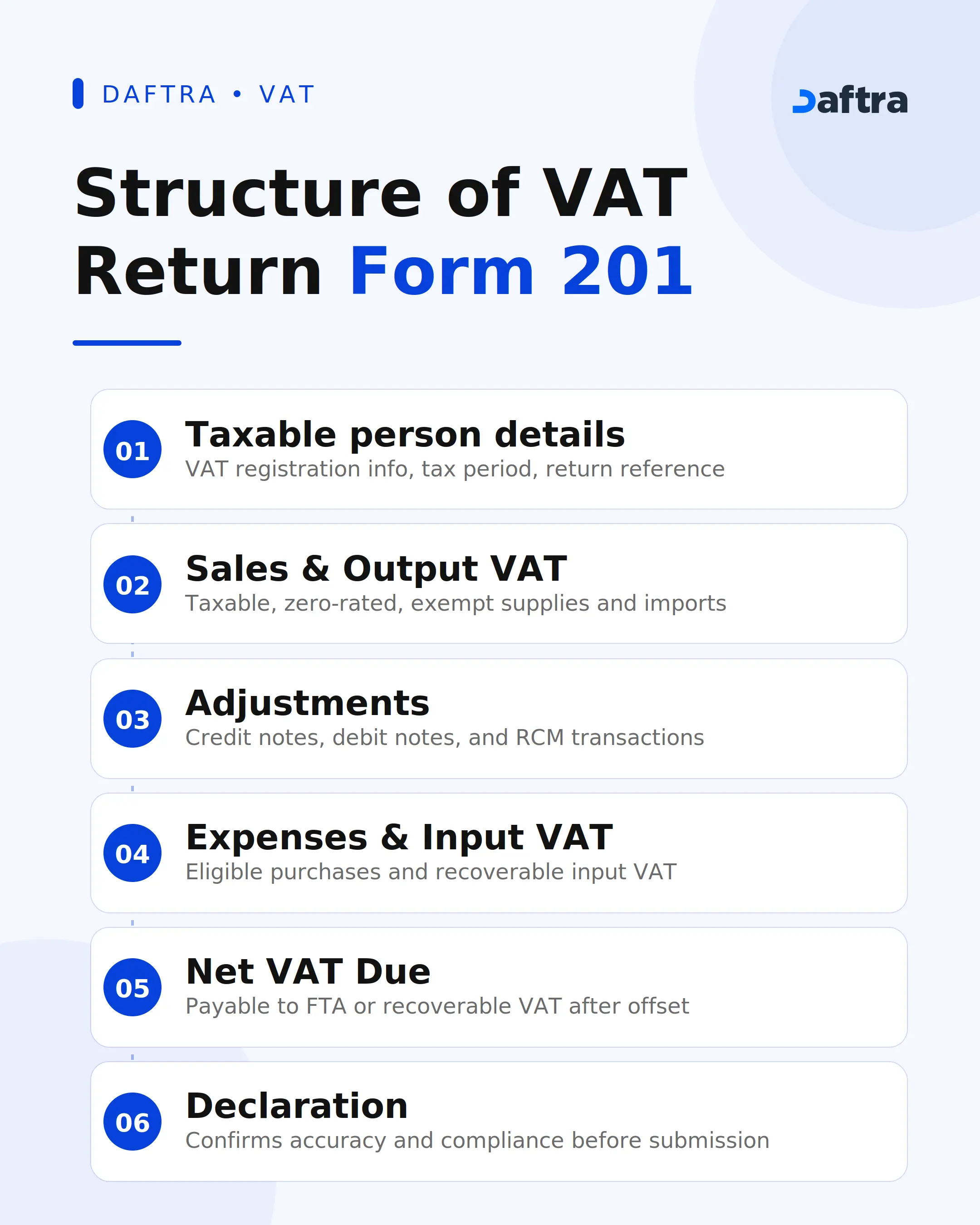
VAT Return Form 201 follows a logical structure that guides businesses from reporting taxable sales to calculating their final VAT position. Each section in the form focuses on a different aspect of VAT reporting, helping the FTA determine whether the correct amount of VAT has been declared for the reporting period.
Here is how the return is organized at a high level:
| Section | Purpose |
| Taxable person details | Business’s VAT registration information, tax period, and return reference details. |
| Sales & Output VAT | Taxable, zero-rated, exempt supplies, imports, and other transactions that generate output VAT. |
| Adjustments | Adjustments affecting VAT reporting (credit notes, debit notes, and transactions under RCM) |
| Expenses & Input VAT | Eligible business purchases and recoverable input VAT deducted from Output VAT, subject to the UAE VAT recovery rules |
| Net VAT Due | Summarize the reported figures determining whether VAT is payable to the FTA or recoverable VAT remains after offsetting output VAT |
| Declaration | Requires the authorized person to confirm that the information provided is accurate, complete, and submitted in accordance with VAT regulations |
It's crucial to ensure that sales, purchases, and adjustments have been reviewed before the final declaration. As every section is built on the previous one, errors in one section can affect the overall VAT position reported in the return.
Sales & Output VAT Section Explained
In Form 201, the sales & output VAT section is where you report the value of your taxable supplies and the VAT charged during the reporting period. This section is the basis for calculating your output VAT (what your business collected or is required to account for) on behalf of the Federal Tax Authority.
Accurate classification is crucial because different types of supplies receive different VAT treatment under UAE VAT law, so reporting a transaction in the wrong category can result in an incorrect VAT liability and might require a correction later.
| Supply | VAT Treatment | Example | Reporting Notes |
| Standard-rated supplies | 5% VAT | Retail sales, professional services, commercial goods, subscriptions | Report the taxable value and the corresponding output VAT. |
| Zero-rated supplies | 0% VAT | Qualifying exports, international transportation, certain healthcare and education services | Although VAT is charged at 0%, these supplies must still be reported in the VAT return. |
| Exempt supplies | Exempt from VAT | Certain financial services, residential property leasing and sales (where applicable), bare land | Exempt supplies are reported separately because they follow different VAT rules and may affect input VAT recovery. |
| Imports and certain cross-border transactions | May be subject to RCM | Imported goods and services that meet the applicable UAE VAT rules | Some imported transactions are reported separately under the RCM rather than as ordinary taxable sales. |
Important Note: Classifying supplies is as important as reporting the correct figures.
Example: Zero-rated and exempt supplies both result in no VAT being charged to the customer; however, they are not the same. Zero-rated supplies remain taxable at the 0% rate, while exempt supplies fall outside the VAT charging mechanism, which affects whether related input VAT is recoverable.
Experienced tip: Before completing this section, business should review their sales records carefully to ensure each transaction is properly assigned to the appropriate VAT category. Proper classification reduces reporting errors and helps ensure the figures reported in Form 201 accurately reflect the business VAT position.
Expenses & Input VAT Section Explained
The Expenses & Input VAT section is where businesses report the VAT paid on eligible business purchases and expenses. If you meet the conditions set by UAE VAT legislation, you can recover and offset input VAT against the output VAT reported on taxable sales, reducing overall VAT payable.
Important Note: Not every expense qualifies for VAT recovery; businesses must first distinguish between recoverable and non-recoverable input VAT before completing this section.
Recoverable Input VAT
Input VAT can be recoverable when:
- The purchase was made for business purposes.
- A valid tax invoice is available.
- The VAT is not specifically blocked under UAE VAT legislation.
- The expense relates to taxable supplies or other qualifying business activities.
Examples:
- Inventory and goods for resale
- Office rent for commercial premises
- Utilities used for business operations
- Professional and consultancy services
- Accounting and legal fees
- Marketing and advertising expenses
Non-Recoverable Input VAT
Certain expenses are blocked or restricted from input VAT recovery under the UAE VAT rules.
Examples:
- Entertainment expenses provided to customers
- Personal expenses unrelated to the business
- Certain motor vehicle expenses where VAT recovery is restricted
Before claiming any input VAT, businesses must ensure that all supporting documents are complete and that the expense satisfies the applicable recovery criteria.
Daftra automatically categorizes expenses, linking purchase invoices to accounting records, and generating structured VAT reports. Moreover, Daftra helps businesses maintain consistent expense classifications and reduce the risk of input VAT being wrongly categorized.
Adjustments & Reverse Charge Mechanism (RCM)
Transactions are not necessarily stable after recording; businesses may issue credit notes, receive debit notes, return goods, or purchase services from overseas suppliers after the original transaction. This means VAT reported in Form 201 may need to be adjusted to reflect the correct tax position.
VAT adjustments
Here are some situations where adjustments might be required:
- Credit notes issued because goods were returned or the selling price was reduced.
- Debit notes issued to increase the taxable amount after the original invoice.
- Discounts or pricing corrections agreed after initial sale.
- Bad debt relief where the applicable UAE VAT conditions are met.
These recorded adjustments ensure that the VAT reported for the tax period accurately reflects the business's actual taxable activities.
Reporting Reverse Charge Mechanism Transactions
The Reverse Charge Mechanism applies when responsibility for accounting for VAT shifts from the supplier to the buyer. This happens in certain transaction scenarios such as:
- Certain imported goods
- Services received from overseas suppliers
- Other transactions specified under the UAE VAT legislation
Rather than paying VAT to the foreign supplier, the UAE business is generally responsible for accounting for the VAT in the return. The same VAT may also be recoverable (input VAT) depending on the nature of the transaction and business eligibility.
Important Note: RCM transactions affect both the Output and Input VAT sections of Form 201, which makes it crucial to identify these transactions before completing the return to ensure correct reporting.
How to Fill VAT Return Form 201 Step-by-Step
Completing VAT Return Form 201 is pretty straightforward once your accounting records have been reviewed and reconciled. The layout of the EmaraTax portal might change over time, but the workflow is likely to remain the same.
Here is a breakdown of the steps needed to complete your VAT return:
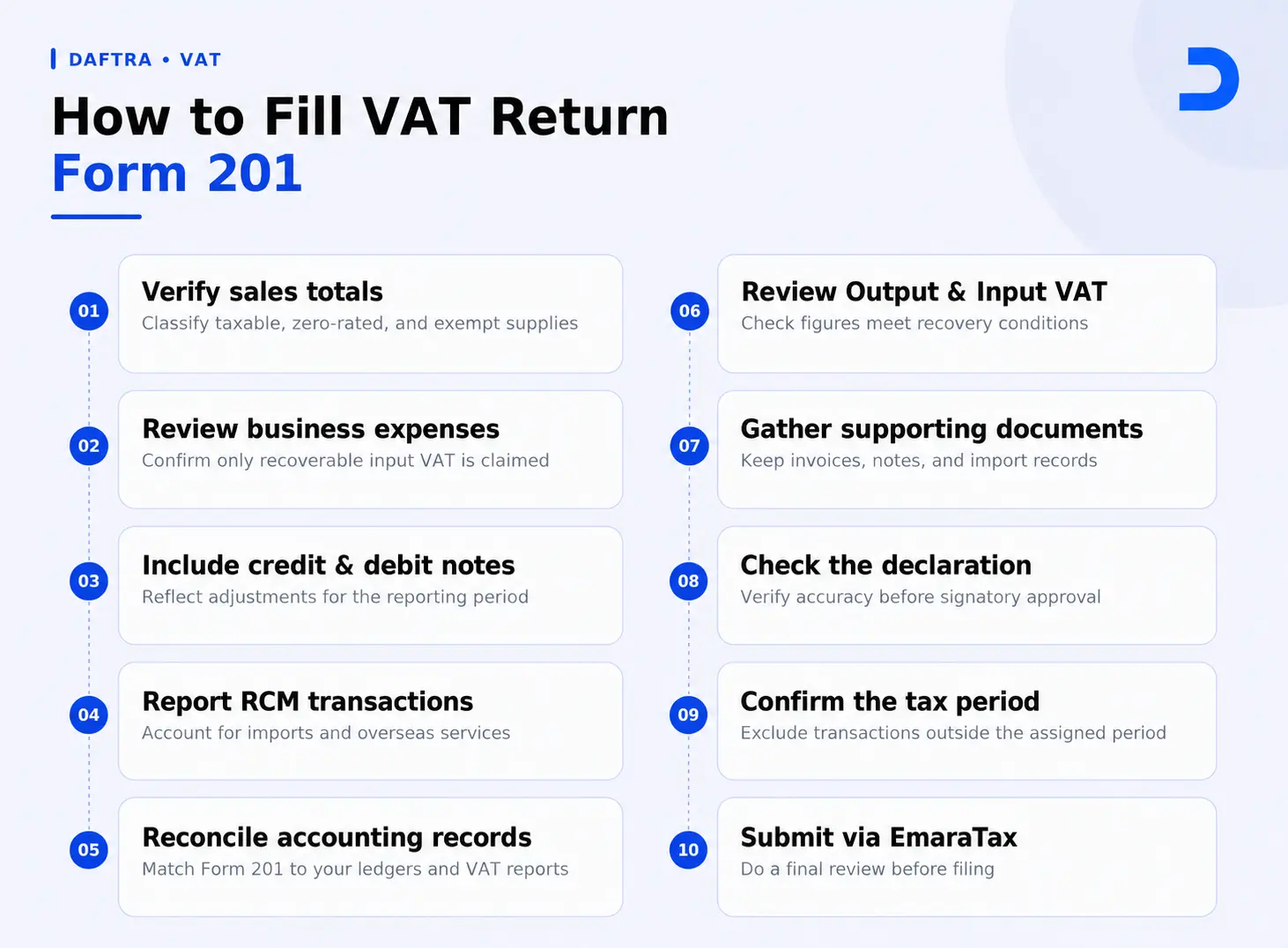
Select the correct Tax Period
Log in to the EmaraTax portal and choose the VAT return that relates to your assigned reporting period; ensure the tax period matches the one you intended to file.
Review your taxpayer information.
Review business details such as tax registration number (TRN), legal entity name, and return reference before proceeding.
Enter your sales and Output VAT totals
Report the totals of the different categories of supplies made during the reporting period, including:
- Standard-rates supplies
- Zero-rated supplies
- Exempt supplies
- Imports or other transactions requiring specific VAT treatment
Transactions must be correctly classified before entering the totals.
Enter your purchase and Input VAT
Report the value of eligible business purchases and the recoverable input VAT for them. Make sure before claiming any VAT recovery that:
- The expense qualifies under UAE VAT rules
- A valid tax invoice is available
- The purchase is business-related
Review any adjustments
For any adjustments due to credit notes, received debit notes, processed returned goods, or transactions subject to the RCM, make sure to reflect them in the appropriate sections of the return.
Check the system calculations
After you enter all required figures, EmaraTax automatically summarizes the information and calculates your overall VAT position. It is important to review the calculated totals to ensure their alignment with your accounting records before submitting the return.
Confirm the declaration
Before filing, the authorized signatory must confirm that:
- The information provided is complete
- The figures are accurate
- The return has been prepared according to the UAE VAT legislation
Note: Inaccurate information may result in additional compliance work and would need to be corrected in the return later.
Submit the VAT Return
After reviewing all the sections and confirming the declaration, submit the return through EmaraTax. Also and most importantly, submitting Form 201 does not automatically complete the payment of any VAT due, so make sure to settle any outstanding VAT liability.
Read also: How to File VAT Return in UAE
Common Mistakes When Completing Form 201
Most VAT reporting errors are due to incomplete records or incorrect transaction classification rather than calculation mistakes. This stresses the importance of reviewing your accounting records before filing to reduce the risk of submitting an inaccurate VAT return.
The following table highlights the most common mistakes businesses make when completing Form 201:
| Mistake | Potential Risk | How to avoid it |
| Mixing transactions from different tax periods | Incorrect VAT return and possible corrections | Verify that every transaction belongs to the reporting period before filing |
| Overclaiming input VAT | Recoverable VAT may be rejected during an FTA review | Claim only VAT that meets the recovery conditions and is supported by valid tax invoices |
| Ignoring RCM transactions | Underreporting VAT obligations | Review imports and overseas supplier transactions before preparing the return |
| Misclassifying supplies | Incorrect VAT liability and inaccurate reporting | Distinguish carefully between standard-rated, zero-rated, exempt, and RCM transactions |
| Filing without reconciling accounting records | Differences between accounting reports and VAT return | Reconcile sales, purchases, and VAT reports before submission |
| Omitting credit or debit notes | VAT reported may not reflect the actual transaction values | Include all adjustments relating to the reporting period before filing. |
| Entering duplicate transactions | Overstated sales, expenses, or VAT | Review reports for duplicate invoices or repeated entries before submission. |
Note that even small errors can create discrepancies that may require correction after submission, which makes the review process crucial before every VAT filing.
Daftra supports centralizing invoices, expenses, tax codes, and accounting records in a single system. Daftra also helps businesses identify discrepancies and reduce manual reporting by easing the reconciliation of VAT reports before filing Form 201.
Read also: VAT Fines and Penalty in UAE
Can VAT Return Form 201 Be Amended?
Businesses may be very careful in their preparation, but mistakes can still occasionally be discovered after a VAT return has been submitted. In this case, the business must review the error and determine whether it can be corrected under the procedures set by the Federal Tax Authority.
Note: The need for amendments depends on the nature and significance of the error. Here are some situations that may require a correction:
- Sales or purchases reported in the wrong amount.
- Transactions assigned to the incorrect VAT category.
- Reverse Charge Mechanism transactions not reported correctly.
- Input VAT claimed incorrectly.
- Credit or debit notes omitted from the return.
- Minor Corrections Vs Significant Errors
Not all mistakes are handled in the same way; some may be corrected through the FTA mechanism in a subsequent VAT return, while others may be more significant reporting errors that require a voluntary disclosure, depending on the UAE VAT rules and the circumstances of the error.
Important Note: Businesses are advised to assess the impact of any mistake as soon as it is identified rather than waiting for future filing periods. Here's why timely corrections matter:
Ignoring errors can lead to:
- Incorrect VAT balances remaining on record.
- Additional compliance work during an FTA review or audits.
- The need for future amendments.
- Administrative consequences where reporting obligations are not met.
This is why businesses are encouraged to reconcile their accounting records regularly and review each VAT return before submission to minimize the odds of corrections later.
VAT Form 201 Final Review Checklist
It is crucial to review your figures and supporting records before submitting VAT Return Form 201. A final check is very useful in identifying missing transactions, incorrect classifications, or reconciliation issues before the return is filed with the FTA.
Here is a checklist for VAT Form 201 that you can use as a final review before submitting in EmaraTax:
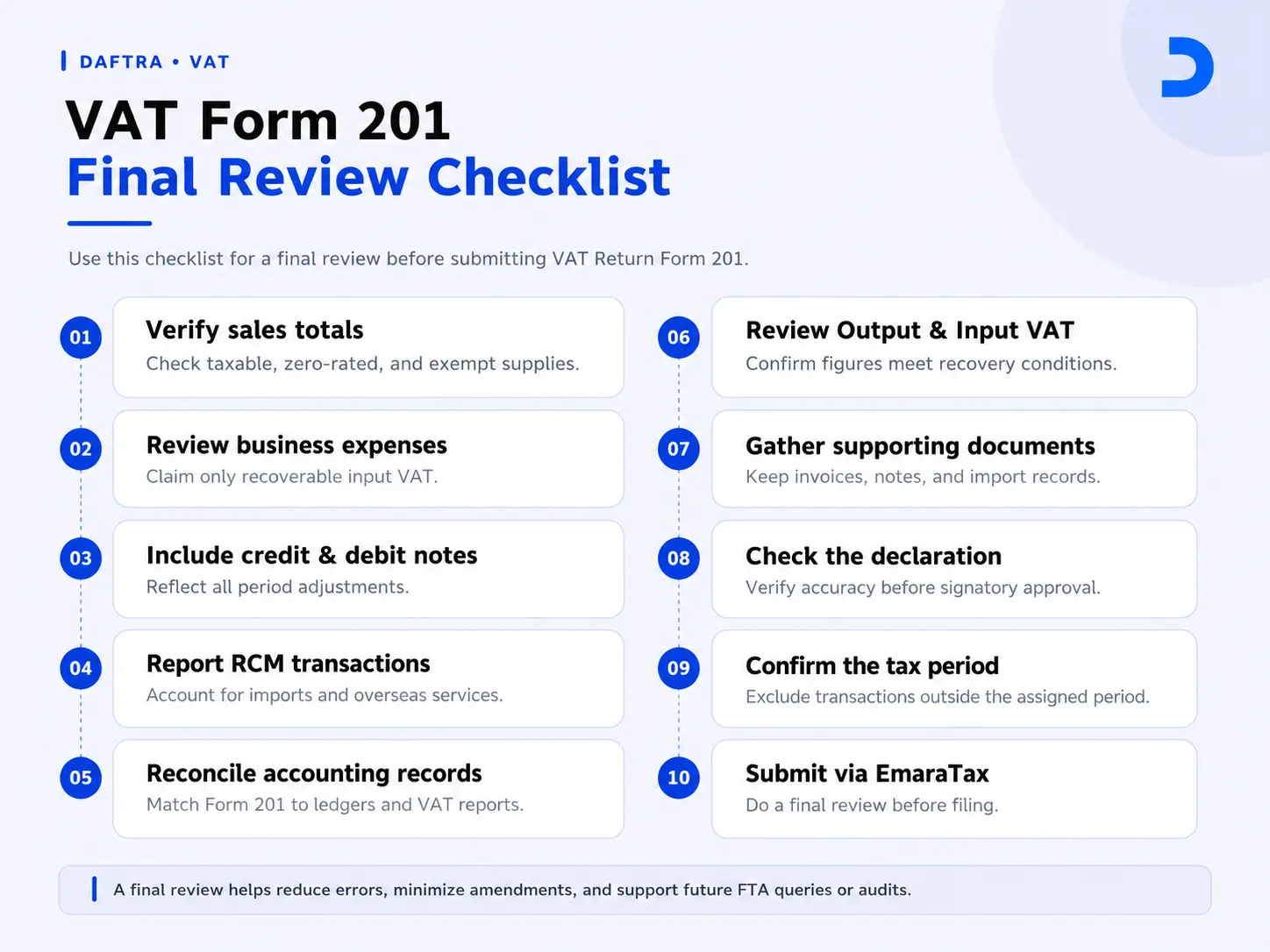
Sales totals verification is completed
Confirm that all taxable sales, zero-rated supplies, exempt supplies, and any other reportable transactions for the tax period have been added and classified correctly.
Business expenses have been reviewed.
Ensure all eligible purchase invoices have been recorded and that only recoverable input VAT has been claimed in accordance with UAE VAT rules.
Credit and debit notes are included.
Check that any adjustments affecting the reporting period are reflected in the VAT return.
Reverse Charge Mechanism (RCM) transactions are reported.
Review imports and services received from overseas suppliers to ensure any transactions subject to RCM have been accounted for accurately.
Accounting records have been reconciled.
Compare the figures in Form 201 with your sales ledger, purchase ledger, general ledger, and VAT reports to confirm they are consistent.
Review Output VAT and Input VAT.
Confirm that Output VAT matches the VAT on taxable supplies and Input VAT is only claimed where the recovery conditions are satisfied.
Supporting documents are available.
Make sure you have retained all relevant documentation, including tax invoices, credit notes, debit notes, import records, and every other evidence supporting the amounts reported in the return.
The declaration has been checked.
Verify the information entered is complete and accurate before the authorized signatory approves the declaration.
The correct tax period is selected.
Ensure that the return relates to the assigned VAT period and does not include transactions from earlier or later reporting periods.
The return is ready for submission.
Review Form 201 one last time before submitting it through the EmaraTax portal.
Reviewing every VAT filing helps reduce reporting errors, minimizes the risk of amendments, and eases the response to any future FTA queries or audits. It is advisable to maintain accurate accounting records throughout the tax period to streamline the preparation of VAT Return Form 201.
FAQs About VAT Form 201 in UAE
What is Form 201?
Form 201 in the UAE is the official electronic document used by VAT-registered businesses to report their VAT liabilities to the FTA, submitted through the EmaraTax portal.
Is Form 201 mandatory?
Yes, Form 201 is mandatory if your business is VAT-registered in the UAE, and you must file your VAT liabilities through the EmaraTax portal.
Can Form 201 be corrected?
Yes, a submitted Form 201 UAE VAT return can be corrected through the FTA portal, and the correction method varies depending on the impact of the error.
Is Form 201 the same as VAT filing?
Yes, Form 201 is the official designation of the VAT return filing in the UAE, submitted through the EmaraTax portal, declaring the collected Output VAT, recoverable Input VAT, and net Tax payable.











 Invoicing
 POS
POS Offers
 Installments
 Sales Commission
 KSA E-Invoice Software
 EGY E-Invoice Software
 JO E-Invoice Software
 E-Invoice Software
 Chart of Accounts
 Asset Management
 Cost Centers
 Expenses
 Cheque Cycle
 UAE VAT-Tax
 Product Management
 Purchases
 Purchase Cycle
 Suppliers
 Requisitions
 Stocktaking
 Organizational Structure
 Personnel Management
 Attendance and Leave
 Contracts
 Payroll
 Requests
 Work Orders
 Booking Management
 Rental and Unit Management
 Time Tracking
 Work Flow
 Lease Contracts
 Manufacturing Management
  Client Follow-Up
 Loyalty Points
 Points and Credits
 Memberships
 Insurance Management
 Daftra ERP Full App
 Point of Sales App
 Point of Sales for Desktop – Support Offline Mode
 AI Expenses Scanner App
 Employee Attendance, Sign & ESS App
 E-invoice Reader App
 Inventory Stocktaking App