


Difference Between Corporate Tax and VAT in UAE (2026)

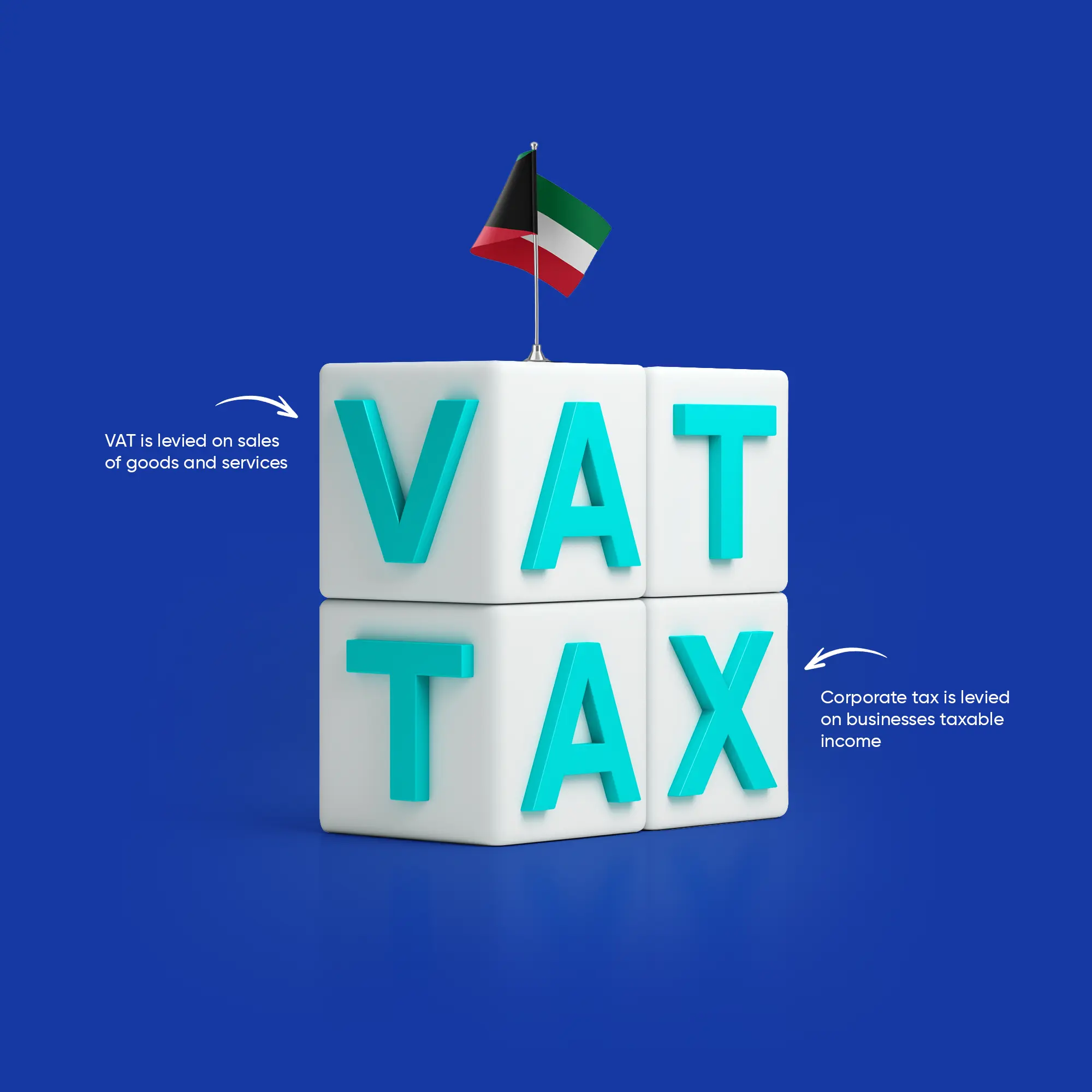
Table of contents:
- Key Summary
- Corporate Tax vs VAT in the UAE
- What is VAT in UAE?
- What is Corporate Tax in UAE
- Key differences that affect business decisions
- Rates & thresholds VAT (5%) vs Corporate Tax (0%/9%)
- Compliance registration, filing & what you submit
- Common misunderstandings
- How ERP helps manage VAT + Corporate Tax together
- Frequently asked questions
If you’re running a business in the UAE, you’ll need to understand the difference between VAT and Corporate Tax, because each one affects your business in a completely different way.
VAT is a transaction-based tax applied to goods and services, while Corporate Tax is a profit tax applied to your business income.
In this guide, we’ll walk through the difference between Corporate Tax and VAT in a practical way, focusing on how each one actually affects your business.
Corporate Tax vs VAT in the UAE
Corporate Tax and VAT are two different types of taxes in the UAE that apply at different stages of your business. Here’s how they compare:
Point of Comparison | Corporate Tax (CT) | Value Added Tax (VAT) |
What it is | A tax applied to your income or profits | A tax applied to the sale and import of goods and services at each stage of the supply chain |
What it applies to | Business profits | Goods & services |
Type of tax | Direct | Indirect |
Standard Rate | 9% | 5% |
Who actually pays | The business | Final customer |
Filing Frequency | Monthly or quarterly | Annually |
Your role | Calculate and pay | Collect and remit |
What is VAT in UAE?
VAT in the UAE is a 5% indirect tax applied to most goods and services. It’s considered a consumption tax, which means the final customer carries the cost, while businesses collect it on behalf of the government and report it to the Federal Tax Authority (FTA).
Registration is required once your taxable turnover exceeds 375,000 AED, while businesses can choose to register voluntarily from 187,500 AED. If you want to go through the registration process you can check how to register for VAT in UAE.
Key things to know about VAT in UAE:
- Standard VAT rate is 5% on most goods and services
- VAT is charged at each stage of the supply chain, but the end customer bears the cost
- Your role is to collect VAT on sales (output VAT) and report it to the FTA
- You can recover VAT paid on business expenses (input VAT), if you are eligible
- Registration becomes mandatory at 375,000 AED
- Some supplies aren’t subject to VAT, so check VAT Exemptions in the UAE to understand when it doesn’t apply
A quick example
You sell a service for 1,000 AED
→ VAT (5%) = 50 AED
→ Customer pays 1,050 AED
For quick calculations, you can use the UAE VAT Calculator before issuing invoices.
What is Corporate Tax in UAE
Corporate Tax in the UAE is a direct tax applied to your business income or profit not your revenue, and it applies to financial years starting on or after 1 June 2023. Once it applies to your business, you’ll need to calculate your taxable income, submit your return, and pay any tax due.
Key things to know about CT in UAE:
- It’s applied to your business profit, not revenue
- 0% applies to profits up to 375,000 AED
- 9% applies to profits above 375,000 AED
- It’s paid by the business itself, not collected from customers
- It doesn’t appear on invoices or affect your pricing directly
- It’s calculated over a financial year, not per transaction
A quick example
Your business makes 500,000 AED in profit
→ First 375,000 AED = 0%
→ Remaining 125,000 AED = 9%
→ Corporate Tax due = 11,250 AED
You can also estimate your payable amount using the UAE Corporate Tax Calculator.
Key differences that affect business decisions
Here’s how Corporate Tax and VAT compare in terms of how they impact your pricing, cash flow, and overall operations.
Point of Comparison | Corporate Tax (CT) | Value Added Tax (VAT) |
Tax base | Applied to profit (after expenses) | Applied to sales (goods & services) |
Who bears the cost | Business | Customer |
Cash flow impact | Paid based on profitability | Collected and paid regularly |
Pricing & invoicing | Not shown on invoices | Added to invoices |
Recordkeeping | Requires financial statements and tax adjustments | Requires detailed invoice tracking |
What this means for you
- VAT is applied to every sale, regardless of your profit, so once you’re registered, it becomes part of your daily operations, while Corporate Tax only applies when your business generates profit above the threshold, making it more about financial performance than transactions.
- VAT affects your cash flow because you collect and pay it periodically, so it needs attention and accuracy, while Corporate Tax requires planning since it’s not something you deal with every day, but something you prepare for as your profit grows.
- VAT impacts your pricing because it's added to invoices and changes what the customer pays, while Corporate Tax doesn’t appear on invoices, but directly affects your net profit.
- Recordkeeping works differently for each, VAT relies on detailed transaction tracking, while Corporate Tax depends on clear financial statements and proper expense classification.
Read also: Profit Margin Scheme under VAT in UAE 2026
Rates & thresholds: VAT (5%) vs Corporate Tax (0%/9%)
Here’s a quick comparison of VAT and Corporate Tax rates and thresholds, and how each one is applied in practice.
Point of Comparison | VAT | Corporate Tax |
Standard Rate | 5% | 0% up to 375,000 AED, 9% above |
Threshold refers to | Revenue (taxable turnover) | Profit (taxable income) |
Mandatory threshold | 375,000 AED | 375,000 AED |
Voluntary threshold | 187,500 AED | Not applicable |
Example A: Company with low revenue
A business revenue is 200,000 AED in revenue.
VAT: Not applied yet because 200,000 AED is below the registration threshold
CT: No tax is applied if the profit is below 375,000 AED
Example B: growing SME
A business revenue is 800,000 AED
VAT: Mandatory 5% is applied, because the revenue is above the registration threshold
CT: May still be 0% depending on profit
Helpful Template:
VAT Return Form 201 Template in UAE
Compliance: registration, filing & what you submit
VAT and Corporate Tax don’t follow the same compliance process. These are the main steps your business needs to handle for each.
CT Compliance | VAT Compliance |
☑ Register for Corporate Tax with the FTA | ☑ Register through the FTA once your turnover exceeds the threshold |
Helpful Template:
Tax Invoice Format Template UAE
Common misunderstandings
These are some of the most common misunderstandings businesses face when it comes to VAT and Corporate Tax in the UAE.
- Myth: VAT is the same as tax
→ VAT is a type of tax, but it’s not the same as Corporate Tax. VAT applies to goods and services, while Corporate Tax applies to business profit. - Myth: The UAE is 100% tax-free
→ Personal income isn’t taxed, but businesses still deal with VAT and Corporate Tax. - Myth: The 9% tax applies to all businesses
→ The 9% rate only applies to taxable profit above 375,000 AED, not revenue. - Myth: VAT reduces your profit
→ VAT is collected from customers and paid to the FTA, so it doesn’t directly affect your profit. - Myth: Free zone companies are always exempt from Corporate Tax
→ Not all are exempt. Some qualify for 0% on certain income, while others may still be subject to 9%. - Myth: If I’m VAT compliant, I’m compliant with Corporate Tax
→ These are separate systems. Being compliant with one doesn’t mean you’re compliant with the other. - Myth: VAT and Corporate Tax follow the same process
→ VAT is handled regularly, while Corporate Tax is filed annually based on profit.
Read also: VAT Late Payment Penalty in UAE
How ERP helps manage VAT + Corporate Tax together
When your numbers are set up properly from the start, handling both VAT and Corporate Tax becomes much easier. Instead of going back to fix things, everything is already in place, and that’s where a system like Daftra helps.
Here is how Daftra helps your business:
- VAT handling becomes structured: VAT codes (5%, 0%, exempt) are applied automatically, so you’re not adjusting things manually each time
- Invoices stay compliant: Required VAT fields, including TRN, are built into your invoice process
- VAT reporting is ready when you need it: Output and input VAT are tracked continuously, making returns easier to prepare
- Corporate Tax readiness improves: A clean chart of accounts and proper cost categorization make it easier to see your actual profit
- Financial reporting stays consistent: Your numbers are organized in a way that supports tax calculations without extra rework
- Documentation is easier to track: Supporting records are stored and linked, which helps when reviewing or sharing with advisors
Here is a quick comparison of how you handle your work manually vs when you’re using Daftra.
Manual approach | Using Daftra |
VAT calculations done manually | VAT is applied automatically based on set codes |
Invoices may miss required details | VAT fields and TRN are included by default |
Data spread across files and sheets | All records are stored in one system |
Reports prepared with manual effort | Reports generated instantly |
Higher chance of errors or mismatches | Reduced errors through structured data |
Frequently asked questions
What is the difference between VAT and Corporate Tax in UAE?
VAT is a type of tax, but it’s not the same as Corporate Tax. VAT is charged on goods and services, while Corporate Tax is applied to business profit.
Does the UAE tax salary?
No, salaries and personal income aren’t taxed in the UAE.
Do foreigners pay tax in the UAE?
Not on personal income. But if they run a business in the UAE, VAT and Corporate Tax can still apply.
Why is UAE a tax haven?
Because there’s no personal income tax and overall tax rates are relatively low, even though businesses still deal with VAT and Corporate Tax.













 Invoicing
 POS
POS Offers
 Installments
 Sales Commission
 KSA E-Invoice Software
 EGY E-Invoice Software
 JO E-Invoice Software
 E-Invoice Software
 Chart of Accounts
 Asset Management
 Cost Centers
 Expenses
 Cheque Cycle
 UAE VAT-Tax
 Product Management
 Purchases
 Purchase Cycle
 Suppliers
 Requisitions
 Stocktaking
 Organizational Structure
 Personnel Management
 Attendance and Leave
 Contracts
 Payroll
 Requests
 Work Orders
 Booking Management
 Rental and Unit Management
 Time Tracking
 Work Flow
 Lease Contracts
 Manufacturing Management
  Client Follow-Up
 Loyalty Points
 Points and Credits
 Memberships
 Insurance Management
 Daftra ERP Full App
 Point of Sales App
 Point of Sales for Desktop – Support Offline Mode
 AI Expenses Scanner App
 Employee Attendance, Sign & ESS App
 E-invoice Reader App
 Inventory Stocktaking App