



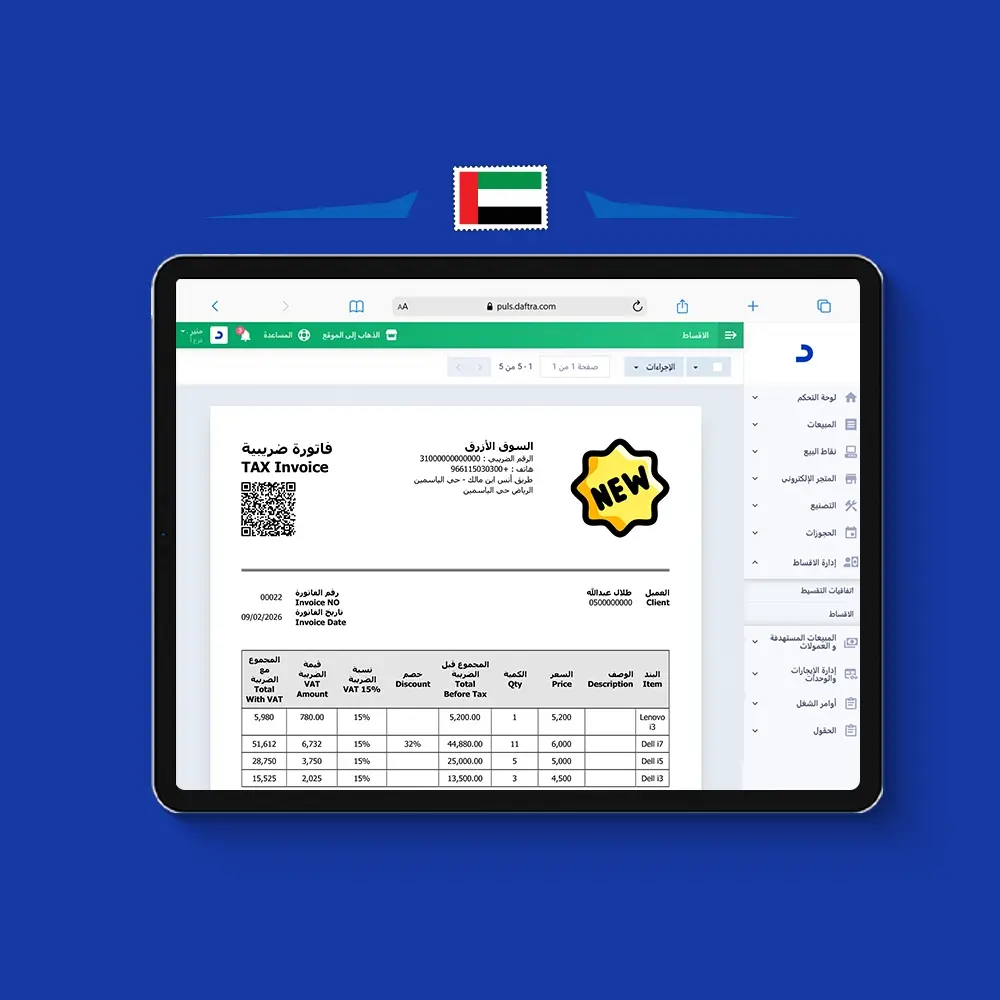
Table of contents:
- Key Summary
- What is e-Invoicing in UAE?
- Is e-Invoicing mandatory in the UAE?
- Who is eligible for e-Invoicing in the UAE?
- Who is exempted from e-Invoicing in the UAE?
- UAE e-Invoicing implementation timeline
- How does e-Invoicing work in the UAE?
- What are the key requirements for e-Invoicing in UAE?
- What are the mandatory fields for e-Invoicing in UAE?
- Mandatory file format
- When to register for e-Invoicing and appoint a service provider
- How to get ready for UAE e-Invoicing
- Frequently Asked Questions about e-Invoicing in UAE
- Conclusion
E-invoicing in the UAE is set to start its pilot phase on 1st July 2026, requiring businesses that are VAT-registered, B2B, or B2G, regardless of their VAT-registration position, to comply. The UAE has established the system setup, testing run, and service provider accreditation in 2024/2025, preparing the system for an official launch by January 2027.
The e-invoicing system is part of a larger goal, the “Forward Ecosystem,” which aims to enhance the UAE's digital infrastructure and government performance.
The e-invoicing system is considered a step forward in the “We the UAE 2031” vision, which is one of the government's main priorities at the moment.
In this article, we will cover everything you need to know about e-invoicing in the UAE: the eligibility framework, the e-invoicing requirements, how it works, who needs to comply, and the implementation timeline.
What is e-Invoicing in UAE?
E-invoicing in the UAE is a structured form of invoicing that is issued, exchanged, and reported electronically to the UAE Federal Tax Authority (FTA).
The FTA has set mandatory standards for issuing, transmitting, and receiving the e-invoices, which means that all invoice exchanges must be:
- XML format
- Automatically validated
- Sent through approved systems.
It has been stated that any invoice sent as a PDF, Excel file, or scanned copy will not be accepted or approved as a valid invoice format by the FTA, which advises following all requirements to avoid legal penalties for non-compliance.
Is e-Invoicing mandatory in the UAE?
E-invoicing is not yet mandatory in the UAE, although by January 2027, every person conducting business in the country, regardless of their VAT registration status, and with few exemptions, will be obligated to comply with the e-invoice system. The exclusion list, as per article 4 of Ministerial decision No. 243, though not finalised, appears to be targeting types of transactions/ activities that may be left out in early implementation phases, like B2C transactions, government activities (sovereign only), and international passenger transportation services (airline goods).
The FTA has advised that after launching the pilot phase, businesses should start preparing to comply, to be ready when it becomes mandatory in January 2027, which includes:
- Onboarding with ASP (via EmaraTax)
- Testing electronic invoice exchange and reporting
- Going live with electronic invoicing
You should take into consideration that e-invoicing will be rolled out on a phased basis, with different thresholds for every Taxpayer working group, with a different time frame for each to comply.
Who is eligible for e-Invoicing in the UAE?
The scope of e-invoice in the UAE is quite broad, as it applies to almost all business transactions (despite their VAT status) in the country, including:
- All VAT-registered businesses, B2B or B2G transactions
- All individuals who make a business transaction in the UAE, regardless of their VAT registration status, are obligated to use the electronic invoicing system.
Who is exempted from e-Invoicing in the UAE?
The Ministry of Finance in the UAE has set a few exemptions for the current stage of implementation, including:
- B2C businesses are not yet in the scope of the e-invoice system.
- International passenger transportation services are not in the scope of e-inovicing.
- Transactions issued by a government entity in a sovereign capacity, and not in competition with the private sector, are excluded from the e-invoicing.
The scope of exemptions is not yet closed, though. The Ministry of Finance has stated that other exclusions may be added later through the issuance of Ministerial decisions.
In scope | Out of scope (currently) |
B2B | B2C |
B2G | G2C |
G2B | C2B |
G2G | C2G |
UAE e-Invoicing implementation timeline
The Ministry of Finance has published a detailed timeline for the implementation of the e-inovicing system through Ministerial decision No. 244 of 2025. As planned, electronic invoicing will be rolled out on a phased basis for any person conducting business in the UAE (despite their VAT status), unless specifically excluded. Here is a breakdown of the rollout phases as decided by the UAE government:
Pilot and voluntary phase
Electronic invoices are set to commence on the 1st of July 2026, with a pilot and voluntary programme, for those who want to participate early, before the mandatory phase. Any person wishing to take part in the pilot phase has to agree to adhere to the technical requirements in writing. Every person participating in the pilot/ voluntary phase will be expected to exchange and report e-invoices.
Both the pilot and voluntary phase participants need to comply with the technical requirements, although no administrative penalties will be imposed for not complying, not until the mandatory phase. As a benefit, this phase will help participants get familiar with the system and perform tests with the flexibility of a trial without penalties.
Mandatory phase
The mandatory implementation of the e-invoice in the UAE will commence in phases, each depending on the person's annual revenue. This is regarding persons, starting January 2027 and government entities, starting October 2027, in scope, as per Ministerial decisions No. 243 and 244 of 2025.
This table summarises the revenue threshold and date of compliance for each phase.
| Phase | Entity | Revenue | Last date to appoint an ASP | Mandatory implementation date |
Pilot | Selected | – | – | 1st July 2026 |
Voluntary | Anyone | – | Flexible | 1st July 2026 |
Phase 1 | Person | AED 50,000,000 or more | 31st July 2026 | 1st January 2027 |
Phase 2 | Person | Below AED 50,000,000 | 31st March 2027 | 1st July 2027 |
Phase 3 | Government | — | 31st March 2027 | 1st October 2027 |
From a practical standpoint, considering that the voluntary programme offers no penalties for errors and enough time to understand the system, is just what a business needs to be ready to align operations, integrate with ASP, and obtain an accounting system to assist and strengthen the business alignment with the UAE’s new e-invoice strategies. Cloud-based accounting systems like Daftra help in the switching and alignment process with the electronic invoicing system.
How does e-Invoicing work in the UAE?
Electronic invoicing represents the major shift that is taking place in the UAE, which is the goal of eliminating the usage of paper and the digitisation of legal documents. Unlike the traditional way, e-invoices are issued, exchanged and validated electronically in the form of XML within a regulated network, rather than PDF or paper document exchange. The whole process of electronic invoicing revolves around 4 main players:
- The supplier (business issuing the invoice)
- The buyer (customer receiving invoice)
- Accredited service provider (ASP)
- Federal Tax Authority (FTA)
The e-invoice system is considered to be a huge change in the way invoices are treated in the UAE, as it is no longer a process between the supplier and the customer; now it passes through an approved intermediary.
Here is a full guide on how the e-invoicing actually works in the UAE:
1. Invoice creation:
Invoices must be issued through an accounting system, and the invoicing process must be initiated through OpenPeppol ASP, and in a machine-readable format (XML).
2. Submitting to ASP:
Contrary to the traditional process, e-invoices should be sent through ASP to ensure that defined technical standards are met. The ASP checks the customer’s details via OpenPeppol before transmitting the data.
3. Collection, validation and delivery:
The receiving ASP validates and directs the data to the tax authorities and the buyer’s software, where it can be read and recorded through a structured format.
4. Reporting and storage:
The data in the e-invoice is now shared with the tax authority, and VAT reporting is made more streamlined.

What are the key requirements for e-Invoicing in UAE?
The Ministry of Finance in the UAE has set technical and regulatory requirements for the electronic invoicing system, which needs to be applied to ensure full compliance with the Federal Tax authorities.
Usage of structured electronic invoice format:
Overthrowing the traditional method, such as PDF and scanned documents, invoices now need to be created in a structured, machine-readable format (XML) to ensure successful validation processes.
Integrating with an accredited service provider (ASP):
Businesses under the e-invoice system are obligated to connect with ASP, which acts as an intermediary between the supplier, the buyer, and the tax authority. ASP is also responsible for validating the data in the invoice, measuring compliance with the defined standards, and transmitting invoices.
Compliance with the OpenPeppol network:
The e-invoicing system in the UAE is using the global network “Peppol”, so individuals and businesses must align their systems with e-invoicing software (via Peppol), which means ensuring:
- Having a unique digital identifier (Peppol ID)
- Connecting through a certified access point
- Adhere to the standardised document formats
Mandatory data fields:
The UAE government has set specific required information that must be included in every invoice to ensure compliance with VAT regulations.
Real-time reporting:
Businesses must share transactions with the tax authorities in real time or near real time. This means invoices must be submitted and validated immediately.
Use of a compliant ERP system:
Businesses must implement accounting systems that are capable of:
- Generating well-structured e-invoices
- Integrating with ASP
- Handling automated validations
- Storing digital records securely
Data accuracy:
Businesses must ensure all their data is accurate before continuing with the process of validation; errors in any required information field will result in rejection of the invoice.
Businesses preparing for the e-invoicing system in the UAE are in need of an accounting system like Daftra to align their operational practices with the mandatory requirements for the e-invoice. Although accounting systems do not cover all regulatory requirements, they play a crucial role in ensuring businesses’ compliance with the hard technical and operational standards.
What are the mandatory fields for e-Invoicing in UAE?
The Federal Tax Authority has laid out a strict framework for UAE E-Invoice Mandatory Fields within the invoice. Businesses should adhere to this framework to ensure full compliance with the law. Here is what the invoice should include:
Supplier information:
- Supplier name
- Tax registration number TRN
- Address
- Contact details
Buyer information:
- Buyer name
- Address
- TRN (if VAT registered)
Invoice details:
- Invoice number
- Issue date
- Invoice type
- Currency
Service details:
- Description of the service or goods
- Quantity
- Unit price
- Line net amount
VAT information:
- VAT rate
- VAT amount
- Tax category
- Total excluding tax
- Total VAT
- Total including VAT
Compliance fields:
- Unique invoice identifier (UUID)
- Payment terms
- Supply date
| Field | Requirment |
| Supplier | Supplier name, TRN, Address, Contact details |
| Buyer | Buyer name, Address, TRN (if VAT registered) |
| Invoice | Invoice number, Issue date, Invoice type, Currency |
| Service details | Description service or goods, Quantity, Unit price, Line net amount |
| VAT information | VAT rate, VAT amount, Tax category, Total excluding tax, Total VAT, Total including VAT |
| Compliance | Unique invoice identifier (UUID), Payment terms, Supply date |
Mandatory file format
The Ministry of Finance, alongside the Federal Tax Authority, has standardised a certain technical and structural format for issuing the e-invoices. This format should be applied to all invoices issued, transmitted and validated in the UAE.
Mandatory invoice technical format:
- All e-invoices are issued, transmitted, and received in XML format or JSON, with the e-Invoice XML format defining the technical structure required for compliant invoice exchange.
- All invoices must follow an international recognized standards; Universal Business Language (UBL), or Peppol PINT
Invalid invoice formats:
- Scanned documents
- Paper invoices
- Unstructured files
You can check how to export e-invoices in XML format inside Daftra and make sure your invoices are ready for the required UAE e-invoicing format.
When to register for e-Invoicing and appoint a service provider
Starting 1st July 2026, businesses or individuals are free to implement the electronic invoicing system on a voluntary basis. As of now, the e-invoice system is not compulsory; when a business chooses to voluntarily participate in it, no penalties will apply to incompliance.
From a practical perspective, early implementation is a major advantage for your business. Getting used to a new system of strict formats and rules can be trying; starting early is always a step in the right direction for reaching the mandatory date with a strong understanding of the system regulations.
More importantly, identifying your implementation phase is strictly important to prepare your business before the mandatory date, to ensure a full awareness of the system and eliminate the penalty headache.
How to get ready for UAE e-Invoicing
Preparation for the implementation of the electronic invoicing system includes multiple important steps:
- Understand the e-invoice system; this is crucial for an easy transition from the old system to the new one, and also to adapting your business to these changes.
- The roll-out phases; you should identify your implementation phase according to the total revenue of your business to ensure completion of requirements before the mandatory date.
- Choose accredited service providers; your ASP should mandatorily align with EmaraTax, as well as obtain a Peppol participant identifier.
- ERP system check; you should ensure that your accounting system supports the structured format set for the e-invoice system.
- Test the e-invoice exchanges; by participating in early voluntary phases, you can test your readiness.
- Comply with e-invoices; assign responsibilities with ASP for invoice transmission oversight and error resolution.
You can check the UAE electronic invoicing setup guide to view the setup steps inside Daftra.
Frequently Asked Questions about e-Invoicing in UAE
Why is e-Invoicing mandatory?
The UAE has introduced the e-invoicing system with a goal to reduce tax fraud and evasion.
Can small businesses use e-Invoicing?
Yes, businesses below 50 million AED are to be obligated to electronic invoicing in 2027.
Who is required to use e-Invoicing?
Every person or business, regardless of their VAT status, is required to comply with the e-invoicing laws.
What is the purpose of e-Invoicing?
The e-invoice system is a part of the UAE plan to eliminate paper usage and adapt to modern green ecosystems.
Conclusion
The e-invoice system in the UAE is strictly regulated with standardised technical and structural formats, with a heavy set of penalties to ensure compliance and full completion of all requirements. The Federal Tax Authorities, along with the Ministry of Finance, laid out the implementation plan for the electronic invoicing system in phases, depending on the annual revenue and business type, each with a mandatory date. Although the compulsory date is set to start in 2027, the pilot phase and voluntary programme are a major boost in businesses’ confidence before mandatory alignment with the new system.
The e-invoice system is a part of a larger plan to align the UAE with the global digital tax ecosystem, together with the UAE’s aims to go paperless. Businesses that prepare early are expected to smoothly transition and comply with the system, solely focusing on benefiting from a significant digital transformation, and not be disturbed with penalties on incompliance.









 Invoicing
 POS
POS Offers
 Installments
 Sales Commission
 KSA E-Invoice Software
 EGY E-Invoice Software
 JO E-Invoice Software
 E-Invoice Software
 Chart of Accounts
 Asset Management
 Cost Centers
 Expenses
 Cheque Cycle
 UAE VAT-Tax
 Product Management
 Purchases
 Purchase Cycle
 Suppliers
 Requisitions
 Stocktaking
 Organizational Structure
 Personnel Management
 Attendance and Leave
 Contracts
 Payroll
 Requests
 Work Orders
 Booking Management
 Rental and Unit Management
 Time Tracking
 Work Flow
 Lease Contracts
 Manufacturing Management
  Client Follow-Up
 Loyalty Points
 Points and Credits
 Memberships
 Insurance Management
 Daftra ERP Full App
 Point of Sales App
 Point of Sales for Desktop – Support Offline Mode
 AI Expenses Scanner App
 Employee Attendance, Sign & ESS App
 E-invoice Reader App
 Inventory Stocktaking App