


PINT AE Format in UAE E-Invoicing

Table of contents:
- Key Summary
- What is PINT AE in UAE e-Invoicing?
- Why is PINT AE important for UAE businesses?
- What does PINT AE include?
- What is the difference between PINT AE, XML, UBL, and BIS?
- What documents and scenarios does PINT AE cover?
- How does PINT AE connect to the UAE Peppol framework?
- How does PINT AE relate to mandatory fields and validation?
- Common mistakes businesses make when interpreting PINT AE
- How should businesses prepare for PINT AE readiness?
- Frequently asked questions about PINT AE in UAE e-Invoicing
- Conclusion
With major transformation underway in the UAE business landscape, the focus is shifting towards the e-invoicing system set to be implemented starting in 2027. At the heart of the e-invoicing is the PINT AE, the system's cornerstone. It is the official electronic invoicing specification from the Peppol international model, customized specifically for the UAE.
The PINT AE model uses an XML format that is readable by accounting systems, ERP systems, and service providers, enabling it to be processed and validated. This model defines the e-invoicing framework, integrating the entire system to ensure the issuance, transmission, and receipt of invoices in a structured format suitable for electronic processing.
What is PINT AE in UAE e-Invoicing?
In simple terms, the PINT AE is the UAE's official data dictionary for each UAE e-Invoice, based on the international Peppol model. The Ministry of Finance and the Federal Tax Authority developed the PINT AE as a customization made specifically for the UAE VAT regulations and local market needs. The PINT AE is designed to streamline the invoicing process and facilitate interoperability through establishing the following;
- What fields does the e-invoice contain?
- Which are mandatory, optional, and conditional?
- How should tax information be presented?
- What exchange rules apply?
- How do all fields connect?
- What does the system look for to validate the data?
- What are the overall compliance technical requirements?
The PINT AE model uses XML, a machine-readable format required for issuing, transmitting, and receiving e-invoices; any other format, such as PDFs, Excel files, or scanned documents, will not be processed as a legitimate invoice.
Helpful Template: Tax Invoice Format Template UAE
Why is PINT AE important for UAE businesses?
As businesses prepare for e-invoicing, understanding the PINT AE model is crucial to comply early, before the mandatory date. PINT AE has a huge effect on whether the data is understood and accepted by the e-invoicing system. Here are some reasons why businesses should incorporate PINT AE:
Compliance with regulations:
PINT AE ensures that e-invoices meet the standardized structure and validation requirements for effective processing through the system exchange network.
It supports the near-real-time, machine-readable data transfer that the FTA is prioritizing.
Data consistency:
The PINT AE model standardizes invoice structure across all business sectors in the UAE. This makes it easier for systems to process and validate data without human intervention, minimizing operational errors.
Finance, IT, and Tax
With PINT AE in place, finance teams can rely on accurate invoice data for reporting, tax teams can use it to prepare for audits, and IT teams can depend on it to ensure the system generates and processes invoices effectively.
This is why understanding PINT AE before going live with e-invoice is crucial for addressing data gaps and preparing businesses for e-invoicing compliance requirements.
What does PINT AE include?
PINT AE is a full-specification model that defines how invoice data should be structured, represented, and validated within the standardized UAE framework. It includes layers that work together to ensure e-invoice accuracy and machine-readability.
Semantic model
This is the part concerned with the business side of the invoice. It states what data must be included in the e-invoice, such as supplier details, tax details, and invoice amounts.
Syntax binding
This is where the process gets technical, depending on the semantic model, syntax binding translates the information from the semantic model into a machine-readable format like XML.
Code lists, rules, and schematrons
Under the PINT AE, these mechanisms regulate and validate the data:
- Code lists define the allowed values in the invoice, such as tax categories.
- Rules define which data elements are mandatory, conditional, or optional.
- Schematrons: verifies the invoice compliance with the defined structure
All of this works together to ensure a consistent, validated exchange of e-invoices.
Helpful Template: UAE-Proforma Invoice Template
What is the difference between PINT AE, XML, UBL, and BIS?
Often lumped together, PINT AE, XML, UBL, and Peppol BIS are inherently different. As technical terms can be intimidating at first, when you understand what they refer to in the layers of the e-invoicing system, it is quite clear. Here is a breakdown of what each term refers to:
XML:
It is the official e-Invoice XML format, meaning data is represented in a machine-readable structure, which in turn allows the exchange of that data within the e-invoice system.
UBL:
Universal Business Language is a tool that organizes data in a structured format and is used in business documents such as invoices and credit notes.
Peppol BIS:
Business interoperability specifications define how invoices should be exchanged consistently across systems within the Peppol network. It regulates the standardized format, such as UBL, to be used in transactions.
PINT AE:
It refers to the UAE's own implementation of the PEPPOL international specifications. The UAE has adopted the system and redefined it to meet the PEPPOL standards and align with local VAT regulations and business needs within the UAE framework.
A quick, easy way to understand it:
- XML → Format
- UBL → Structure
- Peppol BIS → Interoperability layer
- PINT AE → The rulebook
What documents and scenarios does PINT AE cover?
PINT AE applies only to certain types of documents within the e-invoicing framework, primarily those involving structured transactions between businesses. The primary document types covered are:
Invoice transactions:
A request for payment between a seller and a buyer.
Credit notes transaction:
An adjusted previously issued invoice, used in returns or discounts.
PINT AE covers different scenarios in these documents; the required data varies by scenario. Thus, PINT AE lays down the structure and interpretation of the documents, ensuring smooth, consistent processing, validation, and exchange across the UAE’s e-invoicing system.
How does PINT AE connect to the UAE Peppol framework?
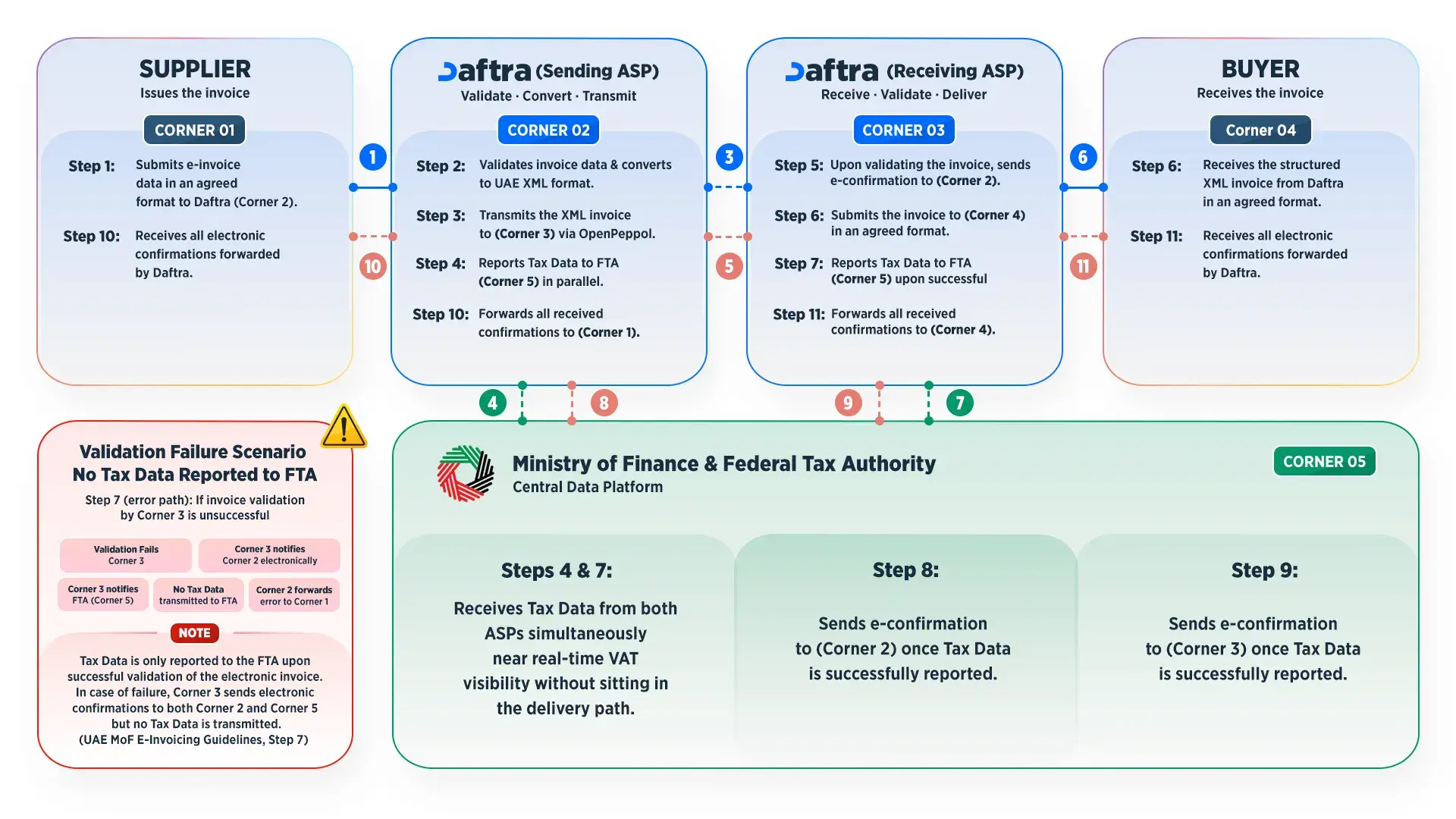
PINT AE sits at the center of the UAE’s e-invoicing framework, aligned with the broader Peppol framework and featuring a specification tailored to the local business environment to ensure VAT compliance through a decentralized 5-corner e-invoicing network.
In this system, invoices are issued, transmitted, and received in a structured and machine-readable format (XML) through an accredited service provider (ASP), and then reported to the FTA.
Throughout the entire process, PINT AE ensures the accuracy of the data structure and interpretation within the invoice. This means that if the e-invoice doesn't meet the PINT AE standards, systems will not understand or process it.
How does PINT AE relate to mandatory fields and validation?
As PINT AE defines the overall structure and rules for organizing data within the invoice, it classifies data as mandatory, conditional, or optional based on the transaction type and scenario.
E-Invoice Mandatory Fields requirements are the minimum data needed for the e-invoice to be processed and validated through the exchange, such as the invoice, seller, and VAT details. While conditional fields depend on the nature of the transaction, they may also require additional fields, such as a discount field. Optional fields are not used for VAT compliance or calculations within the e-invoice; they just add context. They include information about the buyer and additional term identifiers.
Validation is the crucial step where all components come together; all data should meet the PINT AE regulations to be considered valid. This means all mandatory fields should be present, the values should be valid, and the data should be well-structured.
A common misconception is that you only need to complete the mandatory fields for the e-invoice to be valid. In fact, you need to adhere to the entire structure and validation rules set by PINT AE to produce a valid e-invoice.
Common mistakes businesses make when interpreting PINT AE
PINT AE regulations are often mistakenly perceived as intimidating at first; the technicalities may look hard to grasp. Usually, this stems from not fully understanding what the PINT AE specifications are really all about. Here are some mistakes businesses usually make:
- A common misconception is that PINT AE is a PDF, as in a visual invoice layout, which is completely incorrect. PINT AE is specifically designed for system-to-system communication that requires structured data, while PDF is more for human readers.
- Confusing PINT AE with XML is another common source of misunderstanding about the system. XML is the official format for representing the data; PINT AE defines the rules and structure that the data follows for validation.
- Master Data quality is also a key component of a valid invoice, even if the system is compliant, inaccurate or incomplete data can invalidate your e-invoice anyway.
- Another common mistake is assuming their invoice templates are sufficient; they usually lack the structured data needed for automated validation.
How should businesses prepare for PINT AE readiness?
Preparing for PINT AE is crucial for a smooth transition into the e-invoicing model. You should ensure your business is ready to comply with the technical and structural requirements of the e-invoicing system.
Review current invoice data:
Before participating in the system, businesses should assess if their existing data includes all the required components and level its structure.
ERP/ accounting/ invoicing readiness:
To ensure a smooth transition to the e-invoicing model, businesses should verify that their accounting software or e-invoicing software can generate structured invoices that comply with PINT AE requirements.
You can also review Daftra’s UAE e-invoice settings guide to see how invoice configuration can help support local compliance requirements.
Early testing:
Assessing your compliance level early on is an extremely important step to identify gaps and issues before going live with the e-invoice.
Frequently asked questions about PINT AE in UAE e-Invoicing
What is PINT AE?
PINT AE is the official UAE standard electronic invoicing specification; it serves as the rulebook outlining the structure, validation, and exchange processes for e-invoices.
What is the UAE Peppol PINT format?
The UAE Peppol PINT format is the standardized e-invoicing specification by OpenPeppol, customized for the UAE market, VAT regulations, and local business needs.
What is the difference between Peppol PINT and BIS?
Peppol BIS is specifically designed for EU VAT, while Peppol PINT is a new globalized standard designed to support non-EU tax systems.
What is UBL in e-invoicing?
UBL is a standard that organizes data in a structured format and is used in business documents such as invoices and credit notes.
What is the format of e-invoice in UAE?
The e-invoice format for the UAE is an XML file structure, based on PINT AE specifications.
Who is the ASP for e-invoicing in UAE?
Accredited service providers are FTA-authorized technology partners that help businesses comply with the e-invoicing system and integrate with it.
Conclusion
Understanding PINT AE is key to a smooth, successful transition to the UAE e-invoicing system. It defines the structure and interpretation of the e-invoice across different systems, enabling successful processing and validation.
The PINT AE model is often mistaken for a structural format; on the contrary, it defines the rules for how data should be presented within the invoice, how it should be exchanged, and whether the data is valid.
A key element of the PINT AE is that it divides data by scenario and transaction nature into mandatory, conditional, and optional categories. Setting the minimum threshold for e-invoice validation to the required data of the mandatory fields.
Understanding and following the PINT AE specifications is your golden ticket to complying with the e-invoicing system requirement, which, in turn, saves you effort and money by avoiding legal penalties.










 Invoicing
 POS
POS Offers
 Installments
 Sales Commission
 KSA E-Invoice Software
 EGY E-Invoice Software
 JO E-Invoice Software
 E-Invoice Software
 Chart of Accounts
 Asset Management
 Cost Centers
 Expenses
 Cheque Cycle
 UAE VAT-Tax
 Product Management
 Purchases
 Purchase Cycle
 Suppliers
 Requisitions
 Stocktaking
 Organizational Structure
 Personnel Management
 Attendance and Leave
 Contracts
 Payroll
 Requests
 Work Orders
 Booking Management
 Rental and Unit Management
 Time Tracking
 Work Flow
 Lease Contracts
 Manufacturing Management
  Client Follow-Up
 Loyalty Points
 Points and Credits
 Memberships
 Insurance Management
 Daftra ERP Full App
 Point of Sales App
 Point of Sales for Desktop – Support Offline Mode
 AI Expenses Scanner App
 Employee Attendance, Sign & ESS App
 E-invoice Reader App
 Inventory Stocktaking App