




Table of contents:
- Key Summary
- What is a Tax Exemption in Saudi Arabia?
- Why Is It Important to Distinguish Between Tax Treatments?
- Main Types of Tax Exemptions
- Tax Incentives for Specific Activities or Investments
- How to apply for the exemption in KSA?
- What is the difference between VAT Exempt and Zero-Rated
- "No Tax" Doesn't Always Mean the Same Thing
- How does Daftra help you handle Tax Exemption in KSA
- FAQs
Tax exemptions in Saudi Arabia support specific economic activities and encourage investment, while Value Added Tax (VAT) applies to most goods and services. Since VAT was introduced at 5% in 2018 and increased to 15% in July 2020, understanding when VAT does not apply and the difference between exemptions, zero-rated supplies, and other tax treatments has become increasingly important for businesses.
Tax exemptions and incentives may also apply to income tax and customs duties in specific circumstances. Understanding available exemptions and their eligibility requirements helps businesses determine their tax obligations and use applicable incentives under Saudi regulations.
What is a Tax Exemption in Saudi Arabia?
A tax exemption in Saudi Arabia is a legal provision that allows eligible individuals, businesses, or specific transactions to be exempt from paying certain taxes or customs duties that would otherwise be due under Saudi regulations. The exemption may be full or partial and applies based on eligibility criteria and conditions set by the Zakat, Tax and Customs Authority (ZATCA).
Tax exemptions may apply to different types of taxes and duties, including Value Added Tax (VAT), Corporate Income Tax, Zakat, and Customs Duties, depending on the nature of the activity, goods, and taxpayer’s status. These exemptions support economic development, encourage specific business activities, and incentivize sectors that contribute to Saudi Arabia’s economic objectives.
Why Is It Important to Distinguish Between Tax Treatments?
The difference between taxable, zero-rated, and exempt transactions can directly affect how a business records and reports its transactions.
In a case where a Saudi company sells different products, some are subject to VAT, while others may qualify for zero-rating or VAT exemption. The business owner assumed that any transaction with “no VAT charged” is treated the same way.
Then, when the company used Daftra to prepare its financial reports, it became clear that these tax treatments can lead to different accounting and reporting outcomes. A zero-rated transaction is still a taxable supply with VAT charged at 0%, while an exempt supply is outside the standard VAT charge and may have different implications for input VAT recovery.

Main Types of Tax Exemptions
Tax exemptions in Saudi Arabia vary by tax type, the nature of the transaction or activity, and the taxpayer’s eligibility. Rather than applying to all businesses in the same way, exemptions and tax relief measures are generally linked to specific goods, services, entities, or circumstances under Saudi tax and customs regulations.
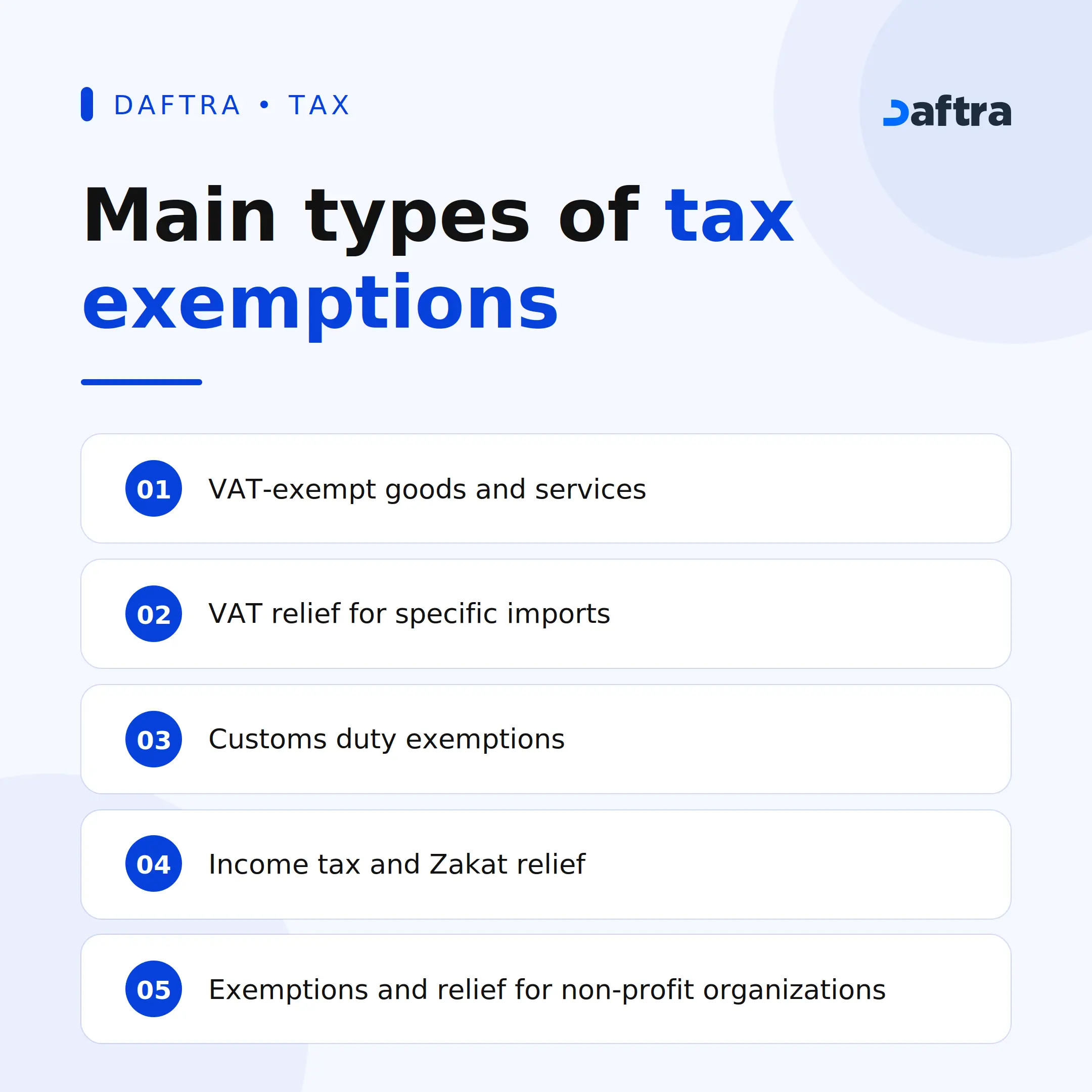
1. VAT-Exempt Goods and Services
Certain goods and services are exempt from Value Added Tax (VAT) under applicable regulations. This means that VAT is not charged on qualifying supplies. However, businesses making exempt supplies generally cannot recover the input VAT related to those supplies.
Common examples of VAT-exempt goods and services include:
- Residential real estate: The rental of qualifying residential properties is exempt from VAT. Certain real estate transactions may also be exempt, depending on the nature of the transaction and applicable rules.
- Financial services: Certain financial services are exempt, including qualifying transactions involving money, securities, credit, credit guarantees, and other specified financial products.
- Life insurance: Qualifying life insurance and related reinsurance services are exempt from VAT.
- Government services: Certain services provided by government bodies in their capacity as public authorities, such as issuing or renewing passports and driving licenses, are outside the scope of VAT.
It is important to distinguish VAT-exempt supplies from zero-rated supplies. Zero-rated supplies are subject to VAT at 0%, while businesses may generally remain entitled to recover eligible input VAT.
2. VAT Relief for Specific Imports
Saudi Arabia provides VAT relief for certain imports when specific conditions are met. These include:
- Zero-rated goods: Imports of goods that are zero-rated or exempt from VAT in the destination Member State may qualify for VAT relief. This includes qualifying medicines, medical equipment, and investment metals that meet the applicable requirements.
- Customs-exempt goods: Imports that are exempt from customs duties under the Common Customs Law may also be exempt from import VAT. These include diplomatic and military goods, used personal belongings and household items brought by citizens returning from abroad or foreigners arriving to reside in Saudi Arabia for the first time, and returned goods.
- Personal luggage and gifts: Travelers entering Saudi Arabia through an airport, port, or land border may bring qualifying personal, non-commercial goods and gifts without import VAT or duties, provided their total value does not exceed SAR 3,000, and they meet the applicable customs conditions.
ZATCA processes import VAT exemptions as part of customs clearance procedures. Other imported goods, including goods subject to 0% customs duties, may still be subject to import VAT unless a specific exemption applies.
3. Customs Duty Exemptions
Saudi Arabia provides customs duty exemptions for certain goods and imports under the Common Customs Law and its Implementing Regulations. These exemptions are subject to specific conditions and documentation requirements and may include:
- Personal luggage and gifts: Travelers may be exempt from customs duties on personal, non-commercial luggage and gifts, provided the total value does not exceed SAR 3,000 and the applicable conditions are met.
- Used personal belongings and household items: Used personal belongings and household items brought by Saudi citizens residing abroad or foreigners arriving in Saudi Arabia for the first time to reside may qualify for exemption, subject to the applicable requirements.
- Diplomatic imports: Certain imports belonging to diplomatic missions, consulates, and accredited diplomatic and consular personnel may qualify for customs duty exemptions under applicable rules and agreements.
- Military imports: Certain goods imported for military and internal security forces may be exempt from customs duties when the relevant requirements and approvals are met.
- Charitable organizations: Imports by qualifying charitable organizations may benefit from customs duty exemptions subject to the applicable conditions.
- Returned goods: Certain goods previously exported from Saudi Arabia and subsequently returned may qualify for customs duty exemption. This can also cover certain goods temporarily exported for manufacturing or repair and then re-imported, subject to the applicable rules.
4. Income Tax and Zakat Relief
Saudi Arabia does not generally impose personal income tax on individuals’ employment income. For businesses, the applicable tax treatment depends on factors such as ownership, residency, and the nature of the entity.
- Zakat relief: Certain qualifying entities may be exempt from Zakat collection, including specific government-owned entities, Waqf-owned Zakat payers, and eligible associations and non-governmental institutions, subject to ZATCA requirements.
- Income Tax: Income Tax generally applies to resident capital companies for shares owned by non-Saudi partners, as well as to certain non-resident persons conducting business or generating income in Saudi Arabia.
- Mixed ownership: Businesses with both Saudi/GCC and non-Saudi ownership may be subject to different Zakat and Income Tax treatments based on the applicable ownership shares.
- Eligibility and compliance: Businesses should verify whether they qualify for any relief and maintain the required records and supporting documents to apply the correct treatment.
Understanding the distinction between Zakat and Income Tax, as well as the applicable reliefs, helps businesses avoid incorrect tax treatment and plan their financial obligations more accurately.
5. Exemptions and Relief for Non-Profit Organizations
Certain charitable and non-profit organizations may receive specific tax treatment depending on their legal status and activities. However, being a non-profit organization does not automatically mean that every transaction is exempt from VAT.
For example, a charitable entity that provides services without consideration may be outside the scope of VAT on those activities. If the organization carries out economic activities for consideration, the VAT treatment depends on the nature of those activities and whether the applicable registration requirements are met.
May help you: Best Accounting Software in Saudi Arabia
Tax Incentives for Specific Activities or Investments
Saudi Arabia also provides various incentives designed to encourage investment, industrial development, and economic diversification. These incentives should not always be described as general tax exemptions, as eligibility may depend on the investment, location, sector, or specific government program.
Businesses operating in designated economic zones or participating in qualifying investment programs may benefit from preferential tax or customs treatment when they meet the relevant requirements.
Although a business may belong to a particular sector or have a specific legal structure, this does not automatically qualify it for incentives. Eligibility usually depends on the type of transaction, business activity, ownership structure, goods involved, and applicable regulatory conditions.
Tax and Customs Incentives in Special Economic Zones
Special Economic Zones offer a range of incentives that may provide investors with preferential tax and customs treatment compared with the treatment applicable outside the zone:
| Tax Type | Treatment Outside the Zone | Treatment Inside the Special Economic Zone |
| Corporate Income Tax | 20% for foreigners | Exemption for up to 50 years |
| Withholding Tax | 5%–20% | Exemption or reduction |
| Value Added Tax (VAT) | 15% | Zero-rated for certain transactions |
| Zakat | 2.5% | May be exempt depending on the zone |
| Customs Duties | Regular customs tariff | Full exemption on imports |
Regional Headquarters Tax Incentives
Qualifying regional headquarters are eligible for specific tax incentives on qualifying activities and income, including:
| Tax Type | Treatment for Qualifying Regional Headquarters |
| Income Tax on Qualifying Income | 0% |
| Withholding Tax on Dividend Payments | 0% |
| Withholding Tax on Payments to Related Parties | 0% |
| Withholding Tax on Payments to Unrelated Parties for Necessary Services | 0% |
Qualifying regional headquarters may receive the applicable tax incentives for 30 years, renewable. The incentive period begins from the date the regional headquarters obtains its license to conduct qualifying activities.
However, the withholding tax exemption does not apply in the following cases:
- If the payments made by the regional headquarters are related to non-qualifying activities.
- In cases of tax evasion specified under the applicable tax rules.
A tax exemption does not necessarily apply simply because a business belongs to a particular sector or has a specific legal structure. Eligibility usually depends on the type of transaction, business activity, ownership structure, goods involved, and applicable regulatory conditions.
Businesses should therefore maintain supporting records and documentation and regularly review their tax position to ensure that any exemption or relief they claim is supported by the relevant Saudi regulations and ZATCA requirements.
How to apply for the exemption in KSA?
The process for obtaining a tax exemption in Saudi Arabia depends on the type of tax and the specific exemption. Some exemptions apply automatically when the relevant conditions are met, while others require registration, supporting documents, or an application through the ZATCA portal.
1. VAT Exemption or Refund
For VAT, qualifying exempt supplies generally do not require a separate exemption application; the exemption applies when the transaction meets the conditions under Saudi VAT regulations.
Eligible organizations, such as qualifying charities and certain diplomatic or international entities, can apply for a VAT refund by:
- Logging in to the ZATCA electronic portal.
- Selecting VAT → Registration of Persons Eligible for VAT Refund.
- Completing the application and providing the required information.
- Waiting for ZATCA to review the request.
Registered VAT taxpayers can separately submit a VAT refund request when they have an eligible credit balance and meet the applicable requirements.
2. Income Tax Exemption or Relief
Income tax exemptions depend on the applicable provision under Saudi tax law or a relevant tax treaty. Some qualifying income may be exempt when specific statutory conditions are met, without requiring a general exemption application.
For treaty-based relief, taxpayers may need to obtain a Tax Residency Certificate through the ZATCA portal and provide supporting information proving their eligibility for the applicable treaty treatment.
3. Zakat Exemption
Saudi Arabia does not provide a general exemption application for ordinary businesses subject to Zakat. Zakat treatment is determined by the taxpayer's status and the applicable Zakat regulations.
Businesses should register with ZATCA and determine their Zakat obligations. If a taxpayer believes its Zakat assessment is incorrect, it can use the applicable objection or reassessment procedures through the ZATCA portal.
4. Customs Duty Exemption
Customs exemptions depend on the goods, tariff classification, industry, or specific exemption decision. For example, eligible industrial imports may qualify under an industrial exemption decision.
Businesses can use ZATCA's Industrial Exemption Inquiry or Tariff Items of Exemptions Inquiry to verify eligible goods and exemption details.
For other customs exemptions, such as those applicable to qualifying returned goods, the importer must meet the relevant conditions and provide the required customs documentation.
There is no single application for all tax exemptions in KSA. VAT exemptions generally depend on the nature of the supply, while eligible entities can apply for VAT refunds. Income tax relief may depend on statutory provisions or tax treaties. Zakat treatment is based on the taxpayer's status and applicable regulations, while customs exemptions depend on the goods and specific customs rules.
What is the difference between VAT Exempt and Zero-Rated
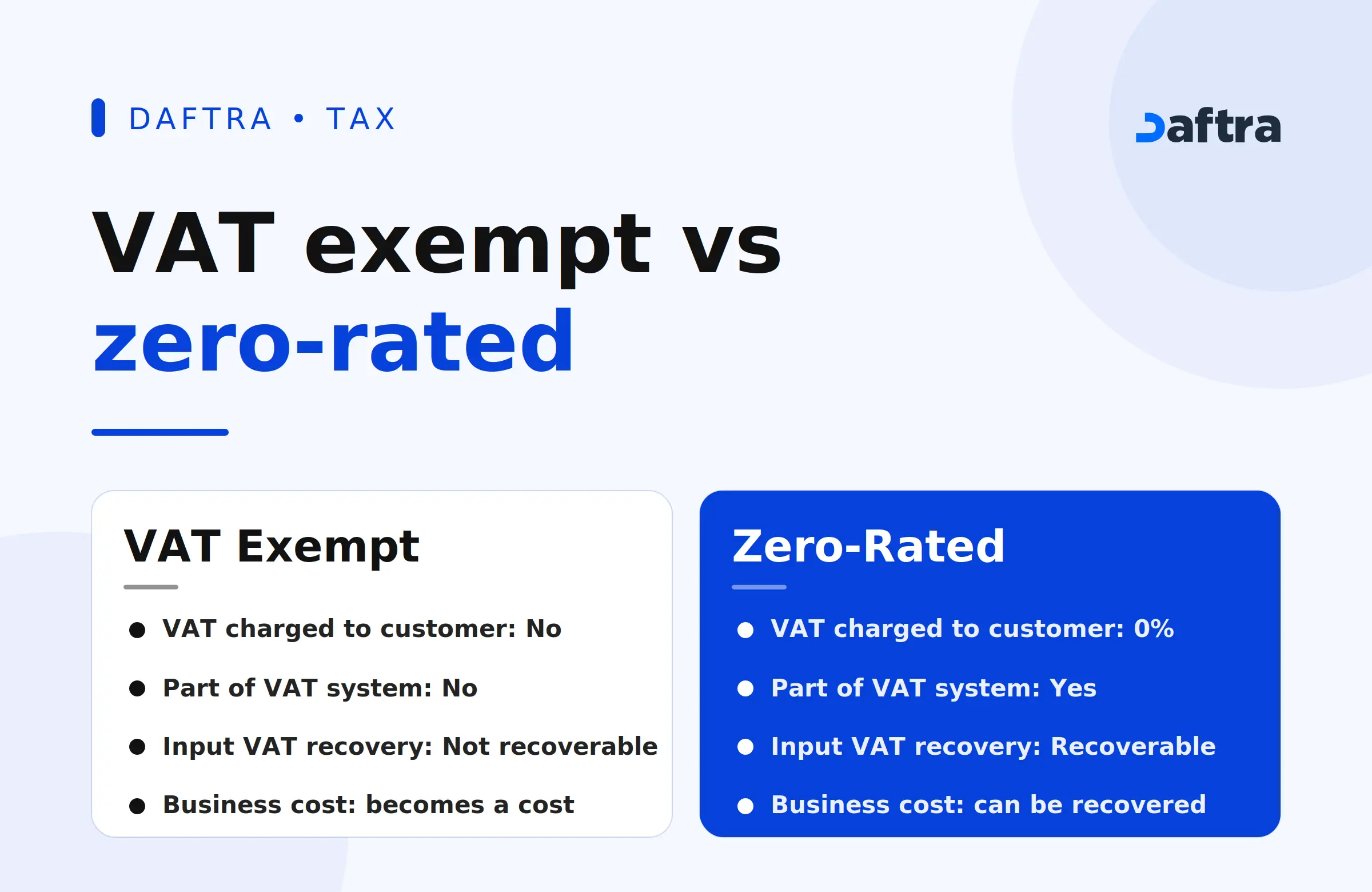
Although both VAT-exempt and zero-rated supplies result in no VAT being charged to the customer, they are treated differently under the VAT system. The main difference is whether the supply remains within the VAT framework and whether the business can recover the VAT paid on related purchases.
VAT-Exempt Supplies
A VAT-exempt supply is not subject to VAT, so the supplier does not charge VAT to the customer. However, the supplier generally cannot recover the input VAT incurred on costs directly related to making those exempt supplies.
Zero-Rated Supplies
A zero-rated supply is still a taxable supply, but VAT is applied at a 0% rate. The customer pays no VAT, while the supplier can generally recover eligible input VAT related to the supply.
"No Tax" Doesn't Always Mean the Same Thing
Seeing no VAT on an invoice does not necessarily mean that the transaction has the same tax treatment. A zero VAT amount can result from zero-rating, VAT exemption, an out-of-scope transaction, or another specific tax treatment under Saudi regulations.
These distinctions are not merely about terminology. They can affect how the transaction is recorded, whether input VAT can be recovered, how it is reported in the VAT return, and what supporting documentation the business needs to maintain.
For example, a Saudi business may sell products that are subject to the standard VAT rate alongside zero-rated or exempt supplies. If all transactions showing no VAT are treated in the same way, the business could incorrectly calculate recoverable input VAT or report its transactions in the wrong category.
Therefore, businesses should look beyond the “VAT amount” shown on an invoice and identify the reason why no VAT was charged. Correct classification helps ensure accurate accounting, VAT reporting, and compliance with Saudi tax requirements.
How does Daftra help you handle Tax Exemption in KSA
Daftra Accounting Software helps businesses manage different tax treatments by allowing them to create and configure the taxes applied to their products and services. This can help businesses record transactions correctly when some supplies are subject to VAT while others receive a different tax treatment.
Set Up Tax Types
Businesses can add a new tax from Settings → Tax Settings → Add Then specify the tax name, such as VAT, zero-rated VAT, or VAT-exempt, along with the tax rate and whether the tax is inclusive or exclusive of the selling price. Once saved, the tax becomes available for selection when creating invoices with our e-invoicing software for Saudi Arabia.
Keep Tax Accounts Organized
When a new tax is created, Daftra automatically creates related accounts in the Chart of Accounts, including accounts for collected and paid tax. This helps businesses keep their tax transactions organized and monitor the difference between the amounts collected and paid.
Review Tax Reports
Daftra provides Tax Reports and Tax Returns under General Accounting Reports. Businesses can select the relevant tax and reporting period, review the resulting data, and download the report in Excel or PDF format.
By keeping tax settings, accounting records, and tax reports organized, Daftra can help businesses maintain clearer records when dealing with different tax treatments. However, the business remains responsible for determining whether a transaction qualifies for a VAT exemption or another treatment under the applicable Saudi tax rules.
FAQs
Which items are tax-free?
Tax exemptions in Saudi Arabia can apply to certain goods and services, including certain financial services, residential real estate transactions and leases, and life insurance services. Specific imports, such as qualifying diplomatic and military imports, returned goods, and certain personal belongings or luggage, may also receive VAT relief when the applicable conditions are met.
Is personal income taxed in Saudi Arabia?
Saudi Arabia does not generally impose personal income tax on individuals’ employment income. For businesses, the applicable treatment depends on factors such as ownership, residency, and the nature of the entity. Saudi and GCC-owned businesses may generally fall under the Zakat regime, while non-Saudi ownership can result in income tax obligations.
What's the difference between Zakat and corporate income tax?
The main difference is who is subject to each regime and how the obligation is determined. Saudi and GCC-owned businesses may generally fall under the Zakat regime, while businesses with non-Saudi ownership may have income tax obligations. The applicable treatment depends on factors such as ownership, residency, and the entity's nature.









 Invoicing
 POS
POS Offers
 Installments
 Sales Commission
 KSA E-Invoice Software
 EGY E-Invoice Software
 JO E-Invoice Software
 E-Invoice Software
 Chart of Accounts
 Asset Management
 Cost Centers
 Expenses
 Cheque Cycle
 UAE VAT-Tax
 Product Management
 Purchases
 Purchase Cycle
 Suppliers
 Requisitions
 Stocktaking
 Organizational Structure
 Personnel Management
 Attendance and Leave
 Contracts
 Payroll
 Requests
 Work Orders
 Booking Management
 Rental and Unit Management
 Time Tracking
 Work Flow
 Lease Contracts
 Manufacturing Management
  Client Follow-Up
 Loyalty Points
 Points and Credits
 Memberships
 Insurance Management
 Daftra ERP Full App
 Point of Sales App
 Point of Sales for Desktop – Support Offline Mode
 AI Expenses Scanner App
 Employee Attendance, Sign & ESS App
 E-invoice Reader App
 Inventory Stocktaking App