


VAT Deregistration in UAE: Rules, Process & Requirements



Table of contents:
- Key Summary
- Should You Consider VAT Deregistration?
- What Is VAT Deregistration in UAE?
- Eligibility for Mandatory VAT Deregistration
- Voluntary VAT Deregistration in UAE
- Documents Required for VAT Deregistration
- How to Apply for VAT Deregistration (FTA Portal Steps)
- Post-Deregistration Obligations
- Common Mistakes in VAT Deregistration
- VAT Deregistration – Final Checklist
- FAQs About VAT Deregistration in UAE
- Conclusion
VAT deregistration is the removal of a business from the UAE VAT register established by the Federal Tax Authority. Once the deregistration request is processed and approved, the business is no longer required to charge VAT on taxable supplies, effective from the deregistration date. It is also important to understand that deregistration does not fulfill any outstanding tax obligations, such as filing VAT returns or settling unpaid VAT.
Businesses might need to apply for VAT deregistration for different reasons; some are legally required to deregister as they are no longer qualified to meet the conditions for VAT, while other businesses may be eligible to deregister voluntarily if their business activities or taxable turnover have changed. Understanding the rules, eligibility criteria, and application process helps businesses remain compliant with the FTA and avoid unnecessary delays. Consider this article your full guide to VAT deregistration in the UAE, how to deregister from VAT, what documentation is required, and what your post-deregistration obligations entail.
Should You Consider VAT Deregistration?
Not every business experiencing lower sales or operational challenges should immediately deregister; the decision depends on whether it still meets the FTA's VAT deregistration requirements.
Here are some scenarios where you might need to consider VAT deregistration:
Your business has permanently stopped trading
If your business has ceased operations and won't be making taxable supplies anymore, you may be required to apply for VAT deregistration.
Your taxable turnover has permanently fallen below the registration threshold
If your business no longer reaches the mandatory VAT registration requirements and is not expecting to recover its taxable turnover, you may qualify for deregistration subject to FTA rules.
Your business model has changed
Your line of business has changed to activities that do not require VAT registration; you might want to review your VAT registration status.
Before submitting a deregistration request, make sure you:
- Meet the FTA's eligibility requirements.
- Complete any outstanding VAT returns.
- Settle unpaid VAT liabilities.
- Prepare the documents required.
Before deciding to deregister, you must ensure that your business is eligible for it, and that you are ready with the VAT deregistration requirements.
What Is VAT Deregistration in UAE?
VAT deregistration is the process of removing a business from VAT registration with the Federal Tax Authority. Deregistration is mainly the opposite of registration, as it removes the business's obligation when it no longer meets the legal requirements to remain registered.
Once the FTA approves the business deregistration request, the business is removed from the VAT register and is no longer required to charge VAT on taxable supplies from the deregistration date.
The FTA has set the deregistration system to ensure the tax system stays accurate while reducing unnecessary compliance obligations for ineligible businesses. Here is a breakdown for both VAT registration and deregistration:
| VAT registration | VAT deregistration |
| Register a business for VAT with the FTA | Removes business from VAT register |
| Business charges VAT on taxable supplies | Business stops charging VAT after the effective date |
| Tax Registration Number (TRNs) | VAT registration is canceled after FTA approval |
| Ongoing VAT filing obligation begins | Final VAT obligations must still be completed before compliance ends |
Important Note:
Businesses are obligated to continue filing VAT returns until the FTA approves the deregistration request, as the business still needs to meet its VAT compliance obligations.
Eligibility for Mandatory VAT Deregistration
When businesses no longer meet the conditions for VAT registration, they must apply for VAT deregistration, known as Mandatory VAT Deregistration.
Businesses must review their VAT registration status if any of the following conditions apply:
- The business permanently stops making taxable supplies from goods or services.
- The business has ceased operations; permanently stopped trading.
- The business has been dissolved or liquidated; the legal entity is formally closed.
- The business no longer meets the VAT registration requirements.
Other situations recognized by the FTA; depending on the business structure or operational changes, additional circumstances may require deregistration under UAE VAT legislation.
Here is a checklist for Mandatory VAT Deregistration:
- The business has permanently stopped trading.
- The business no longer makes taxable supplies.
- The company has been dissolved or liquidated.
- The business no longer meets the legal conditions for VAT registration.
Important Note:
Businesses should not assume their VAT registration ends automatically when they close their business or stop trading; a formal application must be submitted to the FTA, meaning the registration remains active until the FTA responds.
Voluntary VAT Deregistration in UAE
In some cases, businesses choose to deregister if they no longer need to be VAT-registered or satisfy the eligibility requirements set by the FTA, a process known as Voluntary VAT deregistration.
Voluntary deregistration allows businesses to leave the VAT system when maintaining registration is no longer necessary. After submitting a deregistration application, the FTA reviews each request to ensure the applicable conditions are met before approving.
Here are some situations where businesses might want to consider voluntary VAT deregistration:
- Taxable turnover has fallen below the mandatory registration threshold and is not expected to exceed it again.
- The business no longer makes taxable supplies or resumes taxable operations.
- Business operations have changed significantly, whether in the model or activities.
Before applying for voluntary deregistration, businesses should:
- Confirm they meet the FTA's eligibility criteria.
- File any outstanding VAT returns.
- Settle any unpaid VAT liabilities.
- Gather supporting documents required for the application.
Important Note: Even if you are eligible for VAT deregistration, until the FTA approves, you should remain compliant with all VAT obligations.
Read also: Voluntary VAT Registration in UAE
Documents Required for VAT Deregistration
When requesting VAT deregistration, businesses must be ready with supporting documents that allow the Federal Tax Authority to verify their eligibility. The exact documentation requirements vary depending on the reason for deregistration and the nature of the business; however, applicants must ensure all information is present, accurate, and up to date to help avoid delays.
| Document | Purpose |
| Trade License | Confirms the business's legal identity and registration details |
| Tax Registration Number (TRN) | Identifies the business's VAT registration with the FTA |
| Owner Declaration or Board Resolution | Confirms the decision to deregister the business for VAT purposes. |
| Financial Statements (if applicable) | May be requested to support the business's eligibility for deregistration |
| Supporting Evidence of Business Closure or Inactivity | Demonstrate why the business is applying for deregistration |
To ensure a smooth review process, follow these tips before uploading your documents:
- Make sure all documents are valid and up to date.
- Upload clear, complete copies of each document.
- Ensure the information provided matches your VAT registration records.
- Keep copies of all submitted documents for future reference.
Note:
The FTA might request additional documentation or clarification before responding, depending on the circumstances.
How to Apply for VAT Deregistration (FTA Portal Steps)
To apply for VAT deregistration, you must submit an online application through the EmaraTax portal. While some fields and screens might change as the platform undergoes updates, the overall process remains straightforward. Businesses must also ensure they have completed all outstanding VAT obligations and have the necessary supporting documents ready before submitting the request.
Here is a step-by-step guide for the VAT deregistration application:
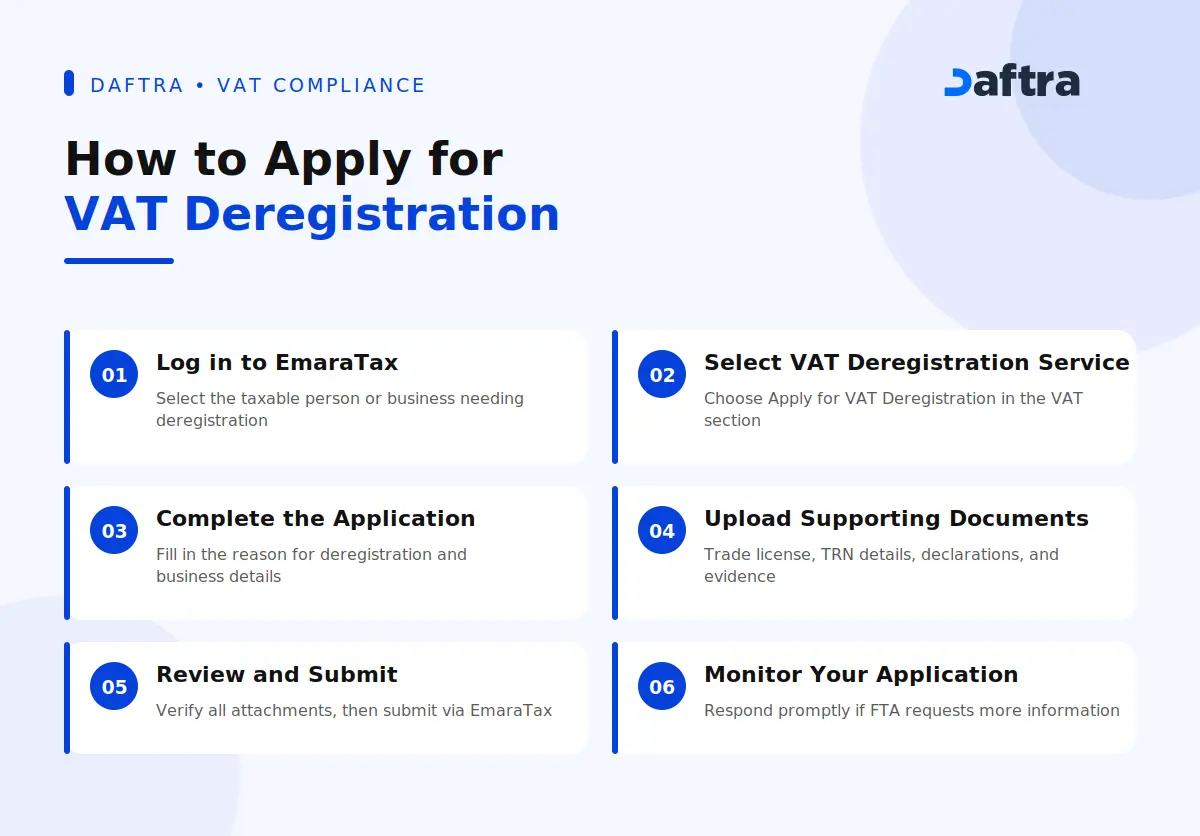
Step 1: Log in to EmaraTax
Log in to EmaraTax and select the taxable person or business that needs VAT deregistration.
Step 2: Select the VAT Deregistration Service
Go to the VAT service section and choose the Apply for VAT Deregistration option.
Step 3: Complete the Application
Fill in the required information, including the reason for deregistration and business details.
Note: Information must match your existing VAT registration records.
Step 4: Upload Supporting Documents
Attach all required documents, including your trade license, TRN details, declarations, and any other supporting evidence.
Step 5: Review and Submit
Review the information entered in the application, verify all attachments are included, and submit the application through the EmaraTax portal.
Step 6: Monitor Your Application
After you submit your application, the FTA reviews the request and may need additional information or documents. Once they are done reviewing, you will receive a response with the outcome through the EmaraTax portal.
Processing time varies depending on the complexity of the application, the documents submitted, and whether the FTA needs additional information.
Businesses should closely monitor their EmaraTax account and respond promptly to any requests to avoid unnecessary delays.
Post-Deregistration Obligations
Getting approved for VAT deregistration does not end all tax responsibilities; businesses must still meet several post-deregistration obligations to remain compliant with the FTA. These requirements are set to ensure all outstanding VAT matters are settled before the business deregisters from VAT.
Here are some of the Post-Deregistration obligations:
File Final VAT Return
When required, businesses must submit a final VAT return covering the period up to the effective deregistration date, including all taxable transactions, adjustments, and VAT due for the final tax period.
Settle any outstanding VAT liabilities
Businesses should ensure that all outstanding VAT liabilities, administrative penalties, and any other obligations are settled.
Retain Tax records
Under UAE VAT legislation, businesses must retain accounting records, invoices, and supporting documents for the statutory record retention period even after deregistration.
Note:
The FTA might request these documents during reviews or tax audits relating to the period when the business was still VAT registered.
Understand the Impact on VAT Refunds
Businesses should understand how deregistration affects any pending VAT refund claim; if it relates to a period before deregistration, the FTA may continue processing it. This means businesses must ensure all refund claims and supporting documentation are complete before closing their VAT registration.
Keep Your Deregistration Confirmation
Businesses must retain a copy of deregistration approval and any related correspondence once the FTA approves their request, as they might be important for future compliance checks, financial reporting, or audits.
Important: After VAT deregistration, businesses should continue to maintain accurate accounting records and historical VAT data.
accounting software (such as Daftra) help you preserve financial records, support audit readiness, and ensure continuity in financial reporting even after deregistering.
After completing the official VAT deregistration process, you can also review how to disable a tax in Daftra while keeping your historical records intact.
Common Mistakes in VAT Deregistration
Applying for VAT deregistration is straightforward; however, overlooking compliance requirements can lead to delays, rejected applications, or future tax issues. Here are some of the most common mistakes people make in the deregistration system:
| Mistake | Consequence |
| Applying for deregistration before meeting the eligibility requirements | FTA may reject the application, causing the business to stay VAT registered |
| Failing to file the final VAT return | Outstanding filing obligations remain, and the business may face additional compliance issues |
| Ignoring unpaid VAT liabilities | Deregistration request may be delayed until all taxes due are settled |
| Submitting incomplete or incorrect supporting documents | Processing is longer, or the FTA may request additional information before making a decision |
| Assuming VAT obligations end immediately after submitting the application | The business remains responsible for VAT compliance until the FTA formally approves the deregistration request |
| Not retaining historical VAT records | Creates difficulties during future FTA audits or compliance reviews |
Here are some tips and best practices for VAT deregistration:
Confirm that your business satisfies the FTA's eligibility conditions before applying.
- Complete all outstanding VAT returns and payments.
- Review supporting documents for accuracy and completeness.
- Keep copies of all submissions and correspondence with the FTA.
- Continue complying with VAT obligations until you receive formal approval.
By following these tips, you can reduce unnecessary delays and ensure the deregistration process is completed in accordance with the UAE VAT regulations.
Read also: VAT Fines and Penalty in UAE
VAT Deregistration – Final Checklist
Before submitting your VAT deregistration application, make sure to complete all the required steps. Follow the VAT Deregistration checklist to reduce delays, avoid unnecessary requests from the FTA, and ensure a smooth deregistration process:
Confirm your eligibility for VAT deregistration
Review the FTA's conditions to determine whether your business qualifies for mandatory or voluntary VAT deregistration.
Complete all outstanding VAT obligations
Ensure all VAT matters, including returns and liabilities, have been settled before submitting your application.
Prepare the required supporting documents
Gather your documents, including your trade license, TRN, owner declaration or board resolution, financial statements, and any supporting evidence.
Submit your application through EmaraTax
Complete the VAT deregistration application, upload the required documents, review the information, and submit your request through EmaraTax.
Respond promptly to FTA requests
Monitor your EmaraTax account for FTA responses and provide any additional information requested.
File your final VAT return (if needed)
Submit the final VAT return for the last tax period and report all taxable transactions up to the deregistration date.
Keep your deregistration approval
Save a copy of the FTA's approval confirmation and all correspondence for your business records.
Retain historical VAT records
Maintain invoices, VAT returns, accounting records, and supporting documents for record retention required under UAE VAT legislation.
Maintain accounting continuity
Even after VAT deregistration, your financial reporting and accounting responsibilities are still important for future audits, tax reviews, and statutory reporting.
Daftra helps you preserve historical VAT data, reconcile financial records, and maintain audit readiness after deregistration.
FAQs About VAT Deregistration in UAE
What triggers VAT deregistration in UAE?
VAT Deregistration in the UAE is triggered if a business stops making taxable supplies, drops below the taxable turnover threshold, or changes/closes operations entirely.
Can I cancel VAT registration if I stop operations?
Yes, if you have stopped operations, you must cancel your VAT registration per UAE law, as your business is no longer eligible for VAT registration.
Does deregistration remove all VAT obligations?
No, VAT deregistration does not remove VAT obligations; you must settle all VAT returns and liabilities and keep historical financial records.
How long does deregistration take?
Deregistration in the UAE takes 20 business days for VAT through the Federal Tax Authority portal (EmaraTax); you must also apply within 20 days of stopping taxable activities.
Conclusion
VAT deregistration is a compliance process in which businesses must meet specific eligibility conditions, settle any outstanding tax obligations, and obtain approval from the Federal Tax Authority. VAT deregistration is sometimes mandatory if business activities have ceased, or it may be voluntary due to changes in taxable turnover, which is why businesses need to follow the correct process to remain compliant and avoid unnecessary complications.
After confirming your business eligibility, you must prepare the required documentation, file any final VAT returns, and retain historical records, so you can complete the deregistration process while ensuring your business is prepared for any future compliance or audit requirements.











 Invoicing
 POS
POS Offers
 Installments
 Sales Commission
 KSA E-Invoice Software
 EGY E-Invoice Software
 JO E-Invoice Software
 E-Invoice Software
 Chart of Accounts
 Asset Management
 Cost Centers
 Expenses
 Cheque Cycle
 UAE VAT-Tax
 Product Management
 Purchases
 Purchase Cycle
 Suppliers
 Requisitions
 Stocktaking
 Organizational Structure
 Personnel Management
 Attendance and Leave
 Contracts
 Payroll
 Requests
 Work Orders
 Booking Management
 Rental and Unit Management
 Time Tracking
 Work Flow
 Lease Contracts
 Manufacturing Management
  Client Follow-Up
 Loyalty Points
 Points and Credits
 Memberships
 Insurance Management
 Daftra ERP Full App
 Point of Sales App
 Point of Sales for Desktop – Support Offline Mode
 AI Expenses Scanner App
 Employee Attendance, Sign & ESS App
 E-invoice Reader App
 Inventory Stocktaking App