


Accounting Cycle: What It Is and Its Stages of Implementation


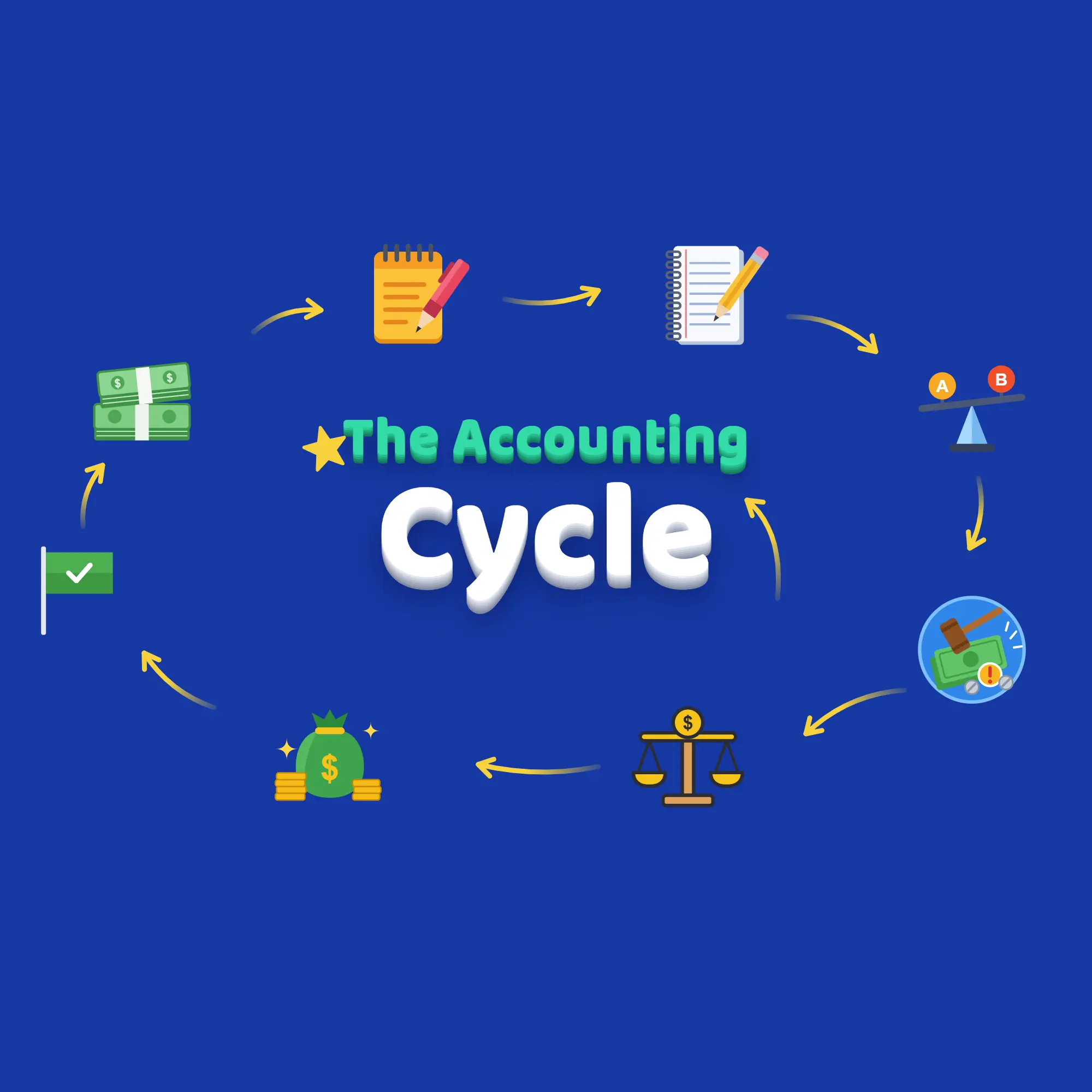
Table of contents:
- Key Summary
- What Is the Accounting Cycle?
- What Are the Objectives of the Accounting Cycle?
- What Is the Accounting Cycle?
- What Are the Objectives of the Accounting Cycle?
- When Is the Accounting Cycle Prepared?
- What Are the Different Stages of the Accounting Cycle?
- The Importance of the Accounting Cycle in a Business's Financial System
- Types of Accounts in the Accounting Cycle
- When Does the Accounting Cycle Begin and End?
- What Principles and Standards Govern the Accounting Cycle?
- What Is the Most Important Step in the Accounting Cycle, and What Is It Based On?
- What Is the Difference Between the Accounting Cycle and the Documentary Cycle?
- Who Is Responsible for Managing the Accounting Cycle in a Business?
- What Are the Common Accounting Cycle Errors, and How Can They Be Avoided?
- The Accounting Cycle in Daftra
- Frequently Asked Questions
- Conclusion
Understanding the steps of the accounting cycle and following them properly provides numerous benefits to any organization. Today, every accountant should understand the importance of the accounting cycle and recognize that their role within any organization is to ensure that the accounting cycle is completed accurately, regardless of whether the business is large or small.
Monitoring and recording all financial transactions that take place within an organization is one of the main reasons why it is essential to understand the accounting cycle. It is a fundamental process that cannot be overlooked or neglected. Therefore, this article explains some of the key concepts and steps involved in the accounting cycle and highlights the importance of the financial information it generates.
What Is the Accounting Cycle?
The accounting cycle is a defined series of steps that every business follows during each accounting period. It records all financial transactions and processes every amount spent during the fiscal year. Accordingly, it covers all accounting procedures an accountant performs, from recording journal entries to preparing financial statements and closing entries.
The accounting cycle can also be viewed as a series of interconnected activities that ultimately produce the financial information needed to support the financial objectives of the business and meet the needs of relevant external stakeholders.
What Are the Objectives of the Accounting Cycle?
The accounting cycle serves several objectives, including verifying and tracking financial transactions, maintaining financial control, and supporting decision-making. The key objectives and benefits of the accounting cycle include:
- Verifying Financial Transactions: Ensuring that all financial transactions are recorded accurately and that there are no errors.
- Tracking Financial Transactions: Enabling external stakeholders to trace financial transactions and supporting accurate tax determination. A well-maintained accounting cycle also builds investor and lender confidence by demonstrating sound financial management and strengthening the business's reputation.
- Maintaining Financial Control: The accounting cycle serves as an internal control system that helps organizations monitor and manage their financial activities.
- Supporting Decision-Making: Providing management with reliable financial information to support future decisions and business development.
- Preventing Fraud and Misconduct: Helping prevent fraud and financial misconduct when collecting, recording, and monitoring transactions throughout the accounting period.
What Is the Accounting Cycle?
The accounting cycle is a defined series of steps that every business follows during each accounting period. It is used to record all financial transactions and process every amount spent during the fiscal year. Accordingly, it covers all accounting procedures performed by an accountant, starting with recording journal entries and ending with the preparation of financial statements and closing entries.
The accounting cycle can also be viewed as a series of interconnected activities that ultimately produce the financial information needed to support the financial objectives of the business and meet the needs of relevant external stakeholders.
What Are the Objectives of the Accounting Cycle?
The accounting cycle serves several objectives, including verifying and tracking financial transactions, maintaining financial control, and supporting decision-making. The key objectives and benefits of the accounting cycle include:
- Verifying Financial Transactions: Ensuring that all financial transactions are recorded accurately and that there are no errors.
- Tracking Financial Transactions: Enabling external stakeholders to trace financial transactions and supporting accurate tax determination. A properly maintained accounting cycle also helps build the confidence of investors and lenders by demonstrating sound financial management and enhancing the business's reputation.
- Maintaining Financial Control: The accounting cycle serves as an internal control system that helps organizations monitor and manage their financial activities.
- Supporting Decision-Making: Providing management with reliable financial information to support future decisions and business development.
- Preventing Fraud and Misconduct: Helping prevent fraud and financial misconduct when collecting, recording, and monitoring transactions throughout the accounting period.
When Is the Accounting Cycle Prepared?
The accounting cycle takes place throughout the accounting period and is repeated each year as long as the business continues to operate. It begins with journal entries, which are recorded daily whenever financial transactions occur, followed by other accounting procedures that are performed periodically.
It is important to note that some transactions and accounting procedures are recorded or performed daily, while others take place monthly, quarterly, or at the end of the accounting period. These activities will be explained in detail in the different stages of the accounting cycle below.
What Are the Different Stages of the Accounting Cycle?
In this section, you will learn about all the steps involved in the accounting cycle and how the accounting cycle works step by step, based on our accounting experience.
There are eight main steps in the accounting cycle, which can be summarized as follows:
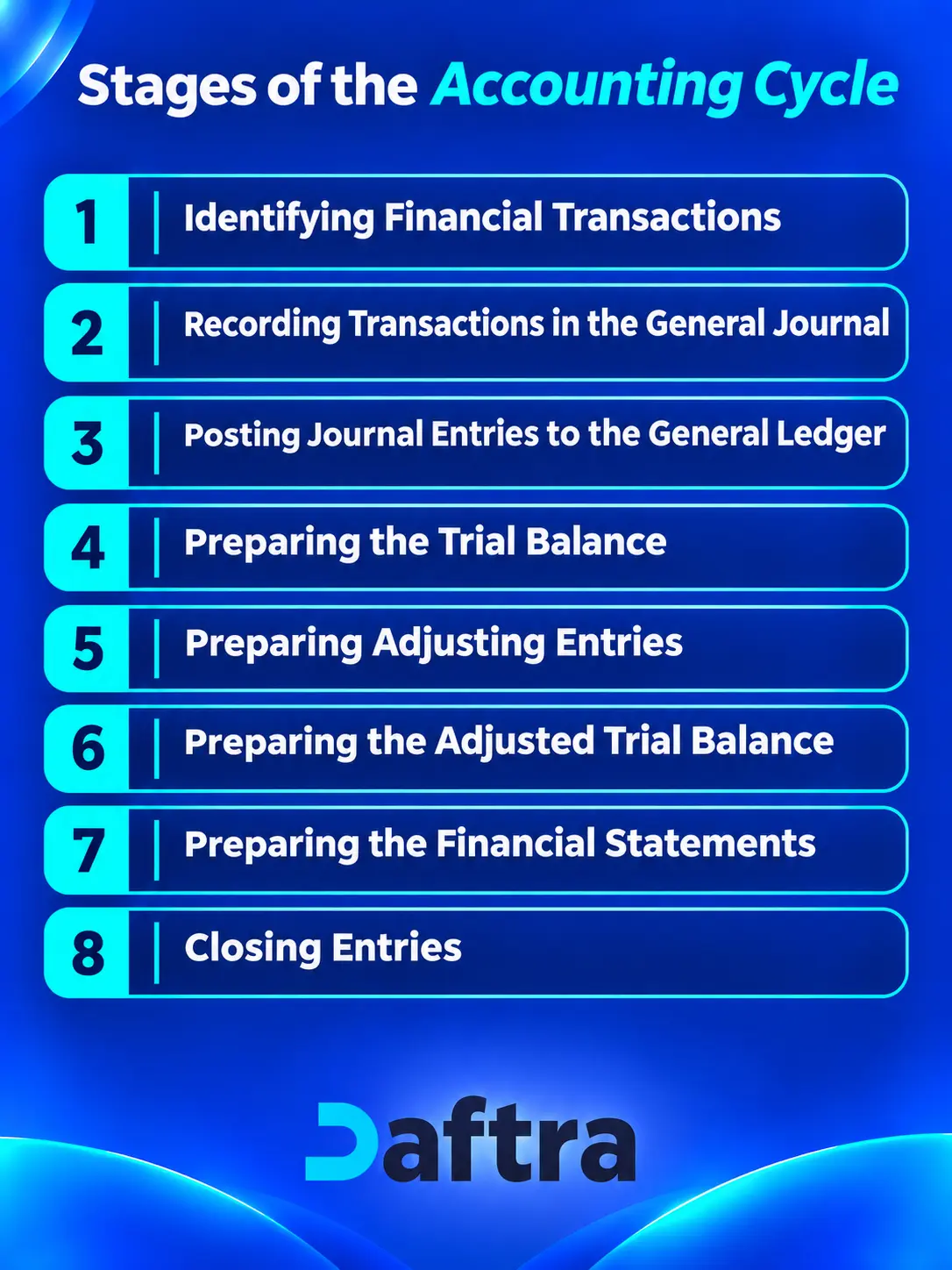
First: Identifying Financial Transactions
Identifying the financial transactions that take place within a business is one of the first and most important steps in the accounting cycle, as all subsequent steps are based on this information. Therefore, the business must identify and document its financial transactions as they occur.
Accountants should identify these transactions on a daily basis rather than postponing them until the end of the month. Whenever a financial transaction takes place, all relevant documents and receipts should be collected. This step is a fundamental part of the documentary cycle, which ensures that financial transactions are properly supported by source documents.
Whether the transaction involves a sale, purchase, expense, or revenue, it must be identified and supported by appropriate documentation. At this stage, the accountant must review all documents related to financial transactions and distinguish between transaction types. The accountant must also determine the appropriate debit and credit accounts so the transactions can be recorded accurately in the journal.
This step in the accounting cycle may take time; however, it should not be overlooked or handled carelessly.
Second: Recording Transactions in the General Journal
Journal entries are among the most important accounting records because they record every financial transaction the business makes under the double-entry accounting system, where total debits must equal total credits. Accordingly, the general journal provides a detailed record of the business's financial transactions.
Examples of financial transactions include:
- Purchasing inventory for cash for SAR 30,000.
- Selling goods to a customer for SAR 50,000.
- Purchasing goods from suppliers for SAR 25,000.
- Selling goods for cash for SAR 100,000.
- Paying SAR 10,000 in cash for rent.
Each of these transactions affects at least two accounts, with one account increasing and another decreasing or otherwise being affected. Therefore, each transaction is recorded in the general journal according to the double-entry accounting system as follows:
Third: Posting Journal Entries to the General Ledger
Posting journal entries to the general ledger is a crucial step in the accounting cycle. This process allows you to determine the balance of each account separately.
It can be difficult to determine each account's balance directly from the journal because of the large number of entries and because transactions involving the same account may be recorded across different entries. Therefore, the transactions are posted to the general ledger, where a separate account is maintained for each account, and its balance is determined at the end of the accounting period.
Based on the journal entries above, the Cash Account can be opened in the general ledger and the relevant transactions posted as follows:
The balance carried down is used to balance the Cash Account. It is recorded on the opposite side of the account's normal balance—in this case, the credit side—as shown above.
The balance brought down is the balance carried forward to the beginning of the next accounting period. It is recorded on the side corresponding to the account's normal balance—in this case, the debit side.
Therefore, the closing balance of the Cash Account at the end of this period is SAR 60,000, which will be the opening balance for the next accounting period.
Post and balance all other accounts the same way before proceeding to the next step.
Fourth: Preparing the Trial Balance
The trial balance summarizes the total debit and credit balances of the accounts. The total debit balances must equal the total credit balances. Prepare it using the account balances from the general ledger.
Preparing a trial balance is important for the following reasons:
- Detecting Errors: If certain errors have occurred when recording journal entries or posting them to the general ledger, the total debit balances may not equal the total credit balances. However, a balanced trial balance does not guarantee that all accounting records are error-free.
- Preparing Financial Statements: It provides a basis for preparing the income statement and statement of financial position.
- Summarizing Account Balances: It shows the total balance of each account for the accounting period.
A trial balance may be prepared quarterly or semiannually, depending on the business's needs and size. The following is an illustrative example of a trial balance:
If the accountant identifies errors while preparing the trial balance, they should review the general ledger and journal entries to locate the source and make the necessary corrections.
Fifth: Preparing Adjusting Entries
Certain types of revenue and expenses must be recognized in the appropriate accounting period. Adjusting entries are therefore an essential stage of the accounting cycle, as they ensure that all relevant amounts are properly allocated to the correct financial period.
There are five main types of adjusting entries:
- Accrued Expenses: Expenses incurred during the current period that have not yet been paid or recorded. These are recognized as liabilities.
- Prepaid Expenses: Expenses paid in advance that relate to future periods. They are adjusted by recognizing the portion that applies to the current period as an expense.
- Accrued Revenue: Revenue earned during the accounting period that has not yet been received or recorded.
- Unearned Revenue (Deferred Revenue): Amounts received in advance for goods or services that have not yet been provided. These amounts are recognized as revenue when the goods or services are delivered.
- Depreciation: The allocation of the cost of fixed assets over their useful lives.
These adjustments affect account balances and therefore require the trial balance to be prepared again. An adjusted trial balance is prepared to verify the updated debit and credit balances.
Sixth: Preparing the Adjusted Trial Balance
At this stage, the accountant prepares the adjusted trial balance using the updated balances of accounts affected by adjusting entries. The process is similar to preparing the initial trial balance, but it incorporates the revised balances.
As with the initial trial balance, total debits must equal total credits. Once the adjusted trial balance has been prepared, the accountant has the financial data needed to prepare the financial statements.
Seventh: Preparing the Financial Statements
At the end of the accounting period, businesses typically prepare three key financial statements:
- Income Statement
- Statement of Financial Position (Balance Sheet)
- Statement of Cash Flows
Income Statement
The income statement is one of the most important financial statements because it shows the business's financial performance over a specific period and indicates whether it has generated a profit or incurred a loss.
It presents the following:
- Revenue
- Expenses
Net profit or loss is determined by comparing the revenue earned with the expenses incurred during the accounting period, rather than considering only the amounts of cash received or paid. This approach applies when the business uses the accrual basis of accounting.
An income statement can be prepared for different periods, such as monthly, quarterly, or annually, depending on the business's needs and financial reporting requirements.
The income statement helps management and investors evaluate the business's performance and profitability. The information it provides may also be used to determine tax liabilities in accordance with applicable laws and regulations.
Statement of Financial Position
The statement of financial position presents the assets and liabilities of a business, along with its equity. Total assets must equal the combined total of liabilities and equity. This relationship is known as the accounting equation:
Assets = Liabilities + Equity
Components of the Statement of Financial Position
| Liabilities and Equity | Assets |
| Liabilities | Non-Current Assets (Fixed Assets) |
| Accounts Payable, Notes Payable, Taxes Payable, Accrued Wages | Land, Buildings, Equipment, Furniture |
| Non-Current Liabilities | Current Assets |
| Long-Term Loans and Obligations | Inventory, Cash, Bank Balances, Marketable Securities |
| Equity | |
| Share Capital, Retained Earnings | |
| Preferred Shares and Treasury Shares (for Joint-Stock Companies) |
Total assets must equal total liabilities and equity.
Cash Flow Statement
The cash flow statement shows changes in a business's cash and cash equivalents during a specific period. It classifies cash flows into three categories: operating activities, investing activities, and financing activities.
Statement of Changes in Equity
The statement of changes in equity shows how the owners' equity in a business changes throughout the accounting period. It presents the opening equity balance and the changes that occur during the period to arrive at the closing balance.
It also shows the effects of net profit or loss, investments or increases in capital, distributions or withdrawals, and any other changes affecting equity.
Key Components:
- Equity at the beginning of the period
- Net profit or loss for the period
- Increases in capital or owners' contributions
- Distributions to owners
- Other changes in equity
- Equity at the end of the period
The closing equity balance can be calculated using the following formula:
Closing Equity = Opening Equity + Net Profit + Capital Increases − Distributions or Withdrawals ± Other Changes
Note: The components of financial statements vary depending on the legal structure of the business and the composition of its equity. For example, joint-stock companies may report share capital, share premium, retained earnings, and reserves.
Eighth: Closing Entries
Closing entries are the final step in the accounting cycle. Once the financial statements have been prepared, the accounting period is considered complete, and a new period begins. At this stage, certain accounts must be closed, including revenue and expense accounts, so that their balances start at zero in the new accounting period.
Therefore, temporary accounts, such as revenue, expenses, and drawings, where applicable, must be closed. In contrast, asset and liability accounts are not closed at the end of each accounting period because they are ongoing accounts that carry their balances forward into subsequent periods.
Revenue Account
The revenue account is used to record sales revenue, interest income, gains from financial investments, commission revenue, rental income from fixed assets, and any other income earned by the business that does not fall under the categories mentioned above.
A subsidiary account can also be created under the revenue account called Unearned Revenue (Deferred Revenue). This account is used to record amounts received before the business has fulfilled its performance obligations.
Inventory Account
The inventory account is one of the most important accounts in the accounting cycle. It is used to record and track the value of inventory held by the business at the end of the accounting period. Inventory is measured at the lower of cost and net realizable value.
The Documentary Cycle
Relying on manual procedures and paper-based documents can slow down document processing and make organization and storage more difficult, particularly when there are numerous transactions and multiple parties responsible for reviewing and approving them.
The Importance of the Accounting Cycle in a Business's Financial System
The accounting cycle helps create an accurate record of a business's financial position by producing reliable summaries of its financial data. Its importance to businesses can be explained through the following benefits:
Financial Control
The accounting cycle is an effective tool for establishing a sound financial control system within a business. It helps track revenue and expense balances, control spending, and manage financial risks.
Financial Planning
The accounting cycle provides the data needed for financial planning and preparing budgets and forecasts. This information helps businesses identify the resources required to support future growth and maintain financial stability.
Compliance with Accounting Standards and Financial Regulations
The accounting cycle is essential for supporting compliance with generally accepted accounting principles, applicable international accounting standards, and relevant financial regulations. It also promotes transparency, credibility, financial accountability, and tax disclosure.
Types of Accounts in the Accounting Cycle
The accounting cycle involves several essential accounts used to record and track a business's financial activities. These accounts include the following:
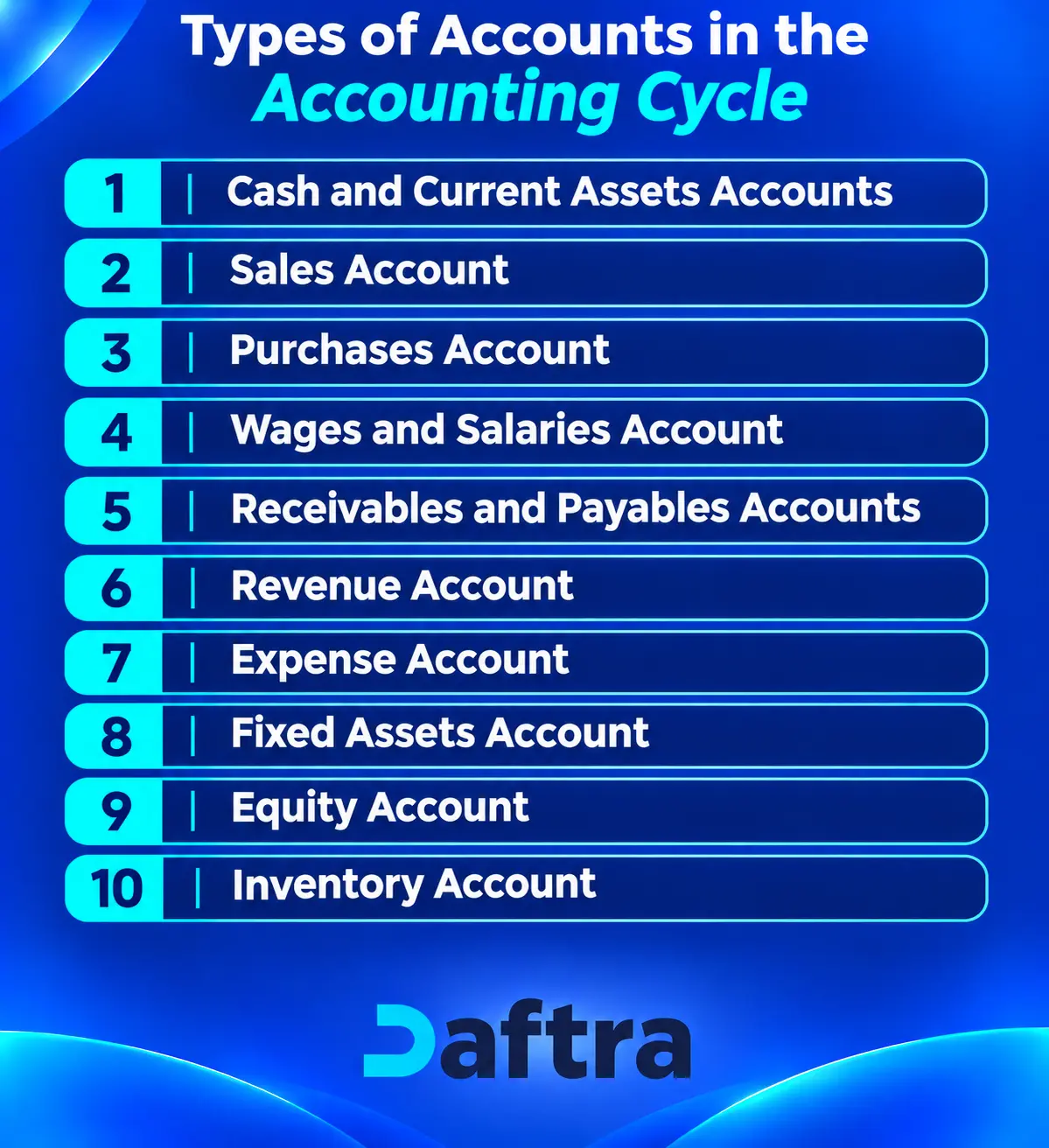
Cash and Current Assets Accounts
These accounts are used to record cash and current assets that can be converted into cash within a short period, such as cash on hand and bank balances.
Sales Account
The sales account records revenue generated from selling products or providing services to customers.
Purchases Account
The purchases account tracks purchase transactions involving raw materials, goods, or services, along with the amounts paid or payable to suppliers.
Wages and Salaries Account
This account is used in the accounting cycle to record payments made to temporary workers and permanent employees, as well as other forms of employee compensation, such as incentives, allowances, and bonuses.
Receivables and Payables Accounts
These accounts record amounts customers owe the business and amounts the business owes suppliers. They help track the financial obligations and outstanding balances arising from credit transactions.
Revenue Account
The revenue account records sales revenue, interest income, gains from financial investments, commission revenue, rental income from fixed assets, and other income earned by the business.
A separate account for Unearned Revenue (Deferred Revenue) may also be maintained to record amounts received before the business has delivered the related goods or services or fulfilled its performance obligations.
Expense Account
The expense account is one of the most important accounts in the accounting cycle. It records direct and indirect expenses, such as utility bills, rent, marketing expenses, maintenance costs, distribution expenses, and other administrative expenses. This account helps businesses analyze their financial performance.
Fixed Assets Account
This account records long-term tangible assets used in business operations, including buildings, machinery, equipment, furniture, and land.
Equity Account
The equity account reflects the owners' interest in the business. It tracks the opening and closing equity balances and changes during the accounting period, including capital contributions, dividends distributed to shareholders, and retained earnings, as applicable to the business's legal structure.
Inventory Account
The inventory account is essential for recording and tracking the value of inventory held by the business at the end of the accounting period. Inventory is generally measured at the lower of cost and net realizable value. Depending on the inventory valuation method used, cost may be determined using methods such as FIFO or the weighted-average cost method.
When Does the Accounting Cycle Begin and End?
The accounting cycle follows the accounting period established by the business. A monthly accounting cycle begins on the first day of each month and ends on the last day of that month. A quarterly accounting cycle begins on the first day of the first month of the relevant quarter and ends on the last day of its third month. An annual accounting cycle begins on the first day of the fiscal year and ends on the last day of that fiscal year.
What Principles and Standards Govern the Accounting Cycle?
The accounting cycle relies on a set of accounting principles and standards that promote consistent and comparable recording, classification, and presentation of financial transactions. The applicable standards vary depending on the country, the type of business, and regulatory requirements. Key principles and standards include the following:
Accrual Basis of Accounting
Revenue and expenses are recognized when they are earned or incurred, rather than only when cash is received or paid.
Going Concern Principle
This principle assumes that the business will continue operating for the foreseeable future unless there is significant evidence to the contrary. This assumption affects how certain assets and liabilities are measured and presented in the financial statements.
Consistency Principle
Accounting policies and methods should be applied consistently from one period to another to facilitate comparisons of financial results. Changes in accounting policies or methods should be handled in accordance with applicable accounting requirements, with disclosures made when necessary.
Matching Principle
This principle involves recognizing expenses associated with the revenue earned during a particular period so that the financial results accurately reflect the business's performance.
Materiality Principle
The recording and presentation of financial information should take into account whether that information could influence decisions made by users of the financial statements.
Reliability and Verifiability
Recorded transactions should be supported by evidence that can be reviewed and verified, such as invoices, receipts, contracts, and bank statements. This helps ensure the accuracy of accounting records and makes financial figures traceable.
International Financial Reporting Standards (IFRS)
IFRS provides the basis for preparing financial reports and statements for entities required to apply these standards. It establishes requirements for the accounting treatment and presentation of various items, including revenue, inventory, property, plant and equipment, and leases.
What Is the Most Important Step in the Accounting Cycle, and What Is It Based On?
One of the most critical steps in the accounting cycle is recording financial transactions, as the accuracy and completeness of this stage directly affect the subsequent stages of the cycle.
This step involves analyzing and interpreting supporting documents related to financial transactions, such as invoices and bank documents, as well as reviewing the information to verify its accuracy and completeness.
The process is guided by applicable accounting principles and standards, including Generally Accepted Accounting Principles (GAAP) and International Financial Reporting Standards (IFRS), depending on the reporting framework applicable to the business. Both frameworks aim to support the accurate and accountable recording of transactions and provide relevant stakeholders with transparent financial information in accordance with financial accountability and disclosure requirements.
What Is the Difference Between the Accounting Cycle and the Documentary Cycle?
The accounting cycle consists of a series of activities used to record all financial transactions within a business. The documentary cycle, on the other hand, supports the accounting cycle by ensuring that the documents and records required to substantiate those transactions are prepared, collected, reviewed, and approved.
In other words, the accounting cycle relies on supporting documents to record financial transactions accurately, while the documentary cycle ensures that the necessary evidence is available. The key differences between the accounting cycle and the documentary cycle are outlined below:
| Comparison Criteria | Accounting Cycle | Documentary Cycle |
| Purpose | The accounting cycle aims to record and summarize financial transactions and their related accounts, prepare financial reports, and close temporary accounts at the end of the period before the next accounting period begins. | The documentary cycle provides formal documentation of financial transactions carried out by the business during a specific period by ensuring that accurate supporting documents and records are available for each transaction. |
| Advantages | It serves as a control mechanism for tracking accounting and financial transactions and identifying errors or discrepancies in accounting records. This helps strengthen trust and transparency between the business and relevant stakeholders, including lenders, investors, and suppliers. | It helps ensure that transactions are recorded accurately and systematically, while allowing supporting documents to be retained as evidence of those transactions for inspection, auditing, and review purposes. |
| Disadvantages | The steps involved can be relatively lengthy and complex, requiring additional time, effort, and expertise to complete accurately. | Errors may occur when collecting and organizing financial documents, leading to inaccuracies in the accounting records used in the accounting cycle. In addition, the documentary cycle may not integrate seamlessly with some accounting software systems. |
Who Is Responsible for Managing the Accounting Cycle in a Business?
Managing the accounting cycle from beginning to end is one of the key responsibilities of the bookkeeping function. Accountants and other finance professionals, including financial analysts and auditors, may also participate in preparing and reviewing the accounting cycle.
In some cases, businesses engage external financial experts to assist with the process. The individuals responsible for managing and carrying out the accounting cycle depend on the size of the business, the nature of its transactions, and whether it uses cloud-based accounting software, which can save time, effort, and costs associated with manual accounting procedures.
What Are the Common Accounting Cycle Errors, and How Can They Be Avoided?
The accounting cycle plays a crucial role in ensuring the accuracy of financial statements and reports. An error at any stage can carry over into subsequent stages, from recording financial transactions to preparing financial statements and closing the accounting period.
The most common accounting cycle errors include the following:
Key takeaway: Preventing accounting cycle errors requires more than reviewing the books at the end of the period. Businesses need a continuous internal control system that monitors every stage of the cycle, supported by automation that connects financial transactions with their supporting documents and reports while reducing manual data entry.
The Accounting Cycle in Daftra
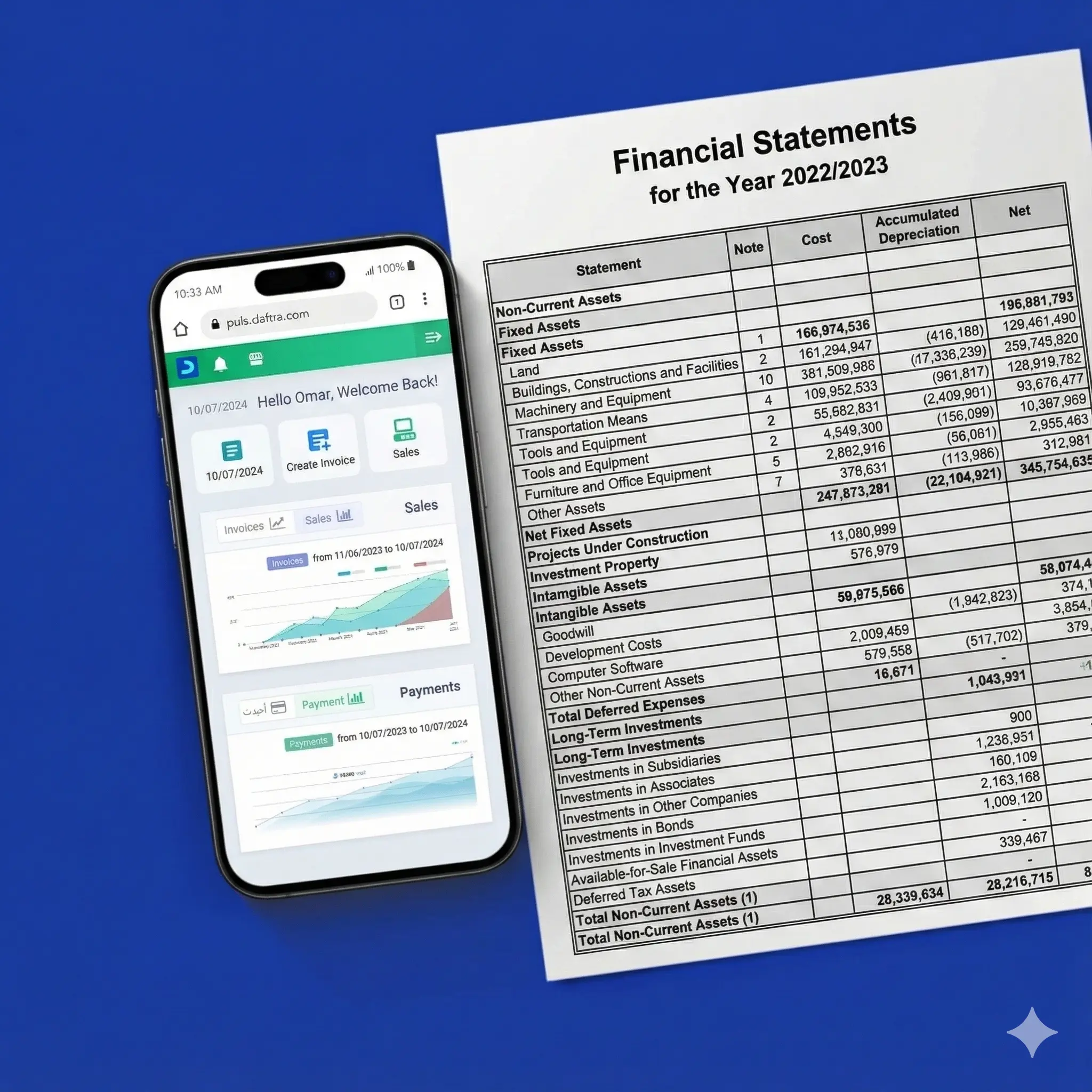
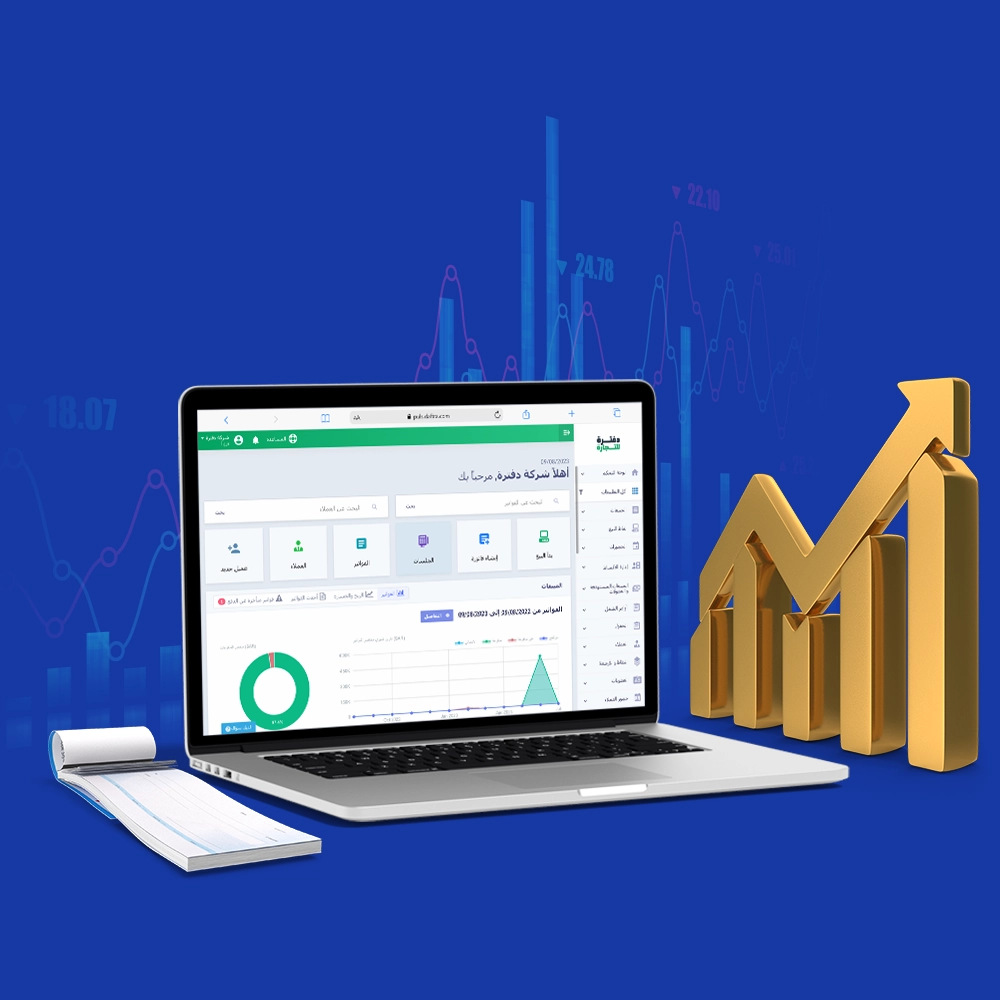
With Daftra Accounting Software, you can manage and track your entire accounting cycle, from identifying financial transactions and recording journal entries to posting them to the general ledger, preparing the trial balance, recording adjusting entries, and generating detailed financial statements through the system's reports.
At the end of the fiscal year, you can close the relevant accounts and start a new accounting cycle. All these processes can be completed with a high degree of accuracy and efficiency.
Daftra also provides technical support and a variety of instructional resources to help you manage the accounting cycle for your business, regardless of its size. The system's user-friendly dashboard guides you through the process step by step, making it accessible to both accounting professionals and users without an accounting background.
Frequently Asked Questions
What is the most important step in the accounting cycle?
The most important step in the accounting cycle is recording financial transactions, as all subsequent steps in the cycle depend on accurate and complete transaction records.
Which accounts are closed at the end of an accounting period?
Temporary accounts, such as revenue, expenses, drawings, and distributions, are closed at the end of an accounting period, depending on the entity’s structure. Their net results are transferred to equity or retained earnings, as applicable.
How many stages are there in the accounting cycle?
The number of stages varies depending on how the accounting cycle is divided. However, it typically consists of eight main stages, beginning with recording financial transactions and ending with closing the books and preparing financial reports and statements.
When does the accounting cycle begin and end?
The accounting cycle begins when the first financial transaction occurs or is recorded during an accounting period. It continues through recording and posting transactions, making adjusting entries, and preparing financial statements, and ends with closing temporary accounts.
Must every business complete all stages of the accounting cycle?
Yes. Every business needs to complete the essential accounting processes. However, the way these processes are carried out and the number of steps involved may vary depending on the size of the business, the nature of its activities, the accounting system used, and its reporting requirements.
When are adjusting entries prepared during the accounting cycle?
Adjusting entries are prepared at the end of the accounting period, before the financial statements are prepared. They ensure that revenues and expenses are recognized in the correct period and that account balances are adjusted as necessary. Examples include accrued expenses, prepaid expenses, unearned revenue, and depreciation.
How many times should the accounting cycle be completed during the year?
There is no fixed number that applies to all businesses. The accounting cycle is completed for each financial reporting period. For example, businesses that prepare monthly reports complete the cycle monthly, while annual financial statements require a year-end accounting cycle.
Does the accounting cycle differ between merchandising and service businesses?
The main stages of the accounting cycle are similar for merchandising and service businesses, but the transactions and accounts involved differ according to the nature of each business. Merchandising businesses deal with purchases, inventory, and the cost of goods sold, whereas service businesses focus on revenue from services and the expenses associated with providing them.
Conclusion
This guide has covered the accounting cycle, its importance, and its main steps, with practical examples. The accounting cycle is more than a series of routine accounting procedures; it is the backbone of an organization’s financial system. It provides a solid foundation of accurate, documented financial information, supported by the documentary cycle, helping businesses manage finances efficiently and make informed decisions that support sustainable growth and success.
Both the accounting cycle and the documentary cycle also reflect a company’s commitment to transparency, integrity, and financial credibility in its dealings with management, regulators, and external stakeholders. By maintaining accurate records, reviewing financial information, and identifying and addressing discrepancies before they escalate, businesses can better manage financial risks, protect their reputations, and support long-term continuity in a competitive business environment.









 Invoicing
 POS
 Offers
 Installments
 Sales Commission
 KSA E-Invoice Software
 EGY E-Invoice Software
 JO E-Invoice Software
 E-Invoice Software
 Chart of Accounts
 Asset Management
 Cost Centers
 Expenses
 Cheque Cycle
 UAE VAT-Tax
 Product Management
 Purchases
 Purchase Cycle
 Suppliers
 Requisitions
 Stocktaking
 Organizational Structure
 Personnel Management
 Attendance and Leave
 Contracts
 Payroll
 Requests
 Work Orders
 Booking Management
 Rental and Unit Management
 Time Tracking
 Work Flow
 Lease Contracts
 Manufacturing Management
 Client Follow-Up
 Loyalty Points
 Points and Credits
 Memberships
 Insurance Management
 Daftra ERP Full App
 Point of Sales App
 Point of Sales for Desktop – Support Offline Mode
 AI Expenses Scanner App
 Employee Attendance, Sign & ESS App
 E-invoice Reader App
 Inventory Stocktaking App