




Table of contents:
- What Is Depreciation?
- What Are Depreciation Methods?
- How Is Depreciation Calculated?
- Examples of Depreciation Calculations
- What Are Depreciation Entries?
- What Is the Importance of Depreciation Entries?
- Depreciation of Fixed Assets and Its Rate
- What Is the Difference Between Accumulated Depreciation and Depreciation Provision?
- What Is the Difference Between Accounting Depreciation and Tax Depreciation?
- Difference Between Depreciation and Amortization
- What Are the Controls and Standards for Depreciation?
- How Is Depreciation Accounted for On a Balance Sheet?
- What assets don't depreciate?
- What happens if you forgot to record depreciation?
- Depreciation in the Saudi Context
- What Is the Depreciation Threshold?
- What Does Depreciating Asset Maintenance Expenses Mean?
- Frequently Asked Questions
Accounting is governed by several mandatory regulatory rules known as accounting principles, including those related to the requirement to match expenses with revenues during each financial period. Depreciation allows the matching of asset depreciation expenses with the revenues generated by those assets over their productive life.
It also serves other accounting and tax purposes, such as recovering the cost of the asset over its useful life and facilitating its replacement, among others. This article explains the meaning of depreciation and the different methods used to calculate it.
What Is Depreciation?
Depreciation is an accounting method through which the cost of tangible assets is allocated over the years of their useful life during which those assets are productive. By allocating this cost, companies can accurately determine the loss in value of those assets, as well as the profits that can be generated from owning them.
For instance, if a shipping company buys a truck for 50,000 SAR; the truck is expected to last 10 years and have no salvage value at the end.
Using straight-line depreciation:
- Cost of the truck: 50,000 SAR
- Useful life: 10 years
Annual depreciation:
50,000/ 10 = 5,000 SAR per year
This means that by the end of the first year, the truck would be valued at 45,000 SAR; in the 2nd year, it would reach 40,000 SAR, and so on until it reaches the 10-year mark, when it would drop to 0 SAR.
Simply: Depreciation lets businesses spread the cost of their assets over the years they are used, rather than recording the full amount as an expense in the year of purchase.
Basic Concepts of Accounting Depreciation
Before elaborating on depreciation methods and their accounting entries, it is useful to explain some basic concepts that help in understanding the details of depreciation discussed later.

What Are Depreciation Methods?
Assets lose value for several reasons, such as use or repairs for production purposes, the introduction of more advanced equipment into the market, or other indirect factors such as inflation.
Depreciation methods are also referred to as types of depreciation. Although the basic principle of depreciation is the same, it can be calculated using several different methods. The most common methods are reviewed below:
1. Units of Production Method
When the units of production method is adopted, depreciation is calculated based on the rate of use of the asset. Depreciation increases as the asset’s usage increases during periods of higher production. The total number of units the asset is expected to produce over its useful life is estimated, and the depreciation cost is then allocated based on the number of units produced, taking the production rate into account.
2. Straight-Line Method
Under the straight-line method, the asset is assumed to depreciate evenly over its useful life. Accordingly, the loss in the asset’s value is allocated equally over the years of its estimated useful life.
Therefore, it is necessary to take into consideration that the salvage value is deducted from the cost of the asset before distributing the depreciation expense. This method is commonly used in depreciation calculations because it is the simplest.
3. Declining Balance Method
This depreciation method is based on the assumption that the asset has a higher value in the earlier years of ownership compared to later years. Accordingly, depreciation in the early years results in a greater loss in the asset’s value, and the depreciation expense decreases over time.
4. Double Declining Balance Method
This method is similar to the declining balance method, where depreciation is higher in the early years and lower in later years, but it operates at a doubled rate. This method is useful for calculating depreciation for assets that lose value rapidly, such as mobile phones and laptops.
5. Sum-of-the-Years’-Digits Method
As with the declining balance and double declining balance methods, depreciation under this method is calculated at an accelerated rate and is primarily based on estimates of the asset’s useful life in years.
How Is Depreciation Calculated?
As previously mentioned, depreciation can be calculated using several different methods, from which a company chooses the one that best suits its needs. For clarification, consider an example in which Company (S) purchases an asset with a cost of 50,000 SAR, a useful life of four years, and a salvage value of 10,000 SAR.
The depreciation of the asset can be calculated by first deducting the salvage value, then dividing the remaining cost of the asset over the years of its useful life according to the selected depreciation method.
In this context, the Daftra Asset Management System helps you calculate depreciation of fixed assets through the depreciation settings available in the system’s dashboard.
With just a few simple clicks, starting by selecting General Ledger from the Daftra dashboard, then choosing Assets, adding a new asset, and entering the asset’s depreciation details, you can select the depreciation method that suits the nature of the asset. The system will then automatically calculate depreciation and provide accurate results.
Examples of Depreciation Calculations
There are several methods for calculating depreciation, as explained earlier. These methods help determine the cost of assets based on their period of use or useful life. Below are practical examples of applying depreciation calculation methods, which enhance accounting understanding and support efficient fixed asset management.
1. Depreciation Using the Units of Production Method
When using the units of production method, it is necessary to estimate the total number of units the asset will produce over its useful life and to deduct the salvage value from the asset’s cost at the outset (50,000 − 10,000 = 40,000 SAR).
Assuming the asset produces 5,000 units over its useful life and 1,000 units during the first year, the depreciation rate for the first year is: (1,000 ÷ 5,000 × 100 = 20%).
The depreciation expense for the first year is calculated by multiplying the depreciation rate by the asset’s value after deducting the salvage value: (0.2 × 40,000 = 8,000 SAR).
If production decreases to 500 units in the second year, the depreciation rate becomes: (500 ÷ 5,000 × 100 = 10%), and the depreciation expense equals: (0.1 × 40,000 = 4,000 SAR).
This method is considered the most accurate because the annual depreciation expense changes in line with the actual rate of asset usage.
2. Depreciation Using the Straight-Line Method
Under the straight-line method, the salvage value is deducted from the asset’s cost at the beginning: (50,000 − 10,000 = 40,000 SAR).
The remaining cost is then divided by the number of years of the asset’s useful life, resulting in the annual depreciation expense: (40,000 ÷ 4 = 10,000 SAR). An amount of 10,000 SAR is recorded as depreciation expense, and 10,000 SAR is also recorded in the accumulated depreciation account each year over the asset’s useful life.
In the event the asset is sold, the proceeds from the sale are recorded on the debit side, and accumulated depreciation is removed from the credit side.
The difference between the two accounts determines whether a gain or a loss has been realized.
3. Depreciation Using the Declining Balance Method
Depreciation under the declining balance method is calculated based on the asset’s useful life and depreciation rate, after deducting the salvage value: (50,000 − 10,000 = 40,000 SAR).
Assuming the asset has a useful life of four years, the annual depreciation rate is 25%.
The depreciation expense for the first year is: (40,000 × 0.25 = 10,000 SAR).
In the second year, the depreciation of the first year is deducted before applying the depreciation rate: (30,000 × 0.25 = 7,500 SAR).
4. Depreciation Using the Double Declining Balance Method
Depreciation under the double declining balance method is calculated in a manner similar to the declining balance method, relying on the annual depreciation rate and the asset’s useful life.
The key difference is that the depreciation rate is doubled when calculating the annual expense.
As with all depreciation methods, we begin by deducting the salvage value: (50,000 − 10,000 = 40,000 SAR).
The annual depreciation rate is doubled to 50%, resulting in depreciation of: (40,000 × 0.5 = 20,000 SAR) In the first year, Which then declines to: (20,000 × 0.5 = 10,000 SAR) in the second year.
5. Depreciation Using the Sum-of-the-Years’-Digits Method
Similar to the units of production method, calculating depreciation using the sum-of-the-years’-digits method requires estimating the period during which the asset will be productive.
After deducting the salvage value from the asset’s cost: (50,000 − 10,000 = 40,000 SAR), The digits of the estimated useful life (four years in this example) are summed: (1 + 2 + 3 + 4 = 10).
The depreciation rate and amount are highest in the first year: (4 ÷ 10 × 40,000 = 16,000 SAR), And then decrease steadily in subsequent years: (3 ÷ 10 × 40,000 = 12,000 SAR) in the second year, (2 ÷ 10 × 40,000 = 8,000 SAR) in the third year, and finally (1 ÷ 10 × 40,000 = 4,000 SAR) in the fourth and final year.
You can use Daftra’s Depreciation Calculator for free to calculate depreciation easily.
What Are Depreciation Entries?
Depreciation entries refer to the various accounting items and records related to how depreciation is treated from an accounting perspective.
These items must be taken into consideration when recording depreciation accounts. There are different types of depreciation entries, including the following:
1. Depreciation Entry
The depreciation entry reflects the decrease in the carrying amount of an asset and is recorded periodically over the asset’s useful life. It is recorded as a debit to the depreciation expense account and for accumulated depreciation in the credit, as follows:
- Debit: Depreciation Expense
- Credit: Accumulated depreciation
2. Fair Value Entry
The fair value entry is used when companies revalue their assets due to an increase or decrease in the company’s market value.
The difference in the asset’s value is allocated over the asset’s productive useful life so that it is included in the depreciation accounts related to that asset.
3. Transfer (Disposal) Entry
Accountants use the transfer entry when an asset is sold. The remaining accumulated depreciation of the asset is removed from the accumulated depreciation account, and the book value of the asset is removed from the fixed asset account. The method of recording varies depending on the relationship between the selling price and the remaining value of the asset.
4. Tax-Related Entries
This entry helps ensure compliance with taxes related to assets, in addition to allocating such taxes over the depreciation period of the asset.
What Is the Importance of Depreciation Entries?
Depreciation entries are highly important due to their impact on a company’s accounts, legal standing, and market value. In addition to being one of the accounting standards that must be complied with, depreciation entries contribute to the following:
Determining the true value of assets
Depreciation entries show how much value assets have lost due to use and the passage of time, making it easier to determine the actual value of the assets currently owned by the company. Accurate asset valuation is particularly crucial when a company sells its assets for any reason.
Determining the company’s true profits
By allocating the cost of owning an asset and matching it with the period during which the asset is productive, depreciation provides a more realistic view of the company’s expenses and profits.
Presenting the company at its true value in financial statements
Through recording depreciation entries, accuracy in asset valuation and net profit calculations can be maintained in the financial statements.
Depreciation of Fixed Assets and Its Rate
The cost of a fixed asset can be viewed as being paid in exchange for what the asset will produce over its useful life. Accordingly, for accounting purposes, the cost of the asset can be considered part of production expenses.
By applying the matching principle between expenses and revenues, the depreciation of the asset is allocated over the years during which it is expected to generate revenue.
With this in mind, the depreciation rate can be estimated by considering how long the company expects the asset to provide economic benefit. Under the straight-line method, if an asset with a useful life of 5 years, would have a depreciation rate of 20%.
1/ 5 = 0.2 x 100 = 20%
For companies operating in Saudi Arabia, determining the useful life of an asset depends on factors like the expected level of use, operating conditions, physical wear and tear, expected production capacity and technological obsolescence. This means there is no standard useful life that goes for every asset.
It is also important to mention that accounting depreciation and tax depreciation are not necessarily the same. The useful life and depreciation method used in financial reporting differ from those used in the Kingdom’s tax system. Meaning, companies should not treat both accounting depreciation and tax depreciation rates as interchangeable, a company might need to maintain separate accounting and tax depreciation calculations. We will discuss the differences between accounting depreciation and tax depreciation in greater detail later in this article.
Once both the useful life and depreciation method are determined, the company records depreciation periodically. When depreciating a fixed asset, accumulated depreciation is recorded on the credit side of the journal, while depreciation expense is recorded on the debit side.
Example: A company records depreciation for the year for 10,000 SAR, the entry is as follows:
- Debit: Depreciation expense → 10,000 SAR
- Credit: Accumulated depreciation → 10,000 SAR
This is why the depreciation entry uses accumulated depreciation on the credit side, as it reduces the carrying amount while keeping its original cost recorded in the fixed asset.
Check our knowledge base: How to Depreciate Fixed Assets with Daftra
What Is the Difference Between Accumulated Depreciation and Depreciation Provision?
The difference between accumulated depreciation and depreciation provision lies in the function and use of each. A depreciation provision is used to reflect the decline in an asset’s value over a specific period and appears as a periodic expense in the income statement.
On the other hand, accumulated depreciation is used as a cumulative account to show the total depreciation charged on an asset since the beginning of its use.
Accumulated depreciation appears in the balance sheet. Below are the key differences between accumulated depreciation and depreciation provision:
1. Definition
According to the international accounting standard IAS 16, accumulated depreciation refers to the total actual depreciation expenses from the date the asset was purchased up to the date accumulated depreciation is calculated.
Accumulated depreciation can be viewed as a representation of the portion of a tangible asset’s value that has been consumed during the period from acquisition to the date of accumulated depreciation.
When referring to the total depreciation expense related to an intangible asset, the term accumulated amortization is used. On the other hand, a depreciation provision, in accordance with IAS 37, is used to represent an estimated depreciation-related amount.
It is considered a provision (contingent liability) that the company may be required to settle as a result of past events. Provisions are uncertain in amount or timing.
For example, companies may create a depreciation provision in cases involving lawsuits that may result in compensation payments, post-sale service obligations, or discount allowances.
2. Impact on Financial Statements
Accumulated depreciation affects the balance sheet and results in a reduction in asset values, while a depreciation provision affects the income statement and leads to a reduction in profits.
The amount of a provision is estimated based on specialists’ assessments. A provision should not be recognized if it is not possible to reasonably estimate the amount of the potential obligation or if there is no dispute regarding the expected financial obligation.
For example, provisions should not be created for payable taxes, as they represent a definite liability.
What Is the Difference Between Accounting Depreciation and Tax Depreciation?
Tax depreciation differs from accounting depreciation mainly in terms of purpose. Tax depreciation is used to reduce taxable income reported in company filings submitted to governmental tax authorities. Tax depreciation rules vary depending on the type of asset and the laws of the jurisdiction under which the entity operates.
In contrast, for accounting depreciation, companies choose the depreciation method they apply based on several factors, such as salvage value and the expected useful life of the asset.
Difference Between Depreciation and Amortization
Depreciation differs from amortization in that depreciation applies to tangible assets such as production equipment, real estate, or machinery. Amortization, on the other hand, refers to the reduction in value of intangible assets that can be sold, such as intellectual property.
Read also: What Is Amortization in Accounting
What Are the Controls and Standards for Depreciation?
Before calculating depreciation, the business must first determine whether the asset is subject to depreciation and establish the assumptions used to calculate it. Depreciation is applicable to property, plant, and equipment that is recognized as an asset, available for use, and has a finite useful life.
Nuance: Assets do not necessarily have to be owned by the company to be depreciable; certain assets recognized under applicable accounting standards, such as leased assets, may be subject to depreciation.
IAS 16 (property, plant, and equipment):
Depreciation is the allocation of an asset's depreciable amount over its useful life; it's calculated by deducting the asset's estimated residual value from its cost, so:
Depreciable amount = Asset cost - Residual value
Note: The company must determine the asset's useful life and choose a depreciation method that reflects the expected pattern of its economic consumption.
Important: Under IAS 16, businesses must update estimates of the asset's useful life, residual value, and depreciation method at least at each financial year-end.
Accurate depreciation depends partly on the company's internal controls; key controls that the company has over its fixed assets include:
- Maintaining an asset register, records of the asset acquisition date, cost, location, useful life, residual value, depreciation method, and accumulated depreciation.
- Verifying asset costs, ensuring the amount recorded is supported by invoices, purchase documents, and relevant records.
- Determining when depreciation begins, when the asset is available for use.
- Reviewing useful life and residual value, ensuring the original estimates remain appropriate.
- Applying an appropriate depreciation method that reflects the expected consumption of the asset's consumption benefits.
- Reconciling the asset register with the general ledger.
- Reviewing disposals and transfers, ensuring depreciation is updated when assets are sold, retired, or transferred.
- Comparing asset records against the amount recorded in the accounting system to identify discrepancies.
- Approving changes, requiring authorization when the useful life, residual value, depreciation method, or any assumptions are changed.
These controls are crucial for preventing common errors such as depreciating an asset early or using an incorrect useful life. The accounting requirements and internal controls provide a reliable basis for determining the depreciation expense and the asset's carrying amount.
How Is Depreciation Accounted for On a Balance Sheet?
On the balance sheet, depreciation reduces a depreciable asset's carrying amount through accumulated depreciation. The asset is first recognized at cost, while accumulated depreciation represents the total depreciation recognized since the asset was put into use.
Under IAS 16, property, plant, and equipment are subsequently measured by either the cost model or the revaluation model, if applicable.
Example
If a company purchases equipment for 50,000 SAR and records 10,000 SAR of depreciation per year:
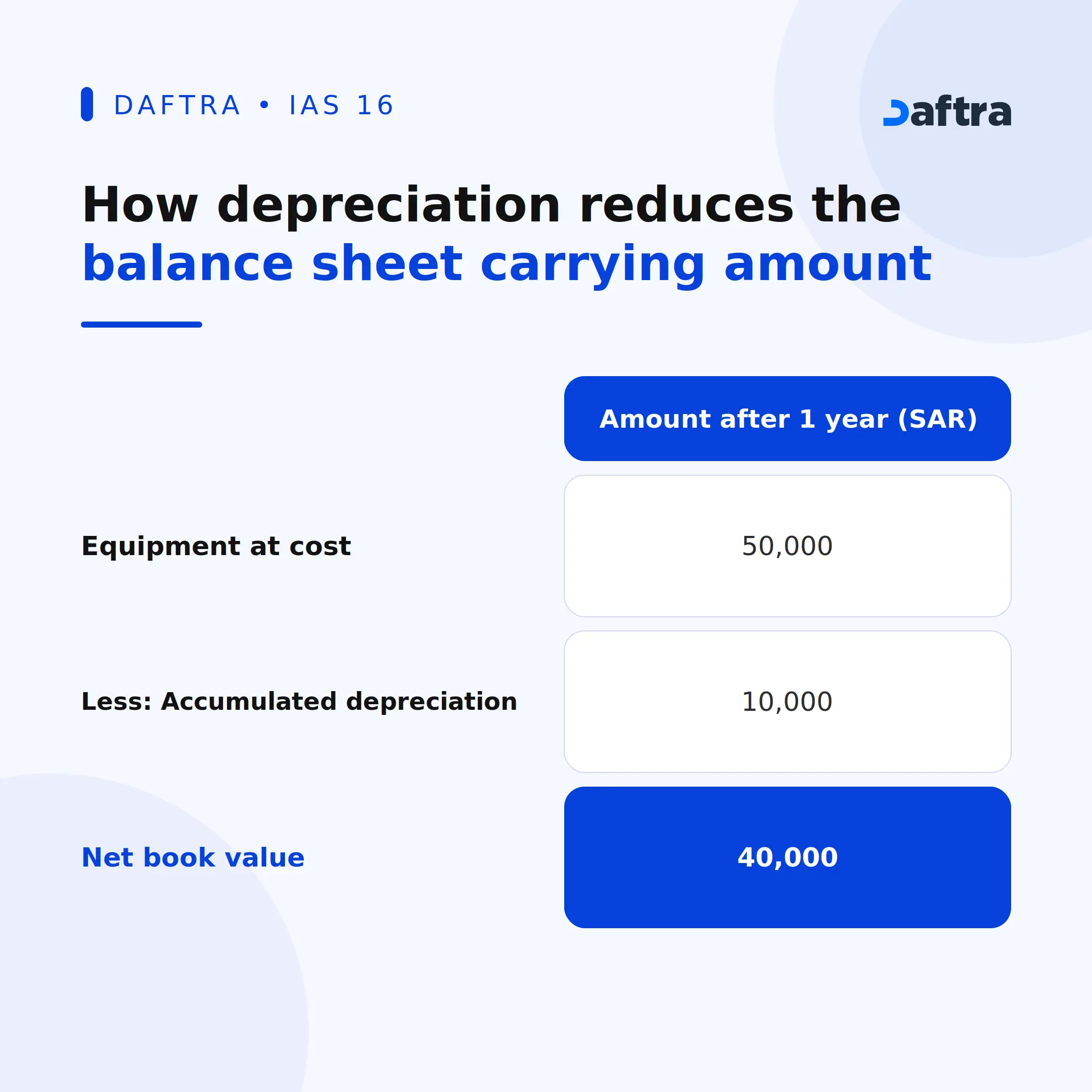
Note: The depreciation expense itself is recognized in the income statement, while accumulated depreciation reduces the asset's carrying amount on the balance sheet.
What assets don't depreciate?
An important distinction for businesses to understand is that not every asset is depreciated; depreciation applies only to assets with a finite useful life whose economic benefits are consumed over that period.
Here are some examples of assets that are not depreciated:
- Land; as it has an indefinite useful life.
- Assets under construction; as depreciation starts when the asset is in use.
- Inventory; as it is accounted for under inventory requirements rather than as depreciable property, plant, and equipment.
Important: Depreciation differs from impairment, as assets that aren't depreciated can still decline in value and may need to be tested for impairment under IAS 36.
What happens if you forgot to record depreciation?
Because depreciation is significant, failing to record it can cause the company's financial statements to overstate asset value and profit because the depreciation expense has not been recognized.
If a company owns equipment that should generate 5,000 SAR in depreciation expense every month but fails to record depreciation for 6 months.
Unrecorded depreciation:
5,000 x 6 = 30,000 SAR
Therefore;
- Depreciation expense → Understated by 30,000 SAR
- Profit → Overstated by 30,000 SAR (before any tax)
- Accumulated depreciation → Understated by 30,000 SAR
- Asset's carrying amount → Overstated by 30,000 SAR
From our experience in the Saudi market, we handled a case where a company failed to record depreciation expense for several months, even though its assets were in use. When the company prepared its financial reports, the omission overstated the asset's carrying value and profits because it did not recognize depreciation expense.
To correct the issue, we reviewed the company's asset records, including when each asset was placed in use, its useful life, and the applicable depreciation method. Then, using Daftra, we organized the depreciation calculations and recorded the appropriate depreciation expenses for the affected periods. By doing so, we ensured asset values, depreciation expenses, and reported profits were presented accurately in the financial statements.
Depreciation in the Saudi Context
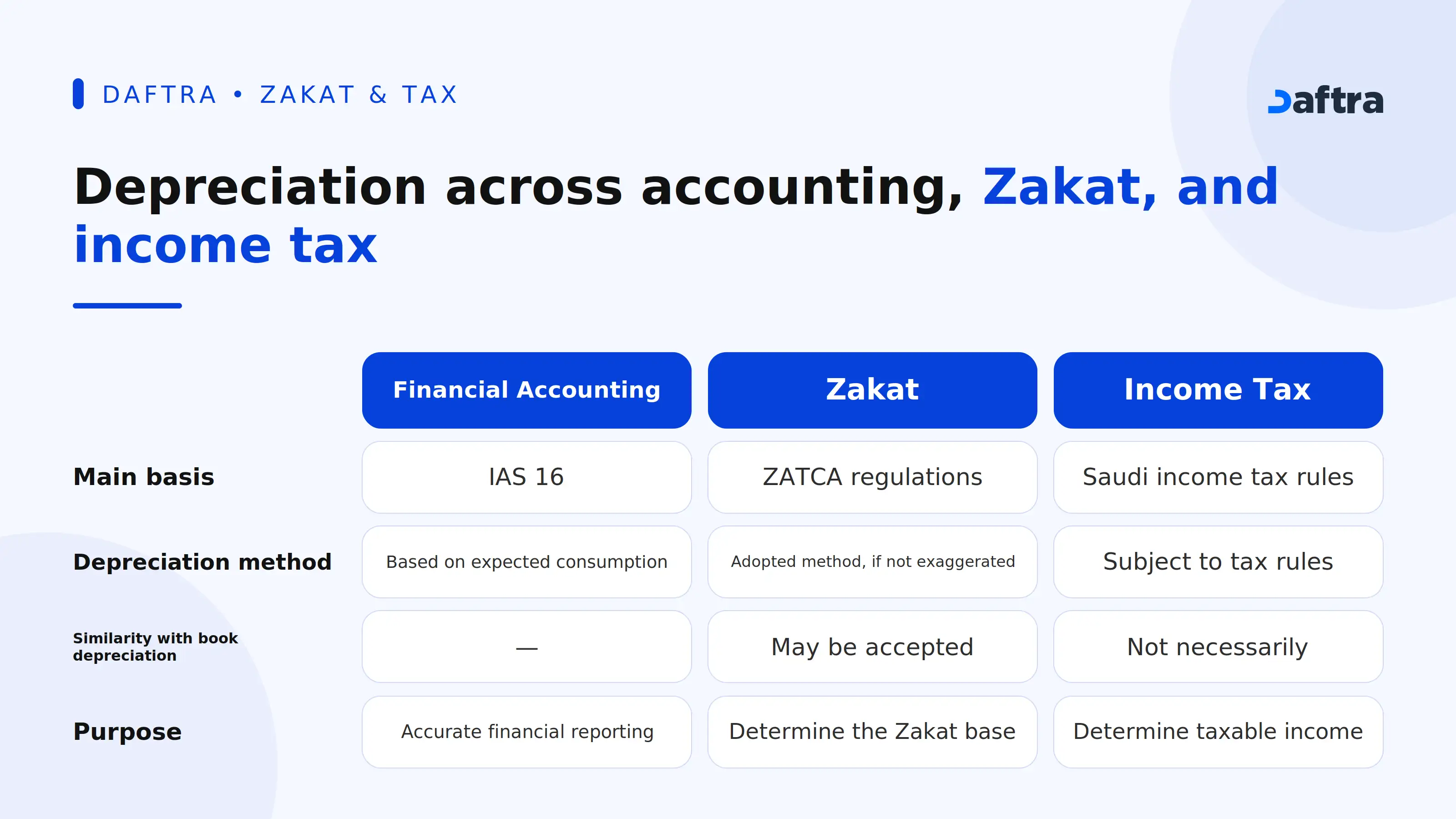
In Saudi Arabia's market, businesses must distinguish between depreciation for financial reporting and for Zakat or tax calculations. For financial reporting, Saudi companies subject to IFRS generally follow its accounting standards, and IAS 16, Property, Plant and Equipment, sets the main requirements for depreciating tangible fixed assets.
IAS 16 also demands that a company select a depreciation method that reflects the pattern in which the asset's future economic benefits are expected to be consumed, including:
- Straight-line: allocates the depreciable amount evenly over the useful life.
- Declining balance: applies the depreciation rate to the asset's declining carrying amount.
- Units of production: based on actual usage or production.
IAS 16
In financial statements, depreciation follows IAS 16 rules; the company determines the following:
- The asset's depreciable amount
- Useful life
- Residual value
- Appropriate depreciation method
Important: IAS 16 does not set a standard depreciation rate for every asset; the method and useful life must reflect the asset's circumstances and expected use.
Zakat
Under ZATCA Zakat regulations, you can deduct the annual depreciation of qualifying fixed assets used in the business, provided the applicable conditions are met.
Important: ZATCA's guidance states that the book depreciation charged to the income statement can be accepted, provided you meet the fixed-asset depreciation requirements, including:
- The asset must be listed in the Zakat payer's financial statements.
- The asset was required for use, not resale.
- The asset is deducted based on its net value as presented in the financial statements.
- The asset is registered in the Zakat payer's name, subject to certain exceptions.
Simply: ZATCA states that the Zakat payer may calculate and recognize depreciation using an appropriate method, provided the depreciation is not overstated.
Income Tax
For income tax, businesses should not assume that the depreciation expense calculated under IAS 16 is the same amount deductible for tax.
The Kingdom's income tax regulations include:
- Asset grouping: in which they are categorized rather than depreciated individually for tax purposes.
- Prescribed rates: each category has a statutory rate.
- Declining-balance calculation: By applying the prescribed rate to the balance of the relevant asset group.
- Additions and disposals: tax treatment specifies how the cost of newly acquired assets and proceeds from disposed assets are incorporated into the calculation of their relevant group.
- Minimum balance rule: A mechanism for dealing with the remaining balance of a group when it falls below a specified amount.
- Special treatment for certain assets: Some have specific rules rather than being treated under the general depreciation provisions.
This means tax depreciation and book depreciation may differ.
What Is the Depreciation Threshold?
Companies can determine a spending threshold for assets above which depreciation begins to be calculated. This threshold is usually set based on the size of the company’s operations and is directly proportional to it. For small businesses, depreciation is often calculated even for low-cost assets.
What Does Depreciating Asset Maintenance Expenses Mean?
It is important to note that maintenance expenses intended to extend an asset’s useful life or increase its productive capacity are added to the asset’s value by the same amount as the maintenance costs.
Such maintenance expenses are included within the depreciation accounts of the asset. In contrast, maintenance expenses are not included in depreciation calculations if they are incurred merely to maintain the asset’s existing productive capacity.
Maintenance expenses are recorded as follows:
Debit: Fixed Assets (under the name of the relevant asset)
Credit: Maintenance Expenses
Frequently Asked Questions
What is the purpose of depreciation?
In addition to applying the matching principle between revenues and expenses, depreciation enables the replacement of assets that are no longer fit for production by spreading the cost of assets over their useful life.
What are the elements of depreciation?
Depreciation has four main elements:
- Asset cost: Includes all costs incurred to acquire the asset, such as purchase price, applicable taxes, shipping costs, and similar expenses.
- Useful life of the asset: The period during which the asset is expected to be productive.
- Depreciation rate: Varies depending on the depreciation method chosen by the company.
- Salvage value: The remaining value of the asset that can be recovered if it is sold after the end of its useful life.
Is depreciation recorded as a debit or a credit?
Depreciation is recorded as a debit because it is recognized as an expense in the company’s accounts.
What are depreciation expenses?
Depreciation expenses refer to the amount of an asset’s depreciation during a specific accounting period and are reported in the financial statements for that period.
Is a trademark depreciated?
Intangible assets are not depreciated; instead, they are subject to amortization, usually on a straight-line basis over their useful life.
Do land assets depreciate?
No, land does not depreciate. Although it is classified as a fixed asset, its value does not decline over time. Depreciation applies to buildings, machinery, equipment, and devices that are subject to wear and tear through use
What is meant by annual depreciation?
Annual depreciation refers to the gradual decrease in an asset’s value over one financial year.
Do buildings depreciate?
Yes, buildings are subject to depreciation due to aging and wear over time.
Does depreciation appear in the income statement?
Yes, depreciation appears as an expense in the income statement and affects net profit or loss for the specific accounting period in which it is calculated.
Does accounting software depreciate?
Yes, accounting software is subject to depreciation (amortization) due to its use. Its cost is allocated over its operational life.
What is accelerated depreciation?
Accelerated depreciation is an accounting treatment through which the value of assets is reduced more quickly during the early years of their useful life.
It is particularly important in supporting the growth and expansion of companies, especially startups and small businesses, by allowing higher tax deductions in the early years.
Why is depreciation added back in the cash flow statement?
Depreciation is added back in the cash flow statement because it is a non-cash expense. Therefore, when preparing the cash flow statement using the indirect method, depreciation is added to show the cash flow generated from operating activities.
What is the difference between depreciation and amortization?
The difference lies in the type of fixed assets involved. Depreciation is used to express the decline in value of tangible assets such as buildings and equipment, while amortization is used to describe the decline in value of intangible assets such as patents, trademarks, and intellectual property rights.
Is depreciation the same as depletion?
Yes, both depreciation and depletion refer to a reduction in asset value. However, depreciation generally reflects a decrease in asset value due to use, while depletion refers to the decline in value due to aging, obsolescence, or lack of use.
Summary
The term depreciation is used to describe an accounting method through which the decline in the value of fixed assets over their productive life is measured. In practice, asset depreciation can be calculated using several methods, such as the units of production method, straight-line method, declining balance method, and others.
Depreciation calculations depend on various elements, including the asset’s cost and its expected productive life. The concept of depreciation is often associated with amortization, which also refers to changes in asset value but applies specifically to intangible assets.











 Invoicing
 POS
POS Offers
 Installments
 Sales Commission
 KSA E-Invoice Software
 EGY E-Invoice Software
 JO E-Invoice Software
 E-Invoice Software
 Chart of Accounts
 Asset Management
 Cost Centers
 Expenses
 Cheque Cycle
 UAE VAT-Tax
 Product Management
 Purchases
 Purchase Cycle
 Suppliers
 Requisitions
 Stocktaking
 Organizational Structure
 Personnel Management
 Attendance and Leave
 Contracts
 Payroll
 Requests
 Work Orders
 Booking Management
 Rental and Unit Management
 Time Tracking
 Work Flow
 Lease Contracts
 Manufacturing Management
  Client Follow-Up
 Loyalty Points
 Points and Credits
 Memberships
 Insurance Management
 Daftra ERP Full App
 Point of Sales App
 Point of Sales for Desktop – Support Offline Mode
 AI Expenses Scanner App
 Employee Attendance, Sign & ESS App
 E-invoice Reader App
 Inventory Stocktaking App