




Table of contents:
- Key Summary
- What Is a Journal Entry in Brief?
- Before Solving the Exercises… How Do You Determine the Debit and Credit Accounts?
- Exercise 1 Recording Opening Capital
- Exercise 2 Purchasing Inventory for Cash and on Credit
- Exercise 3 Selling Inventory for Cash and on Credit
- Exercise 4 Recording Daily Expenses
- Exercise 5 Purchasing a Fixed Asset
- Exercise 6 Sales Returns, Purchase Returns, and Discounts
- Exercise 7 Owner's Drawings and Employee Advances
- Exercise 8 Multiple Transactions on the Same Day
- Common Journal Entry Mistakes
- How to Record Journal Entries Using Accounting Software
- Conclusion
Journal entries are a fundamental part of a company’s accounting system because they record transactions and form the basis for financial statements and accounting reports. They record the company’s business and financial transactions and can then be used to prepare the income statement, balance sheet, and statement of cash flows. Accurate journal entries are essential to proper accounting and support financial transparency and compliance with applicable accounting and legal requirements.
One of the best ways to understand journal entries is to practice recording different types of business transactions and apply the underlying accounting principles to practical scenarios. In this article, we provide a simplified overview of journal entry fundamentals, along with step-by-step examples to make the concepts easier to understand and apply.
To reinforce your understanding of journal entries, work through exercises covering various types of business transactions and apply the concepts in practice. Below, we explain the fundamentals of journal entries and walk through practical examples step by step.
What Is a Journal Entry in Brief?
Journal entries are a fundamental part of the accounting system, used to record a company’s financial transactions under the double-entry accounting system with corresponding debit and credit entries. The appropriate debit or credit depends on the account type and the nature of the transaction. For a journal entry to be balanced, the total debit amount must equal the total credit amount. This is called the journal entry balance.
Before Solving the Exercises… How Do You Determine the Debit and Credit Accounts?
As a general rule, you cannot determine debits and credits solely by whether an asset increases or decreases. Instead, the appropriate treatment depends on the account type and how the transaction affects the accounting equation. For example, an increase in an asset is recorded as a debit, while a decrease is recorded as a credit. Conversely, increases in liabilities, equity, and revenue are generally recorded as credits, while increases in expenses are generally recorded as debits.
The debit side appears on the left of a journal entry, while the credit side appears on the right. To ensure the journal entry is balanced, total debits must equal total credits.
Simple example: A company purchases office supplies for SAR 200 in cash:
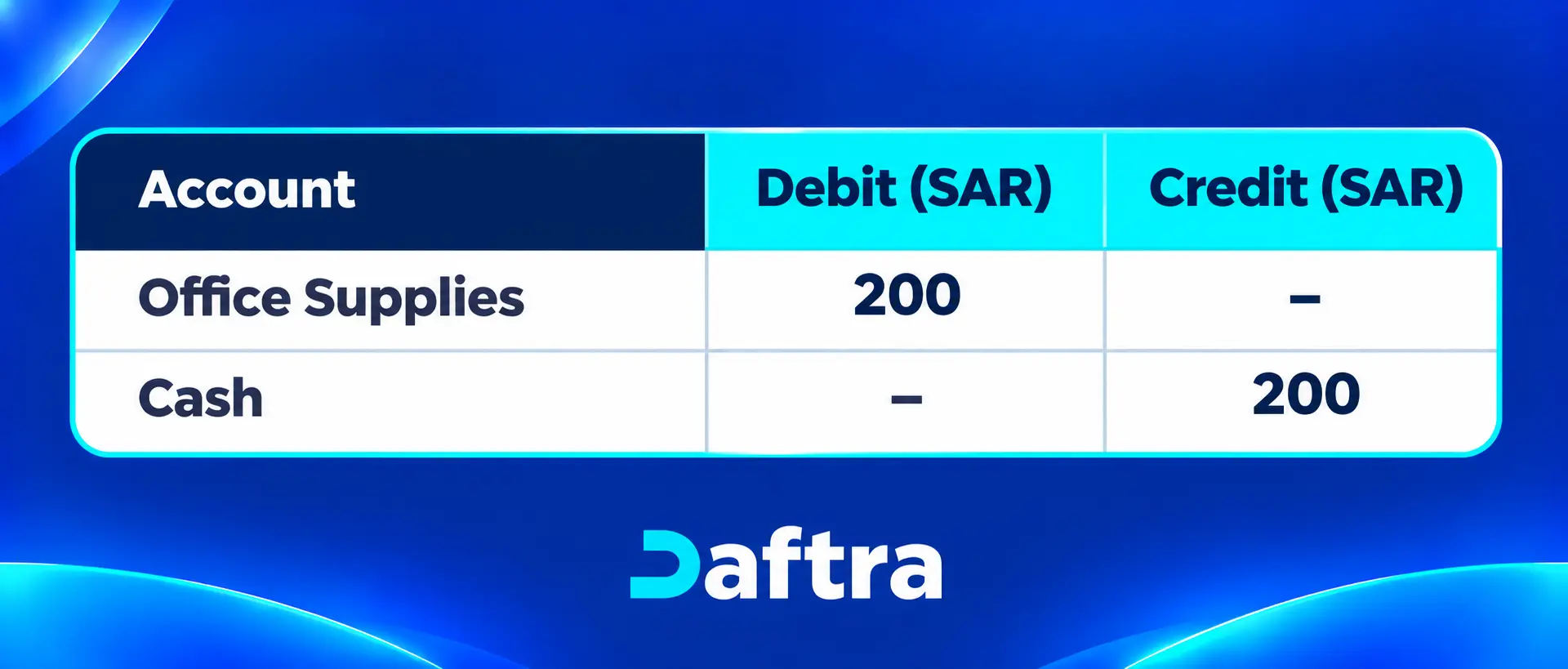
Here, the total debits and credits are both SAR 200, so the journal entry is balanced. Debit Office Supplies because the transaction increases the supplies asset, and credit Cash because the company’s cash balance decreases.
Exercise 1: Recording Opening Capital
Record an opening capital entry when a business is established or at the beginning of an accounting period to record the company's assets in the journal, such as equipment, cash, and buildings. Record these assets as debits, and record Capital as a credit.
Example:
A travel company was established with SAR 20,000 in cash and SAR 10,000 in inventory.
Journal Entry:
Exercise 2: Purchasing Inventory for Cash and on Credit
Purchasing inventory for cash is a straightforward transaction: cash decreases (credit), and inventory increases (debit).
Example:
A company purchased inventory for SAR 5,000 in cash.
Journal Entry:
Purchasing on credit differs from a cash purchase because the inventory increases (debit), while a liability to the supplier is recognized (credit). The entry is recorded as follows:
Example:
A manufacturing company purchased equipment on credit for SAR 6,000.
Journal Entry:
Exercise 3: Selling Inventory for Cash and on Credit
When inventory is sold for cash, the company debits Cash because cash increases, and credits Sales Revenue because the transaction generates revenue.
Example:
Inventory was sold for SAR 2,000 in cash.
Journal Entry:
For a credit sale, debit the customer account because the amount is receivable, and credit Sales Revenue because the transaction generates revenue.
Example:
Inventory was sold on credit for SAR 3,000.
Journal Entry:
If the customer pays part of the outstanding balance, debit Cash and credit Accounts Receivable.
Example:
The customer paid SAR 1,000 toward the outstanding balance of SAR 3,000.
Journal Entry:
The remaining outstanding balance is SAR 2,000, which continues to be recorded under Accounts Receivable as an amount owed by the customer.
Exercise 4: Recording Daily Expenses
Daily expense entries cover routine business transactions, such as paying rent, electricity bills, and advertising expenses.
Example:
A company paid an electricity bill of SAR 800 in cash.
Example: Employee Salaries
A company paid employee salaries totaling SAR 20,000.
Journal Entry:
Exercise 5: Purchasing a Fixed Asset
A fixed asset is recorded differently from an ordinary expense because it is used over an extended period and recognized as a business asset. When a company purchases a fixed asset, its assets increase (debit), while cash or the relevant liability account is credited, depending on how it is financed.
Example:
A company purchased a computer for SAR 3,000 in cash.
Journal Entry:
A fixed asset purchased on credit can be recorded as follows:
Example:
A company purchased equipment for SAR 5,000 on credit.
Journal Entry:
Take care when recording fixed assets because they are recognized as company assets rather than treated simply as expenses.
Exercise 6: Sales Returns, Purchase Returns, and Discounts
Sales Returns
When a customer returns purchased goods, debit Sales Returns and credit the customer’s account to reduce the amount receivable.
Example:
A company sold goods to a customer for SAR 6,000, and the customer later returned goods worth SAR 2,000.
Journal Entry:
Purchase Returns
Purchase returns are recorded when a company returns goods to its supplier, reducing the purchase amount and the outstanding amount payable to the supplier.
Example:
A company purchased equipment worth SAR 5,000 and subsequently returned part of it, valued at SAR 1,000.
Journal Entry:
Discounts
1. Discounts Allowed
A discount allowed is a discount a seller grants a customer. It reduces the amount collected from the customer and is recorded as a debit, while the customer's outstanding balance is credited to clear the receivable.
Example:
A customer owes the company SAR 3,000, pays SAR 2,500, and receives a SAR 500 discount.
Journal Entry:
2. Discounts Received
A discount received is a discount a supplier grants a company. It reduces the amount the company needs to pay to settle its outstanding payable.
Example:
A company owes a supplier SAR 4,000, pays SAR 3,000, and receives a SAR 1,000 discount.
Journal Entry:
Exercise 7: Owner's Drawings and Employee Advances
Owner's Drawings
Amounts withdrawn by the owner for personal use are recorded in the Owner's Drawings account. They are not business expenses and reduce the owner's equity when accounted for in the owner's equity section.
Example:
The business owner withdrew SAR 4,000 in cash for personal use.
Journal Entry:
Employee Advances
Employee advances are amounts paid to employees before they are due, which are recorded as an asset until they are recovered or settled.
Example:
An employee received a cash advance of SAR 1,000 from the company.
Journal Entry:
Exercise 8: Multiple Transactions on the Same Day
A company carried out the following transactions on the same day:
- Purchased inventory for SAR 4,000 in cash.
- Paid rent of SAR 1,000 in cash.
- Sold goods for SAR 5,000 in cash.
- Paid miscellaneous expenses of SAR 500 in cash.
- Purchased a computer for SAR 1,500 in cash.
Journal Entries:
Common Journal Entry Mistakes
Journal entries must be prepared and calculated accurately because they directly affect a company's balance sheet and financial statements and play an important role in maintaining financial transparency. Below are some common journal entry mistakes.

1. Failing to Record Transactions
Ensure that all business and financial transactions are recorded in the journal and reviewed regularly.
2. Numerical Errors
Amounts entered in journal entries must be checked carefully to ensure that financial transactions are recorded accurately.
3. Confusing Debits and Credits
To prepare an accurate accounting entry, it is essential to ensure that debit and credit amounts are assigned to the correct sides of the entry.
4. Confusing Prepaid Expenses with Accrued Expenses
It is important to distinguish between prepaid expenses, which are paid in advance and recorded as assets until the related benefits are consumed, and accrued expenses, which have been incurred but not yet paid and are generally recorded as liabilities.
5. Confusing Owner's Drawings with Business Expenses
Confusing these two categories can lead to errors in journal entries and the classification of cash outflows. Owner's drawings are amounts withdrawn for the owner's personal use and reduce owner's equity, whereas business expenses are incurred to operate the company and generate revenue, reducing net income.
6. Posting Transactions to the Wrong Accounts
Another common mistake is recording business or financial transactions in accounts that do not reflect the nature of the transaction.
How to Record Journal Entries Using Accounting Software
Preparing journal entries accurately can be challenging, particularly when there is a risk of human error when entering amounts or classifying accounts. Cloud-based accounting software, such as Daftra, can help simplify the process and improve the accuracy and consistency of journal entries.
Daftra's accounting software can automatically generate journal entries from financial transactions recorded in the system. It also allows users to add entries when needed and post them to the general ledger for use in preparing financial statements and reports.
Conclusion
Journal entries provide a systematic record of a company's daily business and financial transactions. They help track the company's financial position and support the preparation of financial statements and reports. Although the fundamental principle of double-entry accounting is straightforward—total debits must equal total credits—accurate journal entries are essential to maintain reliable financial records and present a clear picture of the company's financial position.












 Invoicing
 POS
 Offers
 Installments
 Sales Commission
 KSA E-Invoice Software
 EGY E-Invoice Software
 JO E-Invoice Software
 E-Invoice Software
 Chart of Accounts
 Asset Management
 Cost Centers
 Expenses
 Cheque Cycle
 UAE VAT-Tax
 Product Management
 Purchases
 Purchase Cycle
 Suppliers
 Requisitions
 Stocktaking
 Organizational Structure
 Personnel Management
 Attendance and Leave
 Contracts
 Payroll
 Requests
 Work Orders
 Booking Management
 Rental and Unit Management
 Time Tracking
 Work Flow
 Lease Contracts
 Manufacturing Management
 Client Follow-Up
 Loyalty Points
 Points and Credits
 Memberships
 Insurance Management
 Daftra ERP Full App
 Point of Sales App
 Point of Sales for Desktop – Support Offline Mode
 AI Expenses Scanner App
 Employee Attendance, Sign & ESS App
 E-invoice Reader App
 Inventory Stocktaking App