


IFRS 18: A Guide to the New Financial Reporting Standard



Table of contents:
- Key Takeaways
- What Is IFRS 18?
- What Is the Difference Between IFRS 18 and IAS 1?
- What Are the Key Changes Introduced by IFRS 18?
- What Does IFRS 18 Not Change?
- When Does IFRS 18 Become Effective, and Is It Mandatory?
- Who Will Be Most Affected by IFRS 18?
- What Does IFRS 18 Mean in Practice for Finance and Accounting Teams?
- How Does IFRS 18 Affect Companies in Saudi Arabia and Egypt?
- How Can Daftra Help You Prepare for IFRS 18?
- Frequently Asked Questions
- Conclusion
The International Accounting Standards Board (IASB) issued IFRS 18, Presentation and Disclosure in Financial Statements, introducing significant changes to how companies present and disclose financial information. The new standard replaces IAS 1, Presentation of Financial Statements, and aims to improve transparency and comparability in financial reporting.
IFRS 18 introduces a more structured approach to classifying income and expenses in the statement of profit or loss, including defined categories for operating, investing, and financing activities, as well as income taxes and discontinued operations. It also introduces a required definition of operating profit, establishes a new subtotal for profit before financing and income taxes, and strengthens disclosure requirements for management-defined performance measures (MPMs).
Unlike IAS 1, which allowed greater flexibility in presenting financial performance and did not prescribe a universal definition of operating profit, IFRS 18 introduces more consistent presentation requirements. These changes are intended to make it easier for investors and other users of financial statements to compare companies' financial performance.
What Is IFRS 18?
The International Accounting Standards Board (IASB) issued a new international financial reporting standard in April 2024, titled Presentation and Disclosure in Financial Statements (IFRS 18). The new standard aims to improve how companies present information in financial statements, making it more transparent and informative. It replaces IAS 1, Presentation of Financial Statements.
IFRS 18 differs from its predecessor in its presentation and disclosure requirements. It requires companies to provide clearer and more consistent information in their financial statements, improving comparability across companies. The IASB introduced standardized financial statement presentation and disclosure requirements that apply across industries, helping users compare financial performance more consistently.
What Is the Difference Between IFRS 18 and IAS 1?
IAS 1 gave companies more flexibility in presenting financial information, which could lead to differences in how companies reported financial performance and make comparisons harder. IFRS 18 introduces more structured presentation and disclosure requirements to improve consistency and comparability across financial statements. The key differences between the two standards are summarized below:
| Area of change | IAS 1 | IFRS 18 | Impact |
| Statement of profit or loss structure | Greater flexibility in presentation | Required classification into defined categories | Improved comparability across companies |
| Subtotals | No universally prescribed operating profit subtotal | Requires operating profit and profit before financing and income taxes | Clearer presentation of financial performance |
| Operating profit | No standardized definition or required subtotal | Defined through the standard's classification requirements | Greater consistency in reporting operating performance |
| Interest and other income and expenses | Less standardized classification | Classified according to the prescribed categories, subject to specific requirements | Greater consistency in presentation |
| Performance measures | No specific disclosure framework for management-defined performance measures | Requires disclosures about management-defined performance measures (MPMs) that meet the standard's criteria | Greater transparency |
| Aggregation and disaggregation | General presentation principles | More specific requirements for grouping and separating information | Easier interpretation of financial statements |
| Relationship with the notes | Existing disclosure requirements | Enhanced requirements linking financial statement information and explanatory notes | Better-connected financial information |
| Flexibility | Greater flexibility in presentation | More structured presentation requirements | Improved consistency |
IFRS 18 establishes a more structured framework for presenting financial information, improving transparency and enabling more meaningful comparisons between companies.
You may also be interested in: What Are Accounting Reports and Their Types?
What Are the Key Changes Introduced by IFRS 18?
IFRS 18 introduces significant changes to financial statement presentation, including new requirements for classifying income and expenses, presenting subtotals, and disclosing information. These changes aim to improve transparency and comparability across companies.
The standard establishes a more consistent approach to financial statement presentation and disclosure and addresses differences in reporting practices under IAS 1.
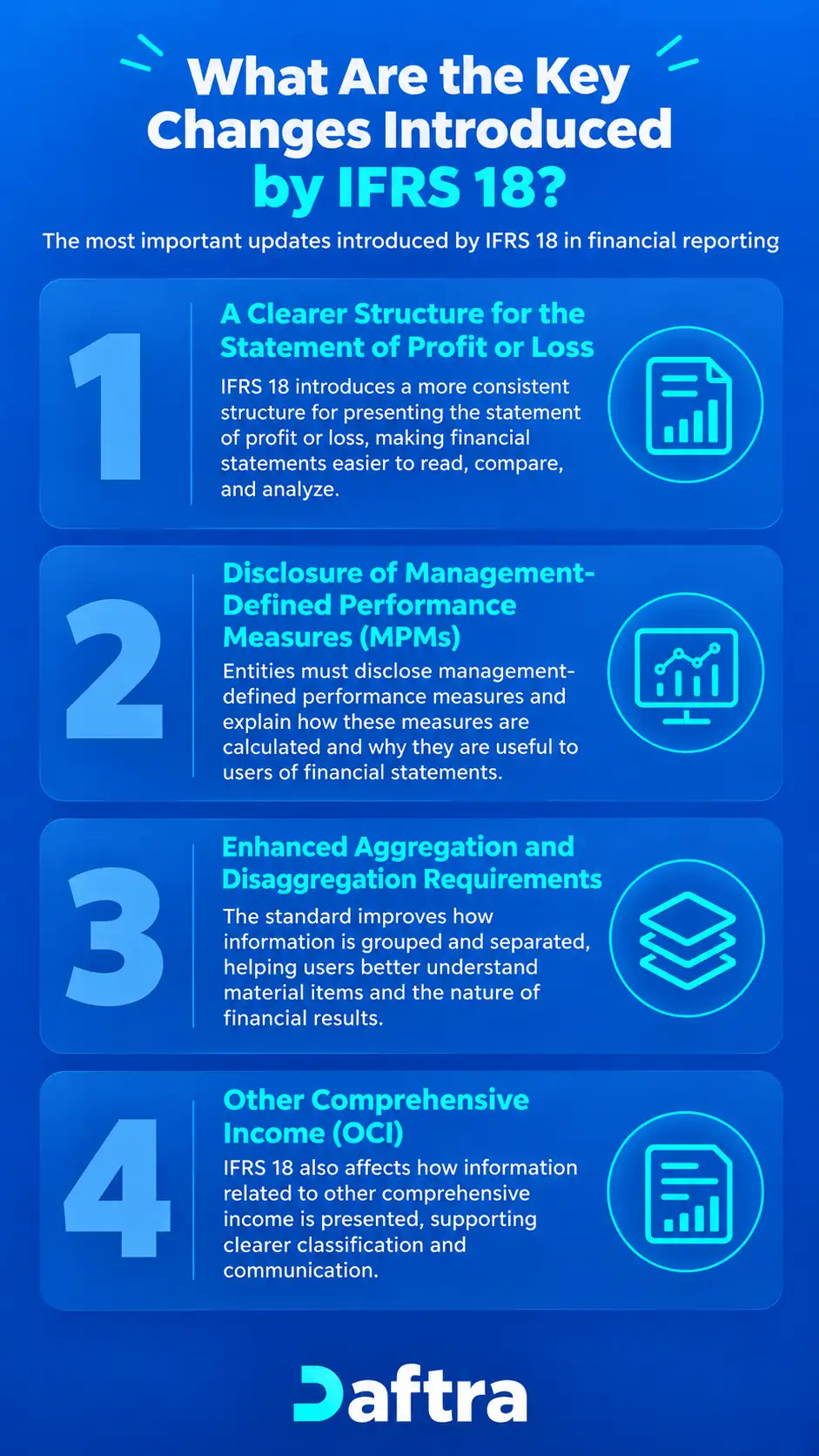
1. A Clearer Structure for the Statement of Profit or Loss
IFRS 18 requires entities to present a more structured statement of profit or loss, classifying income and expenses into five categories:
- Operating
- Investing
- Financing
- Income taxes
- Discontinued operations
The standard also requires specific subtotals, including operating profit or loss and profit or loss before financing and income taxes. These requirements reduce presentation differences and make it easier to assess and compare companies' financial performance.
2. Disclosure of Management-Defined Performance Measures (MPMs)
IFRS 18 introduces specific requirements for management-defined performance measures (MPMs). Entities must disclose qualifying measures, explain how they are calculated, and reconcile them to the most directly comparable subtotals specified by IFRS Accounting Standards. These disclosures help users understand how management communicates the company's financial performance and how its measures relate to reported figures.
3. Enhanced Aggregation and Disaggregation Requirements
A key feature of IFRS 18 is its more detailed requirements for how entities group and separate information in financial statements. The standard retains appropriate flexibility while requiring companies to provide relevant information without obscuring material details.
It also strengthens the relationship between the primary financial statements and the accompanying notes. Items must be aggregated or disaggregated based on their characteristics and users' information needs, making financial statements clearer and more useful.
4. Other Comprehensive Income (OCI)
Financial statements distinguish between profit or loss and other comprehensive income (OCI). OCI includes income and expense items that other IFRS Accounting Standards require or permit to be recognized outside profit or loss.
Profit or loss contributes to total comprehensive income, while OCI items are presented separately and included in total comprehensive income. This distinction helps users understand the different components of an entity's overall financial performance.
You may also be interested in: Financial Accounting Principles With Solved Exercises
What Does IFRS 18 Not Change?
Although IFRS 18 significantly changes financial statement presentation and disclosure, many existing accounting requirements remain unchanged. The International Accounting Standards Board (IASB) has retained the distinction between presentation and disclosure requirements and the recognition and measurement requirements governed by other applicable IFRS Accounting Standards.
1. Recognition
IFRS 18 does not generally change the existing requirements for recognizing revenue, expenses, and assets. Recognition continues to be governed by the relevant IFRS Accounting Standards.
2. Measurement
IFRS 18 does not establish a new general measurement basis for financial statement items. Existing measurement requirements, including historical cost and fair value, remain governed by the applicable standards.
3. Conceptual Framework Principles
Fundamental concepts such as materiality, prudence, and faithful representation remain relevant to financial reporting. IFRS 18 does not replace these underlying concepts.
4. Accounting Treatment
IFRS 18 primarily changes how financial information is presented and disclosed, not how transactions are recognized and measured. However, it also introduces consequential amendments to other standards, so it's inaccurate to say presentation is the only area affected.
You may also be interested in: Accounting Policies: Definition and Benefits
When Does IFRS 18 Become Effective, and Is It Mandatory?
The IASB issued IFRS 18, Presentation and Disclosure in Financial Statements, to replace IAS 1, Presentation of Financial Statements. The new standard aims to address inconsistencies in financial statement presentation while retaining many existing requirements.
IFRS 18 is effective for annual reporting periods beginning on or after January 1, 2027. Earlier application is permitted, provided that the entity discloses that fact in its financial statements. For entities reporting in accordance with IFRS Accounting Standards, application is required from the effective date, subject to the applicable adoption and endorsement requirements in their jurisdiction.
Who Will Be Most Affected by IFRS 18?
IFRS 18 applies to entities preparing financial statements in accordance with IFRS Accounting Standards, subject to the applicable requirements in their jurisdiction. Its impact will vary depending on an entity's activities, existing reporting practices, and the performance measures it communicates to users.
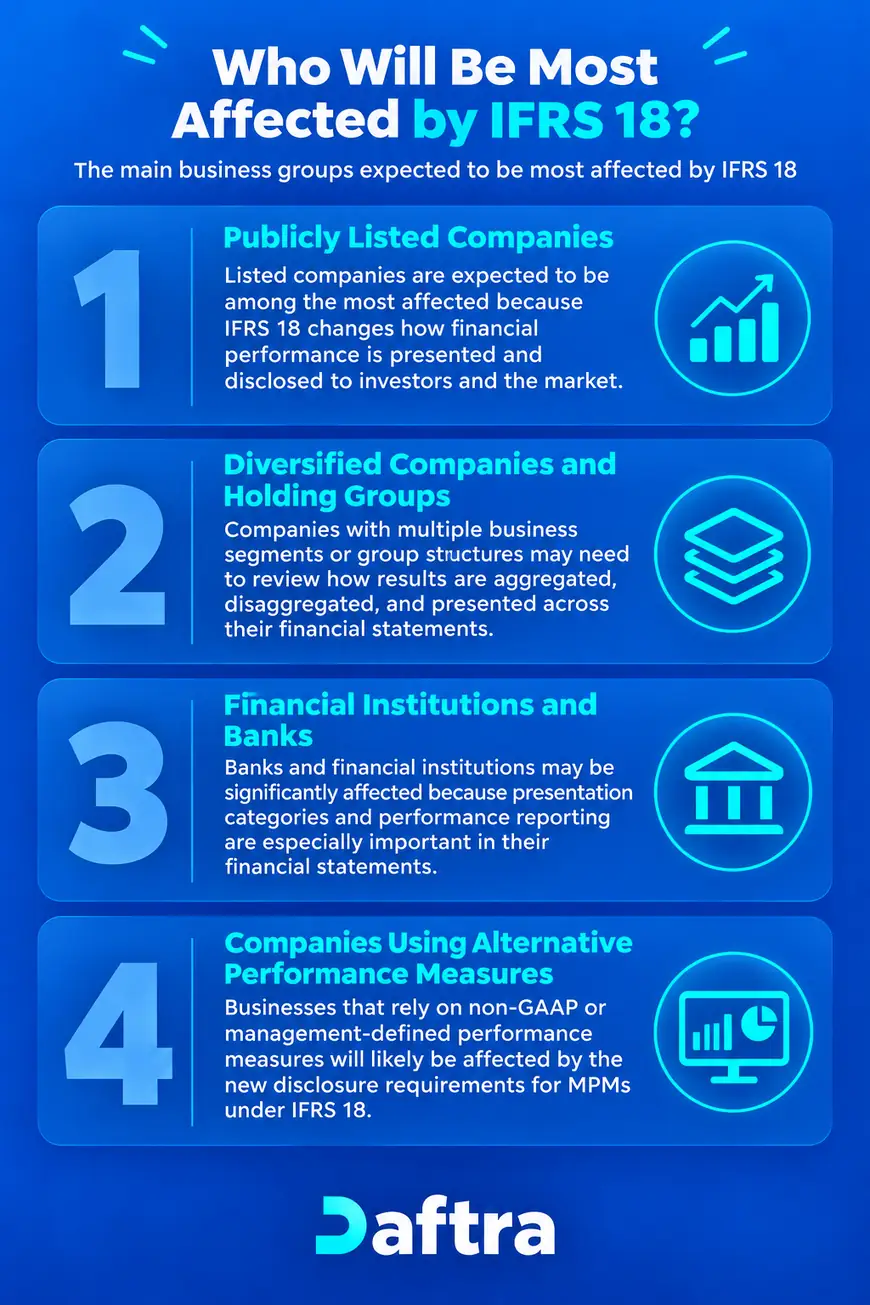
1. Publicly Listed Companies
Listed companies may be particularly affected because investors rely on comparable financial performance information. Where a company uses management-defined performance measures (MPMs) that meet IFRS 18's criteria, it must provide the required disclosures and reconciliations.
2. Diversified Companies and Holding Groups
Companies operating across multiple business activities may need to reassess how they classify income and expenses under the new categories, including operating, investing, and financing. These changes may affect reported operating profit and comparisons with other companies.
3. Financial Institutions and Banks
Banks and other financial institutions may need to review how they present income and expenses and the subtotals they report. The impact will depend on their specific activities and the classification requirements applicable under IFRS 18.
4. Companies Using Alternative Performance Measures
Companies that communicate alternative or management-defined performance measures may need to revise their disclosures. IFRS 18 establishes requirements for qualifying MPMs, including explanations of how they are calculated and reconciliations to specified IFRS subtotals.
What Does IFRS 18 Mean in Practice for Finance and Accounting Teams?
IFRS 18 significantly impacts finance and accounting teams, particularly in financial reporting and presentation. The key areas affected include:
1. Financial Reporting Design
Compliance with IFRS 18 requires companies to review and potentially restructure their profit or loss statements to reflect the standard’s required categories and subtotals.
2. Reduced Flexibility in Presentation
IFRS 18 introduces specific required subtotals, reducing flexibility in how companies present certain aspects of financial performance.
3. Changes to Expense Classification
Companies must classify income and expenses in the statement of profit or loss according to the categories and requirements specified by IFRS 18. The standard also includes requirements concerning the disclosure and presentation of operating expenses by nature, function, or both, as applicable.
4. Defined Operating Profit
IFRS 18 requires companies to present operating profit or loss as a defined subtotal in the statement of profit or loss.
5. Greater Scrutiny
The new requirements may increase the work required to review financial reporting processes and ensure compliance with the new presentation and disclosure requirements.
How Does IFRS 18 Affect Companies in Saudi Arabia and Egypt?
The application of IFRS Accounting Standards varies by jurisdiction. In particular, countries may adopt IFRS Accounting Standards directly or apply local accounting standards that are based on, or converged with, IFRS.
IFRS 18 in Egypt
Egyptian companies generally apply Egyptian Accounting Standards (EAS), which are based on IFRS but may differ and include modifications to reflect Egyptian legislation and regulatory requirements.
Therefore, IFRS 18 will not automatically become mandatory for Egyptian companies simply because the IASB has issued the standard. Its applicability in Egypt depends on the competent authorities' adoption or incorporation of it into the applicable Egyptian Accounting Standards.
IFRS 18 in Saudi Arabia
Saudi Arabia requires certain entities to apply IFRS Accounting Standards as endorsed for use in the Kingdom by the Saudi Organization for Chartered and Professional Accountants (SOCPA).
IFRS 18 is effective for annual reporting periods beginning on or after January 1, 2027. Early application is permitted, subject to the applicable regulatory requirements and disclosures.
How Can Daftra Help You Prepare for IFRS 18?
With the introduction of IFRS 18 and its updated presentation and disclosure requirements, companies may need to review their accounting and financial reporting processes to support compliance.
Cloud-based accounting systems such as Daftra can help businesses organize accounting records and generate financial reports. Daftra’s accounting software includes a chart of accounts, journal entries, and accounting reports that support financial reporting workflows.
However, compliance with IFRS 18 depends on the company’s accounting policies, reporting processes, and the specific requirements applicable to its jurisdiction. The accounting system itself does not determine whether a company is compliant with IFRS 18.
Frequently Asked Questions
When Does IFRS 18 Become Effective?
IFRS 18 is effective for annual reporting periods beginning on or after January 1, 2027. Early application is permitted, provided that the entity discloses this fact in its financial statements.
What Are Management-Defined Performance Measures (MPMs)?
Management-defined performance measures (MPMs) are measures of financial performance that are communicated in public communications outside the financial statements and are used to communicate management’s view of an aspect of the financial performance of the entity as a whole to users of financial statements. IFRS 18 establishes specific disclosure requirements for MPMs that meet its definition.
Has IFRS 18 Been Adopted in Saudi Arabia?
Yes. Saudi Arabia has adopted IFRS 18 for application, and it is effective for annual reporting periods beginning on or after January 1, 2027. Early application is permitted, subject to the applicable requirements.
Is IFRS 18 Mandatory?
IFRS 18 is mandatory for entities that are required to prepare financial statements in accordance with IFRS Accounting Standards, subject to the applicable requirements and adoption framework in their jurisdiction.
Does IFRS 18 Change Recognition and Measurement?
IFRS 18 primarily changes how information is presented and disclosed in the financial statements. It does not generally change the recognition and measurement requirements established by other IFRS Accounting Standards.
Conclusion
IFRS 18 introduces a more structured approach to financial statement presentation and disclosure to improve transparency and comparability across companies. It changes how certain financial information is classified, presented, and disclosed rather than fundamentally changing how transactions are recognized and measured. The standard becomes effective for annual reporting periods beginning on or after January 1, 2027, with early application permitted.
IFRS 18 introduces consistent presentation and disclosure requirements across entities applying IFRS Accounting Standards, including requirements for operating profit or loss, defined subtotals, management-defined performance measures, and the aggregation and disaggregation of information. These changes are intended to improve the usefulness and comparability of financial statements.
Daftra supports preparing financial statements, accounting records, journal entries, and financial reports. Businesses should configure their accounting processes and reporting practices according to the IFRS requirements applicable to their specific circumstances.












 Invoicing
 POS
 Offers
 Installments
 Sales Commission
 KSA E-Invoice Software
 EGY E-Invoice Software
 JO E-Invoice Software
 E-Invoice Software
 Chart of Accounts
 Asset Management
 Cost Centers
 Expenses
 Cheque Cycle
 UAE VAT-Tax
 Product Management
 Purchases
 Purchase Cycle
 Suppliers
 Requisitions
 Stocktaking
 Organizational Structure
 Personnel Management
 Attendance and Leave
 Contracts
 Payroll
 Requests
 Work Orders
 Booking Management
 Rental and Unit Management
 Time Tracking
 Work Flow
 Lease Contracts
 Manufacturing Management
 Client Follow-Up
 Loyalty Points
 Points and Credits
 Memberships
 Insurance Management
 Daftra ERP Full App
 Point of Sales App
 Point of Sales for Desktop – Support Offline Mode
 AI Expenses Scanner App
 Employee Attendance, Sign & ESS App
 E-invoice Reader App
 Inventory Stocktaking App