


Dubai Mainland Company Setup: A Complete Guide

Table of contents:
- Key Summary
- What Is a Mainland Company in Dubai?
- Types of Legal Structures for Dubai Mainland Companies
- Step-by-Step Process for Dubai Mainland Company Setup
- Cost Structure of Dubai Mainland Company Setup
- Timeline for Mainland Company Formation in Dubai
- Tax & Compliance Requirements for Dubai Mainland Companies
- Can Mainland Companies Operate Across the UAE?
- Common Mistakes in Dubai Mainland Company Setup
- FAQs About Dubai Mainland Company Setup
- Final Checklist – Before Setting Up a Mainland Company in Dubai
Do you want to maximize your business exposure in all the UAE's local markets?
Setting up a mainland company in Dubai will make this happen; it simply means registering your business with the Dubai Department of Economy and Tourism (DET) so you can legally operate across the UAE market without restrictions.
Unlike free zone businesses, mainland companies are not limited to specific jurisdictions. They can trade directly with customers anywhere in the UAE and open a physical office in any location across Dubai.
Why choose the Dubai mainland company setup?
- 100% foreign ownership in most activities.
- Access to the entire UAE market without needing a local distributor.
- Work with government entities and public sector projects.
- You can get more residence visas by simply upgrading your office.
What Is a Mainland Company in Dubai?
A mainland company in Dubai is a business licensed by the DET. It allows you to operate across the UAE to deal directly with the local market and build a stronger business presence in the UAE.
Company setup in the Dubai mainland offers many advantages for investors who want to sell locally, open a physical branch, and work on government projects. So it gives your business more commercial flexibility in operating locally, unlike free zone companies that are limited to the specific free zone.
Quick comparison between the mainland and the free zone:
- Market access: Mainland companies can trade across the UAE, while free zone companies usually operate within the free zone or internationally.
- Ownership: Both mainland and free zone companies allow 100% foreign ownership in most activities.
- Business activities: The Mainland offers more flexibility to serve the local market, while free zones are more structured around specific sectors for each free zone.
- Office setup: Mainland companies need a physical office, while many free zones can have other options, such as flexi-desks and virtual offices.
- Government work: Mainland companies can participate in government projects, while only eligible free zone companies can participate through a free zone mainland operating permit.
- Best for: Mainland is often a better fit for retail and logistics businesses that are targeting the UAE market, while free zones suit consulting and trading businesses.
Types of Legal Structures for Dubai Mainland Companies
Choosing the right legal structure is one of the most important steps in Dubai mainland company setup. Each structure suits a different type of business activity and ownership structure, because now investors are to have 100% ownership in most activities, so understanding these options will help you choose what fits your business.
| Legal Structure | Description | Key Advantages |
| Sole Establishment | A business owned and managed by one person. | Full control, simple setup, and lower cost. |
| Limited Liability Company (LLC) | A company with two or more owners. Each owner is only responsible for their share. | It protects personal assets, it’s very flexible, and it’s the most common choice. |
| Limited liability one-person company (OPC) | Allows solo entrepreneurs to establish a limited liability company, and the legal entity is separate from the owner. | Full ownership, limited liability protection, and the ability to hire employees. |
| Civil Company | A partnership between professionals, such as doctors and engineers, who offer services together. | It allows shared ownership, and it’s ideal for service businesses. |
| Holding Company | It doesn’t operate directly but manages other companies. | Managing multiple businesses. |
| Public Joint Stock Company (PJSC) | A large company that can sell its shares to the public and raise money from investors. | Raising big capital and it’s suitable for large companies. |
| Private Joint Stock Company (PrJSC) | Similar to PJSC, but the shares are owned privately and not offered to the public. | Gives more control and still allows multiple investors. |
| General Partnership | A business owned by two or more partners who all share the responsibilities and decisions | Easy to set up and allows shared management |
| Limited Partnership | Some partners run the business, but the others just invest money | Investors have lower risk, and it’s a flexible structure |
| Branch of a Free Zone Company | An extension of an existing free zone company that wants to operate in mainland Dubai. | Expand to the UAE market without starting a new company. |
| Branch of a Foreign Company | It allows registration of a foreign company in Dubai by setting up a company branch to operate in Dubai under the same name. | Enter the Dubai market using the same brand name. |
Step-by-Step Process for Dubai Mainland Company Setup
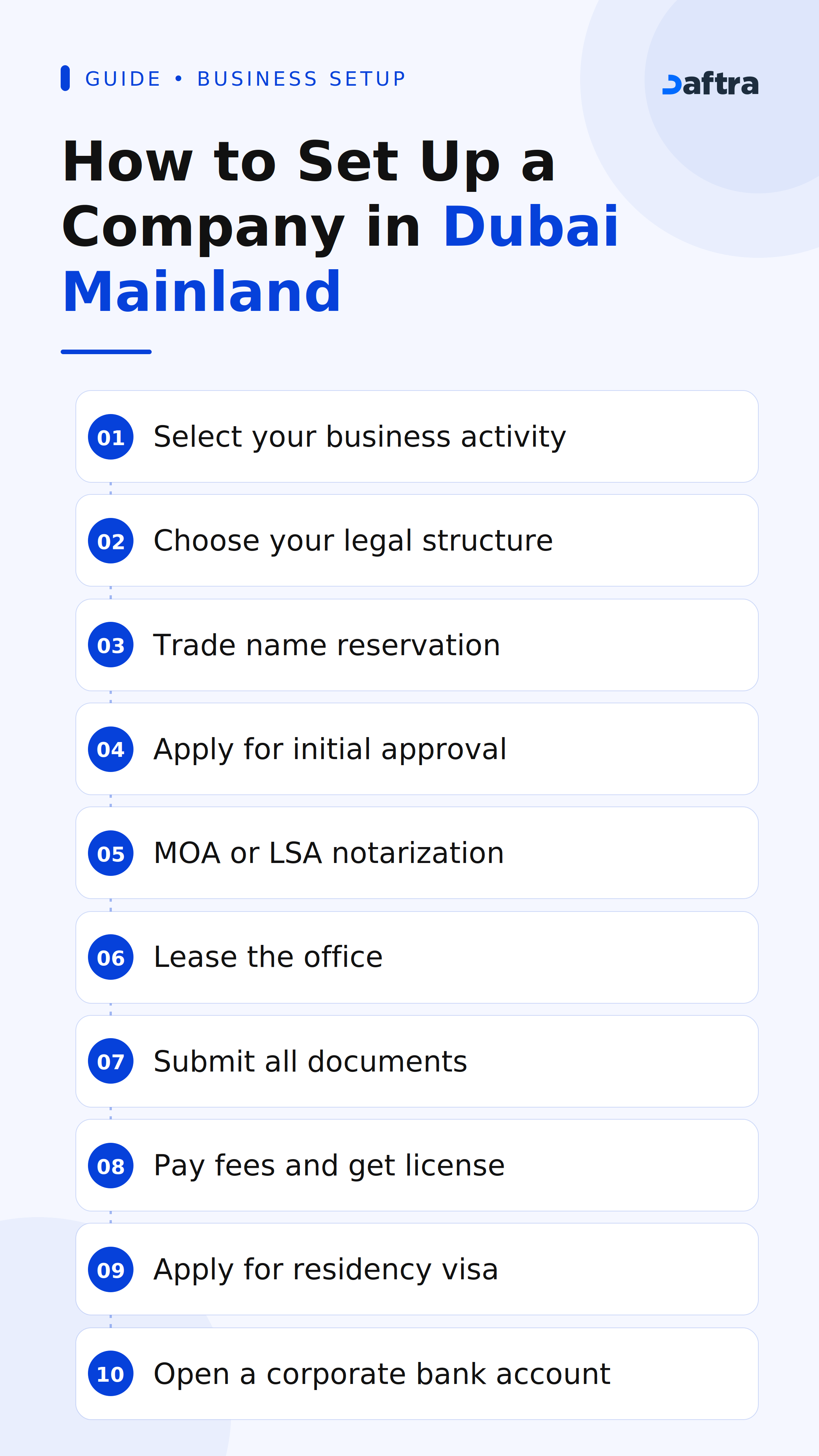
Step 1: Select your business activity
This step affects everything that comes later in the Dubai mainland company setup, because it determines the license type you’ll need and the legal structure. You can select one of these license types that fits your business.
| License Type | Best For |
| Commercial | Trading activities such as import, export, and retail. |
| Industrial | Manufacturing and production activities. |
| Professional | Service-based work, such as consulting and education. |
| Agricultural | Farming activities and animal production. |
| Tourism | Travel agencies and tour operators. |
Step 2: Choose your legal structure
Your legal structure affects the ownership and the liability for each shareholder of the company, which will later on affect the decision-making of the company.
Because there are a lot of legal structures to choose from, this guide will help you choose from the common legal structures based on your exact needs.
| Scenario | Choose this legal structure |
| One person owns and manages the company alone | Sole Establishment |
| Partners, but their personal assets are protected | Limited Liability Company (LLC) |
| Single owner but with limited liability company protection | One Person Company (OPC) |
| Professionals like doctors and lawyers are opening a company together | Civil Company |
| To sell shares in public and raise money | Public Joint Stock Company (PJSC) |
| Private shares for the investors | Private Joint Stock Company (PrJSC) |
| A foreign company wants to enter the Dubai market | Branch of a Foreign Company |
Step 3: Trade name reservation
It’s the business name that you will use officially in the licensing process, and the DET needs to check it before you can move forward with the company setup in the Dubai mainland.
Key naming rules to keep in mind:
- The name must be unique and not similar to another business name.
- It should match the business activity to not mislead people.
- It should not contain any offensive or religious words.
- The legal structure suffix needs to appear in the trade name, such as LLC or PJSC.
Step 4: Apply for initial approval from DET
After choosing the legal structure and the trade name reservation, you will have to get the initial approval. This is the DET’s first confirmation that the business can move forward to the next setup stages.
At this stage, the DET reviews the following:
- The selected business activity.
- The legal structure.
- The trade name.
- The shareholder details.
If everything is accepted, you will receive the initial approval and continue with the Dubai mainland company setup.
Step 5: MOA or LSA Notarization
This document clarifies your company's ownership structure. Depending on the legal structure you chose, you'll prepare either a Memorandum of Association (MOA) or a Local Service Agent (LSA) agreement.

Step 6: Lease the office
Companies in the Dubai mainland need to lease a physical office to complete the formation process. In Dubai, the office lease is registered through Ejari, which is a regulatory system developed by the real estate regulatory agency (RERA). It serves as the official tenancy registration system for Dubai mainland company setup.
To register the company office through Ejari, you need these documents:
- Signed tenancy contract
- Emirates ID
- The initial approval
- Property title deed copy
- Security deposit receipt
Then, you can include the Ejari certificate in your trade license application documents.
Step 7: Submit all documents
After you get the initial approval and the Ejari certificate, you can submit the full application to DET. There are some common documents you will need to submit. These documents include:
- Passport copies of shareholders.
- Emirates ID copies.
- Trade name reservation certificate.
- Initial approval certificate.
- MOA or LSA document.
- Ejari office lease documents.
- Any extra approvals required for regulated activities.
- Some activities may require a short business plan.
Step 8: Pay fees and obtain the trade license
The next step is to pay the required fees. You will find that the Dubai mainland company setup cost varies based on the business activity and legal structure.
Once fees are paid, you will receive the company’s trade license, which serves as the legal document that allows your company to operate across the UAE market.
After receiving your license and starting the operations, you will need to register for tax through the UAE EmaraTax Portal to stay compliant with VAT in UAE requirements.
Step 9: Apply for the residency visa
When you start operating, you will need to apply for investor visas and employee visas, which allow owners and employees to legally live and work in the UAE.
The process usually involves:
- Applying for the relevant entry permit.
- Opening the immigration and labor file.
- Completing the medical tests.
- Applying for the Emirates ID.
The visa capacity you will have is linked to the office space, so if you want to be eligible to have more visas, you’ll need to upgrade your office space.
Step 10: Open a corporate bank account
It’s an important step for the company’s operations because it helps you in managing taxes and receiving payments.
Banks in the UAE usually ask for a set of company and shareholder documents before opening the account. The common documents required include:
- Passport copies of shareholders.
- Emirates ID.
- Trade license.
- MOA or LSA documents.
- Ejari or tenancy contract.
- Sometimes they ask for a business plan.
Cost Structure of Dubai Mainland Company Setup
You can read the Dubai free zone company setup cost to compare the cost structures between the free zone and mainland setup in Dubai.
Timeline for Mainland Company Formation in Dubai
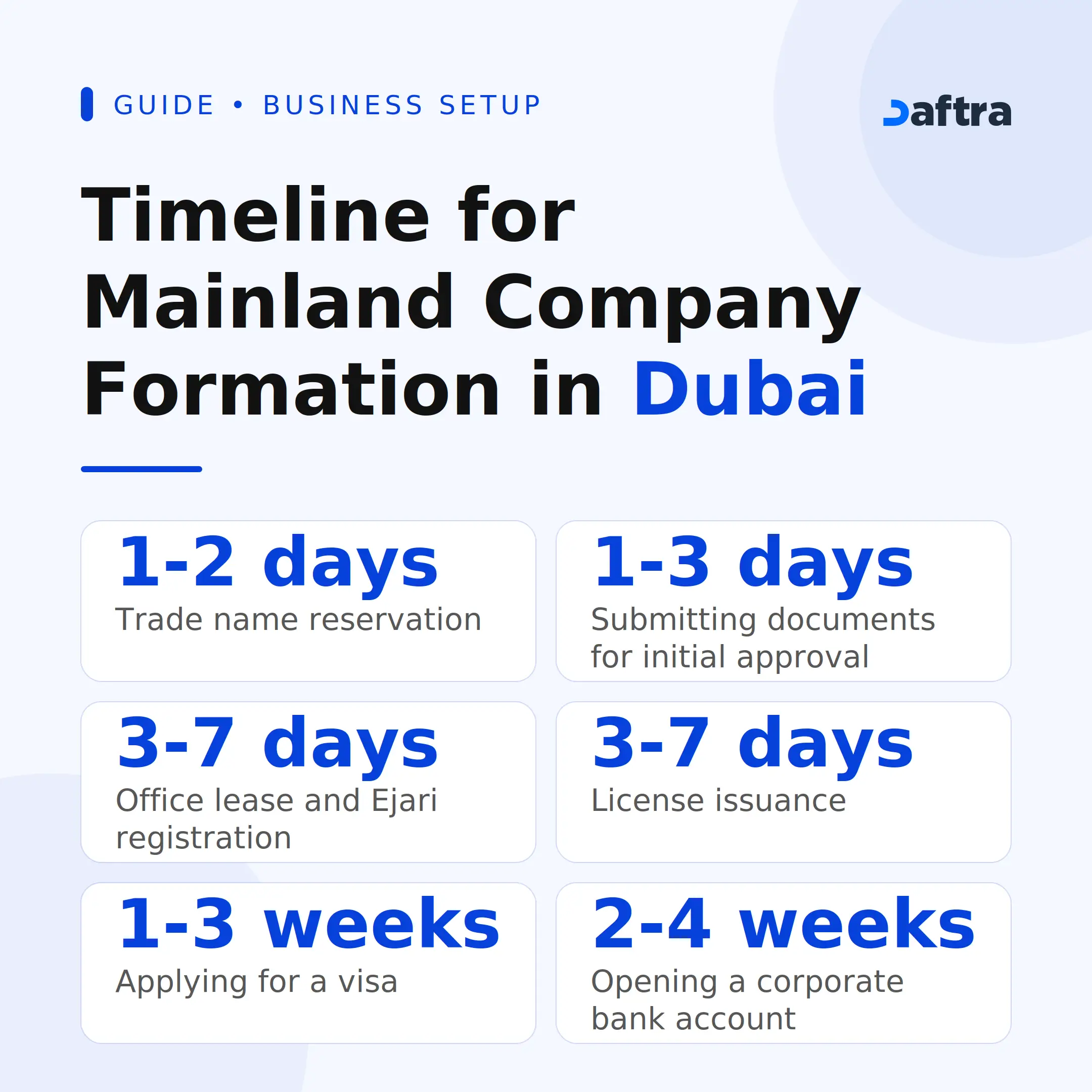
Dubai mainland company setup usually takes about 1 to 3 weeks for normal cases, and it can extend to 4-6 weeks if you want to apply for a visa and open a corporate bank account. Unlike free zone setups, which usually have a faster setup process. You’ll find below how company set up in the Dubai mainland usually progresses:
1- Trade name reservation
Typical days: 1-2 days
It’s the step where you reserve your company name with the DET and confirm that it complies with the UAE naming rules.
What may delay it:
- The proposed name is similar to another existing name.
- The name contains restricted or religious words.
- The name does not match the business activity.
2- Submitting documents for the initial approval
Typical days: 1-3 business days
What happens: The DET reviews the company’s documents to confirm there is no objection to continuing the setup process.
What may delay it:
- Incomplete documents.
- External approval required from other authorities.
3- Office lease and registering through Ejari
Typical days: 3-7 days
What happens: You have to lease a physical office and then register the tenancy through Ejari, as it serves as the official proof for the license application.
What may delay it:
- Time needed to select an office that meets your business needs.
- Delays in signing the tenancy contract.
- Missing documents for Ejari registration.
4- License issuance
Typical days: 3-7 business days
What happens: After you get the approval and pay the fees, the trade license is issued, and the company can legally operate.
What may delay it:
- Requirement for additional approvals.
- Delays in fee payment.
5- Applying for a visa
Typical days: 1-3 weeks
What happens: After the license is issued, you can apply for the residence visa for shareholders or employees.
What may delay it:
- Incomplete documents for employees or investors.
- Delays in medical tests.
6- Opening a Corporate Bank Account
Typical days: 2-4 weeks
What happens: The bank reviews the company documents and shareholder details before activating the corporate account.
What may delay it:
- Requests for a business plan
- Additional compliance checks by the bank.
- Failure to meet minimum balance requirements.
Read Also: Abu Dhabi Mainland Company Formation: A Comprehensive Guide
Tax & Compliance Requirements for Dubai Mainland Companies
VAT registration:
Mainland companies must register for VAT once it reaches AED 375,000; after that, they will be charged for 5% VAT on taxable goods and services.
Why it matters: VAT filing in UAE affects the financial reports; because of that, businesses should understand VAT in the UAE and how to calculate VAT to avoid any financial penalties.
Corporate tax registration
All Dubai mainland companies need to register for UAE corporate tax, which is a 9% rate if their profits are above AED 375,000.
Why it matters: It is an essential part of a company’s financial responsibilities. Understanding the difference between corporate tax and VAT is important because corporate tax keeps your financial reports accurate and compliant.
Annual Audit
You’ll need to review the company’s financial statements depending on the business requirements to ensure they're accurate and organized.
Why it matters: It helps to show that the company’s financial records are accurate, and it’s important when dealing with government authorities.
Financial Records
Mainland companies should maintain organized financial records such as invoices, bank statements, and financial statements.
Why it matters: These records support VAT and corporate tax compliance, and it’s also essential for audits and regulatory checks.
Payroll compliance
You must keep proper employee records and process salaries correctly in line with UAE labor rules.
Why it matters: Helps to meet the rules for employees and avoid problems related to salaries or labor requirements.
Maintaining accurate financial records is important for compliance, and using a structured accounting system like Daftra will simplify the financial records and help your business stay compliant with the UAE tax regulations.
Can Mainland Companies Operate Across the UAE?
Yes, Dubai mainland companies can trade across the UAE without being limited to one emirate, which gives them wider access to the local customers.
While businesses operating in the free zone setup still need additional permits to operate directly in the mainland, mainland companies already have this market access under their license, including:
- Offer goods or services across the UAE market without limitations.
- Operate in different emirates and expand its activities easily.
- Deal directly with customers in the local market.
- Apply for government tenders and work with public entities.
- Increase its visa capacity by upgrading the office space.
Common Mistakes in Dubai Mainland Company Setup
| Mistake | Risk | Prevention |
| Selecting the wrong business activity. | The company will face operational restrictions when it starts to operate. | Select your exact business activity that matches the company’s operations. |
| Choosing the wrong legal structure. | Choosing the wrong legal structure determines ownership and liability for shareholders, which will affect decision-making in the business. | Select the legal structure carefully and choose what suits the management needs and the business goals. |
| Poor office budget planning. | Underestimating office requirements can increase the setup costs and affect the visa eligibility. | Plan office space based on operational needs and expected visa requirements. |
| Ignoring compliance requirements. | The business will face financial penalties and issues if it ignores the compliance requirements. | Understand VAT filing in the UAE, and keep financial records clean to be compliant with the UAE tax regulations. |
| Lack of planning for renewal costs. | Businesses may face unexpected financial pressure when it’s time to renew the license, office lease, and visa. | Include annual renewal costs in the budget from the beginning of the Dubai mainland company setup. |
FAQs About Dubai Mainland Company Setup
How much does a Dubai mainland company setup cost?
Dubai mainland company setup cost is between AED 25,000 and AED 60,000 for the first year. The setup cost varies based on the license type and office space requirements, because it will be higher if the business needs a larger office space to get multiple visas.
Do I need a local sponsor for a mainland company in Dubai?
Foreign investors can often own a mainland company in Dubai without a local sponsor. However, some business activities may still need additional regulatory requirements.
How long does it take to set up a mainland company in Dubai?
The formation process usually takes around 1 to 3 weeks in most cases, but it can vary depending on the business activity and the documents you provide, because the missing documents can make the formation process take longer.
Can mainland companies trade internationally?
Yes, mainland companies can import goods into and export goods from the UAE through airports and seaports if their business complies with local laws and customs procedures. This gives you the same free zone advantages for trading internationally and still operating within the mainland setup.
Is VAT mandatory for mainland companies?
You must register for VAT in UAE once the company’s revenue reaches AED 375,000. Then, your company will be charged 5% VAT on its goods or services.
What documents are required for mainland company formation?
The required documents usually include passport copies of the shareholders, an initial approval certificate, MOA or LSA, and the office lease contract through Ejari. Some businesses may also need extra approvals or a brief business plan.
Final Checklist – Before Setting Up a Mainland Company in Dubai
Many investors think that the Dubai mainland company setup is much more complex than the free zone formation, but it will not be that hard if you keep these important pieces of advice in mind while setting up your company.
- Choose the right business activity: It determines the operational process that you are allowed to do in the mainland, so ensure you choose what covers your exact business needs.
- Confirm the legal structure: It affects all the management decisions within the company, because it determines the ownership and liability for each shareholder.
- Secure the office: Select the office based on your business requirements, and keep in mind that it affects the number of visas you can get for the shareholders and employees.
- Budget Planning: When you think about the setup costs, you need to have a wider look. Consider the renewal costs for the license, office, and visa to avoid any financial pressure after you start operating.
- Understand tax compliance: If you want to stay compliant with the UAE’s tax regulations, you have to understand VAT in UAE and the corporate tax to keep your financial records clean for any regulatory checks.
After knowing how important it is to maintain a clean financial record, you can use compliance systems early on to help you from the start of your company formation. Using tools such as Daftara E-Invoicing Software for UAE will help you manage your finances and compliance to stay compliant from day one.












 Invoicing
 POS
POS Offers
 Installments
 Sales Commission
 KSA E-Invoice Software
 EGY E-Invoice Software
 JO E-Invoice Software
 E-Invoice Software
 Chart of Accounts
 Asset Management
 Cost Centers
 Expenses
 Cheque Cycle
 UAE VAT-Tax
 Product Management
 Purchases
 Purchase Cycle
 Suppliers
 Requisitions
 Stocktaking
 Organizational Structure
 Personnel Management
 Attendance and Leave
 Contracts
 Payroll
 Requests
 Work Orders
 Booking Management
 Rental and Unit Management
 Time Tracking
 Work Flow
 Lease Contracts
 Manufacturing Management
  Client Follow-Up
 Loyalty Points
 Points and Credits
 Memberships
 Insurance Management
 Daftra ERP Full App
 Point of Sales App
 Point of Sales for Desktop – Support Offline Mode
 AI Expenses Scanner App
 Employee Attendance, Sign & ESS App
 E-invoice Reader App
 Inventory Stocktaking App