




Table of contents:
- Key Summary
- What Is a Mainland Company in Abu Dhabi?
- Types of Legal Structures for Mainland Company Formation
- Step-by-Step Process for Mainland Company Formation in Abu Dhabi
- Cost Structure of Mainland Company Formation in Abu Dhabi
- Timeline for Mainland Company Setup
- Tax & Compliance Requirements for Mainland Companies
- Can Mainland Companies Trade Freely in the UAE?
- FAQs About Mainland Company Formation in Abu Dhabi
- Final Checklist – Before Starting Mainland Company Formation in Abu Dhabi
Starting a business in the Abu Dhabi mainland allows you to reach all the UAE local market. Because of that many entrepreneurs choose to start a mainland company formation in Abu Dhabi.
Mainland companies in Abu Dhabi are licensed by Abu Dhabi Department of Economic Development (DED), it’s responsible for regulating its business activities in the Abu Dhabi.
But for investors who want maximum flexibility in the UAE’s local market, the mainland setup will be the preferred option.
Key benefits of mainland company formation in Abu Dhabi
- Direct access to the UAE market without geographic restrictions.
- Flexible office location options across the UAE.
- Several business activities are allowed under the Abu Dhabi DED.
- No restrictions on trading with the local market.
What Is a Mainland Company in Abu Dhabi?
It’s a business licensed and regulated by the Abu Dhabi Department of Economic Development (DED), which marks as the responsible authority for business approvals.
Unlike other businesses involved in company formation in Abu Dhabi free zones, mainland companies can trade directly in the UAE without any geographic restrictions, which make it a suitable choice for investors who want to work with local customers in the UAE.
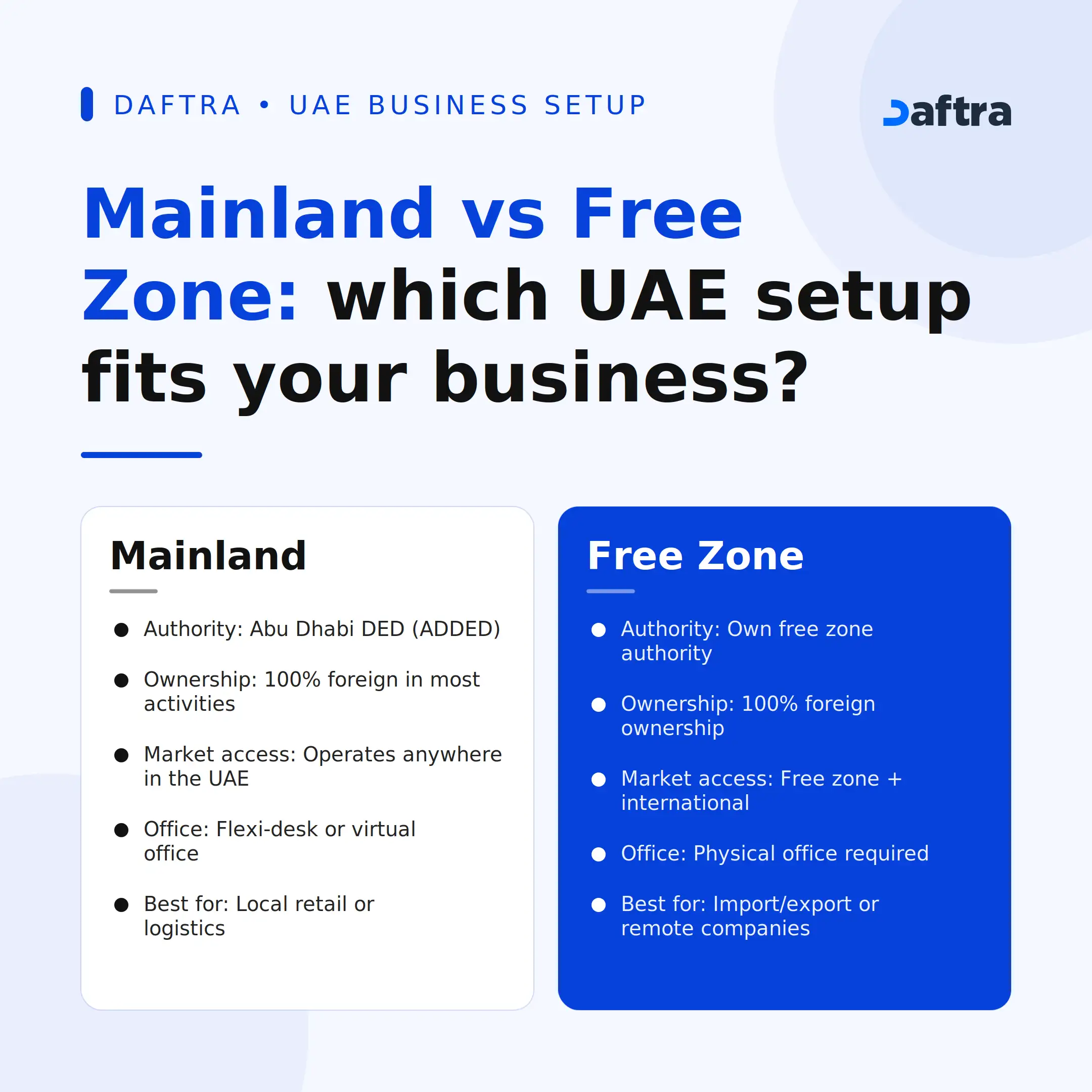
To understand the differences between mainland and free zone companies in Abu Dhabi, here is a quick comparison that can help:
Types of Legal Structures for Mainland Company Formation
When starting a mainland company formation in Abu Dhabi, choosing the right legal structure is an important step, as it determines ownership arrangements and how the business operates under the regulations of the DED. You’ll find below the main legal structures for company formation in Abu Dhabi mainland.
| Legal Structure | Description | Best For |
| Sole Establishment | A business owned by a single individual and operates under their own name. | Consultants and individuals offering professional services. |
| Limited Liability Company (LLC) | It’s the common structure for mainland businesses in Abu Dhabi. It’s owned by two or more shareholders and each person’s liability is limited to their shares in the company.
| Entrepreneurs and SMEs that want to trade directly in the UAE market. |
| Civil Company | A partnership structure typically used by licensed professionals such as doctors, engineers, or lawyers. | Professional service providers who want to operate Abu Dhabi. |
| Public Joint Stock Company (PJSC) | A large company structure that makes companies able to offer their shares to the public and to be listed on financial markets. | Large companies planning to raise capital through public investment. |
| Private Joint Stock Company (PrJSC) | A large company that needs their shares to be privately held and not offered to the public. | Businesses that require capital but prefer private ownership. |
| Branch of a Foreign Company | It allows international companies to establish a branch in Abu Dhabi while operating under the parent company name. | International companies expanding into the UAE market. You can start registration of a foreign company in Dubai, Abu Dhabi, or any other emirate in the UAE. |
| Holding Company | A company created to manage other businesses and It acts as a parent company that controls these companies and its assets. | Business groups that want to manage multiple companies under one structure. |
| Limited Partnership | A company formed with general partners who manage the business and have full liability, and the others are partners whose liability is limited to their shares. | Businesses where some partners manage operations while others participate as investors. |
| General Partnership | It’s formed by two or more partners who are liable for the company’s assets, here all partners participate in managing the business. | Investors who want to run a business together and share full responsibility for the company. |
Step-by-Step Process for Mainland Company Formation in Abu Dhabi
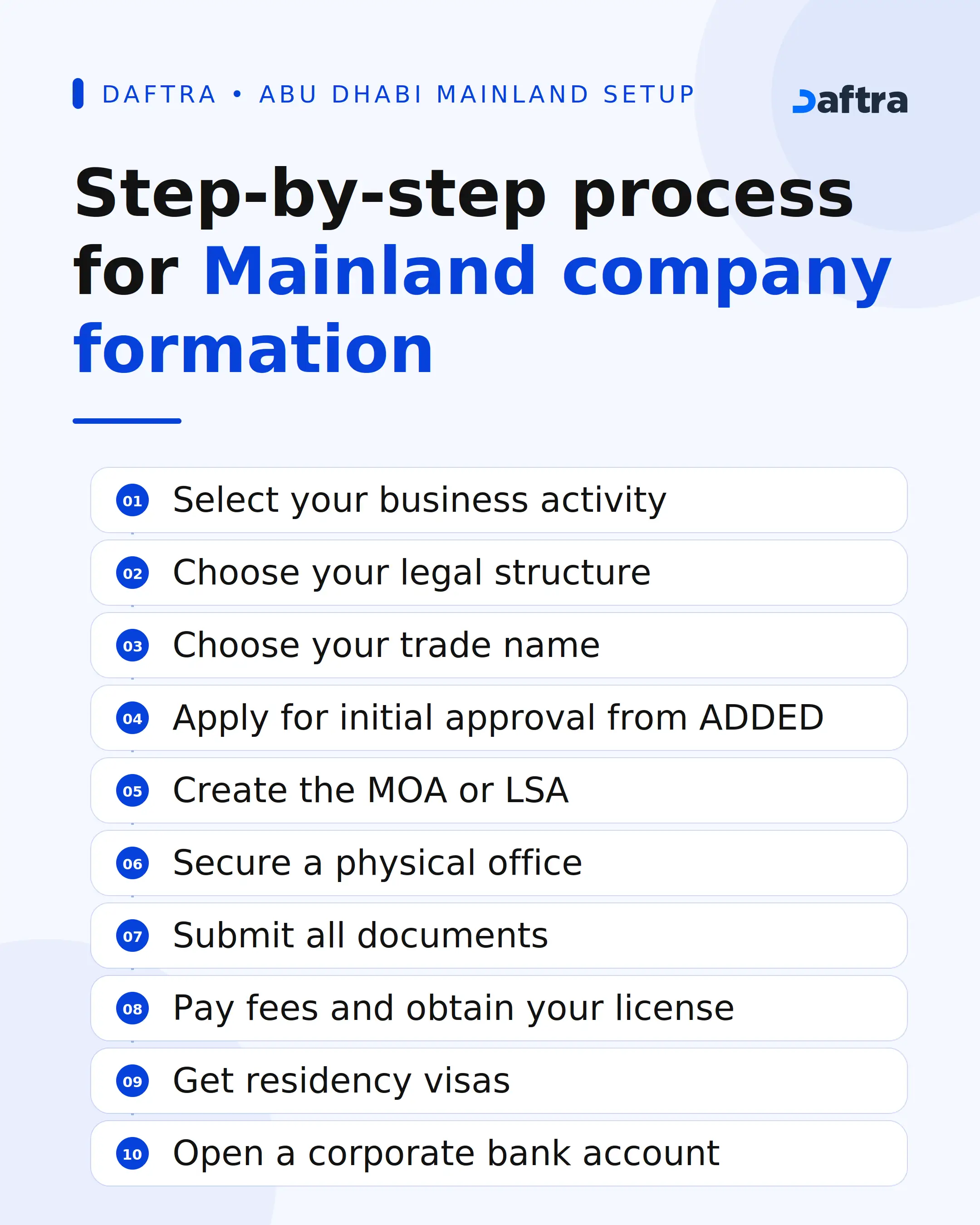
Here is the steps for mainland company formation in Abu Dhabi:
Step 1: Select your business activity
Your business activity determines what type of license you can get which will affect later the free zone and the legal structure you’ll choose. Abu Dhabi offers different license categories you can choose from, here are the common license types:
- Commercial license: for trading goods like importing and exporting businesses.
- Professional license: for individual services like consultants and freelancers.
- Industrial license: for manufacturing and production businesses.
- Tourism license: for travel agencies or tour companies.
- Agricultural license: for farming or similar agri‑business activities.
Step 2: Choose your legal structure
Your legal structure is how your company operates under the UAE law. It also affects the ownership and liabilities for the company’s shareholders.
- Sole establishment: for businesses with a single shareholder.
- Limited liability company (LLC): It’s owned by one or more shareholders and their liability is limited to their shares in the company.
- Civil company: a legal structure for groups of professionals such as doctors, lawyers, consultants, etc.
- Private joint stock company (PrJSC): a large company that wants its shares to be privately held.
- Public joint stock company (PJSC): a large company that lists its shares to the financial market.
- Branch of a foreign company: an existing foreign company that wants to expand in Abu Dhabi’s market.
Step 3: Choose your trade name
In order to continue the company formation in Abu Dhabi mainland, you need to select a trade name for your company, you can complete this step online but you have to ensure that the name meets the UAE naming rules.
Common naming regulations you must follow:
- Choose a unique name that is not similar to another business.
- Avoid religious or offensive words
- The name must reflect your business activity.
- The trade name must include the company’s legal structure as a suffix, such as LLC or PJSC.
Step 4: Apply for initial approval from ADDED
After you choose the activity and the trade name, you have to submit an initial approval request to Abu Dhabi DED. At this step, the ADDED checks:
- Your business activity and structure.
- Your trade name.
- Your shareholder details.
If everything is completed in this stage, you will get the initial approval, which allows you to continue with the rest of mainland company formation in Abu Dhabi process.
Step 5: Create the MOA or LSA
Depending on your structure, you may need to prepare legal documents which define the ownership structure and the profit distribution of the company.
- Memorandum of Association (MOA): For legal structures including LLC, PJSC, PrJSC or civil company.
- Local Service Agent (LSA): For certain legal structure which is the Sole Establishment.
Step 6: Secure a physical office
All mainland companies in Abu Dhabi must have a real physical office. Which remains as a big difference from Abu Dhabi Free Zone, where you can sometimes start with a flexi‑desk or virtual office.
To secure the physical office in Abu Dhabi mainland you need to:
- Lease a physical office space that matches your business activity.
- The address must comply with the ADDED and local municipalities regulations.
- Sign the tenancy contract.
- Register the lease through the Tawtheeq system.
- Submit the contract as part of the documents for the trade license application.
Step 7: Submit all documents
Once all documents and approvals are ready, you can submit all documents to the ADDED. In most cases, the application is filed online through the TAMM government portal, where applicants upload the required documents.
The documents you may need to submit:
- Passports of shareholders
- Emirates ID ( if applicable )
- Trade name certificate
- Initial approval and all previously submitted documents
- MOA and LSA certificate
- Office lease contract
- Brief business plan for certain activities
Step 8: Pay fees and obtain your license
After you submit all documents, you’ll have to pay the required fees to receive your commercial license. Usually the amount of fees depends on your activity and legal structure. After you obtain the license your mainland company can begin to operate officially in the UAE.
After payment and final approval, you will receive:
- The company’s trade license.
- Memorandum of Association (MOA).
- The Economic Register Certificate
In most cases, you can do all of this ADDED system or the TAMM government portal to pay online and collect your license. And after your company is established, you will also need to register for tax through the EmaraTax portal depending on your business requirements.
Step 9: Get residency visas
Once your company’s license is issued, you can start the residency visa process for the shareholders and the employees. It gives you a legal way to live in the UAE yourself and bring in employees to the company.
To get the residency visa you’ll need:
- Apply for an entry permit for coming to the UAE.
- Complete the medical tests and register for an Emirates ID.
- Passport copies of shareholders and employees.
- To complete this you’ll need the previous documents you have got during the company formation.
Step 10: Open a corporate bank account
You will need to open a corporate bank account to receive payments and manage taxes and payroll, this helps you become always aligned with the UAE banking and financial regulations.
In order to open a corporate bank account, banks usually ask for:
- The business license.
- Memorandum of Association (MOA) or LSA.
- Tenancy contract as proof of a physical office.
- Passport copies and Emirates ID of all shareholders.
- Company profile or a business plan.
Read more: Foreign Account Tax Compliance in the UAE
Cost Structure of Mainland Company Formation in Abu Dhabi

Timeline for Mainland Company Setup
The timeline for mainland company formation in Abu Dhabi can vary depending on many factors such as the business activity and approvals. In general, mainland setups may take longer than free zone setup because they usually require additional approvals and a physical office lease. You will find the timeline showing how the process usually happens.
Trade name reservation (1-2 days)
The first step is choosing a unique trade name through the ADDED, this step confirms that the name complies with UAE naming rules.
What may delay it:
- The name is similar to another company
- The name contains restricted words
- Incomplete application details
Submitting documents for the initial approval (2-5 days)
The authority will review the company’s documents, so you can get the initial approval which confirms that the ADDED has no objection to continuing the company formation process.
What may delay it:
- Incomplete documents
- Additional documents requested by the ADDED
- Certain sectors may require a brief business plan
Office lease and registering through Tawtheeq (1-5 days)
All mainland companies must lease a physical office in order to issue the license. You can register it through tawtheeq system, because this certificate will be required to be submitted to ADDED for license approval.
What may delay it:
- Incomplete application documents
- Delays in signing the tenancy contract
- Issues with Tawtheeq registration.
License Issuance (3-7 days)
Once all documents are approved and government fees are paid, the ADDED will issue your commercial license. After receiving the license, the company can legally operate.
What may delay it:
- Requirement for other approvals
- Incomplete application documents
Visa Processing (1-2 weeks)
You can apply for a residency visa for shareholders and employees once the company license is issued.
What may delay it:
- Delays in medical testing
- Incorrect shareholder or employees documents
Corporate Bank Account Opening (2-4 weeks)
Opening a corporate bank account is important to manage company payments. You’ll need to prepare all previous documents because banks usually review all the company details before approving the account.
What may delay it:
- Additional compliance checks by the bank
- Requests for business plans
Tax & Compliance Requirements for Mainland Companies
VAT registration
Businesses must register for VAT in UAE once their revenue exceeds AED 375,000, they will be charged 5% VAT on eligible goods and services and report it to the authorities.
It’s important to understand VAT filing in UAE and how taxes are reported, so businesses must know about how to calculate VAT in UAE to ensure that their tax filings are accurate.
Corporate tax registration
It applies to businesses who have profits above AED 375,000 as they will be charged 9% tax. There is a difference between Corporate Tax and VAT, because each one has its own rules and companies must register to each one to ensure that they comply with FTA regulations.
You might also find this helpful: UAE Freezone Corporate Tax: A Complate Guide
Corporate tax returns
Companies must submit a corporate tax return to the FTA for each tax period. Usually they file returns and pay any taxes required within nine months after the end of their financial year.
Financial records
Maintaining accurate financial records for your business, such as invoices and financial statements is important because these records are essential for any regulatory compliance.
Payroll compliance
Maintaining employee records and processing salaries correctly is crucial to hire employees, because you must comply with UAE labour regulations and follow employment rules set by the Ministry of Human Resources.
During mainland company formation in Abu Dhabi you’ll find that managing financial records and VAT reporting are crucial things to do and it may become more complex as the business grows.
You can use platforms like Daftra which provide tools to track financial transactions and manage payroll to keep your financial records organized.
Can Mainland Companies Trade Freely in the UAE?
Yes, mainland companies in Abu Dhabi can trade directly across the UAE market without any geographic restrictions, so they can sell goods or services anywhere in the UAE. Unlike businesses involved in free zone company formation as they may face restrictions when selling directly in the UAE market or they may need a local distributor.
FAQs About Mainland Company Formation in Abu Dhabi
How much does it cost to start a mainland company in Abu Dhabi?
Cost factors differ from company to another, based on its license type and legal structure. In most mainland company setups the costs range between AED 15,000 to 50,000.
What is the difference between mainland and free zone companies in Abu Dhabi?
Mainland companies can operate anywhere in the UAE, and it can also work directly with government entities. But free zone companies have to operate within the free zone or internationally.
Does a mainland company require a local sponsor in Abu Dhabi?
In most sectors, foreign investors can have 100% ownership but some regulated activities may still require a local partner such as legal consultancy and healthcare sectors.
How long does it take to register a mainland company?
Usually its timeline is around 2-4 weeks for completing all formation steps. It can vary based on the approvals and document preparation.
Do mainland companies in Abu Dhabi pay VAT?
Yes, mainland companies must register for VAT in UAE if their revenue exceeds AED 375,000, they will be charged 5% VAT on goods and services.
What documents are required for mainland business setup?
In order to complete the mainland company setup quickly, you’ll need to prepare all documents required which include passport copies of shareholders, proof of address, trade name reservation certificate, initial approval, MOA or LSA, and the office lease agreement.
Final Checklist – Before Starting Mainland Company Formation in Abu Dhabi
After understanding the key differences between mainland and free zone company formation. If you made your choice to start a mainland company formation in Abu Dhabi, these key points will help you during the formation process.
- Choose Your Business Activity: It will determine the type of license you need, and the activities your company will be allowed to do.
- Confirm the Legal Structure: Determines the ownership and management responsibilities between shareholders. You can choose from multiple structures such as LLC, sole establishment, etc.
- Secure an Office Address: You must lease a physical office to issue the license, and it also affects the visa quota your company could have.
- Understand Tax rules: Mainland companies must register the corporate and VAT in UAE tax once they reach the threshold to stay compliant with the FTA rules.
- Plan Your Budget Carefully: The formation process involves several costs to cover all setup steps, so preparing the budget previously helps you avoid delays during the formation process.
- Plan Operational Systems: Before you start operating in the UAE, you should plan all the operational and accounting systems early, this is a crucial step to keep your financial records organized.
Using accounting and compliance systems early on like Daftra e-invoicing software for UAE can make this easier to manage as your business grows, because it will help you track VAT transactions and maintain structured financial records.












 Invoicing
 POS
POS Offers
 Installments
 Sales Commission
 KSA E-Invoice Software
 EGY E-Invoice Software
 JO E-Invoice Software
 E-Invoice Software
 Chart of Accounts
 Asset Management
 Cost Centers
 Expenses
 Cheque Cycle
 UAE VAT-Tax
 Product Management
 Purchases
 Purchase Cycle
 Suppliers
 Requisitions
 Stocktaking
 Organizational Structure
 Personnel Management
 Attendance and Leave
 Contracts
 Payroll
 Requests
 Work Orders
 Booking Management
 Rental and Unit Management
 Time Tracking
 Work Flow
 Lease Contracts
 Manufacturing Management
  Client Follow-Up
 Loyalty Points
 Points and Credits
 Memberships
 Insurance Management
 Daftra ERP Full App
 Point of Sales App
 Point of Sales for Desktop – Support Offline Mode
 AI Expenses Scanner App
 Employee Attendance, Sign & ESS App
 E-invoice Reader App
 Inventory Stocktaking App