




Table of contents:
- Key Summary
- What Is Foreign Account Tax Compliance in the UAE?
- FATCA vs CRS What Is the Difference?
- Who Needs to Comply With FATCA and CRS in the UAE?
- Are Ordinary UAE Companies Required to Register for FATCA/CRS?
- How UAE Reporting Financial Institutions Register on the FATCA/CRS System
- What Is a GIIN and When Is It Required?
- How FATCA/CRS Annual Reporting Works in the UAE
- What Is a Nil Return Under FATCA/CRS?
- What Is the FATCA/CRS Risk Assessment Questionnaire?
- What Happens if the FATCA/CRS Submission Has Errors?
- What Records and Data Should Businesses Keep Ready?
- Corrections, Amendments, and Deregistration Under the FATCA/CRS System
- Common FATCA/CRS Compliance Mistakes in the UAE
- How Daftra Helps Businesses Stay Ready for FATCA/CRS Compliance
- FAQs
- Conclusion
As global tax transparency requirements continue to expand, foreign account tax compliance in the UAE primarily concerns obligations under FATCA, CRS, and the UAE’s Automatic Exchange of Information (AEOI) framework.
These regulations require certain UAE financial institutions and regulated entities to identify and report reportable financial accounts to the UAE Ministry of Finance in line with international tax transparency standards. FATCA focuses on U.S. reportable accounts, while CRS supports the global exchange of financial account information between participating jurisdictions.
Importantly, these obligations do not apply to every ordinary business in the UAE. FATCA and CRS compliance primarily concerns banks, investment entities, custodians, insurance companies, and other entities that may qualify as Reporting Financial Institutions or be required to be classified under the UAE framework.
This article explains what FATCA and CRS are, who must comply, how registration and annual or nil reporting work, what a FATCA/CRS risk assessment entails, and how entities can avoid common compliance errors.
What Is Foreign Account Tax Compliance in the UAE?
Foreign account tax compliance in the UAE refers to the process of identifying and reporting certain financial accounts to support international tax transparency and combat cross-border tax evasion. The UAE participates in global Automatic Exchange of Information (AEOI) frameworks, particularly the Foreign Account Tax Compliance Act (FATCA) and the Common Reporting Standard (CRS), through the UAE Ministry of Finance.
Under FATCA and CRS rules, UAE Reporting Financial Institutions are required to apply due diligence procedures to identify reportable accounts, collect self-certification documents, maintain records, and submit annual or nil reports through the Ministry of Finance FATCA/CRS reporting system. FATCA specifically focuses on U.S. reportable accounts, while CRS supports the exchange of financial account information between participating jurisdictions worldwide.
Read more: Corporate Tax in UAE
FATCA vs CRS: What Is the Difference?
Although FATCA and CRS both aim to improve international tax transparency, they differ in scope and reporting requirements.
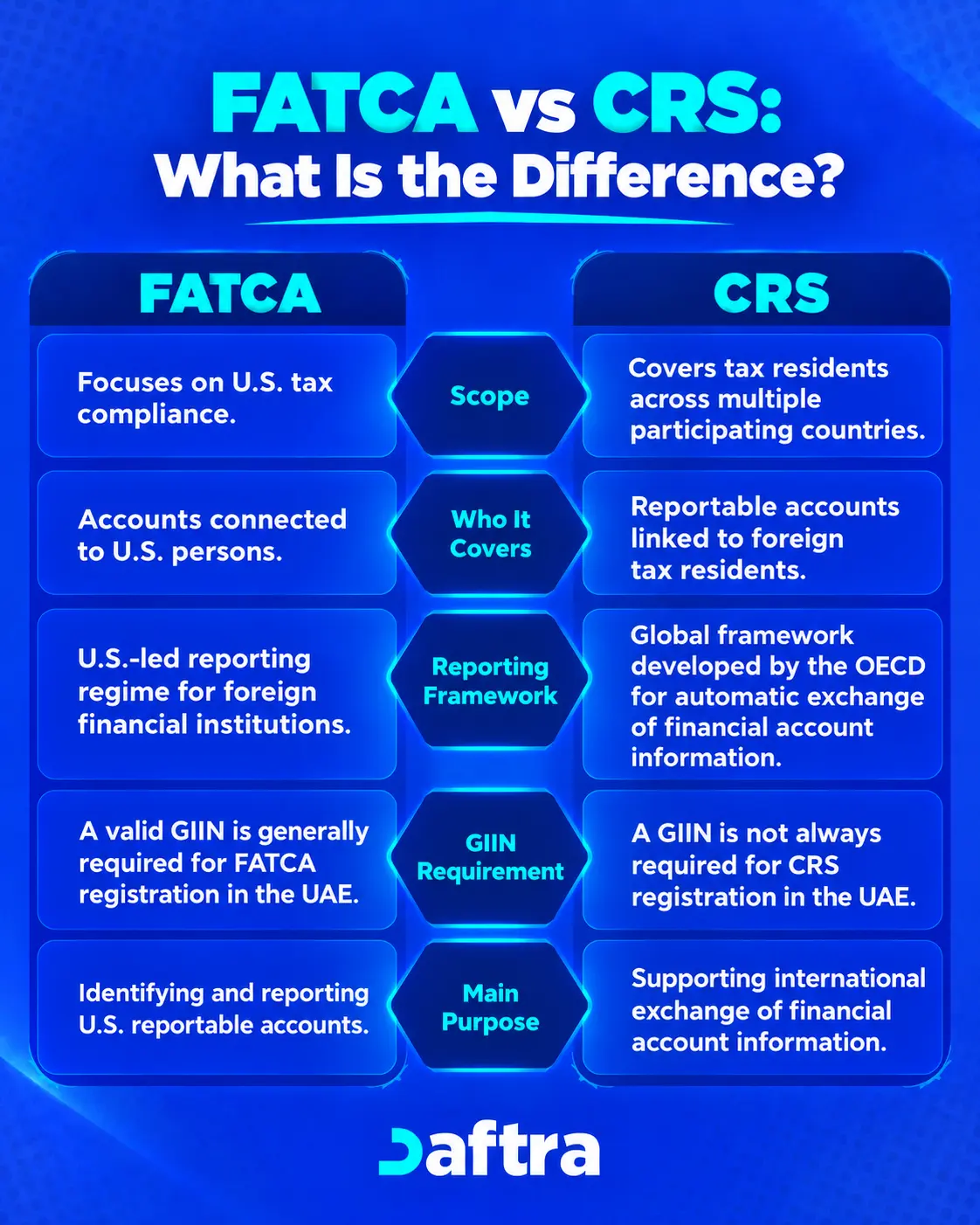
FATCA is a US-led regime that requires foreign financial institutions to identify and report accounts connected to US persons. UAE entities registering for FATCA must generally provide a valid Global Intermediary Identification Number (GIIN), which is verified against the IRS Foreign Financial Institution list.
CRS, developed by the OECD, is a broader global framework for the automatic exchange of financial account information between participating jurisdictions. Unlike FATCA, CRS registration in the UAE does not always require a GIIN.
Another important distinction is that FATCA reporting is tied specifically to US tax compliance, while CRS covers reportable accounts linked to tax residents of multiple participating countries
Who Needs to Comply With FATCA and CRS in the UAE?
In the UAE, FATCA and CRS compliance obligations mainly apply to entities classified as Reporting Financial Institutions (RFIs) under the UAE Ministry of Finance framework. These rules support international tax transparency and the automatic exchange of financial account information between participating jurisdictions.
The following entities may be required to comply with FATCA and CRS obligations in the UAE:
Banks and depository institutions
Custodial institutions holding financial assets for clients
Investment entities and asset managers
Investment funds and certain holding structures
Certain insurance companies issuing investment-related products
Other regulated financial entities, depending on their FATCA/CRS classification
Once an entity is classified as a Reporting Financial Institution, it may be required to:
Register on the UAE Ministry of Finance FATCA/CRS portal
Conduct due diligence procedures on account holders
Identify U.S. reportable accounts under FATCA
Identify foreign tax resident accounts under CRS
Collect self-certification forms and supporting documents
Submit annual FATCA or CRS reports
File nil returns where applicable
Complete annual risk-based assessment questionnaires
Maintain records for audits and regulatory reviews
In some cases, entities that are not classified as Reporting Financial Institutions may still be required by a regulator or licensing authority to register on the Ministry of Finance FATCA/CRS system to declare their legal entity classification. Compliance obligations ultimately depend on the entity’s structure, activities, and whether it maintains reportable financial accounts.
Are Ordinary UAE Companies Required to Register for FATCA/CRS?
In most cases, ordinary commercial businesses in the UAE are not automatically required to register for FATCA or CRS reporting. FATCA and CRS obligations are primarily intended for UAE Reporting Financial Institutions (RFIs), such as banks, custodians, investment entities, certain insurance companies, and other regulated financial entities that maintain financial accounts for clients.
However, whether a UAE entity must register depends on its FATCA/CRS classification rather than simply its trade license activity. Some holding companies, investment structures, family offices, or entities involved in financial asset management may still fall within the definition of a Reporting Financial Institution under FATCA or CRS rules, even if they are not traditional banks.
In addition, some entities that are not classified as Reporting Financial Institutions may still be required by a regulator, licensing authority, or the UAE Ministry of Finance system to register and declare their FATCA/CRS classification status. This is part of the UAE’s broader Automatic Exchange of Information (AEOI) framework, which aims to improve international tax transparency.
Where an entity qualifies as a Reporting Financial Institution, it may become subject to ongoing compliance obligations, including due diligence procedures, annual FATCA or CRS reporting, nil return submissions where no reportable accounts exist, risk assessment questionnaires, and record retention requirements.
Because FATCA and CRS classifications can be technical, many UAE businesses seek professional assessment before determining whether registration is required. Proper classification is important to avoid incorrect reporting, missed filings, or unnecessary regulatory exposure.
How UAE Reporting Financial Institutions Register on the FATCA/CRS System
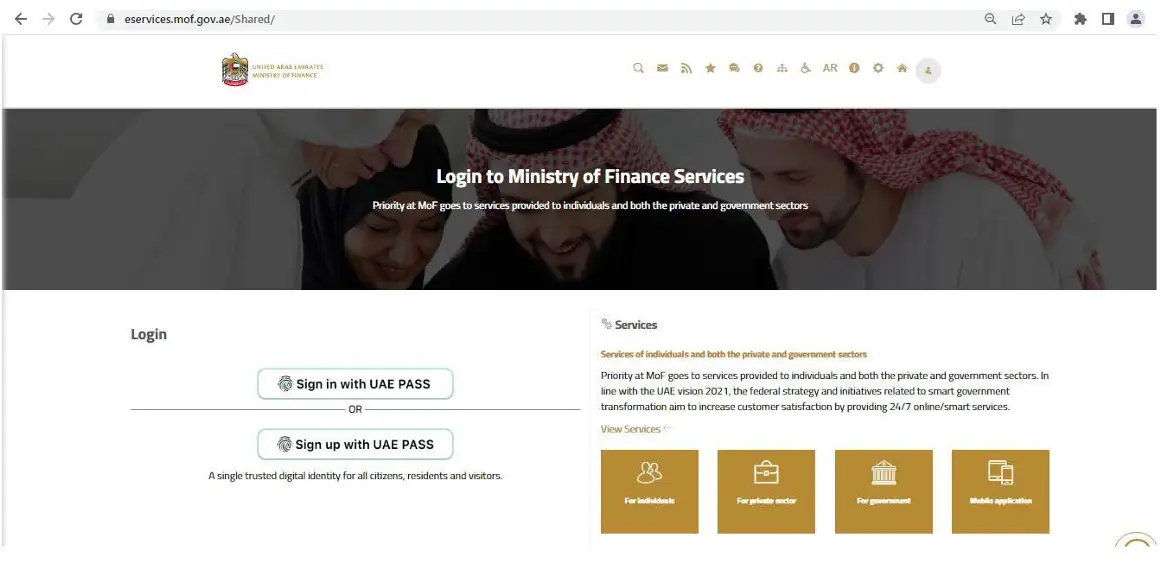
UAE Reporting Financial Institutions register through the Ministry of Finance, FATCA/CRS online portal using UAE PASS authentication.
The registration process generally includes:
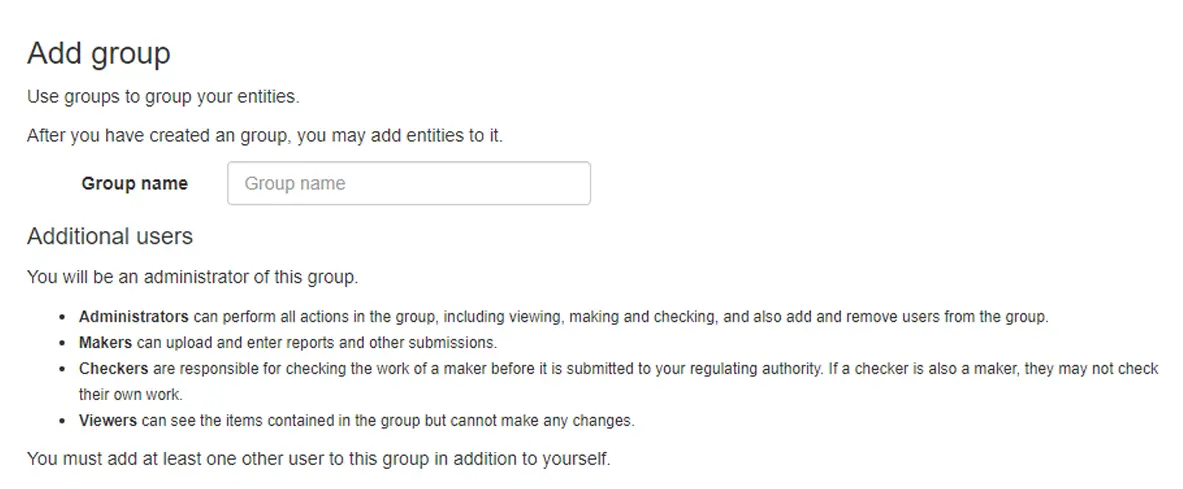
Step 1: Create a Group on the FATCA/CRS Portal
The Reporting Financial Institution (RFI) must first access the UAE Ministry of Finance FATCA/CRS system and create a Group. The Group is used to manage users, reporting submissions, risk assessments, and registration activities. The system also requires assigning user roles such as Administrator, Maker, and Checker.
Step 2: Add a New Financial Institution Entity
After creating the Group, the user must select “Add Entity” to register the Financial Institution. During this stage, the entity must choose whether to register for FATCA, CRS, or both, and select the applicable FATCA and/or CRS classification.
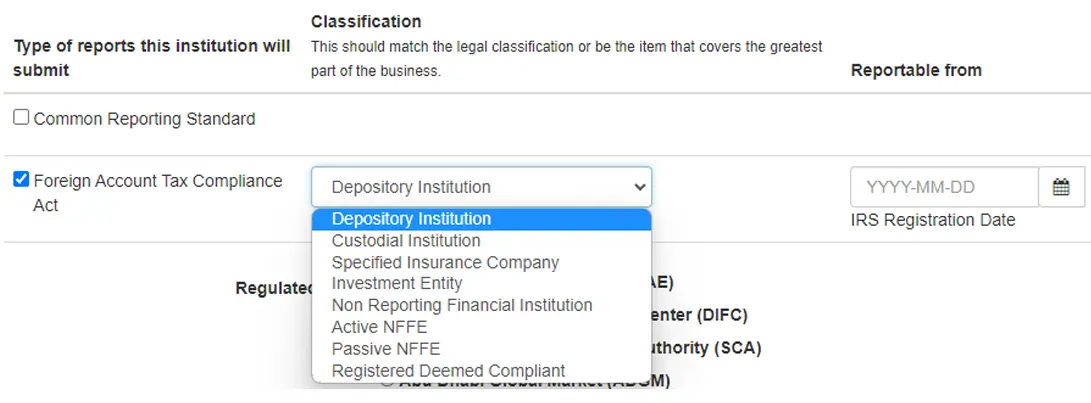
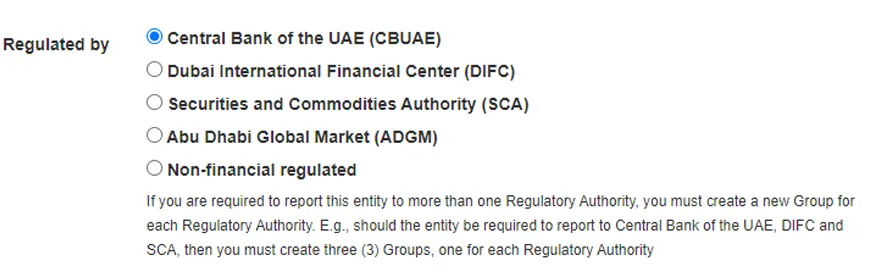
Step 3: Select the Regulatory Authority
The entity must select the UAE Regulatory Authority that supervises it. The system allows only one Regulatory Authority per registration. If the entity reports to multiple regulators, separate Groups may be required.
Step 4: Provide the GIIN (If Required)
For FATCA registrations, a valid Global Intermediary Identification Number (GIIN) is mandatory. The system verifies the GIIN against the IRS Financial Institution list. For CRS-only registrations, the GIIN is generally optional.

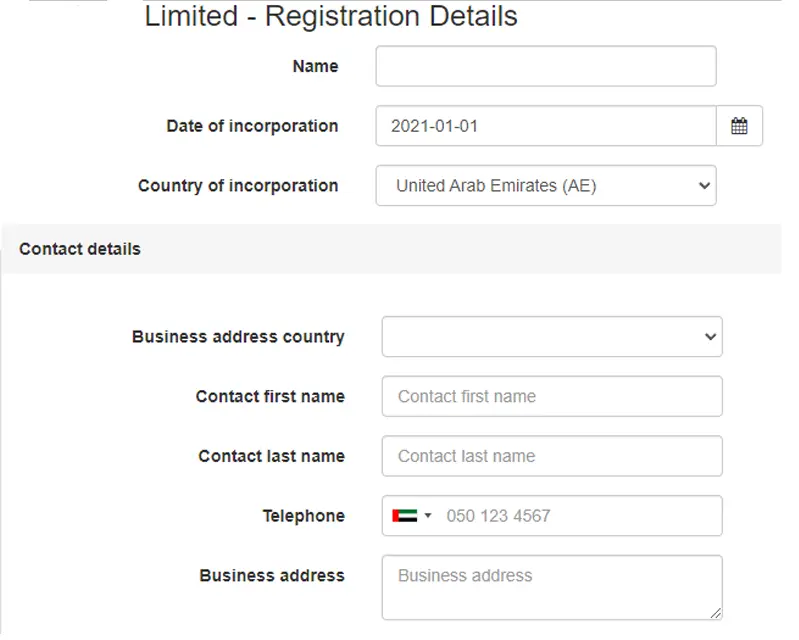
Step 5: Complete the Registration Details
The Financial Institution must complete the registration form by providing:
- Date of incorporation
- Business address
- Contact details
- Telephone number
- FATCA/CRS classification details
- Reportable from date, where applicable
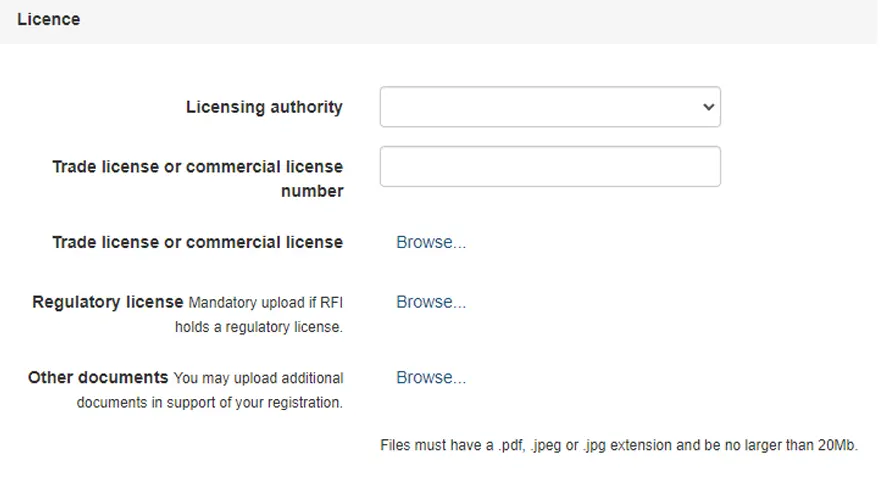
Step 6: Upload Supporting Documents
The entity must upload supporting licensing documents, including trade licenses and regulatory licenses. The system accepts files in PDF, JPEG, or JPG format. Registration cannot be submitted until all required information and documents are completed.
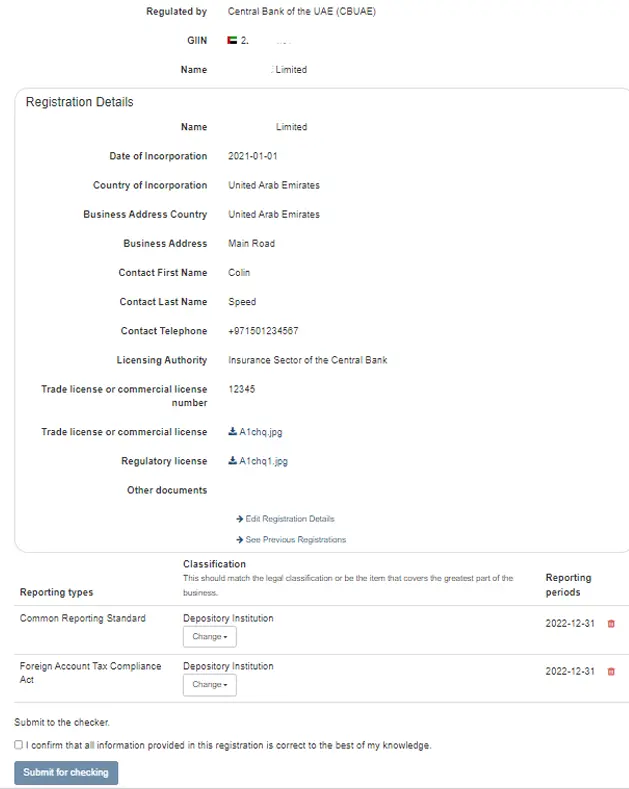
Step 7: Submit the Registration for Checking
Once the information is completed, the user reviews the registration summary and submits it for checking. Under the Maker-Checker process, another authorized user within the Group must review and approve the registration before it is forwarded to the Regulatory Authority.
Step 8: Await Regulatory Authority Approval
After internal checking is completed, the registration is submitted to the Regulatory Authority for authorization. The Financial Institution will receive confirmation once the registration is approved or rejected. Reporting submissions cannot be made until authorization is completed.
What Is a GIIN and When Is It Required?
A GIIN, or Global Intermediary Identification Number, is a unique identification number issued by the U.S. Internal Revenue Service (IRS) to foreign financial institutions and certain registered entities under FATCA. It is used to confirm that the entity has registered for FATCA purposes and is recognized for international tax reporting and compliance.
In the UAE, the GIIN is particularly important for FATCA registration through the Ministry of Finance's FATCA/CRS system. UAE Reporting Financial Institutions with FATCA reporting obligations are generally required to provide a valid, published GIIN upon registration. The GIIN is verified against the official IRS Foreign Financial Institution (FFI) list as part of the registration process.
However, a GIIN is not always required for CRS-only registration. Entities registering only for CRS purposes may still complete registration without a GIIN, depending on their classification and reporting obligations.
Businesses should also be aware that newly issued GIINs may not appear immediately on the IRS FFI list because the list is updated periodically. As a result, entities should avoid delaying FATCA registration until the last minute, especially as annual reporting deadlines approach.
A GIIN is commonly required for foreign financial institutions, certain investment entities, sponsoring entities, and other organizations that have FATCA reporting responsibilities or receive U.S.-source payments subject to FATCA compliance checks. Having a valid GIIN also helps support onboarding, due diligence, and compliance reviews conducted by banks, withholding agents, and financial counterparties.
How FATCA/CRS Annual Reporting Works in the UAE
Annual FATCA and CRS reporting in the UAE follows a structured compliance workflow through the Ministry of Finance FATCA/CRS system, beginning with entity authorization and ending with submission to the relevant regulatory authority.
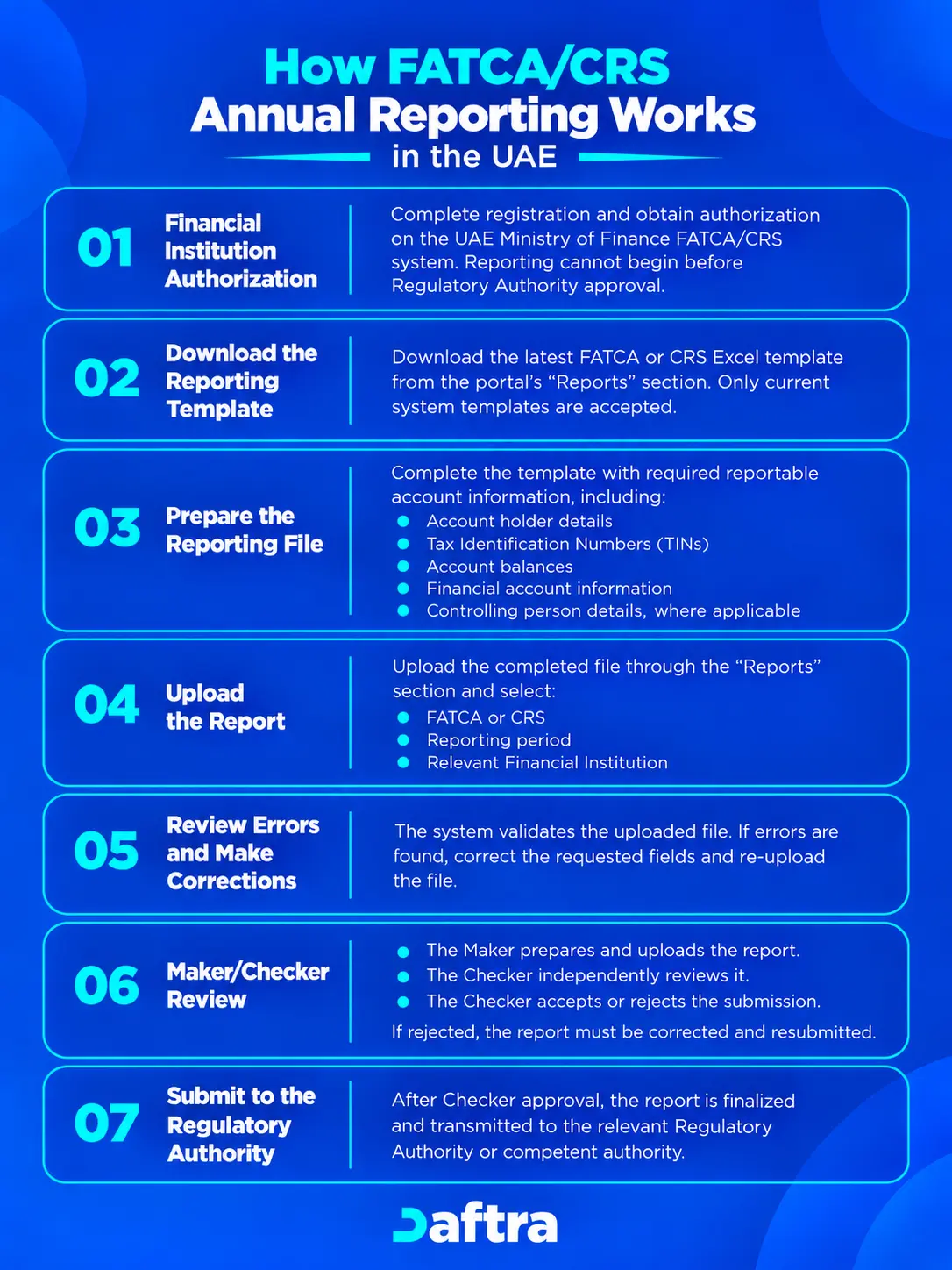
1. Financial Institution Authorization
Before any FATCA or CRS reporting can take place, the UAE Reporting Financial Institution (RFI) must first complete registration and obtain authorization on the UAE Ministry of Finance FATCA/CRS system. Reporting submissions are not permitted until the institution has been approved by the relevant Regulatory Authority.
2. Downloading the Reporting Template
Once authorized, the RFI can access the reporting function through the system’s “Reports” section. The institution must download the latest FATCA or CRS Excel reporting template provided by the portal. Only the current system templates are accepted for submission.
The FATCA and CRS templates contain specific reporting tabs depending on the reporting type. These may include account information, controlling persons, substantial owners, filing instructions, and country reference tabs.
3. Preparing the Reporting File
The institution then completes the template with the required reportable account information identified during due diligence. This may include:
- Account holder details
- Tax Identification Numbers (TINs)
- Account balances
- Financial account information
- Controlling person details where applicable
The reporting template structure must not be modified. Adding, deleting, or editing system-generated rows, columns, or formatting can cause the upload to fail.
4. Uploading the Report
After completing the template, the file is uploaded through the “Reports” section of the Ministry of Finance FATCA/CRS portal. The user selects the applicable compliance type (FATCA or CRS), reporting period, and the relevant Financial Institution before submitting the file for review.
5. Error Review and Corrections
The system performs validation checks on the uploaded file. If errors are identified, the report will not proceed until corrections are made. In some cases, the institution may be required to download a correction template, amend the requested fields, and re-upload the corrected file.
Only the requested corrections should be made. Additional data or changes outside the required fields may result in the submission being rejected.
6. Maker/Checker Review Process
Once the file is uploaded successfully, the submission enters the Maker/Checker review stage. Under this process:
- The Maker prepares and uploads the report
- The Checker independently reviews the submission
- The Checker may either accept or reject the report
If rejected, the file must be corrected and resubmitted for review.
7. Submission to the Regulatory Authority
After the Checker accepts the report, the submission is finalized and transmitted through the system to the relevant Regulatory Authority or competent authority as part of the UAE’s FATCA/CRS reporting framework.
Reporting Financial Institutions may also need to submit nil returns, risk assessment questionnaires, or correction files, depending on their compliance obligations and reporting status for the relevant year.
What Is a Nil Return Under FATCA/CRS?
A nil return under FATCA or CRS is a filing submitted by a UAE Reporting Financial Institution confirming that it did not maintain any reportable financial accounts during the relevant reporting year. In practical terms, this means the institution still has a compliance obligation even when there is no reportable data to submit.
Under the UAE Ministry of Finance FATCA/CRS system, Reporting Financial Institutions that do not maintain financial accounts for the relevant reportable year may still be required to submit a nil return rather than taking no action. The requirement depends on the institution’s FATCA/CRS classification and reporting status.
Before filing a nil return, the institution is still expected to complete its due diligence review and confirm that no reportable accounts exist for the reporting period. Failure to submit a required nil return may result in compliance issues, regulatory follow-up, or administrative penalties.
What Is the FATCA/CRS Risk Assessment Questionnaire?
The FATCA/CRS Risk Assessment Questionnaire is a compliance tool used by the UAE Ministry of Finance to assess how well UAE Reporting Financial Institutions (RFIs) comply with FATCA and CRS requirements. It is mandatory for UAE RFIs registered on the FATCA/CRS system that have reporting obligations for the relevant reporting year.
The questionnaire forms part of the UAE’s Automatic Exchange of Information (AEOI) framework and helps the Ministry of Finance identify compliance risks, operational challenges, and areas where institutions may need improvements in their FATCA and CRS processes.
The requirement applies to banks, insurance companies, investment funds, and other financial entities subject to FATCA or CRS reporting obligations. Where an RFI is regulated by more than one Regulatory Authority, separate Risk Assessment Questionnaires may need to be submitted depending on the entity’s obligations.
The questionnaire is completed through the Ministry of Finance FATCA/CRS portal. It can be prepared by an Administrator, Maker, or Maker+Checker user, while a different authorized user must review and either accept or reject the submission under the system’s Maker/Checker process. The same person cannot perform both functions.
Once the questionnaire is finalized and “Complete Checking” is selected, it is submitted to the relevant Regulatory Authority for review. The system does not permit late submissions, and failure to complete the questionnaire on time may result in penalties or regulatory action.
What Happens if the FATCA/CRS Submission Has Errors?
If a FATCA or CRS submission contains errors, the UAE Ministry of Finance's FATCA/CRS system will generate an error report that identifies the specific validation issues in the uploaded filing. The Reporting Financial Institution (RFI) Maker user must review the error descriptions, correct the data, and re-upload the updated file before the submission can proceed.
The system does not accept submissions with errors. However, submissions containing warnings may still be accepted, though institutions are encouraged to resolve them before final submission.
In some cases, additional validation checks may identify new errors after the first set of corrections has been fixed. This means the RFI may need to repeat the correction and re-upload process multiple times before the file becomes error-free and ready for Checker approval.
The Ministry of Finance also requires institutions to use the latest FATCA and CRS reporting templates, which must be downloaded directly from the system. Older templates or modified files will not be accepted by the portal.
Once the file is uploaded without errors, it moves to the Maker/Checker review stage, where the Checker user reviews and approves the submission before it is finalized within the system.
Read more: How to File Corporate Tax in UAE
What Records and Data Should Businesses Keep Ready?
UAE Reporting Financial Institutions should maintain complete and organized FATCA and CRS records throughout the reporting year to support due diligence, annual reporting, nil return filings, and Risk Assessment Questionnaire submissions.
In practice, institutions are generally expected to keep the following information readily available:
Account holder identification details
Tax residency information
Tax Identification Numbers (TINs)
Self-certification forms
Account balances and financial account data
Controlling personal information for certain entities
FATCA and CRS entity classification records
Due diligence and onboarding documents
Reporting files and submission confirmations
Internal compliance policies and procedures
Evidence of governance reviews and monitoring controls
Businesses should also retain copies of submitted FATCA/CRS reports, nil returns, error reports, correction files, and Risk Assessment Questionnaires generated through the Ministry of Finance FATCA/CRS system.
Where U.S. reportable accounts are involved, institutions may additionally need records showing reasonable efforts to obtain missing U.S. TINs and supporting documentation explaining the use of IRS TIN reporting codes.
Because FATCA and CRS reporting involves ongoing monitoring obligations, institutions should ensure that records are updated whenever there is a change in account holder circumstances, tax residency status, or entity classification.
Maintaining accurate records is important not only for annual reporting but also for responding to Regulatory Authority reviews, system validation checks, compliance inspections, and future correction requests.
Corrections, Amendments, and Deregistration Under the FATCA/CRS System
UAE Reporting Financial Institutions may need to correct, amend, or update information submitted through the Ministry of Finance FATCA/CRS system when reporting errors, classification changes, or registration updates are identified.
Corrections are commonly required where uploaded FATCA or CRS reports contain validation errors, missing account information, incorrect TINs, inaccurate account classifications, or reporting inconsistencies. In these situations, the institution must review the system-generated error messages, correct the relevant data, and resubmit the updated filing through the portal before the submission can proceed for approval.
Amendments may also be necessary after a report has already been submitted if the institution later identifies inaccurate account information, incorrect entity classifications, changes in account holder circumstances, or updated due diligence findings. The FATCA/CRS system allows institutions to manage and update reporting information through the reporting workflow and Maker/Checker review process.
Where changes are required to the institution’s registration details, such as regulatory authority information, entity classification, authorized users, or reporting status, the entity should update its FATCA/CRS profile promptly to ensure that future filings remain accurate.
In some cases, an entity may need to apply for deregistration from the FATCA/CRS system. This may happen where:
- The entity no longer qualifies as a Reporting Financial Institution
- The business has been liquidated or dissolved
- The entity has merged with another institution
- The reporting obligation no longer exists under the applicable FATCA or CRS classification
Before requesting deregistration, institutions should ensure that all outstanding filings, nil returns, Risk Assessment Questionnaires, and compliance obligations for prior reporting periods have been completed.
Because FATCA and CRS filings are closely reviewed by Regulatory Authorities, institutions should maintain supporting records for all corrections, amendments, and deregistration requests submitted through the system.
Common FATCA/CRS Compliance Mistakes in the UAE
Many FATCA and CRS compliance issues in the UAE stem from incomplete due diligence procedures, inaccurate classifications, weak internal controls, or last-minute reporting.
Some of the most common compliance mistakes include:
Incorrect entity classification under FATCA or CRS
Assuming no reportable accounts means no filing obligations
Using outdated or modified Ministry of Finance reporting templates
Missing or incomplete self-certification forms
Incorrect TINs or tax residency information
Failure to identify controlling persons properly
Inconsistent account holder documentation
Delayed correction of system validation errors
Incomplete Risk Assessment Questionnaire submissions
Failure to follow Maker/Checker approval requirements
Leaving reporting and validation work until the filing deadline
Failure to monitor changes in the account holder's circumstances
Another common issue is treating FATCA and CRS as one-time filing exercises rather than ongoing compliance obligations. UAE Reporting Financial Institutions are generally expected to maintain continuous monitoring procedures, accurate onboarding controls, and updated due diligence records throughout the reporting year.
Institutions also face compliance risks when internal teams responsible for onboarding, compliance, operations, and reporting do not coordinate effectively. In practice, FATCA and CRS reporting often depend on accurate information collected during account opening and periodic review processes.
Because the Ministry of Finance's FATCA/CRS system performs validation checks during submission, even small data inconsistencies can result in rejected filings, correction requests, or reporting delays. Preparing records early and reviewing submissions before upload can significantly reduce these issues.
How Daftra Helps Businesses Stay Ready for FATCA/CRS Compliance
Daftra helps businesses in the UAE stay better prepared for FATCA/CRS compliance by improving the quality, structure, and accessibility of financial and customer-related data before reporting is needed.
It works as an operational accounting tool that helps businesses:
- Keep financial records organized through automated journal entries and a structured Chart of Accounts
- Reduce manual errors and data gaps by centralizing transactions across cash and bank accounts
- Store supporting documents directly with transactions for easier retrieval during reviews
- Generate clear financial and VAT-aligned reports that support internal compliance preparation
- Improve visibility and control over cost centers, cash flow, and accounting cycles
Since FATCA/CRS reporting depends heavily on accurate data and proper documentation, Daftra's accounting software mainly helps businesses reduce administrative burden and maintain cleaner, audit-ready records.
FAQs
Is FATCA applicable in the UAE?
Yes. FATCA is applicable in the UAE as part of the country’s participation in the Automatic Exchange of Information (AEOI) framework. UAE financial institutions that qualify as Reporting Financial Institutions, such as banks, custodians, investment entities, and certain insurance companies, are required to comply with FATCA obligations.
This includes identifying U.S. reportable accounts, conducting due diligence, collecting self-certification forms, and submitting reports to the UAE Ministry of Finance via the FATCA/CRS system.
However, FATCA does not apply to all businesses. It mainly targets regulated financial entities that hold or manage financial accounts for clients.
Am I exempt from the Foreign Account Tax Compliance Act (FATCA)?
In most cases, ordinary UAE businesses are not directly subject to FATCA reporting obligations and are therefore effectively outside the scope of FATCA compliance requirements.
You are generally exempt if your entity:
- Is it a normal commercial or trading business
- Does not hold financial accounts for customers
- Is not classified as a Reporting Financial Institution under UAE FATCA rules
However, the exemption depends on classification, not just business type. Some entities, such as holding companies, investment structures, or financial service providers, may still fall within the scope of FATCA and therefore must comply.
While many businesses are not required to register or report, exemption is not automatic and should be confirmed based on your FATCA classification under the UAE Ministry of Finance's rules.
Conclusion
FATCA and CRS compliance in the UAE depends mainly on accurate financial data, proper classification, and continuous recordkeeping rather than just submitting annual reports. Reporting Financial Institutions must maintain strong due diligence processes, accurate documentation, and complete filings, such as annual or nil returns, through the UAE Ministry of Finance system.
Most compliance issues come from poor data quality, missing documentation, or weak internal controls during the year. Therefore, maintaining organized and reliable financial records is essential for avoiding reporting errors and delays.
Daftra supports this process as an operational accounting tool by helping businesses centralize transactions, automate accounting entries, organize supporting documents, and improve financial reporting visibility. This strengthens internal data readiness and reduces administrative workload.
However, FATCA/CRS obligations remain a regulatory responsibility, and Daftra does not replace official reporting or determine compliance status. it simply helps businesses prepare cleaner and more structured financial data for the process.












 Invoicing
 POS
POS Offers
 Installments
 Sales Commission
 KSA E-Invoice Software
 EGY E-Invoice Software
 JO E-Invoice Software
 E-Invoice Software
 Chart of Accounts
 Asset Management
 Cost Centers
 Expenses
 Cheque Cycle
 UAE VAT-Tax
 Product Management
 Purchases
 Purchase Cycle
 Suppliers
 Requisitions
 Stocktaking
 Organizational Structure
 Personnel Management
 Attendance and Leave
 Contracts
 Payroll
 Requests
 Work Orders
 Booking Management
 Rental and Unit Management
 Time Tracking
 Work Flow
 Lease Contracts
 Manufacturing Management
  Client Follow-Up
 Loyalty Points
 Points and Credits
 Memberships
 Insurance Management
 Daftra ERP Full App
 Point of Sales App
 Point of Sales for Desktop – Support Offline Mode
 AI Expenses Scanner App
 Employee Attendance, Sign & ESS App
 E-invoice Reader App
 Inventory Stocktaking App