




Table of contents:
- Key Summary
- What Is the Definition of a General Partnership?
- What Are the Characteristics of a General Partnership?
- What Are the Advantages of a General Partnership?
- What Are the Disadvantages of a General Partnership?
- How Is a General Partnership Managed?
- What Are the Procedures for Establishing a General Partnership Under Saudi Law?
- What Are the Procedures for Establishing a General Partnership Under Egyptian Law?
- What Are the Procedures for Establishing a General Partnership Under Algerian Law?
- What Are the Procedures for Establishing a General Partnership Under UAE Law?
- What Are the Reasons for Liquidating a General Partnership?
- What Are the Cases in Which a General Partnership Is Dissolved?
- What Are the Duties of a General Partnership Manager?
- What Is the Difference Between a General Partnership and a Limited Partnership?
- What Is the Difference Between a General Partnership and a Partnership Limited by Shares?
- How Did Daftra Unify the Data of a General Partnership with Multiple Partners?
- How Can You Manage a General Partnership Using Daftra?
- Frequently Asked Questions
A General Partnership is a common and widely used type of business. Many people, especially small- and medium-sized business owners who aren't specialists, wonder about this type of company, how to establish it, and what distinguishes it from other types of companies. We will explain all of this in the following sections.
What Is the Definition of a General Partnership?
A General Partnership is a company formed by two or more partners. A General Partnership is one type of partnership based on the partners' personal identity. Partners have personal, joint, and unlimited liability for all the company's debts and obligations, meaning their liability extends to their personal assets.
No partner may assign or transfer their interest in the company to a third party without the consent of all the other partners, unless the company's Articles of Association provide otherwise. Partners in a General Partnership acquire merchant status upon the company's establishment and become subject to the legal obligations applicable to merchants.
This type of company is generally suitable for families or individuals with a close relationship and extensive knowledge of one another, as its establishment and continuity depend largely on mutual trust among the partners.
What Are the Characteristics of a General Partnership?
A General Partnership has several characteristics that differ from those of other types of companies. These characteristics can be summarized as follows:
1. Personal and Joint Liability
This is one of the most important characteristics of a General Partnership. Under this principle, each partner has personal liability, meaning that the partner is personally responsible, and joint liability, meaning that each partner acts as a guarantor for the other partners. This liability is not limited to the partner's capital contribution but may also extend to their personal assets when necessary.
2. Company Name
A General Partnership is typically named after one of the partners followed by terms such as "and Partners", "and Sons", or similar wording. The name used is often the most well-known among merchants to give the company greater reputation and recognition.
3. The Partner Acquires Merchant Status
Because a general partner has the right to manage the company and guarantee its debts, the partner must acquire merchant status. As a result, if the company becomes bankrupt, the general partner may also be declared bankrupt, while the reverse is not necessarily true.
4. Restrictions on Transferring a Partner's Interest to a Third Party
As previously mentioned, a General Partnership is based on the personal identity of its partners. This explains why such partnerships are generally built on personal relationships and mutual knowledge. Consequently, transferring one partner's interest to a third party may not be acceptable to the other partners.
However, the partners may agree from the outset that one partner has the right to transfer their interest to specific individuals. In this case, the general partner may transfer their interest to that person based on the prior agreement approved by the other partners.
These characteristics demonstrate the unique nature of a General Partnership in terms of liability, management, company naming, and restrictions on transferring ownership interests. They also reflect the personal nature of partners' relationships.
What Are the Advantages of a General Partnership?
General Partnerships are among the most common business structures for small and medium-sized business owners because they are simple to form and rely on a close partnership among a limited number of individuals. This type of company is also popular because of several advantages that make it a suitable option for those seeking to establish a commercial business.
1. Ease of Formation
Compared with joint-stock companies, establishing a General Partnership is relatively straightforward. It closely resembles an individual business.
2. Greater Chances of Success
As is evident from the nature of General Partnerships, they are primarily based on individuals pooling their financial resources, expertise, and efforts for the benefit of the business. This may increase the likelihood of success.
3. Greater Partner Compatibility
One characteristic of a General Partnership is that partners participate in the business in their personal capacity, along with restrictions on transferring ownership interests without agreement. Although this does not guarantee complete harmony among partners, it can help maintain the partnership and reduce disputes.
What Are the Disadvantages of a General Partnership?
Despite the advantages General Partnerships offer in ease of formation and pooling efforts, they also have disadvantages that may affect continuity and stability. The main disadvantages include:
1. Risk to Personal Assets
The personal assets of partners in a General Partnership are not fully protected. If the company has outstanding debts, creditors may recover those debts from the partners' personal assets. As a result, partners may face the risk of personal bankruptcy.
2. Difficulty Transferring Ownership
A partner cannot transfer their interest in the company to a third party without the other partners' consent, which can make the process difficult.
3. Potential Disputes Among Partners
If the partners have not agreed to appoint one of them as the manager, each partner may have the right to make decisions that they believe serve the interests of the company. Other partners may not be able to challenge such decisions after they have taken effect. This can create confusion when partners disagree on a decision.
4. Ease of Dissolving the Company
If a partner withdraws or dies, the partnership may be dissolved, resulting in the company's closure.
These disadvantages can undermine the stability and continuity of a General Partnership. The direct relationship between partners, the lack of full protection for their personal assets, and certain administrative restrictions and challenges make it important to consider these factors carefully before establishing this type of company.
How Is a General Partnership Managed?
In most cases, all partners participate in management, as in many legal systems worldwide. For example, in Egypt, Article 37 of Law No. 12 of 1964 concerning companies allows the partnership agreement to specify the manager responsible for managing and representing the company.
If there is more than one manager, it is preferable for each manager to have clearly defined responsibilities that do not overlap with those of the other managers. If the agreement does not specify each manager's responsibilities, the managers should coordinate with one another on any decision one needs to implement.
Whether there is one manager or several managers, they are responsible for handling the company's internal and external affairs, including representing it before official, representative, and governmental authorities, unless the partnership agreement restricts certain powers. Disputes arising from ordinary matters may also be resolved by a majority of the general partners.
What Are the Procedures for Establishing a General Partnership Under Saudi Law?
To establish a General Partnership in Saudi Arabia, a number of procedures must be followed, including:
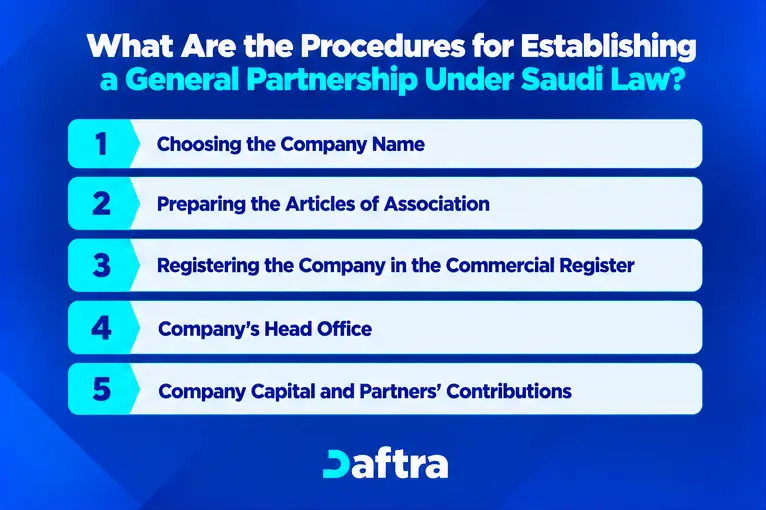
1. Choosing the Company Name
Article 5 of the Companies Law allows a General Partnership to have a distinctive or innovative name, or a name that includes the name of one or more partners, provided the name includes the company's legal form, meaning "General Partnership" is added at the end.
2. Preparing the Articles of Association
The Articles of Association of the General Partnership should include the following information, in accordance with the new Saudi Companies Law:
- Names and details of the partners.
- Company name.
- Company's head office.
- Purpose of the company.
- Company's capital and each partner's contribution.
- Company's term, if it is established for a specific period.
- Company management and partners' resolutions.
- Profit and loss distribution mechanism.
- Start and end dates of the fiscal year.
- Provisions governing the dissolution of the company.
In addition to the above, the Articles of Association may include any terms or provisions agreed upon by all partners, provided that they do not violate the law.
3. Registering the Company in the Commercial Register
This is completed by submitting a unified electronic application through the Saudi Business Center platform. The partners upload the Articles of Association and provide their approval through National Unified Access (Nafath). The Commercial Register and certified Articles of Association are then issued subject to unified fees.
4. Company's Head Office
The General Partnership's head office must be located in the Kingdom of Saudi Arabia.
5. Company Capital and Partners' Contributions
There are several forms of partnership contributions. A partner's contribution may be in cash, in kind, or a combination of both.
Read Also: How to Start a Business in Saudi Arabia: A Step-by-Step Guide
What Are the Procedures for Establishing a General Partnership Under Egyptian Law?
After explaining the procedures for establishing a General Partnership in Saudi Arabia, the procedures for establishing one in Egypt are as follows:
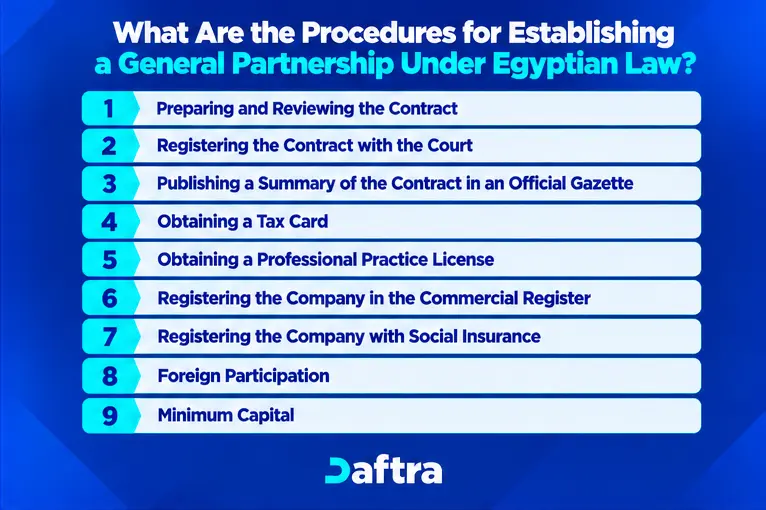
1. Preparing and Reviewing the Contract
The company's contract includes the basic information required for registration, along with any other provisions the partners agree to under the law.
The commercial contract must then be authenticated by having it reviewed and stamped "Valid for Registration" by the Commercial Register office responsible for the company's head office.
2. Registering the Contract with the Court
After the Commercial Register reviews the contract and confirms its validity for registration, the contract is registered with the competent Court of First Instance serving the company's head office.
3. Publishing a Summary of the Contract in an Official Gazette
The partners are required to publish a summary of the General Partnership contract in an official daily newspaper as a form of public disclosure.
4. Obtaining a Tax Card
To obtain a tax card, the company must visit the tax office responsible for its head office and submit an application to obtain a tax card and open a tax file, along with the following documents:
- A copy of the company's contract.
- A copy of the property's lease agreement or proof of ownership.
- Copies of the partners' national ID cards.
- An electricity bill.
5. Obtaining a Professional Practice License
To obtain a professional practice license, the company must visit the Chamber of Commerce responsible for its head office and submit an application for a professional practice certificate, along with the following documents:
- A copy of the company's contract.
- A copy of the property's lease agreement or proof of ownership.
- Copies of the partners' national ID cards.
- Criminal record certificates for the partners.
- Tax card.
- Electricity bill.
6. Registering the Company in the Commercial Register
After obtaining the documents mentioned above, the company must be registered in the Commercial Register by submitting two copies of the newspaper in which the contract summary was published, along with the original and a copy of the company contract, the contract summary, the professional practice license, and proof of identity.
7. Registering the Company with Social Insurance
The final step in establishing a General Partnership is opening an establishment insurance file. One partner submits the registration application personally or through an officially authorized representative, along with the tax card and proof of ownership or lease of the establishment.
8. Foreign Participation
Foreigners may participate with a 100% ownership interest, except in activities restricted to Egyptians. A general partner also acquires merchant status and legal capacity upon reaching age 21, or 18 if the court authorizes it.
9. Minimum Capital
According to Investment Law No. 72 of 2017, the minimum capital for a General Partnership is EGP 300,000, except for service activities carried out entirely within industrial zones and new urban communities, where the required capital is EGP 30,000.
The procedures outlined above represent the traditional process for establishing a General Partnership in Egypt. However, another, easier method eliminates the court and newspaper publication steps by accessing the website of the General Authority for Investment and Free Zones (GAFI) and uploading the required documents online, or by visiting an Investor Service Center. The contract can then be drafted and authenticated, while the Commercial Register and tax card can be obtained at the same time.
Thus, establishing a General Partnership in Egypt requires several legal and administrative steps, beginning with preparing the contract and ending with registering the company in the Commercial Register and enrolling it in the social insurance system, while complying with the applicable requirements to ensure the legality of the establishment and the validity of the procedures.
What Are the Procedures for Establishing a General Partnership Under Algerian Law?
Establishing a General Partnership in Algeria involves several stages, as follows:
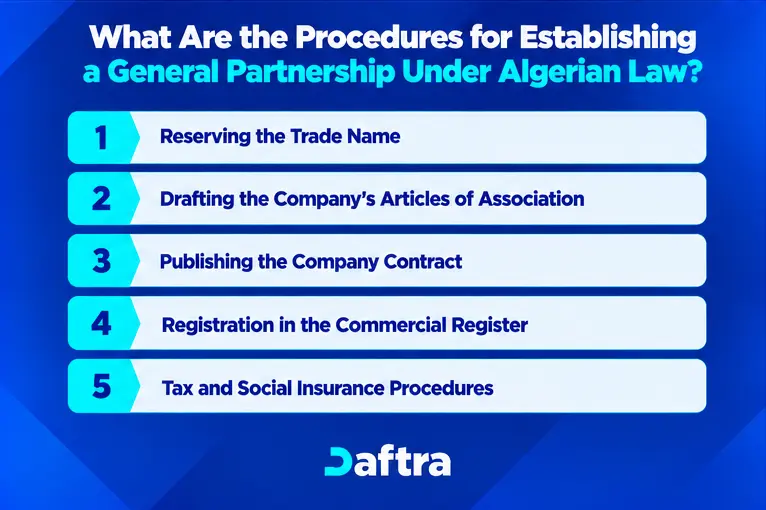
1. Reserving the Trade Name
The partners visit the National Center of the Commercial Register (CNRC) and obtain a certificate confirming that the proposed company name has not already been reserved.
2. Drafting the Company's Articles of Association
An accredited notary must draft and execute a formal company contract. The contract should include the following information:
- Identity of the partners.
- Purpose of the company.
- Head office.
- Appointment of a manager.
- Definition of powers and authorities.
- Deposit of capital.
3. Publishing the Company Contract
The notary or the partners publish a summary of the company's incorporation contract in a national daily newspaper or through the Official Bulletin of Legal Announcements (BOAL).
4. Registration in the Commercial Register
The company is registered through the Commercial Register authorities, after which the company's Commercial Register is issued.
5. Tax and Social Insurance Procedures
Within 30 days of obtaining the Commercial Register, the company must visit the tax inspectorate responsible for its head office to open a tax file and obtain a Tax Identification Number (NIF) and Statistical Identification Number.
The company must then register with the National Social Insurance Fund for employees and the relevant social insurance bodies.
What Are the Procedures for Establishing a General Partnership Under UAE Law?
Establishing a General Partnership in the United Arab Emirates involves a number of steps, including:

1. Basic Requirements
Partners must determine the number of partners, who must be UAE nationals, the capital, and the company name. The name must consist of the names of all the partners or the name of one of them followed by the words "and Partners."
2. Procedural Steps
Complete this step through the Ministry of Economy's One-Stop Shop system. The relevant Department of Economy determines the business activity and reserves the trade name through its website.
3. Initial Approval
The relevant local Department of Economy issues initial approval.
4. Drafting and Attesting the Articles of Association
The Articles of Association include all mandatory information, including the partners' names, their ownership interests, the management structure, and the distribution of profits and losses. The document is then authenticated electronically or in person before a notary public.
5. Establishing an Actual Business Premises
The company must have physical business premises. Accordingly, submit an authenticated lease agreement registered in the relevant emirate's smart system.
6. Approvals
Obtain the required approvals, as certain business activities require prior approval from specific ministries or government authorities.
7. Payment of Fees
Once the partners pay the unified invoice, the commercial license is automatically issued and registered in the country's Commercial Register, giving the company its legal personality.
8. Post-Incorporation Procedures
The company must register with the local Chamber of Commerce in the relevant emirate. It is also important to register with the Federal Tax Authority (FTA) to open a corporate tax file.
You may find it useful: How to Start a Business in UAE
What Are the Reasons for Liquidating a General Partnership?
A company's liquidation does not necessarily result from a dispute. Several general reasons may lead to the dissolution of different types of companies, including General Partnerships. These include:
- Expiration of the company's term, if the Articles of Association specified a term.
- The purpose for which the company was established no longer exists.
- The company cannot continue its business because of a loss of capital.
- Dissolution by operation of law following a court judgment for any reason.
- The unanimous agreement of the partners to dissolve the company.
Therefore, the liquidation of a General Partnership is not always related to disagreements or disputes between partners. It may simply result from the expiration of the company's term or the disappearance of the reason for its existence. The law specifies these circumstances clearly to regulate the dissolution process and protect the rights of all parties involved.
What Are the Cases in Which a General Partnership Is Dissolved?
With reference to the updated Saudi Companies Law governing General Partnerships, Article 50 sets out more precise rules concerning changes that may occur in relation to one of the partners, as follows:
What Are the Duties of a General Partnership Manager?
Local laws and regulations governing companies determine the duties of a general partnership manager. Although these laws may be similar on this point, the manager's duties generally include the following:
- The manager must comply with the powers and responsibilities assigned to them to achieve the company's objectives in accordance with:
- The company's internal regulations approved in accordance with the law.
- General statutory regulations.
- The company's Articles of Association.
- The manager must exercise due care and act in good faith to serve the company's objectives, applying their efforts and expertise in a manner that supports the company's interests and maximizes its value for partners and investors.
- The manager should design, test, and continuously improve operational processes, and implement them to achieve the highest possible quality. Managers can improve operational processes through Daftra Online Operations Management Software that lets businesses design, implement, and monitor operational and production processes, helping them gradually improve performance and achieve higher quality and efficiency.
- The manager should delegate tasks and responsibilities to appropriate employees.
- The manager must remain neutral and objective when making decisions, avoid personal interests, prioritize the company's interests, and avoid conflicts of interest.
- The manager should perform each task based on the knowledge and expertise available to them.
- The manager must refrain from performing any task that involves a direct or indirect interest in a competing company.
The manager must comply with these responsibilities to achieve the company's objectives, protect the partners' interests, ensure efficient business operations, and strengthen the company's stability and continuity in a competitive environment.
What Is the Difference Between a General Partnership and a Limited Partnership?
The difference between a General Partnership and a Limited Partnership is primarily reflected in the nature of their partners. A General Partnership consists only of general partners, whereas a Limited Partnership consists of two types of partners: general partners and limited partners.
What, then, is the difference between a general partner and a limited partner in a Limited Partnership?
What Is the Difference Between a General Partnership and a Partnership Limited by Shares?
The difference between a General Partnership and a Limited Partnership is broadly similar to the difference between a General Partnership and a Partnership Limited by Shares. The distinction also lies in the nature of the partners.
A Partnership Limited by Shares consists of one or more general partners alongside one or more shareholder partners, whereas a General Partnership consists solely of general partners.
The difference between a general partner and a shareholder partner can be summarized in four key points:
- Transfer of Ownership Interest: A general partner may not transfer or sell their interest in the company without the consent of the other general partners, whereas a shareholder partner may sell or transfer their interest to a third party.
- Liability for Company Debts: A general partner may be personally liable for the company's debts, whereas a shareholder partner's liability is limited to their ownership interest and does not extend to their personal assets.
- In the Event of Death: If a general partner dies, the company is dissolved unless the Articles of Association provide otherwise. In contrast, the company does not dissolve upon the death of a shareholder partner, and their heirs replace them.
- Company Management: Only general partners manage the company, and shareholder partners have no right to interfere in its management.
In general, the rules applicable to general partners in partnerships apply to general partners in a Partnership Limited by Shares, while the rules applicable to shareholders in companies apply to shareholder partners. Therefore, a Partnership Limited by Shares is a hybrid form that combines characteristics of both capital companies and partnerships.
How Did Daftra Unify the Data of a General Partnership with Multiple Partners?
How Can You Manage a General Partnership Using Daftra?
Use Daftra to manage your general partnership, allowing partners to monitor the business together and achieve better results through joint decisions based on an analysis of the company's performance.
Therefore, after establishing your company, we invite you to use Daftra to manage your business and support its success in the business world.
Daftra provides everything you need to manage your business, starting with inventory, purchases, sales, and point-of-sale operations, through financial management, employee management, and accounting processes, and ending with periodic performance reports that support sound decision-making.
Frequently Asked Questions
What Does a General Partnership Mean?
A General Partnership is a company formed by two or more natural persons who are jointly liable for the company's obligations with all their assets. This liability extends to their personal assets and is not limited to their respective capital contributions.
What Is the Law Governing General Partnerships?
The law governing General Partnerships provides that all partners are jointly liable for the company's debts. To clarify, Article 22 of the Commercial Law states that partners in a General Partnership are jointly liable for all of the company's financial obligations, including debts and potential losses.
Does a Partner in a General Partnership Acquire Merchant Status?
Yes. A partner in a General Partnership acquires merchant status, meaning they are subject to the obligations that apply to merchants. Accordingly, government employees in Saudi Arabia may not join General Partnerships as partners.
Can One Partner Decide to Admit a New Partner to the Company?
No. A partner may not transfer their interest in the company or admit a new partner unless all partners approve. An exception applies if the company's Articles of Association allow the transfer of an interest or the admission of a new partner.
What Happens to a General Partnership if One of the Partners Dies?
According to the updates introduced under the new Companies Law, Article 42 provides the following:
- The company continues operating after one partner dies. The company values the deceased partner's interest and pays it in cash to the heirs without dissolving the company.
- The company may continue with the deceased partner's heirs, provided that the Articles of Association expressly provide for this and the heirs are legally eligible to participate. In other words, an heir must not be a minor or legally prohibited from engaging in commercial activities. If an heir is not eligible, their interest is converted into a limited partner's interest.
Is There a Minimum Capital Requirement for Establishing a General Partnership?
Saudi Arabia has no minimum capital requirement for establishing a general partnership. Partners can establish the company with any amount they agree upon.
Can the Company's Creditors Require a Partner to Pay the Company's Debts from Their Personal Assets?
Yes, provided that the partner has unlimited liability for the company's debts with all of their assets. Article 41 provides that the company's creditors may not claim the company's debts from a partner's personal assets until the company has been formally notified and requested to make payment and has been given a reasonable period to do so. If the company cannot pay, creditors may then seize the partners' personal assets to settle the debt.
How Much Capital Is Required for a General Partnership?
The minimum capital for partnerships in Egypt is EGP 300,000, except for service activities, which require EGP 30,000. Foreigners may participate in the company's capital, except in activities restricted to Egyptians.
What Are the Procedures for Establishing a General Partnership in Saudi Arabia?
To establish a General Partnership in Saudi Arabia, you need to:
- Complete the incorporation application electronically.
- Submit a copy of the national ID or residence permit for each partner.
- Prepare the Articles of Association, specifying the partners' details, capital, business activity, and profit-and-loss sharing ratios.
Who Makes Decisions in a General Partnership?
Partners' resolutions are generally passed by a numerical majority. However, amendments to the company's Articles of Association must be approved unanimously by all partners unless the Articles of Association provide otherwise.
How Are Profits Distributed in a General Partnership?
Each partner receives a return or interest on the amount they contributed to the company's capital as a form of fair compensation for investing their funds in the company.
After deducting interest on the capital contributions, the remaining profits or losses are distributed among the partners according to their prior agreement, either in proportion to their capital contributions or according to a specific ratio agreed upon in the company's contract.
Use the Percentage Calculator to calculate each partner's share of the company's profit.
What Is the Difference Between a General Partnership and a Limited Liability Company?
In a General Partnership, partners have unlimited liability for the company's debts and obligations, meaning their personal assets may be used to settle the company's debts if it cannot pay.
In contrast, in a Limited Liability Company (LLC), the partners' liability is generally limited to the value of their respective capital contributions.
What Is a Partner's Liability in a General Partnership?
A partner's liability in a General Partnership is unlimited. A partner is personally liable for all of the company's debts and obligations, and creditors may use their personal assets to settle these debts if the company's assets are insufficient.
Liability is also joint among the partners, meaning each partner may be liable for the company's entire debt, not just the portion corresponding to their capital contribution.
What Is the Difference Between a General Partnership and a Joint-Stock Company?
A General Partnership is a partnership based on the personal status of its partners, who are liable for the company's debts. The partners manage the company, and there is no minimum capital requirement.
A Joint-Stock Company (JSC), by contrast, is a capital company whose capital is divided into shares. The shareholders' liability is limited to the value of their respective shareholdings. Establishing a Joint-Stock Company requires a minimum capital amount set by applicable national law, and the company is managed by a board or other corporate management structure.
Who Is a General Partner?
A general partner has unlimited personal liability for the company's debts and participates in its management and obligations.
What Are the Procedures for a Partner to Exit a General Partnership?
A partner may exit a general partnership under the partners' agreement, either by selling their interest or by transferring it to their heirs after death, with the relevant amendment registered in the Commercial Register.
What Provisions Should a General Partnership Agreement Include?
The General Partnership agreement should include the partners' personal details, the company's name and address, its business purpose, capital and the partners' respective contributions and the method of valuing them, the company's term, the management structure and the powers of the partners and managers, the fiscal year, profit and loss distribution, conditions for transferring ownership interests and admitting new partners, as well as the procedures for dissolving and liquidating the company.
What Are the Powers of a General Partner in a General Partnership?
A general partner can manage the company and dispose of its assets.
Who Represents a General Partnership?
All general partners legally represent the company before third parties.
Who Is Responsible for the Company's Debts in a General Partnership?
All general partners are jointly and unlimitedly liable for the company's debts.
Can a Partner's Interest in a General Partnership Be Pledged?
A partner's interest may be pledged, but it may not be sold or transferred without the consent of the other partners.
How Is the Manager of a General Partnership Removed?
The partners hold a meeting and decide by majority vote. If the partners agree to remove the manager, they notify the manager of the decision.











 Invoicing
 POS
 Offers
 Installments
 Sales Commission
 KSA E-Invoice Software
 EGY E-Invoice Software
 JO E-Invoice Software
 E-Invoice Software
 Chart of Accounts
 Asset Management
 Cost Centers
 Expenses
 Cheque Cycle
 UAE VAT-Tax
 Product Management
 Purchases
 Purchase Cycle
 Suppliers
 Requisitions
 Stocktaking
 Organizational Structure
 Personnel Management
 Attendance and Leave
 Contracts
 Payroll
 Requests
 Work Orders
 Booking Management
 Rental and Unit Management
 Time Tracking
 Work Flow
 Lease Contracts
 Manufacturing Management
 Client Follow-Up
 Loyalty Points
 Points and Credits
 Memberships
 Insurance Management
 Daftra ERP Full App
 Point of Sales App
 Point of Sales for Desktop – Support Offline Mode
 AI Expenses Scanner App
 Employee Attendance, Sign & ESS App
 E-invoice Reader App
 Inventory Stocktaking App