


How to Start a Business in UAE


Table of contents:
- Key Summary
- Mainland, Free Zone, or Offshore Which Setup Should You Choose?
- Choose the Right Business Activity and License Type
- Can Foreigners Own 100% of a Business in the UAE?
- Register the Trade Name and Get Initial Approval
- What to Do After Reserving Your Trade Name
- Prepare the Required Documents and Agreements
- Choose a Business Location or Office Setup
- Apply for Additional Approvals if Your Activity Requires Them
- Pay the Fees and Collect the Trade License
- How Much Does It Cost to Start a Business in the UAE?
- Can You Start a Low-Cost or Home-Based Business in the UAE?
- How to Solve Cash Flow Issues in UAE Businesses?
- What to Do After Getting Your UAE Business License?
- How Daftra Helps New UAE Businesses Start on the Right System?
- FAQs
UAE’s strategic location between Europe, Asia, and Africa, combined with world-class infrastructure and investor-friendly policies, has reinforced its reputation as a global commercial hub. T According to the UAE Cabinet confirmed that over 616,000 new companies were added to the country's markets between September 2020 and mid-2024, driven by progressive economic legislation and the overhaul of foreign ownership rules.
Starting a business in Dubai presents unparalleled opportunities for entrepreneurs in 2026, with the UAE now permitting 100% foreign ownership across most economic activities. This comprehensive guide navigates the complete business setup process, regulatory requirements, and strategic considerations for establishing your company in one of the world’s premier hubs.
Today, the regulatory framework in the UAE has advanced considerably, with reforms simplifying procedures for foreign companies establishing operations. Whether launching an enterprise focused on the local market or planning regional expansion, selecting the right jurisdiction is vital for long-term success.
Mainland, Free Zone, or Offshore: Which Setup Should You Choose?
Have you ever thought about starting a business in the UAE but get confused between the mainland, free zone, and offshore setups? You are not alone! With so many kinds of business available, it can get really tricky to know which one suits your needs best.
This guide provides an authoritative overview of the three primary business setup options: Mainland, Free Zone, and Offshore companies, focusing on financial and regulatory compliance.
Business Scope and Activities for Mainland, Free Zone, or Offshore
Allows you to do business anywhere in the UAE without geographical restrictions. Ideal for retail, contracting, and direct consumer services. Requires you to lease a physical office space and register a trade name with the Ministry of Economy & Tourism (MET) . Subject to the standard 9% Corporate Tax on taxable profits exceeding AED 375,000.
Considered highly prestigious for consumer-facing and B2B operations in the region. Immediate, direct access to the lucrative UAE market, including all Emirates. Minimal restrictions on the type or number of business activities that can be licensed under one entity (subject to approval).
Designed primarily for international trade, specialized industries (e.g., tech, media, healthcare), and doing business within the same for UAE Free Zone. Requires a registered address (such as a flexi-desk or dedicated office) within the Free Zone Authority. For TAX, you can benefit from a 0% Corporate Tax rate on qualifying income if you meet the criteria for a Qualifying Free Zone Person (QFZP), which involves maintaining adequate substance in the UAE and conducting specific business activities.
Streamlined setup process and administrative procedures governed by a single authority. Potential for 0% Corporate Tax on qualifying income, provided strict substance requirements are met. In addition, access to highly specialized industry clusters and world-class infrastructure (e.g., JAFZA for logistics, DMCC for trading).
Offshore Company
Strictly for international business and asset protection. You cannot conduct operational business or trade within the UAE. Not require a physical office lease; the registered agent provides the registered address. Entities are exempt from UAE corporate tax as long as they maintain no physical presence or commercial operations inside the UAE (no UAE nexus).
Advantages: Excellent vehicle for wealth management, international assets, and intellectual property holding. High degree of confidentiality, making it attractive for private investment structures. And minimal setup costs and zero ongoing office expenses.
| Aspect | Mainland Company | Free Zone Company | Offshore Company |
| Ownership | 100% foreign ownership allowed for most non-strategic sectors. | 100% foreign ownership standard. | 100% foreign ownership standard. |
| Market Scope | Unrestricted access to the entire UAE market. | Restricted to operating within the free zone or outside the UAE. Can sell to Mainland via a local distributor/agent. | Strictly prohibited from conducting business within the UAE. |
| VAT | Standard 5% VAT on all taxable supplies in the UAE market. | VAT status depends on whether the zone is a 'Designated Zone' for physical goods. Services are generally 5%. | VAT compliance is usually minimal unless assets are held in the UAE. |
| Audits | Mandatory audited financial statements required just for certain legal forms or meeting specific thresholds. | Mandatory annual audit submission to the Free Zone Authority is the norm. | Mandatory filing of accounts / financial statements with the registrar |
Choose the Right Business Activity and License Type
Today, obtaining a business license in the UAE is crucial for many reasons. Legitimizes a company, enabling it to operate within the legal framework of the local jurisdiction. safeguards consumers by ensuring that businesses meet specific standards and regulations, assuring quality and reliability. Additionally, a business license plays a vital role in the economy by facilitating tax collection, which further supports public services and infrastructure development.
Types of business licences in UAE
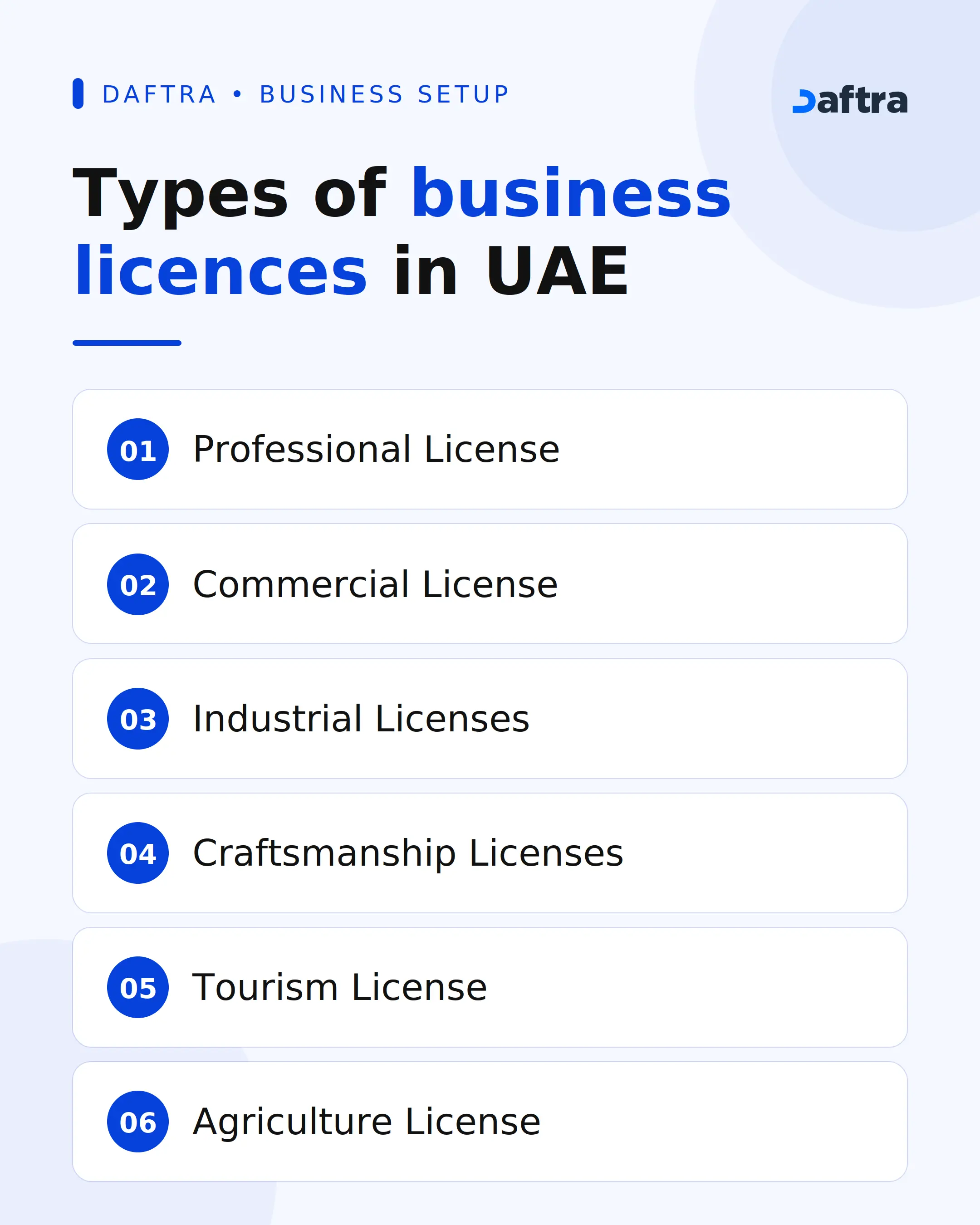
- Professional License: Granted to individuals and businesses providing services based on their specific skills and educational qualifications. This category covers a wide range of activities, including consultancy services, medical services, beauty salons, repair and security services, printing and publishing, and document clearing.
Note: a professional license allows foreign investors to attain 100% ownership of their businesses, providing a significant advantage.
- Commercial Licenses: Apply to companies engaged in commercial trade activities involving goods, commodities, and services. such as logistics, car rental, and real estate brokerage. Each license is limited to 10 tertiary activities related to the main business operation, emphasizing the need to determine specific activities before applying.
- Industrial Licenses: These licenses permit the assembly and processing of goods using locally sourced or imported raw materials. Industries requiring an industrial license include textile manufacturing, food production, metal processing, petroleum products manufacturing, and paper production. Mandatory for businesses involved in manufacturing or industrial activities.
- Craftsmanship Licenses: Issued to individuals or businesses involved in skilled manual labor such as plumbing, carpentry, and electrical work. Businesses that employ artisans for specific tasks must apply for this license to ensure adherence to professional standards.
- Tourism License: This license ensures adherence to the standards set forth by the Department of Tourism and Commerce Marketing. Required for businesses offering tourism-related services, such as hotel rentals, tourist camps, cruise boat rentals, restaurants, guesthouses, and travel agencies.
- Agriculture License: An agricultural license (especially in the Emirates of Sharjah and Ajman) is required for individuals or businesses engaged in agricultural activities, including crop cultivation, trading in pesticides and crops, installing greenhouses, and providing agricultural consultancy services.
Once you have made your decision, submit your application to the relevant Authority. The application form should include details of the proposed business name, the nature of the activities, and the business’s shareholders. The specific Authority will review your application, and upon approval, you will receive an initial approval certificate.
This allows you to proceed with other necessary arrangements, such as leasing business premises. Fulfill all requirements, and the Authority will issue your business license.
Decide the Legal Structure of the Business
Choosing a business structure in the UAE is the most critical foundational step, determining your ownership rights, tax obligations, and visa quotas. It determines how the business is recognized under UAE law, how it handles risk, and how funds move between the company and the owner. Here are the options:
- Limited Liability Company (LLC): An LLC combines limited liability with pass-through taxation. It’s a flexible structure LLCs could have one owner or many, and they can choose from flexible management arrangements and make optional tax elections. LLC can engage in any commercial or industrial activity.
- Sole proprietorship: When one person runs a business without forming a separate entity, it’s a sole proprietorship by default. This structure allows for 100% foreign ownership and full business control. It is the most straightforward structure for freelancers, consultants, and professionals.
- Private Joint Stock Company (PrJSC): Minimum share capital of AED 5 million. Large private investments, institutional funding, and family-owned enterprises looking for high operational credibility without the burden of public scrutiny.
- Public Joint Stock Company (PJSC): Minimum share capital of AED 30 million. Subject to Securities and Commodities Authority. Large-scale enterprises, financial services, insurance companies, and corporations planning an Initial Public Offering to raise substantial public capital.
- Civil Company: It is a business established by two or more partners to provide professional services. These partners use their educational qualifications, intellectual skills, or artistic talents to conduct business. The primary focus is on professional activities rather than commercial trade.
- Representative Office: Established by a foreign company to promote its products or services and conduct market research. It is not permitted to engage in commercial activities that generate revenue.
- Holding Company: Established specifically to hold assets, intellectual property, and shares in other companies. Subject to licensing requirements of the chosen jurisdiction, which vary by emirate and free zone.
- Branch of a Foreign Company: Operate as an extension of the parent company and is wholly owned by it. The parent company controls the UAE based operational activities of such a company. Facilitating expansion into the UAE market and leveraging the parent company’s resources and reputation.
Can Foreigners Own 100% of a Business in the UAE?
From 2021, mainland companies can also have 100% foreign ownership. The Ministry of Economy explains that full foreign ownership is available across all legal structures mentioned in the Commercial Companies Law, including Public Joint Stock Companies (PJSC), Private Joint Stock Companies (PrJSC), Limited Liability Companies (LLC), limited partnership companies and partnership companies, provided the underlying activities are permitted. This means that a UAE mainland LLC can now typically be 100% foreign‑owned, as can many other forms, provided they do not fall within specific restricted or strategic categories determined at the federal and emirate level.
Full foreign ownership does not apply to all activities; certain strategic or restricted sectors (such as defense, energy, telecommunications, oil and gas, nuclear activities, and security-related services) continue to require UAE participation under the applicable federal and emirate-level lists.
100% Foreign Ownership: Mainland vs. Free Zone
Mainland companies are licensed primarily by emirate‑level economic departments, whereas free zone authorities license free zone companies. Both are subject to federal laws, including the Commercial Companies Law (to varying degrees) and the federal Corporate Tax regime. Since 2021, the framework allows a foreign investor to generally achieve full ownership and direct management of a mainland company, similar to what is typically available in free zones, without the traditional local sponsor structure.
Register the Trade Name and Get Initial Approval
After you decide on the activity and legal form of your Business, you now have to register your business trade name.
Trade name reservation in UAE is the official process of securing the exclusive right to use a chosen business name. The Department of Economy and Tourism (DET) issues the trade name reservation certificate.
"Trade Name" Naming Rules
The UAE Government sets out mandatory provisions that every proposed trade name must satisfy. Ministry of Economy and Tourism (MoET) enforces these rules through automated screening systems that cross-check applications against existing registered names, trademark databases, and business activity classifications.
A compliant trade name must meet the following conditions:
- It must be compatible with the type of economic activity and the legal status of the business entity.
- It must be followed by the legal form abbreviation of the company, such as LLC, PJSC, or PrJSC.
- Not have been previously registered by another business for the same or a similar activity.
- It must not violate public morals or public order.
- It must not contain the names of any religion, governing authority, or the names or logos of external bodies.
- The name is transliterated between Arabic and English based on pronunciation. It is not translated.
- Alphabets and numbers are permitted, but icons and special characters are not allowed.
- Names beginning with terms such as "Universal," "International," or "Middle East" are restricted.
Step-by-Step Trade Name Reservation Process:
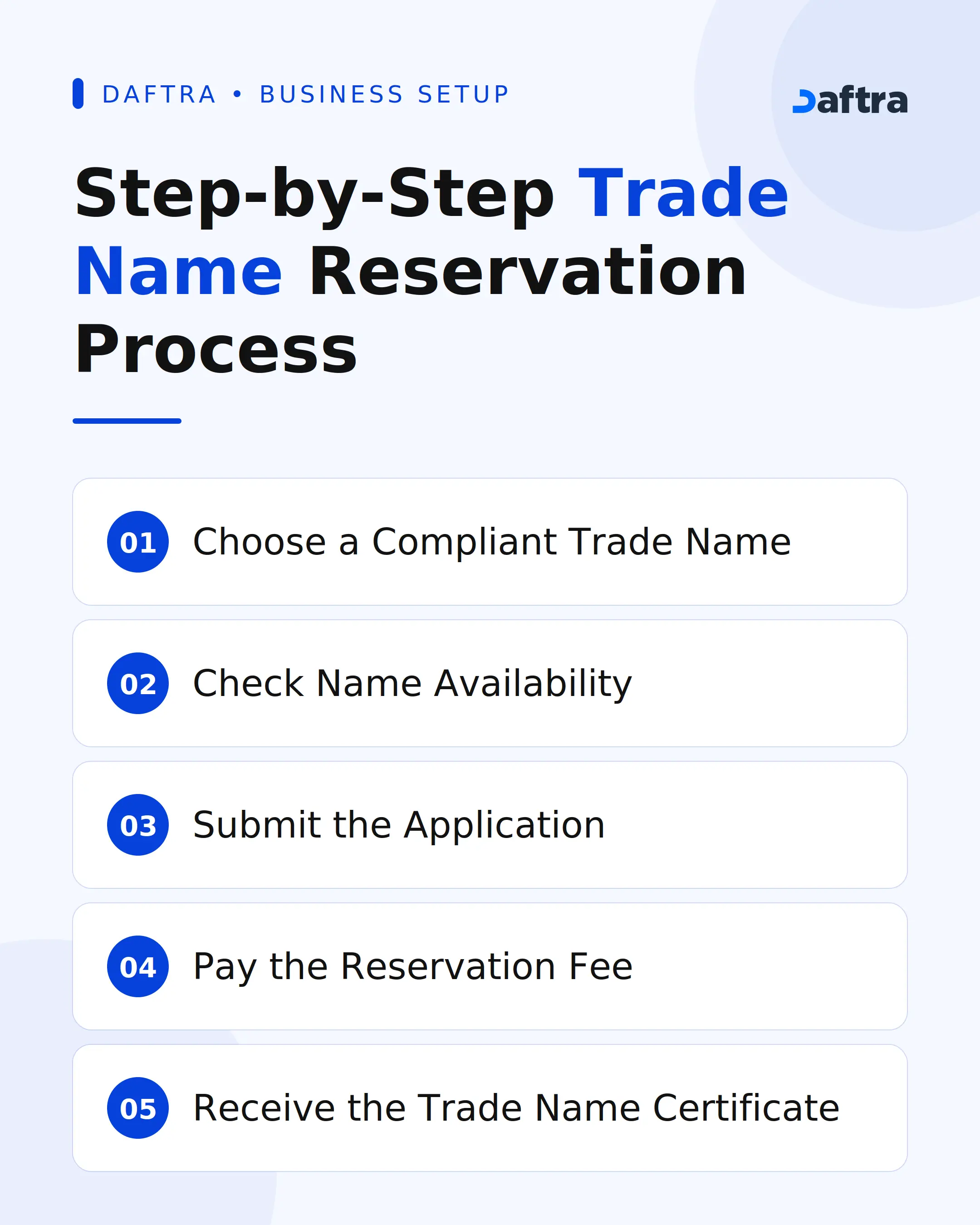
Trade name reservation can be completed through the MoET or Invest in Dubai portal or through an authorized government service centre.
Step 1: Choose a Compliant Trade Name:
Prepare a shortlist of three to five name options. Each name should reflect the intended business activity, comply with the MoET naming rules outlined above, and include the appropriate legal form suffix. Having multiple options reduces the risk of delays if the first choice is already registered.
Step 2: Check Name Availability:
MoET provides an online name search function through the Invest in Dubai or any UAE portal. The system checks the proposed name in both Arabic and English against existing registered names. The search is pronunciation-based, which means phonetically similar names may also be flagged.
Step 3: Submit the Application:
Log in to the Invest in Dubai portal or TAMM portal using UAE Pass or create an account. Navigate to the trade name reservation service, enter the proposed name in both Arabic and English, select the business activity, and upload the required documents. If applying through an authorized government service centre or Daftra, a consultant will prepare and submit the application through official UAE channels on your behalf.
Step 4 Pay the Reservation Fee:
The standard government fee for trade name reservation is AED 620, paid directly to DET in Dubai. Payment through the portal can be made by credit card, debit card, or ePay. Payment must be completed within 72 hours of the issuance of the payment authorization.
Step 5: Receive the Trade Name Certificate:
Once payment is confirmed, MoET issues the trade name reservation certificate. For standard names submitted through the portal, the certificate is generated within minutes. Complex applications or names requiring manual review may take up to 24 hours. The certificate confirms the approved trade name, the reservation number, and the expiry date.
What to Do After Reserving Your Trade Name
Apply for initial approval, which confirms that DET has no objection to the proposed business activity and structure. Prepare incorporation documents. For limited liability companies, this includes a notarised Memorandum of Association that specifies shareholders, capital, and the management structure. Secure business premises, you should hold a valid Tenancy Contract registered with Ejari (Only in Dubai), which is required for all mainland businesses. Free zone companies register their names through the respective free zone authority and follow separate naming guidelines.
Prepare the Required Documents and Agreements
Establishing a company in the UAE requires moving through specific registration phases such as trade name approval, preliminary clearance, and final licensing. The exact required documents and agreements depend on whether the company is located in Abu Dhabi, Dubai, or another Emirate, as well as the company’s ownership structure.
Initial Approval Receipt & Previously Submitted Documents
After submitting your trade name and business activity description, the licensing authority in the UAE issues an Initial Approval. This receipt confirms that the government has no objection to the establishment of the business and permits you to proceed with the legal and facility documentation. Keep this receipt along with all earlier submissions, such as passports, visa copies, and shareholder declarations, for the final licensing stage.
Lease Contract or Office & Facility Agreement
The UAE mandates that every registered business maintain a physical address.
| Mainland | Free Zone |
| You must provide a formal tenancy contract. In Dubai, this lease is legally registered and attested through the RERA Ejari system. | You will sign a facility agreement, which often takes the form of a flexible office, hot desk, or traditional warehouse lease. |
Memorandum of Association (MoA)
The MoA is a mandatory legal contract for multi-owner business entities such as a Limited Liability Company (LLC). It establishes the company's constitution and defines its name, operational objectives, share capital distribution, and shareholders' liabilities. This document must be drafted in both English and Arabic, and all shareholders must sign it before a Dubai Courts Notary Public or an approved private notary.
You can download: Memorandum of Association Template
Local Service Agent (LSA) Agreement
The LSA agreement (previously known as a Service Agent Agreement) is required for certain structures operating in the UAE mainland, primarily for Civil Companies or branches where non-GCC nationals require a Local Service Agent to represent them before administrative and governmental bodies. The LSA acts purely as a service provider for a fixed fee and does not hold ownership or equity in the company's financial operations.
Shareholder and Owner Documents
The required documents depend on whether the shareholder is an individual or a corporate entity:
Individual Shareholders: Clear passport copy with at least 6 months' validity, a copy of your UAE residence visa/entry stamp, passport-sized photographs, and a No Objection Certificate (NOC) if employed by another UAE sponsor. Non-residents may also need to provide proof of a home-country address or a bank reference letter.
Download: NOC Template UAE
Corporate Shareholders: If your company is owned by an existing parent company, you must provide a Board Resolution, a legalized Certificate of Incorporation, the parent company's Memorandum and Articles of Association, and an authorized Power of Attorney.
Required Agreements & Legal Documents
Foundational agreements outline the rules and operations of the business:
- Memorandum or Articles of Association: A legally binding constitution that states the company's legal name, business objectives, ownership percentages, share capital, and dispute resolution mechanisms.
- Tenancy Agreement: All UAE businesses must have a registered physical or virtual business address to obtain a license. This is documented via an Ejari contract for Mainland companies in the UAE or a facility/flexi-desk agreement for Free Zones.
Choose a Business Location or Office Setup
All UAE businesses must maintain a valid physical address to operate legally. Your location requirements will depend on your emirate, license type, business activity, and the authority governing your setup. So, there's no one office size that fits all businesses' solutions.
Download: Tenancy Contract Template
Mainland Businesses
Mainland companies must lease a dedicated commercial space that complies with the emirate's Department of Economic Development (DED) regulations, local zoning policies, and municipality standards. A prerequisite for trade license issuance, visa processing, and opening a corporate bank account. Some activities also require a minimum office area (for example, 30 m² for certain professional licenses).
Free Zone Businesses
Free zone companies always operate from an approved space within their specific zone. Requirements vary significantly by authority zones (such as DMCC or RAKEZ), which offer flexible arrangements like co-working spaces or virtual offices, while others require a dedicated physical unit. Always verify your chosen zone's office policy before committing.
Flexi-Desk and Virtual Office
These options provide a registered business address, mail handling, and a limited visa allocation, typically one to three visas. They suit certain low-footprint activities but are not universally accepted. Eligibility depends on your license type, business activity, and free zone authority rules. They are not a substitute for a physical office where regulations require one.
Warehouse and Industrial Space
Businesses involved in trading, manufacturing, or storage require purpose-zoned industrial space. Zones such as RAKEZ (Ras Al Khaimah) and AFZ (Ajman) offer dedicated industrial facilities with the necessary permits.
Can You Start from Home?
Home-based business licenses exist in certain emirates and under specific conditions, but this is not available across the board. Eligibility depends on the emirate, your activity type, license category, and the relevant authority's rules.
Apply for Additional Approvals if Your Activity Requires Them
Today in the UAE, most general services or consultancy activities are approved quickly; some business activities require extra permissions from specific government authorities.
Operating in any of these regulated sectors requires securing sector-specific No-Objection Certificates (NOCs) and permits from governing authorities prior to issuing your primary trade license. Because each of these activities poses distinct regulatory, national policy, safety, or compliance concerns, the UAE requires specific approvals from the following federal and local entities:
Business Activities That Require Government Approval
| Activity Type | Requires Approval From |
| Medical Clinics & Healthcare | Department of Health (DoH) |
| Tourism & Travel Agencies | Department of Tourism and Commerce Marketing (DTCM) |
| Insurance & Finance | Central Bank of UAE |
| Legal Consultancy | Dubai Legal Affairs Department |
| Car Rental / Limousine Services | Roads & Transport Authority (RTA) |
| Courier or Logistics | Emirates Post, RTA |
| Food Manufacturing / Trading | Dubai Municipality, Food Control Department |
| Telecommunications / Internet | Telecommunications and Digital Government Authority (TDRA) |
| Import / Export of Chemicals | Ministry of Climate Change & Environment |
| Security Services | Ministry of Interior |
| Fire Safety Products | Ministry of Interior Civil Defence, & Emirates Safety Laboratory (ESL) |
| Oil and Gas activities | Supreme Petroleum Council (SPC) |
Pay the Fees and Collect the Trade License
How Much Does It Cost to Start a Business in the UAE?
UAE business setup costs vary because no two companies are registered under the same conditions. The total cost of forming a company in the UAE depends on the jurisdiction, business activity, government approvals, license type, office requirement, and number of residence visas.
Understanding these factors upfront helps you estimate your investment accurately and avoid unexpected costs during setup or renewal.
| Cost Category | Typical Cost Range (AED) | Details |
| Trade License & Registration | AED 5,500 - AED +25,000 | One-time registration and annual license fees. Free zones offer budget packages. |
| Office & Workspace | AED 5,000 - AED +30,000 | Flexi-desks or co-working spaces are widely used for Free Zones, but Mainland requires mandatory physical space (Ejari). |
| Visa & Establishment Card | AED 3,000 - AED 5,000 (per visa) | Includes E-channel registration, establishment card issuance, medical tests, and Emirates ID processing. |
| Corporate Bank Assistance | AED 2,000 - AED 5,000 | Optional but highly recommended if using specialized agencies to fast-track account activation. |
| Corporate Tax & VAT Preparation | AED 3,000 - AED 7,000/year | Bookkeeping and mandatory FTA registration for businesses. |
Real Business Cost in 2026
- E-commerce Startup: RAKEZ trading license at AED 6,500, shared office at AED 15,000, three visas at AED 10,500, customs registration at AED 3,500, totaling AED 42,500 before inventory. Annual renewal costs AED 37,000.
- Mainland Trading: Dubai DED commercial license at AED 18,000, Deira office at AED 42,000 annually, service agent at AED 8,000, two visas at AED 7,000, totaling AED 111,620 first year. This structure enables government contract bidding.
- Solo Consultant: IFZA professional license at AED 7,500, one visa at AED 3,500, health insurance at AED 1,200, and basic services totaling AED 18,870 in the first year. Annual costs drop to AED 12,500.
- Offshore Holding: RAK ICC registration at AED 9,000, registered agent at AED 3,500, nominee services at AED 5,000, totaling AED 30,000. No visas permitted. Annual maintenance drops to AED 17,500.
Can You Start a Low-Cost or Home-Based Business in the UAE?
Yes, launching a low-cost or home-based business in the UAE is 100% legal and highly accessible. You can easily start from home with affordable remote licensing solutions such as Free Zone freelance permits or DED "eTrader" packages.
Practical Low-Cost Setup Clarification You Need to Know
- License Type: Choose between a Freelance Permit or a Professional Services License, as they require significantly lower initial capital than standard commercial or industrial licenses.
- Skip the Physical Office: Low-cost setups rely on flexi-desks or virtual office packages, completely eliminating traditional commercial leasing costs.
- Jurisdiction Matters: Free zones (e.g., IFZA, Shams, Dubai South, Ajman Free Zone) offer the most competitive rates, with packages often starting at AED 5,500-7,500 for a single license.
How to Solve Cash Flow Issues in UAE Businesses?
Solving cash flow issues can mean operating as a profitable project on paper only, yet still failing due to liquidity crunches. You can solve and prevent these issues through:
- Leverage automated business spending platforms (Such as Daftra) to track company expenditures in real time, audit unnecessary costs, and prevent budget leaks.
- Because UAE clients frequently utilize 30 to 90 days payment terms, structure your accounts carefully. Offer early-payment discounts to customers and secure from 60 to 90 days' terms with your own suppliers.
- Separate your personal and business finances strictly. Furthermore, if you are VAT-registered, ensure that the 5% VAT collected from sales is placed in a separate holding account so that quarterly filing doesn't create a surprise deficit.
What to Do After Getting Your UAE Business License?
Getting your UAE business license is a major milestone, but it is just the beginning. To begin with, to operate legally and avoid heavy penalties, businesses must complete several post-license tasks in 2026. In fact, the UAE has introduced stricter compliance systems, meaning that missing even a small step can result in fines or, in some cases, operational blocks.
Daftra will guide you in this post-license checklist to ensure your business remains 100% compliant and ready for growth:
- Register for Corporate Tax: Registration for Corporate Tax is compulsory for all UAE businesses, even if you are not making profits. The deadline is within 3 months of license issuance. However, failure to comply may result in a penalty of AED 10,000 for late registration.
Filing Rule: Always become after registration, you should submit your tax return within 9 months following the end of your financial year.
- Submit Ultimate Beneficial Ownership (UBO) Declaration: Is a mandatory compliance step for new UAE companies. You must complete this filing through your licensing authority within 60 days of license issuance. The UBO declaration process requires tracing company ownership until you identify the natural persons who ultimately own or control 25% or more of your business.
- Open a Corporate Bank Account: Most critical step after receiving your UAE business license. To successfully establish your account, you have to gather your incorporation documents, meet strict KYC (Know Your Customer) standards, and pass the bank’s compliance reviews.
Select a bank that aligns with your business activities and expected minimum balance requirements (which typically range from AED 25,000 to AED 150,000).
Before you apply, prepare a complete set of physical and digital documents:
- Copy of your official Trade License and Memorandum & Articles of Association.
- Clear passport copies, valid UAE visas, and Emirates IDs for all partners and authorized signatories.
- A valid office lease or tenancy agreement (e.g., Ejari in Dubai).
- A detailed business plan or company profile outlining your projected turnover, business model, and source of funds.
- An official board resolution explicitly authorizing the opening of the corporate account.
- Register for VAT & Prepare for E-Invoicing
After getting your UAE business license, your immediate priorities are to register for VAT and prepare for the UAE e-Invoicing mandate. These steps ensure compliance with Federal Tax Authority (FTA) regulations and help avoid hefty fines.
In the UAE, you must register for VAT if your taxable supplies and imports exceed the mandatory threshold of AED 375,000. You can also choose voluntary registration if your supplies exceed AED 187,500.
You should partner with a UAE-accredited provider that integrates with your ERP / accounting system and supports the Peppol network. In addition, ensure your invoicing software is updated to generate mandatory data fields.
Daftra works closely with government authorities in the UAE, helping businesses simplify their invoicing with e-invoice software designed to create, manage, and organize invoices with ease.
- Register on goAML (If Applicable)
Registering your new UAE business on goAML is mandatory for certain sectors to combat money laundering and terrorism financing. If your business falls into regulated categories like real estate, auditing, accounting, or precious metals trading (DNFBPs), you must register with the UAE Financial Intelligence Unit (FIU) to avoid penalties.
Registration is a two-stage process
Step 1: SACM Registration: Visit the UAE Financial Intelligence Unit portal or your relevant Supervisory Authority portal (such as the Ministry of Economy). Register in the SACM (Service Access Control Manager) system to create an organization profile.
Step 2: Go to the goAML Platform. Log in using the SACM username and the passcode from your Google Authenticator app. Click "Register as a New Organization" and select "Reporting Entity". Fill in your trade license number, business activity codes, and Compliance Officer details. Upload your merged PDF document and submit. The FIU will review and approve your application within 5-10 working days, at which point you will receive your unique Organization ID.
- Set up the Establishment Card and Labor File
Your Establishment Card (also known as the Immigration Card or Company Card) essentially registers your business with the UAE immigration authorities. Think of it as opening your company’s immigration file. You cannot hire staff or apply for a single residence visa without it.
You can apply through the Federal Authority for Identity, Citizenship, Customs and Port Security), your specific Emirate's General Directorate of Residency and Foreigners Affairs, an authorized typing center, or your local Free Zone authority.
Once your Establishment Card is approved, you must register your company with the MOHRE. This creates a company file allowing you to manage employee contracts and visas. You can apply via the Ministry of Human Resources and Emiratisation portal or an authorized Tas'heel typing center.
How Daftra Helps New UAE Businesses Start on the Right System?
Download: Tax Invoice Format UAE – Word & Excel
FAQs:
How much does it cost to start a business in the UAE?
Starting a business in the UAE typically costs between AED 5,500 and AED 35,000+ for the first year. Prices vary widely depending on the chosen jurisdiction (Free Zone or Mainland), office requirements, and your number of business activities.
Which is the cheapest business license in the UAE?
The cheapest business licenses in the UAE are Freelance Permits and Zero-Visa Trade Licenses located in Free Zones across the Northern Emirates (Ajman, Umm Al Quwain, and Sharjah). These entry-level packages cater to remote workers and solo entrepreneurs who do not require physical office space or immediate residency visas.
Is 10K AED enough to start a business in the UAE?
Yes, 10,000 AED is enough to secure a basic business license in the UAE, but in general not sufficient to cover visas, physical office space, and operating expenses.
Can foreigners own 100% of a company in Dubai?
Yes, foreigners can own 100% of a company in Dubai. Under the amended UAE Commercial Companies Law, foreign investors are permitted full ownership of mainland Limited Liability Companies (LLCs) across thousands of commercial and industrial activities, eliminating the need for an Emirati partner.
Is it worth opening a business in Dubai?
Yes, opening a business in Dubai is generally worth it if your model leverages its strategic location, tax advantages, and affluent consumer base. However, success requires careful budgeting and understanding the city's complex setup costs and regulatory landscape.
Can I start a business from home in the UAE?
Yes, it is absolutely legal to start a business from home in the UAE. You do not need a traditional physical office space. Instead, you can use flexible alternatives like Virtual Offices, Flexi-Desks, or dedicated Home Business/Freelance Licenses to operate legally.
How do I start a small business in the UAE?
Starting a small business in the UAE requires choosing a jurisdiction (Mainland or Free Zone), deciding on your business activities, and selecting a legal form. You will register a trade name, secure initial approvals, obtain a trade license, and finally set up your corporate bank account and residency visas.
Which business is best for beginners in Dubai?
The best businesses for beginners in Dubai are service based or digital ventures such as, E-commerce, consultancy, and social media management. These require low startup capital, no physical inventory, and can be easily licensed from home through UAE Free Zones with zero personal income tax.
What is the easiest business to start in the UAE?
The easiest and most affordable businesses to start in the UAE are service-based businesses and freelancing (such as digital marketing, consulting, or tutoring). These require minimal initial investment, can be operated remotely, and have fast, streamlined licensing options.
What should I do after getting a UAE trade license?
After receiving your UAE trade license, you must establish a corporate bank account, secure your Establishment Card to sponsor visas, complete Corporate Tax and VAT registration with the FTA, and secure a valid office lease or Ejari.











 Invoicing
 POS
POS Offers
 Installments
 Sales Commission
 KSA E-Invoice Software
 EGY E-Invoice Software
 JO E-Invoice Software
 E-Invoice Software
 Chart of Accounts
 Asset Management
 Cost Centers
 Expenses
 Cheque Cycle
 UAE VAT-Tax
 Product Management
 Purchases
 Purchase Cycle
 Suppliers
 Requisitions
 Stocktaking
 Organizational Structure
 Personnel Management
 Attendance and Leave
 Contracts
 Payroll
 Requests
 Work Orders
 Booking Management
 Rental and Unit Management
 Time Tracking
 Work Flow
 Lease Contracts
 Manufacturing Management
  Client Follow-Up
 Loyalty Points
 Points and Credits
 Memberships
 Insurance Management
 Daftra ERP Full App
 Point of Sales App
 Point of Sales for Desktop – Support Offline Mode
 AI Expenses Scanner App
 Employee Attendance, Sign & ESS App
 E-invoice Reader App
 Inventory Stocktaking App