


How to Start a Business in Saudi Arabia: A Step-by-Step Guide

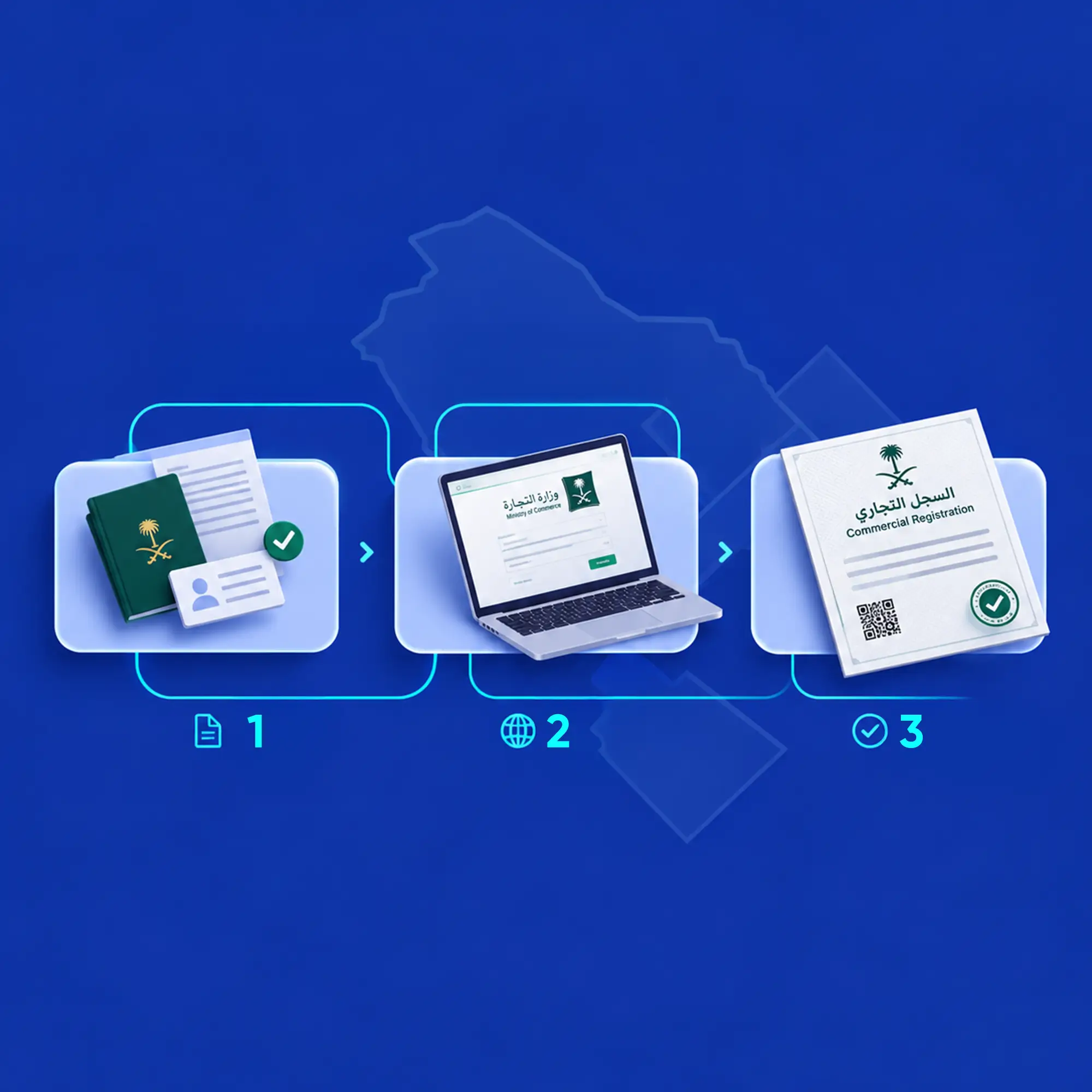
Table of contents:
- Key Summary
- Why Start a Business in Saudi Arabia?
- Steps for starting a business in Saudi Arabia
- How to start a business in Saudi Arabia for foreigners
- Types of Companies Foreigners Can Open in Saudi Arabia
- Taxes in Saudi Arabia An Overview
- Challenges When Starting a Business in Saudi Arabia and how to overcome them
- How does Daftra help you start a new business?
- FAQs
The Kingdom of Saudi Arabia is witnessing tremendous growth in the business sector. Vision 2030 aims to reduce the Kingdom's reliance on oil as its primary source of income by supporting commercial projects across various sectors. These projects are among the largest and most important sources of job creation, thus contributing significantly to reducing unemployment rates.
The Kingdom of Saudi Arabia aims to encourage foreign investment by simplifying tax procedures and facilitating the opening of commercial registrations, thereby attracting capital to the Saudi market and stimulating economic growth.
This article will explain why you should be interested in starting a business in Saudi Arabia, the most important steps to launching any business, the types of foreign companies that can operate in Saudi Arabia, and how you can overcome the most significant challenges you might face.
Why Start a Business in Saudi Arabia?
There are many advantages that make starting a business in Saudi Arabia extremely important for entrepreneurs:
First: Advantages for both investors (Saudi and foreign)
- A Strong Economy: One of Saudi Arabia's advantages is its robust economic stability. The Kingdom offers a secure investment environment thanks to the stability of the Saudi Riyal and its peg to the US Dollar, along with lower inflation rates than other markets.
- A Massive Digital Transformation: Saudi Arabia is moving to fully manage businesses and renew licenses electronically through various platforms such as Qiwa and Absher Business.
- A Strategic Location: The Kingdom's strategic location connecting three continents, along with its prominent position within the Gulf Cooperation Council, provides easy access to regional markets.
- Immense Purchasing Power: The Saudi market is considered a global market characterized by significant purchasing power and demographic diversity.
Second: Advantages for Saudi Investors
- The Kingdom of Saudi Arabia supports the business sector by providing the Monshaat platform, which offers various financing and advisory programs for Saudi citizens.
- The Saudi government prioritizes businesses owned by Saudi citizens, helping ensure a steady flow of projects.
- Facilitated loans are available through various banks, such as the Social Development Bank for startups.
Third: Advantages for Foreign Investors
- Full Ownership: The Saudi government allows full company ownership, eliminating the need for a Saudi guarantor or partner. This is demonstrated by the Ministry of Investment's license.
- Income Tax Exemption: The Kingdom grants any investor who owns a global company and relocates its regional headquarters to Riyadh a 30-year income tax exemption, not just for opening a regular branch.
- Significant Facilitation: The government offers substantial visa facilitation and streamlines the recruitment process.
- Customs Exemptions: Companies can be established in Special Economic Zones (SEZs), which offer customs exemptions and very low corporate taxes, potentially as low as 5% for some sectors.
- No guarantor required for Foreigners: Real estate can be owned without a guarantor, and special residency permits (investor residency) are granted to the investor and their family members.
Steps for starting a business in Saudi Arabia
To establish a business in the Kingdom of Saudi Arabia, there are standardized steps that go through three logical and essential stages, as follows:

Stage One: Pre-Establishment
This is the most important step, whether you are a Saudi or foreign investor. And it includes:
- Market Analysis: This involves precisely defining the target audience and their needs; analyzing direct and indirect competitors to identify their strengths and weaknesses; and assessing demand volume to confirm a market gap.
- Assessment of the Operational and Regulatory Environment: This entails verifying that the company’s or entity’s activities are not prohibited; identifying the government bodies that will oversee the project; determining minimum capital requirements; and ensuring an understanding of the mandatory Saudization quotas applicable to the specific sector.
- Preliminary Financial Study: This involves calculating setup costs, including licensing fees, permits, legal consultancy, and premises; estimating expenses for salaries, rent, and raw materials for a six-month period; and projecting potential revenues.
You might also find this helpful: Sales Growth Strategies and Methods for 2026
Stage Two: Legal and Sharia Establishment (Official Identity)
During this stage, your project is granted legal status, meaning it receives an official name in Saudi Arabia through the Saudi Business Center platform. The following steps are completed through the platform:
- Determining the company's legal structure: This involves deciding whether it is a sole proprietorship, a limited liability company, or a simplified joint-stock company.
- Reserving a trade name for the company's activities: This requires selecting a name that complies with the applicable terms and regulations.
- Documenting the company's articles of association: This includes defining the powers of the board members, the capital, and the number of shares.
- Issuing the commercial registration: This involves preparing the articles of incorporation, specifying the capital, and paying the fees if you are a Saudi investor. However, if you are a foreign investor, you need prior investment approval, legal entity documentation, securing a project site, and confirmation of identity and legal capacity.
Stage three: Government Registration
Once the commercial registration is issued, it is automatically linked to the government system to ensure compliance with tax obligations.
- Activate the national address by registering the official business location through the SPL platform, ensuring official correspondence is delivered to the establishment.
- Register with the Zakat, Tax and Customs Authority to open a zakat file and obtain a tax identification number.
- Open human resources files for the business to enable the establishment to issue work permits, hire employees, and manage contracts.
- Register with social insurance to ensure compliance with labor regulations and protect employee rights.
Important Note: To activate the three files (Zakat file, Human Resources files, and Social Insurance record), you only need the establishment's national address, bank account number, and authorized representative details, thanks to the smart electronic linking in the Kingdom and the unified invoice service.
Stage Three: Preparation and Operation
This is the final step before actually commencing sales or providing any services.
- Obtain a municipal license through the Baladi platform for establishments requiring a physical location, such as a shop, office, or warehouse, to ensure compliance with regulations.
- Obtain any required activity licenses by obtaining approval from supervisory authorities, such as the Food and Drug Authority for restaurants or the Communications Authority for technology projects.
- Open a business bank account to separate personal income from business income.
How to start a business in Saudi Arabia for foreigners
If you are a foreign investor wishing to start your business in Saudi Arabia, it is essential to complete the following steps before proceeding to the preceding stages:
Stage One: Pre-Establishment
Determine the type of investment license you need: The Ministry of Investment offers various licenses, allowing you to choose the one best suited to your business activity. The licenses offered by Saudi Arabia include:
- Industrial Investment License (IIL): covering industrial goods projects and factory construction
- Services Investment License (SIL): covering projects that provide services, consultations, contracting, or technical projects
- Commercial License(CIL): covering projects related to wholesale, retail, import, and export
Obtain an Investment License (MISA License): which you can easily obtain electronically through the Ministry of Investment. You will need to prepare the essential documents for your establishment, which include:
- A valid and approved commercial registration in the country of origin
- A comprehensive memorandum of association including all amendments made to the company
- Audited financial statements of the establishment
- An official resolution from the partners or board of directors expressing their desire to invest in the Kingdom of Saudi Arabia
- Copies of the passports of the owners, shareholders, and proposed managers of the establishment
- A business plan.
Please note that all documents must be translated and certified by the Ministry of Foreign Affairs and then the Saudi Embassy.
- Demonstrate your financial solvency and disclose your capital: Some licenses require a specific capital deposit with an approved bank, or you can provide financial statements from your parent company to prove your ability to conduct business.
- Obtain the necessary security clearances and documentation by verifying identities and official documents: This ensures their authentication by the Saudi embassy outside the Kingdom and the Ministry of Foreign Affairs in the investor's country.
Stage Two: Post-Establishment
- Select the General Manager and activate their visa.
- Apply for Premium Residency, which grants investors numerous benefits, such as exemption from certain establishment fees, as well as freedom of movement and ownership without requiring a sponsor.
- Activate membership in the Chamber of Commerce registered in the city of the headquarters to enable the authentication of all commercial transactions from abroad.
- Complying with and adhering to the gradual Saudization laws regarding the employment of Saudi nationals.
Types of Companies Foreigners Can Open in Saudi Arabia
The Saudi legal system provides various flexible legal structures to enable foreign investors to establish new businesses or acquire full ownership in most sectors.
Below, we outline the entities in which you, as a foreign investor, can invest in Saudi Arabia.

Taxes in Saudi Arabia: An Overview
The tax system in Saudi Arabia is one of the most straightforward. The Saudi tax system is designed to support businesses by reducing the burdens they may face in their initial stages.
Below, we present the tax and zakat obligations that you will face as a business owner in Saudi Arabia:
First: If you are a Saudi investor or a member of the Gulf states

Zakat
The legal zakat rate applies to Saudi business owners and those who belong to one of the Gulf countries, and they are exempt from income tax. The zakat rate is 2.5% annually of the total capital, profits, and net profits after deducting fixed assets
Value added tax
It is 15% and is imposed on most goods. It is mandatory if your annual revenue reaches 375,000 SAR.
You can optionally apply it if the annual revenue reaches 187,000 SAR
Use our free VAT calculator to easily calculate its amount in the KSA.
Real estate transaction tax
Its value is 5%, which is obligatorily imposed on the total value of real estate when ownership is transferred or sold
Excise tax
It is a tax imposed at specific rates on some goods, such as goods that are harmful to health or entertainment goods (Such as cigarettes or energy drinks)
Second: If you are a foreign investor
In addition to paying value-added tax, Real estate transaction tax, and Excise tax, as a foreign investor you will also be required to pay income tax as follows:
Read Also: Tax Exemption in Saudi Arabia: Meaning, Types & How To Apply
Challenges When Starting a Business in Saudi Arabia and how to overcome them
As usual with any new project you want to start, there are a number of challenges that you will face if you want to start a new business in the Kingdom of Saudi Arabia.
Below, we review the most important challenges you will face and how to solve them:
1- Capital and financing
In the beginning, it may be difficult to obtain the financing or bank loan you need to start a business in Saudi Arabia.
But you can solve this challenge by:
- Visit the Monshaat platform, which provides advice and offers appropriate financing solutions.
- Take advantage of the Kafalah program, which aims to guarantee your bank financing.
- Search for investment funds that are widely spread in the Kingdom.
2- Obtaining licenses and completing government procedures
This challenge lies in the presence of some complications that you will face when you want to obtain the documents and records necessary to start your business
But you can meet this challenge by:
- Take advantage of the Saudi Business Platform, which ensures that all licenses are completed electronically quickly.
- Use the Balady platform to obtain a commercial activity license easily.
- Take advantage of the Saudi Investment Center to unify the specialized authorities in one place.
3- Attracting talent
This challenge lies in your commitment to Saudi Arabia's employment rates, as well as in finding qualified cadres.
But you can meet this challenge by:
- Use the Qiwa platform to manage and document contracts, and process visas with ease.
- Take advantage of the Hadaf platform to support and train Saudi employees
If you are a foreign investor who wants to start your business in Saudi Arabia, there are some additional challenges that should draw your attention, which are:
- Authentication of international documents: As a foreign investor, you need to obtain all documents and certificates from the Saudi embassy abroad and then authenticate them with the Saudi Foreign Ministry in the Kingdom before starting your commercial activity.
- Understanding the Saudi culture of consumption: You must understand Saudi customer behavior, purchasing patterns, and how they have changed so you can attract their interest in your business.
How does Daftra help you start a new business?
Daftra accounting software can provide significant support to aspiring entrepreneurs looking to start their businesses in Saudi Arabia, for both Saudis and foreigners, through the following:
- Full compliance with Zakat, Tax and Customs Authority requirements: Daftra adheres to the requirements for electronic invoicing in Phases 1 and 2 and adds a QR code to protect your business from fines or penalties. Daftra also automatically calculates Zakat and taxes through its system.
- Management of employee payroll and staff: Daftra can manage your employees' salaries, calculating wages and allowances in full compliance with the Saudi Wage Protection Program. It also makes it easy to manage employee contracts, working hours, and shifts.
- Financial and accounting management: Daftra can handle all your accounting without requiring you to hire an accounting team. It calculates daily entries, manages cost centers, and generates profit-and-loss reports.
- Comprehensive Inventory Management: Daftra provides real-time inventory tracking for your business and full point-of-sale (POS) support.
- Complete Support for Over 50 Businesses: Daftra offers flexibility and high-level support through customization, allowing you to tailor the system interface to your specific business requirements.
FAQs:
Which business is best to start in Saudi Arabia?
There is no single best project to start if you are a new investor in Saudi Arabia. The best project depends on your capital, your experience in the Saudi market, and the appropriate area for your activity in Saudi Arabia.
But if we look closely, there are a number of projects that support Vision 2030 in the Kingdom, including:
- Contracting and maintenance
- Logistics services
- Education and professional development
The reason for this is the huge demand from major projects within the Kingdom, such as NEOM, Qiddiya, and the New Square
What are the top 3 most profitable businesses?
The most profitable projects in the Kingdom of Saudi Arabia are the following:
- Financial technology
- Luxury hotel and tourism projects
- Food
These activities are characterized by huge profit margins and a great ability to expand
What business will boom in 2027?
Among the most prosperous projects in 2027 in the Kingdom of Saudi Arabia are the following:
- Artificial intelligence solutions
- Cloud computing
- Recycling
Because of its conformity with the Kingdom’s objectives in the sector of environmentally friendly technologies and systems.












 Invoicing
 POS
POS Offers
 Installments
 Sales Commission
 KSA E-Invoice Software
 EGY E-Invoice Software
 JO E-Invoice Software
 E-Invoice Software
 Chart of Accounts
 Asset Management
 Cost Centers
 Expenses
 Cheque Cycle
 UAE VAT-Tax
 Product Management
 Purchases
 Purchase Cycle
 Suppliers
 Requisitions
 Stocktaking
 Organizational Structure
 Personnel Management
 Attendance and Leave
 Contracts
 Payroll
 Requests
 Work Orders
 Booking Management
 Rental and Unit Management
 Time Tracking
 Work Flow
 Lease Contracts
 Manufacturing Management
  Client Follow-Up
 Loyalty Points
 Points and Credits
 Memberships
 Insurance Management
 Daftra ERP Full App
 Point of Sales App
 Point of Sales for Desktop – Support Offline Mode
 AI Expenses Scanner App
 Employee Attendance, Sign & ESS App
 E-invoice Reader App
 Inventory Stocktaking App