


How to Calculate VAT in Saudi Arabia: A Complete Guide


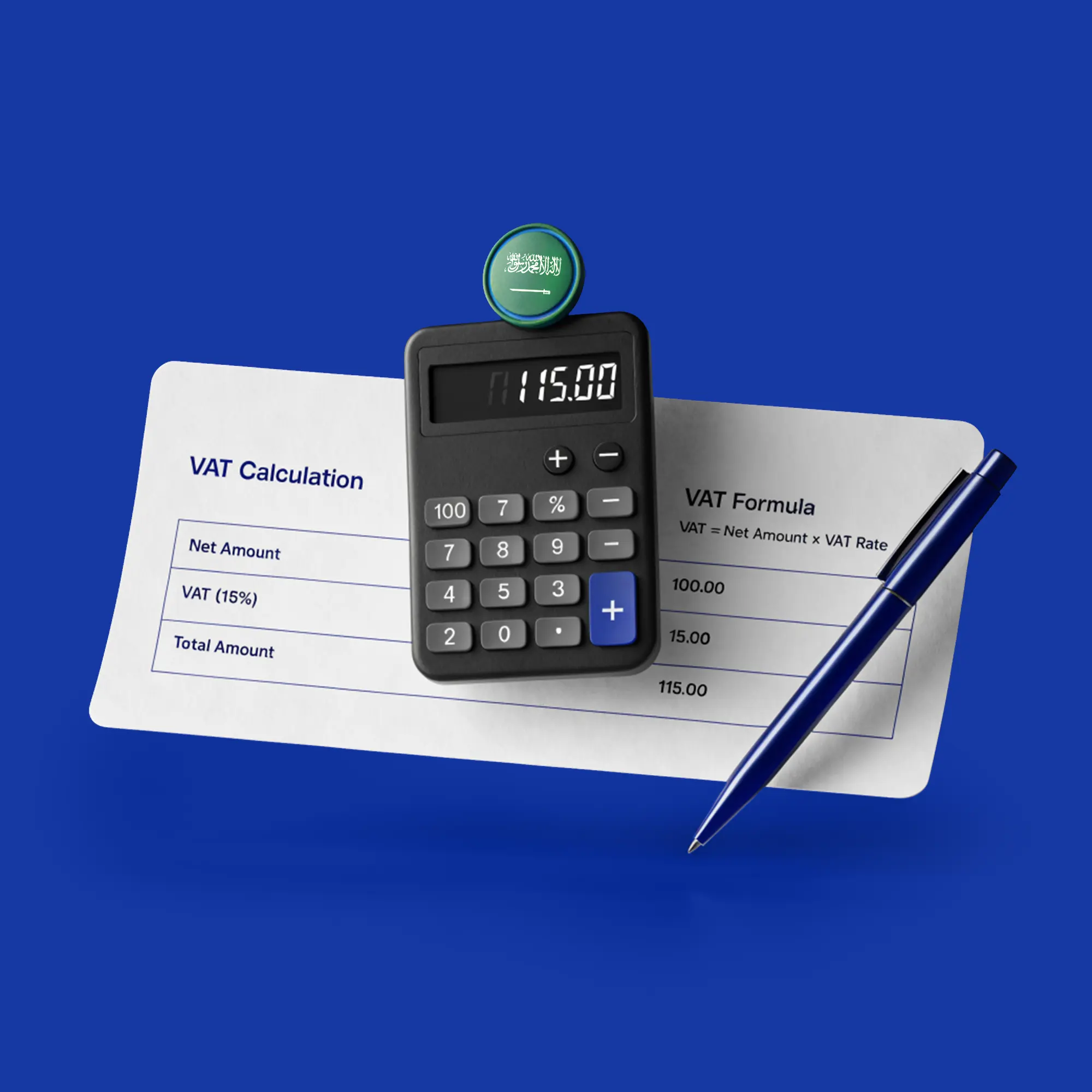
Table of contents:
- Key Summary
- How to Calculate 15% VAT
- How to Calculate Selling Price Including VAT
- How to Calculate VAT From the Total Amount
- How to Calculate the Price Before VAT
- How to Calculate Input and Output VAT in Saudi Arabia
- Common VAT Calculation Mistakes
- How Daftra Helps You Calculate VAT Accurately in Saudi Arabia
- Faqs
Calculating Value Added Tax (VAT) may seem simple at first glance, but applying it correctly requires knowing whether the price includes or excludes tax, how to calculate the tax on sales and purchases, and how to determine the net tax due. With VAT set at 15% in Saudi Arabia, accurate invoice calculation and issuance are crucial to avoid potential accounting errors and issues.
This article explains how to calculate VAT in Saudi Arabia, how to apply it to the total amount, and how to determine a product's value before tax, with practical examples to make the process clearer and easier.
How to Calculate 15% VAT
To calculate VAT in Saudi Arabia, you must first determine whether the displayed price includes or excludes tax. If the price excludes tax, it is calculated by multiplying the taxable amount by 0.15 and then adding the tax amount to the original price. This gives the total price including tax.
The following formula is used:
VAT = Amount × 15%
Formula for calculating the price inclusive of tax:
Price inclusive of tax = Price before tax + VAT
How to Calculate Selling Price Including VAT
To calculate the selling price including VAT, add 15% VAT to the pre-tax selling price. The following is the formula used to calculate the final amount the customer will pay:
Selling price including tax = Selling price before tax × 1.15
To make this clearer, here is a practical example to demonstrate how to calculate the final price:
If the price of the bag before adding VAT is 1000 SAR, then the selling price including VAT will be calculated as follows:
1000 × 1.15 = 1150 SAR
Therefore, the final selling price including VAT = 1150 SAR
How to Calculate VAT From the Total Amount
If the product price includes 15% VAT, the tax is not calculated by multiplying the total by 15%, as it is already included in the total price. Instead, the following formula is used to calculate the VAT from the total amount:
VAT Formula
VAT = Total Amount × 15 ÷ 115
Practical Example
Let's assume a customer's total invoice, including VAT, is SAR 1,150.
To calculate the VAT:
1150 × 15 ÷ 115 = 150
Therefore, the invoice details are as follows:
Why divide by 115? This is because the total price, including VAT, represents 115% of the price before tax, with the original price at 100% and VAT at an additional 15%.
Therefore, when calculating the tax amount from an inclusive sum, 15% is calculated on 115% of the total amount, not directly on 15% of the total invoice.
How to Calculate the Price Before VAT
There are some instances where the listed price of a product includes VAT, but you need to know the price of the product or service before adding the tax. In this case, the 15% tax is not deducted from the total price because the tax is calculated on the base price before tax, not on the total amount including tax.
To calculate the price before VAT, if the total amount includes the standard 15% tax rate, use the following formula:
Price before tax = Price including tax ÷ 1.15
Practical example:
Let's assume the price of a product on the invoice is 1150 SAR, including VAT, and you want to know the price before adding tax.
The calculation is as follows:
1150 ÷ 1.15 = 1,000 SAR
Therefore, the price of the product before adding VAT is 1,000 SAR, while the VAT amount is 150 SAR.
The total price after adding VAT is 1150 SAR
How to Calculate Input and Output VAT in Saudi Arabia
If an establishment is registered for Value Added Tax (VAT), the tax is dealt with through two main aspects: input tax, which is the tax borne by the establishment when purchasing taxable goods and services, and output tax, which is the tax collected from customers when selling taxable goods or providing taxable services.
The Zakat, Tax and Customs Authority has clarified that the current standard VAT rate in Saudi Arabia is 15%, with some supplies subject to a zero rate or other tax provisions.
First: Calculating Input Tax
Input tax is the tax paid by an establishment to its suppliers when purchasing goods or services for economic activity purposes, provided that the transaction is taxable and deductible according to the applicable rules.
To calculate input tax when applying the standard rate, the following formula can be used:
Input Tax = Value of Purchases Before Tax × 15%
Practical Example
If a business purchases goods worth SAR 20,000 before tax, the input tax is calculated as follows:
Input Tax = SAR 20,000 × 15% = SAR 3,000
Therefore:
Total Purchases = SAR 23,000
The input tax on these purchases is SAR 3,000. Note that the possibility of deducting input tax depends on meeting the applicable deduction requirements.
Second: Calculating Output Tax
Output tax is the value-added tax (VAT) that a business charges customers when selling taxable goods or providing taxable services.
To calculate it, the following formula is used:
Output Tax = Sales before tax × 15%
Practical Example
Suppose a business's sales during a specific period amounted to SAR 50,000 before tax.
The output tax is calculated as follows:
Output Tax = SAR 50,000 × 15% = SAR 7,500
Therefore:
Total sales including tax = SAR 57,500
Third: Calculating VAT Due
After determining the input and output taxes, the net VAT is calculated by subtracting the deductible input tax from the output tax. The result may be VAT due or a credit balance, depending on the applicable rules and regulations.
Equation:
VAT Due = Output Tax - Deductible Input Tax
Practical Example:
Then:
7,500 - 3,000 = SAR 4,500
Therefore, VAT Due = SAR 4,500
Common VAT Calculation Mistakes
Some of the most common mistakes when applying Value Added Tax (VAT) in Saudi Arabia include:
- Applying 15% to an amount inclusive of VAT: This is a very common mistake. The total amount inclusive of tax is multiplied by 15%, but it's essential to determine whether the price includes VAT and then use the appropriate formula to calculate the tax amount.
- Confusing the price inclusive of tax with the price before tax: Failing to distinguish between these two prices can lead to incorrect tax calculations, especially when preparing invoices or entering prices into the accounting system.
- Incorrectly calculating VAT when applying discounts: This is one of the most common mistakes, as many people calculate the tax on the price before the discount, while the correct way to calculate it is by calculating it on the net price after the discount.
- Using a 15% rate for all transactions without verification: Not all goods and services can be treated the same way. Some supplies are subject to a zero rate or special tax provisions. Therefore, the tax treatment must be determined first before any calculations are made.
- Confusing output tax and input tax: Net VAT can be calculated correctly, but errors may occur when recording or deducting purchase tax. A taxable person can deduct the input tax due, according to the applicable rules, from the output tax collected on taxable supplies.
- Incorrectly entering the invoice value or the taxable amount: A small error in the sale or purchase value can lead to a difference in the tax amount and thus affect the invoice total and tax return.
- Incorrectly rounding the tax amount: When dealing with decimals, use a consistent, accurate rounding method, especially in businesses that issue a large number of invoices, to minimize rounding discrepancies.
- Failure to review the tax amount shown on the invoice: Ensure that the invoice clearly states the amount due and the value-added tax (VAT), or that the price includes tax, as per the requirements of the tax invoice.
- Relying on manual calculations: Repeated manual calculations can increase the likelihood of errors in data entry or formula application, particularly in businesses with high sales volumes.
How Daftra Helps You Calculate VAT Accurately in Saudi Arabia
Through my experience with many clients, I encountered one who applied discounts and taxes in a different order on invoices, resulting in discrepancies in the tax amount. Upon reviewing the client's invoice cycle, I discovered the error stemmed from the calculation method.
Therefore, we started managing discounts and taxes through the Daftra system to solve this problem, instead of performing calculations separately. The system automatically calculates VAT based on invoice settings. It applies tax to the amount after the discount, helping standardize the calculation method and reduce errors and discrepancies that can occur during manual transactions.
Daftra allows you to apply discounts to invoices, either at the invoice level or per item, and specify the discount method. Tax is also automatically calculated and applied on the invoice according to the system's settings.
These capabilities help streamline the invoicing process and reduce the likelihood of tax discrepancies due to input errors or manual calculations, thereby facilitating the review of invoices and their associated data.
Daftra also allows a separate feature to add invoice deductions after tax calculation, highlighting the importance of specifying the discount processing method on the invoice based on the required situation.
Faqs
What Is the Standard VAT Rate in Saudi Arabia?
The basic rate of value-added tax in Saudi Arabia is 15%, with some supplies subject to a zero rate or an exemption under applicable provisions.
What Is the Formula for Calculating VAT?
If the price excludes VAT, the tax amount is calculated using the following formula:
VAT = Price before tax × 15%
How Do I Calculate VAT From the Gross Price?
If the price includes tax, the tax amount is calculated from the total amount using the following formula:
Tax amount = Total amount including tax × 15 ÷ 115
How Do I Calculate VAT on a Receipt?
If the total receipt includes VAT, the tax amount is calculated as follows:
Tax Amount = Receipt Total × 15 ÷ 115
However, if the total receipt does not include VAT, the tax amount is calculated as follows:
Tax Amount = Receipt Total Before Tax × 15%













 Invoicing
 POS
POS Offers
 Installments
 Sales Commission
 KSA E-Invoice Software
 EGY E-Invoice Software
 JO E-Invoice Software
 E-Invoice Software
 Chart of Accounts
 Asset Management
 Cost Centers
 Expenses
 Cheque Cycle
 UAE VAT-Tax
 Product Management
 Purchases
 Purchase Cycle
 Suppliers
 Requisitions
 Stocktaking
 Organizational Structure
 Personnel Management
 Attendance and Leave
 Contracts
 Payroll
 Requests
 Work Orders
 Booking Management
 Rental and Unit Management
 Time Tracking
 Work Flow
 Lease Contracts
 Manufacturing Management
  Client Follow-Up
 Loyalty Points
 Points and Credits
 Memberships
 Insurance Management
 Daftra ERP Full App
 Point of Sales App
 Point of Sales for Desktop – Support Offline Mode
 AI Expenses Scanner App
 Employee Attendance, Sign & ESS App
 E-invoice Reader App
 Inventory Stocktaking App