




Table of contents:
- Key Summary
- What is the sales budget estimate?
- Explanation of the sales budget estimate
- What are the importance and benefits of preparing the estimated budget?
- How to prepare the sales budget estimate
- What are the stages of preparing the estimated budget?
- A comprehensive practical example of preparing the estimated budget
- What is the difference between the estimated budget and the balance sheet?
- What are the elements of the estimated sales budget?
- What are the principles of preparing the estimated budget?
- How does Daftra help you in preparing the estimated budget?
- Frequently Asked Questions
Are you looking for a powerful financial tool that helps you manage your sales accurately? The answer is simple: it lies in the sales budget, which enables successful and effective financial management for your business. It is an essential accounting tool that enables business owners to set financial goals and plan for future revenue, profits, and expected positive cash flow.
In this regard, every company seeks to prepare an initial projection of its product sales volume each year, which helps it with sound financial planning for its operations. Therefore, in today’s article, we present a comprehensive guide to the sales budget, its importance, and the steps for preparing it, with practical application, to help you, as a business owner, make informed financial decisions that support your business performance.
What is the sales budget estimate?
The term sales budget estimate refers to a detailed statement of the expected sales a company will achieve during a specific period, based on the number of units sold and the selling price of each unit.
The sales budget is considered a planning tool that helps the company manage resources and forecast profits based on the set sales expectations.
The organization's management needs to understand the sales budget to assess production quality, and the sales budget must be as accurate as possible because the information it contains is used in the various other budgets prepared by the organization.
If the sales budget is inaccurate, it will result in errors in the other budgets' data.
When preparing the sales budget estimate, the sales levels achieved by the organization during similar time periods must be taken into consideration to reach the most accurate possible sales forecasts, which ultimately help the organization achieve its goals and generate the highest possible profits.
Explanation of the sales budget estimate
The sales budget estimate is one of the most important tools that help companies estimate their overall business performance, identify ways to increase the efficiency of using their various resources, and determine the amount of profit that may be achieved from selling a particular product.
It also helps set specific goals and achievements the organization seeks to accomplish, and it can determine whether it has achieved its goal by measuring how close it is to it, and identifying the actions that must be taken to improve business performance in the company.
Due to the difficulty of making accurate sales budget forecasts for a specific period, this budget can be adjusted quarterly and refined as necessary.
However, if any adjustments are made to the sales budget, a comprehensive review of the other company budgets must be conducted simultaneously, as the sales budget significantly affects them.
What are the importance and benefits of preparing the estimated budget?
The estimated budget is a highly important accounting and administrative tool in the business world, and the importance of preparing the estimated budget lies in the following factors:
Setting the organization’s priorities and objectives
The estimated budget helps set financial goals and work to achieve them by developing clear plans that analyze future sales and estimate expenses, enabling management to identify the required financial resources and make sound decisions that help ensure successful financial performance.
Achieving financial balance
With the estimated budget, the financial balance between revenues and expenses can be achieved, as it helps determine whether the company will achieve sufficient profits in the future or whether there is a need to develop other plans to reduce costs and increase sources of positive cash flow from sales and other sources.
Making financial decisions
The estimated budget supports the process of making strategic decisions for financial management through the documented and updated information included in the budget regarding monitoring and tracking the company’s actual financial performance against expectations, which facilitates identifying variances and taking the necessary actions and adjustments at the right time, such as developing financial management strategies and allocating resources to control costs and improve financial efficiency.
Attracting the confidence of financiers and investors
The estimated budget is an important tool for attracting investment and external financing, as investors and external parties first compare your business's actual financial performance against the estimated budget to assess the efficiency of management and financial planning for their investment destinations. If the result of the comparison is positive, meaning the organization achieved the expected profit or exceeded it, this encourages investors to make investment decisions with confidence. However, if the result of the comparison is negative, meaning there is a cash deficit compared to what was expected in the budget, they will look at other opportunities with competitors.
Thus, it becomes clear that the benefit of preparing an estimated budget is achieving financial stability and sustainable growth for any organization, as it enhances the quality of financial planning, supports more informed decisions, and builds investor and financier confidence through a clear financial vision and accurate future estimates.
How to prepare the sales budget estimate
There is a set of steps that must be followed when preparing the sales budget estimate in order for it to fully achieve its objective, and these steps are as follows:
1- Choosing the time period
At the beginning, you must determine the budget period, typically monthly, quarterly, or annual. The duration is determined according to the nature of your products. For example, if your products change according to seasons, you may choose a quarterly budget, but if they remain constant throughout the year, you can adopt an annual budget.
2- Inventorying stock and determining its prices
To identify your future sales volume, you must first know the size of the inventory your company owns and accurately determine the prices of these products, whether they will change during the budget period or not, whether you will add new products to your inventory or stop producing a certain product, and other information that helps you accurately forecast your sales.
3- Comparing with previous sales data
You must review the volume of sales you achieved during a period of previous years that is similar to the period for which you are now preparing the estimated sales budget. This not only makes forecasting sales volume easier but also ensures it is grounded in realistic assumptions.
For example, if you are estimating the sales you will achieve during the month of March this year, look at your sales volume during the same month last year. It is not logical to expect an increase in sales this year if they declined in the same month of the previous year.
4- Reviewing competitors’ data
The goals you set for your company must align with market conditions and your competitors so that you do not set goals that are impossible to achieve, and you can adjust your objectives as the market changes.
This comparison also clarifies whether a decline in sales is due to shortcomings in your business or to a general industry slowdown during that period.
5- Surveying the opinions of customers and sales representatives
You can use sales representatives' and customers' feedback when preparing your company’s estimated sales budget. Sales representatives are the closest people to buyers and know which products are in high demand, which products customers want improved, and which new products consumers would like to see introduced.
You can also conduct surveys of consumers who use your product to learn their opinions and gauge demand. This not only helps in forecasting sales but also enhances trust between the organization and the public.
Use Daftar's free commission calculator to automatically determine the value and percentage of sales commissions.
6- Preparing for unexpected events
It is difficult, if not impossible, to fully control market conditions, as major unexpected events may occur and affect market activity. For example, the sudden spread of the novel coronavirus (COVID-19) negatively impacted the global economy in an unforeseen way. Therefore, you must take into account the possibility of any unexpected events occurring during the budget period.
Thus, it becomes clear that preparing the estimated budget involves several essential steps: selecting the appropriate time period based on the nature of the products, then inventorying stock and accurately determining prices, and finally comparing with previous sales data to ensure realistic forecasting.
In addition to analyzing market conditions and competitors’ data, and taking into account the opinions of sales representatives and the public. Finally, it is necessary to prepare for any unexpected events that may affect the market.
What are the stages of preparing the estimated budget?
After reviewing the practical steps required to prepare the estimated budget, the main stages that the estimated budget goes through can be summarized as follows:
Forecasting future revenues
The stage of forecasting future sales and revenues from sales, services, and other various sources of cash inflows is one of the fundamentals of preparing the estimated budget. This stage depends on market analysis, supply and demand, and marketing strategies used to promote goods and services.
Revenues may result from cash sales, credit sales, investment income resulting from the sale of securities, bank loans, or revenues from the sale of fixed assets.
Estimating variable costs related to production operations
These costs include raw materials, irregular labor wages, transportation, distribution, and marketing costs, taxes, and payments to suppliers, banks, and financiers. These costs are determined based on the previous stage, namely the expected future sales volume and the cost per unit sold.
Calculating fixed costs
Calculating fixed costs is one of the most important and simplest stages of preparing the estimated budget, as they do not vary with changes in sales rates or production volume. They include employee wages and salaries, rent, interest, and insurance, and are calculated on a monthly or annual basis depending on the time frame specified for the estimated budget.
Calculating the estimated profit or loss (net cash flow)
After calculating all items related to receipts and payments, the net cash flow is calculated by subtracting expenses from revenues. If the result is positive, this means a profit, i.e., a positive cash flow known as a surplus. If total payments exceed receipts, this indicates a loss and a negative cash flow, known as a financial deficit.
Thus, the stages of preparing the estimated budget can be summarized in four main steps: forecasting future revenues based on market analyses and various sources of income, estimating variable costs related to production operations, and calculating fixed costs that are not affected by production or sales volume.
Finally, calculating the estimated profit or loss by comparing total revenues with expenses to determine the expected net cash flow during the budget period.
A comprehensive practical example of preparing the estimated budget
A Saudi industrial company is preparing the estimated budget for the year 2021 and expects to achieve the following sales:
| January | February | March | April |
| 70,000 | 80,000 | 100,000 | 150,000 |
| Each unit of the finished product uses 8 kilograms of direct materials, and the price per kilogram is 3 Saudi riyals. | |||
| The company keeps, at the end of each month, a finished goods inventory equal to 12% of the following month’s sales, noting that the finished goods inventory on 2020/12/31 was 15,000 units. | |||
| Each unit of the finished product requires 3 labor hours, and the hourly wage is 15 Saudi riyals. | |||
| The company keeps, at the end of each month, a raw materials inventory equal to 16% of the production requirements of raw materials for the following month, noting that the ending raw materials inventory for production on 2020/12/31 was 145,000. | |||
The requirement is to prepare estimated production budgets for January, February, and March, and raw materials and wages budgets for January and February only.
1- Estimated Production Budget
| Statement | January | February | March |
| Estimated volume of units to be produced | 70,000 | 80,000 | 100,000 |
| Ending inventory to be maintained | 80,000 × 12 / 100 = 9,600 | 100,000 × 12 / 100 = 12,000 | 150,000 × 12 / 100 = 18,000 |
| Total | 79,600 units | 92,000 units | 118,000 units |
| Transferred units | 15,000 units | 9,600 | 12,000 |
| Required production after deducting beginning inventory | 64,000 units | 82,400 units | 106,000 units |
2- Estimated Raw Materials Budget
| Statement | January | February |
| Raw materials required for production | 64,000 × 8 = 512,000 kg | 82,400 × 8 = 659,200 kg |
| Ending raw materials inventory to be maintained | 512,000 × 16 / 100 = 81,920 kg | 659,200 × 16 / 100 = 105,472 kg |
| Total | 593,920 kg of raw materials | 764,672 kg of raw materials |
| Beginning raw materials inventory (expected at the start of the month) | 145,000 | 81,920 |
| Final quantity of raw materials to be purchased | 448,920 kg | 682,752 kg |
| Price per kilogram of raw materials | 3 Saudi riyals | 3 Saudi riyals |
| Cost of raw materials to be purchased | 448,920 × 3 = 1,346,760 riyals | 682,752 × 3 = 2,048,256 riyals |
3- Estimated Wages Budget
| Statement | January | February |
| Number of labor hours | 64,000 × 3 = 192,000 hours | 82,400 × 3 = 247,200 hours |
| Hourly wage rate | 15 riyals | 15 riyals |
| Total | 192,000 × 15 = 2,880,000 riyals | 247,200 × 15 = 3,708,000 riyals |
To help you prepare these budgets, you can use the Daftra accounting software, which allows you to prepare all accounting reports easily and accurately. By automatically recording daily entries and accurately tracking expenses and revenues, the program helps you collect and analyze the financial data needed to estimate future sales and costs.
It also provides detailed reports and an organized chart of accounts that enable you to prepare a realistic estimated budget aligned with your company’s objectives, and to monitor performance and compare it with the plan to make the appropriate decisions at the right time.
What is the difference between the estimated budget and the balance sheet?
The difference between the estimated budget and the balance sheet can be clearly explained through the following table:
| Aspect of comparison | Estimated budget | Balance sheet |
| Definition | An estimated plan is prepared based on the organization's current financial position, with the aim of clarifying the course of work for a specific future period. | It is an actual measure of the organization's financial position and performance for a specific period, listing items related to assets, liabilities, and shareholders’ equity. |
| Objective | The budget's estimates of sales, expenses, and profits help with planning and financial control. | Its main objective is to document the company’s financial performance during a specific period. |
| Focus | It focuses on estimating sales and costs for each department or activity within the organization, individually and in detail. | It presents the organization's overall financial results for a specific period as aggregated, summarized information. |
| Time frame | It is prepared at the beginning of the fiscal year. | It is prepared at the end of the fiscal year along with other financial statements such as the income statement, statement of changes in equity, and cash flow statement. |
| Use | Arranging investment priorities and monitoring the implementation of expected financial goals. | Providing reliable and approved financial reports to investors, shareholders, and relevant parties is a fundamental tool for disclosure and financial accountability. |
The estimated budget is included in the future plans section of the balance sheet; therefore, any error in the budget may negatively affect the balance sheet at the end of the fiscal year.
It is clear that the estimated budget differs from the balance sheet in terms of definition, objective, focus, time frame, and use. The estimated budget is a future plan aimed at planning and financial control, detailing sales and expenses for each activity, and it is prepared at the beginning of the fiscal year.
As for the balance sheet, it is a tool that documents the organization's actual financial performance at year-end and summarizes the overall financial results for disclosure to investors and relevant parties. Therefore, any error in preparing the estimated budget may negatively affect the balance sheet results at the end of the period.
What are the elements of the estimated sales budget?
The estimated sales budget is a key element of the master budget, as management relies on it to develop revenue projections for a specific period. To achieve this objective, it is necessary to determine the elements of the estimated sales budget, which are:
1- Forecasting sales volume
By reviewing the company’s data from previous years, management forecasts the sales volume the company will achieve based on past trends. The quantity of a product expected to be sold during the budget period is forecast, which helps estimate the company's profits.
2- Price per unit
The company’s management sets the price for each product or service. If management expects any price fluctuations during the budget period, this expectation must be included in the estimated sales budget.
3- Total revenues and profits
The final element of the sales budget is total revenue, calculated by multiplying the expected sales volume by the price per unit. The result is the estimated sales budget.
The estimated sales budget consists of three main elements: forecasting sales volume based on previous years’ data, determining the price per unit while considering any potential changes, and finally calculating total revenues and profits by multiplying the expected sales volume by the unit price. The result is the estimated sales budget.
What are the principles of preparing the estimated budget?
To ensure the budget effectively supports the organization’s objectives, it is necessary to adhere to a set of fundamental principles that serve as a reference framework for budget preparation and contribute to its accuracy and efficiency. The principles of the estimated budget include:
- Realism and accuracy: Estimates must be realistic and based on accurate data and in-depth analysis.
- Flexibility: The budget must be adjustable to accommodate changes in economic or market conditions.
- Comprehensiveness: It should cover all aspects of the business, from revenues and expenses to cash flows and investments.
- Alignment with strategic objectives: The estimated budget must align with the organization's overall objectives and long-term strategies.
- Participation: It is preferable to involve different departments and administrative levels in the budget preparation process to ensure accuracy and acceptance.
- Monitoring and evaluation: Performance should be monitored regularly against the estimated budget, and variances should be analyzed to take corrective actions when necessary.
The principles of preparing the estimated budget are based on several foundations, most importantly realism and accuracy in estimates, flexibility to keep pace with changes, comprehensiveness to cover all aspects of work, in addition to alignment with the organization’s strategic objectives, participation among various departments, and finally continuous monitoring and evaluation to ensure financial discipline and take corrective actions when needed.
How does Daftra help you in preparing the estimated budget?
To prepare the estimated sales budget, you need to know some things before starting, including the size of the inventory your company owns. You can use the warehouse and inventory management software to view the quantity of products available in stock with just one click, and you will not need to conduct a full inventory count every time you prepare the estimated sales budget.
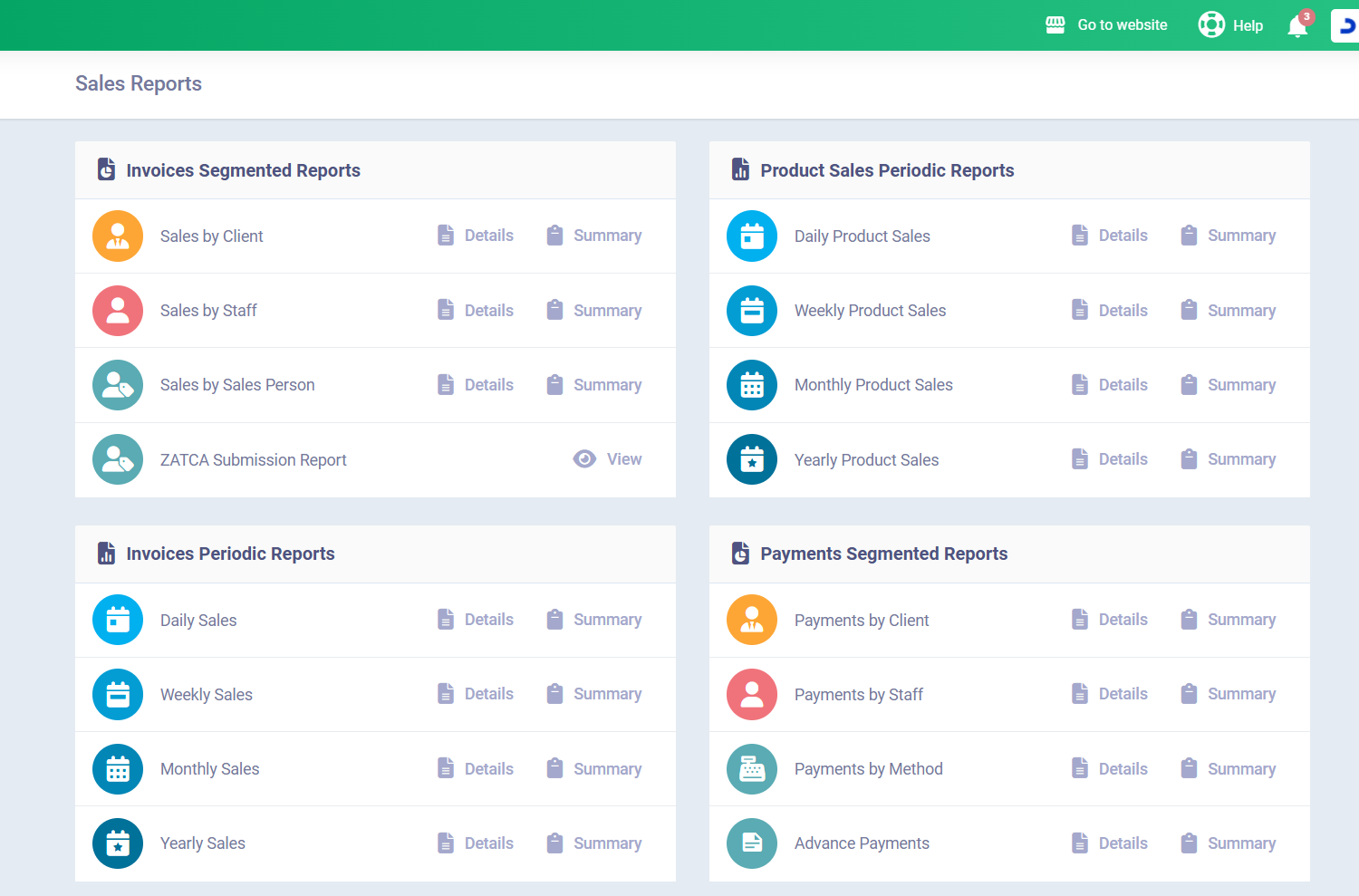
You also need to compare with previous sales data, and you can easily do that in Daftra’s sales management software, where you can identify the volume of sales over a specific period of time of your choice and know the types of products sold and the selling price of each product.
Frequently Asked Questions
What is the sales budget?
The estimated sales budget is a detailed statement of the sales revenues a company will achieve during a specific period, based on the number of units sold and the selling price of each unit. It is used as a planning tool to manage resources and forecast profits based on sales expectations, and it is usually prepared quarterly.
What is the role of estimated budgets in evaluating financial performance?
The estimated budget plays an important role in evaluating financial performance by comparing actual results against what was expected in the budget. This helps management identify variances and take the necessary actions and adjustments, such as developing financial management strategies and allocating resources to control costs and improve financial efficiency.
What is the objective of preparing the estimated budget?
The objective of preparing the estimated budget is to determine the organization’s financial priorities and objectives, achieve financial balance between revenues and expenses, support financial decision-making, and attract the confidence of financiers and investors by presenting a clear picture of the organization’s future financial expectations.
What is the role of the estimated budget in decision-making?
The estimated budget supports the process of making strategic decisions for financial management by providing accurate and documented information about expected performance, which helps in adjusting plans, developing financial policies, and controlling costs in a way that enhances efficiency and profitability.
What are the characteristics of the estimated budget?
Among the most prominent characteristics of the estimated budget are:
- Realism and accuracy: It relies on accurate data and realistic analyses.
- Flexibility: It is adjustable in light of economic changes.
- Comprehensiveness: It covers all financial aspects, including revenues, expenses, and cash flows.
- Alignment with strategic objectives: It aligns with the organization’s vision and goals.
- Participation: It involves different departments to ensure accuracy.
- Monitoring and evaluation: Actual performance is monitored against expected performance to analyze variances.
What are the components of the estimated budget?
The components of the estimated sales budget are:
- Forecasting sales volume: Based on previous years’ data and market analysis.
- Price per unit: The expected price for each product or service.
- Total revenues and profits: The result of multiplying the expected quantity by the selling price.
Why does a sales budget that deliberately underestimates sales have a negative impact on the organization’s performance?
If the sales budget is inaccurate or expectations are intentionally reduced, this leads to errors in related estimated budgets, such as production, purchasing, and labor budgets. This weakens the quality of decision-making, negatively affects the organization's overall financial performance, and hinders the achievement of planned financial objectives.
In conclusion, financial success fundamentally depends on how well planning is carried out and how wisely resources are managed. After presenting all the details related to the estimated sales budget from our accounting perspective, you are now fully aware of the importance of this tool and its role in providing a comprehensive view of your business, helping you identify operations that need improvement and opportunities to achieve financial goals.
Finally, you should know that the estimated sales budget is not a fixed or absolute document; rather, it is flexible and can be modified to suit your business needs, market changes, and external economic factors beyond your control. The estimated budget is like an eagle’s eye, giving you a precise view to control your expenses and revenues.











 Invoicing
 POS
POS Offers
 Installments
 Sales Commission
 KSA E-Invoice Software
 EGY E-Invoice Software
 JO E-Invoice Software
 E-Invoice Software
 Chart of Accounts
 Asset Management
 Cost Centers
 Expenses
 Cheque Cycle
 UAE VAT-Tax
 Product Management
 Purchases
 Purchase Cycle
 Suppliers
 Requisitions
 Stocktaking
 Organizational Structure
 Personnel Management
 Attendance and Leave
 Contracts
 Payroll
 Requests
 Work Orders
 Booking Management
 Rental and Unit Management
 Time Tracking
 Work Flow
 Lease Contracts
 Manufacturing Management
  Client Follow-Up
 Loyalty Points
 Points and Credits
 Memberships
 Insurance Management
 Daftra ERP Full App
 Point of Sales App
 Point of Sales for Desktop – Support Offline Mode
 AI Expenses Scanner App
 Employee Attendance, Sign & ESS App
 E-invoice Reader App
 Inventory Stocktaking App