



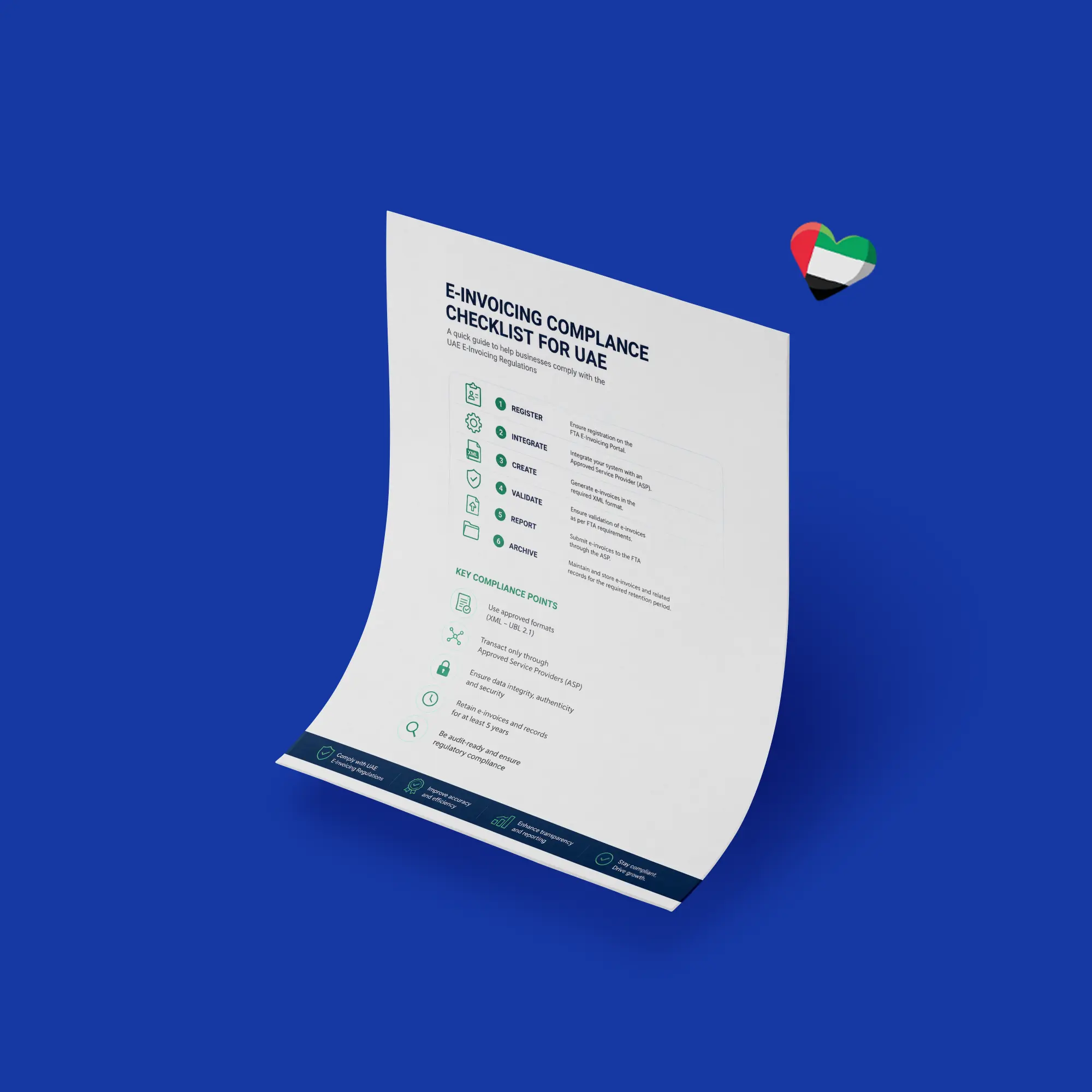
Table of contents:
- Key Summary
- What should a UAE e-Invoicing compliance checklist cover?
- Step 1 Confirm your scope, phase, and deadlines
- Step 2 Build your internal e-Invoicing project team
- Step 3 Assess your invoicing, ERP, and accounting-system readiness
- Step 4 Review mandatory data fields and scenario coverage
- Step 5 Select and onboard your Accredited Service Provider (ASP)
- Step 6 Clean master data and tighten invoice controls
- Step 7 Test end to end before go-live
- Step 8 Prepare storage, evidence, and audit-readiness controls
- Step 9 Train teams and update business processes
- Step 10 Monitor your first 30 days after go-live
- Common mistakes businesses make when using a UAE e-Invoicing checklist
- Conclusion
- Frequently asked questions about UAE e-Invoicing compliance checklists
E-invoicing has caused a massive shift in the UAE's business sector, all within a few months of the new system's announcement. The change was not only in the invoice exchange system but also in how businesses perceive it, how it functions, and how digitization dominates the overall model.
The Ministry of Finance, along with the Federal Tax Authority, has published strict rules and requirements for the electronic invoicing system to deter violations and push compliance. The MoF also encouraged businesses to start preparing early for the new exchange system, whether by releasing the consultation document early or by enrolling participants in the voluntary pilot phase. This phase was crucial for businesses seeking to take their time to understand the system and comply without risking penalties.
E-invoicing readiness is not a single task but a cross-functional program spanning multiple departments, including scope assessment, system readiness, ASP onboarding, invoice data quality, testing, controls, and go-live governance. Businesses preparing for e-invoicing should reference only the official MoF portal and guidance documents as the source framework for the checklist.
With the mandatory date approaching, businesses now need to ensure operational readiness and prepare their systems and processes early. This is your 101 guide to the UAE e-invoicing compliance checklist.
What should a UAE e-Invoicing compliance checklist cover?
The UAE e-invoicing compliance checklist is a tool to help businesses comply with MoF and FTA rules and regulations and prepare their systems for e-invoicing. By following the checklist, e-invoicing readiness becomes more of a structured implementation program rather than a single technical task.
For high-level compliance, coordination among finance, IT, procurement, operations, and external service providers, much before go-live.
Here is what an e-invoicing compliance checklist should include:
- Regulatory scope and implementation timeline
- Invoice data readiness and mandatory fields
- ERP, accounting, and invoicing system capability
- Accredited service provider onboarding
- Internal controls and approval workflows
- End-to-end testing and rejection handling
- Invoice retention and audit evidence
- Team training and process updates
Businesses should understand what e-invoicing compliance entails; it is not just generating invoices correctly. It is a whole process that includes ensuring that:
- Invoice data is accurate
- Workflows are controlled
- Reporting requirements are met
- Operational teams can handle errors or rejections
This is why it is advisable to view compliance, just like the e-invoicing system itself, as an integrated model; everything affects the other, and all should be balanced to achieve compliance.
Step 1: Confirm your scope, phase, and deadlines
The first step in the e-invoicing readiness program that any business should start with is to determine if the mandate applies to your business. If so, when does the implementation phase begin, and what specific deadlines should you consider?
Early readiness is crucial for your business compliance before going live, particularly in your system assessment, ASP onboarding, and testing. Here is what your initial checklist should confirm;
- Whether your business performs in-scope B2B or B2G transactions
- Which implementation phase applies to your business
- The deadline for appointing an accredited service provider
- The mandatory date for invoicing and reporting
- Whether there are any exemptions or special treatment
Businesses should rely on the official Ministry of Finance rollout announcements and implementation guidelines to confirm obligations.
In order to keep track of your internal preparations, here is how to break it down:
| Checklist item | Status | Owner |
| In-scope transaction type | Pending | Tax |
| Identify rollout phase | Pending | Finance |
| ASP appointment timeline | Pending | Project lead |
| Implementation deadlines | Pending | Compliance |
| Special-case treatment (if applicable) | Pending | Tax or legal |
Step 2: Build your internal e-Invoicing project team
The process of preparing for UAE e-invoicing should be treated as a cross-functional program rather than an IT- or tax-only initiative. Even businesses with simple invoicing structures will need strict coordination across multiple departments to properly prepare their systems, workflows, approvals, and reporting processes.
Coordination across departments and teams is what achieves readiness and later compliance.
Here is what a typical internal project team might include:
| Finance | Invoice controls, reconciliation, and reporting oversight |
| Tax | Compliance interpretation and transaction treatment |
| IT/ERP teams | Integrations, data mapping, and system readiness |
| Accounts receivable and payable | Operational invoice handling |
| Procurement or operations | Supplier/customer workflow coordination |
| Legal or compliance teams | Governance and contractual review |
It is also important to appoint a clear project owner to organize implementation activities, track deadlines, and handle issues before go-live. Here is how you can assign responsibility:
- Regulatory compliance → Tax team
- ERP/ accounting system readiness → IT/ ERP team
- Invoice process controls → Finance team
- Customer and supplier coordination → Operations/ procurement team
- Testing and validation → Cross-functional project team
- Go-live monitoring → Project lead
It is also crucial to review how e-invoicing may affect existing accounting and bookkeeping processes, particularly when the entire workflow is currently handled outside a structured system.
Step 3: Assess your invoicing, ERP, and accounting-system readiness
Before technical testing, businesses should assess whether their existing accounting/invoicing system is operationally capable of supporting UAE e-invoicing requirements.
Compliance issues usually appear long before transmission, typically in:
- invoice data
- disconnected workflows
- manual approvals
- incomplete customer records
- systems that cannot properly generate invoices in accordance with the required standards.
At this stage, businesses should evaluate their existing system by asking the following questions:
- Can the current system consistently generate structured invoice data?
- Can it support the required invoice types and transaction scenarios?
- Can it integrate effectively with an Accredited Service Provider (ASP)?
- Are invoice source fields mapped correctly across systems?
- Do existing approval workflows create manual bottlenecks or delays?
- Are invoice corrections and credit-note processes controlled properly?
The assessment goal is to determine whether your current system meets the standards for the e-invoicing system. Manual handling or inconsistent data entry within the workflow will result in rejection after go-live.
Here is an easy way to review and assess your system:
| Invoice generation | Is invoice data structured and consistent? |
| ERP/ accounting integration | Can systems reliably exchange invoice data? |
| Workflow control | Are approvals standardized and traceable |
| Data mapping | Are the tax and customer fields aligned correctly? |
| Credit-note handling | Are corrections managed properly? |
| Reporting support | Can records be reported and validated easily? |
ERP/accounting systems or invoicing software (such as Daftra) are a must for invoicing readiness and compliance.
Step 4: Review mandatory data fields and scenario coverage
One area a lot of businesses struggle to perfect is the invoice data. Even if the system is technically capable, it would not be considered ready if the data is inconsistent or the transaction scenario is handled incorrectly.
At this stage, businesses should ensure that all e-invoice mandatory data field requirements are captured correctly within the workflow, including:
- Seller and buyer identification data
- VAT and tax-related information
- Invoice totals and tax calculations
- Line-item descriptions and classifications
- Currency and payment information
- Credit-note and adjustment handling
- Scenario-specific invoice requirements
It is also crucial to determine which transaction scenario applies to your business:
- Standard B2B invoices
- B2G transactions
- Credit notes
- Advance payments
- Cross-border transactions
- Special tax treatments or edge cases
This objective is to identify any potential gaps early, before testing or go-live. Missing data results in rejection and possible penalties.
Here is an assessment checklist:
| Customer/supplier data | Are identifiers and tax details complete? |
| Invoice line items | Are descriptions and tax logic standardized? |
| Totals and calculations | Are tax calculations generated consistently? |
| Transaction scenarios | Have all applicable invoice types been identified? |
| Exception handling | Can special cases be processed correctly? |
Inconsistent processes (different invoice-handling practices across teams) often affect data quality and only surface during testing. For broader context on the UAE e-invoicing framework and data structure, businesses may refer to the Ministry of Finance’s public consultation document.
Read also: PINT AE Format in UAE E-Invoicing
Step 5: Select and onboard your Accredited Service Provider (ASP)
The next step after assessment is to select and appoint an accredited service provider for UAE e-invoicing. The ASP role is crucial in the process; it enables the exchange and reporting of compliant invoices within the framework. The process of integration, testing, coordination, and onboarding timeline can take some time; it is advisable to start onboarding ASP early. At this stage, you should:
- Shortlist approved or pre-approved ASPs
- Evaluate integration compatibility with existing systems
- Review onboarding requirements and implementation timelines
- Assess support responsiveness and operational capabilities
- Review security, governance, and contractual considerations
- Confirm invoice-transmission responsibilities and workflows
Refer to the Ministry of Finance's list of pre-approved ASPs to ensure working within the framework relevant to their implementation phase.
Here is an ASP checklist:
| Integration capability | Can the ASP connect to existing systems smoothly? |
| Support model | Is the implementation and post-go-live support clear? |
| Security controls | Are governance and data-protection standards sufficient? |
| Workflow responsibilities | Who handles rejections, retries, and monitoring? |
| Scalability | Can the provider support transaction growth? |
At this stage, businesses are advised to review ERP/ accounting systems alongside ASP onboarding plans.
Step 6: Clean master data and tighten invoice controls
One of the most common issues businesses face is master data quality and workflow controls. Even with robust systems, outcomes can be flawed due to inconsistencies in data or tax records. Businesses at this stage should begin reviewing and cleaning customer and supplier records to reduce the risk of rejection or reporting issues later. Key activities:
- Validating customer and supplier identifiers
- Reviewing VAT registration information
- Standardizing legal names and address formats
- Removing duplicate records
- Aligning tax classifications across systems
- Standardizing item and service descriptions
You should also assess how invoices move through internal workflows, by:
- approval structures
- escalation paths
- correction handling
- and duplicate-prevention controls
Here is an easy control checklist:
| Customer/supplier records | Clean and validate master data |
| Tax configuration | Standardize tax logic and classifications |
| Approval workflows | Define clear authorization processes |
| Rejection handling | Create escalation and resubmission procedures |
| Duplicate prevention | Reduce repeated or inconsistent invoice creation |
| Audit traceability | Ensure invoice actions can be tracked |
It is also crucial to decide early how rejection, correction, and resubmission will be handled. This means teams should know the following:
- Who reviews failed invoices
- Who approves corrections
- How will evidence of changes be retained
This stage is very important, and people often fail to understand that noncompliance usually stems from day-to-day operations rather than technicalities.
Helpful Template: Tax Invoice Format In UAE
Step 7: Test end to end before go-live
Testing is a crucial stage of the invoice readiness process. Before going live, businesses should ensure that invoice generation, validation, transmission, reporting, and retention are functioning properly in real-world operational scenarios. Although your system might seem ready for go-live on paper, end-to-end testing can identify gaps that could later cause your business to reject invoices and incur penalties.
You should cover:
- Standard invoice issuance
- Credit-note workflows
- Applicable transaction scenarios
- Validation failures and rejection handling
- Correction and resubmission processes
- Buyer-side invoice exchange where relevant
- Reporting confirmations and acknowledgments
- Retention, retrieval, and evidence generation
It is advisable to include day-to-day operations teams, such as tax, IT, or finance, in the problem-solving training so they understand how issues are to be handled after go-live.
Here is a testing checklist:
| Sample invoices | Verify successful invoice generation and exchange |
| Credit notes | Confirm that correction workflows function correctly |
| Validation failures | Test rejection and error handling |
| Buyer-side exchange | Confirm recipient-side compatibility where applicable |
| Reporting confirmations | Verify acknowledgment and status tracking |
| Retention testing | Ensure invoices can be retrieved and reproduced |
| Operational escalation | Confirm teams know how to resolve failures |
Experiencing both failed and successful transactions is important for businesses to adapt to different scenarios before going live.
Read also: Peppol CTC Model in UAE
Step 8: Prepare storage, evidence, and audit-readiness controls
A vital aspect of e-invoicing compliance is that it does not end after invoice issuance. Businesses should ensure their systems can retain, retrieve, and support invoice records throughout the retention period. Usually, businesses focus on the processes of generation, transmission, and reporting, while overlooking reporting trails, audit-support controls, and evidence management. This is the stage where you should review how invoice records will be sorted, accessed, and monitored after go-live, including:
- Invoice retention and retrievability
- Confirmation and reporting logs
- Rejection and correction trails
- Evidence of invoice exchange
- Access controls and user permissions
- Audit support procedures
It is crucial that businesses maintain strict invoice records and reproduce them accurately if needed for an audit or reconciliation. This means keeping sufficient evidence that shows:
- When invoices were issued
- whether they were exchanged successfully
- whether corrections were made
- and how rejected transactions were resolved
Here is an evidence checklist:
| Invoice retention | Are invoices stored securely and consistently? |
| Retrieval capability | Can records be reproduced quickly when requested? |
| Confirmation logs | Are exchange and reporting acknowledgments retained? |
| Rejection trails | Can failed invoices and corrections be tracked clearly? |
| Access controls | Are permissions and user activity monitored? |
| Evidence management | Is supporting documentation retained properly? |
The tricky part is that the consequences of non-compliance at this stage do not surface immediately. You can be compliant in issuing, transmitting, and reporting invoices, but face issues with audits and reporting reviews over time, and later penalties for e-invoice violations.
Read also: UAE Standard e-Invoice XML Format
Step 9: Train teams and update business processes
An often overlooked step in the invoice readiness process is preparing the operational teams for the system and how it functions in practice. No matter how capable systems are, the risk of failure remains if teams are not trained in approval processes, rejection handling, escalation responsibilities, or reporting procedures. At this stage, businesses should prepare teams for day-to-day operations, including:
- Training AR/AP and finance teams
- Aligning tax, finance, and IT workflows
- Updating internal SOPs and approval procedures
- Defining escalation paths for failed invoices
- Preparing support processes for system issues
- Informing key suppliers or customers where needed
Teams should be trained not only on concepts but firmly on executions; they should understand:
- How do invoices move through workflows?
- What happens if invoices are rejected?
- Who handles corrections?
- How do issues escalate internally?
This stage is also when businesses should review whether their process relies on manual approvals or disconnected communication channels to avoid delays and issues after go-live.
Here is a people-process checklist:
| AR/AP operations | Train teams on new invoice workflows |
| Escalation handling | Define responsibility for failed invoices |
| SOP updates | Align procedures with e-Invoicing requirements |
| Cross-functional coordination | Clarify finance, tax, and IT responsibilities |
| External communication | Inform affected customers and suppliers if needed |
| Operational monitoring | Assign ownership for issue tracking |
Step 10: Monitor your first 30 days after go-live
The first 30 days after go-live are the most operationally sensitive for any business. Even after successful testing, some businesses may encounter workflow gaps or validation issues once real transaction volume begins flowing. This is why readiness should go beyond the implementation stages.
At this point, businesses should monitor operational performance, including:
- Invoice success and rejection rates
- Exchange and reporting confirmations
- Recurring validation errors
- Accredited service provider responsiveness and support quality
- Resubmission and correction workflows
- Evidence retention and retrieval performance
- Operational bottlenecks or approval delays
This also means you might need to establish a process for reviewing recurring issues before they become operational, systemic problems.
Here is a first 30-day checklist:
| Rejection tracking | Identify recurring invoice failures |
| Reporting confirmations | Verify successful exchange and reporting statuses |
| ASP responsiveness | Monitor issue-resolution timelines |
| Correction handling | Confirm the resubmission function works properly |
| Workflow bottlenecks | Identify operational delays or approval gaps |
| Evidence retention | Ensure logs and records remain accessible |
| Internal escalation | Resolve process failures quickly |
This stage is extremely important, as most issues surface in real-world scenarios and should be treated as a stabilization period rather than the end of the trial.
Common mistakes businesses make when using a UAE e-Invoicing checklist
Some businesses fail to achieve operational control because they are overly focused on technical aspects, resulting in day-to-day operational compliance suffering. This does not just affect the completion of the invoicing process; it might also lead to rejection, workflow disruption, or inconsistent reporting.
Here are some common mistakes businesses usually make:
Treating e-invoicing as an IT project only
E-invoicing affects various aspects, including finance, tax, procurement, and operations. That is why it should not be treated only as a technical project, but also as an operational one.
Selecting an ASP too late
Delaying the selection and implementation of an ASP can lead to implementation tension or even compliance issues after go-live.
Assuming the current invoice templates are enough
Existing invoice templates do not contain all required data elements or support all transaction scenarios.
Ignoring special transaction scenarios
Some prepare only for standard scenarios, overlooking:
- Credit notes
- Adjustments
- Operational exceptions
Not testing rejections or corrections
Successful invoices alone are not enough; businesses should also test:
- Validation failure
- Correction handling
- Escalation procedures
Ignoring buyer-side readiness
Invoicing might still fail if customers, trading partners, or procurement workflows are not aligned properly.
Focusing only on go-live
Some businesses stop monitoring after go-live, ignoring post-go-live challenges such as workflow issues or inconsistent reporting that usually appear during the first few weeks of go-live.
Conclusion
Since the very first publication about the e-invoicing system, the MoF has made it clear that compliance is non-negotiable. Whether it is by adhering to the technical requirements or by operating within the operational work frame. The official guidelines document outlined best practices for compliance and stated that there would be penalties for non-compliance.
The most crucial part that people overlook in compliance is the operational aspect. Giving too much focus to the technicalities, the system is machine-reliant, unlike any invoicing system in the UAE before. Most mistakes stem from day-to-day operations rather than technical issues; that is why operational readiness is vital.
The MoF, along with the FTA, has advised businesses to start early in applying the system by learning the implementation timeline, selecting an ASP, evaluating their ERP/invoicing system, and ensuring the quality of their invoice data before go-live. Also, it is equally important to train the operational teams handling invoices and not to treat the new system as an IT project only when it is not, as this can lead to violations.
Finally, it is important to understand that many issues surface after go-live, when you start operating in real-world scenarios. The first 30-day period is considered a stabilization stage and should be treated as such.
Frequently asked questions about UAE e-Invoicing compliance checklists
What are the mandatory requirements for e-invoicing?
Mandatory requirements for e-invoicing in the UAE are to generate, transmit, exchange, and report in a digital format (XML) through approved ASP, and using PINT AE Data Dictionary.
What is the threshold for e-invoicing in the UAE?
The mandatory threshold for e-invoicing in the UAE is AED 50 million for phase 1, below AED 50 million for phase 2, while phase 3 is for Government entities.
What are the mandatory fields for e-invoicing in UAE?
The e-invoicing requirements entail 51 mandatory field under PINT AE format in an XML standard.











 Invoicing
 POS
POS Offers
 Installments
 Sales Commission
 KSA E-Invoice Software
 EGY E-Invoice Software
 JO E-Invoice Software
 E-Invoice Software
 Chart of Accounts
 Asset Management
 Cost Centers
 Expenses
 Cheque Cycle
 UAE VAT-Tax
 Product Management
 Purchases
 Purchase Cycle
 Suppliers
 Requisitions
 Stocktaking
 Organizational Structure
 Personnel Management
 Attendance and Leave
 Contracts
 Payroll
 Requests
 Work Orders
 Booking Management
 Rental and Unit Management
 Time Tracking
 Work Flow
 Lease Contracts
 Manufacturing Management
  Client Follow-Up
 Loyalty Points
 Points and Credits
 Memberships
 Insurance Management
 Daftra ERP Full App
 Point of Sales App
 Point of Sales for Desktop – Support Offline Mode
 AI Expenses Scanner App
 Employee Attendance, Sign & ESS App
 E-invoice Reader App
 Inventory Stocktaking App