


VAT exemption in UAE: Everything You Need to Know

Table of contents:
- Key Summary
- What is VAT exemption in UAE?
- Exempt vs Zero-Rated vs Out of Scope
- List of VAT-exempt supplies in the UAE
- Exempt financial services (and what’s NOT exempt)
- Exempt residential buildings (sale/lease) + when it becomes zero-rated
- Exempt bare/vacant land
- Exempt local passenger transport
- Exempt cases in healthcare and education
- How VAT exemptions affect your business
- How to invoice and report exempt supplies
- Don’t confuse VAT exemptions with VAT Administrative Exceptions
- How ERP automates VAT exemption logic
- Frequently Asked Questions
VAT exemptions in the UAE can look straightforward at first: no VAT charged, problem solved. But once you start applying them in real scenarios, things get a bit more layered. Because while exemptions reduce what you charge your customer, they can also quietly increase your costs if you’re not careful, especially when input VAT is involved.
This guide walks you through what actually counts as exempt, how it’s different from zero-rated supplies, and what that means for your day-to-day decisions, pricing, invoicing, and VAT reporting. The goal isn’t just to define terms, but to help you avoid the kind of small classification mistakes that turn into bigger financial issues later on.
What is VAT exemption in UAE?
A VAT exemption in the UAE simply means that a specific type of supply is not subject to VAT, so you don’t charge VAT on it at all. But it’s not just about what you charge; it also affects what you can claim back. In most cases, when a supply is exempt, the VAT you pay on related costs (like services, utilities, or maintenance) is not recoverable, which can increase your overall expenses without being obvious at first.
Under UAE VAT law, exempt supplies are grouped into four main categories:
- Financial services – such as certain lending or margin-based transactions
- Residential buildings – mainly long-term leases and specific property uses
- Bare land – land with no buildings or permanent structures
- Local passenger transport – domestic transport like taxis, buses, and the metro
Exempt vs Zero-Rated vs Out of Scope
This is the part that trips most people up, and it’s not because the rules are overly complex; it’s because the result looks the same on the surface (no VAT charged), while the impact behind the scenes is completely different.
At a glance, both exempt and zero-rated supplies show “0% VAT,” while out-of-scope transactions fall completely outside the UAE VAT system (not treated as a VAT supply at all). However, the impact on costs, recovery, and reporting is very different.
Treatment | Exempt | Zero-Rated | Out of Scope |
VAT Rate | 0% | 0% | N/A |
Is It Taxable | No | Yes | No |
Input VAT Recovery | Usually NOT recoverable | Usually recoverable | Not applicable |
VAT Filing Obligations | Reported separately from taxable supplies | Reported within VAT returns as taxable supplies | Not reported as a VAT supply |
VAT Registration | No registration required if only exempt supplies | Counts toward registration threshold | Not considered for VAT registration |
Effect on Pricing | Costs may increase due to non-recoverable VAT | Costs stay controlled since input VAT is recoverable | No direct VAT impact |
Mixed Supplies | Input VAT is restricted to the taxable portion only | Input VAT can be claimed proportionally | Not part of VAT apportionment |
Compliance Burden | Simpler but hidden cost due to blocked recovery | Higher amounts that require tracking and claiming input VAT | Minimal VAT compliance impact |
What it means | You don’t charge VAT and absorb VAT on expenses | You charge 0% but still recover VAT on costs | Not treated as a UAE VAT transaction |
How this actually affects your business
- If your supply is zero-rated, you’re still inside the VAT system. You report it, and in most cases, you can recover input VAT on related costs
- If it’s exempt, you don’t charge VAT, but you also usually can’t recover VAT on your expenses, which can quietly increase your costs
- If it’s out of scope, the transaction simply sits outside UAE VAT rules, so it doesn’t enter your VAT calculations in the first place
Example 1: Exempt supply
A landlord rents his residential apartment.
→ The supply is exempt
→ No VAT is charged
→ VAT paid on maintenance or services becomes a real cost, because it’s not recoverable
Example 2: Zero-rated supply
A company exports goods outside the UAE.
→ The supply is zero-rated (0%)
→ No VAT is charged to the customer
→ The business can still recover VAT on shipping, packaging, and operational costs
Example 3: Out-of-scope supply
A UAE company provides services to a client outside the UAE, and the supply is treated as outside the scope of UAE VAT based on the place of supply rules.
→ The transaction is not considered a UAE VAT supply
→ No VAT is charged
→ It’s not treated the same way as taxable or exempt supplies in VAT reporting
List of VAT-exempt supplies in the UAE
The UAE VAT law defines the main categories of exempt supplies. But in reality, it’s rarely just about picking a category and moving on. Each one comes with specific conditions set in the Executive Regulation, and small details can completely change the VAT treatment. Here’s a practical breakdown of the main exempt categories:
1. Financial services
Certain financial activities are exempt, especially when the return comes from a margin rather than a clearly stated fee. The structure of the transaction matters here.
Examples of exempt financial services include:
- Providing loans or credit facilities
- Bank services without explicit fees
- Buying and selling bonds, sukuk
- Running current and savings accounts
2. Residential buildings
Residential property is usually treated as exempt when it’s used for living, not business. The moment it shifts into commercial use, the VAT treatment changes.
Examples of exempt residential transactions include:
- Renting an apartment for the long term
- Leasing a residential unit for living purposes
3. Bare land
Land without buildings or permanent structures is usually treated as exempt. But once development starts, things can shift.
Examples of exempt bare land transactions include:
- Selling an empty plot with no buildings
- Leasing land that hasn’t been developed
4. Local passenger transport
Domestic passenger transport services are exempt, provided they meet the conditions for local transport within the UAE.
Examples of exempt transport services:
- Taxi or ride-hailing apps
- Metro
- Bus
- Trams
5. Specific healthcare and education services
Some services in these sectors don’t follow one clear treatment. While many are zero-rated, there are specific cases where they can be treated as exempt. It usually comes down to the type of service and how it’s provided.
Examples of exempt cases in healthcare and education:
- Primary medical treatment provided under recognised healthcare services
- Preventative healthcare services in certain cases
- Diagnostic services linked directly to treatment
- Inpatient hospital treatment
- Government-provided education services
- Certain extracurricular activities, like school clubs, when they’re not part of the core curriculum
- Student transport services (school bus)
- Accommodation provided to students (dorms or hostels)
Exempt financial services (and what’s NOT exempt)
At a high level, certain financial services are exempt in the UAE under the Executive Regulation. But the key factor isn’t just the type of service, it’s how the return is earned. In many cases, income from an implicit margin (built into the transaction) is typically treated as exempt. Once there’s a clearly stated fee or commission, the treatment can shift.
What usually falls under the exemption
- Income that comes from interest or margin-based returns
- Services where the charge isn’t separately identified
- Core banking-type activities tied to lending or deposits
What may NOT be exempt
- Services with explicit fees or commissions
- Advisory or arrangement services with a clear charge
- Add-on services that are billed separately from the main financial activity
What to do if you have mixed activities
If your business deals with both exempt and taxable financial services, it just means there’s a bit more to manage, but once you understand how it works, it becomes much easier to handle.
This is quite common among banks, fintech companies, and even some SMEs offering various financial services. In these cases, you can’t treat all your expenses the same way. Instead of claiming all your input VAT, you’ll usually need to split it (apportion it) based on what relates to taxable activities and what relates to exempt ones.
This is where many businesses start to feel the impact. Once exempt income is part of the picture, it directly affects how much VAT you can recover. And small details, like how a service is structured or charged, can make a bigger difference than expected.
Common scenarios
This usually shows up in small, practical ways, like the examples below:
Scenario 1: Loan vs processing fee
A business provides a loan and earns interest → this is typically exempt.
But if it charges a separate processing or arrangement fee, that part may be subject to VAT.
Scenario 2: Bank account vs service charges
A bank earns income through account balances or margins → usually exempt.
But monthly account fees or service charges are often treated as taxable.
Scenario 3: Investment returns vs advisory fees
Returns generated from investments (like margins or spreads) → typically exempt.
But charging a client a portfolio management or advisory fee → often subject to VAT.
Exempt residential buildings (sale/lease) + when it becomes zero-rated
This is where most of the confusion usually happens. Residential property in the UAE seems straightforward: no VAT on rent, no VAT on most sales. But once you look a bit more closely, it depends on when the property is supplied and how it’s used.
In general, residential property is treated as exempt, especially when it’s used for long-term living. That’s the default. But there’s an exception that often gets missed: the first supply of a newly built residential property can be zero-rated instead. After that initial stage, it usually goes back to being exempt.
Another thing to keep in mind is how the property is actually used. A unit might be residential by design, but if it’s being used for business, the VAT treatment doesn’t stay the same. That small detail makes a bigger difference than most people expect.
Leasing conditions to keep in mind
For a lease to fall under the exemption, a few basics usually need to be in place:
- The property is used as a place to live
- The lease is long-term, not short-term
- The use is residential, not commercial
Examples
- Renting an apartment to someone for long-term living → exempt
- Leasing a villa as a family home → exempt
- Selling a newly built residential unit for the first time → may be zero-rated
- Selling the same unit later on → exempt
- Using a residential unit as an office → treated as commercial → subject to VAT
Read also: What is TiN Number in UAE
Exempt bare/vacant land
Bare land in the UAE is usually treated as exempt, but only when it’s actually empty. In simple terms, that means no buildings, no structures, and no real construction happening on it. That’s the baseline in the Executive Regulation. But once anything on the ground starts to change, even early construction, the VAT treatment can shift. This is where people get caught. Two plots might look similar, but one small detail can change how they’re treated for VAT.
What qualifies as vacant land
- Land that’s completely empty, with no buildings or structures
- Plots that haven’t been developed or built on
- Land with no active construction
What can change the classification
- Land where construction has already started, even if it’s not finished
- Plots with partially built structures
- Land that’s been prepared or set up for development
Examples
- Selling a completely empty plot → exempt
- Selling land where construction has already begun → may not be exempt
Included (Exempt):
- Empty land
- No structures
- No construction
Excluded (Not Exempt):
- Construction started
- Partial structures
- Developed land
Exempt local passenger transport
Local passenger transport in the UAE is usually treated as exempt, provided it stays within the country.
In most cases, if you’re moving people from one place to another inside the UAE using a normal transport service, it falls under this category. What matters here is the route and the type of service.
Where people sometimes get confused is with international travel. It sounds similar, but it’s not treated the same. International passenger transport is usually zero-rated, not exempt.
When it’s treated as exempt
- The trip happens within the UAE
- It’s passenger transport, not goods
- It uses a regular mode of transport like a taxi, bus, or metro
Domestic (within UAE):
- Exempt
- No VAT charged
- Input VAT not recoverable
International:
- 0% VAT (Zero-rated)
- No VAT charged
- Input VAT recoverable
Exempt cases in healthcare and education
Healthcare and education can be a bit tricky when it comes to VAT. Most of the time, they’re treated as zero-rated. But there are cases where certain services fall under exemption instead, and that’s where things can get confusing.
It usually comes down to the details. What the service actually is, how it’s provided, and who’s providing it. Two services might look almost the same on the surface, but their VAT treatment can still differ.
What can be treated as exempt
- Primary and essential medical care recognised by the Ministry of Health
- Preventive healthcare aimed at avoiding illness or disease
- Inpatient treatment provided by hospitals
- Diagnostic services that are directly linked to medical care
- Government-provided education services
- School buses
- After school activities, if they are not part of the curriculum
What may not be exempt
- Private education services, in many cases
- Higher education, depending on how it’s structured
- Healthcare services that don’t meet the required conditions
Examples
- Preventative healthcare service provided under specific conditions → exempt
- Government-provided education service → exempt
- Private education service → may be zero-rated or taxable depending on the case
How VAT exemptions affect your business
This is where VAT exemptions start to show their real impact. Not charging VAT might sound like a win, but it changes what you can claim back, and that’s where the difference shows up.
If your business makes exempt supplies, the VAT you pay on related expenses is usually not recoverable. And if you have a mix of taxable and exempt activities, you can’t treat everything the same; you’ll need to split your input VAT (apportion it) based on how your costs are used.
Scenario 1: Fully exempt business
A business only provides exempt services.
→ No VAT is charged to customers
→ VAT on expenses becomes a direct cost
Over time, this increases your cost base without being obvious on the surface.
Scenario 2: Mixed activities (taxable + exempt)
A business offers both taxable and exempt services.
→ Some VAT can be recovered, some cannot
→ Input VAT needs to be split based on usage
This is where apportionment comes in, and small classification decisions start to matter more.
Scenario 3: Pricing impact
A business focuses more on exempt supplies.
→ Customers don’t pay VAT
→ But the business absorbs more VAT on costs
So while prices may look more competitive, margins can tighten because of Non-Recoverable VAT in UAE.
How to invoice and report exempt supplies
Exempt supplies don’t need complicated handling, but they do need to be clear from the start. Most issues don’t come from the rules themselves, but from small gaps in how things are written or recorded.
- Leave VAT off the invoice: If the supply is exempt, don’t add VAT. It should be shown clearly without any VAT amount.
- Make it obvious that it’s exempt: A simple note or clear wording goes a long way. It helps avoid confusion later, especially if someone else reviews the invoice. You can see how this is usually handled in a VAT Invoice in the UAE: Details & Format.
- Include it when you file: Even though no VAT is charged, exempt supplies still appear when you prepare your return. You don’t need to get into the details here, but they should be part of your reporting. If you want to know more, check the VAT Return Form 201 in the UAE.
- Keep something to back it up: This is the part people skip. Keep anything that explains why the supply was treated as exempt, such as contracts, agreements, or even simple supporting notes. It makes things much easier later on.
Common mistakes to avoid
- Adding VAT by habit, even when the supply is exempt
- Mixing up exempt and zero-rated treatment
- Leaving the invoice unclear
- Not keeping enough support for the classification
These mistakes can also create compliance risks, so it’s worth reviewing the main VAT penalties in UAE before finalizing your reporting process.
Helpful Template: VAT Return Form 201 Template in UAE
Don’t confuse VAT exemptions with VAT Administrative Exceptions
These two sound similar, but they’re not the same, and mixing them up can lead to unnecessary confusion.
A VAT exemption is about how a supply is treated. It simply means that a specific transaction is not subject to VAT, so no tax is charged.
On the other hand, a VAT administrative exception isn’t about the supply itself; it’s about the process. It’s a way for businesses to get flexibility when they can’t meet certain VAT requirements under normal conditions.
The FTA outlines these exceptions to give businesses some flexibility when needed. They don’t change whether a supply is exempt or taxable; they only affect how certain requirements are applied.
When you might need Administrative Exception
- When issuing standard tax invoices isn’t practical
- When adjustments are needed for tax credit notes
- When a business requires a different tax period or staggered
- When there are challenges with export evidence or timing
VAT Exemption:
- Supply-based
- No VAT charged
- Affects pricing & input VAT
Administrative Exception:
- Process-based
- VAT rules still apply
- Adjusts procedures (invoices, returns, timing)
How ERP automates VAT exemption logic
Once exemptions are involved, VAT stops being something you can just handle as you go. It’s not the rule that’s difficult; it’s applying it the same way every time. That’s usually where mistakes happen.
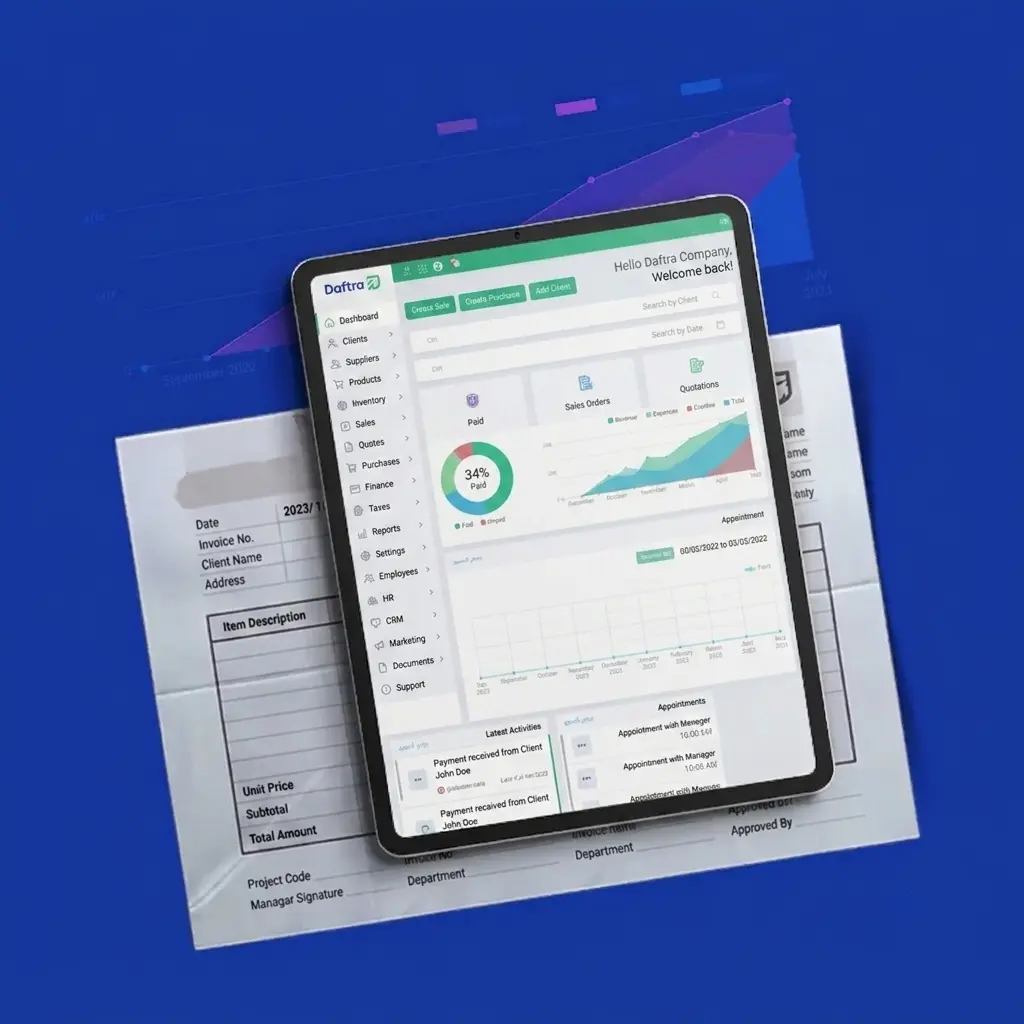
What Daftra handles for you?
- Sets the right VAT treatment from the start: Each item or service is already marked as Exempt, Zero-rated, or 5%, so you’re not deciding it every time.
- Auto-block incorrect VAT: If something is exempt, VAT won’t be accidentally added to it.
- Keeps reporting consistently: Transactions go into your VAT return as they should, without manual adjustments.
- Handles mixed activities: If you have both taxable and exempt income, it helps you split input VAT instead of treating everything the same.
- Keeps a record of decisions: You can always see how something was classified and what it was based on, without going back to check files.
Frequently Asked Questions
What is the VAT exemption?
VAT exemption simply means a specific supply is not subject to VAT, so no tax is charged on it. But it’s not just about what you charge; it also affects what you can claim back. In most cases, if a supply is exempt, the VAT on related costs can’t be recovered.
What is exempted from VAT in the UAE?
A few main categories are usually treated as exempt in the UAE, like certain financial services, residential property, bare land, and local passenger transport.
Who is exempted from VAT in the UAE?
It’s not really about the business being exempt; it’s about the type of supply. A company might have some activities that are exempt and others that aren’t. So the VAT treatment depends on what you’re doing, not who you are.
What is the difference between VAT exempt and zero-rated?
Both might look the same, no VAT charged, but they work differently behind the scenes. With zero-rated supplies, you can usually still recover VAT on your costs. With exempt supplies, you typically can’t. That’s where the real difference shows up.
How to get VAT exemption certificate UAE?
In most cases, there isn’t a general “VAT exemption certificate” for supplies in the UAE. Exemption usually depends on the nature of the transaction and whether it meets certain conditions, not on having a certificate. What matters more is having the right documentation to support why something was treated as exempt.
Who cannot claim VAT back?
Businesses that make exempt supplies usually can’t recover VAT on related expenses. And if a business has both exempt and taxable activities, it can claim VAT only on the part linked to taxable supplies, not on everything.
Finally, VAT exemptions in the UAE can actually make parts of your work simpler, no VAT to charge, fewer calculations. But once you deal with them more closely, you start to see where the real impact is. It’s in what you can’t recover, what turns into a cost, and how a small detail can change the treatment without being obvious at first.
It becomes less about rules and more about awareness. You start to recognize what’s clearly exempt, what might not be, and where you need to slow down for a second look. And with a system like Daftra, a lot of that becomes easier to manage; you’re not going back to fix things, you’re setting them up right from the start and letting them run the way they should.








 Invoicing
 POS
POS Offers
 Installments
 Sales Commission
 KSA E-Invoice Software
 EGY E-Invoice Software
 JO E-Invoice Software
 E-Invoice Software
 Chart of Accounts
 Asset Management
 Cost Centers
 Expenses
 Cheque Cycle
 UAE VAT-Tax
 Product Management
 Purchases
 Purchase Cycle
 Suppliers
 Requisitions
 Stocktaking
 Organizational Structure
 Personnel Management
 Attendance and Leave
 Contracts
 Payroll
 Requests
 Work Orders
 Booking Management
 Rental and Unit Management
 Time Tracking
 Work Flow
 Lease Contracts
 Manufacturing Management
  Client Follow-Up
 Loyalty Points
 Points and Credits
 Memberships
 Insurance Management
 Daftra ERP Full App
 Point of Sales App
 Point of Sales for Desktop – Support Offline Mode
 AI Expenses Scanner App
 Employee Attendance, Sign & ESS App
 E-invoice Reader App
 Inventory Stocktaking App