



Table of contents:
- Key Summary
- What is the Balance Sheet?
- What is the Importance of the Balance Sheet?
- How to Prepare the Balance Sheet?
- Types of Balance Sheets
- What are the Balance Sheet Items?
- Practical Example of Preparing a Balance Sheet
- Balance Sheet Format
- The Purpose and Uses of the Balance Sheet
- What Appears in the Balance Sheet?
- What Account Does Not Appear in the Balance Sheet?
- Balance Sheet Equation
- What Factors Affect the Balance Sheet?
- What are common balance sheet mistakes?
- Tips for Creating Balance Sheets
- Who is Responsible for Preparing the Balance Sheet?
- Net financial position
- How is the Balance Sheet Presented According to IFRS Accounting Standards?
- Limitations of a balance sheet
- How to Improve the Balance Sheet?
- Is the Statement of Financial Position the Same as the Balance Sheet?
- How to Read the Balance Sheet?
- What is the Difference Between a Trial Balance and a Balance Sheet?
- What is the Difference Between a Balance Sheet and a Budget?
- What is the Difference Between Balance Sheet and Income Statement?
- How to Prepare a Balance Sheet in Daftra
- Frequently Asked Questions
Business owners, especially those with startups, need to understand the concept of the balance sheet as it helps them clarify their companies' financial position. The balance sheet can protect your company from collapse and help you solve all financial problems that may befall you. It also provides you with methods to develop your business project and makes you more aware of all events that may affect your profits in the future.
Now, are you a business owner or startup founder struggling with preparing the balance sheet and understanding its nature? Do you feel panic when looking at your financial data and want to know how to use this data to make better financial decisions for the company? You may face difficulty understanding the financial terminology used in the balance sheet, and you may not know how to gather the necessary financial data to prepare the balance sheet correctly. Therefore, we will provide a comprehensive guide about the balance sheet and its purpose, components, and uses, and we will explain the basic steps for preparing the balance sheet with a detailed illustrative example.
What is the Balance Sheet?
The balance sheet is defined as a financial statement that displays the company's assets, liabilities, and shareholders' equity during a specific financial period. The balance sheet reflects the company's financial health and helps inform lenders, investors, or stakeholders about its performance during the previous period and predict its performance in the near future. It also provides essential insights for making important financial decisions.
The balance sheet provides data about what the company owns, what it owes, and the amount invested by shareholders. Company assets are listed on the right side of the balance sheet, while company liabilities and shareholders' equity are listed on the left side. Both sides of the balance sheet must be balanced through the following equation:
Assets = Liabilities + Shareholders' Equity
The balance sheet is one of five components of financial statements, which are:
- Balance Sheet
- Income Statement
- Cash Flow Statement
- Statement of Comprehensive Income
- Statement of Shareholders' Equity
The benefits of the balance sheet are not limited to profitable companies only, but also represent importance for non-profit organizations, as it provides them with information about the organization's financial position, which helps them calculate their own funding that they possess or potential funding organized from different entities.
What is the Importance of the Balance Sheet?
The balance sheet is one of several methods used to track expenses and profits, and it is also called the "statement of financial position." The balance sheet can reveal a lot of information about your company that you may not have known. The importance of the balance sheet lies in the following factors:
- Analyzing Company Growth: The balance sheet helps you analyze company growth by comparing it with the company's level in previous years.
- Revealing Business Expansion: The balance sheet can reveal potential business expansion and future expenses.
- Supporting Financing Acquisition: The balance sheet helps you obtain necessary loans and financing because, when you apply for a loan, the bank uses the balance sheet to determine whether your business project qualifies for investment and what the returns and profits are.
- Helping Investors Make Decisions: It helps investors understand the project they're investing in and what they will receive in return by presenting information such as the assets the company owns, the obligations the company must pay, alongside the financial value for shareholders.
The balance sheet matters because it provides a comprehensive view of a company's financial position by showing growth, revealing expansion opportunities, helping secure financing, and supporting investors in making decisions.
When I looked at the company’s financial statements, things seemed to be going well. Sales and profits were growing, and the owner was thinking about opening a new branch.
But after reviewing the balance sheet, I noticed that a large share of the company’s assets was tied up in inventory and accounts receivable. At the same time, short-term liabilities were high, and the available cash was limited.
This made it clear that profit alone was not enough to decide whether the company was ready to expand. I also needed to look at liquidity, working capital, and its ability to cover short-term obligations. This is why analyzing the balance sheet and other financial statements gives a more complete picture of the company’s actual financial position.
How to Prepare the Balance Sheet?
Preparing a balance sheet is a fundamental step in understanding a company's financial position at the end of a specific accounting period, where details of assets, liabilities, and equity are presented in an organized manner, making it easier to analyze the company's financial performance and make decisions based on it.
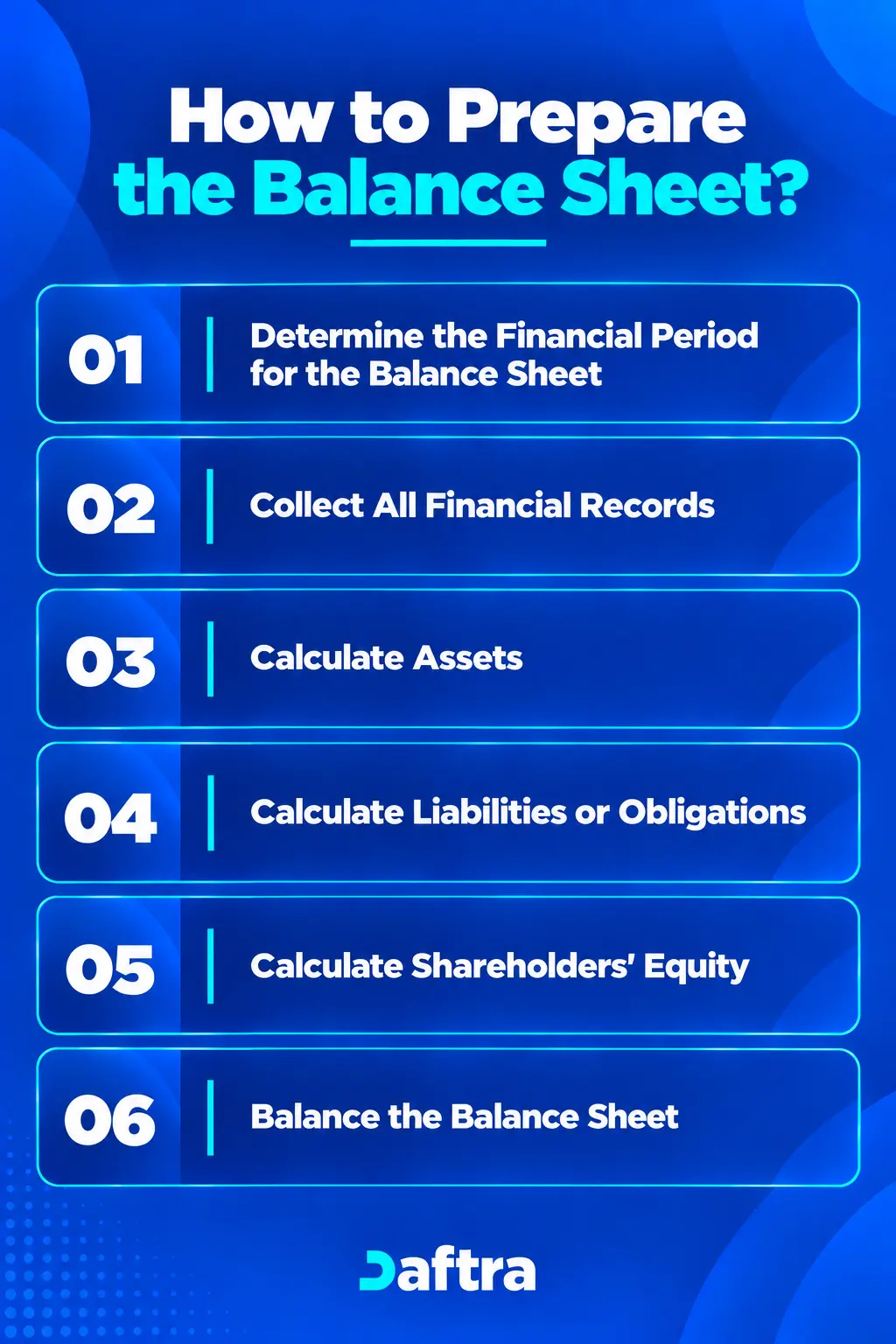
1- Determine the Financial Period for the Balance Sheet
Determine the financial period for the balance sheet; it is usually prepared on a quarterly, semi-annual, or annual basis.
Daftra helps you determine the financial period for which you want to create reports and balance sheets. Follow the steps in the guide to determine a financial period in the Daftar system.
2- Collect All Financial Records
Gather all transactions, invoices, and financial data for the balance sheet period we will prepare.
This data can be found in the company's general ledger, which reflects all financial transactions recorded during a specific period.
3- Calculate Assets
We list the company's assets in two categories: individual items and total assets, with individual assets divided into current and non-current.
Company assets are calculated through the following equation: Assets = Current Assets + Non-current Assets
4- Calculate Liabilities or Obligations
We list the company's obligations in two separate categories: individual items and total obligations, where individual obligations are divided into current liabilities and non-current liabilities.
Company obligations are calculated through the following equation: Liabilities = Current Liabilities + Non-current Liabilities
5- Calculate Shareholders' Equity
Calculating shareholders' equity is easy in individual enterprises because they usually don't have many investors. Conversely, matters become more complex for large companies.
6- Balance the Balance Sheet
First, total liabilities must be added to shareholders' equity through the following equation: Liabilities = Total Liabilities + Shareholders' Equity
Then compare it with total assets using the following equation: Assets = Liabilities + Shareholders' Equity
Here, the balance sheet must be balanced, as what we're doing is comparing the value of assets (what the company owns) against liabilities, or things that could potentially decrease the company's value.
Back in 2017, something quietly went wrong in the books of a small company. No one noticed at the time. The balance sheet simply stopped balancing, and it stayed that way for years—until someone finally decided to find out why.
The investigation began with the old records. After carefully reviewing them, the team found several incorrect journal entries and corrected each one. It seemed like they had finally found the problem.
But they hadn’t.
When they ran the numbers again, a $90 difference remained, with liabilities exceeding assets.
The team approached the problem the way careful accountants do. They reviewed the records month by month, then narrowed the search down to individual days, looking for a transaction that could explain the missing $90. Nothing matched. No single entry matched $90, no obvious mistake, and no clear culprit.
Eventually, an uncomfortable possibility emerged: there may never have been one mistake to find. The difference could have resulted from many small errors, a rounding difference here, a minor data-entry mistake there, accumulating over several years until they added up to $90.
At that point, it would have been easy to keep digging. Instead, the person leading the cleanup stepped back and asked a more practical question: before spending more time investigating years of transactions, was the accounting setup itself correct?
So they went back to the basics.
They checked that every general ledger account appeared on the balance sheet and that each account was mapped to the correct category. It was a simple, inexpensive check, but an important one. If an account had been left out or assigned to the wrong category, it could have distorted the entire balance sheet and needed to be fixed first.
Everything was properly mapped.
With the structure confirmed, the decision became straightforward. Reopening years of records to chase a $90 discrepancy would cost far more in time and effort than the difference was worth. So they posted a single adjusting entry, closed the gap, and the balance sheet finally balanced.
THE LESSON
A small discrepancy doesn't always come from one obvious mistake. Sometimes it results from many small errors accumulating over time. When that happens, check your account setup first. Once you’ve confirmed the structure is correct, a reasonable adjustment may make more sense than reopening years of records to chase a difference too small to justify the effort.
Types of Balance Sheets
The forms and types of balance sheets vary according to their purpose and the size of the entity. There are simple balance sheets that suit individuals and small enterprises, and complex balance sheets for companies with multiple activities and large transaction volumes, often having more than one branch. The following are the most prominent types of balance sheets:
Market Value Balance Sheet:
Asset and liability values are based on prevailing market values, and in this case, the company has no control over the value of its assets and liabilities.
Cost-Based Balance Sheet:
Relies on tracking actual costs associated with assets and liabilities, and is used to track investment costs and profits over specific time periods.
Fair Value Balance Sheet:
The net value of the entity is calculated by subtracting liabilities from assets in a specific time period.
Composite Balance Sheet:
This combines more than one type of balance sheet to serve the institution's interests and provide a more comprehensive view of the entity's financial health, such as combining a market value balance sheet and a cost-based balance sheet to identify current asset prices and long-term investment costs.
Balance sheet types vary by the entity's needs, including market-based, which relies on market values; cost-based, which focuses on actual costs; fair value, which shows net value; and composite, which combines more than one type to provide a comprehensive picture of the financial position. Each type serves a different purpose depending on the company's nature and financial objectives.
What are the Balance Sheet Items?
Before preparing the balance sheet, it's important to understand its main items, as they help organize the company's financial information clearly and make it easier to understand the company's financial position. The items are divided into:
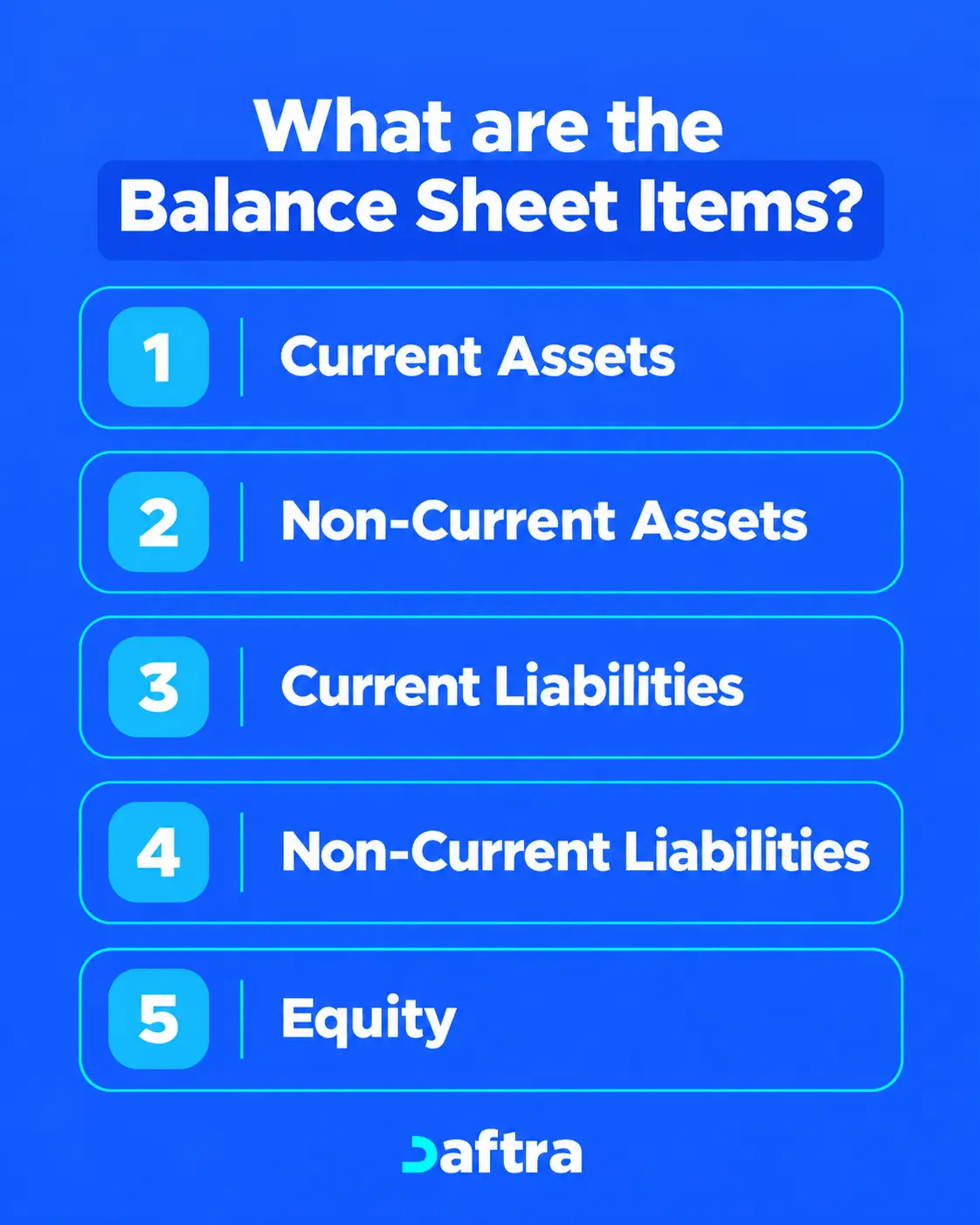
1- Current Assets
- Cash: This is the money obtained during regular transactions through your business project. When you sell resources, you receive payment, and this is recorded in the cash account on the balance sheet as a current asset.
- Accounts Receivable: This records the balance of all sales revenue that is still on credit, meaning outstanding balances that have not yet been collected. When collected, they are deducted from this account on the balance sheet, and the cash account increases by the same amount.
- Inventory: This includes the quantity of raw materials the company has, materials being worked on, and produced resources. Companies use this account to record sales of those resources.
2- Non-Current Assets
- Tangible Physical Assets: Buildings, property, and equipment are non-current assets and tangible physical assets, so when recording them on the balance sheet, accumulated depreciation is deducted. Many companies classify buildings, property, and equipment into different asset types, such as land, buildings, and various types of equipment.
- Intangible Assets: This item includes all fixed assets that are intangible or non-physical for the company, whether they can be identified, such as patents and licenses, or cannot be identified, such as goodwill and the company's reputation.
3- Current Liabilities
- Accounts Payable: This is the amount the company owes to creditors for resources or services purchased on credit but not yet paid.
- Current Debt/Notes Payable: This includes obligations due that are not in accounts payable and notes payable due over a long period, such as more than a year.
- Long-term Debt: This account may seem similar to notes payable, but it differs significantly. Long-term debt, for example, includes a bank loan paid over five years; this account includes the portion of the loan due for payment in the coming year.
4- Non-Current Liabilities
Due in more than one year, such as long-term bank loans, bonds payable, mortgage loans, long-term lease liabilities, and deferred tax liabilities.
5- Equity
Equity refers to the money attributed to business owners or shareholders and reflects the amount that would remain if all assets were sold and all liabilities were paid. Equity is listed on the left side of the balance sheet and is calculated using the following equation: Equity = Assets – Liabilities
The equity list includes the following:
- Retained Earnings: Net profits that the company reinvests in the business or uses to pay its debts, while the remaining amount is distributed to shareholders.
- Treasury Stock: Shares the company has repurchased and can sell later to raise funds.
- Treasury shares: Shares that the company has repurchased and that can later be sold to raise money.
- Capital: The amount that shareholders have invested in the company since its establishment.
The balance sheet consists of basic components that enable you to display the company's financial position clearly and systematically, including current and non-current assets, which represent the company's resources and properties.
In addition, current and non-current liabilities show what the company owes in debts and dues, and shareholders' equity reflects the value of money attributed to business owners after deducting liabilities.
Practical Example of Preparing a Balance Sheet
Let's assume that Company "X" has the following financial data at the end of 2025:
1- Assets:
- Cash and bank account: 200,000 Saudi Riyals
- Inventory: 500,000 Saudi Riyals
Fixed assets: 1,000,000 Saudi Riyals
2- Liabilities:
- Accounts payable: 200,000 Saudi Riyals
Long-term loans: 500,000 Saudi Riyals
3- Shareholders' Equity:
- Share capital: 1,000,000 Saudi Riyals
Let's now prepare the balance sheet together step by step:
1- Determine the Financial Period
Prepare the balance sheet at the end of 2025.
2- Gather Financial Data
Gather financial data from the company's financial records for 2025, as listed above, and arrange it by nature.
3- Calculate Assets
We calculate the assets gathered from our financial records as follows: Assets = Current Assets + Non-current Assets
Assets = (Cash + Bank Account + Inventory) + (Fixed Assets)
Assets = 200,000 + 500,000 + 1,000,000 = 1,700,000
4- Calculate Liabilities
We calculate the liabilities gathered from our financial records as follows: Liabilities = Current Liabilities + Non-current Liabilities
Liabilities = Accounts Payable + Long-term Loans
Liabilities = 200,000 + 500,000 = 700,000
5- Calculate Equity
We calculate shareholders' equity from the following equation: Equity = Assets – Liabilities
Equity = 1,700,000 – 700,000 = 1,000,000, which is exactly the share capital value listed in the financial records data.
6- Balance the Balance Sheet
The following equation must be achieved to ensure the balance sheet is balanced: Assets = Liabilities + Shareholders' Equity
1,700,000 = 700,000 + 1,000,000
Balance Sheet Format
The balanced balance sheet format would be as follows:
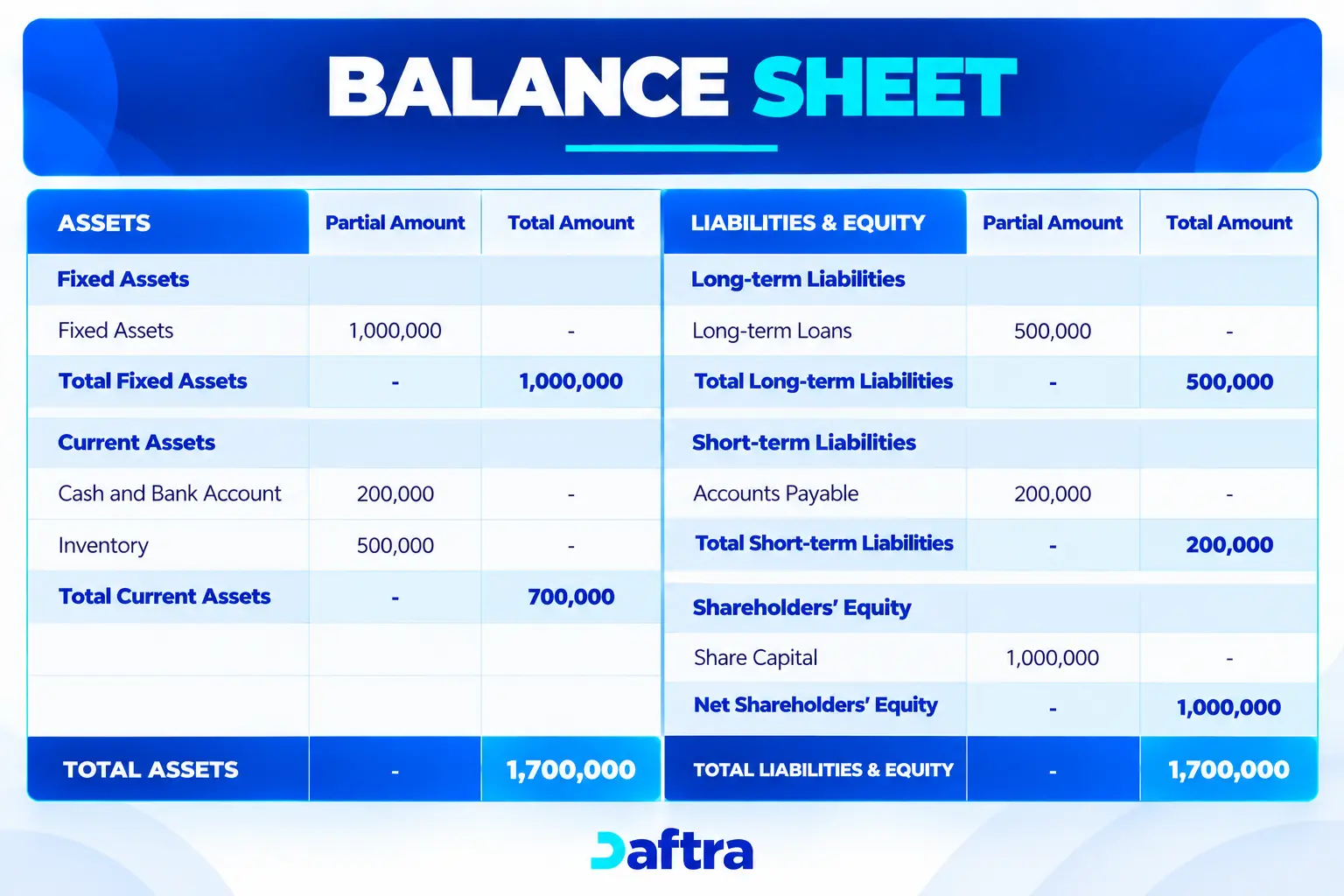
How to Read this Balance Sheet for Company “X”
The balance sheet shows that Company X owns assets worth 1,700,000 at the end of 2025, of which 700,000 are current assets and 1,000,000 are non-current assets.
The balance sheet also shows that Company X has liabilities of 700,000 at the end of 2025, of which 200,000 are short-term and 500,000 are long-term.
Additionally, the balance sheet shows that Company X has shareholders' equity worth 1,000,000 at the end of 2025.
The Purpose and Uses of the Balance Sheet
Companies create balance sheets to understand the organization's financial position, as they interpret and clarify the company's possessions (assets), obligations, bonds, and loans, as well as its financial value. The objectives of the balance sheet are as follows:
1- Revealing the Financial Position
One of the main objectives of creating a balance sheet is to understand the company's financial position over both long-term and short-term periods. It provides accurate, reliable information about the financial position for management, government, or shareholders, helping them make informed financial decisions.
2- Displaying the Picture of Assets and Liabilities
The balance sheet is prepared to determine the value of the company's assets and liabilities at year-end.
3- Information about Creditors and Debtors
The balance sheet provides a complete picture of creditors and debtors and their financial transactions related to the entity during a specific period.
4- A Tool for Financial Analysis and Revealing Liquidity Position
The balance sheet reflects the company's liquidity; thus, it can show cash flow and working capital financing.
5- Clarifying the Company's Solvency Position
Financial solvency is the company's ability to meet its fixed obligations and achieve long-term expansion and growth, as shown in the balance sheet statement, which identifies investment risks and returns.
6- Calculating Financial Ratios
Financial ratios are among the most important tools in financial analysis, and they primarily depend on data from the balance sheet. They help management identify strengths and weaknesses by comparing data to analyze the current situation, and banks also use the balance sheet to evaluate a company's net worth, financial position, and future investment indicators.
The objectives of the balance sheet are to accurately reveal the company's financial position in the short and long term, provide a clear picture of asset and liability values, and provide complete information about creditors and debtors.
It is also a primary tool for financial analysis, revealing liquidity and clarifying the company's ability to meet obligations and achieve financial growth. Management and banks also rely on it to calculate financial ratios that help evaluate strengths and weaknesses and make sound decisions regarding the company's investments and financial future.
What Appears in the Balance Sheet?
The balance sheet displays the company's financial position at a specific point in time through its elements. Three main elements appear in the balance sheet:
What Account Does Not Appear in the Balance Sheet?
Accounts that do not appear in the balance sheet are those related to revenues and expenses, which are recorded in the income statement, such as "goods sales" or "salary expenses" accounts. These do not appear on the balance sheet because they relate to financial performance over a specific period, not the financial position at a point in time.
Balance Sheet Equation
The method of calculating the balance sheet is based on the basic balance sheet equation, where assets owned by the company and to which it has rights are calculated, such as current or non-current assets, as well as obligations that the company must pay to creditors due to obtaining resources or services without paying the amount due, alongside shareholders' equity represented by company shares. The balance sheet calculation equation is as follows:
Assets = Liabilities + Shareholders' Equity
What Factors Affect the Balance Sheet?
The balance sheet reflects a company's financial position, but it doesn't remain constant; several factors can change it. These are the factors affecting the balance sheet:
Thus, the balance sheet is affected by a variety of factors, including operating performance, investment and financing decisions, asset valuation and depreciation, changes in accounting policies, economic conditions, legal events, and potential risks.
What are common balance sheet mistakes?
When preparing the balance sheet, some accountants or business owners may make common errors that affect the accuracy of financial data and create an incorrect picture of the company's financial position. Therefore, it's important to identify these errors to avoid them. Here are some common errors that accountants make when preparing the balance sheet:
1- Overlooking the Inclusion of All Assets
Some may overlook including all asset elements in the balance sheet, which is one of the most common errors when preparing it. Types of assets that are overlooked include:
- Tangible assets such as (land, equipment, inventory, and others).
- Intangible assets such as patents, trademarks, broadcasting and publishing rights, copyrights, and goodwill.
- Investment assets such as stocks, securities, various currencies, bonds, gold, silver, iron, and investment funds.
- Personal assets such as bank accounts and certificates, cars, and jewelry.
2- Failing to Include All Liabilities
Including all liabilities is as important as listing assets, and many people overlook this step when preparing the balance sheet. These forgotten liabilities may include:
- Some types of taxes.
- Interest on loans.
- Accrued expenses for warranties not fully paid.
- Mortgage.
- Deferred compensation.
- Pension obligations.
3- Incorrect Classification
One of the common errors when preparing the balance sheet is incorrectly classifying asset and liability items, such as accounts receivable and accounts payable, that can be recorded on both sides depending on their specific situation, such as bank accounts, customer accounts, or supplier accounts.
4- Neglecting to Update the Balance Sheet Regularly
The balance sheet's main purpose is to provide a comprehensive view of the entity's financial health during a specific period, so its data should be updated and accurate monthly or quarterly. Some may neglect this update, resulting in inaccurate financial information about the institution's financial position and status.
Common balance sheet errors to avoid include overlooking assets or liabilities, misclassifying items, or failing to update data regularly. Avoiding these errors helps ensure the balance sheet accurately reflects the entity's true financial position and supports sound, well-considered financial decisions.
Tips for Creating Balance Sheets
Making errors when preparing this balance sheet may lead to inaccurate financial results that negatively affect decision-making. From this perspective, following clear steps helps avoid those errors and ensure the integrity of financial information, which are as follows:
- Clearly Define the Entity's Financial Objectives: These objectives should be measurable and trackable, such as revenue increase rate or expense reduction.
- Rely on Accurate Financial Data: Ensure the accuracy and reliability of financial data used in preparing the balance sheet and use previous financial reports, documents, and records for comparison, auditing, and reviewing accounting information.
- Regular Review: Review the balance sheet regularly, update its information, and make necessary adjustments, settlements, and corrections in a timely manner.
- Consult Financial Experts and Accounting Advisors: Appoint specialists to review and evaluate the balance sheet.
It becomes clear that by following these steps to avoid balance sheet preparation errors, we can produce a balance sheet that supports the company's financial stability. These steps begin with accurately defining financial objectives, relying on reliable data, reviewing regularly, and consulting experts, which is fundamental to avoiding accounting errors and preparing a balance sheet that accurately reflects financial reality.
Who is Responsible for Preparing the Balance Sheet?
The person responsible for preparing the balance sheet for any organization varies from one organization to another, depending on the actual size of the organization. For example:
- For Small Companies: The company owner or its accountant may be sufficient to prepare the company's balance sheet.
- For Medium-Sized Companies: In this case, an external accountant may be consulted to review what was prepared internally in the balance sheet.
- For Large Corporations: Preparing balance sheets for large and public companies requires a high level of accuracy; therefore, these companies may consult an external group of accountants recognized for their competence to review and audit the financial statements.
Net financial position
Net financial position is a term used to describe the difference between an organization's total assets and liabilities. Net financial position measures how wealthy a company or financial entity is, as it indicates the company's financial health and its ability to meet long-term obligations.
Net financial position is calculated using the following equation:
Net Financial Position = Total Assets - Total Liabilities
If assets exceed liabilities, the company has a positive net financial position, indicating a stronger financial position. However, if liabilities exceed assets, the company has a negative net financial position, which may indicate financial problems.
How is the Balance Sheet Presented According to IFRS Accounting Standards?
Under International Financial Reporting Standards (IFRS), the standard emphasizes clear, accurate presentation of financial information and requires information that helps evaluate the company's financial performance and position. Under this accounting standard, the balance sheet is presented to show assets, liabilities, and equity. The general structure is as follows:
Assets:
- Current Assets: such as cash and cash equivalents, trade receivables, and inventory.
- Non-current Assets: such as fixed assets and long-term investments.
Liabilities:
- Current Liabilities: such as trade payables, short-term loans.
- Non-current Liabilities: such as long-term loans.
Equity:
- Paid-in capital, retained earnings, and other equity accounts, such as the current account.
- The total assets must equal the total liabilities and equity.
Limitations of a balance sheet
- Historical cost principle: assets are usually recorded at their original cost.
- Intangible assets are often missing: things like brand reputation and employee knowledge.
- It shows one point in time: the balance sheet reflects the company’s financial position on a specific date.
- Some figures are based on estimates: certain amounts depend on accounting estimates such as depreciation.
How to Improve the Balance Sheet?
Companies should continuously improve their balance sheet through effective strategies that strengthen their financial position. These are the ways to improve the balance sheet:
- Reviewing Underutilized Assets: Reviewing company assets that are not being used as required or necessary, as selling those assets at that time would be a positive factor for the company.
- Reducing Liabilities and Expenses: Limiting liabilities or obligations and reducing expenses, alongside having a reserve amount to be used for immediate spending in necessary cases.
- Reduce staffing costs: Good employees are an important part of any business, but maintaining a large team can also be a major expense. If you can manage staffing more carefully without affecting work quality, you can reduce costs and improve your overall financial position.
- Identify and sell unproductive assets: Your assets should provide enough value to support your business and cover your liabilities. If you have assets that don't contribute much to the business, selling them may be worth considering. This can free up cash to invest in more useful assets or other areas of the business.
Improving the balance sheet depends on strategic decisions such as disposing of underutilized assets and reducing obligations while maintaining a financial reserve, enabling companies to enhance their financial stability.
Is the Statement of Financial Position the Same as the Balance Sheet?
Yes, the statement of financial position is another term for the balance sheet. Both terms are used interchangeably and refer to the same financial statement, where the balance sheet represents a document containing the distribution of financial resources and expenses for the government or state over a specific time period, usually one fiscal year, and the balance sheet can be considered a reference for understanding the government's financial performance and spending directions.
On the other hand, the statement of financial position is part of the balance sheet and provides more detail on revenues, expenses, debts, assets, and liabilities for a specific period.
How to Read the Balance Sheet?
Reading the balance sheet provides a comprehensive view of assets, liabilities, and equity, and helps evaluate financial performance and make strategic decisions. To read the balance sheet correctly and accurately, the following points should be considered:
- Maintaining Balance Sheet Equation Balance: Ensure the balance sheet equation balances: Assets = Liabilities + Equity.
- Arranging Elements by Liquidity: Assets and liabilities are usually arranged by liquidity, from most liquid to least liquid.
- Analyzing Financial Trends: Compare balance sheet numbers with previous periods to analyze trends and changes in the company's financial position.
- Using Financial Ratios: Ratios such as the current ratio, debt-to-equity ratio, and return on assets can provide deep insights into the company's financial position.
Also, when reading the balance sheet, the following elements should be taken into consideration:
- Revenues: Include all sources from which the government generates income, such as taxes, service fees, donations, loans, external grants, and others.
- Expenses: Include all government expenditures, such as salaries and wages, infrastructure spending, education, health, defense, public services, and public debt.
- Surplus or Deficit: A surplus occurs when revenues exceed expenses, while a deficit occurs when expenses exceed revenues.
- Debt: Amounts the government must borrow to finance the budget deficit or other government projects.
Reading the balance sheet correctly requires attention to some important points, such as balancing the accounting equation, arranging elements by liquidity, and analyzing financial trends using financial ratios.
Alongside understanding the basic elements, which are details of revenues, expenses, surplus or deficit, and debt. Together, these elements enable readers to accurately assess the financial position, whether in the private or public sector, and support sound financial planning and decision-making based on clear, reliable information.
Read also: What Are Accounting Tables
What is the Difference Between a Trial Balance and a Balance Sheet?
Both the trial balance and the balance sheet are fundamental tools in an institution's financial system, but each serves a different function and plays a specific role in the accounting cycle. The difference between a trial balance and a balance sheet can be identified through the following elements:
| Aspect | Trial Balance | Balance Sheet |
| Purpose | Used to verify the accuracy of accounting records and ensure that total debits and credits are balanced before preparing financial statements. | Shows the company's financial position at a specific point in time by presenting its assets, liabilities, and equity. |
| Content | Contains all accounts in the general ledger, including assets, liabilities, revenues, and expenses, along with the balance of each account. | Contains only assets, liabilities, and equity as of a specific date. |
| Timing | Usually prepared at the end of each accounting period as a preliminary step before closing accounts and preparing financial statements. | Usually prepared at the end of the fiscal year or when needed to report the company's financial position. |
I once assumed that everything was fine because the total debits and credits in the trial balance were equal. But when I went back and checked the accounts, I found that some equipment had been recorded as an operating expense instead of being recorded as an asset.
At first, the trial balance still looked correct because the debits and credits were balanced. But the problem was how the transaction was recorded and classified.
The equipment was not shown under assets, and the operating expenses were higher than they should have been. This affected both the balance sheet and the income statement.
That was when I realized that a balanced trial balance does not necessarily mean that the financial statements are correct. A trial balance can be balanced even when some transactions are recorded in the wrong accounts.
What is the Difference Between a Balance Sheet and a Budget?
Some people confuse the balance sheet and budget because of their similar names, but each plays a different role in financial management. The difference between the balance sheet and the budget can be identified through the following items:
Definition
The balance sheet is a financial statement that shows assets, liabilities, and equity on a specific date, while the budget is a financial plan that estimates revenues and expenses for a future period.
Purpose
The balance sheet evaluates the company's current financial position, while the budget serves as a tool for financial planning and control, helping guide the company toward its financial objectives.
Operating Mechanism
The balance sheet shows actual values as of a specific date, while the budget shows expected or planned values for a future period.
The difference between a balance sheet and a budget is that the balance sheet is a financial statement that shows assets, liabilities, and equity on a specific date and aims to evaluate the company's current financial position, relying on actual data.
In contrast, the budget is an estimated financial plan that shows expected revenues and expenses for a future period and is used as a tool for financial planning and control to achieve desired objectives.
What is the Difference Between Balance Sheet and Income Statement?
The balance sheet and income statement are fundamental financial statements used to analyze the financial performance of institutions, but each serves a different purpose. The difference between the balance sheet and the income statement is based on the following factors:
Purpose
The balance sheet shows the company's financial position at a specific point in time, such as the end of the fiscal year, while the income statement or profit and loss statement shows the company's financial performance over a period of time, such as a month, quarter, or year.
Contents
The balance sheet includes assets, liabilities, and equity, while the income statement includes revenues, expenses, and the final result as profits or losses.
The difference between the balance sheet and income statement lies in purpose and content. The balance sheet shows the company's financial position at a specific point in time by stating assets, liabilities, and equity, while the income statement shows financial performance during a specific time period, displaying revenues, expenses, and the final result of profits or losses.
How to Prepare a Balance Sheet in Daftra
In Daftra accounting software, you won't need any additional effort to generate your balance sheet, as it's sufficient to enter your primary accounting data, including assets, liabilities, and equity, then go to the reports and financial statements menu and click on the balance sheet list for Daftra to prepare it in seconds. This helps you understand the company's financial position, reveal your financial status, estimate available liquidity, and assess your ability to meet current and future financial obligations.
Frequently Asked Questions
When is the balance sheet prepared?
The balance sheet is usually prepared at the end of an accounting period, such as month-end, quarter-end, or year-end, but you shouldn't wait until the end of the period to complete it.
Does the balance sheet always balance?
Yes, the balance sheet must always balance. If it doesn't balance, it may be for one of the following reasons:
- Data is incomplete or entered in the wrong place
- Incorrect entry of financial transactions and their amounts
- Errors in currency exchange rates
- Errors in stock calculations
- Errors in inventory calculations
What are the principles of the balance sheet?
The principles or characteristics of the balance sheet include:
- Displaying the company's financial picture: Through recording assets, liabilities, and shareholders' equity
- Financial balance: Asset value must equal the sum of liabilities and equity
- Accuracy and reliability: Data must reflect the true financial position
- Reliance on specific financial periods: Whether annual, semi-annual, or quarterly
Accurate accounting classification: For assets, liabilities, and equity
What is the difference between a balance sheet and financial position?
There is no fundamental difference between the terms; balance sheet and statement of financial position are two names for the same accounting document. Both show the entity's financial position at a specific point in time.
What are balance sheet closing entries?
Balance sheet closing entries are a set of accounting entries recorded at the end of the financial period to zero out temporary accounts, such as revenue and expense accounts, and transfer their balances to permanent accounts, such as capital or retained earnings accounts.
Where does the partner’s current account appear in the balance sheet?
In the balance sheet, it tracks transactions between partners and the company, such as capital contributions, drawings, and profit distributions. If the account has a debit balance, the partner owes the company; if it has a credit balance, the company owes the partner.
Do Drawings appear in the balance sheet?
Personal drawings by partners or owners do not appear directly on the balance sheet. Instead, these drawings affect the equity account. Drawings reduce equity because they are considered distributions to owners from retained earnings or capital.
Do sales appear in the balance sheet?
Sales do not appear on the balance sheet; they appear on the income statement, which shows revenues, expenses, and profit or loss for a specific accounting period. The balance sheet shows assets, liabilities, and equity at a specific point in time and does not include revenue or expense details.
What are marketable securities on a balance sheet?
Marketable securities are liquid financial instruments listed under current assets on a company’s balance sheet that can be quickly converted into cash within one year.
What is the golden rule of the balance sheet?
The length of time an asset stays useful should roughly match how long the money funding it is tied up. In other words, if a company buys machinery, vehicles, or buildings, assets it'll use for years, it should pay for them with long-term money: equity, provisions, or long-term loans. Short-term items like inventory, receivables, and cash are different. Since they turn over quickly, short-term debt is a reasonable way to fund them.
What are the red flags in a balance sheet?
Declining cash flows, rising debt levels, low or negative equity, unusual asset valuations.
What happens if a balance sheet is not balanced?
It means the core accounting equation (assets = liabilities + equity) has been violated, marking a data entry error.
When is the balance sheet prepared?
The balance sheet is usually prepared at the end of an accounting period, such as month-end, quarter-end, or year-end, and you shouldn't wait until the end of the period to complete it.









 Invoicing
 POS
POS Offers
 Installments
 Sales Commission
 KSA E-Invoice Software
 EGY E-Invoice Software
 JO E-Invoice Software
 E-Invoice Software
 Chart of Accounts
 Asset Management
 Cost Centers
 Expenses
 Cheque Cycle
 UAE VAT-Tax
 Product Management
 Purchases
 Purchase Cycle
 Suppliers
 Requisitions
 Stocktaking
 Organizational Structure
 Personnel Management
 Attendance and Leave
 Contracts
 Payroll
 Requests
 Work Orders
 Booking Management
 Rental and Unit Management
 Time Tracking
 Work Flow
 Lease Contracts
 Manufacturing Management
  Client Follow-Up
 Loyalty Points
 Points and Credits
 Memberships
 Insurance Management
 Daftra ERP Full App
 Point of Sales App
 Point of Sales for Desktop – Support Offline Mode
 AI Expenses Scanner App
 Employee Attendance, Sign & ESS App
 E-invoice Reader App
 Inventory Stocktaking App