




Table of contents:
- Key Summary
- What is a receipt voucher?
- What are the benefits of a receipt voucher?
- What are the disadvantages and issues with a receipt voucher?
- What are the contents of a receipt voucher?
- What is the format of a receipt voucher?
- What is the Electronic Receipt?
- What are the steps to create an electronic receipt in Excel?
- How to Create a Receipt Template in Word?
- What is an Electronic Receipt Template?
- What is the Journal Entry for a Receipt?
- How Does Daftra Make It Easier to Create Receipts?
- Frequently Asked Questions
- Conclusion
Are you aiming for a stable cash flow? There are many reasons for cash flow instability, but there are even more solutions available in return. What if you discovered that achieving this goal could come from a simple activity like recording a receipt voucher?
Maintaining a stable cash flow for your company is necessary to support its financial health, which is why the receipt voucher is one of the activities that help regularly monitor cash and ensure its availability in your company for long periods, both directly and indirectly. But how does this happen?
Continue reading to learn how to document receiving an amount from a client through the receipt voucher, one of the most important routine activities that maintains your resources and the continuity of your company in the long run!
What is a receipt voucher?
A receipt voucher is a proof-of-payment document for the organization or the concerned parties to ensure the rights of both parties. It describes the receipt of an amount related to a completed financial transaction, whether in cash or by check.
Each receipt voucher has its own details that clarify the data, without which it cannot be recognized. The receipt voucher governs payment transactions between the first party (the customer) and the second party (the company) for the purchase of goods or the receipt of services.
Some notes on the receipt voucher:
- It is one of the important documents in the accounting cycle.
- It is an explicit acknowledgment of receiving a certain amount of money.
- A receipt voucher is issued when a customer pays for a service or deposits funds for the purchase of goods.
- The advance payment for a service is not recorded as earned revenue in the journal; instead, a receipt voucher is issued to document the rights.
What are the benefits of a receipt voucher?
A receipt voucher is one of the important accounting documents relied upon by companies and institutions to record cash receipts. Its importance is not limited to proving revenue receipt; it also helps prepare financial and accounting reports. Here are the key advantages provided by using a receipt voucher:
- Important accounting reference for organizing financial transactions: The receipt voucher serves as a primary reference for the financial accountant when collecting documents related to the accounting cycle, helping them organize financial operations.
- Legal proof for protecting rights: The receipt voucher acts as legal proof of the rights of the voucher holder. It is an important document to refer to in case of any errors or manipulation, through verification in the journal or the general ledger.
- Facilitates bank reconciliations: The receipt voucher streamlines reconciling bank statements for vouchers issued monthly and throughout the financial year, thereby supporting the accuracy of financial records.
- Supporting account balance: Issuing new receipt vouchers triggers periodic book updates, helping balance the accounts in the accounting records.
- Reducing theft and embezzlement: It helps minimize theft and embezzlement committed by accounting staff, as every receipt transaction is documented.
- Indicator of cash flow: It makes it easier to assess the company's cash availability, as receipt vouchers indicate effective cash flow, aiding management in making sound financial decisions.
One of the most important benefits of a receipt voucher is that it helps organize financial transactions, enhances the accuracy of records, and provides legal proof of transactions. It also supports internal control procedures, helps prepare financial reports, and enables more accurate decision-making, making it an essential element of any institution's financial system.
Using the Daftra accounting software, you can easily issue electronic receipt vouchers, saving you time and effort in tracking cash receipt transactions. The system allows you to link each voucher to the appropriate account, ensuring accurate accounting records.
Additionally, Daftra enables you to securely and systematically archive all vouchers, making them easy to access at any time, especially when preparing financial reports or conducting periodic audits.
Moreover, the program supports integration between receipt vouchers and other components of the accounting cycle, such as invoices, reports, and bank reconciliations, helping maintain account balance and reducing the risk of errors or fraud.
What are the disadvantages and issues with a receipt voucher?
There are some drawbacks and issues with receipt vouchers, especially paper-based ones. These flaws can cause various problems for the company or the parties involved in the voucher. Some of these drawbacks include:
1- Absence of one of the main signatures
Signatures are a key element in any disbursement entry. They prove that your company has received the amount, are signed by the responsible individual, and may include the reviewer's or supervisor's signature, as well as the client who made the payment. The absence of one signature reduces the reliability of the receipt voucher, and it is often not recognized.
2- Lack of dating or incorrect date
The date is a crucial factor that could cast doubt on the voucher's validity. This can cause issues between your company and the client regarding the accuracy of the cash receipt. Sometimes, receipt vouchers may lack sufficient information to fully document the transaction, making it difficult to review financial records.
3- Loss of the company's copy of the receipt vouchers
Not using an electronic system or failing to maintain an electronic copy exposes the receipt voucher to risk. Therefore, it is essential to always have a backup copy, whether digital or stored in a physical file.
4- Contradiction between the receipt voucher and the company's internal records
The company maintains a journal and accounting entries that interact with each transaction. A discrepancy may occur between the amounts recorded in the accounting entries and those recorded in the receipt voucher.
There are several issues that can reduce the effectiveness of a receipt voucher, especially when relying on traditional paper forms. These include the absence of key signatures, errors in the date, loss of paper copies, and the potential for discrepancies between the voucher data and the company's accounting records.
Therefore, transitioning to electronic accounting systems, such as Daftra business management software, is an important step to reduce these issues and ensure the accuracy and integrity of financial data.
What are the contents of a receipt voucher?
For a receipt voucher to be a legally and financially acceptable accounting document, it must include a set of essential data that ensures its accuracy and completeness. This also makes it easier for accountants to review the voucher and link it to other financial transactions. Below are the key components that should be included in a receipt voucher:
1- Title indicating the type of receipt voucher
The title is specified by writing "Receipt Voucher" at the top of the document, and identifying whether it is a cash receipt voucher or a check receipt voucher.
2- Voucher number
Each receipt voucher issued by your company to the customer has a unique issuance number. The numerical sequence of receipt vouchers simplifies reconciliation and makes registration and review easier.
3- Voucher issue date
The date on which the receipt voucher was issued is specified. This date is needed by the financial accountant to ensure the transaction is recorded correctly in the journal, especially if it is a due payment. An advance payment is recorded as an asset.
4- Company name, address, and logo
Your company should include its name, address, and contact details as listed in the commercial register. Providing this information builds the client's trust and enhances transparency. This ensures that the receipt voucher is considered an official document issued by your company.
5- Voucher amount
The amount received should be clearly specified, as receipt vouchers are essentially cash receipt documents. The amount should be stated in both numeric figures and written words to avoid any ambiguity or disputes regarding the amount.
6- Voucher holder
The voucher holder is the customer or party who paid the amount in exchange for the voucher. It could also be another party with whom the company has dealings, such as a company that receives goods or services in return for payment.
7- Beneficiary's signature
The beneficiary here is the individual who officially represents the receiving party. By signing, they confirm their supervision over the receipt of the funds from the voucher holder. The signature should be placed at the bottom of the document to confirm receipt of the payment. The person overseeing the receipt is usually the department manager or the supervisor.
8- Payment method
The payment method should be specified, whether by cash or check.
9- Check details
If the payment method is by check, the check details should be provided, including the check number and the bank name on which the check is drawn.
10- Reason for payment
This specifies why the voucher was issued. It could be for a sale, a service payment, or a transfer of funds to shareholders or partners.
11- Account details
Receipt vouchers may include the client's account details, showing the amounts previously paid and any outstanding debts.
12- Recipient's signature
Finally, the financial accountant's signature should be included on the receipt voucher. Even if the manager has signed, this does not exempt the financial accountant from signing the receipt vouchers.
With the inclusion of essential elements such as the title, voucher number, date, company details, amount, parties involved, and payment method, the receipt voucher becomes a valid document that accurately and professionally records financial transactions.
What is the format of a receipt voucher?
There is no fixed format for receipt vouchers, as they may vary from one company to another or by business type. However, the most important elements to always include are the basic details: the amount, the names of the parties involved, and the date. You can use one of the following sample receipt voucher formats:
Template #1
On the date ______________, corresponding to _________,
An amount of ______________ was received from the company ______________ to the company ______________, for the purpose of ______________.
It has been confirmed that the amount specified is due and will be delivered immediately through a bank transfer from our company's account to theirs. This document is official and legally valid.
Company Name:
Manager's Signature:
Second Party's Signature:
Accountant's Signature:
Template #2
Receipt Title: ______________
I, ______________, have received from ______________ (Cash / Check) the amount of ______________ only. This payment is for the service: ______________ during the period from
ـــــــــــــــــــــ / ــــــــــــــــــــ / ــــــــــــــــــــ to ــــــــــــــــــــ / ــــــــــــــــــــ / ــــــــــــــــــــ .
| Recipient: Name: ______________ Signature: ______________ Date: ______________ | Paying Party: Name: ______________ Signature: ______________ |
Template #3
On the day ______________, corresponding to _______ / _______ / _______ , and based on the agreement between the first party ______________ and the second party ______________, the amount of ______________ was received, which is written in words as ______________, in exchange for providing the service ______________.
This receipt voucher was issued accordingly.
| Recipient: Name: ______________ Signature: ______________ Date: ______________ | Paying Party: Name: ______________ Signature: ______________ |
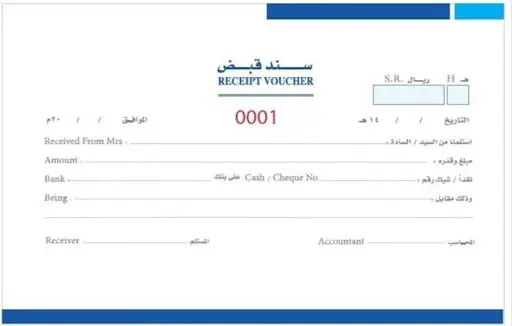
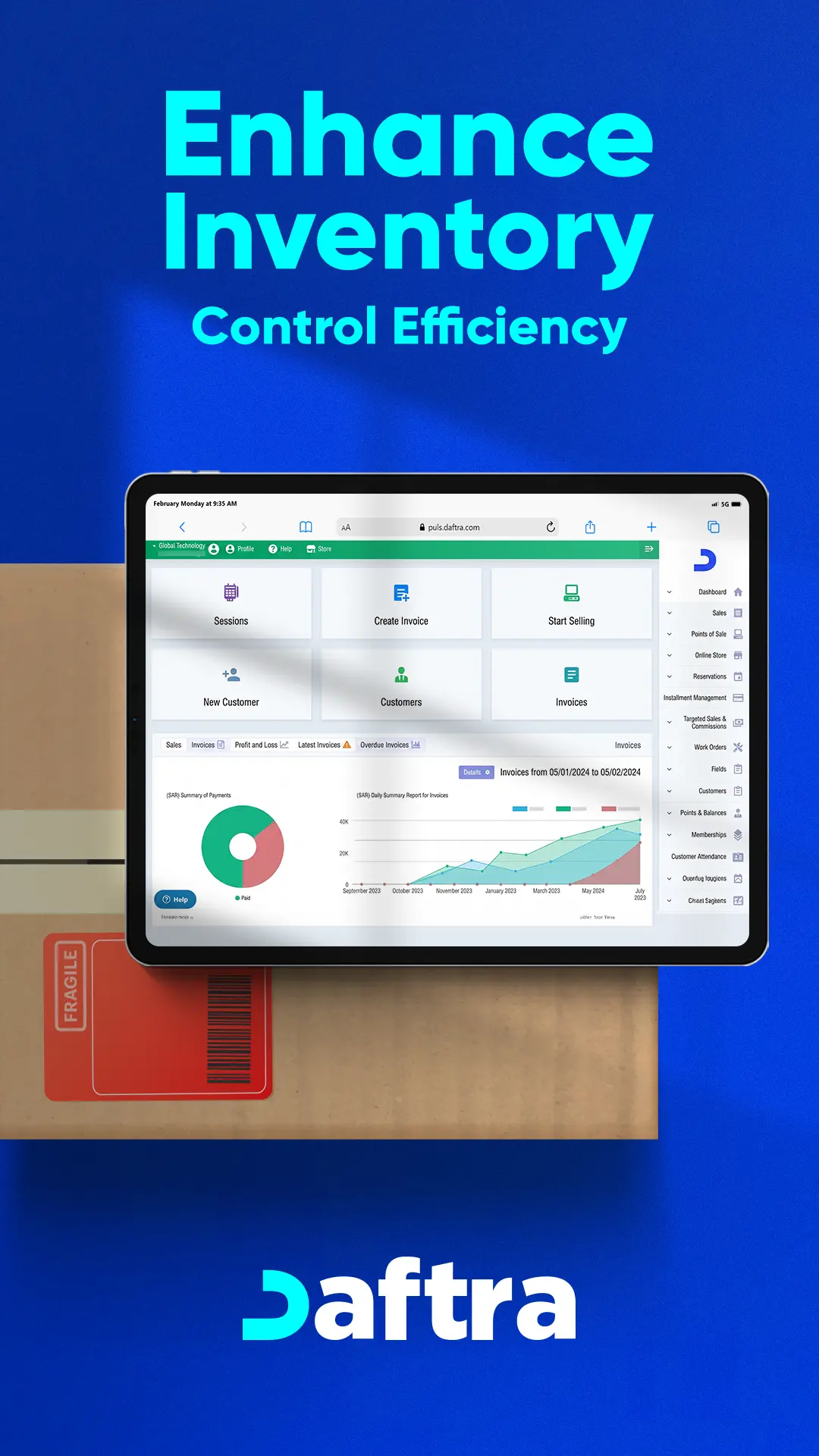
Receipt Voucher Example Image:
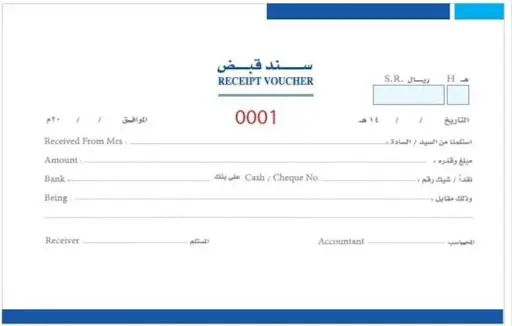
Here, all the data can be easily filled in. Before entering the data, it is important to ensure the following:
- That the data of the parties to the receipt are correct and complete.
- In the payment method, it should be clarified whether it is in cash or by check. If it is a check, make sure to include the check number and the name of the bank on which it is drawn.
- Do not forget the signature of the recipient and the financial accountant.
- If the amount paid is written in numbers, ensure it is also written in words.
You can also download a free, ready-made receipt template in PDF, Word, or Excel.
What is the Electronic Receipt?
An electronic receipt is a document issued by two parties to prove a transaction, such as the sale or purchase of a particular service. However, this receipt is prepared electronically through one of the electronic or cloud accounting programs, such as the accounting program from Daftra.
An electronic receipt can also be created using Excel. The components of the electronic receipt are the same as those of the paper receipt. It also includes the receipt number, issue date, names of both the payer and the recipient, transaction description, payment method, the amount paid, and the signatures of the concerned parties.
What are the steps to create an electronic receipt in Excel?
- You can open Excel on your device.
Write the title of the receipt, then the date and the amount paid, as shown:
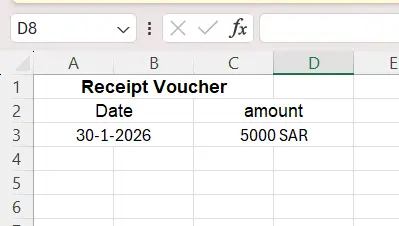
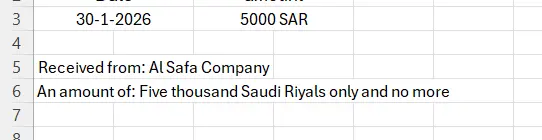
3- Then clarify the party paying the voucher amount and state the amount in words as shown:
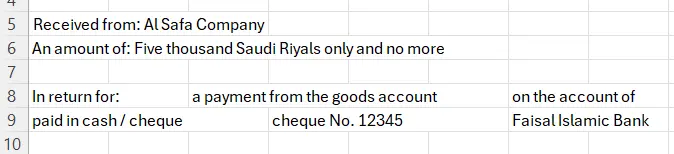
4- After that, it is clarified what this amount is in return for, and whether it was paid in cash or by cheque, and the cheque number and bank account are stated as shown:
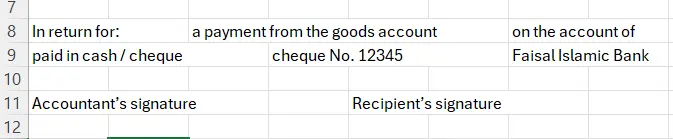
5- Finally, the signatures of the accountant and the recipient are stated as follows:
How to Create a Receipt Template in Word?
- Open the Word program.
- Write the title as "Receipt".
- Write the amount paid in numbers.
- Clarify the voucher issue date in the following format: Date (Hijri): —-/—- /—- 14–AH Corresponding to:—- /—- / —-20–AD
- Then write "We have received from" followed by the name of the establishment or the person who will pay the amount.
- Write the amount in figures and in words.
- Specify whether this amount is paid in cash or by check by writing "Cash" or "Check No: ______ on Bank: ______" and the name of the bank.
- Then, write "In exchange for" and clarify the reason for issuing the receipt.
- Finally, include the signatures of the accountant and the recipient.
What is an Electronic Receipt Template?
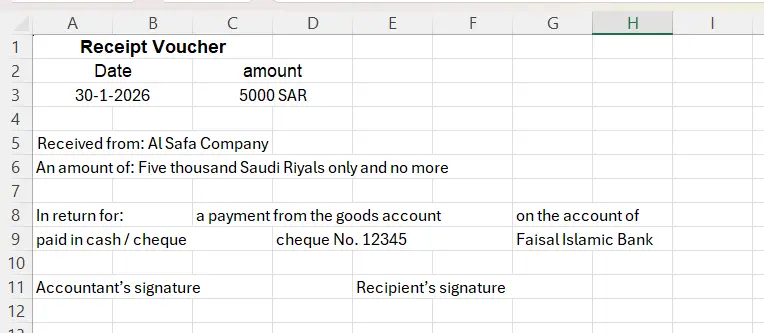
This document provides an example of an electronic receipt template created in Excel, along with a printed version.
What is the Journal Entry for a Receipt?
Like any financial transaction, it needs to be recorded in the journal. Since the receipt represents an incoming transaction to the company's cash or bank account, the debtor in this case is the cash account (for example), while the customer’s account is the creditor.
| Description | Debit | Credit |
| From A/C Cash | XXXXX | |
| To A/C Customer Name | XXXXX |
How Does Daftra Make It Easier to Create Receipts?
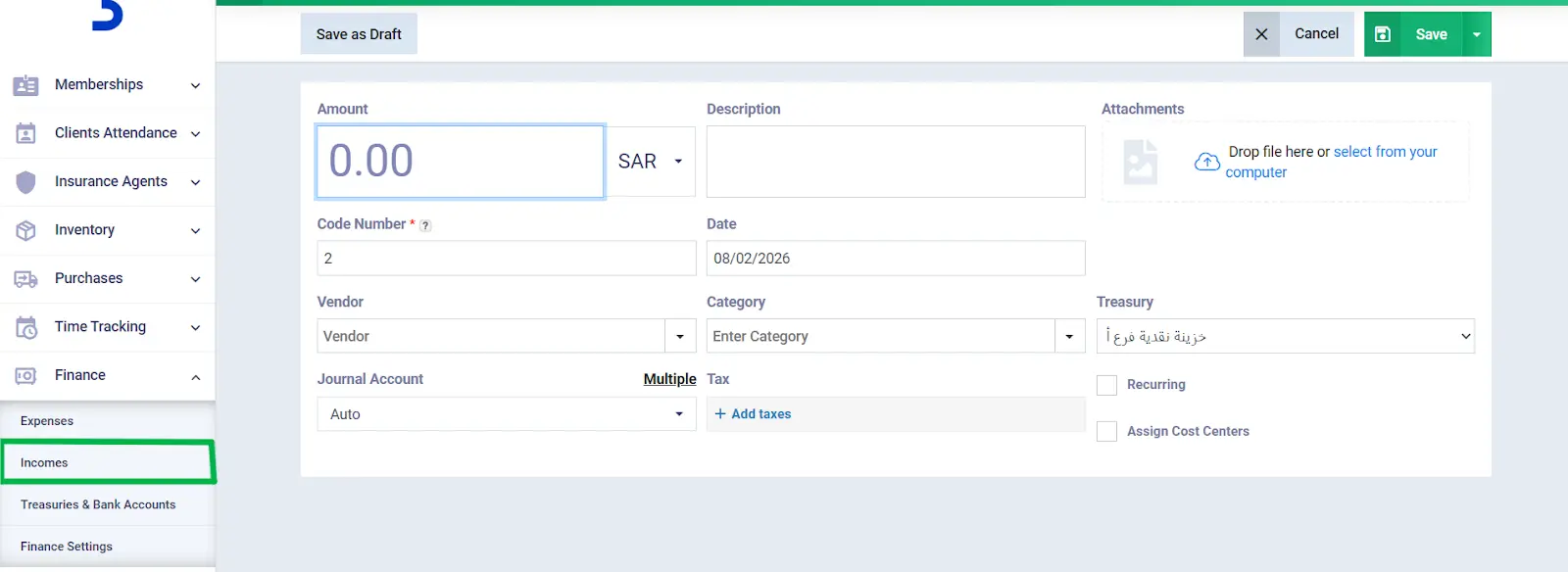
With Daftra’s accounting software, specifically in the financial section of the dashboard, you can track receipts based on categories. If you want to divide them by the issuer and source, you can do that easily. Additionally, you can distinguish your incoming financial transactions from each other using the receipt screen, which provides all the data you need:
- The amount of the incoming receipt.
- A brief description of the reason for the payment.
- The receipt code, which is automatically numbered by the program for enumeration.
- The receipt date.
- Who received it?
- Its classification: Is it a customer receipt, another company's receipt, or indirect profit, etc.?
- The cash register where you want to receive the amount.
- Any taxes related to the receipt, if applicable.
- The cost center allocation.
- The account of the receipt in the chart of accounts.
- A scanned copy of the paper receipt.
Once saved, you can return to the receipts list at any time to view them.
Frequently Asked Questions
What is the difference between a receipt and an invoice?
The main difference between a receipt and an invoice is that a receipt is a declaration that your company has received payment from the customer, either as a due payment or in advance. An invoice, on the other hand, is a notice that informs the customer of the amounts due for services or products sold.
Who is the recipient of the receipt?
The recipient mentioned on the receipt is the cashier or the accountant responsible for handling cash and recording it in the cash account.
What are the common types of receipts?
There are four types of receipts: cash receipts that document cash collection, bank receipts that document bank and banking collection transactions, receipts that document simple daily expenses, and charitable receipts that document the company’s donations to a specific entity.
What is the difference between a receipt and a payment voucher?
A receipt is a document issued by your company and given to the customer to prove the receipt of an amount of money in cash or by check from the entity representing the customer in exchange for the goods or services provided.
A payment voucher, on the other hand, is a document issued by your company to prove the disbursement of an amount of money in exchange for purchasing raw materials or goods from a supplier.
Is a receipt mandatory?
A receipt is mandatory and must comply with the conditions set out in the financial documents. These include clarifying the amount received, the concerned parties, the payment date, and other elements mentioned in the previous lines in the section on receipt contents.
If these conditions are met, the receipt can be treated as an official receipt recognized in various situations, allowing the customer to prove payment of the service or product amount.
How can using receipts help maintain a steady cash flow?
Receipts can help maintain steady cash flow by documenting the company’s right to receive payments from customers on the specified due dates. This helps with financial planning and forecasting future cash inflows, tracking collections, identifying late payments, and communicating with customers about them to avoid cash shortages.
Receipts can also be used to analyze cash flow using the accurate data they provide on received amounts, which helps management make informed financial decisions.
What are the most common accounting errors that may occur when preparing a receipt?
- Entering the receipt data incorrectly, whether by recording a higher or lower received amount, or posting the amount to the wrong customer account.
- Failing to record the receipt in the accounting books.
- Issuing duplicate receipts for the same transaction, thereby inflating revenues and presenting them inaccurately.
- Not reconciling receipts with the payments actually received, which affects the accuracy of financial records.
Can a payment voucher and a receipt be used in the same transaction?
Yes, both a receipt and a payment voucher can be used in the same transaction. For example, a receipt can be used to document receiving the amount from the customer, and then a payment voucher can be used to document paying the amount to the supplier.
Can a landlord issue a receipt?
Yes, a landlord can issue a receipt in order to document receiving rent from the tenant. In this case, the components of the receipt include the tenant’s name, the amount paid, the date of receipt, and the rental period covered.
The purpose of the receipt in this case is to protect the landlord’s rights in the event of any payment disputes and to document the tenant’s obligations, thereby enhancing transparency and credibility between the two parties.
How can I cancel a receipt?
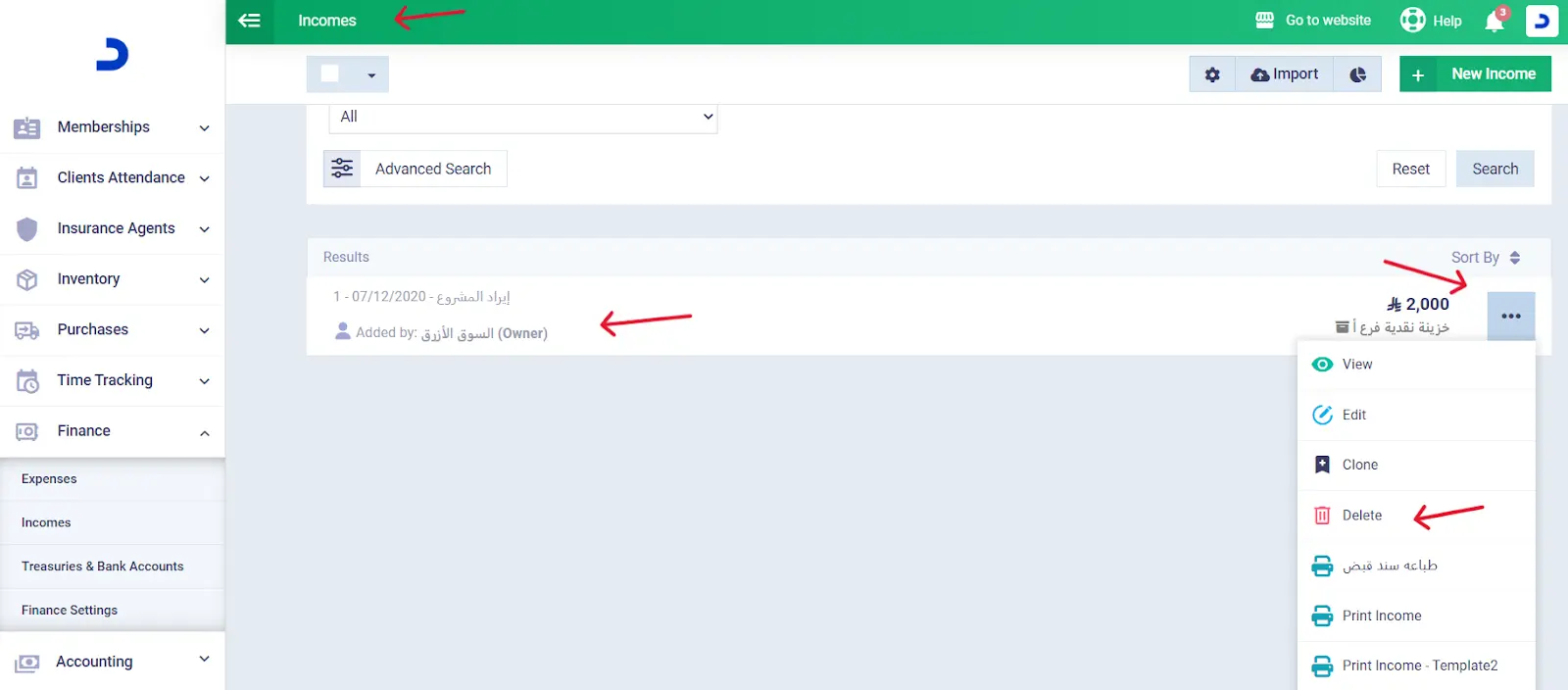
A receipt can be canceled in the Daftra accounting program by clicking on the receipt settings button, then choosing Delete from the drop-down menu, as shown:
What is a receipt between two individuals?
A receipt documents the payment process and confirms the receipt of a monetary amount from one person to another in exchange for the delivery of a product or service.
Is it a receipt, a debit, or a credit?
A receipt is considered a debit for the buyer and a credit for the seller, who benefits from it.
How can I issue a receipt?
To issue a receipt, you can use the Daftra accounting software, which enables you to create electronic receipts to ensure accuracy in financial transactions.
Who issues the receipt?
The recipient or the party that received the amount of money in exchange for a service or product is the one who issues the receipt. The owner of the receipt is the customer or the party that paid the amount in return for issuing the receipt.
What is the difference between a receipt and a payment voucher?
The difference between a payment (disbursement) voucher and a receipt lies in the nature of the financial transaction they represent. A payment voucher is used to document paying an amount to a person or entity, while a receipt is used to document receiving an amount.
Does a receipt stop services?
No, a receipt does not stop services, as it is merely a documentation of receiving a sum of money and has no relation to services.
Is a receipt prohibited?
No, using a receipt is not legally prohibited. It is used to prove the receipt of an amount in exchange for a service or product.
What is an advance payment receipt (Arbun)?
An advance payment receipt (Arbun) is a document that proves the payment of a monetary amount as part of the price or as a deposit for purchasing a product or service. This document guarantees the rights of both the creditor and debtor.
How do I create a receipt on the Ejar platform?
Log in to the Ejar platform, then go to the Finance or Receipts section. Select the contract or invoice paid in cash or via an external transfer, and click Create Receipt. Enter the amount and payment method, then confirm the process with a verification code. After that, the receipt is issued electronically and can be saved or printed.
How do I issue a receipt from Najiz?
To issue a receipt from the Najiz platform, you can follow these steps:
- Log in to the Najiz platform.
- Submit a request to execute an electronic promissory note.
- Enter the amount and the due date.
- Review the request and send it for court review.
What are receipt books?
A receipt book is a book used to document cash collection transactions received within the framework of commercial activities.
What is the size of a receipt book?
Receipt book sizes vary, but they are usually A5, with a carbon copy book of 2 copies measuring 12×17 cm and a capacity of 50 pages.
Conclusion
In conclusion, after explaining what a receipt is, its components, and its importance to the different parties involved, it can be said that a receipt is an essential part of any successful accounting system.
Therefore, do not hesitate to use receipts correctly as outlined above, to ensure accuracy and transparency in documenting financial transactions and to build trustworthy relationships with clients.










 Invoicing
 POS
POS Offers
 Installments
 Sales Commission
 KSA E-Invoice Software
 EGY E-Invoice Software
 JO E-Invoice Software
 E-Invoice Software
 Chart of Accounts
 Asset Management
 Cost Centers
 Expenses
 Cheque Cycle
 UAE VAT-Tax
 Product Management
 Purchases
 Purchase Cycle
 Suppliers
 Requisitions
 Stocktaking
 Organizational Structure
 Personnel Management
 Attendance and Leave
 Contracts
 Payroll
 Requests
 Work Orders
 Booking Management
 Rental and Unit Management
 Time Tracking
 Work Flow
 Lease Contracts
 Manufacturing Management
  Client Follow-Up
 Loyalty Points
 Points and Credits
 Memberships
 Insurance Management
 Daftra ERP Full App
 Point of Sales App
 Point of Sales for Desktop – Support Offline Mode
 AI Expenses Scanner App
 Employee Attendance, Sign & ESS App
 E-invoice Reader App
 Inventory Stocktaking App