


What is the Peppol CTC Model in UAE for E-Invoicing

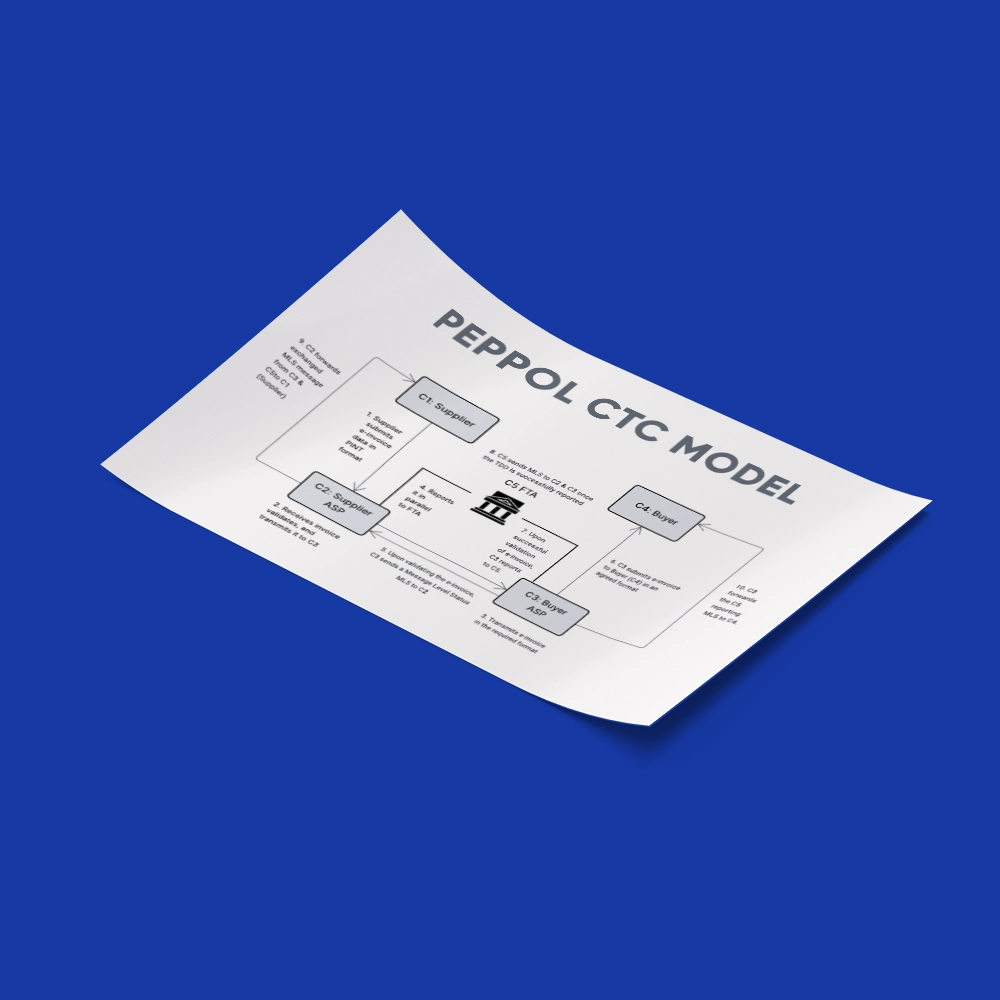
Table of contents:
- Key Summary
- What is the Peppol CTC model in the UAE?
- What do Peppol, CTC, and DCTCE mean?
- Why did the UAE choose the Peppol CTC model?
- How does the Peppol CTC model work in UAE e-Invoicing?
- What is the difference between the Peppol CTC model and the UAE 5-corner system?
- What role do Accredited Service Providers (ASPs) play in the Peppol CTC model?
- What gets reported to the FTA in the UAE Peppol CTC model?
- How does the Peppol CTC model connect with XML, PINT AE format, and mandatory fields?
- Is Peppol mandatory in the UAE?
- How do businesses prepare for the UAE Peppol CTC model?
- How does the Peppol CTC model affect accounting and bookkeeping processes?
- Frequently asked questions about the Peppol CTC model in UAE
- Conclusion
The UAE’s e-invoicing system is set to officially launch in 2027, promising a digital transformation of the country’s data infrastructure. With major aims in maximizing operational efficiency, economic digitization, and reducing tax gaps.
As part of the UAE’s execution plan, the Peppol Continuous Transaction Control (CTC) model was chosen as the framework for the e-invoicing system. The CTC model serves as a link among businesses, Accredited service providers (ASPs), and the Federal Tax Authority, creating a fully integrated e-invoicing exchange system.
This article covers how the CTC framework operates, how invoices are exchanged, the role of ASPs, how the tax is reported in real-time, and how you should prepare your business.
What is the Peppol CTC model in the UAE?
The UAE has selected the Peppol-based Continuous Transaction Exchange CTC model as its e-invoicing framework. Thus, enabling the exchange of invoices between the supplier and the buyer through an accredited service provider that structures, validates, and reports relevant data to the Federal Tax Authority.
The UAE’s official documentation refers to the Peppol-based decentralized CTC model as Decentralized Continuous Transaction Control and Exchange (DCTCE). This reflects the country’s approach to creating an integrated network for the electronic exchange of invoices between businesses through accredited Peppol service providers. Then, data collection and reporting to the FTA are done in real time or near real time.
The Peppol CTC model is designed as a complete operational framework that regulates how invoices move through the system, ensures their validation, and maintains compliance with UAE e-invoice requirements throughout the process.
What do Peppol, CTC, and DCTCE mean?
One of the most confusing aspects of the UAE’s e-invoicing system is the distinction among the Peppol network, CTC, and DCTCE.
Here is a clear breakdown for each of them:
Peppol network:
Peppol is an international network and set of standards that enable secure electronic document exchange among ERP systems.
The UAE’s official documentation explains how useful OpenPeppol is for exchanging documents beyond the UAE through the “Connect one, Connect All” model, which in turn supports cross-border interoperability.
Continuous Transaction control (CTC):
The CTC model is a digital framework designed to ensure tax compliance by establishing an e-invoice exchange system that reports to the tax authorities in real time or near real time. This means that the FTA does not wait for the transaction to finish; instead, it is reported as the transaction happens, or close to when it happens.
Decentralized Continuous Transaction Control and Exchange (DCTCE):
The DCTCE is the UAE’s official e-invoicing model. It allows businesses to exchange invoices through a Peppol-accredited service provider, with the invoices reported to the Federal Tax Authority in real time or near real time. It is set as a 5-corner e-invoicing model, launching in 2026, and covering the entire invoice exchange process for B2B and B2G businesses, from issuance to reporting to the government.
The differences among the Peppol, CTC, and DCTCE models lie in the nature of each. The Peppol network is understood as the main framework defining the e-invoice exchange and validation process, CTC is what ensures real-time tax reporting to the authorities, while DCTCE is the UAE’s implementation of the CTC, but decentralized, Peppol-based, and non-clearance.
Helpful Template: Tax Invoice Format Template UAE
Why did the UAE choose the Peppol CTC model?
The UAE’s vision for implementing the e-invoicing system is to accelerate the exchange and reporting process toward near-time reporting, which is why Peppol CTC was the best option. Here are some benefits of Peppol CTC:
1. Transparency:
Real-time tax visibility helps in combating tax evasion.
2. Automation:
Automated reporting through ASP results in fewer manual errors.
3. Efficiency:
Fast invoice processing and lower processing costs.
4. Effectiveness:
Better audit and more compliance.
5. Compliance:
Assist in tackling the shadow economy and reducing the tax gap.
6. Cross-border interoperability:
Through the OpenPeppol international network, businesses in the UAE can trade with international partners.
The Ministry of Finance stated in the official guidelines that e-invoicing in the UAE is designed to align with the global Digital Reporting Requirements (DRR) in general and the Continuous Transaction Control (CTC) in particular.
How does the Peppol CTC model work in UAE e-Invoicing?
The Peppol CTC model follows a structured multi-layered flow in which invoice data is validated, exchanged, and reported. This process is carried out through an accredited service provider (ASP) within an integrated system that connects the businesses, the ASP, and the FTA.
The process works as follows:
- The supplier creates invoice data using accounting software and sends it to ASP.
- ASP validates the invoice for compliance and converts it to the mandatory XML format (if needed).
- After the validation, the invoice gets transmitted through the Peppol network to the buyer’s ASP.
- At the same time, relevant tax data are reported by the supplier’s ASP to the Federal Tax Authority.
- From the buyer’s side, their ASP is performing validation checks before admitting the invoice to the buyer’s system.
- Buyer’s ASP reports the tax data to the FTA after validation.
- Finally, a status message is sent back to state rejection or confirmation.
This flow ensures that e-invoices are transmitted, validated, and reported efficiently and in real time or near real time, thereby supporting the UAE’s e-invoicing compliance framework.

What is the difference between the Peppol CTC model and the UAE 5-corner system?
The Peppol CTC model may appear similar to the UAE 5-corner e-invoicing system, but they are not the same. Here is the difference between them:
- Peppol CTC model: the overall framework the UAE uses for e-invoicing. It states how invoice data is exchanged among businesses, validated through ASP, and reported to the FTA as a part of an integrated, continuous transaction control system.
- 5-corner system: Is the technical architecture used to implement the Peppol CTC framework. It defines both the supplier and the buyer, their respective ASPs, and the process regulations.
Quick way to differentiate between them:
- Peppol CTC → The framework of the e-invoice exchange system
- 5-corner model → The architecture used to implement the system
Realizing the distinction between the Peppol CTC model and the 5-corner system is crucial for understanding the e-invoicing system as a whole.
Helpful Template: UAE-Proforma Invoice Template
What role do Accredited Service Providers (ASPs) play in the Peppol CTC model?
The Accredited service provider is considered to be an essential player in the e-invoicing system. It acts as an intermediary between businesses and the Federal Tax Authority.
Here is what the role of ASP entails:
- Facilitates the invoice exchange between the supplier and the buyer.
- Validates data against UAE requirements
- Connects businesses to the Peppol network, ensuring secure, standardized invoice transmission.
- Transmits relevant tax data to the Federal Tax Authority as part of the transaction flow.
- Enables the use of a participant identifier after onboarding
- Maintains alignment with the latest technical specifications and regulations
- Provides ongoing technical support to businesses
ASPs' role is considered a cornerstone of the exchange system; they manage the exchange, validation, and reporting of invoices while ensuring compliance with mandatory requirements throughout the process.
What gets reported to the FTA in the UAE Peppol CTC model?
Under the UAE’s e-invoice initiative, reporting tax data is now part of the process rather than a later step. Instead of submitting tax reports after the transaction, relevant tax data is now submitted to the Federal Tax Authorities as part of the e-invoice flow.
While businesses may view the e-invoice structure through a familiar lens, it is now standardized and can be automatically validated, processed, and reported. It is important to understand the difference between a human-readable invoice and an invoice built in XML under strict PINT AE rules, designed primarily for machines.
Relevant tax data, as part of the ongoing e-invoice process, is reported to the FTA in accordance with regulatory requirements and through an FTA- approved accredited service provider. This is designed to happen automatically through an ASP or an ERP/accounting system, with minimal human intervention.
The UAE’s e-invoice model is also bidirectional, as it is built on reporting and validating the data from both the supplier and buyer sides. This aids consistency, limits discrepancies, and enhances overall compliance performance.
Reporting tax data as part of the flow is the UAE’s approach to maximizing efficiency, supporting real-time oversight, and establishing a more controlled tax environment.
How does the Peppol CTC model connect with XML, PINT AE format, and mandatory fields?
The Peppol CTC model is the main framework, with components that work together to support the entire invoice management process.
The foundation of this system clearly differentiates between the framework, format, data, and specifications.
Here are the distinctions between them and how they all integrate despite their different nature:
- The Peppol CTC model defines the overall operational framework for exchanging, validating, and reporting invoices.
- XML is a machine-readable format that structures how invoices are created and transmitted.
- The PINT AE format is the UAE’s own specification of the Peppol model, customized to the local market and tax needs.
- The mandatory data represents the minimum required data present in the e-invoice to be validated.
One needs to understand that each component does not operate as a separate system; they are all parts of a bigger ecosystem, acting as interconnected layers that play different roles in the e-invoicing system.
The Peppol CTC serves as the framework that manages the process, while the UAE’s standard e-invoice XML format ensures structural consistency; PINT AE handles compliance with the requirements, and UAE E-Invoice Mandatory Fields ensure that all required tax data is recorded.
Is Peppol mandatory in the UAE?
Yes, the e-invoicing system will be mandatory for businesses in scope and will be implemented through a phased roll-out. In that sense, the UAE has adopted a Peppol- based framework to regulate the exchange and reporting of invoices. All businesses in scope are required to comply with the e-invoicing regulations, under the mandated format and through an accredited service provider.
The e-invoice model is mandatory for people and businesses operating in the UAE, subject to specific scope criteria, dates, and business categories. Thus, Peppol should be understood as the infrastructure of the e-invoicing system; understanding the UAE’s e-invoice special requirements, exemptions, guidelines, and scopes is crucial for your compliance with the system.
How do businesses prepare for the UAE Peppol CTC model?
Preparing for the UAE’s Peppol CTC model does not require rebuilding your system from scratch; rather, it requires ensuring that your business meets the regulatory readiness and technical setup requirements.
Here is what you should do to prepare your business:
- Determine if your business is within the scope of the e-invoice mandate and learn the compliance timeline
- Choose an accredited service provider; they play an essential role in participating in the e-invoicing system.
- You should onboard your business using the relevant government platform (EmaraTax) to get a participant identifier, so you can start exchanging invoices through the system.
- Get your ERP/ accounting system ready to start generating e-invoices and integrate with your ASP. (Daftra supports FTA-compliant e-invoice generation and relevant tax data reporting).
- Run a test trial for the full invoice flow end-to-end to ensure you are on track to go-live.
You can check the UAE electronic invoicing setup guide to view the setup steps inside Daftra and prepare your account for UAE e-invoicing requirements.
How does the Peppol CTC model affect accounting and bookkeeping processes?
The implementation of the Peppol CTC model in the UAE is set to revolutionize how accounting and bookkeeping operate daily. Because the invoices must adhere to structured data standards, undergo validation checks, and be processed within a strict framework, accounting teams will work with cleaner, more consistent data flows.
The UAE’s e-invoicing impacts accounting and bookkeeping at the core of operations. By automating the entire process, there will be less human intervention and manual entry, leading to more efficient, less error-prone performance. As the invoices are checked before and during transmission, errors will be identified early in the process, rather than during audits.
Also, continuous reporting leads to a better, more reliable audit trail that leans on documented transactions and compliant data. Nonetheless, these advantages demand changes towards a more system-driven approach in business.
Frequently asked questions about the Peppol CTC model in UAE
What is the CTC model of e-invoicing?
The Continuous Transaction Control model is an e-invoicing framework in which data must be submitted, validated, and reported to the tax authorities in real time or near real time.
What is Peppol in UAE?
Peppol in the UAE is the infrastructure that standardizes e-invoicing. It manages the exchange of invoices in a structured format through an accredited service provider.
How does Peppol work?
Peppol operates as a secure, standardized network that enables businesses to exchange and process invoices automatically between systems.
How do I get a participant ID?
To obtain a participant ID, use the first 10 digits of your VAT TRN as your 10-digit tax identification number. Register this ID through ASP and connect to the Peppol network.
Conclusion
Understanding the Peppol CTC model as the underlying infrastructure that manages the e-invoicing process, enabling the exchange of data between suppliers and buyers through accredited service providers in a standardized format, while relevant tax data is reported to the FTA simultaneously. This model governs the components of the e-invoicing system, ensuring effective data flow.
The UAE’s choice of the Peppol CTC model as the e-invoicing architecture was driven by the primary goal of adopting an innovative data exchange model that ensures real-time reporting to the FTA, which in turn results in reducing VAT leakage, fewer manual entry errors, less processing time, better audit, compliant data, and overall workflow automation.











 Invoicing
 POS
POS Offers
 Installments
 Sales Commission
 KSA E-Invoice Software
 EGY E-Invoice Software
 JO E-Invoice Software
 E-Invoice Software
 Chart of Accounts
 Asset Management
 Cost Centers
 Expenses
 Cheque Cycle
 UAE VAT-Tax
 Product Management
 Purchases
 Purchase Cycle
 Suppliers
 Requisitions
 Stocktaking
 Organizational Structure
 Personnel Management
 Attendance and Leave
 Contracts
 Payroll
 Requests
 Work Orders
 Booking Management
 Rental and Unit Management
 Time Tracking
 Work Flow
 Lease Contracts
 Manufacturing Management
  Client Follow-Up
 Loyalty Points
 Points and Credits
 Memberships
 Insurance Management
 Daftra ERP Full App
 Point of Sales App
 Point of Sales for Desktop – Support Offline Mode
 AI Expenses Scanner App
 Employee Attendance, Sign & ESS App
 E-invoice Reader App
 Inventory Stocktaking App