


How to Price Products and the Latest Pricing Strategies


Table of contents:
- Key Summary
- Concept of Product Pricing
- Steps for Product Pricing
- A Practical Example of Product Pricing and Profit Margin Calculation
- What are the Pricing Objectives?
- Product Pricing Strategies for 2026
- Tips on How to Convince Your Customers of Your Product Pricing Without Reducing Prices
- How to Control Your Product Pricing Using Daftra
- Frequently Asked Questions
Many of us wonder how commercial institutions and retail stores make customers feel that certain products are worth every penny. The common commercial term for these methods is "pricing strategies," through which the desired balance is achieved between the value offered to customers and the profit objectives that the business seeks to attain.
This term raises many questions, including: What are the goals of product pricing? What factors can influence pricing decisions? What are the best pricing strategies to follow? And how are products priced?
All these questions and more have clear, detailed answers with practical explanations, based on our accounting experience, on how to apply the pricing steps. This ultimately enables you to attract both current and potential customers and boost sales, whether you run a micro, medium, or even a large and famous brand.
Concept of Product Pricing
Pricing is the process of determining the amount a business receives for selling a product or service.
Price is considered one of the main components of the marketing mix, along with product, place, and promotion. The fundamental difference between price and the other components of the marketing mix is that price generates revenue, whereas the other components require costs to be incurred to be completed properly. Based on this, product pricing is of utmost importance for any business.
Steps for Product Pricing
There is a set of steps that a company or business management must follow to price its products correctly, in a way that achieves its economic objectives. Below is a list of the product pricing steps, with a detailed explanation of each step in the article lines:
- Determining production costs.
- Determining the profit margin.
- Understanding your customers’ characteristics.
- Analyzing competitors.
- Choosing a pricing strategy.
- Monitoring and adjusting prices.
1- Determining Production Costs
To be able to make a profit, your sales must cover the costs incurred by the company to provide the product or service to the public. Costs are divided into three types:
- Raw Materials: These include the components and materials used in the manufacturing process.
- Labor: The company pays for its staff through salaries, insurance, payroll taxes, and other expenses.
- Overhead Expenses: This includes all monthly expenses the company pays regardless of sales volume, such as rent, equipment usage costs, insurance, taxes, shipping, product marketing costs, and others.
After understanding the details of each cost type, calculate the total costs to determine the minimum sales amount required to cover them.
2- Determining the Profit Margin
The second step in product pricing is determining the profit margin that each company wants to achieve through selling its services or products. The method for determining profit margin varies across management teams.
Daftra accounting software helps you accurately and clearly determine profit margins through a set of integrated accounting tools that make it easier to manage costs and analyze sales. The software allows you to record all types of costs, whether direct or indirect, and track sales volume for each product or service, automatically calculating the profit margin for each sale.
Daftra also provides detailed reports showing the most profitable products and customers, enabling you to make smart pricing decisions based on actual data.
Use Daftra’s profit margin calculator to know the profit percentage for all your operations automatically and for free.
3- Understanding Your Customers’ Characteristics
Before setting your product prices, you must know who your target customers are. It is important to understand the following basics:
- Customer Demographics: Age, gender, and understanding their economic and social status.
- Customer Priorities: You should know whether your product or service is a priority for customers or a secondary concern.
- Customer Preferences: Determine whether customers are looking for premium features regardless of price, or if they care more about low prices, and other details that can be identified through precise research and surveys, either online or field-based; this helps you set the price correctly.
4- Analyzing Competitors
Once you can accurately determine your target customers’ characteristics, you will be able to identify your direct competitors more easily. At this stage, you should analyze their pricing strategies so that you don’t stray too far from them.
It is important to know what attracts customers to your competitors and not to you; so you can try to adjust shortcomings in your products or at least compensate for them during the pricing process. This step is very important and allows you to set the price with maximum accuracy.
5- Choosing a Pricing Strategy
After determining costs and the desired profit margin, and after researching and analyzing your customers and competitors accurately, the next step is to determine the product pricing strategy you will follow in your business.
It is not necessary to stick to a single pricing strategy; you can combine multiple methods based on your business needs. In this article, we will discuss a set of the most prominent strategies for pricing your product correctly.
6- Monitoring and Adjusting Prices
The pricing process does not end with setting product prices for the first time and then ignoring them. It is important to continuously monitor the market to understand changes in it and in your customers, so you can make the necessary adjustments.
It is also important to monitor the product manufacturing costs and ensure that they do not increase significantly without your attention. Additionally, monitoring the general perception of your product, whether positive or negative, is necessary, as these factors may sometimes require intervention, price re-evaluation, and adjustments based on perceptions.
In summary, the product pricing process begins by calculating production costs and determining the required profit margin. After that, customer characteristics are studied, and competitors are analyzed to better understand the market.
Based on this information, the company chooses the appropriate pricing strategy and needs to monitor and update prices continuously as market and cost conditions change. By following these steps, the company ensures effective pricing that achieves its profit objectives.
A Practical Example of Product Pricing and Profit Margin Calculation
If the production cost of a women’s fashion item (a dress) is 250 Saudi Riyals, after calculating the variable costs (raw materials, shipping and distribution expenses, utilities, packaging, advertising and promotion costs), as well as the fixed costs (employee wages, rent, equipment used, consumed utilities), and the factory owner sets a profit margin of 20% per item:
Requirement: Clarify the pricing of a single item and calculate its profit.
Solution
It is assumed that the profit percentage is calculated using the following equation:
250 * 20 / 100 = 50 Saudi Riyals
The price of a single item will be calculated using the following equation:
Item Price = Cost of a Single Item + Added Profit Margin
= 250 + 50 = 300 Saudi Riyals
What are the Pricing Objectives?
When the management of any company or institution establishes a product or service pricing model, it sets a set of objectives that guide price determination in line with its vision. The most prominent objectives of product and service pricing are as follows:
1- Market Continuity
Pricing aims to find a price that is suitable for consumers and keeps them attached to the product or service despite intense market competition; this allows the product to remain in the market for the longest possible period and to establish strong roots. Afterwards, pricing can be reconsidered once a large customer base is formed.
2- Increasing Profit Margins
Every company seeks to increase its profit margin from selling its products or services based on market supply and demand, and competitor quality. Therefore, if the supply of a service is high, its price will also increase accordingly.
3- Market Control
Sometimes companies set low prices for their products and services to control market purchases and achieve the highest possible sales by increasing demand for their products; this eventually leads to a reduction in production costs for the company.
4- High Prices for Innovative Ideas
If a company introduces an innovative idea or product to the market, it sets a high price due to the high production costs required to deliver all these features in a single product, as large technology companies do.
Thus, it becomes clear that the goal of the pricing process is: maintaining continuity and competition through attractive prices; increasing profit margins in line with demand and quality; achieving market control by attracting the largest number of customers with well-studied prices; and, finally, pricing innovative products at high prices that reflect their unique value.
Product Pricing Strategies for 2026
Product pricing can influence a company's success and market share, as well as whether customers seek alternatives. Therefore, management must carefully choose the strategy to follow in the pricing process to achieve the desired results. The most prominent product pricing strategies are as follows:
1- Value-Based Pricing Strategy
This strategy is based on setting the price based on the product's or service's actual value or the value the audience can gain from acquiring it.
Companies that follow this strategy seek to understand how their product positively affects customers’ lives, how it provides comfort and meets their needs, or to what extent it enhances their social status in front of others. All of this is true regardless of competitors’ prices, as companies focus on their product’s features rather than comparing them to others'.
This strategy can be used when setting a pricing model for a premium product, such as jewelry, high-end fashion, or other luxury goods.
2- Competitive Pricing Strategy
This strategy relies on monitoring competitors’ prices and setting prices slightly lower than theirs to gain a competitive advantage.
This strategy can be applied to stable products with relatively steady markets, such as household tools. However, it is essential to continuously monitor competitors’ prices and promotional offers to consistently offer better prices than they do.
3- Price Skimming Strategy
This strategy is based on initially setting a high price for a new product, then gradually lowering it over time.
It is used for products that people eagerly anticipate entering the market, such as electronics, digital games, and others.
However, caution is necessary with this strategy, as it is a double-edged sword. It may cost your brand if a competitor launches a similar product at a lower price. Additionally, prices should not be reduced too quickly to avoid upsetting customers, who may feel they wasted their money; instead, one should wait until the product reaches full market saturation.
4- Cost-Based Pricing Strategy
This is one of the most widely used product pricing strategies, especially for companies or institutions with a large number of products that cannot afford much research into target audience characteristics.
The method relies on calculating the product's actual manufacturing cost and then adding a small profit margin. However, it is essential to ensure the product cost is calculated accurately, without overlooking any expenses, to avoid affecting the profit.
5- Penetration Pricing Strategy
This strategy is the opposite of price skimming. It aims to set low initial prices to attract buyers, then raise prices after consumers are attracted to the product’s features relative to competitors.
This strategy is often used by internet companies that offer introductory deals, such as a free month or discounts of up to 50%, after which the actual prices are applied.
Although this strategy can achieve high sales, it carries significant risks, as some consumers may exploit these offers and return to their previous service providers once the promotion ends.
6- Dynamic Pricing Strategy
This method relies on varying the product price based on the seller, time of sale, and demand quantity, similar to how some ride-hailing companies set different rates during peak and off-peak hours.
However, it should be noted that this strategy may annoy customers due to price fluctuations, as they may feel they could have purchased the product at a better price.
Product pricing methods vary according to market nature, product type, and target audience, each with its own suitable use.
The most prominent include value-based pricing focusing on the benefits offered by the product, competitive pricing that aligns with competitors’ prices, price skimming starting high and gradually decreasing, cost-based pricing covering costs and profit margin, penetration pricing starting low to attract customers, and finally, dynamic pricing that changes based on time and demand.
Choosing the appropriate strategy significantly contributes to achieving company goals, increasing sales, and maintaining market stability.
Tips on How to Convince Your Customers of Your Product Pricing Without Reducing Prices
Pricing products is one of the most important steps in launching any new service or product. This step often confuses management until they reach a price that balances achieving a reasonable profit with maintaining competitive market opportunities.
Convincing customers of the value of your product pricing without lowering the price relies on some important tips, including:
1- Focus on Added Value and Unique Features
Always show your customers how your products and services can solve their problems and meet their needs in exceptional ways. Highlight the value of your products better than competitors by offering unique features in design, quantity, or advanced technology. You can also leverage customer reviews and positive testimonials to enhance your brand’s reputation.
2- Gain Customers’ Trust Through Quality Certifications
Market your products with internationally recognized certificates that demonstrate compliance with quality standards, helping consumers purchase with confidence and ensuring safe use.
3- Enhance Customer Experience
Provide exceptional customer service by offering fast responses to inquiries at any time and smart solutions to problems, ensuring this is delivered through high-quality communication channels.
4- Offer Additional Services
Provide pricing options to suit all customer segments. You can distinguish premium pricing packages with added services such as technical support, free shipping, or others, so that customers feel they receive real additional value for what they pay.
5- Follow Comprehensive Marketing Plans
Ensure your product and service marketing plans are complete and integrated to achieve rapid reach with the largest possible audience.
This can be done by combining marketing strategies with paid advertising on social media platforms (Facebook, Instagram, LinkedIn, Twitter, Snapchat, TikTok, YouTube), email marketing, promotional blog articles, and engaging visual content with strong design.
6- Offer Flexible Payment Plans
Provide multiple payment options to facilitate the purchase process. If installment plans are possible, do not hesitate to offer them. These options attract customers to products at their set prices without the need to reduce them.
In summary, you can convince your customers of the value of your prices without lowering them by focusing on the added value and unique features of your product, highlighting quality certifications and international accreditations to build customer trust, and improving the customer experience.
Offering additional services within pricing packages, following a comprehensive marketing plan that effectively reaches the target audience, and providing flexible payment methods. All these factors make the customer feel they are receiving real value for the price, enhancing their confidence in the purchase decision.
How to Control Your Product Pricing Using Daftra
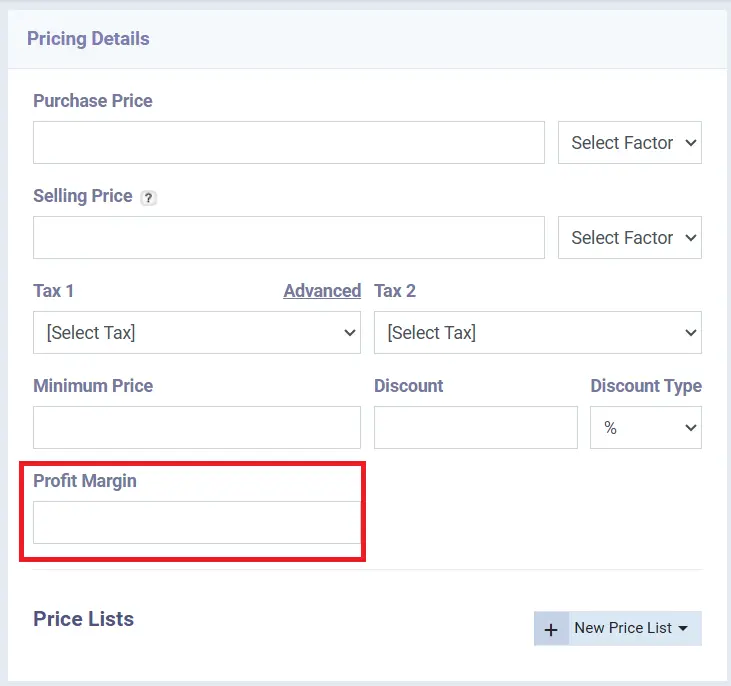
Daftra accounting software provides a dedicated pricing section when adding any product or service, allowing you to control pricing based on your pricing strategy.
It offers features such as calculating commercial discounts on products as a percentage or a fixed amount, adding taxes to the product, and setting a minimum selling price if the seller offers a special pricing deal to the customer.
Additionally, Daftra provides specialized price lists that reprice the products assigned to them, which can be used for specific customers or during special occasions and holidays.
Frequently Asked Questions
How is the product price calculated?
The product price is calculated using the following equation:
Product Price = Cost of Raw Materials + Other Indirect Costs (shipping, distribution, marketing, etc.) + Profit Margin (+/-), the percentage determined after comparing with competitors’ prices
What is the difference between price and pricing?
Price is the monetary value that a customer pays to a seller to obtain a specific product or service, whereas Pricing is the process of determining the appropriate price for a product based on several factors, including the target audience, the company’s profit objectives, and the study of market trends and competitors in the business sector.
Who is responsible for product pricing?
The Pricing Supervisor is responsible for product pricing and for creating and implementing the company’s overall pricing policy. This depends on the type of products or services the company offers and the geographic scope of product distribution.
The Pricing Supervisor collaborates with production and sales managers to update and improve prices over time, aligning them with the company’s profit objectives, ensuring financial stability, and supporting the company's competitive value in the market.
What is cost-based pricing?
Cost-based pricing is the simplest approach to pricing products or services. It involves calculating the total production cost and adding the profit, based on the company's profit margin expressed as a percentage.
What are the components of pricing?
Pricing components include several factors such as the product cost, supply and demand rates in the market, the value, benefits, and unique advantages of the product for customers, and the level of competition among businesses in the same sector.
What are the main points on which product pricing relies?
The main points in product pricing include the profit target the company aims to achieve, market analysis, prices of similar products, and marketing strategies used to target specific market shares. For example, when a company wants to gain a large market share, it may price its products low to attract customers and increase sales.
What is the most commonly used method for real estate pricing?
Sales comparison is the most commonly used method in real estate pricing. In this method, the person responsible for pricing, known as the real estate appraiser, compares recent sales transactions in the real estate sector to determine an appropriate market value, then adjusts it based on the property type and condition.
In the sales comparison method, the properties being compared should be as similar as possible, and important variables such as property age, sale terms, location, and additional features like gardens, varied spaces, and attractive designs should be considered.
How are products with unstable production costs priced?
A set of smart strategies should be adopted for pricing products with unstable production costs, such as:
- Evaluating all variable production costs, including materials, labor, and overhead, and negotiating smartly with suppliers to obtain the best purchasing offers.
- Using flexible pricing strategies such as value-based or cost-based pricing, while regularly tracking costs and prices to adjust pricing strategies when necessary.
- Communicating with customers to explain the reasons for price changes to enhance trust and credibility.
- Diversifying products to reduce risks associated with cost fluctuations.
What metrics are used in product pricing?
- Profit Margin Metric: Determines the difference between production cost and selling price to reach a reasonable profitability percentage, which is considered when pricing.
- Supply and Demand Metric: Shows the impact of customer demand on the offered price across different periods.
How do companies know if their product price is too high or too low?
Companies can determine whether their product price is too high or too low based on several elements:
- Comparing with what competitors offer.
- Calculating fixed and variable production costs.
- Analyzing sales data and profit margins.
- Understanding customer perceptions of prices.
- Considering market fluctuations and economic variables resulting from inflation or economic recession.
What are the risks and Challenges Companies Face When Pricing Products?
- Customer objections to product prices, especially if they are high and do not match their financial capabilities.
- Price reductions by competitors to attract more customers, known as “price undercutting,” make it difficult for the company to maintain its pricing strategy.
- Decreased sales and profits due to lower demand for the product.
- Lack of brand recognition or brand damage due to poor use of marketing methods, which leads to customer resistance to the implemented pricing strategy.
How Can Wholesale Pricing Be Done?
Wholesale pricing refers to adding the product cost to the manufacturer’s profit margin and then selling it to distributors and retailers. Wholesale prices are always lower than retail prices.
What is Mandatory Pricing?
Mandatory pricing is the official price set by government authorities responsible for pricing, such as the Ministry of Commerce and Industry, the Ministry of Economy, regulatory bodies like the Consumer Protection Authority, municipalities, or central banks.
Distributors must not exceed mandatory pricing, which usually applies to essential food items, public utilities such as electricity and water, and pharmaceuticals.
What is Transfer Pricing?
Transfer pricing is the process of setting prices for products and goods exchanged between multinational or multi-branch companies under a single corporate entity. The purpose of transfer pricing is to help subsidiaries distribute profits evenly and, for financial and tax reporting purposes, to the relevant authorities.
What Are the Best Pricing Methods?
The best product pricing methods include:
- Value-Based Pricing: Setting prices based on the benefit the product provides to the customer.
- Competitive Pricing: Setting the price based on competitors’ prices to attract customers.
- Price Skimming: Starting with a high price and gradually lowering it.
- Cost-Based Pricing: Adding a profit margin to the production cost.
- Penetration Pricing: Starting with a low price and raising it later.
- Dynamic Pricing: Adjusting prices based on time or demand.
What Are the Elements of Pricing?
Pricing elements include:
- Production costs (fixed and variable)
- Profit margin
- Market and competitor analysis
- Product value for customers
- Suitable pricing strategy
What Are the Characteristics of Pricing?
Pricing characteristics include:
- Flexibility according to the market and customers
- Strategy based on business objectives
- Adjustable with market or cost changes
- Linked to the value received by the customer
- A competitive tool that influences purchase decisions
What Is the Product Pricing Equation?
Products are priced using an equation to achieve profit:
Product Price = Production Cost + (Profit Margin × Production Cost)
Example: If the product cost is 250 Riyals and the profit margin is 20%:
→ Price = 250 + (250 × 0.20) = 300 Riyals
What Is the Product Pricing Policy?
A pricing policy is the method a company uses to set prices. It includes:
- Competitive pricing
- Value-based pricing
- Penetration pricing
- Price skimming
- Dynamic pricing
Policies vary according to company objectives and customer behavior.
What Is a Product Pricing Model?
A pricing model is the method used to determine the price based on:
- Product cost
- Value provided
- Target market
- Competition
- Profit objectives
It is often used as a calculation model or ready-made document, such as Daftra’s product pricing template.
What Is International Pricing?
International pricing refers to setting product prices in foreign markets, taking into account cost and tax differences, exchange rates, customers’ purchasing power, and international marketing policies.
After covering all aspects of product pricing, its importance, steps, and recently updated strategies to attract customers and boost sales, it can be concluded that pricing strategies are a key pillar in managing the financial affairs of commercial and industrial entities across different sectors.
Companies cannot ignore the power and importance of product pricing and its impact on markets to achieve maximum profitability from sales.
It is important to understand that product pricing is not just about numbers; it is a complex accounting process with multiple dimensions that require a deep understanding of the target audience’s needs and consumer behavior to generate profits and deliver value beyond customer expectations.
This ultimately supports the success of commercial entities and increases their market share. Therefore, as a business owner, you should carefully price your products or services to meet customer expectations, align with their financial capabilities, and achieve your desired objectives.
Pricing strategies and methods vary according to business size, product type, target markets, and the competitive landscape of other entities in the same field.











 Invoicing
 POS
POS Offers
 Installments
 Sales Commission
 KSA E-Invoice Software
 EGY E-Invoice Software
 JO E-Invoice Software
 E-Invoice Software
 Chart of Accounts
 Asset Management
 Cost Centers
 Expenses
 Cheque Cycle
 UAE VAT-Tax
 Product Management
 Purchases
 Purchase Cycle
 Suppliers
 Requisitions
 Stocktaking
 Organizational Structure
 Personnel Management
 Attendance and Leave
 Contracts
 Payroll
 Requests
 Work Orders
 Booking Management
 Rental and Unit Management
 Time Tracking
 Work Flow
 Lease Contracts
 Manufacturing Management
  Client Follow-Up
 Loyalty Points
 Points and Credits
 Memberships
 Insurance Management
 Daftra ERP Full App
 Point of Sales App
 Point of Sales for Desktop – Support Offline Mode
 AI Expenses Scanner App
 Employee Attendance, Sign & ESS App
 E-invoice Reader App
 Inventory Stocktaking App