





Table of contents:
- What Is Corporate Accounting?
- What Are the Types of Corporate Accounting?
- What is the Importance of Corporate Accounting?
- The Principles of Corporate Accounting
- How Does Corporate Accounting Differ from Other Types of Accounting?
- What is the Purpose of Accounting for Companies with Branches?
- What are the Accounts Related to Corporate Accounting?
- What are the Difficulties Related to Corporate Accounting and Ways to Overcome Them?
- What are the Differences Between Corporate Accounting and General Accounting?
- What are the Duties of Corporate Accountants?
- How Does Daftra's Accounting Software Help You Manage Your Company's Accounts?
In the world of accounting, you may encounter complex problems and essential questions that cannot be solved through any of the known scientific solutions. Therefore, corporate accounting aims to provide clear answers to these questions and focuses on the systems of different companies, regardless of their type, defining the characteristics and features of each type.
For example, financial accounting in its raw form will not help you answer questions such as:
- How can profits and losses be divided?
- If there are multiple partners, are profits divided equally among them?
- What is the required capital that each person must contribute to be considered a partner?
Management accounting will not be sufficient to answer questions such as:
- What is the legal level of authority for each partner? And on what basis does he speak?
- What is the organizational structure, and what does the board of directors look like?
- What responsibility falls on each partner if the company becomes involved in debts it cannot repay?
Therefore, corporate accounting emerged to provide clear answers to these questions and focuses on the systems of different companies, regardless of their type, defining the characteristics and features of each type among the various company types, as well as the responsibility of the corporate accountant in any institution. For this reason, in this article, we will explore accounting in different companies, the characteristics of each, and the responsibilities of the corporate accountant in any institution.
What Is Corporate Accounting?
Corporate accounting is an integrated process that records, classifies, analyzes, and presents financial information about a business's activities and transactions. Corporate accounting determines a company's profits and losses and identifies all revenues and expenses during the financial period. In turn, it distributes profit and loss ratios among partners.
It also determines the company's profits and losses and identifies all revenues and expenses during the financial period. In turn, it distributes profit and loss ratios among partners.
It helps create a clear picture of financial performance, enabling more efficient and accurate decision-making. Corporate accounting goes beyond recording daily journal entries; it includes preparing reports, monitoring accounting controls and procedures, and adhering to regulatory and tax requirements specific to the business.
This ability to distribute profits among partners and shareholders is one of the key characteristics that distinguishes corporate accounting from other accounting types; it is not much different from government accounting, which considers the specific needs of government entities.
The purpose of issuing these shares is to raise more funds and invest them in expansion and growth. Ultimately, a comparison of cost and revenue accounts determines the company's profits and divides them among partners.
As a result, corporate accounting is crucial for understanding company performance, overseeing resources, and supporting management decisions.
Basic Standards for Companies:
There are a number of standards that must be available in any company or institution, such as:
- The company must fulfill certain documents that prove it has shareholders, directors, and capital.
- The company is treated as a legal entity with a separate personality from the company owners and is dealt with independently, where if there are obligations on the company, they are not on its owners.
- The company must have a common seal, and any document or paper must bear this seal.
- Financial and economic standards that an expert financial accountant must consider to ensure the company's success and sustainability. These standards include profitability, liquidity, financial solvency, operational efficiency, growth and economic diversification, competitiveness, and awareness of economic changes and understanding their effects on the labor market.
- Corporate accounting compliance with Islamic accounting standards, especially for Islamic countries that care about these standards, so that the company does not fall into prohibited practices such as issuing bonds that are considered part of usury and other Islamic prohibitions that are not taken into consideration economically and legally.
What Are the Types of Corporate Accounting?
Companies use various types of accounting, depending on the intended purpose of the financial information and the parties who will use it.
Corporate accounting helps companies and business entities plan, control, and make decisions, unlike financial accounting, which primarily shows a company's financial position and performance.
Below, we review the most important types of accounting used in companies:
Financial Accounting:
This type of accounting involves recording, classifying, and processing financial transactions to prepare reports and financial statements that illustrate the company's performance, financial position, and cash flows. The information generated through financial accounting assists investors and lenders.
The outputs of financial accounting typically include the Statement of Financial Position (Balance Sheet), the Statement of Profit or Loss and Other Comprehensive Income, the Statement of Cash Flows, and the Statement of Changes in Equity.
Managerial Accounting:
Managerial accounting supports management in planning, control, and decision-making. Consequently, management accounting helps prepare budgets and forecasts and analyze performance. It enables management to determine whether adjustments to sales targets or expense allocations are necessary.
Cost Accounting:
Cost accounting focuses on identifying, measuring, and analyzing the costs associated with products, services, or activities. It involves classifying costs, understanding cost behavior, and identifying the factors that influence them. This provides a foundation for planning, control, and decision-making regarding pricing, profitability, and resource utilization.
Tax Accounting
Tax accounting identifies transactions and data that affect an entity's tax liabilities, facilitating the preparation of required information and tax returns, as well as the ongoing application and monitoring of tax regulations.
Tax accounting is important because it ensures compliance, monitoring, and documentation for the transactions that underpin an entity's accounts and tax filings.
What is the Importance of Corporate Accounting?
Corporate accounting is of paramount importance in business management and in enhancing compliance with accounting standards. The following are the most prominent factors that illustrate the importance of corporate accounting:
1- Providing Financial Information
Corporate accounting provides the necessary financial data about the company's expenses, revenues, assets, and liabilities, thus presenting a comprehensive picture to relevant parties about the company's financial position and performance.
This helps them make sound decisions in favor of expansion, growth, and maintaining the company's success and sustainability, in addition to enhancing its competitiveness in the job market, by comparing performance results with set objectives and budgets.
Additionally, the accounting data resulting from corporate accounting helps inform investors and financiers with the necessary information that supports confidence and credibility in the company, thereby facilitating access to necessary funding.
2- Financial Planning
Corporate accounting can be utilized in financial planning and budget preparation, as well as in monitoring and analyzing costs and profits, which helps rationalize expenses, efficiently distribute resources, and improve production and operations.
3- Legal Compliance
Corporate accounting helps in complying with financial laws and adhering to accounting standards, thereby avoiding consequences associated with legal violations and reducing potential risks and financial crises.
4- Enhancing Oversight and Curbing Fraud
Corporate accounting helps strengthen control over financial operations and transactions by tracking the movement of funds and assets, as well as conducting reconciliations and audits. This enables early detection of discrepancies and plays a vital role in safeguarding company assets and mitigating fraud risks.
5- Evaluating the Performance of Activities and Departments
A real-world example illustrating our expertise at Daftra involves a company that accurately recorded its revenues and expenses but struggled to prepare a budget that identified which departments or activities incurred the highest costs or generated the best returns. We resolved this issue by utilizing Daftra’s Cost Center feature, which categorizes revenues and expenses and links them to specific departments and activities.
This enabled analysis of each activity's performance, leading to more precise resource decisions and improved profitability.
The Principles of Corporate Accounting
Corporate accounting depends on several principles that regulate how financial transactions are recorded, processed, and presented so the resulting information is more useful, comparable, and reliable. The most important of these principles are as follows:
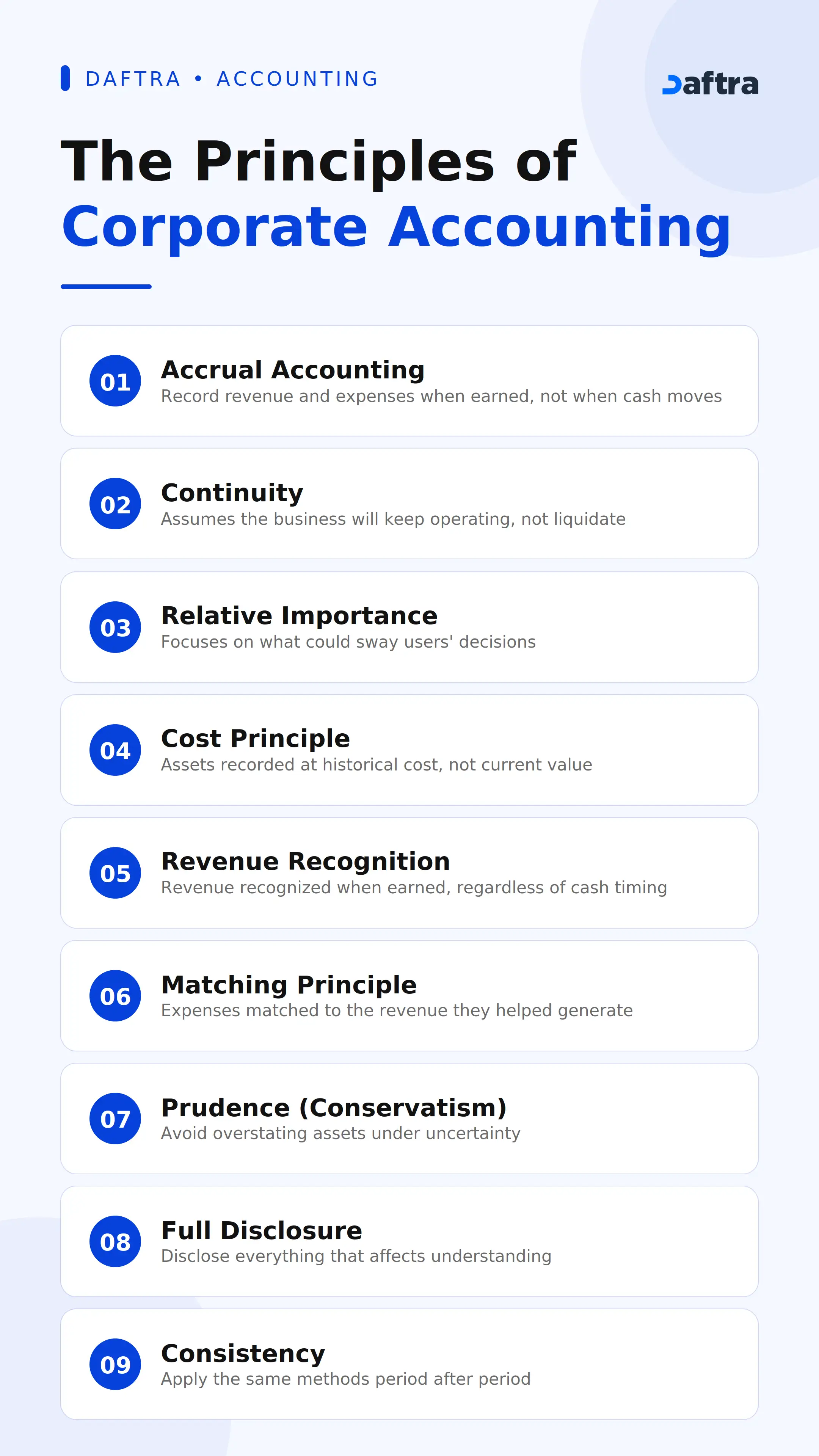
Accrual Accounting
Revenues and expenses are recognized when they are realized and not only when cash is received or paid. Therefore, the company records an expense in the period in which it benefited from the service, even if it has not paid for it yet.
Continuity
Financial statements are usually prepared on the assumption that the company will continue its activities in the future, meaning there are no circumstances or intentions indicating liquidation or cessation of activities; this assumption affects the measurement and presentation of some assets and liabilities.
Relative Importance
This principle focuses on the extent to which information may affect the decisions made by users of financial statements. This means not all errors have the same effect. Therefore, essential information is information that, if omitted or distorted, would affect users' decisions.
Cost Principle
This principle requires recording and dis accounting is specialized because companies vary widely, which requires determining each partner's share og assets at historical cost rather than current value, enhancing the reliability of financial reports.
Revenue Recognition Principle
This principle dictates the timing and method for recognizing revenue in financial statements; it requires revenue to be recognized when earned, regardless of when cash is received, ensuring revenue is recorded in the appropriate period.
Matching Principle
This principle requires recognizing expenses in the same accounting period as the revenues they helped generate, ensuring a proper match between expenses and revenues.
Prudence (Conservatism) Principle
This principle requires accountants to exercise caution and choose an approach that avoids overstating assets in uncertain situations, helping prevent manipulation.
Full Disclosure Principle
This principle requires the entity to disclose all information that could influence the understanding of its financial statements.
Consistency Principle
This principle requires companies to apply the same accounting methods and principles from one accounting period to the next, facilitating comparison and analysis of financial information over time.
How Does Corporate Accounting Differ from Other Types of Accounting?
One key characteristic of corporate accounting is its broad scope; rather than focusing on a single accounting aspect, it addresses the company's financial cycle comprehensively. This includes recording and classifying transactions; analyzing data, expenses, and costs; preparing financial reports and statements; ensuring control and compliance; and providing information that supports decision-making.
In contrast, other types of accounting are typically more specialized and have more specific objectives.
The following table outlines the key differences between corporate accounting and other types of accounting:
| Feature | Corporate Accounting | Public Accounting | Government Accounting | Forensic Accounting |
| Employer | Private or public company | Independent firm of certified public accountants or public body | Local government authorities | Law firms or specialized agencies |
| Focus | Allocating internal resources and preparing budgets and reports | Auditing, preparing tax returns, and providing advisory services | Ensuring public financial accountability and regulatory compliance | Investigating cases of financial fraud, embezzlement, and disputes |
| Target Audience | Company executives | Investors, tax authorities, and the general public | Taxpayers, government officials, and legislative bodies | Courts and judges |
What is the Purpose of Accounting for Companies with Branches?
When a company or facility expands to multiple branches, branch accounting becomes essential for transparency and financial control. This system maintains separate financial records for each branch so management can track each branch's performance, profitability, and cash flows, then integrate this data into the company’s consolidated financial statements.
One of the most important goals of accounting for companies that own multiple branches:
- The ability to determine the location of each branch: by knowing the profit or loss that each branch achieves and thus evaluating it as a profit or cost center.
- Knowledge of the financial position: The assets, liabilities, inventory, and cash of each branch are determined separately at the end of each accounting period
- Oversight and control: By providing a basis through which branch operations are monitored, in addition to assigning financial responsibility to branch managers
- The ability to estimate needs: by knowing the requirements of each branch separately for goods and cash in order to plan the supply more efficiently
- Performance comparison: Identifying the best and least performing branches helps analyze differences and thus implement better solutions
- Strategic decision support: by maintaining detailed data by location and thus better guiding expansion, closure, or restructuring decisions and evaluating the investment feasibility of each branch.
- Tax and regulatory compliance: by meeting tax requirements if branches are located in different geographical areas
- Commission calculation: It facilitates the calculation of branch managers’ commissions if they depend on the profitability of the branches
To make it clearer, here is an illustrative example
One case where we can reflect our experience in a Daftra is a company that started with only one branch, and management handled sales, expenses, and inventory directly and simply. As the company expanded and opened more branches, management faced a different problem: it was no longer easy to know total sales, expenses, and profitability for each branch. Another problem emerged: tracking common data such as products and customers.
The solution was to unify accounting data management in one system and link each process to its branch. This made it possible to record each branch’s sales, expenses, and financial movements independently, while using a common database for products and customers, and then extract reports that help management compare branch performance.
As a result, management no longer has to choose between separating branch accounts and keeping company data in one place. Thus, it is now possible to do both through an accounting system that supports branch management, so each process is linked to its own branch while shared data remains central and trackable at the company level.
And to handle accounting transactions in companies with branches, there are two methods that we will briefly learn about:
| Method | The Centralized Method | The Decentralized Method |
| How does it work | Under this method, individual branches do not maintain independent accounting records; instead, they forward documentation such as invoices, receipts, and other records to the head office. The head office then records all branch transactions in its books and prepares financial statements for all branches. | In this approach, each branch maintains an independent accounting ledger and handles its own accounting operations, including preparing separate financial statements. Subsequently, the company consolidates these financial statements into a single comprehensive report covering all branches. |
| Advantages | Cost savings on business operations. Standardization of accounting treatment across all branches. | Ensures faster, more accurate report generation. |
| Disadvantages | A certain degree of data delay, which is a drawback from a management accounting perspective that relies on rapid decision-making. | High costs associated with accounting operations. Inconsistencies in the methods used to process accounting transactions. |
What are the Accounts Related to Corporate Accounting?
There is a group of accounts known to be related to corporate accounting. These accounts are numbered using a fixed numbering system, as is common in accounting treatments for entries and other purposes. Each account refers to a different function. Among the most prominent of these accounts are:
Account 101
Known as the "Individual Contributions" account, forms the company's capital. This account is credited with the nominal values of shares that have been subscribed by the company.
Account 108
This is the account used to record withdrawal and payment transactions that occur between the company and its owner. At the end of the year, if withdrawals exceed payments, Account 108 is debited and recorded on the credit side against Account 101. In this case, Account 101 decreases. Conversely, if payments are greater than withdrawals, Account 108 is credited and recorded on the debit side against Account 101, and accordingly, Account 101 increases.
Account 103
Which refers to premium differences related to the company's capital increase. Premium differences appear between the nominal value of shares and the actual or real value.
Account 11
Known in corporate accounting as the "Retained Earnings" account. This account is used to record part of the profits or losses that the institution has acknowledged, but will make a decision about at a later time, not at the time of acknowledging them.
What are the Difficulties Related to Corporate Accounting and Ways to Overcome Them?
Corporate accounting faces some challenges in management, laws, and falling behind technological developments that may affect the accuracy and efficiency of its information. Learn about the most important accounting challenges and the most prominent tips to overcome them:
1- Complexity of Corporate Accounting Operations
Complex accounting operations related to processing corporate accounting entries, capital formation accounts, as well as profit and loss distribution calculations among partners, and determining share values and returns. This challenge can be overcome by hiring experienced accountants and financial advisors to accomplish these tasks accurately.
2- Lack of Integration of Corporate Accounting Software and Its High Prices
The lack of integration between cloud accounting programs and systems that automate corporate accounting operations through smart solutions, combined with the high costs of purchasing accounting software and the additional expenses required to obtain extra or customized features, is a problem.
This challenge can be controlled by using an integrated accounting software that offers solutions at reasonable prices, with integrated internal modules that are also easy to integrate and use with other company systems.
3- Errors in Financial Statements and Regulatory Filings
Errors in recording revenue or expenses, or in preparing financial statements, can lead to inaccuracies that expose the company to significant regulatory and financial risks. Companies can mitigate this issue by implementing internal controls such as segregation of duties, periodic account reconciliations, and data reviews before approval to minimize manual errors.
4- Changing Regulatory and Tax Requirements
Constant changes in accounting standards and tax regulations pose a major challenge for companies. The solution lies in staying updated on these changes, training accounting teams, and engaging specialists when necessary.
5- Fraud and Weak Internal Controls
Inadequate controls over payments, vendors, and financial authorizations can increase the risk of fraud or the misappropriation of company assets. Companies can mitigate this risk by segregating responsibilities and authorities, reviewing payment and vendor processes, conducting periodic reconciliations, and establishing multi-level review procedures.
6- Cash Flow Management Challenges
Delayed collections and rising expenses can impair a company's ability to meet its obligations. To address this, companies should prepare periodic cash flow forecasts, monitor customer balances and outstanding receivables, speed up collections, and negotiate favorable payment terms with suppliers.
Download Now: Free Cash Flow Forecast Template
7- Cybersecurity and Data Protection
Accounting systems house highly sensitive financial data, making them prime targets for cyberattacks. Therefore, access privileges must be restricted and multi-factor authentication enabled, and periodic backups must be performed.
8- Weak Financial Analysis
Accounting staff may become preoccupied with recording entries and making adjustments, neglecting analysis of results and providing critical information to management. Consequently, automate routine processes and use reports to analyze revenue, expenses, and profitability.
What are the Differences Between Corporate Accounting and General Accounting?
Corporate accounting does not differ from general accounting in terms of the steps of the accounting cycle; however, differences can be observed in the scope of work and responsibilities. Learn about the differences between corporate accounting and general accounting in the following table:
| Type | Corporate accounting | General accounting |
| Nature of work | Accountants working for one specific company | External accountants work in accounting fields, aiming to serve more than one client |
| Customers | There are no external clients | Multiple clients from companies or individuals |
| Scope of services | He cares about and focuses on the company's financial needs by preparing reports, budgets, and cost analysis | It relies on audits, tax preparation, financial consulting, and various advisory services |
| Target audience | Internal management and internal stakeholders | Stakeholders, investors, regulators, as well as banks and shareholders |
| Type of reports | Internal financial reports support decision-making, planning, and control | Prepares external financial records to ensure compliance |
| Main goal | Providing information, planning, and operational control | Providing audit, tax, and consulting services to external clients |
| Regulatory compliance | Internal policies, procedures, and local regulations are complied with | You comply with professional standards and external regulatory requirements |
| Work environment | An internal environment in which cooperation takes place with all departments of the company | A more challenging environment as customers are navigated |
| Required skills | Requires specialized skills in the company's field, tools in financial analysis and planning | Requires skills in customer service, auditing, taxation, and consulting |
What are the Duties of Corporate Accountants?
Corporate accountants in various companies perform several tasks to determine profits and losses and distribute them by preparing financial reports and analyzing the financial position. Learn about corporate accountant duties in the following points:
- Mastering the use of cloud accounting software to help control the accounting aspects of the company.
- Documenting daily entries, including partner current accounts and profit and loss distribution accounts.
- Opening and closing accounts for profit and loss distribution and partner current accounts.
- Processing capital formation.
- Determining partner percentages and their shares in capital.
- Determining profits and losses at the end of the period.
- Distributing profits and losses among partners and determining each one's share.
- Preventing manipulation in company accounts, such as using creative accounting methods to achieve personal gains for any party.

How Does Daftra's Accounting Software Help You Manage Your Company's Accounts?
Regardless of the most suitable accounting treatment for your company according to the type of company you belong to, Daftra's accounting software provides you with ready-to-use accounting transactions, with flexibility for modification. It only takes a quick look at the system's features and sections to learn how to manage your company's accounting operations through Daftra's electronic accounting software.
Most specialized accounting matters fall under the "General Accounting" section, taking into consideration that all accounting entries and transactions you perform result in automatic entries that are handled accordingly. Inventory is tied to your accounting transactions in the program, and purchases are linked to accounting in Daftra until you reach comprehensive management that connects everything.
The software offers an integrated approach, where all modules work together seamlessly, ensuring that your financial data flows smoothly across various business functions, from inventory management to purchasing, all unified under one comprehensive accounting system that maintains accuracy and consistency throughout your business operations.











 Invoicing
 POS
 Offers
 Installments
 Sales Commission
 KSA E-Invoice Software
 EGY E-Invoice Software
 JO E-Invoice Software
 E-Invoice Software
 Chart of Accounts
 Asset Management
 Cost Centers
 Expenses
 Cheque Cycle
 UAE VAT-Tax
 Product Management
 Purchases
 Purchase Cycle
 Suppliers
 Requisitions
 Stocktaking
 Organizational Structure
 Personnel Management
 Attendance and Leave
 Contracts
 Payroll
 Requests
 Work Orders
 Booking Management
 Rental and Unit Management
 Time Tracking
 Work Flow
 Lease Contracts
 Manufacturing Management
 Client Follow-Up
 Loyalty Points
 Points and Credits
 Memberships
 Insurance Management
 Daftra ERP Full App
 Point of Sales App
 Point of Sales for Desktop – Support Offline Mode
 AI Expenses Scanner App
 Employee Attendance, Sign & ESS App
 E-invoice Reader App
 Inventory Stocktaking App