


Everything You Want to Know About Electronic Accounting



Table of contents:
- Key Summary
- What is Electronic Accounting?
- What are the characteristics of electronic accounting?
- What Are the Types of Electronic Accounting?
- What are the objectives of electronic accounting?
- What is the relationship between electronic accounting and accounting information software?
- How to Convert Your Traditional Accounting to E-Accounting?
- What are the advantages and disadvantages of electronic accounting?
- What is the difference between electronic accounting and traditional accounting?
- What Should Saudi Businesses Consider When Choosing Electronic Accounting Software?
- How does Daftra become your path to the advantages of electronic accounting?
- In conclusion
- Frequently Asked Questions
Electronic accounting uses digital technologies and accounting software to record, process, organize, and analyze financial transactions and data. Electronic accounting streamline many accounting operations and tasks that traditional accounting usually handle manually. However, despite all the advantages of electronic accounting, we find that it has also posed many challenges, such as facing electronic breaches, cyber attacks, and others, which necessitate that companies become familiar with all aspects of electronic accounting and learn how to benefit from its advantages and minimize its disadvantages as much as possible.
Therefore, we present in this article a comprehensive guide to electronic accounting, including its characteristics, objectives, and the most prominent advantages and disadvantages of this approach. All this and more can be found with detailed information that helps you manage your business successfully.
What is Electronic Accounting?
Electronic accounting is the use of computers, digital technologies, and accounting software to record, process, store, and analyze financial data electronically, which reduces reliance on manual accounting processes and paper-based records.
Business management takes a long time, but accounting software helps complete daily accounting tasks online, where financial data can be added continuously and evaluated at the appropriate time. Using computers saves time for companies and maintains good organization of financial information.
Through the previous paragraphs, you have learned what electronic accounting is: using modern technologies rather than traditional ones.
One experience we had was with a retail store in Riyadh that, at the time, still relied on handwritten invoices and accounting ledgers to record its daily transactions. Their team had to collect and review sales, customer balances, and expenses manually at the end of each day. As sales increased, it became increasingly difficult to track outstanding customer balances and daily expenses accurately and efficiently.
To address this, the store switched to electronic accounting, allowing it to record invoices, expenses, and other financial transactions in a single system. Financial data could also be updated continuously, while accounting reports were generated from the recorded transactions, making it easy to monitor customer balances, expenses, and the store's overall financial position.
What are the characteristics of electronic accounting?
In a few small paragraphs, we will clarify the most important characteristics of electronic accounting, which can be summarized as being learnable, not complex, flexible, and reliable, as it is also available at any time and from anywhere.
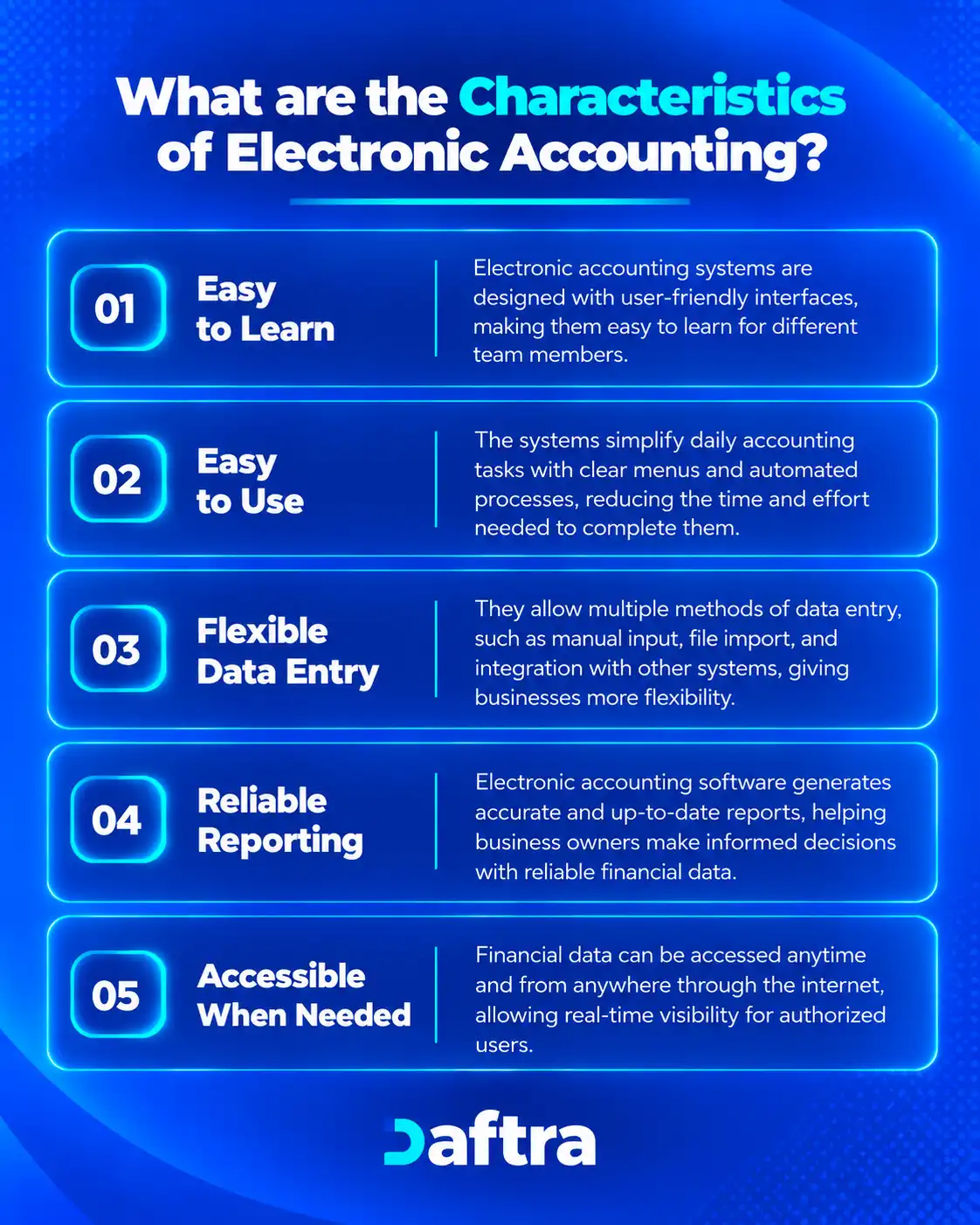
We can go into more detail about the features and characteristics of electronic accounting:
1- Easy to Learn
Accountants or workers in the accounting field can easily learn electronic accounting and become familiar with its basics without complexity or difficulty.
2- Easy to Use
Electronic accounting software is characterized by its simplicity and ease of use, allowing it to be used effectively by both company employees and specialized accountants.
3- Flexible Data Entry
Accounting software can handle a large volume of financial data much more efficiently than manual record-keeping.
4- Reliable Reporting
The reports and invoices obtained through electronic accounting are characterized by high reliability because electronic accounting helps reduce calculation errors and thus increases the reliability of results.
5- Accessible When Needed
Electronic accounting is an accounting software that can be accessed at any time you want to view the financial data and reports that have been stored and entered.
What Are the Types of Electronic Accounting?
Electronic accounting isn't limited to a single type of software or tool; it includes several approaches to recording, organizing, processing, and analyzing financial data electronically. It ranges from spreadsheets to specialized accounting software and integrated Enterprise Resource Planning (ERP) systems. Each serves different business needs, depending on business size, transaction volume, and required integration.
1- Spreadsheets
Excel and Google Sheets are among the simplest forms of electronic accounting. Used to record sales, expenses, invoices, customer balances, and other financial data, they can also perform calculations and prepare basic financial summaries. They are usually suitable for small businesses that manage a limited number of transactions.
2- Ready-to-Use Financial Accounting Software
Accounting software provide predefined accounting tools, templates, and workflows that assist businesses' accounting activities, such as recording transactions, managing invoices, and generating financial reports. Suitable for businesses that need more structured accounting processes without necessarily requiring extensive customization.
3- Customized Accounting Software
Designed to meet a business's specific requirements, as the system can be adapted to accommodate particular accounting processes, reporting requirements, or operational needs. Useful for businesses with specialized processes that require more management and detail.
4- Cloud-Based Accounting Software
It allows businesses to store and process financial data on remote servers and access the system through the internet. Users can access the system from different locations and devices; they can also easily maintain financial data in a centralized system and collaborate across teams or branches. Examples include Daftra, which provides accounting tools through a cloud-based environment.
5- Enterprise Resource Planning (ERP) Software
It integrates multiple business functions within a single system. They connect procurement, inventory, sales, customer management, human resources, and other operational processes. ERPs are generally designed for businesses that need close integration between financial and operational activities.
The right type of electronic accounting depends on the business's size, transaction volume, number of users or branches, and required integration.
Another case we handled in Jeddah was a small construction company that initially used Excel to record its revenues, expenses, and financial data. As the company grew and began managing multiple projects and branches, maintaining separate spreadsheets for each project, consolidating financial information, and preparing accurate reports became harder. To better manage its projects, the company began using a cloud-based accounting system (such as Daftra) to consolidate revenues, expenses, and financial reports in one place, streamlining financial data management across its projects and branches.
What are the objectives of electronic accounting?
Electronic accounting has goals that it works to achieve high accuracy reporting, reduce repetitive manual work, improving work quality, and helping in decision-making. It also works to facilitate financial tracking and preparing invoices and budgets.
We then move on to the detailed explanation of these points, and here are the purposes and objectives of electronic accounting:
1- High-accuracy financial reports
Electronic accounting aims to obtain more financial and accounting reports and data required in financial accounting with efficiency and accuracy.
2- Reducing repetitive work
When using traditional manual accounting, many accountants experience repetitive calculations, data entry, and reporting, which electronic accounting helps to significantly reduce.
3- Improving accounting work
Electronic accounting seeks to improve accounting work by eliminating traditional methods of this work and trying to keep pace with technological development so that accounting work becomes better in the future.
4- Making strict and quick decisions
Electronic accounting aims to help company officials make informed and timely decisions through quick and immediate access to reports and data related to the company's internal and external accounting, while facilitating accounting work for companies and their operations that are closely tied to controlling the company's finances.
5- The ability for financial tracking
Electronic accounting seeks to facilitate the financial tracking process for company owners, so through this type of accounting, it has become possible to simply monitor your company's money in terms of income and expenses.
6- Getting financial invoices on time
This is the basic function of the electronic accounting software, where customer data records are stored, accurate invoices are created on time, and the collection process is carried out by sending reminders to send invoices on time and tracking overdue payments.
7- Budget preparation and forecasting
The computer-based accounting software creates reports for different time frames, which helps track the company's work performance and prepare accordingly for the future, based on past balance sheet summaries.
What is the relationship between electronic accounting and accounting information software?
Electronic accounting refers to using digital technology for accounting operations, while accounting information software records and stores key data and figures, helping users analyze, retrieve, and access them easily to complete accounting operations accurately and reliably with less time and effort.
Accounting information software depends on keeping up with technological updates that integrate advanced software technologies, which contribute to easy information exchange between concerned parties, improving accounting work efficiency, and managing institutional resources and financial affairs effectively and comprehensively.
Thus, we have answered the question of what the link is between electronic accounting and accounting information software, which can be summarized in that electronic accounting software uses information software to complete storage operations and their numbers easily.
How to Convert Your Traditional Accounting to E-Accounting?
Switching from traditional accounting to electronic accounting is more than replacing paper records with software; it also involves reviewing existing accounting processes, organizing financial data, and choosing a system that supports the business's current and future needs.
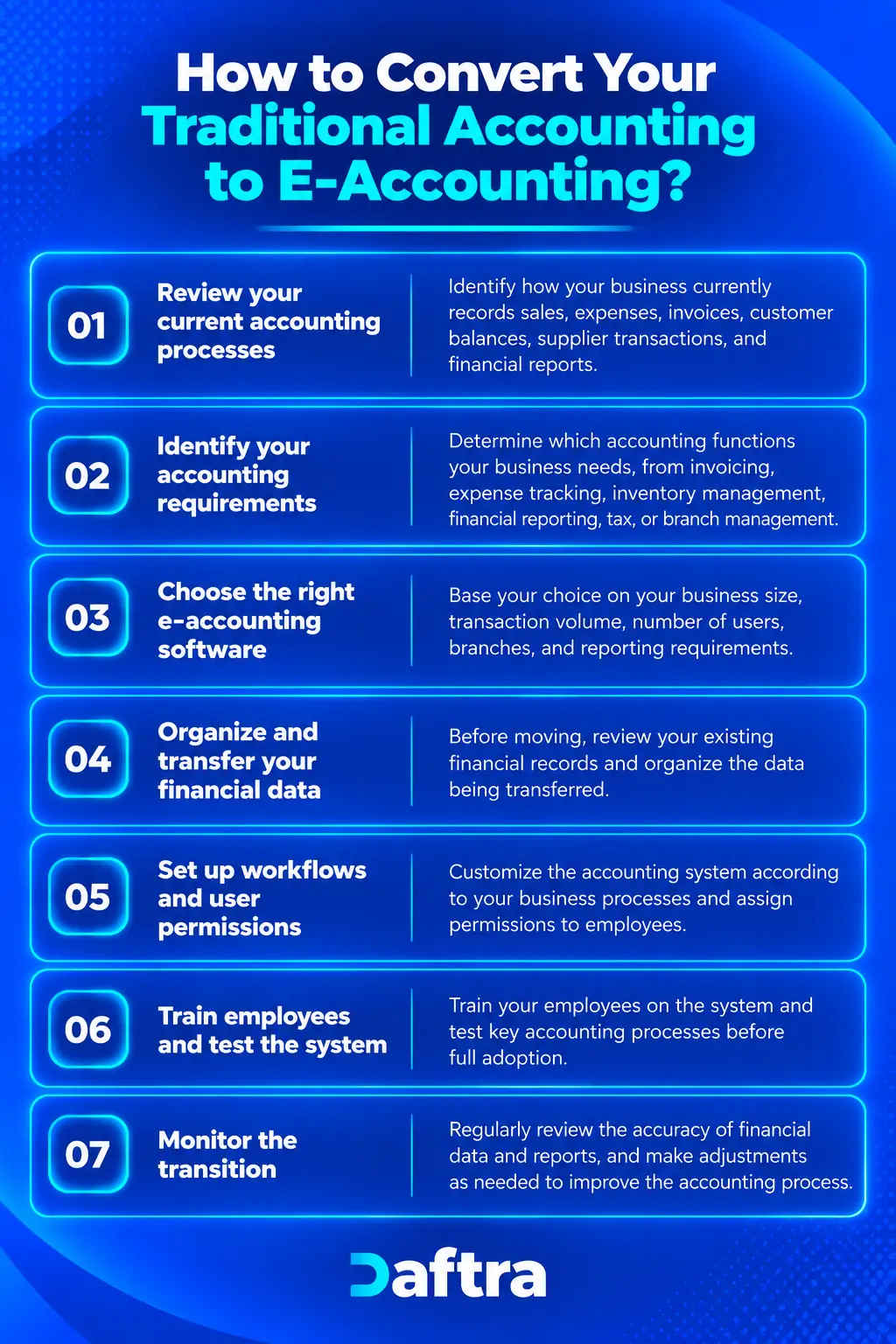
1- Review your current accounting processes
Identify how your business currently records sales, expenses, invoices, customer balances, supplier transactions, and financial reports.
2- Identify your accounting requirements
Determine which accounting functions your business needs, from invoicing, expense tracking, inventory management, financial reporting, tax, or branch management.
3- Choose the right e-accounting software
Base your choice on your business size, transaction volume, number of users, branches, and reporting requirements.
4- Organize and transfer your financial data
Before moving, review your existing financial records and organize the data being transferred.
5- Set up workflows and user permissions
Customize the accounting system according to your business processes and assign permissions to employees.
6- Train employees and test the system
Train your employees on the system and test key accounting processes before full adoption.
7- Monitor the transition
Regularly review the accuracy of financial data and reports, and make adjustments as needed to improve the accounting process.
What are the advantages and disadvantages of electronic accounting?
Electronic accounting, like anything around us, has advantages and disadvantages. Despite its many advantages, electronic accounting is not immune to flaws. Let us explore the advantages and disadvantages of electronic accounting in more depth.
Advantages of Electronic Accounting
Electronic accounting offers many advantages that greatly help companies, including quick access to data and transactions, faster performance, lower costs, reliable and secure operations, and permanent data storage.
These factors encourage companies to adopt electronic accounting. Here are the advantages in detail and clearly:
1- Easy access to data and accounting transactions
Electronic accounting applications help with daily tasks such as tracking company-specific expenses, creating invoices and receipts, and sharing invoices, helping companies stay financially organized. When information is entered into the software, data can be tracked and retrieved more quickly.
2- Faster accounting
As modern accounting software, the program lets companies enter, process, store, and access accounting data in real time. Using electronic accounting software saves companies time, as accountants can process more data faster, which saves a lot of time that was spent reviewing accounting data, and also saves effort.
3- Saving money
Electronic accounting can reduce the time and manual effort required for repetitive tasks, potentially lowering administrative costs. Electronic accounting also reduces the occurrence of financial deficits, which helps ensure correct calculations free from errors.
4- Highly reliable accounting transactions
Electronic accounting software reduces calculation errors and improves consistency when transactions are entered and configured correctly.
5- Facilitating collaboration
Electronic accounting software enables remote collaboration with certified accountants and company employees, synchronizes data with the company's bank, and lets you import financial reports in seconds when needed.
6- High-security accounting transactions
Electronic accounting software is created with advanced security mechanisms to protect your company's highly confidential financial data. It maintains the security of all financial information, passwords, accounts, tax information, and so on through secure access for limited users.
7- Easy tax management
The electronic accounting software provides you with one platform where you can get a quick overview of how much tax you have paid so far. In addition to that, it also provides the amount due to be paid in taxes on each invoice, meaning that electronic accounting applies tax accounting principles.
8- Permanent data storage
Information storage is vital for businesses and companies. After entering information into the accounting software, it is stored indefinitely. Through electronic accounting, regular backups can be made on the company's financial software, which is mandatory to avoid losing any information.
9- Report preparation
Electronic accounting software allows companies to distribute financial information easily. Financial data and reports are printed directly and distributed internally and externally to those who need them electronically. Accounting transactions can also be accessed from all company departments through electronic accounting software, which gives accountants better access to financial information.
10- Effective internal control
With all the advantages of online accounting software, business owners and companies can design their own internal control software and increase the effectiveness of this control, which is one of the most important tasks of management accounting, when they use electronic accounting.
These advantages allow companies to manage taxes and financial and accounting operations smoothly and quickly.
Disadvantages of Electronic Accounting
Electronic accounting has some disadvantages that may worry some companies because it may have technical errors, may incur costs for maintenance and installation, and is also threatened by hacking.
Here are the details of the disadvantages and problems of electronic accounting:
1- Technical errors
Any software that operates electronically is susceptible to facing technical problems at any time, and similarly, while using electronic accounting software, many technical errors can also be encountered, such as server problems, power outages, software errors, and so on.
2- Installation and maintenance costs
Although the electronic accounting software may seem cost-effective in the long run, its adoption in the company and its maintenance can be very expensive. Initially, a lot of investment must be made to train company employees to understand and get used to automated accounting software.
3- Threat of hacking
Despite storing business accounting information securely, it can be easily hacked and misused against your company, so you must be careful while securing electronic accounting information with strong passwords and granting access to it only to the most trusted people.
4- Work disruption
When using electronic accounting, workflow can be disrupted for a period of time that may be short and sometimes may be long, which significantly affects the company's software, because electronic accounting is susceptible to technical failures.
5- Possibility of manipulation
Usingcreative accounting methodsthat encourage changing financial data and falsifying numbers to serve certain interests can cause financial and ethical disasters for companies.
What is the difference between electronic accounting and traditional accounting?
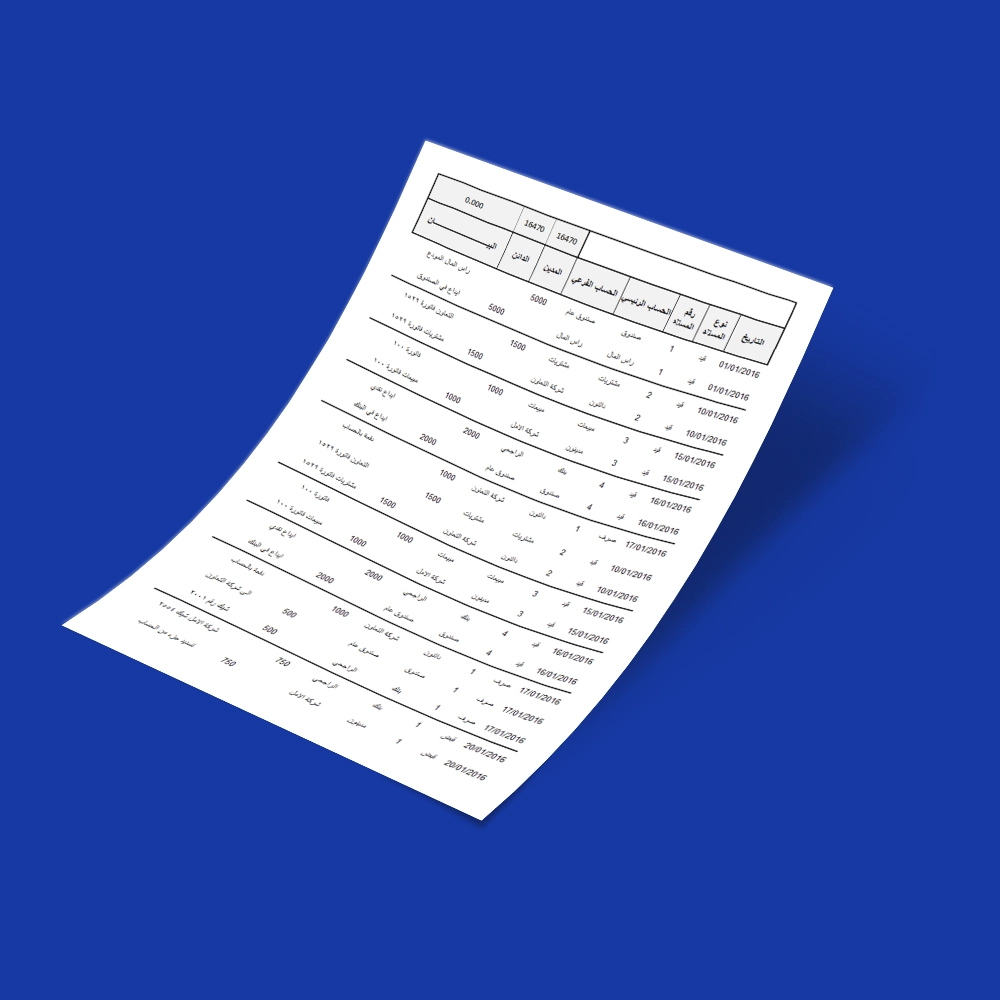
Electronic accounting and traditional accounting differ in many ways. Electronic accounting works to perform various operations automatically and records data in its own database. In addition, it provides backup copies to ensure data is not lost, and financial data can be accessed after it is recorded throughout the year.
As for traditional or manual accounting, all operations must be performed individually, and all details must be recorded in a daily ledger. It also takes a relatively long time to complete all operations. In addition, it requires recording data multiple times to create backup copies.
There are many differences between electronic and manual accounting, and here are these differences in more depth:
What Should Saudi Businesses Consider When Choosing Electronic Accounting Software?
When Saudi businesses are choosing electronic software, they must consider whether the system fits their accounting processes, supports local requirements, and can keep up with their needs as the business grows, including:
- Compliance with Saudi requirements: The software must support the Kingdom's accounting, tax, and electronic invoicing requirements.
- E-invoicing support: Verify that the software can support the applicable e-invoicing processes and requirements of the Saudi e-invoicing system.
- VAT Management: The software must support the business's VAT needs, like recording VAT on transactions and preparing relevant reports.
- Ease of use: A clear, user-friendly interface reduces employee training time and makes it easier to adopt the system in daily operations.
- Cloud Accessibility: The system is supposed to let users access financial information from different locations and devices, which is very useful for businesses with multiple branches or distributed teams.
- Financial reporting: Check whether the system can provide financial and management reports that help monitor revenues, expenses, balances, profitability, and overall financial performance.
- Scalability: The system must handle increasing transaction volumes, users, products, and branches as the business grows.
- Integration with other business operations: Consider whether the accounting system can connect with sales, inventory, purchasing, payroll, or customer management when these integrations are relevant.
- Data security and user permissions: Financial information, as sensitive as it is, should be protected through appropriate access controls and user permissions, allowing the business to manage its visibility and modification access.
- Customer support and updates: The system must have a strong technical support, system updates, and ongoing maintenance.
How does Daftra become your path to the advantages of electronic accounting?
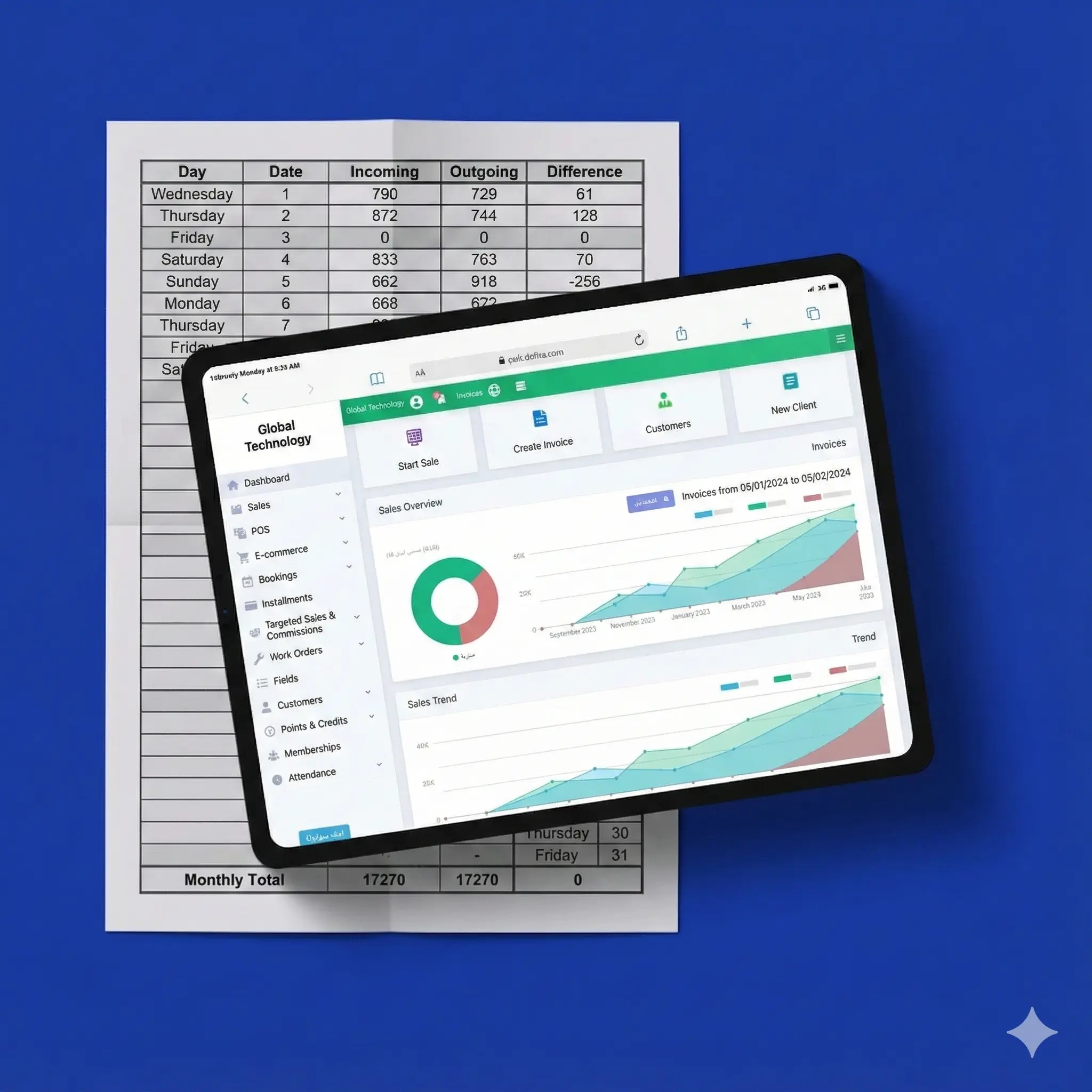
Switching from manual accounting to electronic accounting is easier when you manage data and accounting processes in one integrated system. Daftra accounting software helps businesses organize accounting operations, from recording transactions and managing expenses to issuing invoices and generating reports.
Businesses can manage their financial data in one system and access up-to-date information when needed, reducing repetitive tasks and manual work while improving data organization. Daftra also connects financial information such as invoicing, inventory, purchasing, expenses, and employee management with related business activities.

In conclusion
Growing businesses today need to adapt to a world moving toward the digital age, which includes digitizing every aspect of business. Therefore, many companies have turned to using electronic accounting software that has helped facilitate many accounting transactions that used to take a lot of time and effort. If you want to complete your company's financial transactions in the fastest time and with minimal effort, do not hesitate to try electronic accounting.
Frequently Asked Questions
What is an e-accountant?
An e-accountant is a professional/ a cloud-based service that manages bookkeeping, taxes, and financial reports entirely via online platforms.
What is the difference between electronic accounting and accounting in Excel?
- Electronic accounting is an integrated accounting software with tools and techniques that serve accounting, facilitate it, and make it more accurate. Accounting software manages accounting operations such as invoices, entries, and finances.
- Electronic accounting provides ready-made templates, is integrated with many other tools, and is also connected to banks for easy completion of financial operations. Electronic accounting may require a monthly or annual subscription, but it includes many services that make accounting work easier.
- Accounting Excel is a general accounting tool that depends on the settings made by the user and does not provide ready-made accounting templates, but rather templates that the user implements, and it requires some time to do all the settings needed to create their own accounting model.
- Accounting Excel is not integrated with other tools and banks, so it is difficult to complete various operations easily.
What is electronic accounting information software?
Accounting information software is an integrated software for storing, processing, and managing various data completely and helping in decision-making, in addition to maintaining accounting and financial data.
What are the most popular accounting software programs in Saudi Arabia?
Daftra is considered one of the most popular and widely used accounting software programs in Saudi Arabia because it provides many accounting tools that help complete operations easily. It helps with issuing invoices, managing finances and taxes, and recording all operations that occur periodically and automatically to save time and effort, in addition to providing complete security for all your data and financial operations.
What are ready-made accounting software programs?
They are applications that work to make accounting operations and their management easier by providing various technologies that give you the ability to issue invoices, prepare financial reports, and many other electronic facilities.
Can accounting be learned from the internet?
Yes, you can learn accounting from the internet through various training courses available for free or paid until you reach mastery and get all the information you need.
What is electronic accounting disclosure?
Electronic accounting disclosure is the publication of accounting and financial data and information related to the company on the internet, and this may be beneficial in gaining the trust of investors.







 Invoicing
 POS
 Offers
 Installments
 Sales Commission
 KSA E-Invoice Software
 EGY E-Invoice Software
 JO E-Invoice Software
 E-Invoice Software
 Chart of Accounts
 Asset Management
 Cost Centers
 Expenses
 Cheque Cycle
 UAE VAT-Tax
 Product Management
 Purchases
 Purchase Cycle
 Suppliers
 Requisitions
 Stocktaking
 Organizational Structure
 Personnel Management
 Attendance and Leave
 Contracts
 Payroll
 Requests
 Work Orders
 Booking Management
 Rental and Unit Management
 Time Tracking
 Work Flow
 Lease Contracts
 Manufacturing Management
 Client Follow-Up
 Loyalty Points
 Points and Credits
 Memberships
 Insurance Management
 Daftra ERP Full App
 Point of Sales App
 Point of Sales for Desktop – Support Offline Mode
 AI Expenses Scanner App
 Employee Attendance, Sign & ESS App
 E-invoice Reader App
 Inventory Stocktaking App