



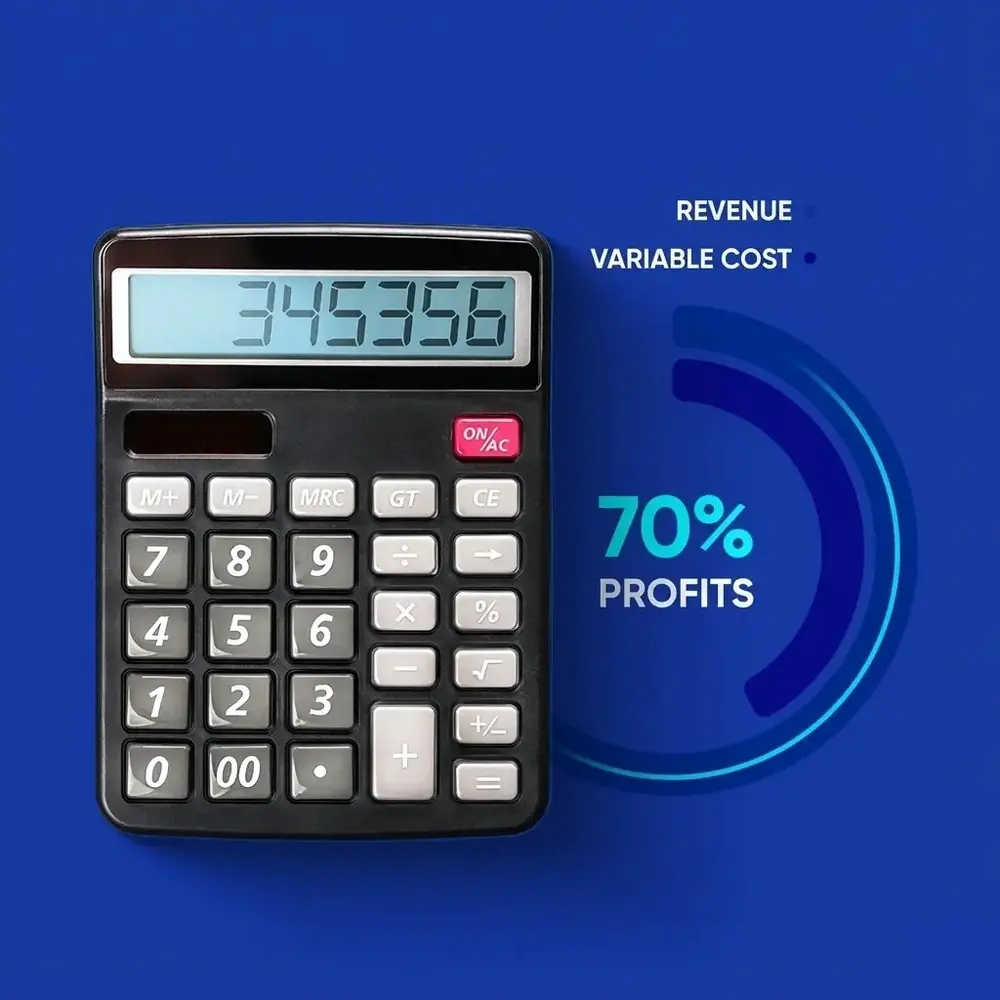
Table of contents:
- What is Contribution Margin?
- Contribution Margin Ratio
- How to Calculate Contribution Margin?
- Illustrative Example of Calculating Contribution Margin
- What is the Contribution Margin at the Break-Even Point?
- What is the Difference Between Profit Margin and Contribution Margin?
- What is the Difference Between Gross Margin and Contribution Margin?
- What is the Importance of Contribution Margin?
- How Can I Use Technological Solutions to Calculate Contribution Margin?
- Frequently Asked Questions
- Conclusion
How Can Contribution Margin Affect a Company's Overall Financial Performance? The answer lies in using the contribution margin as a strategic indicator for making pricing decisions, financial planning, and allocating resources efficiently and effectively.
In this article, we provide a comprehensive guide to the concept of contribution margin, its importance, how to calculate it, the meaning of the contribution margin ratio, and the difference between contribution margin and other key concepts related to understanding the basics of profit and costs.
What is Contribution Margin?
The term contribution margin refers to the revenue remaining to cover fixed costs at a specified profit level after deducting the variable costs associated with manufacturing products or providing services.
Here, variable costs are those that change based on the production volume and type of activity. The variable costs of a product increase with the production of more units, meaning they change according to total output, while the variable cost per unit remains fixed. Variable costs include direct material costs, labor costs, and shipping supplies (packaging).
Contribution Margin Ratio
The abbreviation (CMR) refers to the contribution margin ratio, and it is analyzed either on a yearly basis (YoY) or quarterly basis (QOQ), or by comparing it with similar companies operating in the same field. The contribution margin ratio can be calculated using the following formula:
Contribution Margin Ratio (%) = (Revenue – Variable Costs) ÷ Revenue
Practical Example of Applying the Contribution Margin Ratio
If a retailer sells shoes online for 3,000 USD, and the variable cost per unit is 20 USD, the contribution margin calculation would be as follows:
3,000 – 20 = 2,980
Contribution Margin Ratio = 2,980 ÷ 3,000 = 0.9
This means that the contribution margin ratio is less than 1% of the generated revenue.
Calculating the contribution margin on modern accounting systems helps ensure the best and most accurate results.
Applied to the Daftra accounting system, the following is observed:
The sales management program is used to find the revenue of selected products over a specific period, while the inventory management program is used to calculate the cost of goods sold. Of course, Daftra programs are integrated, allowing you to calculate the contribution margin with a single click, based on the data previously entered in the accounts.
How to Calculate Contribution Margin?
Business managers, accountants, and financial management experts are interested in getting a comprehensive answer to how the contribution margin is calculated.
The contribution margin and contribution margin ratio are calculated using the following formulas:
1- Accounting formula used to calculate the total contribution margin
Contribution Margin = Total Revenue – Total Variable Costs
- Total revenue means the total money the company earned from selling products and providing services.
- Total variable costs mean the variable expenses in manufacturing products, such as raw materials, labor wages, and others.
2- Accounting formula to calculate the contribution margin ratio
Contribution Margin Ratio = (Contribution Margin ÷ Total Revenue) * 100%
3- Accounting formula to calculate the contribution margin per unit
Contribution Margin per Unit = Selling Price per Unit – Variable Costs per Unit
The previous accounting formulas show how to calculate the contribution margin in two ways: either by calculating the total contribution margin or by calculating the contribution margin for each product separately, which is also called the marginal contribution margin.
Now that we have learned how to calculate the contribution margin ratio, let’s review an illustrative example to help understand the calculation method.
Illustrative Example of Calculating Contribution Margin
“Sport Master” company, specialized in manufacturing sports equipment, achieves annual sales and revenue of 2,500,000 USD, and the total variable costs amount to 1,200,000 USD.
The task is to calculate the total contribution margin that covers the variable costs for the “Sport Master” company, as well as calculate the total contribution margin ratio.
1- Calculating the contribution margin using the total method
Total Contribution Margin = 2,500,000 – 1,200,000 = 1,300,000 USD
Total Contribution Margin Ratio = (Revenue – Variable Costs) ÷ Revenue
Applied: Total Contribution Margin Ratio = 1,300,000 ÷ 2,500,000 = 0.52 (52%)
2- Calculating the contribution margin per unit for each product
If the selling price per unit of a football product is 100 USD, and the variable costs to manufacture it are 12 USD, the contribution margin per unit of the football product will be:
100 – 12 = 88 USD
Contribution Margin Ratio per Unit = 88 ÷ 100 = 0.88 (88%)
When calculating the contribution margin, the result can be negative, which indicates that the company’s expenses exceed its sales revenue. Therefore, management must take the necessary decisions to stop producing the product or adjust its production and pricing strategies.
What is the Contribution Margin at the Break-Even Point?
The contribution margin at the break-even point occurs when revenue equals expenses. The equation subtracts variable costs from net revenue, and if the result shows no profit or loss, that indicates the break-even point.
The contribution margin at the break-even point cannot be zero, because fixed costs have not yet been deducted from the contribution. Therefore, if the contribution margin equals zero at the break-even point, it indicates a loss.
The break-even point for contribution margin is calculated using the following accounting formula:
Break-Even Point (Units) = Fixed Costs ÷ Contribution Margin per Unit (Marginal Contribution)
What is the Difference Between Profit Margin and Contribution Margin?
The difference between contribution margin and profit margin is that the contribution margin is the difference between the selling price and the variable costs, including both direct and indirect costs, while the gross profit margin is the excess money remaining after generating revenue.
Gross profit margin is calculated by dividing net profit by total revenue after deducting the cost of goods sold. Its percentage measures the profitability of pricing strategies and how efficiently production materials and human resources are managed.
However, it should be noted that contribution margin and net profit margin complement each other, as they are important management tools and help define a framework for increasing company revenue. The contribution margin percentage provides key information such as pricing and commissions.
Therefore, it can be said that profit margin is a measure and evaluation of the financial decisions reached through the contribution margin to increase profits, improve services, and adjust employee incentive structures.
What is the Difference Between Gross Margin and Contribution Margin?
The difference between gross margin and contribution margin is that contribution margin is used in a partial framework, meaning it determines profits and gains at the product level and internal department operations. It helps identify operational strategies and includes only variable costs.
Contribution Margin = Product Selling Price – Variable Costs
While gross profit margin is used to analyze profits and revenue at higher levels for the entire company, and to prepare external reports used by stakeholders and interested parties to analyze overall profitability, gross profit margin includes both fixed and variable costs.
Gross Margin = Revenue – Cost of Goods Sold
Thus, the contribution margin is the difference between the product selling price and the variable cost, while gross margin is the difference between revenue and the cost of goods sold.
What is the Importance of Contribution Margin?
Contribution margin holds significant importance in both large and small companies, as business managers, accountants, and financial management experts use it in initial budget planning, determining expected profits, analyzing and controlling expenses, and many other steps resulting from calculating the contribution margin.
Here are the reasons that highlight the importance of contribution margin:
- Measuring Profitability: The total and marginal contribution margin and calculating the ratio are used to measure the profit the company earns from selling each additional unit of the product when reaching the break-even point, through cost-volume-profit analysis, which leads to achieving the break-even point.
- Determining the Break-Even Point: It shows the minimum required sales to cover variable costs. It determines whether selling prices cover variable costs that change according to activity level, which in turn affects pricing decisions and budget planning.
- Setting the Product or Service Price: Calculating the contribution margin is important for pricing the product by analyzing different price levels and volume, which supports effective budget planning.
- Budget Planning: By calculating the contribution margin, it is possible to find ways to increase revenue or reduce variable costs by using cheaper alternatives or options, increasing product prices, and determining expected revenues and potential profits.
- Making Investment Decisions: Calculating the contribution margin helps in adding a new production line, determining distribution areas, designing, or making other decisions.
- Improving Profitability and Controlling Costs: After knowing the total contribution margin and the margin of each product, we can study and analyze profit trends and how to control costs.
How Can I Use Technological Solutions to Calculate Contribution Margin?
Smart accounting software and systems help calculate the contribution margin accurately. Daftra accounting software is considered one of the best programs that provides accurate data through its automated applications in sales management, profit ratios, purchasing management, and issuing the necessary reports that help rationalize costs and increase sales profits.
The Daftra system helps distribute production and human resources effectively through the inventory and warehouse management program, as well as the employee and human resources management program. All these solutions and more are offered by Daftra across more than 50 business fields in an integrated manner through an easy-to-use control interface that supports the Arabic language.
Technological solutions provided by Daftra software for calculating contribution margin:
- Daftra’s enterprise resource planning software includes performing accurate and fast automatic calculations to calculate the total contribution margin, which helps evaluate the performance of production operations.
- The Daftra system contributes to collecting data related to profits and costs in order to analyze them, study product trends, and determine how to control variable costs.
- Using past and current results to forecast future contribution margins, plan budgets, and price products.
- Tracking contribution margin indicators and changes for each time period and for each production line is essential for preparing reports on the performance of the company’s production operations.
- The integration of programs within the Daftra system ensures comprehensive and accurate results by using inputs in expense calculations and cost of goods sold alongside achieved revenues, to arrive at the total contribution margin as well as the marginal contribution margin.
Frequently Asked Questions
How can I calculate the margin on variable cost?
Margin on variable cost = (Variable costs − Unit selling price) / Total selling price.
What is the marginal contribution margin?
The marginal contribution margin is the monetary amount used to produce one unit of a product. Use the following formula to calculate the marginal contribution margin:
Marginal contribution margin = Unit selling price − Variable cost to produce the unit.
Calculating the contribution margin per unit helps determine the number of units that must be sold to cover fixed costs so that the company reaches the break-even point. The break-even point means that sales cover the costs incurred. It is also used in analyzing product profitability and pricing decisions.
What are the forms of the contribution margin?
- Total contribution margin: The difference between the total selling price of units and the total cost of goods sold.
- Contribution margin per product: The difference between the selling price of one product and the cost of manufacturing the product.
- Contribution margin ratio: The percentage that expresses the difference between the selling price and the product cost.
What are the levels of the contribution margin?
- Negative contribution margin: When the selling price does not cover the cost of manufacturing the product.
- Positive contribution margin: When the product price covers the fixed cost of manufacturing it, the higher the ratio, the better.
Is the contribution margin the remaining amount after that?
Yes, the contribution margin is the remaining amount after deducting the variable cost from the product’s selling price.
How to find contribution margin income?
- Determine revenue balances resulting from sales.
- Determine variable costs such as raw materials, distribution, and others.
- Subtract variable costs from revenues.
- Find the percentage by dividing the contribution margin by revenues and multiplying the result by 100.
Conclusion
In conclusion, after reviewing everything related to the contribution margin, it must be recognized that the contribution margin is not just a few numbers added to company budgets, but rather a fundamental element that helps transform financial data into valuable insights.
Therefore, the contribution margin must be well understood and properly applied to improve financial performance and operations, and reduce costs through the smart integration of contribution margin analysis with financial strategies to make informed decisions that enhance production profitability and support expansion and growth.













 Invoicing
 POS
POS Offers
 Installments
 Sales Commission
 KSA E-Invoice Software
 EGY E-Invoice Software
 JO E-Invoice Software
 E-Invoice Software
 Chart of Accounts
 Asset Management
 Cost Centers
 Expenses
 Cheque Cycle
 UAE VAT-Tax
 Product Management
 Purchases
 Purchase Cycle
 Suppliers
 Requisitions
 Stocktaking
 Organizational Structure
 Personnel Management
 Attendance and Leave
 Contracts
 Payroll
 Requests
 Work Orders
 Booking Management
 Rental and Unit Management
 Time Tracking
 Work Flow
 Lease Contracts
 Manufacturing Management
  Client Follow-Up
 Loyalty Points
 Points and Credits
 Memberships
 Insurance Management
 Daftra ERP Full App
 Point of Sales App
 Point of Sales for Desktop – Support Offline Mode
 AI Expenses Scanner App
 Employee Attendance, Sign & ESS App
 E-invoice Reader App
 Inventory Stocktaking App