


VAT Inclusive vs VAT Exclusive UAE: Meaning, Examples & Common Mistakes

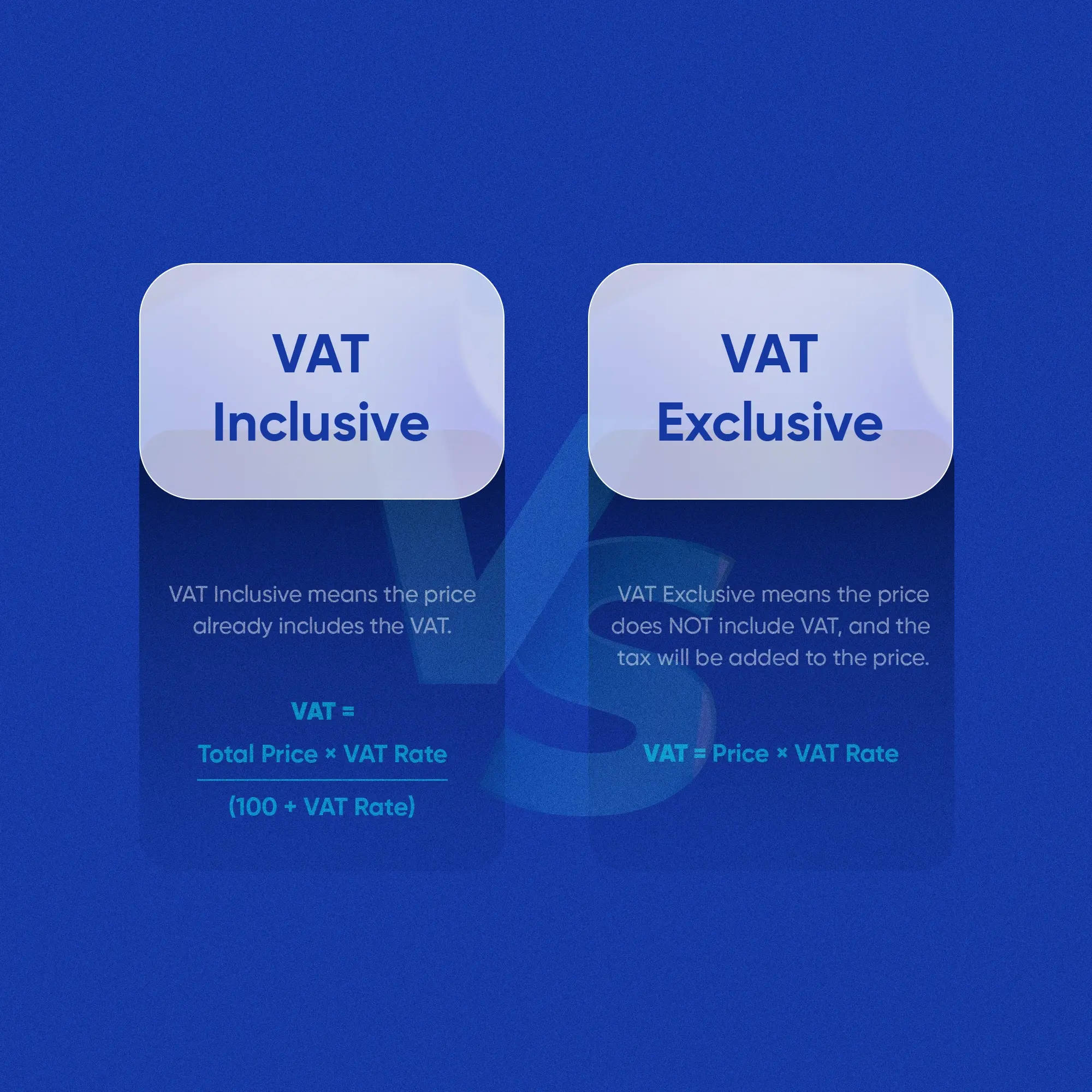
Table of contents:
- Key Summary
- What does “VAT inclusive” mean?
- What does “VAT exclusive” mean?
- VAT inclusive vs VAT exclusive
- VAT exclusive formula
- VAT inclusive formula (how to extract VAT from total)
- VAT inclusive and VAT exclusive formula
- Real Cases Examples
- Common Mistakes
- How ERP prevents VAT inclusive/exclusive errors
- FAQ
- Conclusion
Confusion often arises because some prices are displayed including VAT, while others are displayed as VAT-excluding. This seemingly minor difference in presentation can completely alter the calculation process and lead to significant pricing errors or misinterpretations of invoices.
In this guide, we explain the concept simply and provide you with the basic formulas and practical examples of the 5% VAT in the UAE, enabling you to calculate it quickly and accurately.
In this article, you will learn:
- The difference between inclusive and exclusive pricing.
- Equations for calculating tax.
- How to calculate tax from inclusive pricing.
- Practical examples.
What does “VAT inclusive” mean?
VAT inclusive means that the displayed price of the product or service already includes VAT (i.e., it includes the 5%), so the customer does not need to add any extra amount when paying for this service or product.
In other words, the final price the customer sees is the same price they will pay.
Example:
Product price = 105 AED inclusive of VAT
This means the product price is 100 AED, and the 5 AED is VAT.
You can use the UAE VAT Calculator to calculate VAT-inclusive and VAT-exclusive prices quickly and accurately.
What does “VAT exclusive” mean?
VAT Exclusive means the price excluding VAT is the displayed price and does not include Value Added Tax (VAT). Therefore, the 5% VAT is added when the invoice is issued or payment is made for the goods or services, resulting in the final total price payable.
Example:
If the product price is AED 100 excluding VAT, 5% (AED 5) is added as VAT, making the product price AED 105.
VAT inclusive vs VAT exclusive:
It is important to understand the difference in daily transactions between the price inclusive of VAT and the price exclusive of VAT, as this difference directly affects pricing, invoicing, and the final amount.
The following table illustrates the key differences between the two:
| Item | Price Inclusive VAT | Price Exclusive of VAT |
| What does the price represent | Final price including tax | Base price before tax |
| What the customer pays | The price shown is direct without any additional | Price + 5% tax |
| Where the tax appears | Integrated and not detachable | Added separately |
VAT exclusive formula:
When preparing invoices and pricing, if the price excludes VAT, the tax calculation in the UAE is very simple and uses a fixed rate of 5%. This type of calculation is commonly used when adding the tax to the base price.
Formula:
Tax Amount = Net * 0.05
Total = Net * 1.05
Practical examples in UAE (AED):
| Net Price | Tax Amount | Total |
| 250 | 12.5 | 262.5 |
| 1000 | 50 | 1050 |
| 5000 | 250 | 5250 |
VAT inclusive formula (how to extract VAT from total):
When dealing with prices inclusive of VAT in the UAE, the tax is not shown separately but is integrated into the final price at a rate of 5%. Therefore, the direct method of calculation cannot be used, as this may lead to inaccurate results. The correct method involves first breaking down the price into its net price and then calculating the tax amount from that.
This method is crucial for accounting, invoicing, and sales analysis, especially for companies and online stores that need to accurately determine the tax amount in each sale.
The steps required to calculate the tax correctly:
- Calculate the net price (the value before adding tax):
Net = Gross / 1.05
This step separates the tax included in the price and returns it to its original value. - Calculate the VAT amount:
VAT = Gross - Net
Now you get the actual tax amount included in the price.
| Total inclusive of tax | Net price = Gross/1.05 | VAT = Gross - Net |
| 20 | 19.05 | 0.95 |
| 40 | 38.10 | 1.90 |
| 80 | 76.19 | 3.81 |
| 100 | 95.24 | 4.76 |
It can be observed that the tax value is not calculated at 5% directly from the total, but is extracted by separating the net price and then calculating the difference between it and the total.
VAT inclusive and VAT exclusive formula:
Dealing with Value Added Tax (VAT) is one of the most important skills any business owner, company director, or accountant needs. This involves the ability to quickly convert between the inclusive and exclusive prices. While this conversion takes only a few seconds, using incorrect formulas can lead to significant errors.
This section provides a concise guide that you can easily use to accurately perform daily calculations, prepare invoices and pricing, and review figures.
Basic formulas:
- exclusive → inclusive: × 1.05
- inclusive → exclusive: ÷ 1.05
- VAT from exclusive: × 0.05
Practical example:
If the price is 100 ِAED excluding tax:
Then the price including tax = 100 x 1.05 = 105 AED
The tax = 100 x 0.05 = 5 AED
However, if the price is 105 AED, including tax:
The price excluding tax = 105 ÷ 1.05 = 100 AED
Then the tax = 105 x (0.05 ÷ 1.05) = 5 AED
Real Cases Examples:
Example1:
If you enter a store in Abu Dhabi and want to buy a shirt priced at AED 210 (including VAT),
Then the price includes 5% VAT.
The amount you will pay is 210 AED.
Example2:
If you own a business and want to purchase a service from a marketing agency, the price of the service is 2000 AED (excluding VAT).
Therefore, VAT will be added at checkout. The total amount due after adding 5% VAT is 2100 AED.
Example3:
If you are browsing an e-commerce shopping site and have added more than one product to your shopping cart (all products on these sites include VAT),
In this case, the tax will be calculated automatically for each product by the system.
Then you will pay the amount shown at checkout.
Example4:
You purchase a water filter
The price of the filter is 315 AED, including tax.
The installation cost is 400 AED, excluding tax.
The total is calculated as follows:
315 + (400 x 1.05) = 315 + 420 = 735 AED
Common Mistakes:
Dealing with VAT may seem simple, but in reality, many mistakes can occur during the pricing or invoicing process.
Below are the most important and common errors to be aware of, along with how to correct them quickly and easily.
Using 5% of the total:
Use the total ÷ 1.05 to calculate the net amount first, then calculate the tax correctly.
Inconsistent rounding:
Rounding numbers randomly is one of the most common mistakes. You should establish a rule for rounding that applies to all invoices.
Mixing prices:
When displaying prices, it is incorrect to have some prices inclusive of tax and others excluding it. Consistent presentation is one of the most important ways to avoid errors in invoice calculations.
Mixing VAT with discounts:
When applying any discounts, calculate the discount first, then add the VAT.
Read also: TRN verification in the UAE
How ERP prevents VAT inclusive/exclusive errors:
Manually managing VAT, especially when there are different prices (some inclusive, some exclusive), increases the likelihood of errors in pricing, invoicing, and reporting. This is where ERP systems come in. They automate calculations, ensure the correct application of tax rules, apply the specific tax for each country, and coordinate all processes from sales to financial reporting.
One of the most important benefits of the ERP systems:
- Applying consistent rounding rules to avoid minor discrepancies that could lead to overpayments.
- Adjusting the pricing process, allowing customization, and automatically calculating taxes on invoices without any manual intervention.
- Reducing potential human errors, such as calculating 5% of the total price.
- Generate accurate financial and tax reports that comply with local regulations.
Comparison between manual and ERP systems:
| Side | Manual Systems | ERP Systems |
| Pricing | Undefined and fixed | Predefined and fixed |
| Tax Addition | Manual and prone to error | applied automatically |
| Rounding | Non-uniform | Uniform and constant |
| Reporting | requires a lot of time and effort | Generate accurate reports quickly |
| Tax Compliance | Huge penalties can be imposed as a result of mistakes. | Compliant with the UAE tax authority regulations |
Read also: How to register for VAT in uae
FAQ
What does VAT excluded mean?
Non-VAT does not always mean complete exemption, but includes two main treatments: exemption, where no VAT is charged, and no inputs are recovered, or zero rate, where no VAT is charged, and inputs are fully recovered.
Is VAT included in the price in the UAE?
There is no fixed answer in this case; it depends on how the price is presented. It's possible to check whether the price includes or excludes tax before payment.
Do businesses quote VAT inclusive or exclusive?
Both types of pricing are used in UAE companies, where prices inclusive of tax are used when selling directly to consumers (B2C), while prices excluding tax are used in B2B transactions.
How do you calculate VAT inclusive?
inclusive of VAT, which is an indirect tax imposed at a rate of 5% in the UAE on most goods and services, and is added to the selling price.
To do an inclusive VAT calculation, the price must include the tax, which is extracted from within the price itself and not added to it.
You can use this equation to calculate it:
Tax=total x (0.05 ÷ 1.05)
How to calculate VAT exclusive?
You can use this equation to calculate it:
Tax = Net × 0.05
Total = Net × 1.05
Conclusion:
Understanding the difference between a price excluding VAT and one including it is not just an accounting detail; it's a fundamental element of accurate pricing, precise invoicing, and, of course, sound financial management.
Using the simplified formulas and quick equations explained in this guide makes dealing with any price more accurate and reliable. With continued practice and the use of ERP systems, these processes become automated, fast, and largely error-free.












 Invoicing
 POS
POS Offers
 Installments
 Sales Commission
 KSA E-Invoice Software
 EGY E-Invoice Software
 JO E-Invoice Software
 E-Invoice Software
 Chart of Accounts
 Asset Management
 Cost Centers
 Expenses
 Cheque Cycle
 UAE VAT-Tax
 Product Management
 Purchases
 Purchase Cycle
 Suppliers
 Requisitions
 Stocktaking
 Organizational Structure
 Personnel Management
 Attendance and Leave
 Contracts
 Payroll
 Requests
 Work Orders
 Booking Management
 Rental and Unit Management
 Time Tracking
 Work Flow
 Lease Contracts
 Manufacturing Management
  Client Follow-Up
 Loyalty Points
 Points and Credits
 Memberships
 Insurance Management
 Daftra ERP Full App
 Point of Sales App
 Point of Sales for Desktop – Support Offline Mode
 AI Expenses Scanner App
 Employee Attendance, Sign & ESS App
 E-invoice Reader App
 Inventory Stocktaking App