


Direct Selling: What Is It? How Does It Work? And How Is It Different from Indirect Selling?


Table of contents:
- What is Direct Selling?
- How Does Direct Selling Work?
- What is an Example of Direct Selling?
- What Are the Advantages of Direct Selling?
- What Are the Disadvantages of Direct Selling?
- What Is the Difference Between Direct and Indirect Selling?
- What Are the Types of Direct Selling?
- What Are the Methods of Direct Selling?
- How Can You Succeed in Direct Selling?
- How Does Daftra Help in Direct Selling Operations?
- Frequently Asked Questions
system, which provides smart solutions allowing them to work and complete sales anytime, anywhere, without a constant internet co
You cannot start a successful journey as a business owner without knowing what direct selling is. Likewise, if you are an employee and want to break free from job constraints and move toward freelancing, direct selling can be a lifeline.
In this article, we will explore together what direct selling is, how it works, and the difference between it and indirect selling. We will also review its advantages for both companies and sales representatives, and conclude with important tips for success in direct selling. This will enable you to manage your sales more effectively.
What is Direct Selling?
Direct selling is the process of selling that occurs directly between the manufacturing or producing company and the customer, without the involvement of an intermediary such as a retailer.
Direct selling usually takes place at the customer's workplace, home, or any other location outside a retail store or distribution center.
Based on this definition, we can infer that the main feature distinguishing direct selling is that the end consumer receives the product directly from the manufacturer through one of its sales representatives, not through another trader. From this, direct selling gains several advantages, which we summarize as follows:
- Increased revenue.
- Reduced operating costs.
- Understanding the market.
- Awareness of customer trends and needs.
- Enhanced brand awareness.
- High returns for direct sales representatives.
- Development of persuasion and negotiation skills for the direct sales employee.
- Ability to build personal relationships with customers that can be leveraged later.
How Does Direct Selling Work?
Direct selling is one of the most active marketing methods, allowing companies to reach customers without intermediaries. Therefore, it is necessary to understand how this method works to achieve greater profits more easily. This leads to an important question: who are the parties involved in the direct selling process?
- The producing or manufacturing company.
- The direct selling company.
- The independent sales representative.
What is an Example of Direct Selling?
The producing company launches a product or service, then the direct selling company comes into play, acting as the link between the manufacturer and the sales representative. The direct selling company has databases of independent sales representatives and provides them with the necessary information. These representatives use their personal networks, acquaintances, and even social media accounts to sell the product or service, earning a sales commission in return.
This ensures that the producing company’s products or services reach the end consumer without an intermediary who might alter the marketing message or misrepresent the product or service. The direct selling company is paid for its services, and the sales representative earns the commission they deserve.
Use Daftar's commission calculator to automatically determine the value and percentage of sales commissions for free.
What Are the Advantages of Direct Selling?
Direct selling is characterized by its ability to meet customer needs immediately, which enhances customer satisfaction, improves their experience, and increases brand loyalty. Below, we outline the benefits of direct selling for both companies and sales representatives:
1- Advantages of Direct Selling for the Sales Representative
A- Increased Income
Direct selling serves as an additional source of income for many, often with a limited number of hours and without fixed daily schedules, allowing it to be a side job alongside another position.
B- Flexible Working Hours
Direct selling is not a full-time job, so there are no fixed office hours. However, the sales representative should consider the best times to contact customers if personal interaction is needed.
C- Work from Anywhere
Direct selling does not require the sales representative to be present at the company’s headquarters like full-time employees. They only need to perform their tasks and complete sales, regardless of where they are.
The direct sales representative benefits from the POS (Point of Sale) program in the Daftra system, which provides smart solutions allowing them to work and complete sales anytime, anywhere, without a constant internet connection. It works on mobile phones, desktop computers, tablets, and handheld devices.
D- Be Your Own Manager
The nature of the direct sales representative’s work is independent, so they are not supervised by a manager. Their success depends solely on achieving higher sales.
E- Building Relationships
The work nature of a direct sales representative allows them to build a wide network of relationships, especially if the product or service targets companies (B2B) rather than individual consumers (B2C).
2- Advantages of Direct Selling for Companies
A- Price and Cost Control
The absence of intermediaries between the manufacturer and the end consumer allows the company to monitor prices and ensure the product or service reaches the consumer at the real price without increases or manipulation.
B- Deeper Understanding of Customer Needs
In direct selling, the manufacturer has a greater opportunity to understand its customers’ needs, as they interact directly with the products or services and make purchasing decisions. This contrasts with indirect selling, where the manufacturer has no control over distribution or customer communication.
The CRM system in Daftra helps companies manage customer data and transactions accurately, with customizable templates to send SMS messages, emails, invoices, quotations, or account statements.
C- Ensuring Customer Satisfaction
Successful manufacturers set standards to ensure customer satisfaction. If there is an intermediary between the company and the customer, the company cannot guarantee that the intermediary will follow these standards, which may affect customer satisfaction. Direct selling from the company to the end customer adds this advantage.
D- Ensuring the Marketing Message Reaches the Customer
Even if the manufacturer cannot guarantee the marketing message fully reaches the customer in direct selling, they can at least ensure it is not distorted by retailers or distribution agents. This is an important advantage for applying the company’s long-term marketing strategy.
What Are the Disadvantages of Direct Selling?
Despite all the previously mentioned advantages, there are some challenges associated with the direct selling model. It is important to understand the potential risks associated with this type of sales to address them effectively. In the following lines, we review the most prominent disadvantages of direct selling:
1- Pressure on Sales Representatives
Direct sales representatives sometimes feel significant pressure to achieve more sales targets that generate higher income for them, which may affect their psychological performance. In addition, convincing customers to buy new or unfamiliar products can be difficult, which may frustrate sales representatives.
2- Difficulty Reaching Customers
Direct selling may face challenges in reaching potential customers, especially due to market saturation with certain products or services, making them harder to sell. Additionally, some customers may not respond, particularly those who hesitate to deal with direct sales representatives due to a lack of trust or previous negative experiences.
3- Travel and Transportation Expenses
Some direct selling processes require spending additional costs on transportation and travel to reach target customers, which may affect profitability.
4- Strong Competition
Strong competition is one of the most prominent challenges facing direct selling and may affect its profitability. This competition may result from:
- The availability of multiple options for customers from different companies.
- The development of digital sales channels, which increases pressure on direct selling methods.
- Changing consumer preferences.
- The introduction of new products at lower prices may attract customers.
5- Negative Impact on the Brand
Some customers may feel uncomfortable or experience a loss of privacy when dealing with direct sales representatives, which may negatively affect the brand's overall image.
What Is the Difference Between Direct and Indirect Selling?
The main difference between direct and indirect selling lies in their operating mechanisms. In indirect selling, manufacturing companies rely on distributors and retail intermediaries to connect them to the end consumer. In contrast, direct selling involves the company dealing directly with the consumer without intermediaries.
In light of this fundamental difference in the working mechanism, there are several other differences, the most prominent of which are explained below:
| Direct Selling | Indirect Selling |
| There is no intermediary trader between the manufacturer and the consumer. | There is an intermediary trader between the manufacturer and the consumer. |
| Responsibility for distribution lies with the manufacturing company. | Responsibility for distribution lies with retailers and distribution agents. |
| There is direct communication between the manufacturer and the consumer, ensuring the message is delivered. | There is no direct communication between the manufacturer and the consumer, and the company may be represented poorly. |
| It is easy for the manufacturer to monitor prices. | Retailers' involvement in the sales process makes it difficult for the manufacturer to monitor the final price. |
| The manufacturer bears the burdens and responsibilities of distribution. | Distribution agents and retailers handle product distribution. |
What Are the Types of Direct Selling?
Direct selling can be of two types: single-level or multi-level.
1- Single-Level Direct Selling
Single-level direct selling refers to sales that rely solely on the sales representative’s own network, without involving other people. Therefore, the representative earns a commission only on the sales they personally make.
2- Multi-Level Direct Selling
In multi-level direct selling, a sales representative recruits other sales representatives who report to them. In this case, they earn a commission on the sales they personally make, in addition to a commission on the sales made by those working under them.
What Are the Methods of Direct Selling?
After learning about the types of direct selling, we now highlight the methods of direct selling, which refer to the means and forms used to communicate with customers to complete sales.
1- Face-to-Face Selling
In this case, communication occurs directly between the sales representative and the customer, usually by arranging a meeting. During the meeting, the sales representative works to convince the customer to make a purchase.
2- Selling Through a Gathering or Public Meeting
In this method, the sales representative organizes an event or public meeting and invites a group of potential customers. This meeting usually includes several activities, during which the product’s advantages are presented to close sales.
3- Selling via the Internet
The internet is currently the fastest and most widespread communication tool in the world, which is why it is widely used to complete direct selling operations. Therefore, the sales representative uses all available online channels to complete the sales process.
4- Selling via Phone
The phone is one of the most commonly used methods for marketing and completing sales. Because selling by phone requires advanced skills such as strong persuasion and effective conversation management, it truly requires a professional sales representative.
How Can You Succeed in Direct Selling?
Based on the above discussion, it becomes clear that direct selling is an ideal option for those seeking additional income and freelance work. Therefore, the following points present the most important tips for success in direct selling:
1- Focus on Expanding Your Network
The main asset of a direct sales representative is their network of relationships. They are always faced with the challenge of identifying the right potential customer who could become an actual customer. Therefore, it is very important to have a wide network to make this task easier.
2- Build Your Own Community
It is important to have people who listen to you and trust you. With the availability of communication tools through social media platforms and websites, it has become easy to build a community that responds to your advice and opinions and accepts your recommendations.
3- Know the Product or Service Well
You cannot sell something you know very little about. Doing so will not only cause you to lose the sale but will also make your customers lose trust in you and in your sales capabilities. Therefore, make sure you fully understand every detail of the product or service you are about to sell, including its disadvantages before its advantages.
4- Keep a List of All Your Customers
Maintain a record of every customer you have dealt with, whether or not you successfully completed the sale. This helps you build a customer database across sectors and saves you the effort of searching for them again.
5- Develop Your Sales Skills
This is the most important and prominent advice. You must be able to create a need for the customer and convince them you have the solution. You must be professional in your sales to build a good reputation and successfully close sales.
6- Use an Integrated Sales Software
One of the most important steps to succeed in direct selling is to use an integrated sales management system from the Daftra system. The program provides advanced tools necessary to increase your sales volume, such as the loyalty points management program in Daftra, in addition to other solutions like tracking customer payments, sending quotations, and issuing invoices.
How Does Daftra Help in Direct Selling Operations?
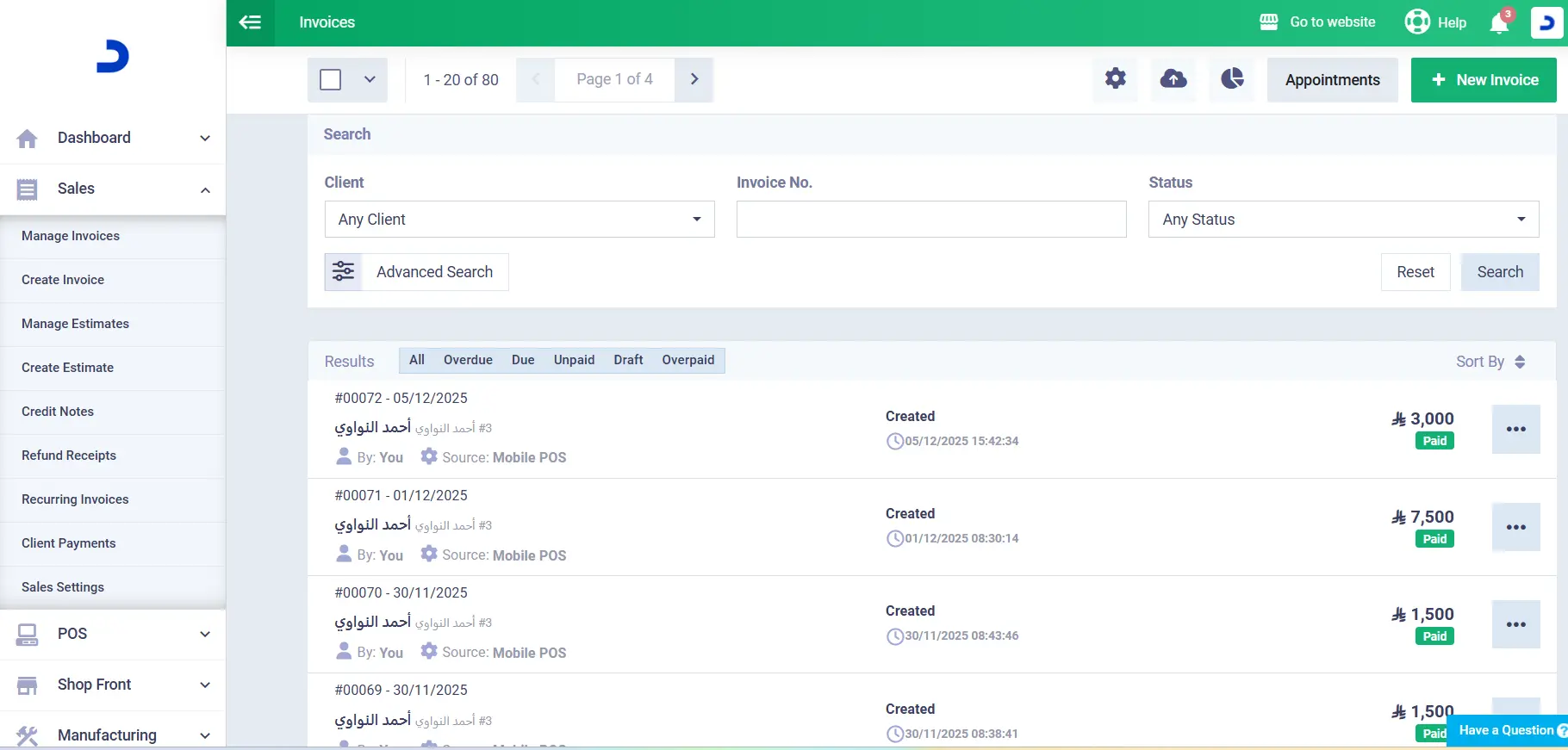
ERP systems such as Daftra help you achieve this, as Daftra’s sales software allows you to automatically and comprehensively control all sectors and departments of the company. You will be able to add your products and services, calculate sales commissions, create customer profiles, and link all of that to sales operations, while automatically processing general accounts and expenses.
Frequently Asked Questions
What Are the Best Direct Selling Strategies?
- Understanding customer needs through in-depth research and surveys helps use direct selling methods more effectively.
- Maintaining regular communication with customers over long periods and following up with them even after completing sales transactions.
- Using CRM (Customer Relationship Management) software to track customer interactions and improve communication.
- Content marketing that attracts customers and enhances credibility.
- Analyzing the results of direct selling strategies, evaluating them, and adjusting them based on performance and feedback.
What Is the Difference Between Direct Selling and Pyramid Marketing?
The main difference between direct selling and pyramid marketing lies in the way revenue and profits are generated. Direct selling relies on generating profits through selling goods and products directly to customers without intermediaries.
On the other hand, pyramid marketing relies on creating a network of distributors who pay subscription fees, and then selling through them while these distributors earn commissions from their own sales and from the sales of customers they bring in.
Pyramid marketing is often associated with risks, such as fraud and scams, because it relies on attracting as many new members as possible to increase sales through them.
What Are the Skills of Direct Selling?
- Effective communication and good listening to customers to understand their needs and deal with their objections and concerns.
- Skills in persuading customers of the benefits of products and how to benefit from them.
- The ability to negotiate to complete the buying and selling process in a way that satisfies both parties.
- The ability to manage and organize time effectively to achieve profit goals from direct selling.
- Knowledge of the features and characteristics of the offered products or services.
Finally, it should be noted that direct selling is a successful sales strategy that helps companies achieve their sales goals while maintaining consistency with their vision and marketing message. However, to ensure the success of your business and investment, achieving sales alone is not enough; success also requires effectively managing all aspects of the company.














 Invoicing
 POS
POS Offers
 Installments
 Sales Commission
 KSA E-Invoice Software
 EGY E-Invoice Software
 JO E-Invoice Software
 E-Invoice Software
 Chart of Accounts
 Asset Management
 Cost Centers
 Expenses
 Cheque Cycle
 UAE VAT-Tax
 Product Management
 Purchases
 Purchase Cycle
 Suppliers
 Requisitions
 Stocktaking
 Organizational Structure
 Personnel Management
 Attendance and Leave
 Contracts
 Payroll
 Requests
 Work Orders
 Booking Management
 Rental and Unit Management
 Time Tracking
 Work Flow
 Lease Contracts
 Manufacturing Management
  Client Follow-Up
 Loyalty Points
 Points and Credits
 Memberships
 Insurance Management
 Daftra ERP Full App
 Point of Sales App
 Point of Sales for Desktop – Support Offline Mode
 AI Expenses Scanner App
 Employee Attendance, Sign & ESS App
 E-invoice Reader App
 Inventory Stocktaking App