


Tax in Saudi Arabia: A Complete Guide for Business Owners

As businesses in Saudi Arabia face several types of taxes and tax-related obligations, in turn, the applicable treatment varies depending on the business structure, activity, and nature of transactions. With this in mind, calculating tax correctly starts with identifying your transactions, determining which tax applies to them, and then how they should be treated.
Under the Kingdom's tax laws, some sales may be subject to the standard 15% Value Added Tax (VAT), while other goods and services are subject to different VAT treatment. In this guide, we explain the main types of taxes in Saudi Arabia, what is subject to which taxes, and how to calculate your taxes accurately with practical examples.
Tax in Saudi Arabia: An Overview
The tax system in Saudi Arabia varies in its nature and calculation method; businesses may face different tax obligations depending on:
- Legal structure
- Ownership
- Business activity
- Nature of the transaction
The Zakat, Tax and Customs Authority regulates and administers the Kingdom's key tax laws and obligations.
The first and most important step for businesses is to understand which tax applies to which transactions so they can calculate it correctly. One of the most common mistakes is treating all tax types as one and the same, when they differ in nature, formulas, rules determining who is liable, what is taxable, which rates apply, and whether deductions, exemptions, or special treatments are available.
As per experience, we dealt with a company that, when handling their VAT, simply added 15% to their transactions; they received penalties from ZATCA. After analyzing the situation, we realized that the business's mistake was treating all transactions the same by simply adding 15% to each. We resolved the issue by identifying the transactions and determining whether they were zero-rated, exempt, or subject to specific VAT rules before applying the calculations.
Simply: Before calculating your tax, you should ask three necessary questions:
- What type of tax applies to this transaction?
- Is this transaction taxable? If so, what is its taxable base?
- Which rate and tax treatment should be applied?
By answering these basic questions, you can determine where your business stands tax-wise.
Tax Types in Saudi Arabia
Saudi Arabia has different types of taxes and tax-related obligations; the applicable requirements depend on factors such as the business structure, ownership, transaction type, and the residential status of the parties involved.
Important: Knowing the tax type is more crucial than knowing the calculation formula; Applying the wrong tax treatment leads to incorrect calculations even if the mathematics are correct.
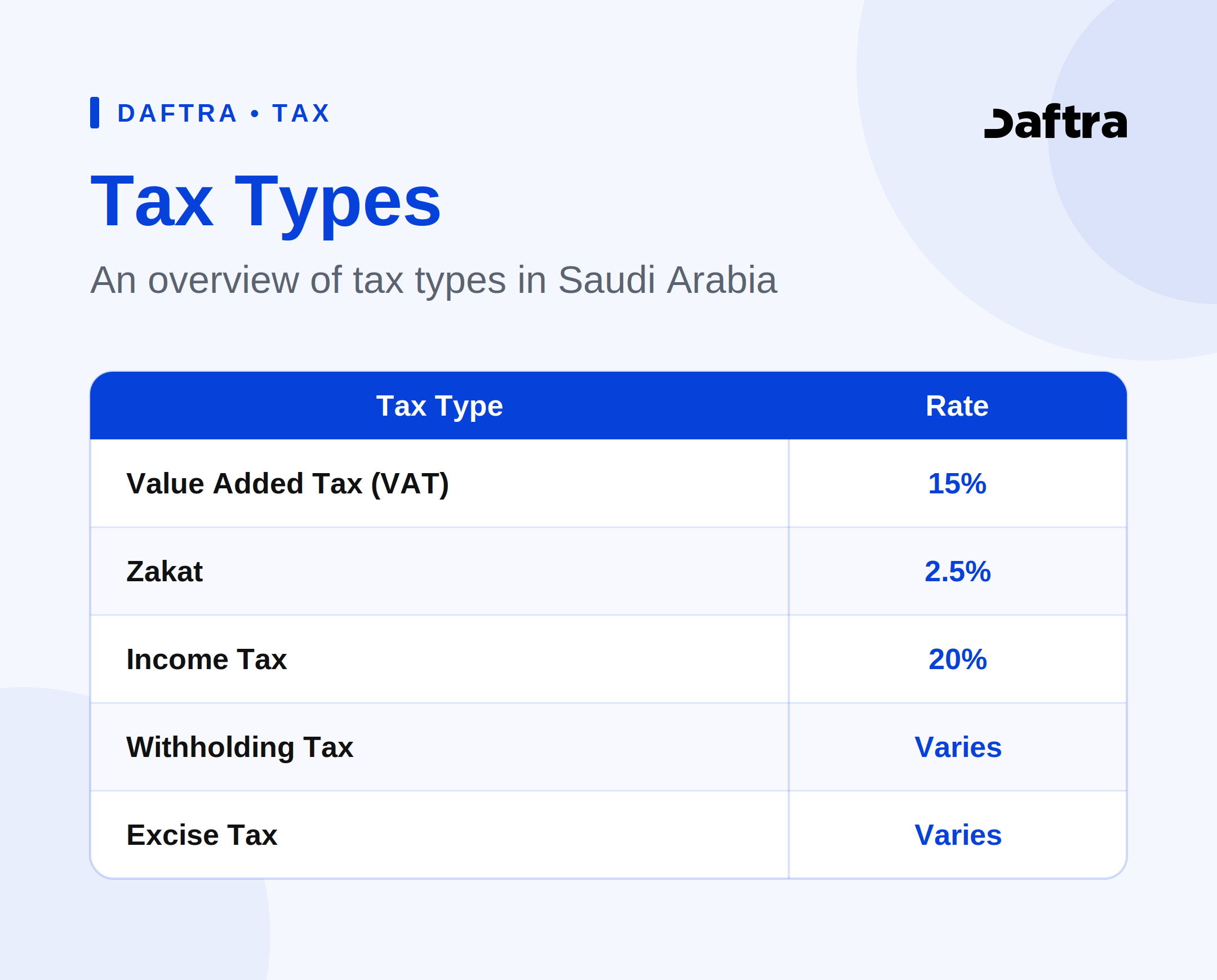
Here is a breakdown of Saudi Arabia's tax types:
Value Added Tax (VAT)
VAT is an indirect tax imposed on taxable supplies of goods/services and certain imports; the VAT rate started at 5% in 2018 and increased to 15% in 2020.
The VAT concept is as follows: registered businesses collect output VAT from customers on taxable sales and may deduct eligible input VAT paid on business expenses, subject to ZATCA's applicable rules.

Explore more on this topic:
Zakat
Zakat is the amount used to determine how much a business owes; it applies to Saudi and GCC-owned businesses and is set at 2.5% for companies operating under the Hijri calendar.
Important: Businesses must treat Zakat as a separate concept, as you cannot determine your zakat liability by looking at your revenue or adding a tax percentage to your invoices.
The Zakat calculation requires determining the relevant base and applying the rules relevant to the taxpayer. The Zakat base is the amount determined by ZATCA after considering the business’s relevant source of funds, assets, liabilities, and applicable adjustments.
Simply: Zakat due = Zakat base x 2.5%
Income Tax
Income tax applies to non-Saudi investors and shareholders in Saudi companies; it is not a universal tax on all Saudi businesses. It is imposed on taxable income, not total revenue, and is rated at 20% for many taxpayers.
In resident companies with mixed ownership, the Saudi share is subject to the Zakat regime, while the non-Saudi shares are subject to the income tax law.
For example, if a Saudi resident company is owned 60% by Saudi partners and 40% by non-Saudi partners, it has taxable income of 1,000,000 SAR during the year.
Withholding Tax
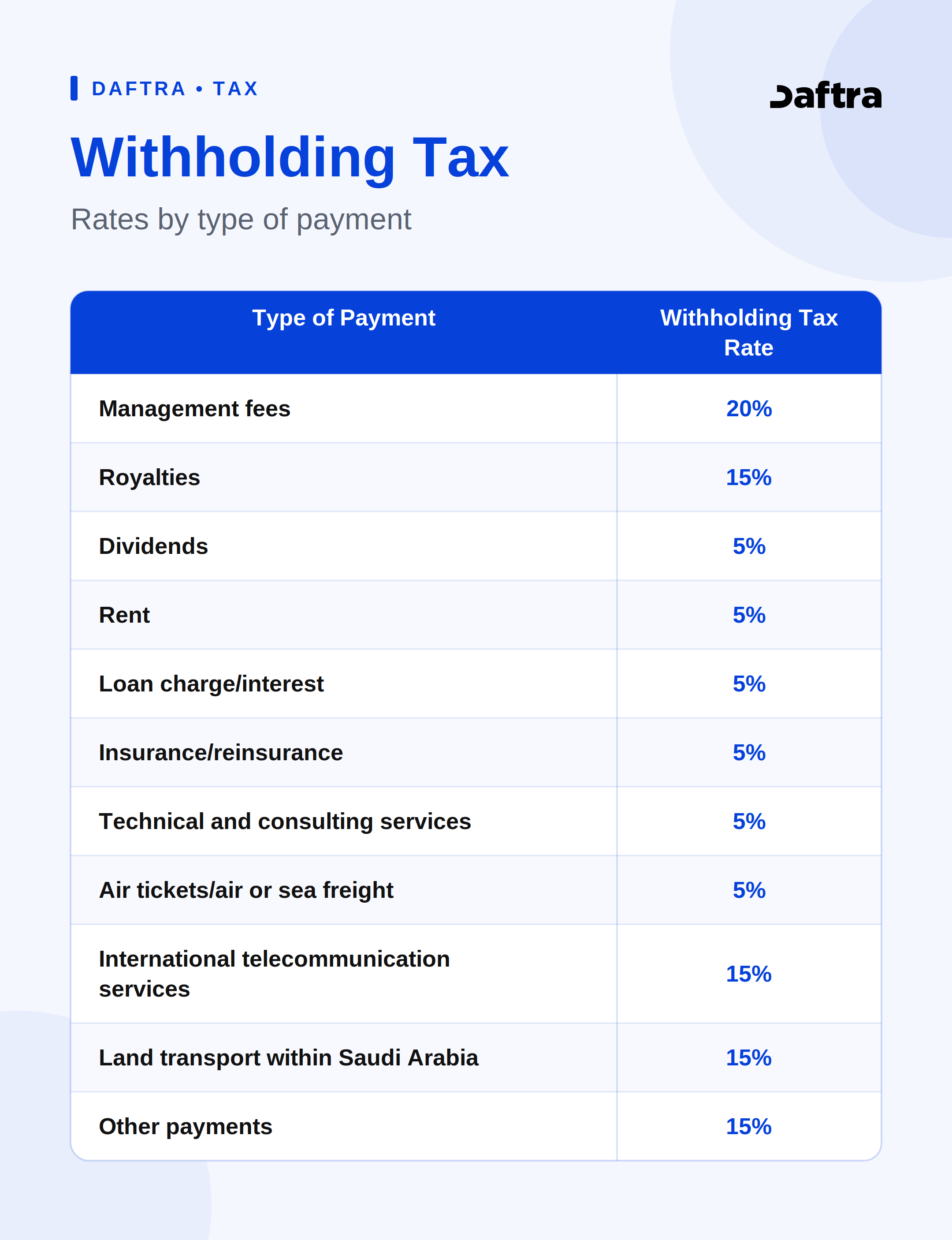
Applicable when a Saudi resident makes certain payments to a non-resident; in this case, the resident is required to withhold tax from the payment and remit it to ZATCA at the applicable rate. Withholding tax applies to services, royalties, dividends, interest, rent, and other specified payments, and the rate depends on the type of payment.
The following table states the rates of different payments of withholding tax:
Excise Tax
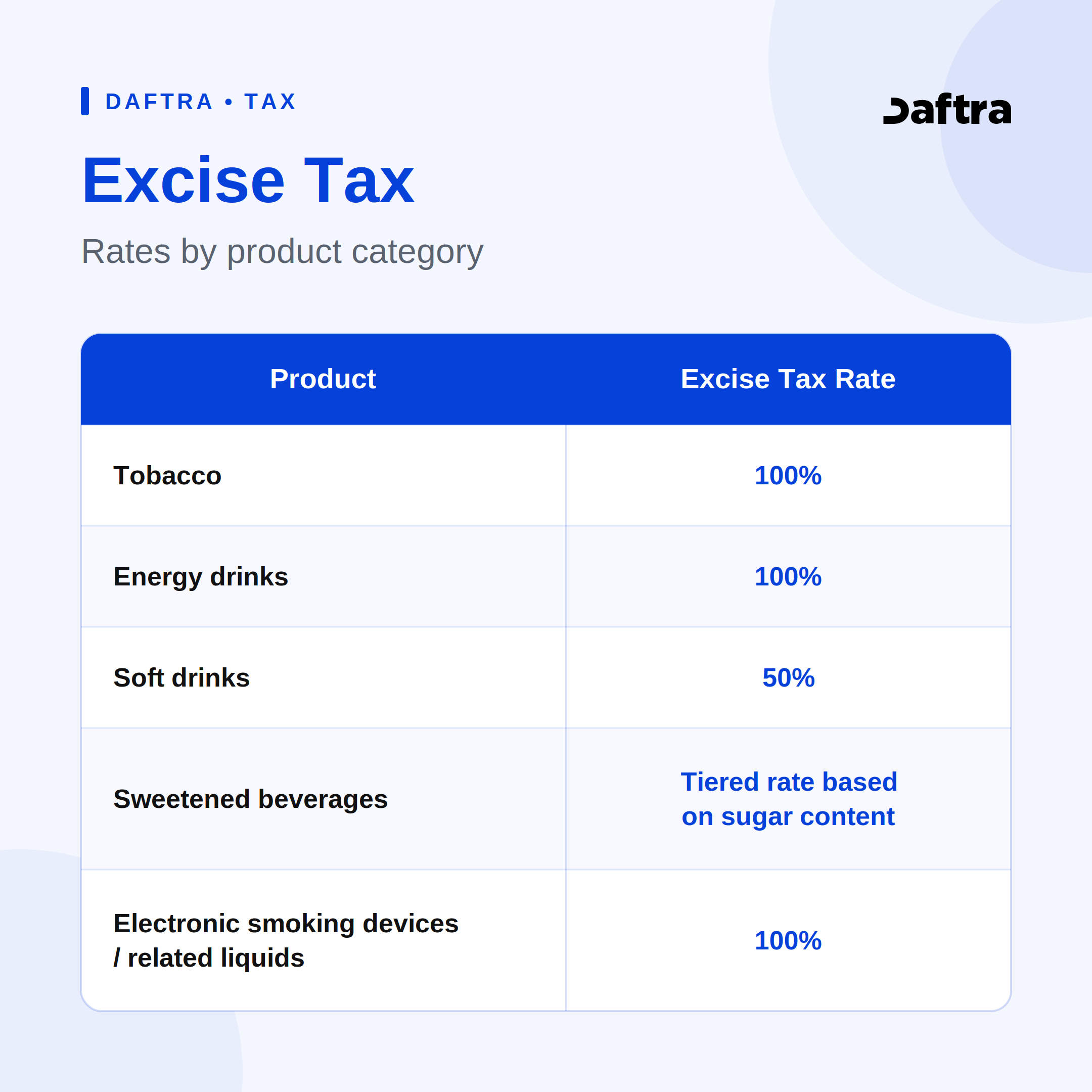
Applicable to specific goods, rather than regular business transactions, it affects businesses that manufacture or import goods within the scope.
How to calculate tax in Saudi Arabia?
There is no single formula to calculate every tax in Saudi Arabia, but the basic calculation generally goes as follows:
Tax liability = Taxable base x Applicable tax rate
Before calculating the tax, determine the taxable base and the applicable rate. Follow these steps to accurately calculate tax in Saudi Arabia:
1- Identify the type of tax
Determine whether the transaction relates to VAT, withholding tax, income tax, excise tax, zakat, or another obligation.
2- Determine whether the transaction is taxable
As every transaction is treated differently, ZATCA confirms, for example, that while the standard rate is 15%, some goods can be subject to a 0% rate depending on the transaction.
3- Determine the taxable amount
Once you know the treatment, calculate the amount to which tax applies.
Example
Taxable sale is 100,000 SAR; the standard 15% VAT rate applies
100,000 x 15% = 15,000 SAR
Invoice total: 100,000 + 15,000 = 115,000 SAR
4- Consider deductions and adjustments
Under VAT, the amount collected from customers is not necessarily the amount the business ultimately pays to ZATCA. A VAT-registered business may have eligible input VAT from purchases that can be deducted under the applicable rules.
From experience, we personally lived in the Saudi market, a business might see a sale for 100,000 SAR and immediately calculate 15% VAT. The business might assume the 15,000 SAR is the amount supposedly paid to ZATCA. This is not true; this amount represents the output VAT on those sales, not the company’s final liability. The company also had 6,000 SAR of eligible input VAT from business purchases; its net VAT was 9,000 SAR.
5- Keep the calculation tied to the underlying transaction
The tax calculations must be supported by invoices, purchase and sales records, and contracts. The most crucial part is classifying and recording every transaction before calculating tax.
Important: Following the correct steps to identify and calculate tax is crucial for accurate tax reporting, especially for businesses handling multiple types of transactions.
Main Mistakes When Calculating Tax in Saudi Arabia
Calculating tax correctly isn't just multiplying a number by a percentage; the math might be right, but in most cases, mistakes happen before we even get to the calculation. The main mistakes are when a business incorrectly classifies a transaction or applies the wrong tax treatment.
Some of the most common mistakes include:
How does Daftra help in implementing different types of taxes in Saudi Arabia?
Businesses handling hundreds or thousands of sales, purchases, expenses, and other transactions struggle to manage, calculate, and organize taxes manually, a time-consuming and error-prone process. That is why businesses should automate accounting operations to maintain consistent, accurate financial records and simplify tax-related processes.
Daftra accounting software helps businesses organize accounting transactions and automate tax-related processes such as VAT. Businesses can rely on Daftra to automatically keep their sales, purchases, invoices, and financial data organized in one place.
Daftra E-Invoice Software for KSA also helps businesses:
- Automate VAT calculations on applicable sales and purchase transactions.
- Track sales and purchase invoices and their tax amounts.
- Clarify the business's VAT position by separating input and output VAT.
- Organize accounting data and reports essential for reviewing tax-related transactions.
- Reduce manual data entry to minimize calculation and recording errors.
- Keep financial transactions connected so that tax figures are based on accounting records rather than separate manual calculations.
This is crucial for businesses that make multiple transactions of transactions each day. Instead of manually reviewing each invoice and calculating tax in separate spreadsheets, Daftra keeps relevant transaction data organized and automates calculations.
FAQs
Is salary in Saudi Arabia tax-free?
Yes, Salaries in Saudi Arabia are tax-free, specifically from income tax; however, businesses and individuals may still have other taxes, zakat, or social insurance obligations depending on their circumstances.
Does Saudi Arabia have 15% VAT?
Yes, Saudi Arabia's standard VAT rate is 15%; however, it does not apply to every transaction. Some may be zero-rated, exempt, or subject to different rules.
How much tax will I pay in Saudi Arabia?
No standard tax rate applies to every business in Saudi Arabia; your tax liability depends on the type of tax, your business structure, ownership, the nature of transactions, and the taxable base.
Is Saudi Arabia completely tax-free?
No, Saudi Arabia is not completely tax-free; it has several taxes and tax-related obligations, including VAT, income tax, withholding tax, excise tax, and zakat.











 Invoicing
 POS
POS Offers
 Installments
 Sales Commission
 KSA E-Invoice Software
 EGY E-Invoice Software
 JO E-Invoice Software
 E-Invoice Software
 Chart of Accounts
 Asset Management
 Cost Centers
 Expenses
 Cheque Cycle
 UAE VAT-Tax
 Product Management
 Purchases
 Purchase Cycle
 Suppliers
 Requisitions
 Stocktaking
 Organizational Structure
 Personnel Management
 Attendance and Leave
 Contracts
 Payroll
 Requests
 Work Orders
 Booking Management
 Rental and Unit Management
 Time Tracking
 Work Flow
 Lease Contracts
 Manufacturing Management
  Client Follow-Up
 Loyalty Points
 Points and Credits
 Memberships
 Insurance Management
 Daftra ERP Full App
 Point of Sales App
 Point of Sales for Desktop – Support Offline Mode
 AI Expenses Scanner App
 Employee Attendance, Sign & ESS App
 E-invoice Reader App
 Inventory Stocktaking App