




Table of contents:
- What is the definition of sale?
- Sales between the past and the present
- What are the conditions of sale?
- What are the pillars of sale?
- What is the difference between selling and marketing?
- What are the stages of the sales process?
- What is the importance and objectives of the sales process?
- Why should you manage your sales using Daftra?
- Frequently Asked Questions
- Conclusion
Do you ever think about how our daily lives run? If you focus on the activities we carry out throughout the day, you will find that they consist of an endless number of buying and selling transactions. At times, you find yourself a seller; at other times, a buyer.
For example, you start your day by working, thus acquiring the role of a seller. After work, you go to buy the products you need, thus taking on the role of a buyer. And so you exchange roles, and life goes on in a cycle of buying and selling.
The process of selling can be simplified briefly and clarified further through this description: if there is a person looking for a specific service or product, and there is another person who provides this product or service, and the first person can obtain them in exchange for a sum of money from the second person, then we describe the first person as the “buyer” and the second person as the “seller.”
Both parties proceed through a process called the “sales process,” recognizing that sales methods should suit the field: the methods for increasing sales in restaurants differ from those for increasing sales in factories, and of course differ from methods for increasing sales in supermarkets.
What is the definition of sale?
A sale is a transaction between two parties: the first party is called the “customer” or “buyer,” and the other party is the “seller” or “salesperson.” This transaction occurs when the first party (the customer) obtains a good or service from the second party (the seller) in exchange for a monetary payment.
One characteristic of a sale is that it transfers ownership from one party to another and does not occur without compensation or consideration.
Sales include different forms, such as personal selling, which is very similar to the affiliate marketing model, where people take your goods at a lower price and sell them at a price they set, keeping the profit margin for themselves; or direct selling, in which the seller deals with the buyer without an intermediary, such as through a face-to-face meeting.
Sales between the past and the present
In the past, the process of selling was based on barter, as people met their daily needs by exchanging goods. Then money appeared, taking the selling process to a new stage that we still live in today.
The art of selling today refers to the commercial process between the seller and the buyer, in which the seller identifies the customer’s need or desire and fulfills it by providing the required products or services. The price of the product or service, and the terms of payment and delivery, are then agreed upon between the seller and the customer.
This commercial process aims to convert products or services into money and value. By applying the principles of successful selling, companies can achieve profitability and growth in their target markets.
In general, the rules of selling include a wide range of activities and strategies designed to facilitate the exchange of goods and services in competitive markets, through the application of sales skills and training that keep pace with the development of the economy and the increasing complexity of the goods and services sold.
What are the conditions of sale?
There are several conditions that every seller must adhere to in order to ensure the success of the sales process and gain the customer’s trust and satisfaction. These conditions include:
1- Providing value to the buyer
This is done by identifying the target customer segment, understanding their needs and requirements, and then providing appropriate solutions by offering a product or service that meets the target market's needs. The products or services offered must be of high quality and meet the required specifications.
Demonstrating the value of your product or service is essential in the sales process, so it is important to explain how your offering meets customer needs and solves their problems.
2- Ownership and consent
The seller must have ownership rights, meaning the right to sell and dispose of the product or service, and those rights must be documented and legally recognized.
It is required to obtain the customer’s explicit and clear consent before carrying out any sale, and the agreement must be based on the free and independent will of both parties.
The buyer must also be legally capable of making the purchase, including reaching the age of legal majority, having no legal disabilities or restrictions, and being aware of all terms and conditions related to the product or service.
3- Price
The price of the product or service must be suitable for the target customer's ability and financial capacity, not excessive, and competitive in the market.
An inventory and warehouse management system from Daftra helps you create a product price list, whether for wholesale or retail sales.
4- Payment methods
Flexible payment options must be provided, especially given the increasing variety of payment methods today, in a way that suits each customer's needs and convenience.
The invoicing program from Daftra provides flexible and multiple payment methods that facilitate buying and selling processes, and you can manage and assign payment methods through the Daftra dashboard settings, which are easy to use.
5- Delivery services
One important additional service, if the sale is conducted remotely, is providing fast, secure delivery of products.
You can benefit from the smart solutions provided by the shipping companies' management system in Daftra to track shipping stages and delivery times to customers at the appropriate time.
6- Customer service
It is important for the seller to deal well with customers, build a good relationship with them, and maintain it so that customers feel confident in the sales and products they intend to purchase.
The relationship between the seller and the customer does not end once the sales process is completed; therefore, the seller must maintain a good image in the customer’s mind.
This ensures high-quality customer service by providing technical support to resolve any issues the customer may encounter after purchasing the product, with support available at all times to ensure customer satisfaction and strengthen the relationship.
This can be achieved by providing after-sales service to customers. Here, you can use the Daftra customer relationship management (CRM) system, which provides integrated management for tracking customers, their interactions, accounts, and balances.
7- Returns and exchanges
Also among the most important after-sales services is the option to return or exchange products in case of any problems. In this step, you can manage returned invoices with a few simple clicks from the Daftra dashboard, helping you accurately control all sales and purchase transactions.
8- Contracts
The law protects no one without documents, so to ensure the rights of each party, contracts must include the agreements that will take place during the sales process, explicitly written as a basic condition for sale and contracting between the two parties.
Among the important documents in the sales process is the sales order.
9- Trust and transparency
The seller must be able to persuade customers to purchase the product, clarify its value to them, and clearly and attractively explain its features and benefits to motivate them to buy.
However, for this to succeed, the seller must provide accurate information about the product or service being sold and any additional conditions that may affect the purchase process. The buyer must also present accurate information about their purchasing intentions and actual financial ability.
Building good relationships with customers is extremely important in sales, as this helps build trust and credibility, which in turn helps close more deals.
Read also: The most important methods and means of boosting sales
What are the pillars of sale?
A sale consists of several pillars that must be considered to achieve positive results that enhance revenues and profits. These pillars are:
1- The buyer
This element refers to the primary target to whom the sales offer is directed. The main objective of the sales process is persuasion and obtaining the buyer’s or customer’s approval to purchase the product or service.
2- The product or service
This aspect relates to the quality and type of the product offered for sale. The product or service must have specifications and features that provide value to customers in line with their needs and requirements. Therefore, the seller must ensure that the product is distinctive and high-quality, and verify its availability and suitability for use.
3- The place
The place refers to the location where the product or service is offered, whether in stores, online, or elsewhere.
4- The time
Time refers to when the product is offered for sale and the period during which the sale is completed. The goal is to determine the most suitable times to present the product and to improve the time efficiency of the sales process.
5- Display and presentation
This aspect refers to how the product or service is presented and displayed to customers. The seller should present it in an attractive, distinctive way, provide sufficient information the buyer may need, and offer after-sales service.
6- The relationship between the seller and the customer
This is one of the decisive factors in the sales process. The seller must build a good relationship with the customer by providing the necessary support, ensuring full responsiveness to all needs and requirements, and caring about the customer’s satisfaction with the product or service and the overall sales process.
7- Marketing
Marketing refers to the advertising and promotional efforts taken to promote the product or service and attract buyers. These efforts include creating advertising campaigns and developing marketing strategies.
What is the difference between selling and marketing?
The main difference between selling and marketing is the level of comprehensiveness. Selling is a sub-stage of a broader, more comprehensive process: marketing. It is important to apply both sales and marketing strategies in an integrated manner in any business to ensure its success and stability.
Below are some elements that illustrate the difference between the fundamentals of selling and marketing:
1- Definition
Marketing refers to a set of activities through which customer needs and desires are analyzed, and strategies are developed to meet them profitably for the company. The marketing process also includes designing and developing products and services, setting prices, creating advertising plans, determining distribution channels, analyzing competitors, and evaluating the performance of marketing campaigns.
Marketing is a long-term process aimed at building a relationship between the business and its customers. Its main focus is on creating value for customers, building brand awareness, and establishing a loyal customer base for the product or service.
Selling, on the other hand, is the process of persuading a customer to purchase a product or service. It is a short-term process aimed at completing a sale and generating revenue for the company. Selling involves direct interaction with customers and demonstrating the product or service's benefits to convince them to make a purchase.
2- Focus
Selling focuses on the product or service offered, as its direct goal is achieving sales rather than building a long-term relationship with the customer, whereas marketing focuses on the customer and their needs.
3- Objectives
The goal of selling is to close a deal or complete a transaction between the seller and the buyer, while the goal of marketing is to build relationships with customers, create long-term brand loyalty, and improve the image of the product or service in the market.
4- Timing
Selling tends to occur later in the customer journey, when the customer already shows interest in the product or service, whereas marketing begins at the start of the customer journey by building brand awareness and attracting potential customers.
The sales process occurs at the final stage of the marketing process, where marketing strategies are used to promote the product or service and build demand. Once this stage is completed, the process moves to selling to finalize the deal.
5- Mechanism of work
Selling often operates on a short-term strategy to increase sales, while marketing works on a long-term strategy that focuses on building brand equity and customer loyalty over time.
6- Timeframe
The sales process is usually completed in a short period, while the marketing process requires a longer time to achieve its objectives and produce positive results.
7- Strategies
There is a difference between the strategies used in selling and marketing. Selling often involves face-to-face interactions with customers, while marketing uses a wide range of strategies, including advertising, public relations, content marketing, social media marketing, and other methods.
What are the stages of the sales process?
When we talk about selling as an organized process, we must answer the question: how does the sales process take place? The steps of selling can be divided into three main stages, each with a number of specific, necessary tasks. The sales process, with its stages and details, can be presented as follows:
1- The pre-sale stage
Before carrying out the actual sale, several necessary tasks are completed to continue the sales process and move to the next stage. These tasks include:
- Identifying the target audience: In this step, sales management officials search for potential customers interested in their product or service. This may include making informal calls, email marketing, or communication through networks.
- Assessing needs: This step aims to understand the customer’s needs and preferences in more detail by asking questions about specific pain points or challenges they face. This information is then used to position a product or service as a solution to these challenges.
2- The sale completion stage
At this stage, communication with customers occurs, and their willingness to purchase is assessed. Once the customer’s needs are well understood, the product or service is presented and demonstrated. This includes explaining how the product works, its specifications, and all related details, as well as responding to all inquiries about the products or services.
The customer may raise objections or concerns about the product or service. Here, the seller must be prepared to handle these objections and provide assurances that their product or service is the appropriate solution for the customer. This stage concludes with signing the final contract and paying for the service or product.
3- The post-sale stage
After completing the sale, the seller should continue maintaining the relationship with the customer to ensure their satisfaction with the product or service and to receive their suggestions for development and improvement.
Read also: The best sales management software
What is the importance and objectives of the sales process?
The benefits of selling can be summarized in achieving a fair level of revenue, understanding the market, maintaining the competitive position of the brand, and meeting customer needs. The following points outline the most important functions and objectives of selling:
1- Achieving profits
The ultimate and primary goal of the sales process is to generate profits. The sales team's efforts are focused on converting potential customers into core customers. The seller sets the price of the product or service to cover costs, achieve a profit, and increase overall revenue.
2- Providing service to customers
The sales process is a tool for meeting customer needs and fulfilling their requirements by providing the products and services they need.
3- Building relationships with customers
A good sales process goes beyond simply closing deals. Every successful business depends on strong customer relationships. The sales process is a way to build and strengthen these relationships by understanding customer needs, providing excellent service, and addressing all their concerns.
This helps build customer loyalty, which may lead to future repeat business with the seller.
4- Improving brand image
The sales process gives companies the opportunity to improve their brand image and increase their popularity and reputation by providing distinguished, high-quality products and services to achieve customer satisfaction and encourage them to share their positive experiences, thereby building a good market reputation.
5- Understanding the market
The sales process helps companies better understand the market and its needs by analyzing customer behavior and trends and monitoring competition. Companies then use this information to make key decisions about product development, pricing, and marketing strategies.
6- Achieving economic growth
The sales process is a fundamental tool for achieving economic growth, as it contributes to increasing revenues and generating profits, and it is also an essential means of providing job opportunities and improving the overall economy.
7- Improving efficiency
A well-planned sales process helps reduce the time and effort required to close deals, which can improve efficiency, reduce costs, and increase company profits.
8- Achieving more strategic objectives
The sales process contributes to achieving additional strategic goals for the company, such as acquiring new customers, entering new markets, and increasing the company’s market share.
Why should you manage your sales using Daftra?
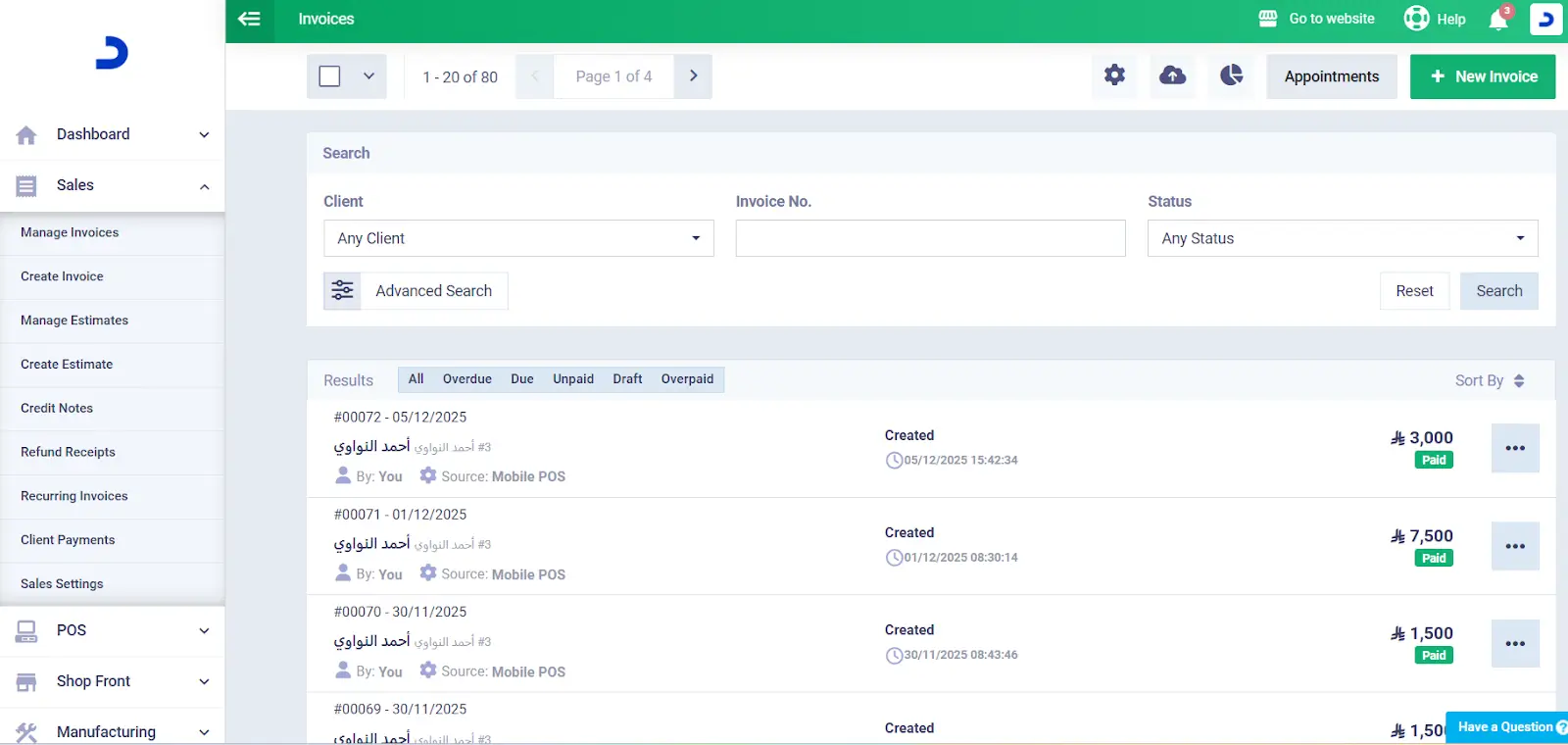
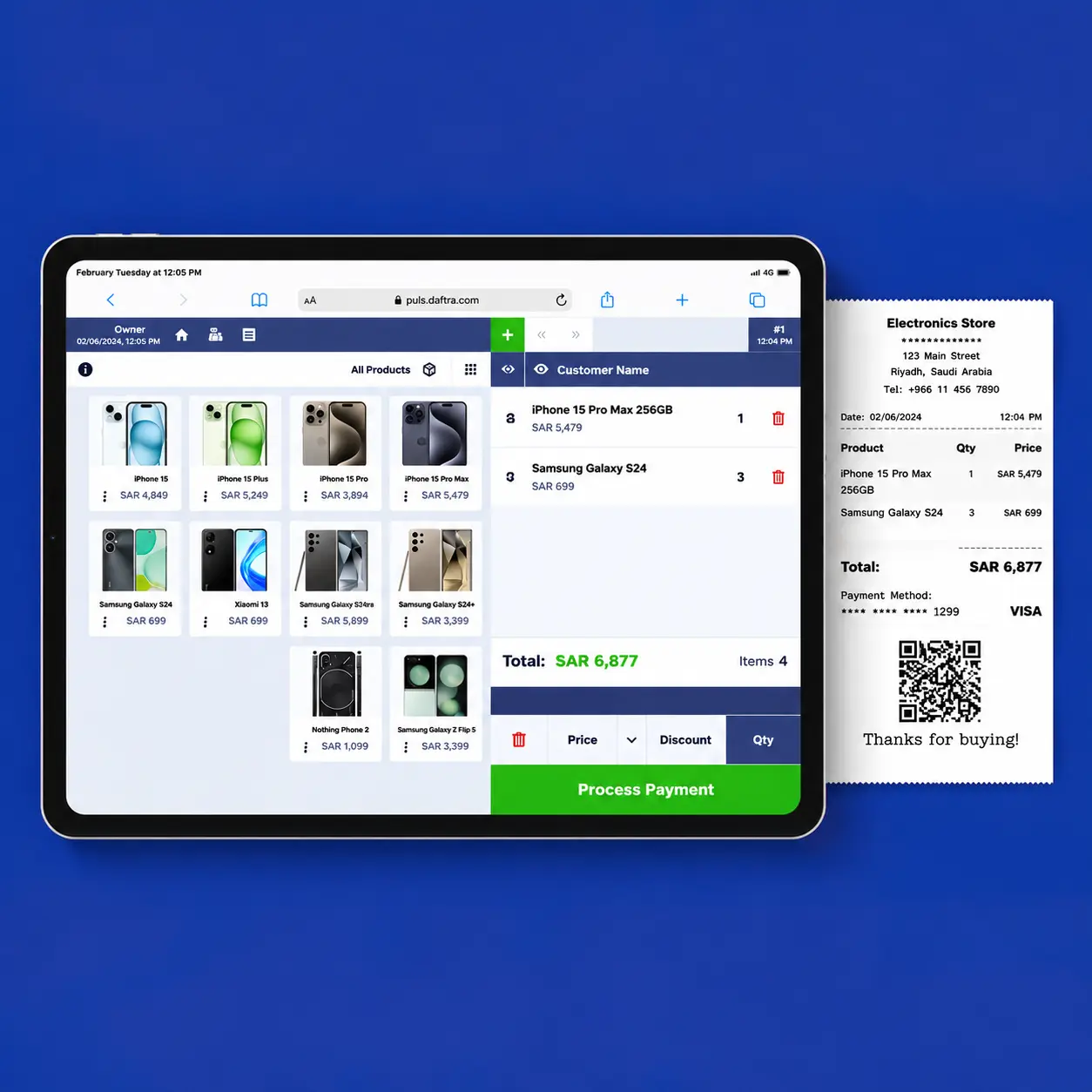
Daftra’s sales management software helps you issue invoices, manage offers and discounts, track the performance of salespeople, identify customer complaints, and schedule appointments with them.
In addition, it offers a wide range of payment methods, making it easier for you to collect your dues. All of this helps you develop your sales process, reduce errors, and learn from reports to make the most suitable decisions for your business.
This ultimately leads to increased sales and, consequently, higher profits. Try the free version of Daftra and see for yourself how one system can deliver all these capabilities to maximize your investment returns.
Frequently Asked Questions
What are the types of selling?
The types of selling include:
- Direct selling, which takes place between the seller and the customer or consumer without an intermediary.
- Retail selling in online stores or physical shops.
- Wholesale selling through traders and distributors.
- Commission-based selling through brokerage agents.
- Installment selling, especially for high-value products, involves providing products or services to customers in exchange for payments over specific time periods.
Selling may also vary depending on the type of sale contract, such as an absolute sale, a salam sale (forward sale), a currency exchange sale, or a barter sale.
What are sales skills?
- Effective communication and listening to customer needs, and the ability to build ongoing relationships with them.
- Persuasion skills and the ability to present product benefits logically and attractively.
- Time management skills to achieve sales targets.
- Adaptability and flexibility with market supply and demand, and changing customer and consumer purchasing behaviors.
What are the foundations of successful selling?
The foundations of successful selling include:
- Providing real value to customers.
- The ability to convert potential customers into actual customers.
- Full knowledge of the details of the products or services offered in the sales process.
- Analytical thinking to identify market trends and direct sales efforts properly in a way that enhances profitability, growth, and financial stability.
- Setting clear sales goals to motivate the sales team.
What is the difference between a pillar and a condition in selling?
The difference between a pillar and a condition in selling lies in the element of flexibility. The pillars of sale cannot be changed or dispensed with, as doing so would render the sales contract invalid.
A condition in a sale, however, may include additional elements that are not necessarily essential. This means that a sales contract can be valid even if it does not meet specific conditions. It is worth noting that there are types of conditions in sale, such as suspensive conditions and resolutory conditions, which affect the execution of the sales process.
Conclusion
In summary, the sales process is the process of converting products or services into money by selling them to customers. This process consists of multiple stages that begin with identifying the potential customer and understanding their needs and desires, continue with persuading them to purchase, and conclude with finalizing the deal, delivering the product, and providing good service.
The main objectives of this process are to achieve sales and profits, increase the company’s market share, raise brand awareness, strengthen customer relationships, and enhance credibility. Selling also helps improve inventory management, pricing, marketing, advertising, and distribution.
Finally, it should be noted that the difference between selling and marketing lies in timing. Selling focuses on promoting products and converting them into money in the short term, while marketing focuses on understanding customers’ needs and desires and building a long-term relationship between the company and its customers.
In general, the sales process is a crucial component of any business and cannot be overlooked. It helps increase revenues, build customer relationships, understand the market, achieve sales objectives, and improve efficiency.













 Invoicing
 POS
POS Offers
 Installments
 Sales Commission
 KSA E-Invoice Software
 EGY E-Invoice Software
 JO E-Invoice Software
 E-Invoice Software
 Chart of Accounts
 Asset Management
 Cost Centers
 Expenses
 Cheque Cycle
 UAE VAT-Tax
 Product Management
 Purchases
 Purchase Cycle
 Suppliers
 Requisitions
 Stocktaking
 Organizational Structure
 Personnel Management
 Attendance and Leave
 Contracts
 Payroll
 Requests
 Work Orders
 Booking Management
 Rental and Unit Management
 Time Tracking
 Work Flow
 Lease Contracts
 Manufacturing Management
  Client Follow-Up
 Loyalty Points
 Points and Credits
 Memberships
 Insurance Management
 Daftra ERP Full App
 Point of Sales App
 Point of Sales for Desktop – Support Offline Mode
 AI Expenses Scanner App
 Employee Attendance, Sign & ESS App
 E-invoice Reader App
 Inventory Stocktaking App