



Table of contents:
- Key Summary
- What Is a Qualifying Free Zone Person in the UAE?
- Free Zone Person vs Qualifying Free Zone Person
- Conditions to Be a Qualifying Free Zone Person
- What Is Qualifying Income for a QFZP?
- What Activities Are Qualifying Activities?
- What Are Excluded Activities?
- How the De Minimis Rule Works for QFZPs
- How Mainland and Non-Free Zone Transactions Affect QFZP Status
- How Permanent Establishments, Immovable Property, and Intellectual Property Affect QFZP Treatment
- What Happens If a QFZP Fails the Conditions?
- Do QFZPs Still Need to Register, File, and Keep Records?
- How QFZP Status Appears in the Corporate Tax Return
- Is QFZP Status the Same as Corporate Tax Exemption or Small Business Relief?
- Common Mistakes Free Zone Companies Make With QFZP Status
- How Daftra Helps Free Zone Businesses Manage QFZP Compliance
- FAQs About Qualifying Free Zone Persons in the UAE
- Conclusion
The UAE introduced its Corporate Tax law in June 2023 under Federal Decree-Law No. 47 of 2022, marking a significant shift in nationwide business taxation and a deliberate step toward aligning with the OECD's BEPS Pillar Two global minimum tax standards. Under the new law, companies are generally taxed at 0% on profits up to AED 375,000 and 9% on profits above that threshold.
For businesses operating in one of the UAE's 50+ Free Zones, however, a different framework applies. A company that meets the right conditions can qualify for a 0% Corporate Tax rate on its qualifying income, a status formally known as a Qualifying Free Zone Person, or QFZP. This is not a blanket exemption granted to every Free Zone entity; it requires meeting specific conditions related to business activities, operational substance, related-party transactions, and compliance obligations. Any income that falls outside the qualifying criteria remains subject to the standard 9% rate.
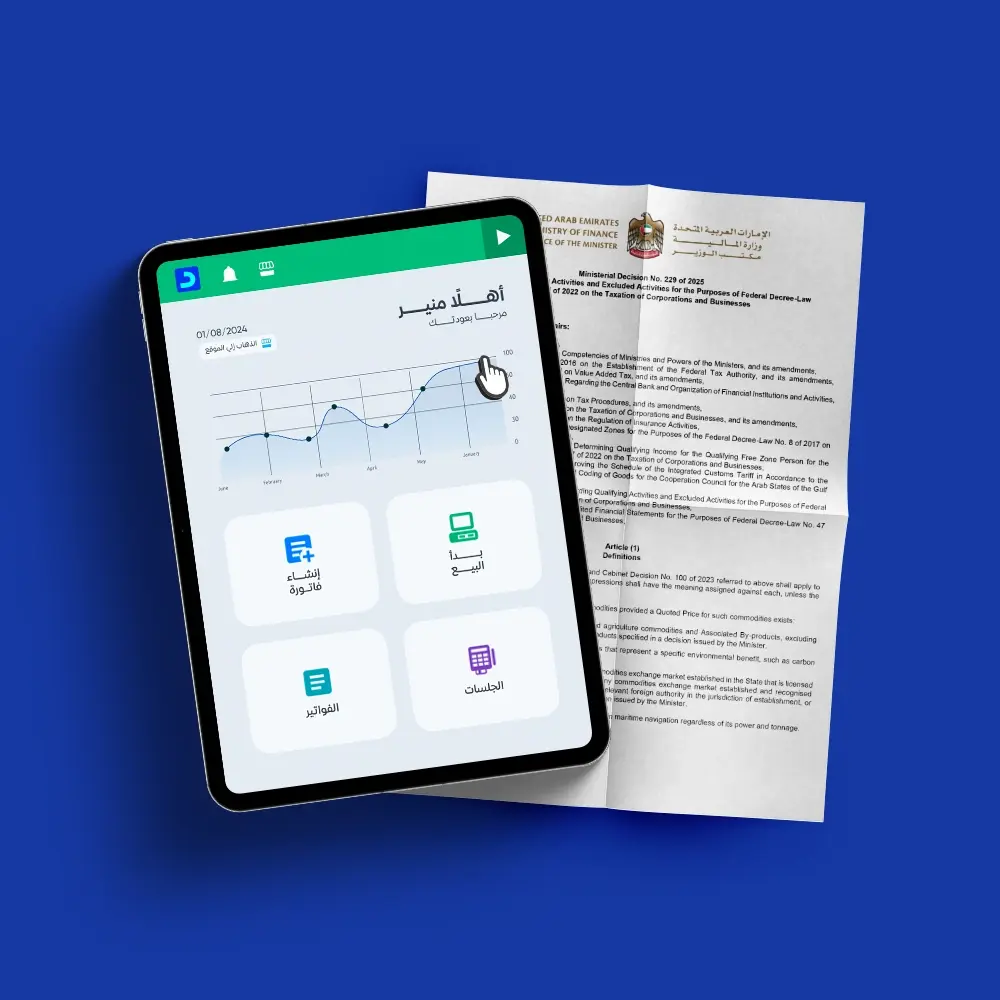
To clarify how the regime works in practice, the UAE issued Cabinet Decision No. 100 of 2023 and Ministerial Decision No. 265 of 2023, followed by a dedicated Federal Tax Authority guide, CTGFZP1, to address areas that had remained open to interpretation.
In this article, we break down what it means to be a QFZP, what income qualifies for the 0% rate, and what Free Zone businesses need to do to stay compliant under UAE Corporate Tax Law.
What Is a Qualifying Free Zone Person in the UAE?
A Qualifying Free Zone Person (QFZP) is a juridical person incorporated, established, or registered in a UAE Free Zone that meets specific conditions under Federal Decree-Law No. 47 of 2022 on Corporate Taxation.
QFZPs benefit from a 0% corporate tax rate on their Qualifying Income, while their non-qualifying income remains subject to the standard 9% corporate tax rate.
The QFZP regime recognizes the continued importance of Free Zones to the UAE economy while ensuring that only businesses genuinely operating within Free Zones and conducting appropriate activities benefit from the preferential tax treatment.
This framework allows Free Zone companies to maintain their competitive advantages while contributing to the UAE's broader economic transformation.
Example:
A company established in a UAE Free Zone that earns qualifying income from approved activities and meets all QFZP conditions may benefit from a 0% corporate tax rate on that qualifying income. However, the company remains subject to UAE corporate tax rules and must continue meeting the QFZP requirements to retain this treatment.
Free Zone Person vs Qualifying Free Zone Person
Not every Free Zone Person automatically qualifies as a QFZP. The distinction is critical:
| Aspect | Free Zone Person (FZP) | Qualifying Free Zone Person (QFZP) |
| Definition | A juridical person incorporated, established, or otherwise registered in a UAE Free Zone. | A Free Zone Person that meets all the conditions set out in Article 18 of the UAE Corporate Tax Law. |
| Who Can Qualify? | Includes companies established in a Free Zone, foreign companies with a branch in a Free Zone, and UAE juridical persons with a branch in a Free Zone. | Must first be a Free Zone Person and then satisfy all QFZP requirements. |
| Status Under Corporate Tax Law | A Taxable Person under the UAE Corporate Tax regime. | Also a Taxable Person under the UAE Corporate Tax regime. |
| Eligibility for Preferential Tax Treatment | Not automatically entitled to the QFZP tax benefits. | Eligible for the special QFZP tax regime if all conditions continue to be met. |
| Tax Rate on Qualifying Income | Not applicable. | 0% Corporate Tax on Qualifying Income. |
| Tax Rate on Non-Qualifying Income | Subject to the standard Corporate Tax rates. | Subject to 9% Corporate Tax on Taxable Income that is not Qualifying Income. |
| Standard AED 375,000 Threshold | Benefits from the standard Corporate Tax rates, including 0% on the first AED 375,000 of Taxable Income and 9% on income above that amount. | Does not benefit from the AED 375,000 threshold for non-Qualifying Income. Any non-Qualifying Taxable Income is taxed at 9% from the first dirham. |
| Consequence of Not Meeting QFZP Conditions | Remains subject to the ordinary Corporate Tax rules applicable to Taxable Persons. | Loses access to the preferential QFZP regime and is taxed under the standard Corporate Tax rules. |
Conditions to Be a Qualifying Free Zone Person
A Free Zone Person must satisfy all QFZP conditions in every Tax Period to benefit from the preferential Corporate Tax treatment. The QFZP regime is not optional once a business seeks to apply the 0% rate on Qualifying Income; every condition must be met simultaneously. If a Free Zone Person fails to satisfy any of the required conditions, it will cease to qualify as a QFZP.
The UAE Corporate Tax Law and the FTA Corporate Tax Return Guide identify the following core conditions:
The QFZP regime is designed to ensure that only Free Zone businesses with genuine economic activity and qualifying sources of income can benefit from the 0% Corporate Tax rate on Qualifying Income. Meeting all of the above conditions is therefore essential to obtaining and retaining QFZP status.
What Is Qualifying Income for a QFZP?
Qualifying Income is the income that a Qualifying Free Zone Person (QFZP) can be subject to the preferential 0% Corporate Tax rate. Under the UAE Corporate Tax regime, Qualifying Income is determined primarily by the source and nature of the income, not the amount earned.
The 0% Corporate Tax rate applies to qualifying transactions and activities carried out from within a UAE Free Zone, including Designated Zones. To benefit from this treatment, the income must fall within one of the categories prescribed under the Corporate Tax rules.
Sources of Qualifying Income
A QFZP may treat the following types of income as Qualifying Income:
1. Transactions With Other Free Zone Persons
Income derived from transactions with other Free Zone Persons qualifies, provided:
- The recipient is the Beneficial Recipient of the goods or services; and
- The transaction does not relate to an Excluded Activity.
The Beneficial Recipient is the person that has the right to use and enjoy the goods or services and is not contractually required to pass them on to another party. A Free Zone Person acting merely as an agent, nominee, or intermediary would not be regarded as the Beneficial Recipient.
2. Income From Qualifying Activities
Income generated from Qualifying Activities can constitute Qualifying Income, provided the activity is not classified as an Excluded Activity.
This means that a QFZP may still earn Qualifying Income from transactions with Non-Free Zone Persons when those transactions relate to eligible Qualifying Activities.
3. Income From Qualifying Intellectual Property
Income derived from the ownership or exploitation of Qualifying Intellectual Property may qualify for the 0% rate. Such income is determined using the nexus approach, which links the tax benefit to the qualifying research and development expenditures associated with the intellectual property.
4. Other Income That Meets the De Minimis Requirement
Any other income may be treated as Qualifying Income if the QFZP satisfies the de minimis requirement, meaning its non-qualifying revenue remains within the permitted thresholds.
What Activities Are Qualifying Activities?
Qualifying Activities are specific activities prescribed in Ministerial Decision No. 265 of 2023. When a QFZP earns income from one of these activities, even if the customer is a Non-Free Zone Person, that income can be Qualifying Income, provided the other conditions are satisfied.
The full list of Qualifying Activities is:
Qualifying Activities also include ancillary activities, activities that are either necessary for the performance of a main Qualifying Activity, or that make a minor financial contribution and are so closely related to the main activity that they should not be treated as separate. Whether an activity is ancillary depends on the specific facts and circumstances and must be assessed on a case-by-case basis.
Importantly, a single solitary transaction, for example, a one-off sale of an aircraft does not itself constitute a Qualifying Activity unless it forms a natural and integral part of a coherent Business the Free Zone Person operates in relation to that Qualifying Activity.
What Are Excluded Activities?
Excluded Activities are activities that generate non-qualifying Revenue for a QFZP. Revenue from these activities is never treated as Qualifying Income and is counted toward the de minimis threshold.
The main Excluded Activities are:
- Transactions with natural persons (individuals): except for certain activities such as ship operations, regulated fund management, regulated wealth and investment management, and aircraft financing and leasing.
- Banking activities: including deposit-taking, lending, currency exchange, money transfers, and other regulated banking services.
- Insurance activities: except for reinsurance services and certain captive insurance activities provided as part of headquarters services to Related Parties.
- Finance and leasing activities: except for ship financing and leasing, aircraft financing and leasing, and treasury and financing services provided to Related Parties.
- Ownership or exploitation of immovable property: except for income from Commercial Property located in a Free Zone when the transaction is with another Free Zone Person.
In addition, ancillary activities that are closely related or integral to an Excluded Activity are also treated as Excluded Activities.
How the De Minimis Rule Works for QFZPs
The de minimis rule gives a QFZP a limited tolerance for earning non-qualifying Revenue without losing its QFZP status entirely. It is not a carve-out for deliberate non-qualifying Business; rather, it exists to prevent a QFZP from losing its status due to immaterial or incidental non-qualifying Revenue.
The de minimis requirement is satisfied if the QFZP's non-qualifying Revenue in a Tax Period does not exceed the lower of 5% of its total Revenue, or AED 5,000,000.
Non-qualifying Revenue is Revenue derived from:
- Excluded Activities,
- Activities that are not Qualifying Activities where the other party is a Non-Free Zone Person, and
- Transactions with a Free Zone Person that is not the Beneficial Recipient.
Total Revenue for de minimis purposes is not the same as the Revenue figure in the financial statements. The following sources are stripped out of both total Revenue and non-qualifying Revenue before the test is applied:
- Revenue attributable to a Foreign Permanent Establishment,
- Revenue attributable to a Domestic Permanent Establishment,
- Revenue from Immovable Property located in a Free Zone (other than qualifying Commercial Property transactions with Free Zone Persons), and
- Revenue from the ownership or exploitation of intellectual property (other than Qualifying Income from Qualifying Intellectual Property).
This carve-out is important: Revenue from a Domestic Permanent Establishment, for example, is simply taxed at 9% as Taxable Income; it neither helps nor harms the QFZP's de minimis calculation.
Example of how the test works: If a QFZP earns total Revenue of AED 10,000,000 (after stripping out Permanent Establishment and property income), of which AED 400,000 comes from Excluded Activities, the non-qualifying Revenue is 4% of total Revenue. Since 4% is below the 5% threshold and AED 400,000 is below AED 5,000,000, the de minimis requirement is met.
If, in the same scenario, the non-qualifying Revenue were AED 600,000, it would be 6% exceeding the 5% threshold. Even though it is below the AED 5,000,000 absolute cap, the QFZP fails the de minimis test because both thresholds must be satisfied.
Failure to meet the de minimis requirements causes the Free Zone Person to lose QFZP status from the beginning of that Tax Period and for the subsequent four Tax Periods.
How Mainland and Non-Free Zone Transactions Affect QFZP Status
A QFZP is not prohibited from transacting with Non-Free Zone Persons, including mainland UAE companies and foreign entities. The question is whether the income from those transactions qualifies for the 0% rate.
When a QFZP transacts with a Non-Free Zone Person, the income is Qualifying Income only if it arises from a Qualifying Activity that is not also an Excluded Activity. General services not on the Qualifying Activities list, for example, legal advice, consulting, or IT services rendered to a mainland company, will generate non-qualifying Revenue and count against the de minimis thresholds.
When a QFZP transacts with another Free Zone Person, the income can be Qualifying Income regardless of whether the activity is a Qualifying Activity, as long as the Free Zone Person receiving the services or goods is the Beneficial Recipient and the transaction does not involve an Excluded Activity.
This distinction has a practical planning implication: a QFZP that operates largely in the business-to-business services space can structure its activities to serve primarily other Free Zone Persons, thereby preserving Qualifying Income status even for non-Qualifying Activities. However, once Excluded Activities are involved, even Free Zone-to-Free Zone transactions generate non-qualifying Revenue.
If a QFZP has a Domestic Permanent Establishment, a business presence outside the Free Zone in the UAE, such as a mainland branch or office that is not merely preparatory or auxiliary. the Revenue attributable to that Permanent Establishment is taxed at 9% and is excluded entirely from the QFZP's de minimis calculation. The arm's length value for the Domestic Permanent Establishment's activity must be determined using the separate-entity approach.
How Permanent Establishments, Immovable Property, and Intellectual Property Affect QFZP Treatment
These three areas represent the most technically complex dimensions of the QFZP regime and deserve careful attention.
What Happens If a QFZP Fails the Conditions?
The consequences of failing to meet any QFZP condition are significant and long-lasting.
If a QFZP fails to meet the criteria in a given Tax Period, whether because it failed the de minimis test, lacked adequate substance, did not maintain audited financial statements, or for any other reason, it ceases to be a QFZP from the beginning of that Tax Period and for the four subsequent Tax Periods.
Consequences of failing QFZP conditions:
1. Standard corporate tax rates apply
The company is taxed at 0% on the first AED 375,000 and 9% on the remainder of its taxable income for a minimum of five years, even if the breach is fully corrected the following year.
2. Voluntary opt-out carries the same five-year lock-out
A Free Zone Person that elects to leave the QFZP regime under Article 19 faces identical consequences. The election can apply to the current or the following tax period and must be filed before the relevant tax return deadline. Once the five years expire, the company can reassess its eligibility and return to QFZP status if all conditions are met.
3. Further breaches during the lock-out do not extend it
Additional non-compliance during the five-year period does not restart or extend the lockout. Once those five years are served, the slate is clean for re-qualifying.
4. Standard corporate tax reliefs become available
While outside the QFZP regime, the company gains access to reliefs otherwise unavailable to a QFZP:
- Small Business Relief
- Qualifying Group Relief
- Business Restructuring Relief
- Transfer of Tax Losses
- Membership in a Tax Group
Do QFZPs Still Need to Register, File, and Keep Records?
Yes, being a QFZP with primarily 0%-taxed income does not exempt a company from its administrative obligations under the Corporate Tax Law. A QFZP is a Taxable Person, and all the obligations that apply to Taxable Persons apply to it.
Tax Registration: Every Free Zone Person, including a QFZP, must register for Corporate Tax with the Federal Tax Authority (FTA) within the prescribed timelines. Failure to register on time results in Administrative Penalties.
Tax Return and Payment: Corporate Tax is a self-assessed regime. The QFZP must file its Tax Return and pay any Corporate Tax due within nine months from the end of the relevant Tax Period. Even if all income is Qualifying Income taxed at 0%, the Tax Return must still be filed.
Record Keeping: A QFZP must maintain all records and documents required for Corporate Tax purposes for seven years following the end of the Tax Period to which they relate. Records must be easily accessible for FTA inspection upon request.
Accounting Standards: Financial Statements must be prepared in accordance with IFRS (or IFRS for SMEs for entities with Revenue of AED 50,000,000 or less), or Cash Basis of Accounting where permitted. While the QFZP is not required to prepare separate Financial Statements for its Qualifying Income and non-Qualifying Income components, it must maintain sufficient documentation to demonstrate how Qualifying Income was calculated.
Audited Financial Statements: This is one of the explicit QFZP conditions: audited Financial Statements are required regardless of Revenue size. This is more onerous than the rules that apply to ordinary Taxable Persons, which only require an audit above certain Revenue thresholds.
How QFZP Status Appears in the Corporate Tax Return
The QFZP Corporate Tax Return is self-assessed. In filing its return, the QFZP must:
- Segregate its Revenue into the Qualifying Income component and the non-Qualifying Income (Taxable Income) component.
- Allocate expenses among those components on an arm's-length basis, using appropriate allocation keys (such as headcount, floor space, Revenue, or time spent), applied consistently across Tax Periods.
- Apply the standard rules of Article 20 of the Corporate Tax Law to determine its Taxable Income that is not Qualifying Income, excluding reliefs that a QFZP is not entitled to benefit from.
- Calculate the 9% Corporate Tax liability on the non-Qualifying Income component without benefiting from the AED 375,000 standard threshold.
- Demonstrate that the de minimis requirements have been met, by reference to the non-qualifying Revenue and total Revenue figures calculated in accordance with the prescribed methodology.
- Report any Tax Losses incurred on the Taxable Income component, which can be carried forward to offset future non-Qualifying Income (but cannot be transferred to other entities or offset against Qualifying Income).
The QFZP must be prepared to provide supporting documentation to the FTA upon request, including Transfer Pricing documentation, the calculation of Qualifying Income from Qualifying Intellectual Property, and the methodology used to attribute profits between the Free Zone parent and any Permanent Establishments.
Is QFZP Status the Same as Corporate Tax Exemption or Small Business Relief?
No, and the distinction is important.
A QFZP is a Taxable Person that benefits from a 0% preferential tax rate on its Qualifying Income. It remains within the Corporate Tax system, files returns, maintains records, and pays 9% on any non-Qualifying Income. It is not exempt from Corporate Tax; it is taxed at a preferential rate.
An Exempt Person under Article 4 of the Corporate Tax Law is entirely outside the scope of Corporate Tax. Examples include government entities, extractive businesses (for their extractive activities), qualifying public benefit entities, and qualifying investment funds. An Exempt Person has no Corporate Tax obligations in relation to its exempt activities, whereas a QFZP has ongoing compliance obligations.
Small Business Relief under Article 21 allows eligible Taxable Persons with Revenue below AED 3,000,000 to elect to be treated as having no Taxable Income for a Tax Period. It is a temporary administrative simplification for small businesses.
A QFZP is explicitly not eligible for Small Business Relief. Conversely, a Free Zone Person that has elected out of QFZP status or failed the QFZP conditions may, if it meets the Revenue threshold, be eligible for Small Business Relief during the years it is not a QFZP.
The trade-off is real: QFZPs gain the 0% rate on significant income but sacrifice the AED 375,000 tax-free threshold, access to Small Business Relief, Qualifying Group Relief, Business Restructuring Relief, the ability to transfer or receive Tax Losses, and Tax Group membership.
Companies should weigh these trade-offs, particularly if they are in a growth or restructuring phase, before assuming that QFZP status is always optimal.
Common Mistakes Free Zone Companies Make With QFZP Status
Understanding where companies most often go wrong helps avoid costly, long-lasting errors.
- 01 Assuming QFZP status is automatic.
While a Free Zone Person is deemed to be a QFZP by default, this is only true if all conditions are continuously met. Many companies assume their Free Zone license alone guarantees a 0% tax rate, without examining whether they have adequate substance, whether their transactions meet the Beneficial Recipient test, or whether they have non-qualifying Revenue breaching the de minimis limits.
- 02 Overlooking the de minimis test on a Revenue-weighted basis.
It is easy to focus on the AED 5,000,000 absolute cap and assume that small amounts of non-qualifying Revenue are fine. But the 5% test can catch companies by surprise; a company with low overall Revenue can fail the test on a relatively modest amount of non-qualifying income. The test applies to both thresholds simultaneously, and the lower of the two prevails.
- 03 Treating all Free Zone-to-Free Zone transactions as automatically qualifying.
The Beneficial Recipient requirement means that when a Free Zone Person sells services or goods to another Free Zone Person and simply passes them on to a third party, the transaction does not generate Qualifying Income. Companies that are part of group structures in which one entity acts as a conduit need to assess their Beneficial Recipient status carefully.
- 04 Failing to establish adequate substance.
Having a registered office in a Free Zone is not the same as having adequate substance. The company must have qualified full-time employees performing the core income-generating activities, adequate assets, and real operating expenditures in the Free Zone. Letterbox entities will not satisfy this requirement.
- 05 Misclassifying activities.
Companies sometimes assume that because an activity is performed in a Free Zone, it is a Qualifying Activity. The list of Qualifying Activities is exhaustive, and activities not on the list, such as general legal, IT, or consulting services to Non-Free Zone Persons, generate non-qualifying Revenue. Selling to a Non-Free Zone Person is only qualifying if the activity itself is a Qualifying Activity.
- 06 Generating income from Immovable Property or intellectual property without understanding the consequences.
Rental income from Free Zone property let to mainland or foreign tenants is an Excluded Activity. IP income that does not meet the Qualifying Intellectual Property definition, or that lacks the required nexus tracking, will not qualify for the 0% rate. These are frequently overlooked.
- 07 Not preparing audited financial statements.
Some companies, particularly smaller ones, assume that the audit requirement does not apply to them because they fall below normal audit thresholds. Under the QFZP regime, audit is mandatory regardless of Revenue size.
- 08 Failing to document the arm's length basis of intra-group and Permanent Establishment transactions.
The arm's length principle and Transfer Pricing documentation requirements are conditions of QFZP status, not merely good practice. A failure of documentation can put the entire QFZP status at risk.
- 09 Not understanding the five-year lock-out.
Companies sometimes believe they can dip in and out of QFZP status depending on the year's activities. In reality, failing the conditions for even one Tax Period triggers a mandatory five-year period outside the QFZP regime. This is one of the strongest incentives for ongoing, proactive compliance monitoring.
How Daftra Helps Free Zone Businesses Manage QFZP Compliance
Maintaining QFZP status is not a one-time exercise; it requires continuous monitoring of Revenue composition, transaction classification, expense allocation, and documentation across every Tax Period. This is where accounting and business management software becomes a practical necessity, not a convenience.
1- Revenue tracking by source and counterparty: Daftra enables businesses to categorize transactions by the nature of the activity and the type of counterparty, Free Zone Person, Non-Free Zone Person, or natural person, so that the split between qualifying and non-qualifying Revenue can be assessed at any point in the financial year, not just at year-end. This makes it possible to identify a de minimis risk before it crystallizes into a QFZP status failure.
2- Expense allocation: For QFZPs with both Qualifying Income and non-Qualifying Income, allocating shared expenses on a defensible and consistent basis is a condition of compliance. Daftra's expense management capabilities support the kind of allocation key documentation by headcount, Revenue, floor space, or other measurable criteria that is expected by the FTA.
3- Audit-ready financial reporting: Because audited Financial Statements are a mandatory QFZP condition regardless of Revenue size, having accounting records that are structured, complete, and easily convertible into IFRS-compliant financial statements is essential. Daftra's financial reporting module is designed to support the production of IFRS-standard statements, reducing the time and cost of the annual audit process.
4- Transfer Pricing documentation support: By maintaining detailed records of all intercompany transactions, including amounts, terms, and the basis for pricing. Daftra provides the underlying data foundation required by Transfer Pricing documentation. This is particularly relevant for Free Zone companies that are part of a group with Related Party transactions.
5- Tax Return preparation: Daftra's integration with tax filing workflows means that the data needed for the QFZP's Corporate Tax Return, the segmentation of Revenue into Qualifying and non-Qualifying components, the allocation of expenses, the calculation of Taxable Income, and the de minimis ratio can be generated directly from the accounting records, reducing the risk of errors and the time required for year-end Tax Return preparation.
For Free Zone businesses serious about preserving the commercial benefits of QFZP status, proactive, well-structured financial management is not optional. The compliance framework is detailed, the penalties for failure are long-lasting, and the FTA expects businesses to demonstrate their qualifying status with documented evidence at any time.
FAQs About Qualifying Free Zone Persons in the UAE
What is the difference between qualified and unqualified income?
Qualified Income is income that meets the UAE's QFZP requirements and is eligible for the 0% Corporate Tax rate, such as income from qualifying activities or certain transactions with Free Zone Persons.
Unqualified (non-Qualifying) Income is income that does not meet these requirements, including revenue from excluded activities or non-qualifying transactions, and is generally subject to 9% Corporate Tax. Excessive non-qualifying income may also cause a business to lose its QFZP status.
Conclusion
The QFZP regime is one of the more nuanced parts of the UAE Corporate Tax framework, and that nuance matters. A Free Zone license does not, on its own, deliver a 0% tax rate. What it delivers is the opportunity to qualify for that rate, provided the business maintains genuine substance, earns income from the right sources and counterparties, stays within the de minimis thresholds, and keeps its documentation in order every single Tax Period.
The five-year lock-out rule is what makes this regime particularly unforgiving. A single year of non-compliance, whether through a de minimis breach, a lapse in audited financials, or an undocumented related-party transaction, forces a company out of the preferential regime for five years, with no way to accelerate the return. For most businesses, that cost far exceeds whatever short-term savings came from cutting corners.
That said, the regime is workable. Companies that understand it properly, classify their activities accurately, and build compliance into their day-to-day operations rather than treating it as a year-end exercise can genuinely benefit from the 0% rate and compete effectively from their Free Zone base.









 Invoicing
 POS
 Offers
 Installments
 Sales Commission
 KSA E-Invoice Software
 EGY E-Invoice Software
 JO E-Invoice Software
 E-Invoice Software
 Chart of Accounts
 Asset Management
 Cost Centers
 Expenses
 Cheque Cycle
 VAT & Tax Compliance
 Product Management
 Purchases
 Purchase Cycle
 Suppliers
 Requisitions
 Stocktaking
 Organizational Structure
 Personnel Management
 Attendance and Leave
 Contracts
 Payroll
 Requests
 Work Orders
 Booking Management
 Rental and Unit Management
 Time Tracking
 Work Flow
 Lease Contracts
 Manufacturing Management
 Client Follow-Up
 Loyalty Points
 Points and Credits
 Memberships
 Insurance Management
 Daftra ERP Full App
 Point of Sales App
 Point of Sales for Desktop – Support Offline Mode
 AI Expenses Scanner App
 Employee Attendance, Sign & ESS App
 E-invoice Reader App
 Inventory Stocktaking App