




Table of contents:
- What Is Artificial Intelligence and Machine Learning?
- How Does Machine Learning Work?
- Why Is Artificial Intelligence Important for Businesses?
- How Can Businesses Use Artificial Intelligence?
- Applications of Artificial Intelligence Across Different Industries and Fields
- Common Myths About Using Artificial Intelligence in Business
- Types of Artificial Intelligence Used Across Businesses and Industries
- How Can AI Give Your Business a Competitive Advantage?
- Companies That Have Achieved Success Using Artificial Intelligence
- Why Is Daftra a Suitable Choice for Businesses Adopting AI?
- Frequently Asked Questions
- Conclusion
Artificial intelligence (AI) emerged in the mid-1950s, and the term “artificial intelligence” was first used in 1956 at Dartmouth College during the Dartmouth Conference on Artificial Intelligence. Since then, researchers and academics have produced more than one million publications addressing artificial intelligence and its various definitions.
A digital chart published by the World Intellectual Property Organization (WIPO) tracking the spread and development of artificial intelligence showed that its growth remained relatively slow and gradual for many years. This limited growth can be attributed, in part, to the lack of a clear understanding of how AI works and how organizations can effectively leverage it.
The adoption of artificial intelligence began to accelerate relatively significantly around 2012, driven by the expansion of databases, advances in computing capabilities and technologies, and the gradual adoption of AI across various fields, particularly scientific fields and technology and communications services.
Major companies and institutions are increasingly turning to artificial intelligence and its applications and adopting it as one of the most important modern technologies capable of driving significant transformation across various fields and business activities. With its growing adoption, alongside the continuous development of computer systems and machine learning, artificial intelligence is expected to become a fundamental technological breakthrough that businesses can no longer afford to overlook in order to maximize efficiency and value across different sectors.
What Is Artificial Intelligence and Machine Learning?
Artificial intelligence simulates human intelligence and supports people in thinking, working, and communicating more efficiently. It primarily relies on a range of technological methods and computer-based systems that automatically collect, process, extract, and analyze data to perform required tasks efficiently and generate future predictions.
Some people use artificial intelligence and machine learning interchangeably, as though they refer to the same concept. However, although machine learning is a subset of the broader field of artificial intelligence, the two terms are not synonymous. Not all machine learning techniques necessarily represent AI, nor do all AI systems necessarily rely on machine learning. The distinction between the two ultimately depends on how each operates within its underlying workflow.
How Does Machine Learning Work?
Machine learning, as a component of artificial intelligence systems, works by developing algorithms and statistical models used by computer systems. These processes can take different forms, ultimately enabling systems to perform tasks based on patterns and inference without relying on explicit manual instructions for every task.
Why Is Artificial Intelligence Important for Businesses?
Artificial intelligence has become an essential business tool, particularly as the world moves toward digitalization and companies increasingly adopt modern technologies to become more competitive and responsive. AI provides businesses across different departments with numerous benefits and opportunities, including:
01
Understanding Customers
Understanding consumer behavior and identifying customer needs.
02
Better Marketing
Improving marketing strategies and increasing sales.
03
Access to Detailed Data
Analyzing data accurately and obtaining deeper insights to support better decision-making.
04
Enhancing Performance
Improving productivity and operational efficiency.
05
Forecasting
Identifying patterns and generating predictions.
06
Process Improvement
Reducing errors and costs while improving profitability.
07
Developing Innovative Solutions
Identifying customer problems and providing solutions quickly and effectively.
08
Better Customer Experience
Delivering a better user experience, retaining existing customers, and attracting new and potential customers.
09
Continuous Development
Improving management systems and providing informed recommendations to enhance decision-making processes at the right time.
How Can Businesses Use Artificial Intelligence?
Artificial intelligence can be applied across various business functions and use cases. When implemented appropriately, it can generate valuable results that support a company’s growth and development and strengthen its competitiveness across different levels of operations. Some of the most important AI use cases in businesses include:
Customer Support, Communication, and Follow-Up
Intelligent chatbots are one of the most notable applications of artificial intelligence for providing fast, direct communication and comprehensive customer support. Businesses can use chatbots to communicate with customers and provide clear, relevant, and comprehensive answers to their questions and inquiries.
Intelligent chatbots also support continuous customer engagement throughout the communication process, which can improve the customer experience, increase satisfaction with the services provided, and ultimately encourage customers to engage with the company and benefit from its services.
A practical example is Daftra, which uses a chatbot to enhance the user experience and provide fast and accurate responses to different customer inquiries.
Analysis and Performance Improvement
Businesses can use AI technologies and programming techniques to analyze data related to competitors, as well as customer data and feedback, in order to generate organized and accurate insights. These insights can help companies improve their operations and achieve their strategic objectives.
Extracting Data from Visual Content
AI-powered computer vision systems can be used to scan visual content, including images, videos, documents, and other visual files, and extract important data and information from them.
Preventive Maintenance and Predictive Analysis
AI systems can detect anomalies in various operational processes within a company, helping businesses implement preventive maintenance procedures at the right time, avoid potential failures, reduce costs, and generate predictions that support preparation for potential challenges.
Improving Error Messages
DataOps error messages are often difficult to understand and may not clearly indicate what action should be taken to resolve a problem. This is where artificial intelligence can help through natural language processing (NLP), making error messages easier for people to understand and helping them identify, address, and resolve problems and system failures more efficiently.
Applications of Artificial Intelligence Across Different Industries and Fields
The scope of modern AI technologies and practical applications expanded significantly at the beginning of the new millennium, alongside advances in machine learning, deep neural networks, and big data analytics. This development also led to the emergence of AI-powered applications such as intelligent robots, smart home devices, and autonomous vehicles.
Today, artificial intelligence is being adopted extensively across a wide range of industries and is no longer limited to scientific and technical applications. Some of the key industries and fields using AI include:
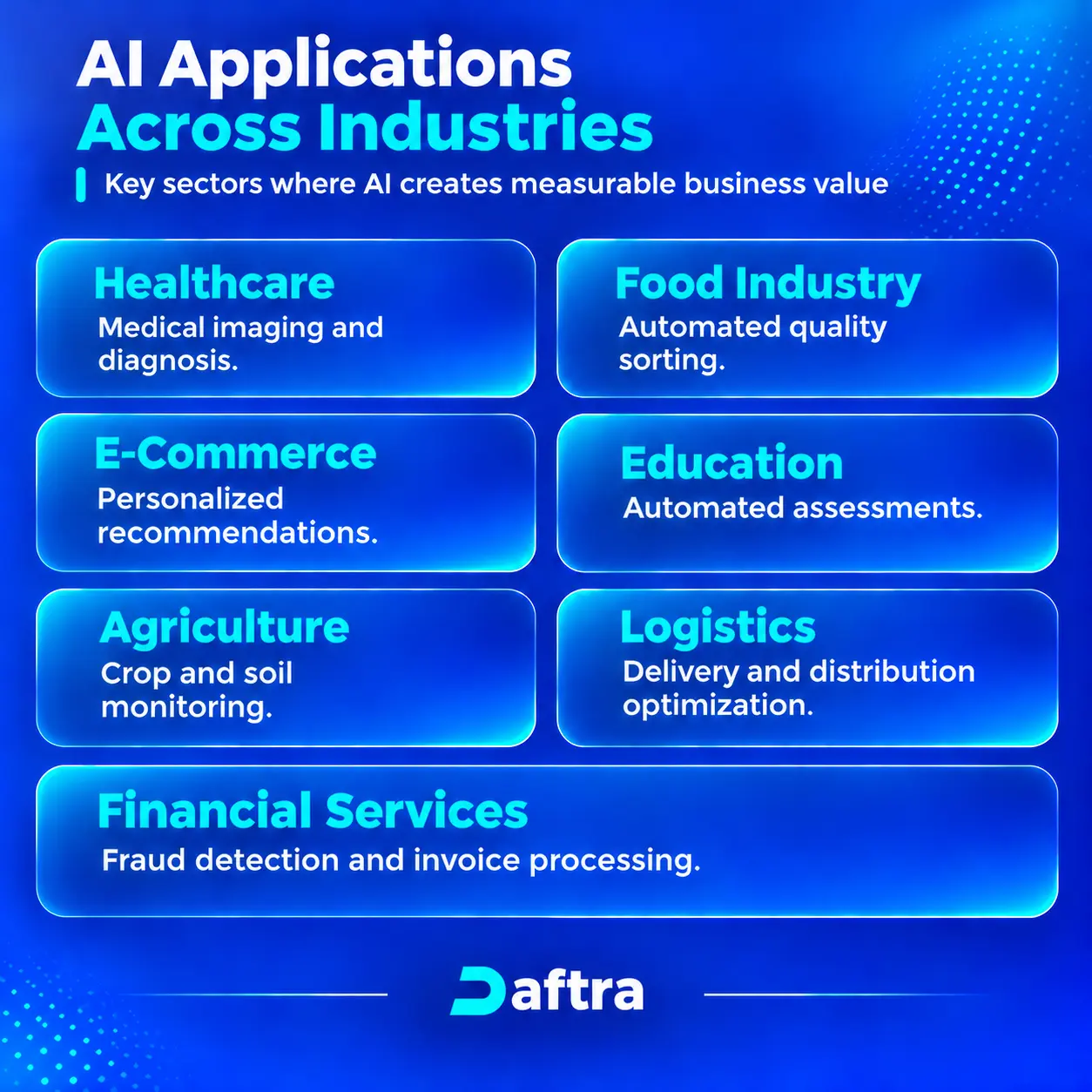
Healthcare
Artificial intelligence can support faster and more accurate diagnosis of certain diseases compared with manual diagnosis by analyzing X-rays, magnetic resonance imaging (MRI), and various medical imaging and scanning technologies. AI also contributes to drug development and can help accelerate clinical trials for new chemical compounds.
Food Industry
AI developments have also reached the industrial food-processing sector. For example, Tomra Systems ASA has developed AI-powered food-sorting equipment targeting markets such as French fries, peeled potatoes, and cut and minced meat. These systems process food by analyzing characteristics such as the size, shape, and color of French fries, or the fat content of meat.
E-Commerce and Digital Marketing
Artificial intelligence can help businesses create engaging content using simple prompts and potentially achieve high levels of engagement. It can also identify the types of messages that are most relevant to target audiences and personalize communication for different groups or even individual customers, a practice known as hyper-personalization.
AI can improve advertising campaigns by analyzing audience behavior and interactions with advertisements. AI algorithms can also recommend how advertising budgets should be allocated across multiple channels based on predicted campaign performance.
Education
Artificial intelligence has contributed to automating many educational tasks and processes, making various activities easier for teachers and students. Machine learning applications in education can also support the rapid updating of curricula to keep pace with the current and future expansion of information and knowledge.
AI can also support teachers and academics in delivering lessons and lectures across different fields of specialization. In addition, it can assist in creating, administering, and grading educational assessments across different educational levels.
Agriculture
The use of artificial intelligence in agriculture has expanded significantly due to its contribution to improving various agricultural processes, including detecting, analyzing, and treating plant diseases; monitoring soil health; increasing productivity by improving the efficiency of agricultural land; and identifying pest attacks and determining the most effective use of pesticides.
Sentient uses artificial intelligence and data to analyze the effects of variables such as ultraviolet radiation, salinity, temperature, and water on plants and flowers. AI systems can help develop new methods for growing optimal crops. More broadly, the agricultural sector has recently witnessed increased adoption of smart tractors and harvesting machines.
Logistics
Artificial intelligence and its various applications are increasingly being adopted across the logistics sector and its diverse operations. AI can significantly reduce the time, effort, and costs associated with logistics processes, improve the storage, distribution, and delivery of goods and services, and ultimately generate analytical, audit, and evaluation reports.
Financial Services and Cloud Accounting
AI-powered solutions can help businesses detect and prevent fraudulent activities by analyzing large volumes of data and identifying patterns that may indicate fraudulent behavior. AI systems can also help financial institutions assess borrowers’ credit risk by analyzing data related to their financial history, credit scores, and other relevant factors. This enables institutions to make more informed lending decisions and reduce the risk of default.
Artificial intelligence can also help businesses streamline invoice processing by extracting data from invoices and automating payment processing. Deep learning and computer vision technologies can effectively read invoice details from various data sources, helping reduce administrative costs and improve payment accuracy.
AI can further enhance automated accounting processes by automatically classifying transactions, reconciling accounts, and generating financial data. Ultimately, these capabilities save time spent on data entry and help reduce errors.
Common Myths About Using Artificial Intelligence in Business
As artificial intelligence has become increasingly prevalent in the business world, several misconceptions have emerged about its capabilities. These include the belief that AI can handle every task, replace all jobs, or operate without errors. The following sections explore some of the most common myths about artificial intelligence in business.
Types of Artificial Intelligence Used Across Businesses and Industries
The types of artificial intelligence used by businesses vary according to their specific needs, problems, and challenges. Some of the most common types and techniques include:
- Machine learning
- Natural language processing (NLP) for information extraction
- Image and video recognition
- Mathematical modeling
- Neural networks
- Artificial general intelligence (AGI)
How Can AI Give Your Business a Competitive Advantage?
Artificial intelligence can give your business a competitive advantage when you use machine learning systems and applications supported by comprehensive, accurate, industry-specific data and configure them to address clearly defined operational needs. Some of the key competitive advantages include:
- Identifying Weaknesses: Identifying areas of weakness and developing improvement plans to increase productivity and operational efficiency.
- Customer Management: Identifying emerging market needs and predicting how customers may respond to new products and services.
- Security and Fraud Prevention: Detecting fraudulent activities and security threats and taking appropriate preventive measures.
- Increasing Revenue: Using AI-powered technologies to provide product recommendations that may encourage additional purchases.
- Integrated Marketing: Developing more targeted, data-driven marketing strategies designed to achieve business objectives.
- Customer Insights: Analyzing customer sentiment to assess how customers respond to a product or service.
- Employee Development: Improving employee performance and creating more advanced work environments through virtual training programs.
- Enhancing the User Experience: Using chatbots to personalize customer experiences, answer inquiries in real time, and recommend relevant areas of interest. According to a survey cited in the original article, AI can increase recommendation rates for services and products by approximately 67%.
- Maintaining Up-to-Date Data: Strengthening a company’s competitive position by keeping business data updated and available when needed.
- Forecasting: Helping businesses prepare for unexpected events by improving communication, optimizing system capabilities, and generating reports that identify data patterns and forecast future trends, supporting stronger performance in competitive markets.
- Responding to Unexpected Events: Using adaptive machine learning algorithms to respond to market shocks. This can be particularly valuable for businesses and investment firms, helping banks and large companies manage their investment portfolios and mitigate potential financial losses and insolvency risks.
Companies That Have Achieved Success Using Artificial Intelligence
01
Artificial intelligence and machine learning have contributed significantly to Google's success, particularly in analyzing and understanding web page content and identifying patterns in user behavior. These capabilities help Google better understand what users are searching for and deliver more relevant search results.
02
Amazon
Amazon uses AI-powered strategies to improve product recommendations, enhance search functionality, and deliver targeted advertising. The company uses AI to process data and predict what individual customers are likely to purchase, then integrates relevant recommendations into their shopping experiences.
Artificial intelligence has helped transform Amazon's online store into a more interactive shopping environment, particularly in terms of customer engagement and overall sales. According to figures cited in the original article, Amazon's AI features can reduce bounce rates by 10–15% and increase customer engagement by more than 40%.
03
Tesla
Tesla's use of artificial intelligence throughout the development and manufacturing of its electric vehicles has contributed to its competitive position in the electric vehicle industry.
Tesla's AI systems and applications collect and analyze data from sensors and cameras installed in its vehicles. These capabilities help the vehicles identify potential road hazards, predict risks, and make real-time decisions to take appropriate action and help avoid accidents.
Why Is Daftra a Suitable Choice for Businesses Adopting AI?
Daftra provides a range of software solutions that help businesses simplify their operations, improve accuracy, and achieve better results. These solutions include employee management, accounting software, customer relationship management (CRM), financial account management, invoicing, asset management, and various other business tools designed to meet companies' operational needs.
Frequently Asked Questions
How Can Businesses Use Artificial Intelligence?
Businesses can use artificial intelligence across many functions, including marketing, human resources management, and the automation of routine tasks that require speed and accuracy. AI can also help improve customer experiences, increase customer satisfaction, analyze data, and support decision-making.
What Are the Applications of Artificial Intelligence in Management?
AI can support management by organizing and validating data, reducing manual errors, and reviewing operational processes to identify inaccuracies. It can also help improve overall management efficiency and support the development of more integrated business systems.
How Can AI Applications Be Used for Teamwork?
AI can support teamwork in several ways:
- Enabling Communication: Providing communication tools that team members can access from different locations and at different times, helping them collaborate more efficiently.
- Distributing Tasks: Allocating tasks appropriately and clarifying each team member's responsibilities to facilitate collaboration.
- Measuring Team Performance: Assessing team performance and identifying strengths and weaknesses that need attention.
- Providing Information: Giving team members access to relevant information so they can work in a more organized and informed way.
- Tracking Tasks: Monitoring task progress and tracking the work of individual team members.
- Encouraging Innovation: Generating ideas, suggesting solutions, and supporting brainstorming sessions to help teams develop projects and solve problems more effectively.
How Can I Use AI to Choose a Company Name?
You can use AI-powered business name generators by providing information about your company or business project, including its industry, products, target audience, and brand identity. The tool can then suggest potential names for you to review and choose from.
Conclusion
Artificial intelligence initially experienced relatively slow adoption across businesses. However, continuous technological advances have accelerated the development and adoption of AI across various industries. Its key benefits include analyzing results, improving productivity and operational efficiency, enhancing the quality of business processes, forecasting future trends, mitigating risks, and supporting better decision-making—all of which can contribute to business success.
Businesses should consider investing in AI systems and training employees to use the available tools and technologies effectively in their daily operations. Doing so can help companies strengthen their competitive advantages, improve operational security, protect against fraud and cyberattacks, and keep pace with the ongoing digital transformation of the business world.










 Invoicing
 POS
 Offers
 Installments
 Sales Commission
 KSA E-Invoice Software
 EGY E-Invoice Software
 JO E-Invoice Software
 E-Invoice Software
 Chart of Accounts
 Asset Management
 Cost Centers
 Expenses
 Cheque Cycle
 UAE VAT-Tax
 Product Management
 Purchases
 Purchase Cycle
 Suppliers
 Requisitions
 Stocktaking
 Organizational Structure
 Personnel Management
 Attendance and Leave
 Contracts
 Payroll
 Requests
 Work Orders
 Booking Management
 Rental and Unit Management
 Time Tracking
 Work Flow
 Lease Contracts
 Manufacturing Management
 Client Follow-Up
 Loyalty Points
 Points and Credits
 Memberships
 Insurance Management
 Daftra ERP Full App
 Point of Sales App
 Point of Sales for Desktop – Support Offline Mode
 AI Expenses Scanner App
 Employee Attendance, Sign & ESS App
 E-invoice Reader App
 Inventory Stocktaking App