




Table of contents:
- Key Summary
- What Does Corporate Tax Exemption Mean in the UAE?
- Which Entities Are Automatically Exempt From UAE Corporate Tax?
- Extractive and Non-Extractive Natural Resource Businesses
- Qualifying Public Benefit Entities
- Pension Funds, Social Security Funds, and Qualifying Investment Funds
- Wholly Owned Subsidiaries of Certain Exempt Persons
- Are Free Zone Businesses Exempt From Corporate Tax?
- Are Small Businesses Exempt From UAE Corporate Tax?
- Exempt Person vs 0% Corporate Tax Rate vs Small Business Relief
- Do Exempt Persons Still Need to Register, File, or Submit an Annual Declaration?
- What Happens if an Exempt Person No Longer Meets the Conditions?
- How to Check Whether Your Business Is Eligible for UAE Corporate Tax Exemption
- How Daftra Helps UAE Businesses Stay Ready for Corporate Tax Exemption and Compliance
- FAQs About UAE Corporate Tax Exemption
- Conclusion
The UAE has long been known for its business-friendly environment, but the introduction of Federal Corporate Tax in June 2023 changed how businesses are taxed. While a 9% tax applies to taxable profits exceeding AED 375,000, the Corporate Tax Law also exempts specific categories of entities based on their legal status and activities.
These exempt persons include government entities, natural resource businesses, qualifying public benefit organizations, pension and social security funds, qualifying investment funds, and certain wholly owned subsidiaries of exempt entities. However, exemption is not automatic in all cases and depends on meeting and maintaining specific conditions.
This guide explains the main categories of exempt entities, the eligibility requirements for each, how to obtain exemption status, and the compliance obligations that may still apply.
What Does Corporate Tax Exemption Mean in the UAE?
Corporate Tax exemption in the UAE means that a Person, whether an individual or a legal entity, is entirely excluded from the scope of Corporate Tax under the Federal Decree-Law No. 47 of 2022 on the Taxation of Corporations and Businesses (the "Corporate Tax Law").
Rather than being taxed at the standard rates of 0% (on income up to AED 375,000) and 9% (on income exceeding AED 375,000), an Exempt Person pays no Corporate Tax at all on their activities and income, provided they continue to meet the conditions required for their exemption.
The rationale for corporate tax exemptions is rooted in strong public-interest and policy considerations. The UAE government recognizes that certain types of entities, such as government bodies, natural resource businesses already taxed at the Emirate level, public benefit entities, and certain investment structures, serve purposes that justify excluding them from the federal tax net.
It is important to understand that exemption from Corporate Tax does not necessarily mean exemption from all compliance obligations. Even Exempt Persons may be required to maintain records, submit annual declarations, or register for Corporate Tax under specific circumstances.
Which Entities Are Automatically Exempt From UAE Corporate Tax?
Under the UAE Corporate Tax regime, certain entities are automatically exempt from Corporate Tax due to their nature and role in the economy. These entities do not need to apply for exemption status, although they must continue to meet the relevant legal conditions.
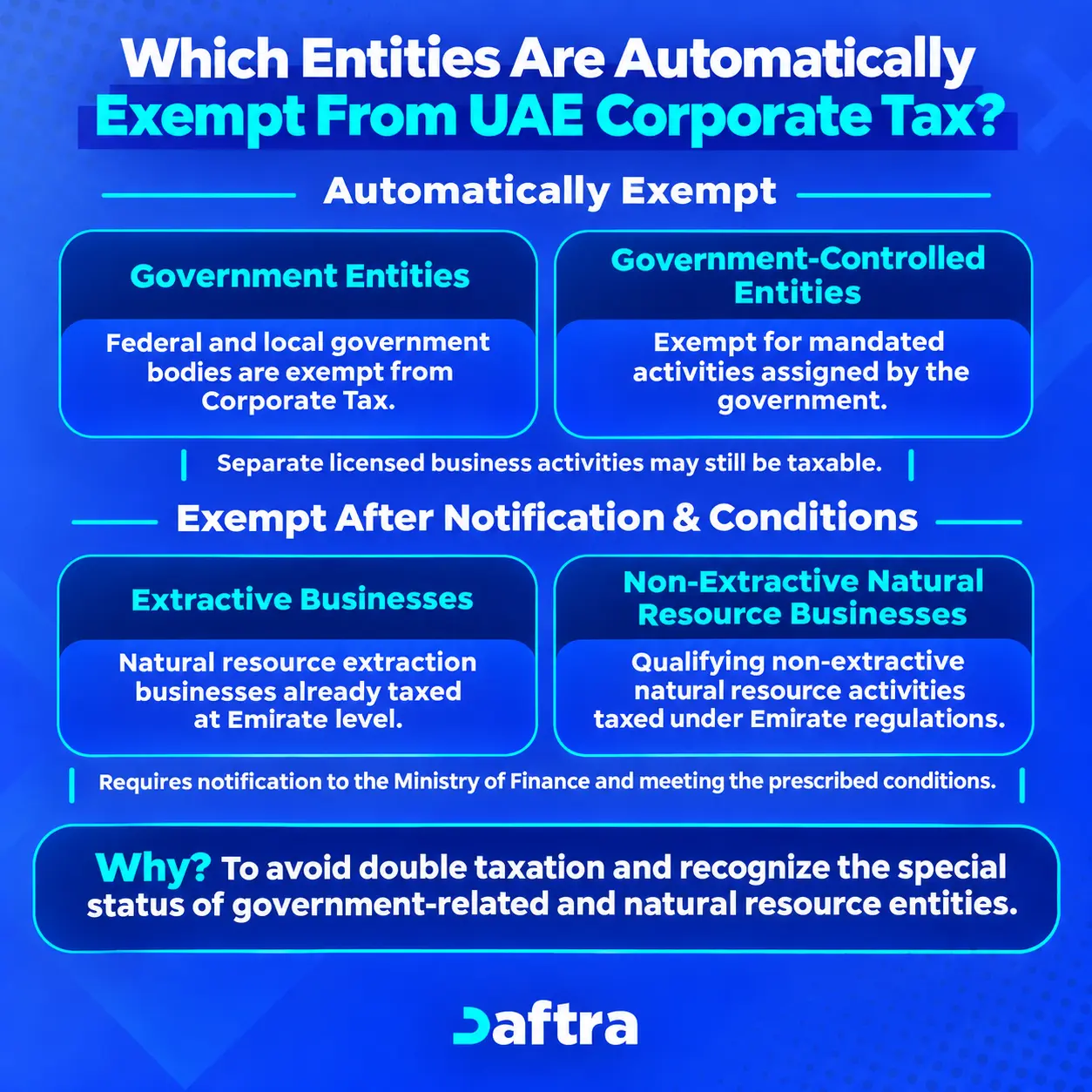
The entities that qualify for automatic exemption include:
- Government Entities: Federal and local government bodies are exempt from Corporate Tax. However, if they conduct a taxable business activity under a separate license, that activity may be subject to Corporate Tax.
- Government-Controlled Entities (for their Mandated Activities): Government-owned entities carrying out activities assigned to them by the government are exempt from Corporate Tax on those mandated activities. Any non-mandated business activities may be taxable.
In addition, the following entities can qualify for exemption once they notify the Ministry of Finance and satisfy the prescribed conditions:
- Extractive Businesses: Companies engaged in the extraction of natural resources that are already subject to Emirate-level taxation.
- Non-Extractive Natural Resource Businesses: Businesses involved in non-extractive natural resource activities that meet the relevant conditions and are taxed under applicable Emirate regulations.
These exemptions reflect the UAE's approach of avoiding double taxation and recognizing the special status of government-related and natural resource entities within the country's tax framework.
Extractive and Non-Extractive Natural Resource Businesses
The UAE Constitution recognizes that each Emirate's natural resources are the public property of that Emirate. Accordingly, persons engaged in the extraction and exploitation of Natural Resources are typically subject to Emirate-level taxation. To avoid double taxation, the Corporate Tax Law provides a federal-level exemption for two categories of natural resource businesses, subject to conditions.
For this purpose, Natural Resources means water, oil, gas, coal, naturally formed minerals, and other non-renewable, non-living natural resources that may be extracted from UAE territory. Renewable resources such as solar energy, wind, animals, and plant materials are not included.
Extractive Businesses
An Extractive Business involves the exploration, extraction, removal, or other production and exploitation of Natural Resources.
Non-Extractive Natural Resource Businesses
A Non-Extractive Natural Resource Business covers the steps that take a Natural Resource product from its raw, extracted form to its final point of sale, including separating, treating, refining, processing, storing, transporting, marketing, or distributing Natural Resources.
For Non-Extractive Natural Resource Businesses, there is an additional condition: the business must not derive income from persons outside the scope of Corporate Tax (such as natural persons who do not undertake a Business or Business Activity). This limits the exemption to businesses that deal exclusively with other businesses rather than end consumers.
Additional compliance note: Where either an Extractive Business or Non-Extractive Natural Resource Business conducts an independent Business that is not ancillary to its ordinary business, and that independent Business accounts for more than 5% of total Revenue, it will be required to register with the FTA for Corporate Tax purposes in relation to that independent Business.
Qualifying Public Benefit Entities
Qualifying Public Benefit Entities (QPBEs) play a critical role in the social and cultural fabric of the UAE. In recognition of this, such entities can be exempt from Corporate Tax, provided they meet certain conditions and are listed in a Cabinet Decision.
Who Qualifies?
To be eligible, a public benefit entity must be established and operated either:
- Exclusively for a public benefit activity, covering purposes such as: religious, charitable, scientific, artistic, cultural, athletic, educational, healthcare, environmental, humanitarian, animal protection, or other similar purposes; or
- As a professional entity, chamber of commerce, or similar entity operated exclusively to promote social welfare or public benefit.
Additional Requirements
In addition to operating for a qualifying purpose, the entity must also:
- Not conduct a Business or Business Activity, except for activities directly related to its charitable or public benefit purpose;
- Use its income and assets solely for the purposes for which it was established, or as payment for necessary and reasonable expenditure; and
- Not use any of its income or assets for the personal benefit of its shareholders, members, trustees, founders, or settlors (unless those persons are themselves Qualifying Public Benefit Entities, Government Entities, or Government Controlled Entities).
How to Obtain QPBE Status
An entity that meets these conditions must apply to the Ministry of Finance for listing in a Cabinet Decision. Cabinet Decision No. 37 of 2023 has been published and lists all currently recognized Qualifying Public Benefit Entities. Exemption takes effect from the beginning of the Tax Period in which the entity is listed.
The FTA may request records and information from a QPBE at any time to verify continued compliance. The list will be updated periodically to add or remove entities as circumstances change.
An important practical implication: donations, grants, or gifts made to an organization that is not a QPBE are not deductible for Corporate Tax purposes. Businesses making charitable donations should therefore verify that the recipient is a recognized QPBE to retain deductibility.
Pension Funds, Social Security Funds, and Qualifying Investment Funds
Certain entities that manage pooled assets or pension savings on behalf of beneficiaries can apply to the FTA for Corporate Tax exemption. This reflects the UAE's commitment to ensuring tax neutrality for investment and retirement structures.
Read Also: Foreign Account Tax Compliance in the UAE
Wholly Owned Subsidiaries of Certain Exempt Persons
The UAE Corporate Tax Law allows certain UAE-incorporated subsidiaries to qualify for Corporate Tax exemption when they are wholly owned and controlled by specific categories of exempt persons and meet the required conditions. This exemption is not automatic and requires approval from the Federal Tax Authority (FTA).
The Ministry of Finance (MoF) includes wholly owned and controlled UAE subsidiaries of certain exempt persons among the entities that may obtain exemption upon application and FTA approval.
Who Can Own an Exempt Subsidiary?
A subsidiary may qualify if it is wholly owned and controlled by an eligible exempt person, including:
- Government Entities
- Government-Controlled Entities
- Qualifying Investment Funds
- Public pension funds and social security funds
- Private pension funds and social security funds that meet the relevant conditions
Conditions for the Exemption
To benefit from the exemption, the subsidiary must be wholly owned and controlled by the exempt person and carry out qualifying activities. These generally include:
- Undertaking part or all of the exempt person's activities
- Holding assets on behalf of the exempt person
- Investing funds for the benefit of the exempt person
- Carrying out activities that are ancillary or supportive to the exempt person's operations
A subsidiary that conducts substantial independent commercial activities outside these purposes may not qualify for the exemption.
Extension to Certain Foreign Entities
A significant update was introduced through Cabinet Decision No. 55 of 2025, which expanded the exemption framework to cover certain foreign entities that are wholly owned and controlled by specified exempt persons.
Under this update, a foreign juridical person may qualify as an exempt person if it satisfies the ownership, control, and activity requirements. Similar to UAE subsidiaries, the foreign entity must generally:
- Undertake part or all of the exempt person's activities
- Hold assets or invest funds for the benefit of the exempt person
- Carry out ancillary or supporting activities related to the exempt person's objectives
This expansion provides greater tax neutrality for exempt organizations that operate through both UAE and overseas holding, investment, or funding structures, while ensuring that the exemption remains limited to entities that primarily support the exempt owner's activities.
Are Free Zone Businesses Exempt From Corporate Tax?
One of the most common misconceptions about the UAE Corporate Tax regime is that all Free Zone businesses are automatically exempt from Corporate Tax. In reality, this is not the case.
Free Zone companies are generally subject to the UAE Corporate Tax regime. The Ministry of Finance has confirmed that juridical persons established, incorporated, or registered in a UAE Free Zone are treated as taxable persons under the Corporate Tax Law and are therefore subject to the relevant compliance requirements.
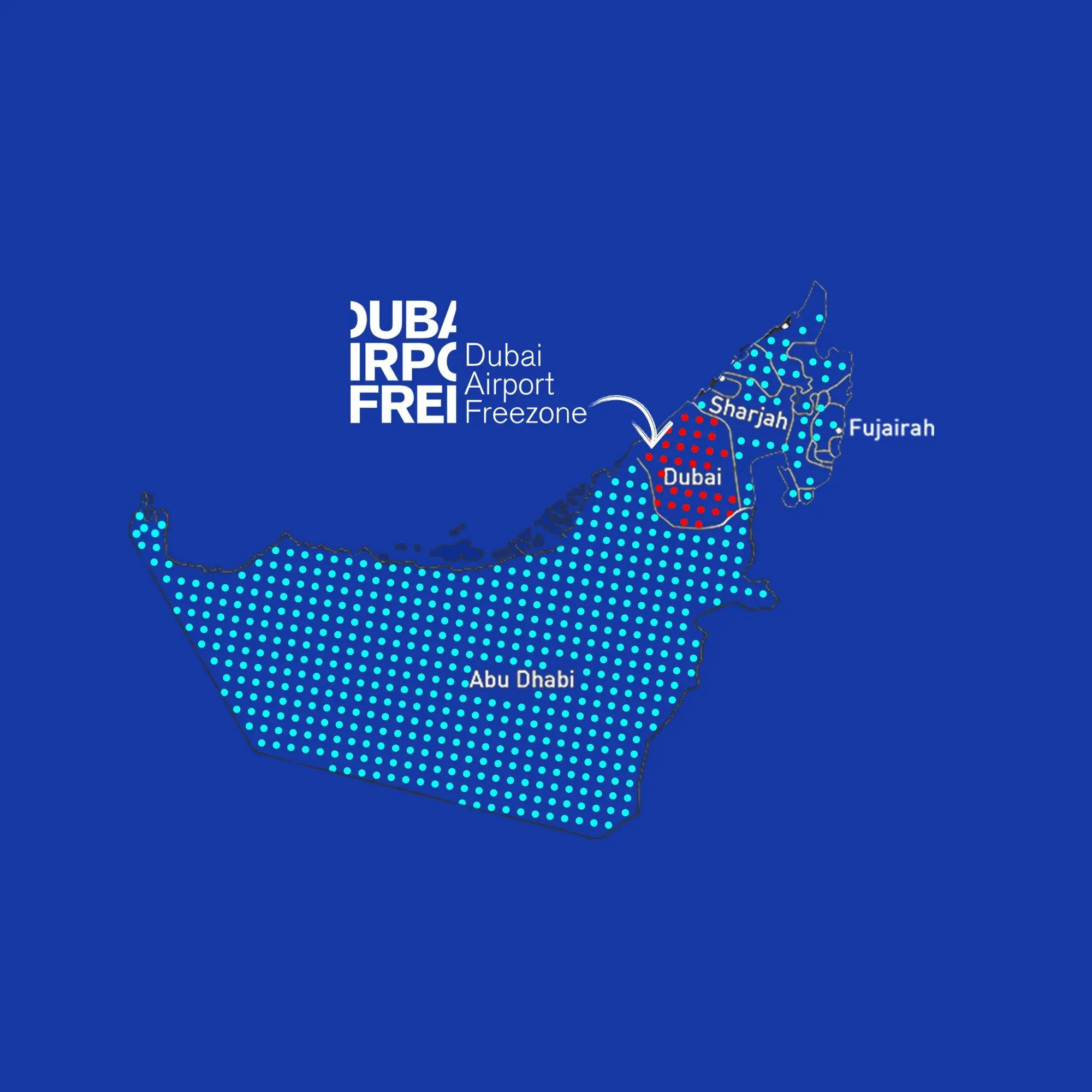
While Free Zone businesses are not exempt persons, some may qualify for a preferential 0% Corporate Tax rate on certain income if they meet the requirements to be treated as a Qualifying Free Zone Person (QFZP).
This distinction is important. An Exempt Person is specifically excluded from Corporate Tax under the Corporate Tax Law, whereas a Qualifying Free Zone Person remains within the tax system but may benefit from a 0% tax rate on qualifying income.
As a result, Free Zone businesses should not assume they are exempt from Corporate Tax simply because they operate in a Free Zone. Their tax treatment depends on whether they meet the requirements of the QFZP regime and continue to comply with the applicable Corporate Tax rules.
Are Small Businesses Exempt From UAE Corporate Tax?
A common misconception is that small businesses are automatically exempt from UAE Corporate Tax. In reality, small businesses do not qualify as Exempt Persons under the Corporate Tax Law solely because of their size or revenue level.
However, some businesses may be eligible for Small Business Relief, which is a tax relief election rather than an exemption. When the conditions are met and the election is made, the business is treated as having no taxable income for the relevant tax period, effectively removing its Corporate Tax liability for that period.
Who Can Benefit From Small Business Relief?
According to the Federal Tax Authority's guidance, Small Business Relief is available to eligible Resident Persons whose revenue does not exceed AED 3 million in the relevant tax period and in all previous tax periods within the applicable relief period.
The relief is not available to:
- Qualifying Free Zone Persons (QFZPs).
- Members of a Multinational Enterprise (MNE) Group that are subject to Country-by-Country Reporting requirements.
Small Business Relief is not automatic and must be elected in the Corporate Tax Return. It is also separate from the UAE's Corporate Tax rates and thresholds. Therefore, when discussing "small business exemptions," "minimum income requirements," or ways to reduce Corporate Tax liability, it is important to distinguish between being an Exempt Person under the law and electing to claim Small Business Relief when eligible.
Exempt Person vs 0% Corporate Tax Rate vs Small Business Relief
These concepts are frequently grouped together under the label of “tax exemptions,” but they operate very differently under the UAE Corporate Tax regime.
Understanding the distinction is important because being an Exempt Person, benefiting from a 0% tax rate, claiming Small Business Relief, or earning Exempt Income can produce similar tax outcomes while relying on completely different legal rules.
| Feature | Exempt Person | 0% Rate (Free Zone) | Small Business Relief |
| Who qualifies | Government Entities, QPBEs, pension funds, investment funds, natural resource businesses, wholly owned subsidiaries of certain Exempt Persons | Free Zone Persons meeting QFZP conditions | Resident Taxable Persons with Revenue ≤ AED 3,000,000 |
| Tax outcome | No Corporate Tax at all | 0% on Qualifying Income; 9% on non-Qualifying Income | Treated as having no Taxable Income |
| Registration required? | Not always (Government Entities and some others are exempt from registration) | Yes, must register | Yes, must register |
| Tax Return required? | Generally no (but annual declaration may be required) | Yes | Yes (simplified) |
| Record-keeping | Must maintain records evidencing exempt status for 7 years | Must maintain audited Financial Statements | Simplified — no full Taxable Income calculation required |
| How obtained | Automatic, by notification, by Cabinet Decision listing, or by FTA application — depending on category | Conditions-based; automatic if all QFZP requirements are met | By election in Tax Return |
| Can join a Tax Group? | No | No (unless election made to be taxed at general rates) | Yes (subject to conditions) |
In summary: Exempt Persons sit entirely outside the Corporate Tax regime; Qualifying Free Zone Persons are within the regime but enjoy a 0% rate on eligible income; and Small Business Relief beneficiaries are technically Taxable Persons who elect to be treated as having nil income for a Tax Period.
Do Exempt Persons Still Need to Register, File, or Submit an Annual Declaration?
A common misconception is that once an entity qualifies as an Exempt Person, it has no further Corporate Tax obligations. In practice, the compliance requirements depend on the type of exempt person and the activities it carries out.
While some exempt categories may be relieved of registration, filing, and other Corporate Tax obligations, others may still need to apply for exempt status, maintain supporting records, or submit periodic declarations to show they continue to meet the relevant conditions.
1- Government Entities and Certain Government-Related Bodies
Government Entities, specified Government-Controlled Entities, Extractive Businesses, and Non-Extractive Natural Resource Businesses may generally be exempt from Corporate Tax registration, filing requirements, and certain other compliance obligations.
However, this treatment applies only to their exempt activities. If they engage in an activity that falls within the charge of Corporate Tax, such as a taxable business activity conducted under a commercial license, they may become subject to the normal Corporate Tax compliance requirements for that activity.
2- Exempt Persons That Require Approval or Ongoing Monitoring
Some categories of Exempt Persons, such as Qualifying Investment Funds, Qualifying Public Benefit Entities, and certain wholly owned subsidiaries of exempt persons, may need to apply for exemption, obtain approval, or provide information to the Federal Tax Authority (FTA) to demonstrate continued eligibility.
These entities should also maintain sufficient records and documentation supporting their exempt status and compliance with the relevant conditions.
3- Foreign Partnerships and Annual Declarations
In certain cases, compliance may take the form of an annual declaration rather than a full Corporate Tax Return. For example, foreign partnerships seeking specific tax treatment may be required to periodically confirm that they continue to satisfy the applicable conditions.
Regardless of category, exempt persons should maintain records, accounts, and supporting documentation that allow the FTA to verify their exempt status. These records should clearly demonstrate that the entity continues to meet the requirements of the exemption on which it relies.
There is no single compliance rule that applies to all Exempt Persons. Some categories may be exempt from registration and tax return filing altogether unless they conduct a taxable business, while others may need to register, apply for approval, submit declarations, or maintain ongoing documentation. Exempt status reduces or removes Corporate Tax liability, but it does not necessarily eliminate all compliance responsibilities.
What Happens if an Exempt Person No Longer Meets the Conditions?
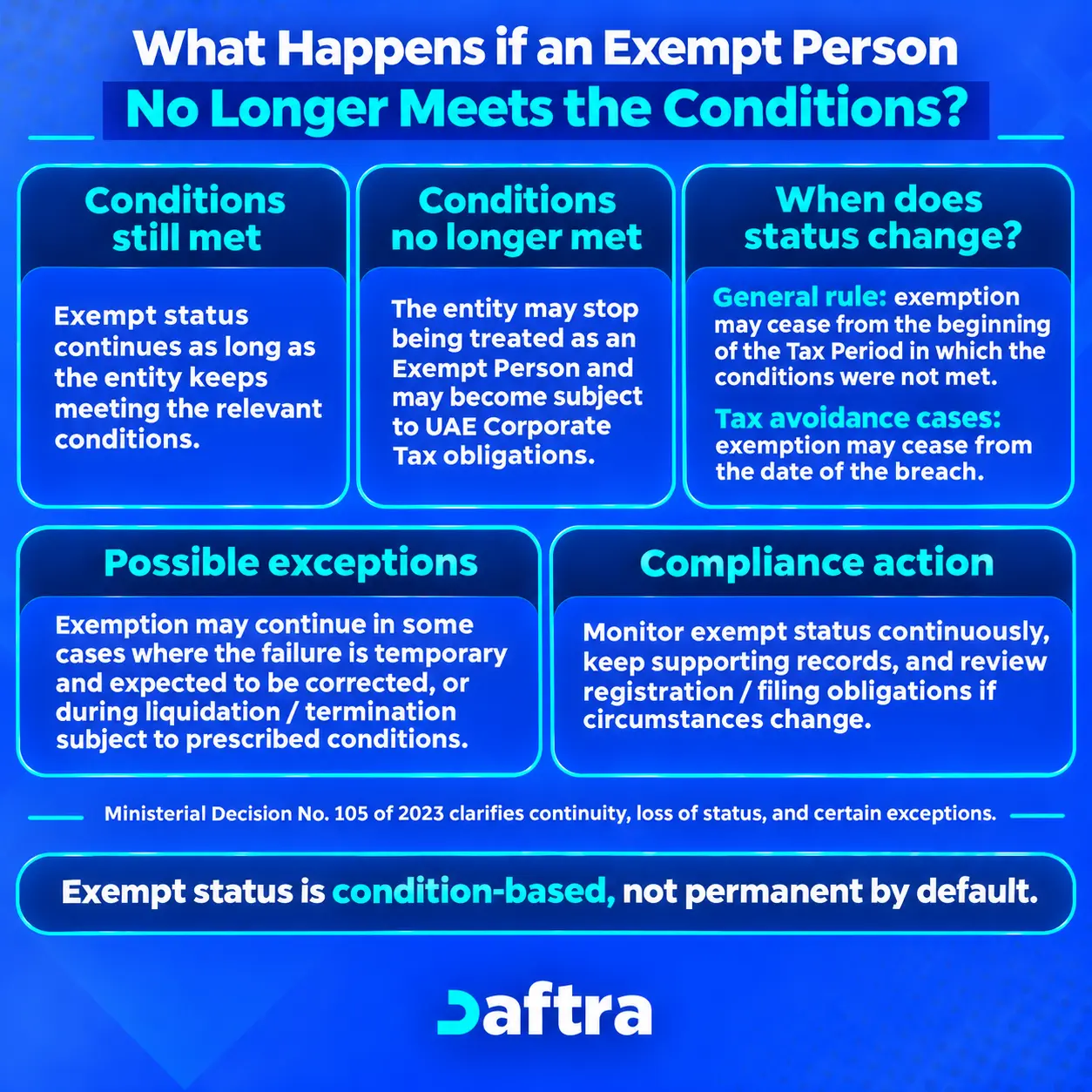
Exempt status under the UAE Corporate Tax regime is not permanent by default. It depends on the entity continuing to meet the specific conditions applicable to its exemption category. If those conditions are no longer satisfied, the entity may cease to be treated as an Exempt Person and could become subject to UAE Corporate Tax obligations, depending on the nature of the exemption and the timing of the change.
The Ministry of Finance issued Ministerial Decision No. 105 of 2023 to further clarify the circumstances under which a person may continue to qualify as an Exempt Person or cease to be treated as one. This includes situations such as liquidation or termination, as well as temporary or rectifiable failures to meet conditions.
Continuity of Exemption (Condition-Based Treatment)
Exemption is generally maintained only where the entity continues to satisfy all relevant conditions under the UAE Corporate Tax Law and applicable ministerial decisions. These conditions may differ depending on the type of exempt entity (for example, public benefit entities, pension funds, or other qualifying exempt categories). If compliance with those conditions is maintained, the exemption continues without interruption.
Risk of Losing Exempt Status
If an entity stops meeting one or more of the required conditions, it may cease to be treated as an Exempt Person. The effective timing of this change depends on the circumstances, including:
- The general rule, where exemption may cease from the beginning of the Tax Period in which the conditions were not met
- Cases involving tax avoidance, where exemption may cease from the date the conditions were breached
In both cases, the outcome depends on the specific exemption category and the nature of the non-compliance, rather than a blanket rule.
Continuity Considerations and Exceptions
Ministerial Decision No. 105 of 2023 also recognizes that not all failures should immediately result in loss of exempt status. In certain cases, exemption may continue where:
- The failure is temporary and expected to be corrected within a reasonable timeframe, or
- The failure arises in the context of liquidation or termination procedures, subject to prescribed conditions
These provisions ensure that short-term or transitional issues do not automatically disrupt exempt treatment where the underlying qualifying status remains valid.
Key Risk and Compliance Perspective
The key consideration is that exempt status is continuously assessed based on ongoing compliance with the relevant conditions. Entities must therefore monitor their status carefully, as any change in circumstances may affect their classification under the UAE Corporate Tax framework and, consequently, their tax obligations under the UAE Corporate Tax Law.
How to Check Whether Your Business Is Eligible for UAE Corporate Tax Exemption
Determining whether your business qualifies for UAE Corporate Tax exemption requires more than identifying your industry or ownership structure. Exemption is only available to specific categories of entities that meet the conditions prescribed under the Corporate Tax Law and any applicable ministerial or Cabinet decisions. In some cases, additional approvals, notifications, or ongoing compliance requirements may also apply.
Use the following checklist to assess whether your business may qualify:
Corporate Tax exemption is not based on self-classification. Businesses should carefully verify that they fall within an official exempt category, understand how to obtain exemption for that category, confirm their activities remain within the qualifying scope, and ensure all registration, reporting, and record-keeping requirements are met.
Since the conditions can vary significantly between exemption types, a thorough eligibility review is essential before treating a business as exempt from UAE Corporate Tax.
How Daftra Helps UAE Businesses Stay Ready for Corporate Tax Exemption and Compliance
Whether your business is fully exempt, benefits from the Free Zone 0% rate, qualifies for Small Business Relief, or is a fully taxable entity, maintaining accurate, well-organized financial records is the foundation of Corporate Tax compliance in the UAE.
Daftra accounting software is a comprehensive cloud-based accounting and business management platform designed for UAE businesses. Here is how Daftra supports your Corporate Tax readiness:
1- Accurate Financial Record-Keeping
The Corporate Tax Law requires all Taxable Persons — and most Exempt Persons — to maintain financial records for seven years. Daftra's accounting module automatically records transactions, tracks income and expenses, and generates financial statements compliant with IFRS standards, which are required for UAE Corporate Tax purposes.
2- Revenue Tracking for Threshold Monitoring
For businesses seeking to qualify for Small Business Relief (Revenue ≤ AED 3,000,000) or assessing the de minimis threshold for Free Zone status (non-qualifying Revenue ≤ AED 5,000,000 or 5% of total Revenue), Daftra's real-time revenue dashboards make it easy to monitor your position throughout the year.
3- Invoicing and Transaction Documentation
A cornerstone of Corporate Tax compliance is having complete, auditable records of all transactions. Daftra's invoicing system produces professional, VAT-compliant invoices and maintains a full audit trail, ensuring that your records support any Tax Return or FTA query.
4- Categorization of Income Types
For Free Zone businesses, distinguishing between Qualifying Income and non-qualifying Revenue from Excluded Activities is critical. Daftra's flexible chart of accounts and income categorization features allow businesses to accurately tag and track different income streams.
5- Support for Multiple Entities
Businesses with related entities, such as parent companies, subsidiaries, or group structures, can manage multiple entities within Daftra, supporting the consolidated record-keeping required for Tax Groups and related-party transaction reporting.
6- Audit-Ready Financial Statements
Qualifying Free Zone Persons and businesses with Revenue exceeding AED 50,000,000 are required to maintain audited Financial Statements. Daftra produces IFRS-compliant financial statements that can be provided directly to external auditors, simplifying the audit process.
7- Staying Current With Regulatory Changes
The UAE Corporate Tax framework continues to evolve, with new Cabinet Decisions and Ministerial Decisions issued regularly. Daftra's platform is updated to reflect regulatory changes, helping your business stay compliant without manually tracking every legislative development.
By using Daftra as your financial management backbone, your UAE business can approach Corporate Tax with confidence — whether you are filing a full Tax Return, submitting an annual declaration as an Exempt Person, or simply maintaining the records needed to demonstrate your exempt or relief-eligible status to the FTA.
Read Also: UAE New Tax Rules 2026
FAQs About UAE Corporate Tax Exemption
Who is exempted from UAE corporate tax?
The UAE Corporate Tax Law exempts specific categories of entities that meet the prescribed conditions. These include Government Entities, certain Government-Controlled Entities, Extractive Businesses, Non-Extractive Natural Resource Businesses, Qualifying Public Benefit Entities, qualifying pension and social security funds, Qualifying Investment Funds, and certain wholly owned subsidiaries of eligible Exempt Persons.
Depending on the category, exemption may be automatic, notification-based, listing-based, or subject to approval by the Federal Tax Authority (FTA).
Which companies are exempted from Corporate Tax?
Companies may qualify for exemption if they fall within an officially recognized exempt category under the Corporate Tax Law and satisfy the applicable conditions.
Examples include natural resource businesses subject to Emirate-level taxation, Qualifying Public Benefit Entities listed in a Cabinet Decision, Qualifying Investment Funds, and certain wholly owned subsidiaries of eligible Exempt Persons.
Eligibility depends on the company's activities, ownership structure, and compliance with the relevant requirements.
What is the corporate tax participation exemption in the UAE?
The participation exemption is different from Exempt Person status. While an Exempt Person is generally outside the scope of Corporate Tax, the participation exemption is a separate provision that may exempt certain qualifying income, such as dividends or gains from qualifying shareholdings.
It applies to specific types of income rather than exempting the entity itself from the Corporate Tax regime.
Is a Free Zone exempted from corporate tax in the UAE?
No. Free Zone companies are not automatically exempt from UAE Corporate Tax. Free Zone entities are generally treated as Taxable Persons under the Corporate Tax Law.
However, eligible businesses may benefit from a 0% Corporate Tax rate on qualifying income if they meet the requirements to be treated as a Qualifying Free Zone Person (QFZP). This is different from being an Exempt Person.
What income is exempt from corporation tax?
Certain categories of income may be exempt from Corporate Tax under the law, even where the recipient is not an Exempt Person. This is separate from entity-level exemptions. Businesses should distinguish between exempt income provisions and Exempt Person status, as each operates under different legal rules and conditions.
What's the difference between a tax deduction and exemption?
A tax exemption removes an entity or specific income from the scope of tax, meaning no Corporate Tax is payable on the exempt amount. A tax deduction, on the other hand, reduces the amount of taxable income that is subject to tax. In simple terms, an exemption excludes income or entities from taxation, while a deduction reduces the tax base used to calculate the tax liability.
Conclusion
Corporate Tax exemption in the UAE is designed to support entities that serve public, governmental, social, investment, or natural resource-related purposes. However, exemption is not a one-size-fits-all benefit. Each category has its own eligibility criteria, approval process, and ongoing compliance requirements.
Businesses should carefully assess whether they fall within an officially recognized exempt category, understand how to obtain and maintain exemption, and distinguish exemption from other tax benefits such as Small Business Relief, exempt income, or the 0% rate available to qualifying Free Zone Persons.
Because exempt status depends on continued compliance with the relevant conditions, organizations should regularly review their activities, governance structure, and reporting obligations to ensure they remain eligible. Maintaining accurate financial records and supporting documentation can help businesses demonstrate compliance and confidently manage their UAE Corporate Tax responsibilities.









 Invoicing
 POS
 Offers
 Installments
 Sales Commission
 KSA E-Invoice Software
 EGY E-Invoice Software
 JO E-Invoice Software
 E-Invoice Software
 Chart of Accounts
 Asset Management
 Cost Centers
 Expenses
 Cheque Cycle
 VAT & Tax Compliance
 Product Management
 Purchases
 Purchase Cycle
 Suppliers
 Requisitions
 Stocktaking
 Organizational Structure
 Personnel Management
 Attendance and Leave
 Contracts
 Payroll
 Requests
 Work Orders
 Booking Management
 Rental and Unit Management
 Time Tracking
 Work Flow
 Lease Contracts
 Manufacturing Management
 Client Follow-Up
 Loyalty Points
 Points and Credits
 Memberships
 Insurance Management
 Daftra ERP Full App
 Point of Sales App
 Point of Sales for Desktop – Support Offline Mode
 AI Expenses Scanner App
 Employee Attendance, Sign & ESS App
 E-invoice Reader App
 Inventory Stocktaking App