



Table of contents:
- Key Summary
- What Is the UAE Corporate Tax Registration Penalty Waiver?
- Who Can Benefit From the Late Registration Penalty Waiver?
- What Is the Main Condition for Getting the Penalty Waiver?
- How Does the 7-Month Rule Work?
- What Happens if the AED 10,000 Penalty Was Already Paid?
- Do You Need to Submit a Separate Waiver Request?
- Does the Waiver Change the Normal Corporate Tax Filing or Payment Deadline?
- How to Check Eligibility for the Corporate Tax Late Registration Penalty Waiver
- How to Benefit From the Penalty Waiver Through EmaraTax
- What If You Submitted a Reconsideration Request for the Penalty?
- Examples of When the Penalty Waiver Applies and When It Does Not
- Common Mistakes Businesses Make With the UAE Corporate Tax Penalty Waiver
- How Daftra Helps Businesses Avoid Corporate Tax Registration and Filing Penalties
- FAQs About UAE Corporate Tax Registration Penalty Waiver
- Conclusion
To encourage Corporate Tax compliance, the UAE introduced a penalty waiver initiative that allows eligible businesses and certain exempt persons to avoid or recover the AED 10,000 late Corporate Tax registration penalty. The relief is available to taxpayers who meet specific conditions, most notably submitting their first Corporate Tax return or annual declaration within the required 7-month period.
This guide explains who qualifies for the waiver, how the eligibility rules work, what happens if the penalty has already been paid, and the practical steps businesses can take to benefit from the initiative while staying compliant with UAE Corporate Tax requirements.
What Is the UAE Corporate Tax Registration Penalty Waiver?
The UAE Corporate Tax Registration Penalty Waiver is an initiative introduced by the Federal Tax Authority (FTA) that allows eligible businesses and certain exempt persons to have the AED 10,000 late corporate tax registration penalty waived.
Under the UAE Corporate Tax rules, persons required to register for Corporate Tax may be subject to an administrative penalty of AED 10,000 if they fail to submit their corporate tax registration application within the timeline specified by the FTA. To encourage timely compliance, the FTA launched a special initiative that provides relief from this specific penalty where certain conditions are met.
In practical terms, the waiver applies only to the administrative penalty imposed for late Corporate Tax registration. It is not a general tax amnesty, does not apply to all Corporate Tax penalties, and does not remove a business's obligation to register, file Corporate Tax returns, or pay any Corporate Tax due.
To benefit from the initiative, the taxable person must generally submit its first Corporate Tax return within seven months from the end of its first tax period. Where the eligibility requirements are satisfied, the FTA may waive the AED 10,000 late registration penalty or refund it if it has already been paid.
Who Can Benefit From the Late Registration Penalty Waiver?
The UAE Corporate Tax late registration penalty waiver is intended for persons who are required to register for Corporate Tax and either:
✓ Have already incurred the AED 10,000 late registration penalty because they submitted their Corporate Tax registration application after the required deadline; or
✓ Have not yet submitted their Corporate Tax registration application and may otherwise become subject to the penalty.
According to the FTA clarification, the initiative can apply to various categories of persons required to register for Corporate Tax, including:
✓ Taxable persons required to file a Corporate Tax return.
✓ Natural persons carrying on a business or business activity that is subject to Corporate Tax.
✓ Juridical persons such as companies and other legal entities required to register.
✓ Persons that register individually and later form or join a Tax Group.
✓ Qualifying Public Benefit Entities that are required to register and submit the relevant declarations.
✓ Certain exempt persons that initially register as taxable persons and later obtain approval for exemption.
✓ Other eligible exempt categories that are required to register and submit annual declarations under the Corporate Tax rules.
The waiver is therefore not limited to companies alone. Depending on the circumstances, it may apply to natural persons, juridical persons, tax group members, qualifying public benefit entities, and certain exempt persons that have Corporate Tax registration obligations.
Eligibility for the waiver ultimately depends on meeting the conditions set by the FTA, including the timely submission of the first Corporate Tax return or annual declaration, as applicable.
What Is the Main Condition for Getting the Penalty Waiver?
The main condition for benefiting from the UAE Corporate Tax late registration penalty waiver is submitting the first Corporate Tax return early.
Under the standard Corporate Tax rules, a taxable person is generally required to submit its Corporate Tax return within nine months from the end of the relevant tax period. However, to qualify for the late registration penalty waiver, the FTA requires the first Corporate Tax return to be submitted earlier, within seven months from the end of the first tax period.
For certain exempt persons who are required to register and submit an annual declaration, the same principle applies. The annual declaration must be submitted within seven months from the end of the first financial year to qualify for the waiver.
It is important to distinguish between the normal filing deadline and the waiver requirement:
- Normal Corporate Tax filing deadline: Generally within 9 months from the end of the tax period.
- Penalty waiver condition: The first Corporate Tax return (or annual declaration, where applicable) must be submitted within 7 months from the end of the first tax period or first financial year.
- Purpose of the 7-month rule: It is a special condition for obtaining the late registration penalty waiver and does not replace the normal 9-month filing deadline under the Corporate Tax Law.
In other words, submitting the registration application alone is not enough to qualify for the waiver. The taxpayer must also file the first Corporate Tax return, or annual declaration where applicable, within the required seven-month period.
Example:
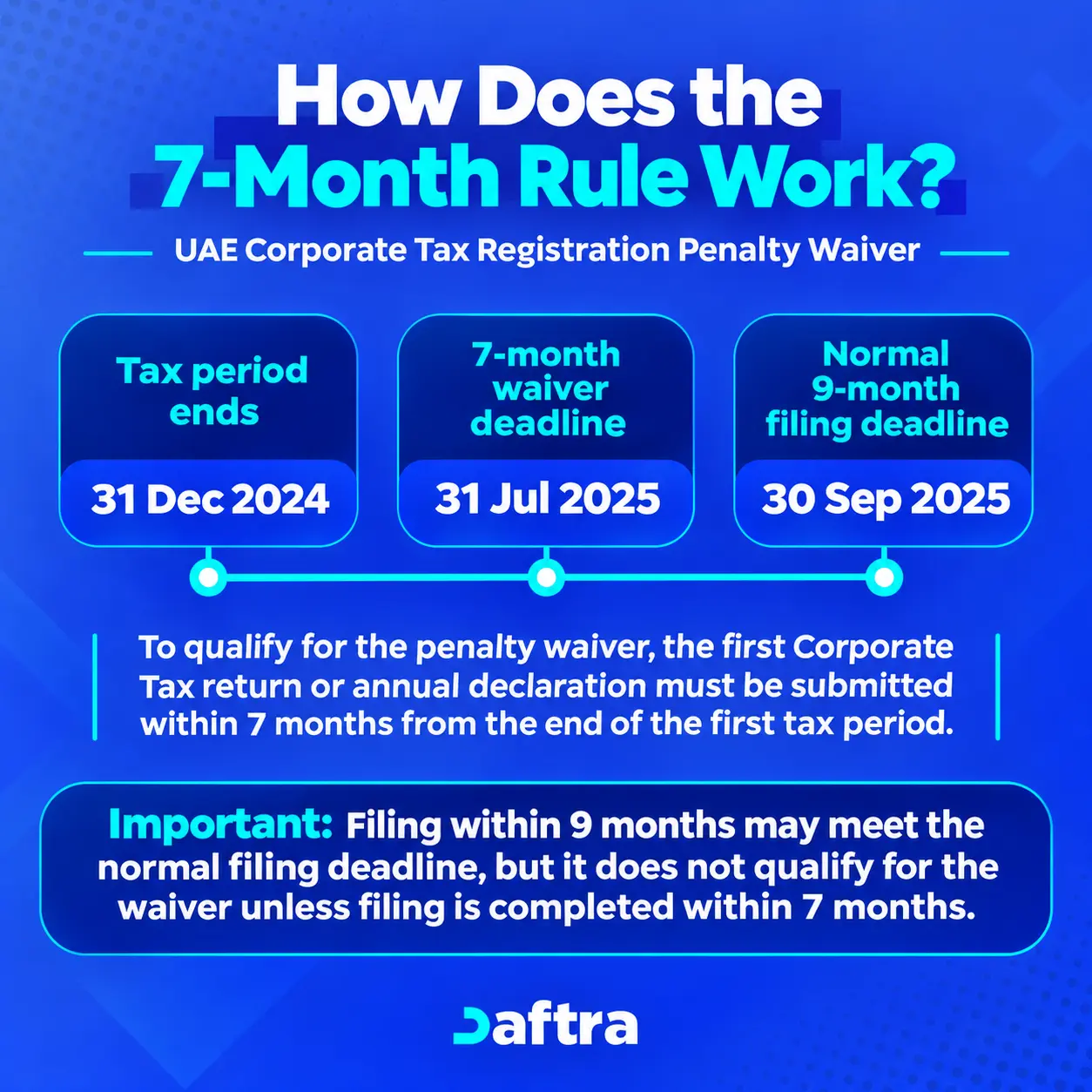
Assume a company's first tax period ends on 31 December 2024.
- The normal Corporate Tax return deadline would generally be 30 September 2025 (9 months after the period end).
- To qualify for the late registration penalty waiver, the company must submit its first Corporate Tax return by 31 July 2025 (7 months after the period end).
If the return is filed on or before 31 July 2025, the business may qualify for the waiver. If it is filed after that date, even if still submitted before 30 September 2025, the business would generally not meet the waiver condition.
This makes the seven-month filing requirement the key eligibility test for obtaining relief from the AED 10,000 late Corporate Tax registration penalty.
How Does the 7-Month Rule Work?
The 7-month rule is the key requirement for benefiting from the UAE Corporate Tax late registration penalty waiver. It requires eligible persons to submit their first Corporate Tax return earlier than the normal filing deadline.
To understand how it works, it is important to distinguish between:
- The normal Corporate Tax return deadline, which is generally 9 months from the end of the tax period.
- The penalty waiver deadline, which is 7 months from the end of the first tax period.
The 7-month deadline does not replace the normal filing deadline. It is simply an additional condition that must be met to qualify for the waiver of the AED 10,000 late registration penalty.
Example
Assume a business has its first tax period ending on 31 December 2024.
- The normal Corporate Tax return deadline would generally be 30 September 2025 (9 months after the end of the tax period).
- To qualify for the late registration penalty waiver, the business must submit its first Corporate Tax return by 31 July 2025 (7 months after the end of the tax period).
If the return is submitted on 15 July 2025:
- The return is filed within the 7-month waiver period.
- The business may qualify for the late registration penalty waiver, subject to meeting the other applicable requirements.
If the return is submitted on 15 August 2025:
- The return is still filed before the normal 9-month deadline.
- The business would generally avoid any penalty for late filing of the tax return.
- However, because the return was not submitted within 7 months, the business would not qualify for the late registration penalty waiver.
What Happens if the AED 10,000 Penalty Was Already Paid?
Paying the AED 10,000 late Corporate Tax registration penalty does not automatically prevent a person from benefiting from the waiver initiative.
The FTA has clarified that persons within the scope of the initiative may still qualify for the waiver even if they have already settled the late registration penalty, provided they meet the required eligibility conditions, including the timely submission of the first Corporate Tax return or annual declaration, where applicable.
How Does the Refund Work?
If an eligible person has already paid the AED 10,000 late registration penalty and subsequently qualifies for the waiver, the FTA does not automatically issue a cash refund. Instead, the amount is automatically credited to the person's Corporate Tax account on EmaraTax.
This means the AED 10,000 is added back to the person's tax account as a credit balance.
What Can Be Done With the Credit?
Once the amount has been credited to the EmaraTax account, the person can:
- Leave the credit in the account and use it to settle future Corporate Tax payable; or
- Submit a refund request through EmaraTax to recover the amount.
This approach ensures that eligible persons who have already paid the late registration penalty can still benefit from the initiative without paying the same amount twice.
The penalty waiver can apply whether the AED 10,000 late registration penalty remains unpaid or has already been paid. Where the penalty has been settled, the FTA's mechanism is to automatically credit the amount to the person's EmaraTax Corporate Tax account, after which the credit can either be used against future Corporate Tax liabilities or refunded through EmaraTax upon request.
Do You Need to Submit a Separate Waiver Request?
In most cases, no separate waiver request is required under this specific UAE Corporate Tax late registration penalty initiative.
The FTA has clarified that eligible persons who meet the required conditions—most importantly, submitting their first Corporate Tax return or annual declaration within the applicable 7-month period—can benefit from the waiver automatically. There is no need to submit a separate Reconsideration Request or Penalty Waiver Request for the AED 10,000 late Corporate Tax registration penalty covered by this initiative.
Once the eligibility conditions are satisfied, the FTA applies the waiver automatically. If the penalty has not yet been paid, it is removed from the person's Corporate Tax account. If the penalty has already been paid, the AED 10,000 amount is automatically credited to the person's EmaraTax Corporate Tax account.
However, this automatic treatment applies specifically to the late Corporate Tax registration penalty covered by the FTA's waiver initiative. Other administrative penalties may be subject to different procedures. In cases involving other types of penalties, taxpayers may still need to use the FTA's general administrative penalty services through EmaraTax, which include requests for penalty waivers, installment plans, or penalty refunds.
Does the Waiver Change the Normal Corporate Tax Filing or Payment Deadline?
No, the UAE Corporate Tax late registration penalty waiver does not change the normal deadlines for filing Corporate Tax returns or paying Corporate Tax.
The FTA has clarified that the initiative only provides relief from the AED 10,000 late registration penalty for eligible persons. It does not affect when Corporate Tax payable must be settled, and it does not change the standard filing obligations under the Corporate Tax regime.
To avoid confusion, businesses should distinguish between the normal Corporate Tax deadlines and the special waiver condition:
- Normal Corporate Tax return deadline: Generally within 9 months from the end of the relevant tax period.
- Normal Corporate Tax payment deadline: Generally within 9 months from the end of the relevant tax period.
- Penalty waiver condition: The first Corporate Tax return (or annual declaration, where applicable) must be submitted within 7 months from the end of the first tax period or first financial year.
The 7-month requirement exists solely as a condition for obtaining the late registration penalty waiver. It does not replace or amend the statutory 9-month filing and payment deadlines.
A business may file its first Corporate Tax return after the 7-month waiver deadline but before the normal 9-month filing deadline. In that case, it may still comply with the standard return filing requirements and avoid a late filing penalty. However, it would generally not qualify for the AED 10,000 late registration penalty waiver because the special 7-month condition was not met.
The FTA also reminds taxable persons and exempt persons who are required to register that Corporate Tax returns or annual declarations must generally be submitted within the applicable 9-month deadline. Failure to file on time or pay Corporate Tax when due may result in separate administrative penalties that are not covered by this late registration penalty waiver initiative.
The waiver does not extend filing deadlines, change payment deadlines, or remove the obligation to pay Corporate Tax. The normal filing and payment deadlines generally remain 9 months from the end of the relevant tax period, while the 7-month deadline is a separate requirement that applies only to qualifying for the late registration penalty waiver.
How to Check Eligibility for the Corporate Tax Late Registration Penalty Waiver
Eligibility for the UAE Corporate Tax late registration penalty waiver depends on several factors, including the business's establishment date, financial year, first tax period, registration status, and whether the first Corporate Tax return or annual declaration can be submitted within the required 7-month waiver period.
To help taxpayers determine whether they may qualify, the FTA provides an online Corporate Tax Late Registration Penalty Waiver – Eligibility Check tool. The checker asks for information such as the date of establishment and the financial year to help assess eligibility under the initiative.
Before relying on the waiver, review the following points:
There is no single eligibility date that applies to all businesses. Because establishment dates, financial years, and first tax periods can differ, businesses should carefully assess their own circumstances. Reviewing the above checklist and using the FTA's Corporate Tax Late Registration Penalty Waiver Eligibility Check tool can help determine whether the conditions for the waiver are likely to be met.
How to Benefit From the Penalty Waiver Through EmaraTax
EmaraTax is the platform the FTA uses for Corporate Tax registration, return filing, tax payments, and the administration of Corporate Tax accounts. Businesses that wish to benefit from the late registration penalty waiver should use EmaraTax to complete the required compliance steps and monitor the status of their Corporate Tax account abyfollowing these steps:
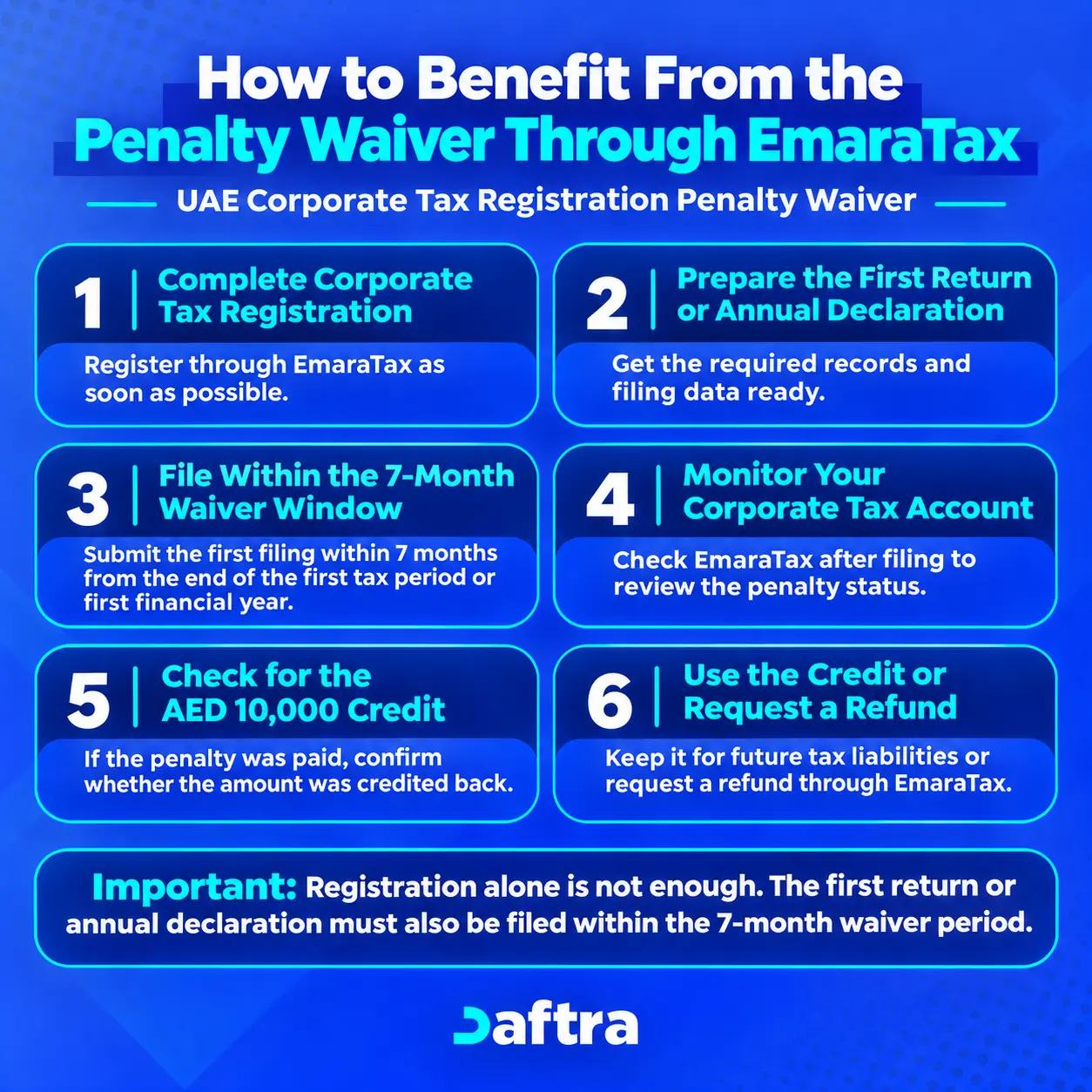
1. Complete Corporate Tax Registration
If Corporate Tax registration has not yet been completed, submit the registration application through EmaraTax. Registration remains a mandatory requirement and should be completed as soon as possible.
2. Prepare the First Corporate Tax Return or Annual Declaration
Determine whether your business is required to submit a Corporate Tax return or, in the case of certain exempt persons, an annual declaration. Ensure that the necessary financial records and supporting information are ready before the filing deadline.
3. Submit the Filing Within the 7-Month Waiver Window
To qualify for the late registration penalty waiver, the first Corporate Tax return or annual declaration must be submitted through EmaraTax within seven months from the end of the first tax period or first financial year, as applicable.
Submitting the registration application alone is not enough to benefit from the initiative. The first return or annual declaration must also be filed within the required 7-month period.
4. Monitor Your Corporate Tax Account on EmaraTax
After the filing has been submitted, review your Corporate Tax account on EmaraTax to check how the late registration penalty has been treated.
Depending on the circumstances, the penalty may be removed, or the AED 10,000 amount may be credited to the account.
5. Check Whether a Credit Has Been Applied
If the late registration penalty was previously paid and the waiver conditions are met, the FTA may credit the AED 10,000 amount to the Corporate Tax account on EmaraTax.
Review the account balance and transaction history to confirm whether the credit has been processed.
6. Decide How to Use the Credit
If a credit balance appears in the Corporate Tax account, the business can:
- Keep the amount in the account and use it to offset future Corporate Tax payable; or
- Submit a refund request through EmaraTax if it wishes to recover the amount.
The practical route to benefiting from the waiver is to complete Corporate Tax registration, submit the first Corporate Tax return or annual declaration through EmaraTax within the 7-month waiver period, and then monitor the Corporate Tax account for any penalty removal or credit applied by the FTA.
What If You Submitted a Reconsideration Request for the Penalty?
A common question is what happens if a business has already submitted a reconsideration request regarding the AED 10,000 late Corporate Tax registration penalty and later becomes eligible for the penalty waiver initiative.
The FTA has clarified that if a person qualifies for the late registration penalty waiver, any reconsideration request relating to that same penalty is considered null and void. In other words, once the penalty is waived under the initiative, there is no longer a need for the reconsideration process to continue.
There is also an important exception to keep in mind. If the FTA has already approved the reconsideration request and the late registration penalty has already been canceled as a result, the person will not be eligible for an additional waiver under the initiative.
The same AED 10,000 late registration penalty cannot be waived twice. If the penalty is removed through a successful reconsideration request, the waiver initiative provides no further relief. Conversely, if the penalty is waived under the initiative, any pending reconsideration request for that penalty becomes unnecessary.
Examples of When the Penalty Waiver Applies and When It Does Not
Because the UAE Corporate Tax late registration penalty waiver depends on specific deadlines, practical examples can help illustrate when a person may qualify and when they may not.
The most important distinction is between the normal Corporate Tax filing deadline and the waiver deadline. Filing within the standard 9-month period may satisfy the normal filing requirement, but the late registration penalty waiver generally requires submitting the first Corporate Tax return or annual declaration within the special 7-month period.
Common Mistakes Businesses Make With the UAE Corporate Tax Penalty Waiver
The UAE Corporate Tax late registration penalty waiver can provide valuable relief, but many businesses misunderstand the conditions and unintentionally lose eligibility. Below are some of the most common mistakes and why they matter.
1. Assuming the Waiver Applies to Every Corporate Tax Penalty
Some businesses believe the initiative provides relief from all Corporate Tax penalties.
Why it matters: The initiative applies specifically to the AED 10,000 late Corporate Tax registration penalty. Other penalties, such as those relating to late filing, late payment, or other compliance failures, are subject to separate rules and are not automatically covered by this waiver.
2. Registering Late but Not Filing the First Return Within 7 Months
Some taxpayers focus on completing their Corporate Tax registration and assume that registration alone is enough to qualify for relief.
Why it matters: The key condition is not merely registration. To benefit from the waiver, the first Corporate Tax return or annual declaration must also be submitted within the special 7-month waiver period.
3. Confusing the 7-Month Waiver Condition With the 9-Month Filing Deadline
This is one of the most common misunderstandings.
Why it matters: The normal Corporate Tax filing and payment deadline generally remains 9 months from the end of the tax period. However, the waiver requires the first return or annual declaration to be submitted within 7 months. A business that waits until month eight or nine may still meet the normal filing deadline but lose eligibility for the late registration penalty waiver.
4. Waiting Until the 9-Month Deadline
Some businesses assume they can wait until the normal filing deadline and still receive the waiver.
Why it matters: The waiver is designed to encourage early compliance. Missing the 7-month deadline, even by a short period, can leave the AED 10,000 late registration penalty payable.
5. Miscalculating the First Tax Period
Businesses sometimes calculate deadlines incorrectly because they do not properly identify their first tax period or first financial year.
Why it matters: The waiver is tied to the first tax period (or first financial year for certain exempt persons). An incorrect calculation may lead to filing after the 7-month waiver window and losing eligibility.
6. Ignoring Annual Declaration Obligations
Some exempt persons focus on Corporate Tax returns and overlook the requirement to submit an annual declaration.
Why it matters: Certain exempt persons are still required to register and submit annual declarations. Missing the applicable deadline may prevent them from qualifying for the waiver.
7. Assuming the AED 10,000 Is Refunded Automatically in Cash
Businesses sometimes expect an immediate cash refund once they qualify for the initiative.
Why it matters: Where the penalty has already been paid, the FTA's process is to credit the AED 10,000 amount to the person's EmaraTax Corporate Tax account first. The amount can then be used against future Corporate Tax liabilities or refunded through EmaraTax upon request.
8. Submitting a Reconsideration Request When the Waiver Conditions Have Not Been Met
Some taxpayers focus on challenging the penalty instead of addressing the waiver requirements.
Why it matters: For businesses that fall within the scope of the initiative, meeting the waiver conditions is generally the relevant route to obtaining relief. In addition, the FTA has clarified that reconsideration requests relating to the same penalty become unnecessary where the penalty is waived under the initiative.
9. Failing to Keep Financial Records Ready for the First Return
Businesses sometimes delay bookkeeping, financial statement preparation, or record collection until close to the filing deadline.
Why it matters: The 7-month waiver period leaves less time than the normal 9-month filing window. Without complete and accurate records, a business may struggle to prepare and submit its first Corporate Tax return in time to qualify for the waiver.
Daftra helps businesses keep accurate records through integrated accounting and bookkeeping tools, making it easier to prepare Corporate Tax returns on time. With organized financial data and ready-to-use reports, businesses can reduce filing delays and improve their chances of meeting the 7-month deadline required for the late registration penalty waiver.
10. Assuming No Tax Payable Means No Return Is Required
Some businesses believe they only need to file a Corporate Tax return if they have Corporate Tax to pay.
Why it matters: Filing obligations and payment obligations are separate. Even where no Corporate Tax is payable, taxable persons and exempt persons required to register must still submit the required Corporate Tax return or annual declaration within the prescribed deadline. Failure to do so can affect compliance and may jeopardize eligibility for the waiver.
Most businesses lose eligibility for the waiver not because they fail to register, but because they misunderstand the special 7-month filing requirement. Understanding the difference between the normal 9-month filing deadline and the waiver condition, preparing records early, and monitoring the EmaraTax account can help ensure businesses don't miss the opportunity to eliminate the AED 10,000 late registration penalty.
How Daftra Helps Businesses Avoid Corporate Tax Registration and Filing Penalties
Daftra UAE accounting software helps businesses maintain organized accounting records throughout the year rather than waiting until filing season to collect information.
By keeping invoices, expenses, customer transactions, and financial records in a single system, businesses can access the information needed for Corporate Tax compliance faster and more efficiently.
Daftra also helps reduce manual tracking errors by automating key accounting processes and providing real-time financial visibility. This allows finance teams to spend less time searching for information and more time preparing accurate tax filings.
1- Better Prepared for Corporate Tax Filing
Complete, up-to-date financial records make it easier to prepare the first Corporate Tax return within the required timeframe. With organized accounting data and readily available reports, businesses can approach filing deadlines with greater confidence and avoid the stress of last-minute data collection.
2- Stronger Documentation and Audit Readiness
Corporate Tax compliance depends on maintaining proper records and supporting documentation. Daftra helps businesses keep invoices, financial transactions, and accounting records organized in one place, making it easier to retrieve information when preparing tax returns or responding to documentation requests.
3- Reducing Compliance Stress
Instead of managing multiple spreadsheets, paper records, and disconnected files, businesses can centralize their financial information within a single platform. This reduces administrative burden, improves visibility over financial data, and helps teams stay prepared for important Corporate Tax deadlines.
While Daftra does not replace EmaraTax or determine eligibility for the late registration penalty waiver, it provides the accounting and recordkeeping foundation that businesses need to stay organized, prepare returns efficiently, and support timely compliance with UAE Corporate Tax obligations.
FAQs About UAE Corporate Tax Registration Penalty Waiver
How to waive corporate tax penalty in UAE?
For the AED 10,000 late Corporate Tax registration penalty, eligible businesses can benefit from the FTA's waiver initiative by submitting their first Corporate Tax return (or annual declaration, where applicable) within 7 months from the end of their first tax period or financial year. If the conditions are met, the penalty may be waived automatically or credited back through EmaraTax if it was already paid.
What is the tax amnesty in UAE?
The UAE does not currently have a general Corporate Tax amnesty program. However, the FTA's late registration penalty waiver initiative provides relief from the AED 10,000 Corporate Tax registration penalty for eligible persons. It does not remove obligations to register, file tax returns, or pay Corporate Tax due.
Conclusion
The UAE Corporate Tax Registration Penalty Waiver allows eligible businesses and certain exempt persons to eliminate the AED 10,000 late registration penalty. To qualify, the most important requirement is submitting the first Corporate Tax return or annual declaration within 7 months of the end of the first tax period or financial year. This is a special condition for the waiver and does not replace the normal 9-month filing and payment deadlines.
Businesses should review their eligibility carefully, monitor their EmaraTax account, and keep their financial records well organized in advance. By maintaining accurate accounting records and preparing for compliance early, businesses can improve their chances of benefiting from the waiver while avoiding future Corporate Tax penalties.








 Invoicing
 POS
 Offers
 Installments
 Sales Commission
 KSA E-Invoice Software
 EGY E-Invoice Software
 JO E-Invoice Software
 E-Invoice Software
 Chart of Accounts
 Asset Management
 Cost Centers
 Expenses
 Cheque Cycle
 UAE VAT-Tax
 Product Management
 Purchases
 Purchase Cycle
 Suppliers
 Requisitions
 Stocktaking
 Organizational Structure
 Personnel Management
 Attendance and Leave
 Contracts
 Payroll
 Requests
 Work Orders
 Booking Management
 Rental and Unit Management
 Time Tracking
 Work Flow
 Lease Contracts
 Manufacturing Management
 Client Follow-Up
 Loyalty Points
 Points and Credits
 Memberships
 Insurance Management
 Daftra ERP Full App
 Point of Sales App
 Point of Sales for Desktop – Support Offline Mode
 AI Expenses Scanner App
 Employee Attendance, Sign & ESS App
 E-invoice Reader App
 Inventory Stocktaking App