



Table of contents:
- What Are the Challenges Small Businesses Face When Implementing E-Invoicing?
- What Are the Benefits of E-Invoicing for Small Businesses?
- How Does Daftra Meet E-Invoicing Requirements for Small Businesses?
- What Are the E-Invoicing Requirements for Small Businesses?
- What Are the Consequences of Non-Compliance with E-Invoicing Requirements?
- Which businesses must implement E-Invoicing Phase Two?
- Conclusion
E-Invoicing for small businesses in Saudi Arabia is a key modern development that streamlines accounting processes and helps them manage operations more efficiently. It also reduces the issues associated with paper-based processes and traditional documents, including paper invoices and books.
In addition, E-Invoicing in Saudi Arabia offers several benefits, including security, ease of use, and compliance with tax requirements.
If you own or manage a small business, adopting E-Invoicing is a smart step to improve operations, ensure legal compliance, and meet the requirements of the Zakat, Tax and Customs Authority (ZATCA).
This article highlights the key challenges small businesses may face when implementing E-Invoicing, how to address them and turn them into opportunities, and how to choose the best E-Invoicing software for small businesses.
What Are the Challenges Small Businesses Face When Implementing E-Invoicing?
Implementing E-Invoicing in small businesses involves several common challenges, including:
1. Additional Costs
Implementing E-Invoicing requires investment in purchasing or subscribing to compliant accounting software and systems, such as Saudi E-Invoicing Software from Daftra. It may also involve additional costs associated with training employees to use the software properly.
Digital technologies may not be easy for everyone, particularly those accustomed to traditional, routine methods of recording and managing accounts. This may require businesses to appoint a specialized team to train employees, adding costs and time that can affect productivity and profits.
2. Technical Issues and Lack of Integration
Some small businesses may struggle to integrate their existing accounting system with the Saudi E-Invoicing system, creating additional technical issues that disrupt operations, such as difficulty meeting tax obligations, delays in payment processing due to unexpected system disruptions, or customer unfamiliarity with handling E-Invoices.
3. Cybersecurity Threats
Cybersecurity concerns are among the challenges small businesses may face when implementing E-Invoicing. Such attacks may put sensitive financial information and data at risk.
What Are the Benefits of E-Invoicing for Small Businesses?
Despite the challenges mentioned above, E-Invoicing offers small businesses several benefits and advantages, including:
- Saving time and effort when issuing E-Invoices compared with traditional methods, while reducing printing and paper costs.
- Reducing human error from manual invoice data entry, improving invoice accuracy.
- Making it easier for small businesses to store e-invoices; some accounting systems, such as Daftra's cloud-based system, allow businesses to store an unlimited number of invoices. This makes it easier to track invoice statuses, whether fully paid, pending, or partially paid, and retrieve invoices at any time.
- Improving cash inflows for small businesses by accelerating payment and collection processes and enabling quick, easy invoice delivery to customers.
- Meeting and complying with the Zakat, Tax and Customs Authority (ZATCA) tax requirements by maintaining accurate records of all tax invoices and credit notes.
- Providing customers with a better experience based on greater credibility and transparency. E-invoicing lets small businesses send invoices with a single click, enabling customers to track all transaction details.
- It helps small businesses prepare more accurate sales reports, analyses, and cash flow reports, supporting sound business decisions that drive growth and expansion.
How Does Daftra Meet E-Invoicing Requirements for Small Businesses?
Daftra’s cloud-based software offers the following services to help small businesses implement E-Invoicing efficiently and comply with requirements, making it easier to manage your financial operations effectively and systematically.
1. Integration with Other Systems
Daftra provides an Enterprise Resource Planning (ERP) system and a Customer Relationship Management (CRM) system through a single interface. It helps you integrate your E-Invoicing and tax invoicing software with customer relationship management, sales, cashier, and loyalty and discount points systems.
All these functions are available through a single interface, enabling small business owners to monitor all their operations at once, from anywhere, using cloud-based access on any internet-connected device.
2. E-Invoice Data Security and Protection
Electronic seals and encryption are among the security features associated with the E-Invoicing system requirements established by the Zakat, Tax and Customs Authority (ZATCA). Daftra addresses data security through secure servers with SSL 256-bit encryption, restricted data access permissions, and regular backups, helping protect E-Invoices from loss or damage.
3. Compliance with the Technical Requirements of the E-Invoicing System
Daftra enables you to generate invoices containing the required information and data, including a Quick Response (QR) Code, in accordance with ZATCA requirements.
A QR Code is mandatory for Simplified Tax Invoices and optional for standard Tax Invoices under Phase One requirements. The code contains encoded information you can scan to display specified invoice details, including the seller’s name, VAT registration number, invoice date and time, total invoice amount, and total VAT amount.
4. A Compliant Program That Supports Major Languages
Small and newly established businesses in Saudi Arabia look for accounting software that supports Arabic. Daftra’s cloud-based software supports both Arabic and English, making it suitable for Saudi customers and citizens, as well as customers in other countries. Daftra also provides an E-Invoicing solution designed to meet ZATCA’s E-Invoicing requirements. For reference, see the list of E-Invoicing solution providers.
5. Custom Invoice Creation
Daftra provides a simple user interface that does not require complicated procedures, making it easier to create E-Invoices quickly and efficiently. It also allows businesses to customize invoice templates to match their brand identity, including adding logos and adjusting colors and layouts, helping reinforce the company’s image in customers’ minds.
6. Automated Reminders and Instant Sending
Daftra provides automated reminders that notify customers of upcoming or overdue payments according to the relevant sales invoice. It also lets you send invoices directly from the system by email, helping you deliver them promptly, improve cash flow, and track and collect payments on time.
7. Managing an Unlimited Number of E-Invoices
Some businesses need to delete invoices saved in their records, but Daftra helps eliminate the need to delete invoices for storage purposes. The system allows businesses to retain and manage an unlimited number of sales invoices, quotations, and transactions through cloud-based or offline point-of-sale systems. This makes it easier to access and retrieve invoices when needed without relying on paper storage and its associated drawbacks.
8. Reducing Employee Salary Costs
Daftra meets the needs of small businesses looking for accounting software that complies with ZATCA’s E-Invoicing requirements. It lets businesses generate different types of E-Invoices with detailed information, helping them manage their accounts automatically without hiring additional accountants.
What Are the E-Invoicing Requirements for Small Businesses?
Small businesses subject to Saudi Arabia’s E-Invoicing regulations must meet certain requirements, including using a compliant invoicing system, integrating with ZATCA when required, ensuring that invoices contain the required information, and retaining electronic copies of invoices. The following sections explain these requirements in detail.
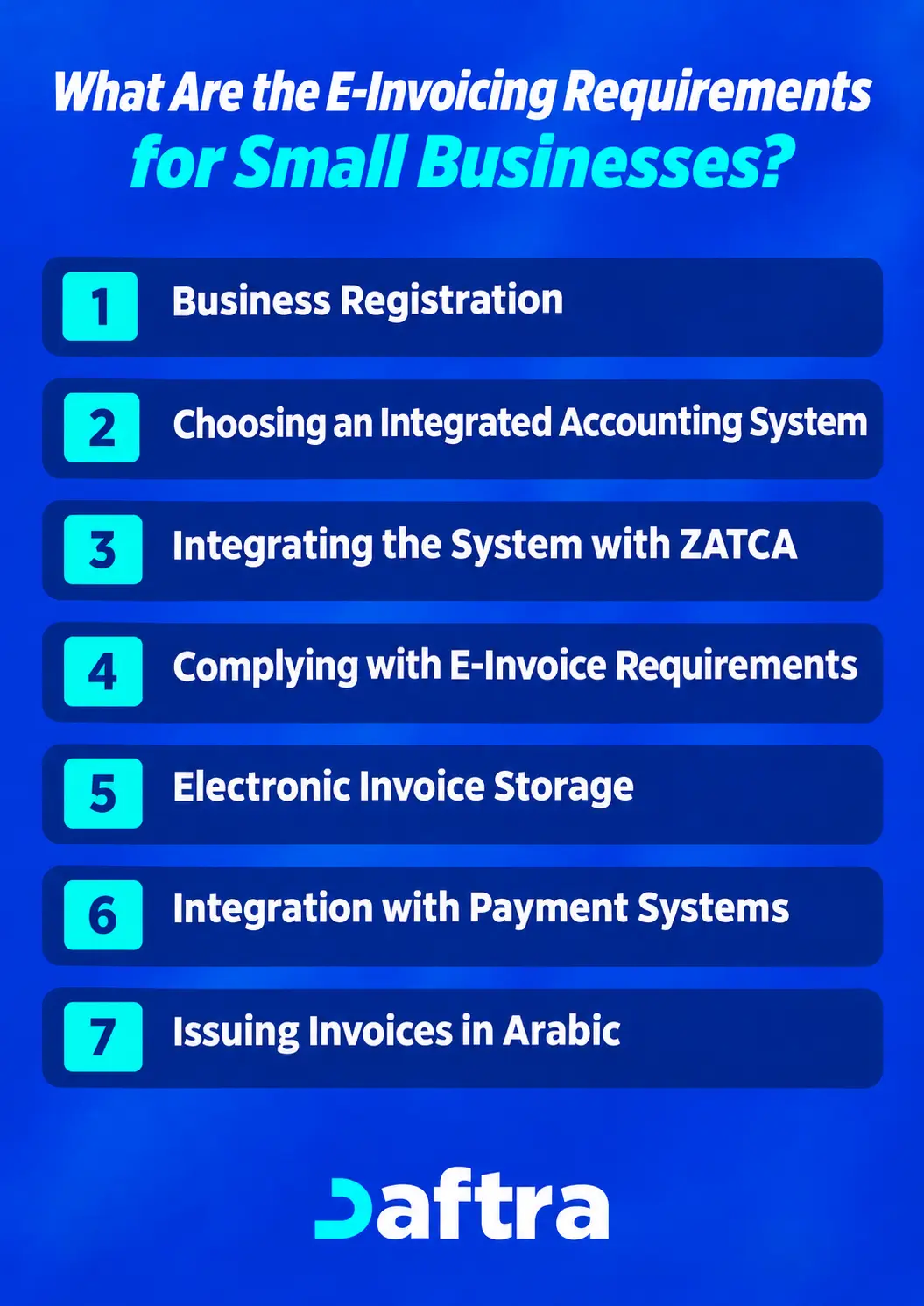
1. Business Registration
Businesses must meet the applicable legal and tax registration requirements. E-Invoicing applies to persons subject to VAT in Saudi Arabia, as well as other parties issuing Tax Invoices on behalf of taxable suppliers, subject to the applicable exceptions.
You can learn more about business registration through Absher Business.
2. Choosing an Integrated Accounting System
Small businesses subject to E-Invoicing must use an accounting system that supports E-Invoice generation and complies with ZATCA’s applicable requirements, such as Daftra.
ZATCA does not require businesses to use a formally approved solution. Businesses may use any E-Invoicing solution that meets the applicable requirements.
3. Integrating the System with ZATCA
Businesses subject to Phase Two (Integration Phase) must integrate their E-Invoicing solutions with ZATCA’s systems in accordance with the applicable technical requirements and implementation schedule. This enables the required electronic submission of invoice data through the FATOORA Platform.
Phase One (Generation Phase) does not require integration with ZATCA’s systems.
4. Complying with E-Invoice Requirements
E-Invoices must contain the information required under the applicable VAT and E-Invoicing regulations. Depending on the invoice type and implementation phase, this may include the seller’s details, VAT registration number, invoice issue date, invoice number, descriptions and details of the goods or services supplied, and the applicable amounts and VAT.
You should also ensure that VAT is calculated accurately.
5. Electronic Invoice Storage
Businesses subject to E-Invoicing must retain electronic copies of issued E-Invoices in accordance with the applicable requirements. The system must support the required storage and retrieval of invoices for recordkeeping and inspection purposes. Cloud storage may be used to facilitate access, but cloud hosting itself is not a universal ZATCA requirement.
6. Integration with Payment Systems
Integrating accounting software with different payment systems can help businesses collect payments more efficiently. However, integrating with multiple payment systems is an operational feature, not a universal ZATCA E-Invoicing requirement.
7. Issuing Invoices in Arabic
Under Saudi VAT requirements, Tax Invoices and Simplified Tax Invoices must display data fields in Arabic. Invoices may also be bilingual and include English.
What Are the Consequences of Non-Compliance with E-Invoicing Requirements?
Businesses that violate E-Invoicing requirements may face warnings or financial penalties. The consequences depend on the type of violation and how many times it is repeated.
- Failure to issue and store E-Invoices electronically: The published starting penalty is SAR 5,000.
- Warnings for specific violations: These may apply when a Simplified Tax Invoice lacks the required QR Code, a Tax Invoice omits the buyer’s VAT registration number when required, or a business fails to notify ZATCA of a malfunction that prevents E-Invoice issuance.
- Deleting or amending E-Invoices after issuance: The published starting penalty is SAR 10,000.
These amounts are starting penalties published by ZATCA; the applicable penalty depends on the nature and recurrence of the violation.
Which businesses must implement E-Invoicing Phase Two?
ZATCA rolls out Phase Two (the Integration Phase) in waves. The following table summarizes the criteria and integration deadlines published by ZATCA. Revenue thresholds refer to revenue subject to VAT.
Conclusion
Despite the challenges small businesses may face when implementing e-invoicing, complying with the Zakat, Tax and Customs Authority (ZATCA) requirements offers several benefits.
Choosing an accounting system that supports e-invoicing can improve operational efficiency, save time and effort, and help businesses comply with the applicable tax regulations and requirements in Saudi Arabia.
Small business owners should therefore prepare to comply with the applicable phases of e-invoicing, even if they are not currently required to integrate with ZATCA’s systems. As the rollout continues, e-invoicing remains an important part of Saudi Arabia’s digital transformation efforts.








 Invoicing
 POS
 Offers
 Installments
 Sales Commission
 KSA E-Invoice Software
 EGY E-Invoice Software
 JO E-Invoice Software
 E-Invoice Software
 Chart of Accounts
 Asset Management
 Cost Centers
 Expenses
 Cheque Cycle
 UAE VAT-Tax
 Product Management
 Purchases
 Purchase Cycle
 Suppliers
 Requisitions
 Stocktaking
 Organizational Structure
 Personnel Management
 Attendance and Leave
 Contracts
 Payroll
 Requests
 Work Orders
 Booking Management
 Rental and Unit Management
 Time Tracking
 Work Flow
 Lease Contracts
 Manufacturing Management
 Client Follow-Up
 Loyalty Points
 Points and Credits
 Memberships
 Insurance Management
 Daftra ERP Full App
 Point of Sales App
 Point of Sales for Desktop – Support Offline Mode
 AI Expenses Scanner App
 Employee Attendance, Sign & ESS App
 E-invoice Reader App
 Inventory Stocktaking App