





Table of contents:
- Article Summary
- What Is a Limited Partnership Company?
- What Are the Characteristics of Limited Partnerships?
- What Are the Advantages of Limited Partnerships?
- What Are the Disadvantages of Limited Partnerships?
- What Are the Procedures for Establishing a Limited Partnership in Saudi Arabia?
- What Are the Procedures for Establishing a Limited Partnership in Egypt?
- When Is a Limited Partnership Dissolved in Saudi Arabia?
- What Are the Procedures for Dissolving and Liquidating a Limited Partnership?
- What Is the Difference Between a Limited Partnership and an Undisclosed Partnership?
- What Is the Difference Between a Limited Partnership and a Limited Liability Company?
- What Is the Difference Between a General Partnership and a Limited Partnership?
- What Is a Limited Partnership Under Egyptian Law?
- What Is a Limited Partnership Under Saudi Law?
- What Is a Limited Partnership Under UAE Law?
- What Is a Limited Partnership Under Algerian Law?
- How Can Daftra Help Manage a Limited Partnership?
- Frequently Asked Questions
Limited partnership companies play a significant role in business, combining features of partnerships and general partnerships. This structure lets business owners operate with greater flexibility in partners’ financial responsibilities and liabilities.
A limited partnership consists of two types of partners: general partners and limited partners. The general partner is responsible for the company’s debts and obligations, including from their personal assets, while the limited partner’s liability is generally limited to the extent of their contribution to the company. This structure allows limited partnerships to offer greater flexibility and diversity in partners’ financial guarantees and liabilities.
If you are looking for a comprehensive guide to limited partnership companies, you are in the right place. This article provides detailed information about the nature and characteristics of limited partnerships and the procedures for establishing them. It also explains the key differences between limited partnerships, joint ventures, and limited liability companies, and how commercial laws treat these companies across jurisdictions.
What Is a Limited Partnership Company?
A limited partnership is a type of partnerships and consists of two types of partners. One type is liable for the company’s debts using their personal assets, while the other is liable only up to the amount of their contribution and does not bear liability beyond that amount with their personal assets, unlike partners in a general partnership. The first is a general partner, while the second is a limited partner.
Accordingly, limited partnerships are closely related to general partnerships, in which all partners are general partners. The two structures are similar in almost every respect, except for the partners' roles and responsibilities.
What Are the Characteristics of Limited Partnerships?
Limited partnerships have four key characteristics that distinguish them from other types of companies:
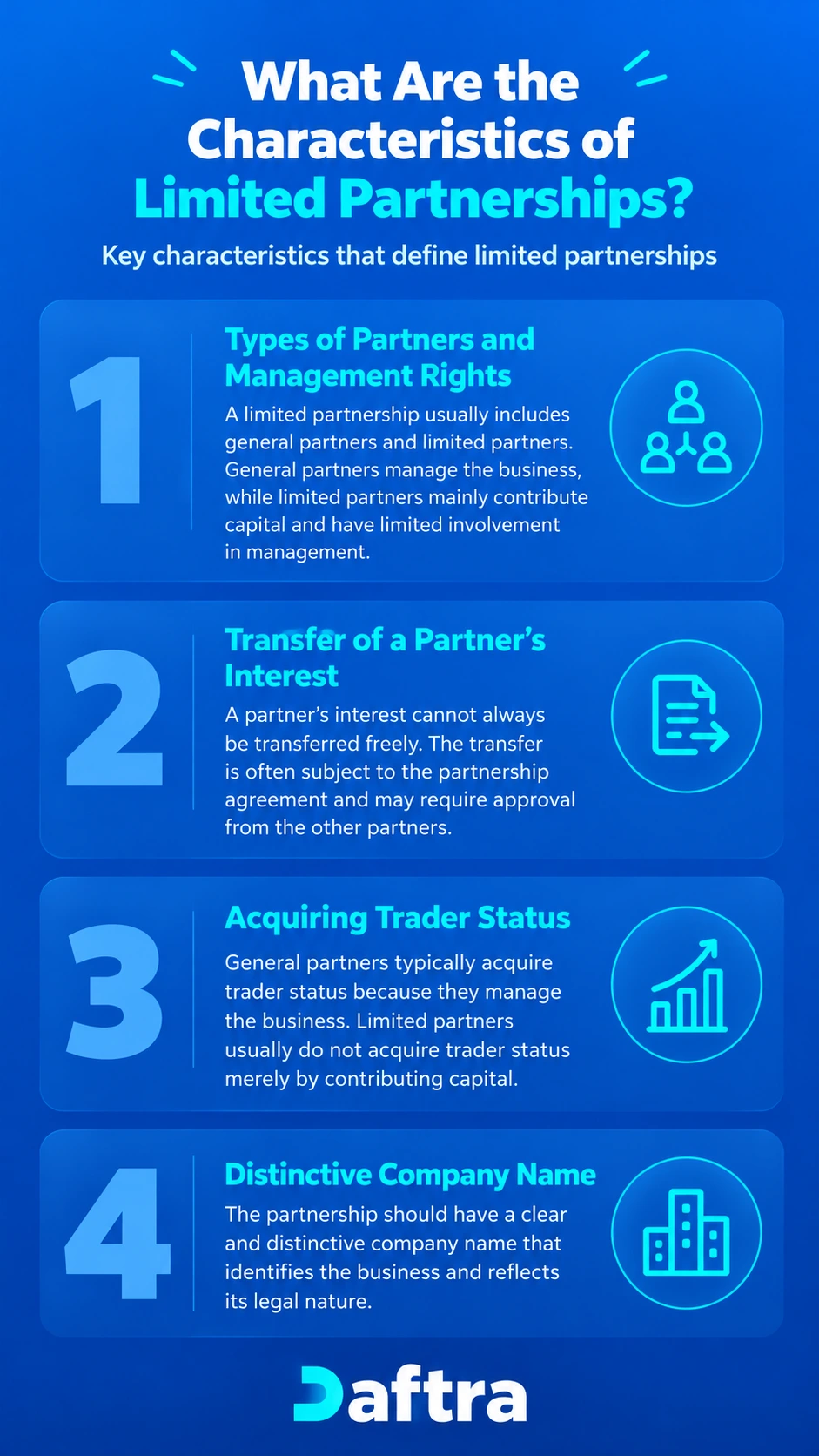
1. Types of Partners and Management Rights
A limited partnership consists of two types of partners: general partners, who are responsible for paying the company’s debts from their personal assets when necessary, and limited partners, whose liability for the company’s debts is limited to their contributions to the company’s capital and who are not personally liable beyond those contributions.
In addition, general partners manage the company, while limited partners do not have the right to participate in management.
2. Transfer of a Partner’s Interest
In a limited partnership, a partner may transfer their interest through assignment, sale, or other means. However, it is important to note that neither type of partner, general or limited, may transfer their interest to a third party without the consent of the other partners.
This aligns with the nature of partnerships, which are based on each partner's personal consideration. Accordingly, the other partners must be satisfied that any new partner joining the company is suitable.
However, the company’s founding agreement may provide for the right of all or some partners to transfer their interests to third parties, provided that the identities or characteristics of the new partners to whom the interests are transferred are specified.
3. Acquiring Trader Status
Another characteristic of limited partnerships is that general partners acquire trader status. This distinguishes general partners from limited partners, who are not required to acquire trader status. This also explains why only general partners manage the partnership, while limited partners are not entitled to participate in management.
4. Distinctive Company Name
The company name is another distinguishing characteristic of a limited partnership. The company name should include the name of one of the general partners along with the words “and Partners” or a similar expression. The name of a limited partner may not be included.
This characteristic matters because it determines whether a limited partner becomes personally liable for the company’s debts. If the limited partner includes their name in the company name with their knowledge and consent, they become liable for the company’s debts. If their name is included without their knowledge or if they object to its inclusion, they are not held liable.
What Are the Advantages of Limited Partnerships?
Limited partnerships offer several advantages, including the following:
1. Diversity of Partners
Having both general and limited partners makes this type of company suitable in many situations. Any person can be a limited partner in a limited partnership without necessarily having legal capacity or acquiring trader status.
2. Ease of Establishment Procedures
Establishing a limited partnership does not involve complicated procedures. No additional or complex procedures are required beyond those generally required when establishing a company.
3. Availability of Factors for Success
Having one or more general partners alongside one or more limited partners strengthens the company. While the limited partner’s role is limited to providing financial contributions up to the amount of their interest in the company, the general partner contributes personal assets, as well as management expertise.
This, in turn, supports serious management of the company and encourages efforts to strengthen its success, maintain its competitiveness, and preserve its leading position.
4. Compatibility Among Partners
Limited partnerships are based on personal consideration, meaning the identity of each partner matters. Accordingly, no partner may transfer their interest to a third party without the other partners' consent, which helps ensure a high degree of compatibility among the partners.
What Are the Disadvantages of Limited Partnerships?
Despite the many advantages of limited partnerships, they also have certain disadvantages that may affect this type of company. The main disadvantages include:
1. Overlapping Management Responsibilities
Overlapping management responsibilities may occur in limited partnerships. If the roles and responsibilities of the partners are not clearly defined, all partners may have the right to intervene in managing the company’s affairs and making decisions.
2. Restrictions on the Transfer of Ownership
In a limited partnership, ownership cannot be transferred unless the company’s agreement includes a provision specifying the identities or characteristics of the persons to whom ownership may be transferred. Therefore, disagreements among partners over this matter may hinder the company’s operations.
3. Risk Borne by the General Partner
Unlike the limited partner, a general partner in a limited partnership is personally liable for the company’s debts when necessary. This means a creditor may demand that a general partner pay the company’s debt, and the general partner must settle it. As a result, the bankruptcy of the company may lead to the bankruptcy of the general partners.
What Are the Procedures for Establishing a Limited Partnership in Saudi Arabia?
The Ministry of Commerce offers a service to establish a limited partnership in Saudi Arabia through the Saudi Business Center platform. The procedures include:
Registering the commercial registration and the company’s articles of incorporation.
Publishing the articles of incorporation in the Aamali newspaper.
Opening an establishment file with the Ministry of Human Resources and Social Development.
Registering with the Zakat, Tax and Customs Authority.
Registering with the General Organization for Social Insurance.
Registering for the Saudi Post SPL certified business address.
Registering with the chambers of commerce according to the company’s location.
The following information is entered when using the Saudi Business Center platform service:
- Accessing the Saudi Business Center platform.
- Select the service to establish a limited partnership.
- Clicking Start Service.
- Specifying the number of partners.
- Specifying the company type.
- Applying for the service.
- Providing the commercial registration duration, company headquarters, activities, and purposes.
- Entering the partners’ information.
- Providing the commercial registration information.
- Providing the company information.
- Providing the company management information.
- Providing the company agreement information.
What Are the Procedures for Establishing a Limited Partnership in Egypt?
You can establish a limited partnership in Egypt through the electronic incorporation services provided by the General Authority for Investment and Free Zones (GAFI). These services cover partnerships, including limited partnerships and general partnerships. The Authority completes the incorporation process through its electronic portal. The procedures for establishing a limited partnership in Egypt are as follows:
1. Submitting the Incorporation Application: The applicant submits the application through the Authority’s official website and enters the basic information, such as the company name, distribution of interests, type of activity, and capital.
2. Preparing the Required Documents: The required documents include the articles of incorporation, a copy of the national ID card or passport, proof of ownership of the company’s premises, whether through a lease or ownership agreement, a copy of the power of attorney if the company is being established through an agent, and proof of payment of the minimum capital.
3. Reviewing the Application: GAFI reviews and verifies all submitted documents and approves them after ensuring that all legal requirements for establishing the limited partnership have been fulfilled.
4. Paying the Fees: After completing the application requirements, the incorporation fees payable to the entities participating in providing the service are paid in a single payment.
5. Electronically Signing the Articles of Incorporation: The investor electronically signs the company’s articles of incorporation and bylaws through the electronic portal using an electronic signature.
6. Electronically Documenting the Articles of Incorporation: The investor electronically signs the minutes documenting the articles of incorporation issued by the Real Estate Publicity and Notarization Authority to complete the company documentation procedures.
7. Completing the Incorporation Procedures and Receiving the Documents: GAFI completes the remaining incorporation procedures on behalf of the investor and then delivers the company’s final documents through the Investors Services Center.
When Is a Limited Partnership Dissolved in Saudi Arabia?
In Saudi Arabia, a limited partnership is not dissolved by a limited partner's death, the imposition of guardianship over them, the commencement of liquidation proceedings against them under the Bankruptcy Law, or their withdrawal from the company.
A limited partnership may be dissolved for general reasons, including the expiration of its specified term or the completion of the purpose for which it was established.
What Are the Procedures for Dissolving and Liquidating a Limited Partnership?
The procedures for dissolving a limited partnership include the following stages:
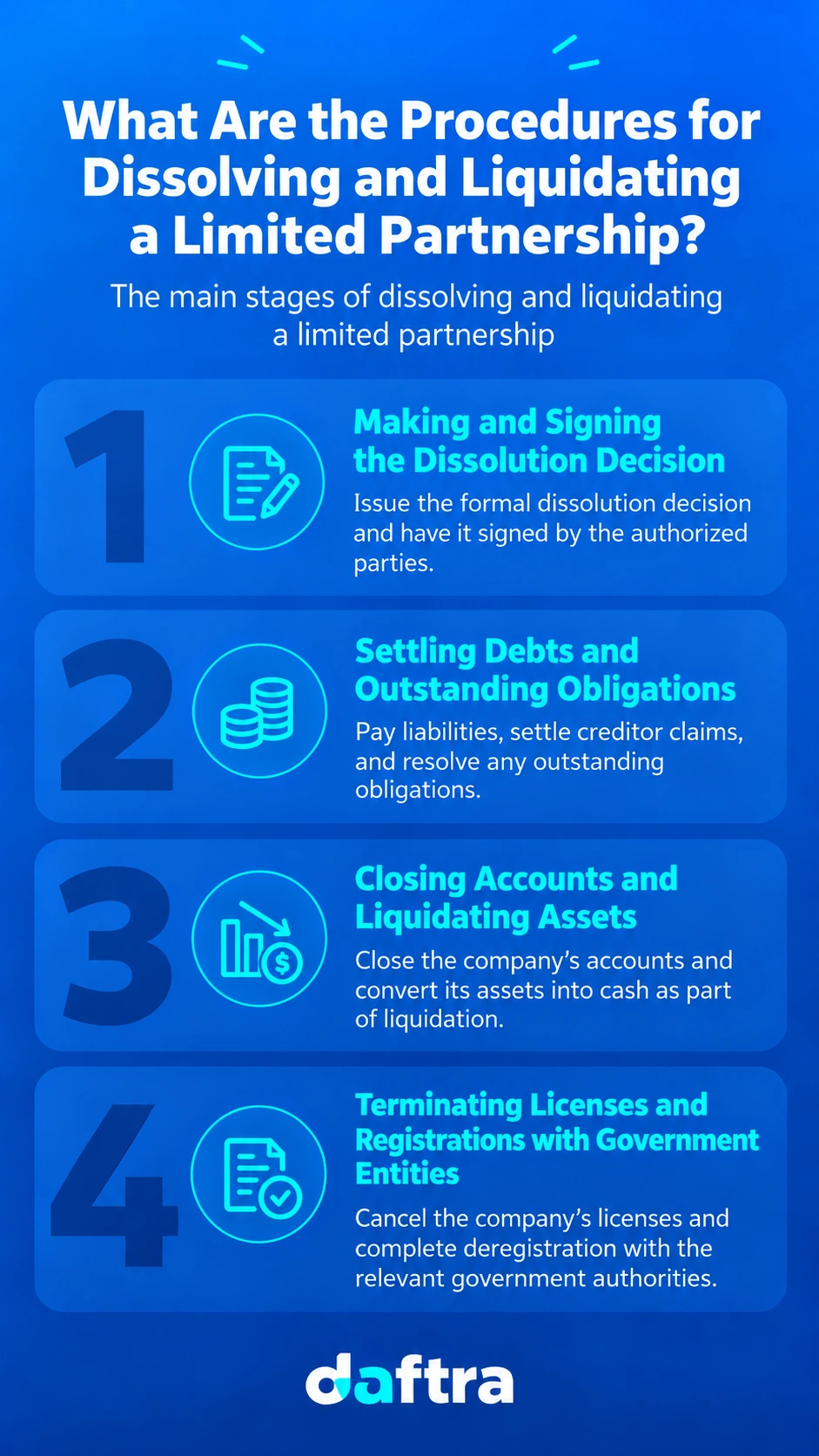
Stage 1: Making and Signing the Dissolution Decision
The process begins with the partners deciding to liquidate the company, whether by mutual agreement or because a legal ground for liquidation has arisen. This stage includes:
- Holding a partners' meeting and recording the liquidation decision in the official minutes.
- Specifying the reason for liquidation.
- Obtaining the signatures of all relevant partners on the liquidation decision.
- Documenting the decision with the competent authorities in accordance with the requirements of the Saudi Ministry of Commerce.
Stage 2: Settling Debts and Outstanding Obligations
After the liquidation decision is approved, the liquidator or the partners begin identifying the company’s financial liabilities. This stage involves preparing a list of all the company’s debts and outstanding financial obligations, followed by settling amounts owed to government entities, suppliers, and employees.
Stage 3: Closing Accounts and Liquidating Assets
At this stage, the companydeals with its assets assets are dealt with after settling its liabilities. The procedures include closing the company’s bank accounts, selling movable and immovable assets, preparing liquidation financial statements, and distributing the remaining funds among the partners according to the proportions agreed in the company agreement or in accordance with Saudi law.
Stage 4: Terminating Licenses and Registrations with Government Entities
The fourth and final stage formally ends the company’s legal existence with the relevant authorities. This includes striking the company’s commercial registration off the Ministry of Commerce’s register and closing its tax file with the Zakat, Tax and Customs Authority.
What Is the Difference Between a Limited Partnership and an Undisclosed Partnership?
Both limited partnerships and undisclosed partnerships are partnerships. However, they differ in several fundamental respects regarding their formation and legal status.
A limited partnership has an independent legal existence. It must have a designated name and registered office, and it must specify its capital and the distribution of interests among its partners. It has legal personality, conducts business with third parties in its own name, and must be officially registered and disclosed.
By contrast, an undisclosed partnership has no designated name or registered office, and its capital is not publicly disclosed. It is not officially disclosed, lacks legal personality, and has no independent legal existence in dealings with third parties. Instead, the partners deal with third parties in their personal capacities, and the partnership is not recognized as an independent legal entity.
To clarify the key differences between the two types, the main characteristics of each are outlined below:
| Aspect | Limited partnership | Undisclosed partnership |
| Company name and registered office | The company must have a designated name and registered office. | The company does not have a designated name or registered office. |
| Capital | The company’s capital and each partner’s contribution must be disclosed. | The company’s capital is not disclosed. |
| Legal existence | The company exists as a legal entity and conducts business with third parties in its own name. | The company exists only through its partners. |
| Disclosure and registration | The company must be officially disclosed and registered. | The company is not required to be officially disclosed. |
| Legal personality | The company must have legal personality. | The partners deal with third parties in their personal capacities, and the company does not have independent legal personality. |
What Is the Difference Between a Limited Partnership and a Limited Liability Company?
Many people may confuse limited partnerships, which are a type of partnership, with limited liability companies, which fall under the category of capital companies.
The differences between these two company types relate to the type and number of partners, the company’s naming requirements, and the extent of the partners’ legal liability for company debts. They also differ in their management structure and liability toward third parties.
| Aspect | Limited partnership | Limited liability companies |
| Company name | The name must include the name of one of the general partners, along with an expression indicating that other partners are involved, such as “and Partners.” | The company name is derived from its purpose or business activity. A name non-confusion certificate must be obtained during incorporation. |
| Partners | Consists of two types of partners: general partners and limited partners. | Consists of one type of partner. |
| Maximum number of partners | There is no maximum limit on the number of partners. | The maximum number of partners is 50. |
| Liability for debts | General partners have unlimited liability for the company’s debts, including liability extending to their personal assets. | All partners have limited liability for the company’s debts, generally limited to their contributions to the company’s capital, without extending to their personal assets. |
If you serve limited partnerships as an accountant or financial consultant, whether you handle their bookkeeping, tax work, or liquidation financial statements, you need a system that keeps every client organized in one place. Daftra’s accounting services management software lets you keep a file for each client with their documents and service history, assign accountants and advisors to specific tasks, and issue recurring invoices for ongoing contracts. You can also track each project’s revenue, expenses, and net profit, and follow every partnership’s balances through a full chart of accounts with automated journal entries, so your reports stay clear and accurate without extra manual work.
What Is the Difference Between a General Partnership and a Limited Partnership?
The differences between a general partnership and a limited partnership can be understood by examining the following factors:
1. Company Name
In a limited partnership, the company name includes the name of one or more general partners, along with an expression such as “and Partner” or “and Partners” to indicate the presence of other partners, including limited partners.
In a general partnership, the company name includes the names of all partners. This is intended to strengthen the company’s financial position by indicating that more than one general partner is responsible for the company’s debts and obligations, even when repayment must come from their personal assets.
2. Partners and Company Structure
A limited partnership always consists of two types of partners: general partners and limited partners.
In a general partnership, all partners are general partners. Each has the right to participate in management, sign on behalf of the company, and bear responsibility for settling the company’s debts. An agreement exempting a partner from paying the company’s debts is not permitted, although there is some flexibility in agreements concerning the partners’ personal debts.
3. Capital and Commercial Registration
In a limited partnership, the names of limited partners are not included in the summary of the company agreement; instead, their contributions are specified, reflecting the limits of their liability.
In a general partnership, the commercial register identifies the partners authorized to manage and sign on behalf of the company. The company’s entire capital is also recorded without distinguishing between the partners.
4. Financial System
A general partnership has a bank account associated with the partners, containing their names and signatures.
In a limited partnership, responsibility for managing the financial system rests entirely with the general partners rather than the limited partners.
5. Company Agreement
In a general partnership, the names of all partners are included in the company agreement and its summary because all partners bear unlimited liability for the company’s debts and obligations.
In a limited partnership, the company agreement includes the names of all general and limited partners. However, the summary identifies only the general partners and specifies the contributions of the limited partners without mentioning their names.
What Is a Limited Partnership Under Egyptian Law?
In Egypt, a limited partnership is a type of partnership established under Investment Law No. 72 of 2017 and Egyptian Commercial Law No. 17 of 1999.
The company’s capital must be at least EGP 300,000, with no maximum capital limit. It must have at least two partners, with no maximum limit on the number of partners. Appointing an auditor or legal advisor is not required to establish a limited partnership in Egypt. Each partner’s contribution is calculated in units of EGP 1,000.
What Is a Limited Partnership Under Saudi Law?
Under Saudi Arabia’s Companies Law of 1437 AH, Article 36 stipulates that a limited partnership must consist of two groups of partners. One group must include at least one general partner, while the other must include at least one limited partner.
The provisions governing general partners in a general partnership also apply to general partners in a limited partnership. In general, the rules applicable to general partnerships apply to limited partnerships unless a specific provision provides otherwise for this type of company.
What Is a Limited Partnership Under UAE Law?
Under the UAE Commercial Companies Law No. 2 of 2015, limited partnerships are among the officially recognized company types. Article 9 of the same law identifies the legal forms of companies as general partnerships, limited partnerships, public joint-stock companies, private joint-stock companies, and limited liability companies.
Article 65 of the UAE Commercial Companies Law stipulates that a limited partnership agreement must identify which partners are general partners and which are limited partners. If the agreement does not specify the partners’ status, the company is considered a general partnership, and all its partners are treated as general partners.
What Is a Limited Partnership Under Algerian Law?
Article 563 bis 5 of Algerian legislation No. 75-59, which governs commercial companies, stipulates that a limited partner may not perform management activities on behalf of the company, even under a power of attorney.
If this provision is violated, the limited partner becomes jointly liable with the general partners for the company’s debts and obligations. However, a limited partner may manage certain internal affairs and has the right to inspect the company’s accounting books and documents twice a year.
The transfer of partnership interests is subject to specific conditions under Article 563 bis 7. As a general rule, a partner’s interest may be transferred only with the consent of all partners. However, the company’s articles of association may permit limited partners to transfer their interests to other partners or to third parties, provided that the transfer to third parties is approved by all general partners and limited partners representing a majority of the company’s capital.
A general partner may also transfer part of their interest to a limited partner or to a person outside the company, subject to the conditions prescribed by law.
How Can Daftra Help Manage a Limited Partnership?
Several factors contribute to business success, including understanding the different types of companies and choosing the structure that best suits your needs. Effective business management is another important factor. In this regard, Daftra’s integrated business management software offers a flexible user interface that can be customized to suit your industry.
Daftra is a cloud-based system that can be accessed anytime and from anywhere. It includes the applications needed to manage your business, from inventory, purchasing, and sales to general accounting, financial management, and employee affairs. It also supports customer relationship management and performance reporting, with free technical support available around the clock.
Frequently Asked Questions
How Can a Limited Partnership Agreement Be Dissolved?
A limited partnership is dissolved by agreement among the partners, after which the company enters the liquidation phase to wind up its operations and settle its obligations.
Who Is Responsible for the Debts of a Limited Partnership?
In a limited partnership, general partners are responsible for the company’s debts and obligations, while limited partners’ liability is limited to the value of their contributions to the company’s capital.
Can a Limited Partner Manage a Limited Partnership?
No. A limited partner is not entitled to manage a limited partnership. Their role is also limited to monitoring the company’s activities and reviewing its books and documents in accordance with the law.
Can a Limited Partner Access the Company’s Records?
Yes. A limited partner has the right to inspect the company’s books and documents and submit written questions regarding its management at least twice a year.
What Is a Partner’s Liability in a Limited Partnership?
A limited partner has limited liability and is responsible for the company’s debts only up to the amount of their contribution to its capital. A general partner, on the other hand, has unlimited liability for the company’s debts.









 Invoicing
 POS
 Offers
 Installments
 Sales Commission
 KSA E-Invoice Software
 EGY E-Invoice Software
 JO E-Invoice Software
 E-Invoice Software
 Chart of Accounts
 Asset Management
 Cost Centers
 Expenses
 Cheque Cycle
 UAE VAT-Tax
 Product Management
 Purchases
 Purchase Cycle
 Suppliers
 Requisitions
 Stocktaking
 Organizational Structure
 Personnel Management
 Attendance and Leave
 Contracts
 Payroll
 Requests
 Work Orders
 Booking Management
 Rental and Unit Management
 Time Tracking
 Work Flow
 Lease Contracts
 Manufacturing Management
 Client Follow-Up
 Loyalty Points
 Points and Credits
 Memberships
 Insurance Management
 Daftra ERP Full App
 Point of Sales App
 Point of Sales for Desktop – Support Offline Mode
 AI Expenses Scanner App
 Employee Attendance, Sign & ESS App
 E-invoice Reader App
 Inventory Stocktaking App