



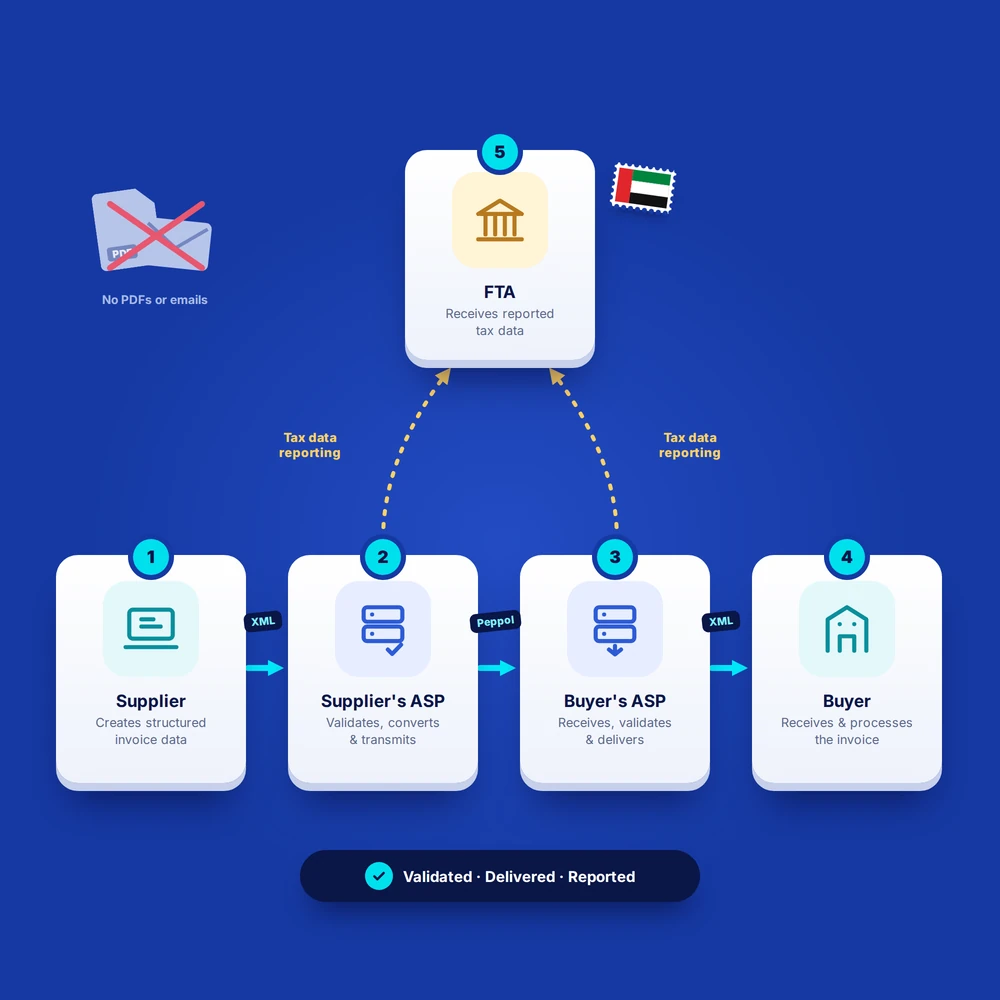
Table of contents:
- Key Summary
- What is the UAE 5-corner e-Invoicing model?
- Why does the UAE use a 5-corner model instead of a simpler invoice-exchange setup?
- What are the five corners in the UAE e-Invoicing system?
- How does an invoice move through the UAE 5-corner system?
- How is the UAE 5-corner model different from the standard 4-corner model?
- What responsibilities sit with suppliers, buyers, and ASPs in the 5-corner system?
- How does the 5-corner model connect with PINT AE, XML, and mandatory fields?
- Common misunderstandings about the UAE 5-corner e-Invoicing system
- What should businesses do to prepare for the UAE 5-corner system?
- Frequently asked questions about the UAE 5-corner e-Invoicing system
- Conclusion
The UAE e-invoicing system is a digitized, more advanced exchange model than any the country has seen. It uses a 5-corner model under the Peppol CTC model, officially known as the Decentralized Continuous Transaction Control and Exchange model (DCTCE).
The Ministry of Finance stated that the e-invoicing system is designed to reduce manual intervention and processing time, improve transparency, and ensure government access to all relevant data. Thus, the switch to the DCTCE model was implemented to secure invoice exchange, enable real-time or near-real-time validation, reduce VAT leakage, and improve tax visibility.
The 5-corner model is not just a digitized form of an older model; it is a revolutionary exchange system. The supplier and buyer do not email each other a PDF or other document; instead, invoice data is created in a structured electronic format, transmitted through an accredited service provider, and then reported to the Federal Tax Authority.
The regulation of the e-invoicing system is very strict regarding the use of PDFs, Word files, scanned documents, or emails, all of which are considered invalid. This article explores the DCTCE 5-corner model in detail.
What is the UAE 5-corner e-Invoicing model?
The UAE’s e-invoicing program is built around a structured 5-corner architecture that governs the flow of invoice data among suppliers, buyers, accredited service providers, and the Federal Tax Authority. Instead of the traditional direct exchange model between businesses, the model introduces regulated intermediaries and reporting layers to ensure exchange, validation, interoperability, and visibility into tax data.
Under the 5-corner model, move through accredited service providers rather than directly exchanged between supplier and buyer.
Here is a quick breakdown of the 5 corners:
| Corner | Participant | Main role |
| Corner 1 | Supplier | Creates invoice data |
| Corner 2 | Supplier’s ASP | Validates, converts, transmits, and reports invoice data |
| Corner 3 | Buyer’s ASP | Receives, validates, and delivers invoice data |
| Corner 4 | Buyer | Receives and processes the invoice |
| Corner 5 | FTA | Relieves reported tax data and support confirmation flows |
This model is architected to support:
- Secure invoice exchange
- Standardized data transmission
- Interoperability
- Tax reporting
- Validation and confirmation
Unlike traditional invoicing models, the 5-corner model embeds tax reporting to the authorities directly into the exchange process.
Why does the UAE use a 5-corner model instead of a simpler invoice-exchange setup?
As part of the UAE’s broader digitization plans, a simple supplier-buyer model would not be sufficient for the UAE's invoicing environment. The 5-corner model is not designed to just deliver invoices; it also supports:
- Invoice data validation
- Interoperability between systems
- Secure transmission through ASPs
- Reporting to the FTA
- Confirmation and status messaging
The traditional exchange model is 4-corner between
- Supplier
- Supplier access point
- Recipient access point
- Recipient
In the UAE’s 5-corner model, the addition is the Federal Tax Authority, which changes the system into a compliance-enabled reporting system.
This, in turn, enables the system to support tax data reporting, validation status handling, and confirmation messaging.
What are the five corners in the UAE e-Invoicing system?
The DCTCE model consists of 5 participants, each playing a specific operational role in the invoicing process. Each corner has defined responsibilities for invoice creation, transmission, validation, reporting, delivery, and confirmation handling.
Overview of the 5-corner model:
Detailed breakdown of each corner in the UAE’s 5-corner model:
Corner 1: Supplier
The supplier is the business that creates and issues the invoice.
This is where the invoicing process begins: the supplier uses their ERP/accounting system or invoicing software to create invoice data and submit it to their ASP.
The supplier corner is responsible for:
- Generating invoice information
- Ensuring invoice accuracy
- Maintaining compliance
- Sending invoice data to ASP
The supplier is responsible for the compliance obligations related to the invoice data at all times.
Corner 2: Supplier’s Accredited Service Provider
This is the supplier’s service provider; it handles more than simple transmissions, including technical and operational functions. It typically handles:
- Invoice data validation
- Conversion into the UAE’s standard XML (if needed)
- Secure transmission to the buyer’s ASP
- Reporting tax data to the FTA
- Routing confirmation message to the supplier
The Accredited service provider for UAE e-invoicing acts as a secure exchange gateway, validation layer, and reporting intermediary.
Corner 3: Recipient’s Accredited Service Provider
The recipient’s ASP is the buyer’s side intermediary responsible for receiving and validating the invoice data before it reaches the buyer.
When the invoice from the supplier ASP arrives, the buyer ASP performs checks before forwarding it to the buyer.
The recipient’s ASP typically:
- Receive invoice data
- Validates invoice structure and exchange requirements
- Delivers the invoice to the recipient
- Report successful validation to the FTA
The recipient’s ASP is crucial for confirmation handling, validation outcomes, and controlled invoice delivery.
Corner 4: Recipient
The recipient is the buyer receiving the invoice. After the invoice passes through the recipient's ASP, it reaches the recipient's ERP/accounting system for processing.
The recipient typically:
- Receives invoice data
- Review and process invoices internally
- Integrate invoice information into the ERP system
- Manages payment and recordkeeping workflows
This is where traditional exchange models usually stop.
Download: Payment voucher template
Corner 5: The Federal Tax Authority
The FTA corner is what sets this model apart from traditional 4-corner models. In the UAE’s invoicing system, the tax reporting is built directly into the invoicing process rather than being a separate process.
The FTA typically:
- Receives reported tax data
- Support confirmation and status flow
- Participate in the reporting structure
- Enable visibility into invoice exchange activity
The FTA corner sets this invoicing system apart from other exchange systems, establishing it as an exchange-and-compliance-reporting architecture.
How does an invoice move through the UAE 5-corner system?
The UAE’s 5-corner model follows a structured invoice-routing process in which invoice data passes through ASPs before reaching the recipient, while tax data reporting and confirmation occur simultaneously.
Here is how the invoice flow goes:
| 1 | Supplier creates invoice data |
| 2 | Supplier sends invoice data to ASP |
| 3 | Supplier ASP validates the invoice |
| 4 | ASP converts the invoice into UAE XML format |
| 5 | Supplier’s ASP transmits the invoice to the buyer’s ASP |
| 6 | Supplier ASP reports tax data to the FTA |
| 7 | Recipient ASP validates the invoice |
| 8 | Recipient’s ASP delivers the invoice to the buyer |
| 9 | Recipient ASP reports a successful or negative validation |
| 10 | Confirmation and status message move back through the system |
| 11 | Supplier receives final confirmation or status outcome |
Step-by-step explanation of the invoice flow:
1. Supplier creates invoice data
The process starts when the supplier generates the invoice information using their accounting/ERP system.
2. Invoice sent to the supplier ASP
The supplier transfers the invoice data to their accredited service provider for processing.
3. Supplier ASP validates the invoice
The ASP performs validation checks on the invoice to ensure it can move through the network.
4. The invoice is converted to XML
The ASP converts the invoice into the UAE’s structured format (XML) if required.
5. Supplier ASP transmits the invoice
The validated invoice is being directed to the recipient ASP
6. Tax data is reported to the FTA
The supplier side reports the tax-relevant data to the FTA.
7. Recipient ASP validates the invoice
Buyer’s ASP performs validation checks before delivery to the buyer.
8. Invoice is transmitted to the buyer
The validated invoice is forwarded to the recipient ERP system.
9. Validation status is reported
Either the recipient ASP reports successful validation or a negative status.
10. Confirmation message move back
Status and confirmation messages move back through the network.
11. Supplier receives confirmation
The supplier receives confirmation or rejection of the invoice at the end.
The 5-corner model is an integrated system that supports the next step of the exchange flow while simultaneously involving the Federal Tax Authority throughout.
How is the UAE 5-corner model different from the standard 4-corner model?
The standard 4-corner model used in invoice exchange usually involves the sender and the receiver through intermediary access points. This is close to the UAE’s model, with a difference of involving the FTA in the exchange process.
4-corner model
This is how the 4-corner model is built:
| 1 | Supplier |
| 2 | Supplier access point |
| 3 | Recipient access point |
| 4 | Recipient |
This model focuses on invoice exchange, interoperability, and secure transmission between businesses.
UAE’s 5-corner model
The UAE’s model adds a fifth corner: the FTA, which changes the system from a simple exchange model into a reporting-enabled operating model.
This additional corner supports:
- Tax-data reporting
- Validation status communication
- Confirmation messaging
- Integrated reporting workflow
Rather than being a separate process, tax reporting to the FTA becomes an essential part of invoicing.
What responsibilities sit with suppliers, buyers, and ASPs in the 5-corner system?
The 5-corner systems divide the compliance responsibility among the supplier, buyer, and ASPs.
Here is a breakdown of each of the supplier, buyer, and ASP responsibilities:
Supplier
The supplier is responsible for the accuracy of the information in the invoice they issue. Some other responsibilities include:
- Invoice accuracy
- Tax-related data content
- Collecting recipient participant identifiers
- Ensuring internal invoicing control
This means the supplier is fully responsible for the data and its accuracy while ASP handles transmission and reporting.
Buyer
Recipients maintain their responsibilities within the model, including:
- Receiving invoices properly
- Maintain internal processing workflows
- Integrate invoices into ERP/accounting system
- Handle approvals and payments
This means the buyer’s corner is actually an active participant, not a passive endpoint.
Accredited service provider
The ASP is responsible for the network and technical functions inside the model. The ASP responsibilities include:
- Secure invoice transmission
- Invoice data validation
- Invoice routing
- Interoperability handling
- Participant lookup
- UUID generation
- Tax-data reporting
- Status and confirmation messaging
Although ASPs are considered vital players in the UAE model, the responsibility for compliance does not fall solely on the ASP; it is shared among the model's participants.
How does the 5-corner model connect with PINT AE, XML, and mandatory fields?
Most businesses confuse the 5-corner model with other parts of the e-invoicing system. All layers of the e-invoicing system are connected one way or another; after all, it is an integrated system that supports all parts in favor of one another. The 5-corner model outlines how invoices move through the system, while other layers define what invoices should look like and the mandatory e-invoicing field requirements.
Here is a breakdown of the different layers of the e-invoicing model to highlight their different natures:
The 5-corner model
The architecture of the e-invoicing model focuses on:
- Participants (supplier, buyer, and FTA)
- Routing invoice data
- Validation flow
- Reporting flow
- Confirmation handling
The 5-corner model specifies who participates in the e-invoicing exchange and what data is exchanged.
XML
XML is the official, machine-readable format used to structure invoice data during the exchange process. It is responsible for standardizing how invoice information is represented among systems.
PINT AE
PINT AE is the Data Dictionary that structures the e-invoicing information. It defines:
- Invoice structure rules
- Interoperability
- Formatting requirements
PINT AE defines how invoice information should be structured within the exchange.
Mandatory fields
Mandatory fields are the information that must be included on the invoice. That includes:
- Supplier & buyer details
- Tax amounts
- Invoice identifiers
- Dates
- Line-item information
Invoices may be invalidated if any mandatory fields are missing.
| Invoicing concept | The meaning behind it |
| 5-corner model | Exchange & routing architecture |
| XML | Structured invoice data format |
| PINT AE | The specification layer defines the invoice structure |
| Mandatory fields | Required data elements |
Common misunderstandings about the UAE 5-corner e-Invoicing system
As the UAE e-invoicing system has multiple layers, businesses often confuse the technical layers with the architecture, formats, specifications, or compliance rules.
It is crucial to understand the 5-corner model and what it entails for implementation readiness.
Here are some of the common misunderstandings businesses have about the 5-corner system:
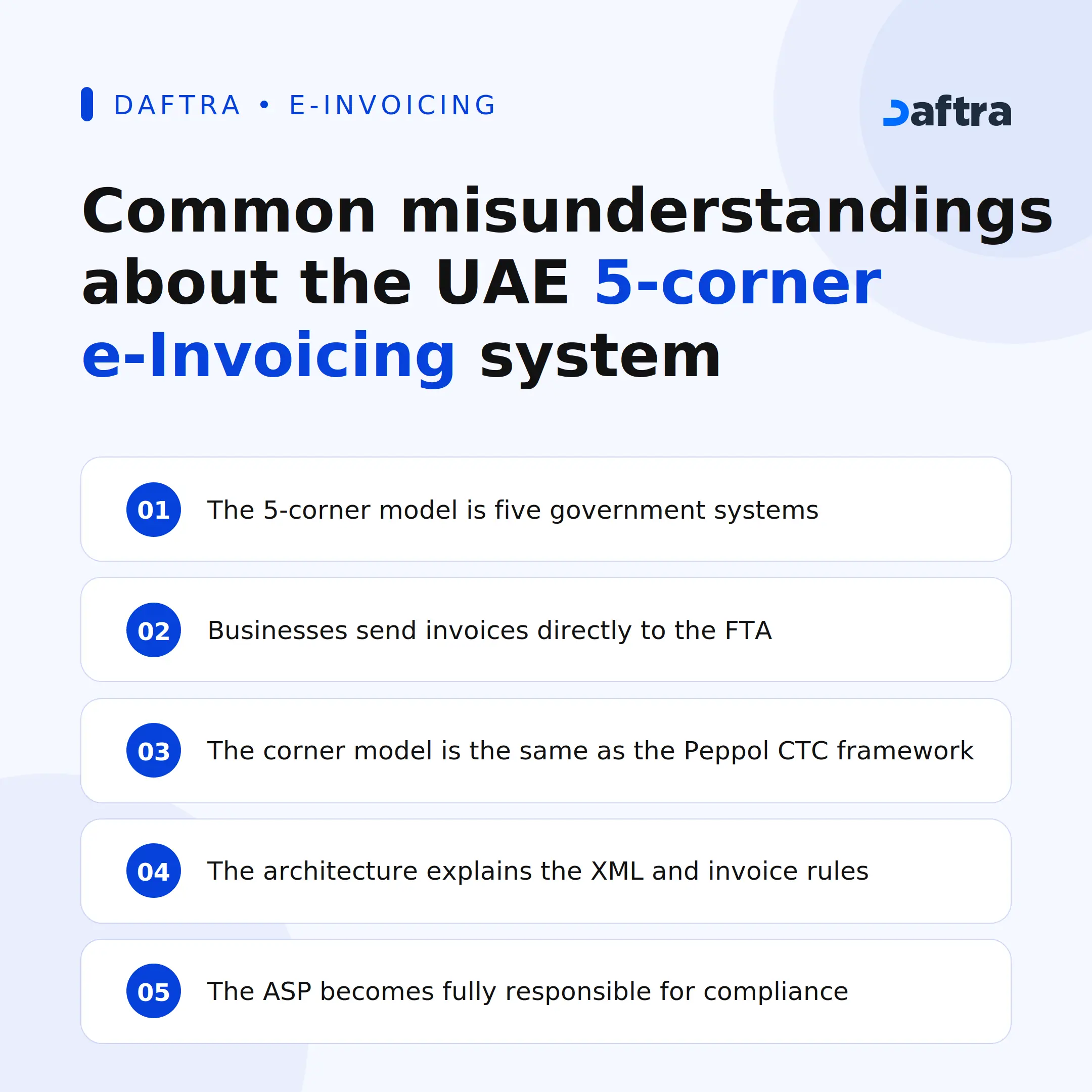
1. The 5-corner model is five government systems
This is a very misunderstood concept within the e-invoicing system; the 5-corner model is not 5 separate government systems. There are five participants in the invoicing exchange:
- Supplier
- Buyer
- Supplier ASP
- Buyer ASP
- FTA
The 5-corners represent the participants and roles within the architecture.
2. Businesses send invoices directly to the FTA
Businesses do not connect directly to the FTA or send invoices to it; rather, invoice exchange occurs through an accredited service provider. ASPs typically handle:
- Transmission
- Routing
- Validation
- Reporting workflows
3. The corner model is the same as the Peppol CTC framework
The 5-corner model is a part of a broader invoicing framework. It explains:
- Participants
- Routing structure
- Exchange flow
The Peppol CTC framework includes:
- Interoperability standards
- Technical specifications
- Exchange rules
- Data-format requirements
Both are related concepts but not identical, and do not serve the same purpose.
4. The architecture explains the XML and invoice rules
The 5-corner model is responsible for participants, routing, and exchange flow; it does not define:
- XML syntax
- Mandatory fields requirements
- PINT AE specifications
- Validation rules
All these belong to separate technical and compliance layers.
5. The ASP becomes fully responsible for compliance
While ASPs are responsible for many operational and technical exchange functions, they do not hold the full compliance responsibility. Suppliers and buyers are still responsible for:
- Invoice accuracy
- Business data
- Operational control
- Transactions compliance requirements
It is very important for businesses to understand that while ASPs are vital for compliance, they do not take over your role.
What should businesses do to prepare for the UAE 5-corner system?
Businesses preparing for e-invoicing should not focus only on compliance; operational readiness is an essential part of the process. The UAE 5-corner model affects:
- Invoice workflows
- Accounting processes
- ERP integration
- Invoice data quality
- Confirmation handling
Preparations should start before the go-live phase. Here are the key preparation steps for businesses to follow:

1. Understand where your business sits in the architecture
As the first step in readiness, businesses should determine whether they are acting as suppliers or buyers, how invoice data will flow through ASPs, and where confirmation and reporting fit within operations.
2. Review invoice data quality and workflow
Businesses should assess:
- Invoice consistency
- Supplier & buyer master data
- Tax-data accuracy
- Approval workflows
- Accounting readiness
Poor quality data triggers invalidation and exchange issues.
Free Download: Tax invoice format uae Word & Excel
3. Prepare ERP/ accounting system
Businesses should ensure their system is capable of:
- Properly generating structured invoice data
- Support exchange workflows
- Confirmation & status handling
- Support ASP integration
4. Coordinate with an ASP
Businesses should ensure integration with an ASP for invoice exchange, including:
- Connectivity planning
- Participant identification setup
- Exchange & validation testing
Confirmation handling
5. Operation flow testing before go-live
Businesses should test:
- Invoice transmission
- Validation outcomes
- Rejection handling
- Confirmation workflow
Testing helps businesses identify issues and gaps before the mandatory deadline.
Read more: E-Invoicing Compliance Checklist for UAE
Frequently asked questions about the UAE 5-corner e-Invoicing system
What are the five corners in UAE e-invoicing?
The UAE uses a 5-corner model known as DCTCE, which facilitates invoice exchange among participants while enabling simultaneous reporting to the FTA. The 5-corer model includes:
Corner 1 → Supplier
Corner 2 → Supplier’s ASP
Corner 3 → Recipient’s ASP
Corner 4 → Recipient
Corner 5 → The FTA
Read Also: UAE e-Invoicing Frequently Asked Questions
Why is the FTA the fifth corner?
The 5th corner in the 5-corner model sets this model apart from other invoice exchange models, as it enables the FTA to receive and monitor transactions in real time or near real time as they occur. This is beneficial because it ensures compliance, tax reporting, and fraud reduction.
How is the 5-corner model different from the 4-corner model?
The 5-corner model shares the same base as the 4-corner model while adding a 5th very important corner: the FTA. This allows tax reporting to occur simultaneously with transactions, in real time or near real time.
Does the supplier send invoices directly to the FTA?
No, the supplier does not send invoices directly to the FTA. As the e-invoicing process takes place, relevant tax data are being reported to the FTA in parallel under the UAE’s Peppol 5-corner model. This means the whole process occurs simultaneously with the transaction, in real time or near real time.
What does the buyer’s ASP do?
In the UAE’s 5-corner model, the buyer’s ASP is responsible for receiving, validating, and routing the supplier’s e-invoice data to the buyer’s ERP/ accounting system.
Is the 5-corner model the same as the Peppol CTC model?
Yes, the 5-corner model represents the technical architecture, while the Peppol CTC is the overall framework built on said architecture.
Conclusion
The 5-corner model differs from other exchange models by adding the FTA within the process as the fifth corner, after the supplier with their ASP, and the buyer with their ASP. This architecture defines not only who participates in the exchange, but also what each participant operationally owns.
The 5-corner model's uniqueness stems from its integration of tax reporting into the exchange process rather than treating it as a separate act. As this model reports tax in real time or near real time, this improves tax visibility, prevents tax fraud, and reduces leakage.
As accredited service providers are an essential part of the 5-corner model, some businesses think compliance accountability lies only with ASPs. Despite ASP's significant role in the exchange process, the supplier and buyer remain responsible for invoice accuracy, operational control, and compliance with transaction requirements. Understanding the 5-corner model is crucial for improved implementation readiness and compliance with FTA regulations for electronic invoice exchange and reporting.









 Invoicing
 POS
 Offers
 Installments
 Sales Commission
 KSA E-Invoice Software
 EGY E-Invoice Software
 JO E-Invoice Software
 E-Invoice Software
 Chart of Accounts
 Asset Management
 Cost Centers
 Expenses
 Cheque Cycle
 UAE VAT-Tax
 Product Management
 Purchases
 Purchase Cycle
 Suppliers
 Requisitions
 Stocktaking
 Organizational Structure
 Personnel Management
 Attendance and Leave
 Contracts
 Payroll
 Requests
 Work Orders
 Booking Management
 Rental and Unit Management
 Time Tracking
 Work Flow
 Lease Contracts
 Manufacturing Management
 Client Follow-Up
 Loyalty Points
 Points and Credits
 Memberships
 Insurance Management
 Daftra ERP Full App
 Point of Sales App
 Point of Sales for Desktop – Support Offline Mode
 AI Expenses Scanner App
 Employee Attendance, Sign & ESS App
 E-invoice Reader App
 Inventory Stocktaking App