



Table of contents:
- Key Summary
- How will UAE e-Invoicing change accounting and bookkeeping workflows?
- What changes in invoice capture, posting, and day-to-day bookkeeping?
- How will e-Invoicing affect accounts receivable and accounts payable?
- How will e-Invoicing change reconciliations and the month-end close?
- What does UAE e-Invoicing mean for audit readiness, tax controls, and recordkeeping?
- Why will master data and chart-of-transaction accuracy matter more?
- How will accounting roles and team responsibilities change?
- What new accounting and bookkeeping challenges should businesses expect?
- How should finance teams prepare now?
- Frequently asked questions about e-Invoicing and accounting/bookkeeping impact
- Conclusion
The UAE has set the e-invoicing framework not only as a tax or compliance development, but it also changes how finance teams handle invoices from creation, validation, to reconciliation, storage, and approvals.
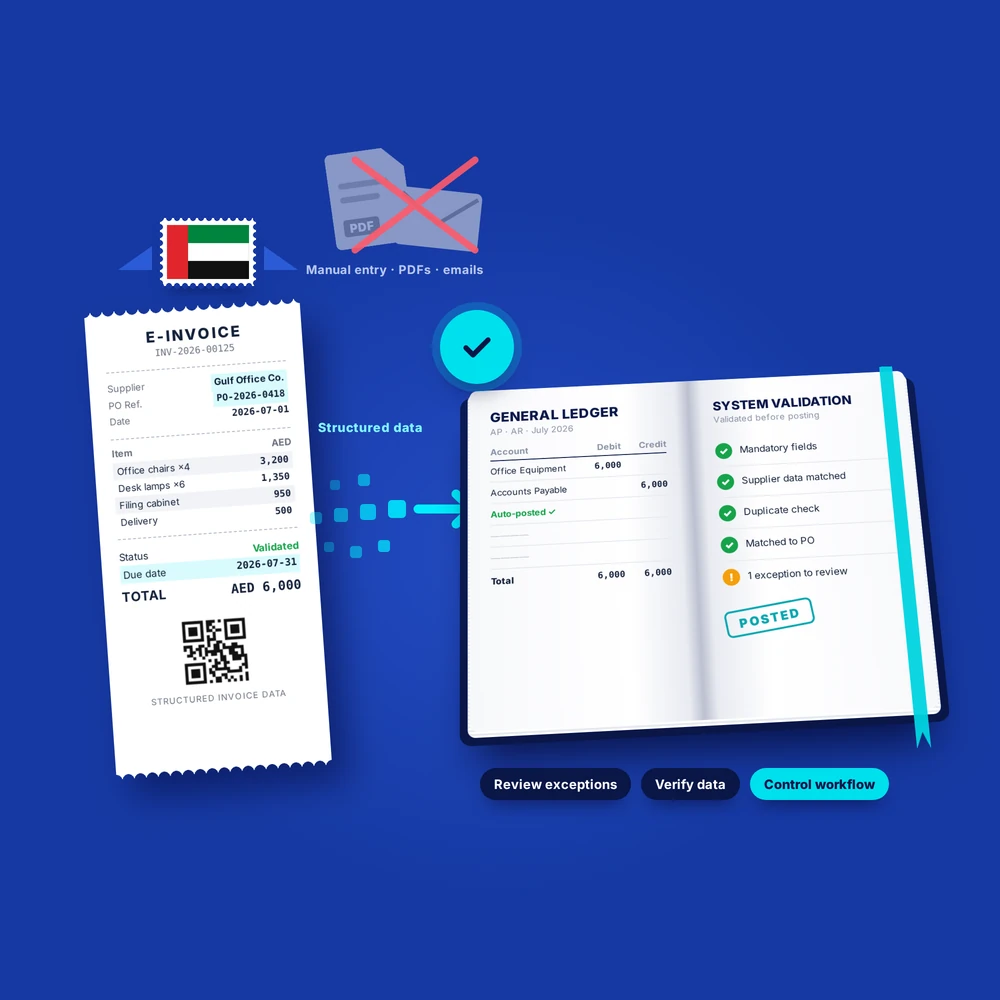
Instead of the traditional exchange formats like PDFs, emails, and manual bookkeeping workflows, businesses now work with structured invoice data that moves among systems in a standardized way. This shift will revolutionize the whole business workflow in the UAE. From bookkeeping to accounting teams handling manual entry or duplicating materials, e-invoicing is set to streamline the entire process with efficiency and automation.
The system is not intended to eliminate the human factor in the process, but rather to rationalize the intervention to limit errors. Accountants still need to ensure master data accuracy, which in turn determines the invoice validation and acceptance. Accounting and bookkeeping jobs have become more about ensuring data accuracy, VAT treatment, and system controls than about entering invoices.
This article explores the impact of e-invoicing systems on accounting and bookkeeping.
How will UAE e-Invoicing change accounting and bookkeeping workflows?
The UAE’s e-invoicing system will shift the whole accounting and bookkeeping workflows. By moving finance teams away from manual handling and towards a more structured, standardized approach to invoicing, including its processing, electronic exchange, validation, and exception management.
The traditional invoice exchange depended on PDFs or emails and manual data entry to move invoice data into the accounting system. This changes with the e-invoicing system; as of now, invoice data moves through a standardized electronic flow that ensures traceability and consistency throughout the exchange process.
It is also important to note that this system affects both the invoice issuer and recipient. Businesses not only generate invoices but also receive, process, validate, and reconcile them within their financial systems.
Here are some key workflow shifts:
| Traditional workflow | Electronic workflow |
| Manual invoice entry | Structured invoice data processing |
| Document-based review | System-based validation |
| Error correction after issuing | Validation before processing |
| Heavy administrative work | Exception-focused review |
This eases the burden on finance teams as it shifts their focus from repetitive administrative work and more into:
- Reviewing exceptions
- Monitoring data quality
- Managing workflow control
- Supporting compliance and readiness
This creates a bookkeeping flow focused on accuracy and control, rather than on manual entry loads.
Read our guide: E-Invoicing in UAE: Full Guide
What changes in invoice capture, posting, and day-to-day bookkeeping?
The UAE’s e-invoicing system has a huge impact on operational workflows, including the e-invoicing mandatory fields. As invoice information is structured, businesses will become less reliant on manual data re-keying. There is no longer a need for manual invoice data entry; instead, accounting systems can process information more efficiently through integrated workflows.
Invoice capture
Invoice capture is undergoing a major shift as it moves from a document-centered process to a data-centered one. Here is a breakdown of some of the challenges of traditional invoicing and the impacts of e-invoicing:
Traditional challenges:
Manual invoice entry
Duplicate data handling
Missing information
Inconsistent formats
Higher risk of errors
Electronic impacts:
Reduced manual data entry
Improved data consistency
Faster processing
Better validation before posting
Minimal administrative efforts
Posting workflows
As invoice information is validated early, posting activities are more streamlined.
Here is a before-and-after of the electronic invoicing:
| Before | After |
| Manual review of invoice data | Automated validation checks |
| Frequent correction cycles | Early error detection |
| Delayed posting | Faster processing and posting |
| High manual control dependency | High dependency on system control |
Bookkeeping role evolution
Bookkeeping role evolved from entry tasks, including:
Typing invoice data
Correcting formatting issues
Exchanging information between systems;
To more control-focused tasks, including:
Reviewing exceptions
Verifying data accuracy
Monitoring workflow performance
How will e-Invoicing affect accounts receivable and accounts payable?
Among the finance teams most affected by e-invoicing are accounts receivable and accounts payable.
Here is a breakdown of the e-invoicing impact on both teams:
Account receivable
E-invoicing systems improve how invoices are generated, delivered, tracked, and managed.
Accounts receivable teams will spend less time on
- Sending duplicate invoices
- Resolving formatting problems
- Correcting basic errors
And more time focusing on:
- Monitoring invoice status
- Managing exceptions
- Resolving validation issues
| Area | Impact |
| Invoice issuance | Faster processing and transmission |
| Delivery timing | More standardized exchange workflows |
| Disputes | Minimal errors and inconsistencies |
| Credit notes | Better structured processing |
| Processing time | Faster transition into accounting systems |
Account payable
An e-invoicing system standardizes invoice information in a consistent format. This greatly benefits the accounts payable teams and improves operations.
Faster approval routing
Less manual reviewing
More consistent credit-note processing
This does not take away from AP teams; it gives me time to focus on:
Exception handling
Validation failures
Workflow monitoring
This improves AP teams' efficiency as they concentrate on important review activities rather than repetitive administrative tasks.
How will e-Invoicing change reconciliations and the month-end close?
Reconciliations and month-end close are areas largely affected by the e-invoicing system. As invoice information is generated in a structured, standardized format, businesses can easily improve data consistency across systems while reducing the manual effort required to identify discrepancies.
Reconciliation improvement
Reconciliation becomes more time-consuming if the data is inconsistent or entered manually across different systems. Structured invoice data supports consistency across invoice transactions.
Reconciliation improvement areas:
| Area | Impact |
| Invoice matching | High accuracy |
| Invoice consistency | Fewer discrepancies |
| Error identification | Fast detection |
| Exception review | Great visibility |
| Supporting documentation | Better traceability |
| Close preparation | Improved efficiency |
Month-end close impact
The month-end close process usually takes time as finance teams correct errors, chase documents, or resolve inconsistencies. This changes with the e-invoicing system, as now businesses can benefit from:
- Faster reconciliation cycles
- Reduced manual corrections
- Improved close discipline
- Better audit support
Important caveat: businesses might still face reconciliation challenges and mismatches because of:
- Poor quality master data
- Incorrect tax data
- Integration issues
- Processing errors
Although improvements to reconciliation still depend on process readiness and data accuracy, they benefit finance teams by enabling them to focus more on reviewing exceptions. This means businesses can benefit from:
- Clean financial records
- Accurate reporting
- Efficient closed cycles
- Strong internal control
The Ministry of Finance in the UAE has stated in its official documentation that the system is intended to reduce processing costs, improve cash flow, and provide financial awareness to support decision-making.
What does UAE e-Invoicing mean for audit readiness, tax controls, and recordkeeping?
The e-invoicing system in the UAE was designed with objectives of improving transparency, traceability, and accountability in business transactions. Creating a structured, consistent invoice data record strengthens audit readiness, a necessity for finance teams.
Here is how e-invoicing strengthens audit readiness:
Strong transaction traceability
As traditional invoicing relied on PDFs, emails, scanned documents, and manual approvals, reconstructing transaction history for audits was a huge challenge.
A structured invoice workflow harmonizes invoice creation, validation, processing, accounting treatment, and storage. This helps businesses recognize how transactions moved through the system.
Easy retrieval of supporting evidence
Finance teams spend significant amounts of time gathering documentation for various reasons:
- Audits
- Tax reviews
- Compliance assessments
With standardized, structured invoice records, businesses can efficiently retrieve and collect information.
This eliminates the need to locate documents manually, thereby reducing the risk of errors.
Improved tax-control environment
The e-invoicing system supports stronger tax control by:
- Full data consistency
- Better validation practices
- Great process visibility
This closely relates invoice processing with tax compliance activities as part of everyday practices.
Conclusion table of challenging areas and e-invoice impact:
| Area | Impact |
| Audit trail | More traceable transaction history |
| Document retrieval | Fast access to invoice records |
| Record consistency | Low risk of missing information |
| Evidence quality | Strong supporting documents |
| Tax reviews | Better linkage between transaction and reporting |
| Internal controls | Great visibility into processing |
Why will master data and chart-of-transaction accuracy matter more?
A vital cornerstone of the e-invoicing system is data quality. No matter how advanced the invoice workflow, if the accounting data is incomplete or inconsistent, it will result in compliance issues. This makes it a critical responsibility for finance and bookkeeping.
Here are some important aspects affected by the master data quality:
Poor master data correlates with operational friction
Weak master data leads to:
- Invoice rejection
- Validation failure
- Delayed processing
Many businesses face processing problems because they fail to meet master data standards that feed the invoicing process.
Consistency equals less manual correction
E-invoicing encourages getting accurate information on the first go, so finance teams do not need to manually correct it during the process. This gives businesses more time to focus on:
- Maintain accurate customer records
- Standardize supplier information
- Review tax data quality
- Reduce unnecessary manual overrides
Master data responsibility team
A common misconception is that master data quality is the
responsibility of the ERP system or IT team alone. In fact, the finance team influences the records used during the processing. Successful e-invoicing readiness requires coordination and collaboration between finance, IT, accounting, tax, and the operations team.
The following table highlights the important data elements and their areas of significance:
| Data elements | Significance |
| Customer records | Accurate invoice issuance |
| Supplier records | Improved processing |
| Tax identifiers | Compliance accuracy |
| Product classification | Correct transaction treatment |
| Invoice scenarios | Reduce processing and validation errors |
| Line-level information | Improves reconciliation |
How will accounting roles and team responsibilities change?
Although e-invoicing is automation-heavy, it does not eliminate the need for finance expertise; it appoints it in more crucial areas. As invoicing becomes more standardized and structured, finance teams can spend more time focusing on oversight, validation, and exception management.
Here are some roles and how they would shift:
Bookkeeping
Bookkeeping shifts from manual entry-focused to control-focused. Bookkeepers will spend less time on:
- Entering invoice information
- Correcting formatting issues
- Manually transferring data among systems
And more time on:
- Reviewing validation status
- Monitoring exceptions
- Maintaining data quality
AR and AP teams
With structured and standardized invoice processing, AR and AP teams can focus more on:
- Status monitoring
- Processing visibility
- Exception resolution
This means their focus becomes more workflow-centric.
Team collaboration increases
As e-invoicing spans multiple departments, collaboration unites businesses’ efforts for compliance. This means finance teams work closely with:
- Tax specialists
- ERP administrators
- IT teams
- Operations team
Team collaboration ensures that invoice data, system integrations, and accounting treatment are perfectly aligned throughout the process.
The following table summarizes the shift in some business roles:
| Role | Traditional | Improvement |
| Bookkeeping teams | Manual entry and posting | Validation + exception review |
| AR teams | Invoice distribution + follow-up | Status monitoring + dispute resolution |
| AP teams | Manual invoice processing | Approval workflows + exception handling |
| Finance managers | Transaction review | Control oversight + performance monitoring |
| Tax teams | Post-processing reviews | Scenario accuracy + compliance alignment |
| IT/ERP teams | System maintenance | Integration + data-flow management |
What new accounting and bookkeeping challenges should businesses expect?
While e-invoicing systems promise more efficiency and visibility, it should not be viewed as friction-free. This introduces new challenges and rules that finance teams should be considering. Some of these challenges include:
Weak legacy data
Because the e-invoicing system is integrated, any information issue can affect the entire process. Businesses used to manually correct invoice data before posting, which is a hard issue to hide with the current system. Problems within the invoice data:
- Duplicate customer records
- Incomplete supplier information
- Inaccurate tax details
Will disrupt invoice processing and result in additional review work for the finance team.
Integration challenges
Businesses often operate multiple systems across accounting, ERP, sales, and procurement. This means they need proper integration to ensure the invoice flow goes smoothly. If integration fails, it would result in:
- Duplicate processing
- Delayed approvals
- Reconciliation issues
This is why system integration is a crucial step before implementation.
Daily exception handling
Invoice automation is meant to reduce repetitive tasks, but still finance teams need to handle situations such as:
- Rejected invoices
- Validation failure
- Approval issues
- Missing data
Accounting and finance teams are expected to investigate and resolve invoicing and processing issues.
Summary table of accounting and bookkeeping challenges:
| Challenge | Impact |
| Poor quality master data | Validation failure + processing delays |
| Legacy system limitations | Difficulty supporting workflows |
| Integration gaps | Inconsistent data across systems |
| Incorrect invoice classification | Processing error + compliance risk |
| Rejected invoices | Exception handling workload increase |
| Weak process discipline | Low efficiency |
How should finance teams prepare now?
As implementation timelines progress, businesses are advised to begin preparing for go-live. Preparations should include understanding workflows, identifying weaknesses, improving data quality, and ensuring the system supports compliance. Finance and bookkeeping teams should:
Map current invoice workflows
This is important for identifying hidden issues within their existing process. Finance teams should review:
- How invoices are created
- How are they approved
- How corrections are done
- How information moves among systems
Review master data quality
A structured invoice demands accurate information to process, making early assessment a must. Data elements worth reviewing:
- Customer & supplier records
- Tax details
- Transaction classification
- Product information
Ensuring data quality before go-live is crucial to the success of future validation.
Identifying manual workarounds
In structured systems, workarounds may cause more problems than they solve. Many businesses rely on them to keep the workflow going, including:
- Duplicate data entry
- Manual corrections
- Email approval chains
This should not be the case when working with a standardized, structured exchange system like the UAE’s.
Confirm system capability
Businesses should ensure that their ERP/accounting/invoicing system can support e-invoicing requirements. Some questions to consider to ensure your system readiness:
- Can the system consistently capture the required invoice data?
- Can workflows support validation and exception handling?
- Can integration be maintained across systems?
This is crucial for identifying gaps before the implementation phase.
Align finance, tax, and IT teams
As e-invoicing affects multiple departments, the finance team should be working closely with:
- Tax specialist
- Procurement
- IT teams
- Operations
This supports integration within the organization and therefore the exchange process.
Test end-to-end invoice scenarios
Businesses are advised to test complete workflows, including:
- Invoice creation
- Approvals
- Credit notes
- Reconciliation processes
- Exception handling
- Reporting outcomes
This helps businesses identify their weaknesses and address them before go-live.
Businesses are eager to review their readiness, including their ERP/accounting/invoicing systems, to ensure clean workflows and strong integration. Daftra offers secure invoice exchange and successful tax reporting in full compliance with FTA requirements.
Read more: E-Invoicing Compliance Checklist for UAE
Frequently asked questions about e-Invoicing and accounting/bookkeeping impact
What is the impact of an e-invoice?
E-invoicing in the UAE is bound to shift businesses' workflow. It is aimed to increase operational efficiency, reduce VAT leakage, and align UAE businesses with international trading environments.
How does e-invoicing affect audits?
E-invoicing in the UAE simplifies audits by providing structured, standardized invoice data and direct transmission channels. This encourages transparency and traceability.
Is invoicing part of bookkeeping?
Yes, bookkeeping involves recording daily transactions, including issuing invoices.
Is invoicing part of accounting?
Yes, invoicing is the primary transaction record that triggers accounts receivable. Also, invoice data is used to prepare financial statements and to analyze overall business performance.
How does e-invoicing save money?
The e-invoicing system saves UAE businesses by eliminating manual human intervention, which leads to errors and, in turn, costs money. It also cuts administrative work and processing costs.
What are the challenges of e-invoicing?
The UAE’s e-invoicing system requires businesses to understand and overcome some challenges, including:
- Understanding of the core principles of the system
- Adhering to strict regulations and compliance requirements
- Keeping up with phased enforcement deadlines
- Data governance gap
System integration issues









 Invoicing
 POS
 Offers
 Installments
 Sales Commission
 KSA E-Invoice Software
 EGY E-Invoice Software
 JO E-Invoice Software
 E-Invoice Software
 Chart of Accounts
 Asset Management
 Cost Centers
 Expenses
 Cheque Cycle
 UAE VAT-Tax
 Product Management
 Purchases
 Purchase Cycle
 Suppliers
 Requisitions
 Stocktaking
 Organizational Structure
 Personnel Management
 Attendance and Leave
 Contracts
 Payroll
 Requests
 Work Orders
 Booking Management
 Rental and Unit Management
 Time Tracking
 Work Flow
 Lease Contracts
 Manufacturing Management
 Client Follow-Up
 Loyalty Points
 Points and Credits
 Memberships
 Insurance Management
 Daftra ERP Full App
 Point of Sales App
 Point of Sales for Desktop – Support Offline Mode
 AI Expenses Scanner App
 Employee Attendance, Sign & ESS App
 E-invoice Reader App
 Inventory Stocktaking App