



Table of contents:
- Key Summary
- What is the UAE e-Invoicing public consultation document?
- Why did the Ministry of Finance release the consultation document?
- What did the consultation document propose for UAE e-Invoicing?
- What is the DCTCE model mentioned in the consultation paper?
- What did the consultation document say about the Data Dictionary and PINT AE?
- What use cases were included in the consultation document?
- What feedback did the MoF ask stakeholders to provide?
- Why was the consultation document important for businesses at the time?
- What changed after the consultation document release?
- What should businesses take away from the consultation document today?
- Conclusion
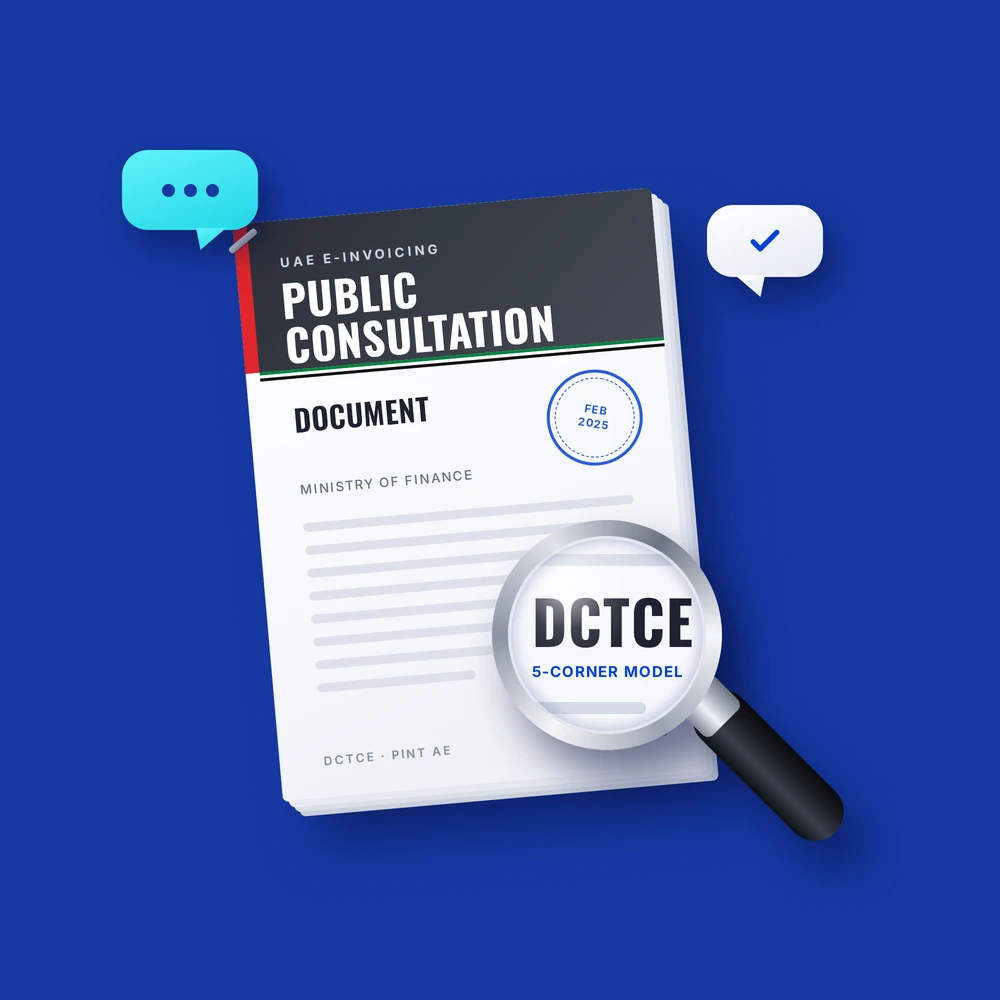
Before the UAE published the e-invoicing guidelines, a very important document was released: the Public Consultation Document, considered a crucial milestone in the e-invoicing system. The document, from the Ministry of Finance, concerns the e-invoicing program and aims to assess the market affected by the decision.
The Public Consultation Document was the first point of visibility for the UAE's e-invoicing requirements. The main purpose of the document was to gather feedback about the proposed e-invoicing framework from UAE businesses, e-invoicing service providers, accounting firms, and software vendors.
This release was particularly important in all aspects and for all concerned parties. Businesses operating in the UAE can finally see the proposed framework, which is essential to begin internal preparations, and stakeholders can also review the proposed data requirements.
The release of the Public Consultation document has invited significant interactive feedback across the business and commercial environment in the UAE.
Despite the huge hit it caused upon its release, the consultation document is not the current source for implementation. The document was released in February of 2025, with a feedback due date of the 27th of February 2025, now closed. The MoF’s guidelines are the official documentation for the e-invoicing system in the UAE.
This article is your 101 guide on everything you need to understand about the Public Consultation Document release.
What is the UAE e-Invoicing public consultation document?
The UAE Public Consultation document is a 168-page paper released by the Ministry of Finance in February 2025 as a part of the country’s broader e-invoicing initiative. The document was released to provide visibility into the proposed e-invoicing framework for businesses, software providers, tax professionals, and other stakeholders, ahead of the official guidance release and the model implementation phase.
The consultation paper introduced core principles and approaches that define the electronic invoicing system. The document introduced the proposed e-invoicing framework, the Decentralized Continuous Transaction Control and Exchange (DCTCE) model, and the data dictionary known as the PINT AE format, all of which are part of a single integrated invoice exchange system.
Although it is not the final legal rulebook, the document functions as a tool to help businesses understand what’s upon them and what they need to prepare for. The Ministry of Finance successfully used the document to gather stakeholder input about the proposed data requirements, operational practicality, and invoicing scenarios before the later guideline release.
Why did the Ministry of Finance release the consultation document?
The Ministry of Finance released the document to publicly build a shared understanding about the e-invoicing system and its implementation phases. Since the documentation aimed at gathering feedback before finalizing the e-invoicing framework directly affects accounting systems, ERP platforms, tax reporting workflows, and invoice processing practices across the UAE business environment.
By publishing the document declaring the proposed structure before the guidelines were issued, the Ministry of Finance has given businesses time to begin preparing their systems for e-invoicing compliance and go-live. Also assess whether their accounting systems and ERP software can meet strict requirements for invoice generation.
As the consultation sought detailed stakeholders' input about the practicality of the proposed framework, the feedback was on the following:
- Are mandatory fields sufficient?
- If additional fields are needed for certain industries?
- Is there any contradiction between the requirements? and operational realities?
- Would the terminology or the coding structure create any future difficulties?
Beyond feedback, the Ministry of Finance used the document to identify potential gaps that might affect the implementation of the e-invoicing system and to improve clarity before releasing the official guidelines.
What did the consultation document propose for UAE e-Invoicing?
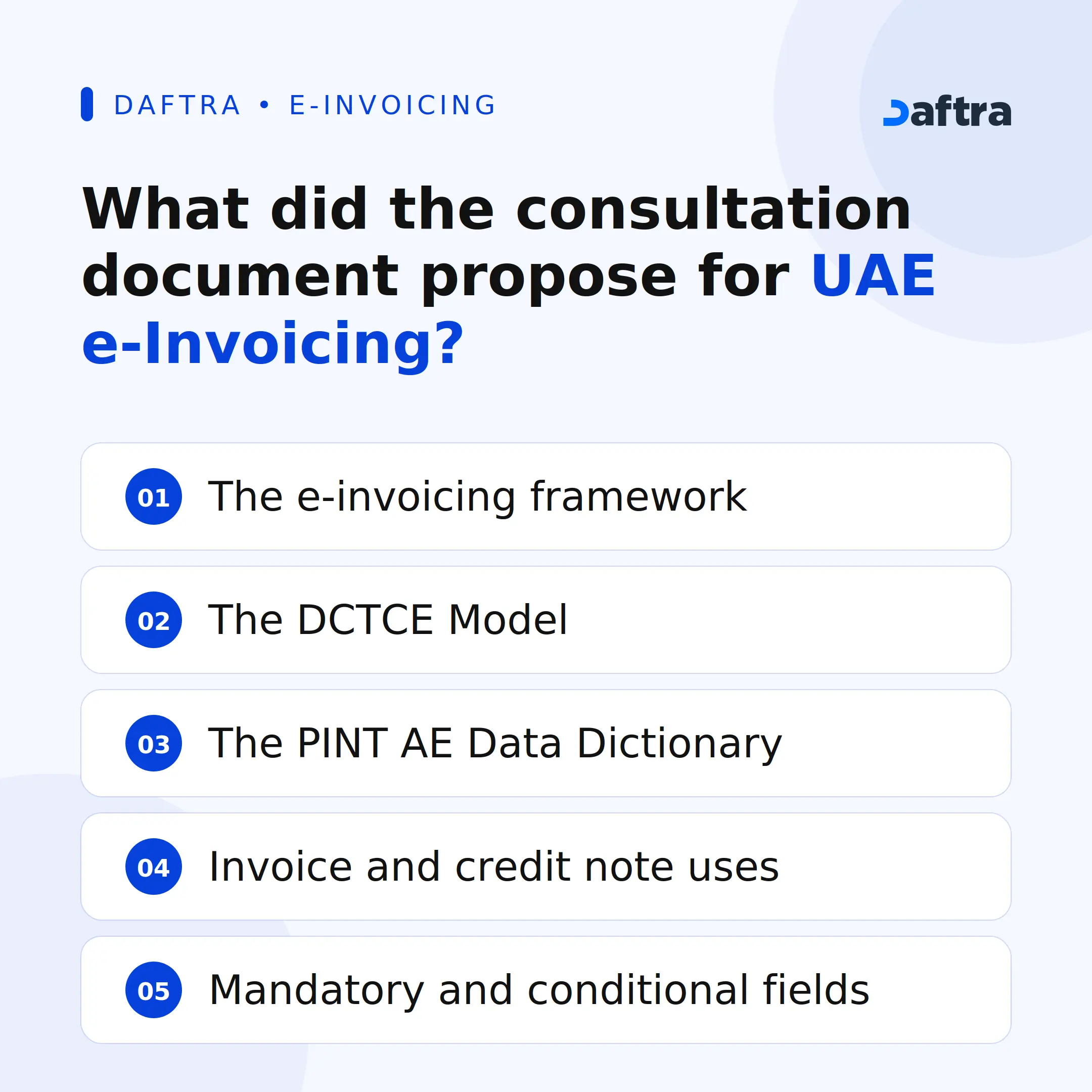
The Public Consultation document proposed the fundamental structure of the UAE’s e-invoicing ecosystem. Laying down how invoices should be exchanged, how it is structured, and through what mediums.
Here is a breakdown of everything the Public Consultation Document entails:
The e-invoicing framework
It established how invoices should be generated, exchanged, validated, and reported across systems. Intended to support tax compliance according to the Federal Tax Authority, interoperability, and digitizing business processing.
The DCTCE Model
The Decentralized Continuous Transaction Control and Exchange model enables secure, real-time, and digital invoice exchange between businesses through an interconnected ecosystem.
The PINT AE Data Dictionary
It defined how invoice information should be structured, organized, and standardized across invoice types and transaction scenarios, creating consistency across different business sectors.
Invoice and credit note uses
The documentation included multiple invoice and credit note use cases covering commercial scenarios, including:
- Exports
- Free zone trade transaction
- Zero-rated supplies
- Disclosed agent billing
- Deemed supply
This is intended to cover different operational environments.
Download: Electronic Export Invoice Template
Mandatory and conditional fields
The document proposed the treatment of mandatory and conditional fields for the invoices and credit notes, focusing on the overall view rather than an implementation specification.
Download: Tax invoice format uae template
What is the DCTCE model mentioned in the consultation paper?
The DCTCE (Decentralized Continuous Transaction Control and Exchange) model is a UAE 5-corner e-invoicing system, and is considered a cornerstone of the e-invoicing system, first introduced in the consultation paper. The DCTCE model proposed a decentralized framework in which electronic invoices are exchanged through a Peppol-accredited service provider in real time.
This phase of the invoicing system, the consultation paper, is designed to support invoice exchange, structured in accordance with FTA requirements, and to support interoperability between systems.
The mention of the DCTCE model is significant not only for its role in the e-invoicing system but also for giving businesses an idea of how the system is structured. The early public release of the consultation paper also benefited the UAE business community, as it gave them an early view of what they need to understand about the system, evaluate their own system capabilities, and assess their e-invoicing exchange readiness.
It is important to note that the consultation paper only introduced the DCTCE model at a conceptual level; the implementation and practical details are much more precise in the later documentation release, the guidelines.
What did the consultation document say about the Data Dictionary and PINT AE?
The Consultation document presented the Data dictionary of the e-invoicing system, known as the PINT AE format. Under the e-invoicing system, PINT AE is introduced as the structured catalog of data elements that aids the generation, exchange, processing, and reporting of invoices across systems.
As per the consultation document, PINT AE aims to standardize the data elements across different transaction scenarios and business environments. This is crucial for eliminating variation in invoice data across systems, thereby enforcing consistency in invoice terminology and content.
The paper also outlined how mandatory and conditional fields would be presented within the framework. While the consultation document focuses on the core concept and structure, the latter documentation goes into detail on the implementation specifications.
The PINT AE, as presented in the consultation paper, is revolutionizing how invoice data is perceived and establishing invoice generation as a distinct prompt rather than a simple PDF or file.
What use cases were included in the consultation document?
The consultation paper presented 16 use cases covering a wide range of common business and tax scenarios that the proposed e-invoicing framework would support. These scenarios include:
- Standard tax invoices
- Commercial invoices
- Self-billing arrangements
- Export transactions
- E-commerce activities
- Margin-scheme transactions
- Free-trade-zone supplies
- Disclosed-agent billing situations
The UAE’s invoice framework is designed to cover various commercial activities rather than a simple invoice flow.
Download: Commercial Invoice Template
As part of the public release of the consultation document, the use cases play a vital role in providing businesses with early visibility into how the system would be applied in operational environments. This gave businesses an opportunity to evaluate their systems for invoice-generation readiness, ERP configuration, and alignment of transaction structures with the requirements.
You can read also: UAE e-Invoicing Frequently Asked Questions
What feedback did the MoF ask stakeholders to provide?
Why was the consultation document important for businesses at the time?
The consultation document for businesses served as a magnifying glass on how the e-invoicing system would be structured. It directly addressed businesses’ concerns about how it would affect;
- Invoicing operations
- Accounting systems
- Tax processes
- Data management requirements
Upon its release, the consultation paper was the first indication of the operational and technical changes underway in the invoice exchange process. It provided early visibility into;
- Structured data requirements
- Invoice standardization expectations
- Different transaction scenarios
This allowed businesses to evaluate their ERP systems, and invoicing workflows could properly handle invoice generation up to the requirements.
The e-invoicing system highlighted the automation and interoperability in tax and invoice exchange processes, meaning that compliance entails cleaner data structures, consistent data format, and integration between invoicing and accounting systems.
The consultation phase was every UAE business's opportunity to evaluate and update its system, processes, operational readiness, and alignment with FTA rules. (Daftra supports FTA-approved e-invoices generation in full alignment with the phased rollout requirements)
What changed after the consultation document release?
What should businesses take away from the consultation document today?
After the release of the latter documentation and guidance, the consultation paper's purpose shifted from being a publication to serving as a strategic reference point.
There are a few takeaways. from the consultation paper:
- Plays a crucial role in understanding the original policy logic behind the UAE’s e-invoicing framework.
- Establishes the importance of structured standards such as PINT AE.
- Helped the Ministry of Finance gather feedback prior to implementation.
- Provides a context on why the framework includes use cases, standardized data structures, and invoice requirements across different transaction scenarios.
- Businesses with the document have a clear understanding of how the e-invoicing system developed and how feedback aided the framework's evolution.
It is important to understand that businesses preparing for implementation can not rely on the consultation paper alone. It served as a preview of the system; however, since its release, the invoicing system has progressed into a more developed stage of implementation and readiness, supported by more detailed guidelines and technical documentation.
For businesses preparing for go-live, the focus should shift to reviewing the invoice workflow, improving structured data quality, and eliminating manual processing. E-invoicing software or ERP systems like Daftra improve e-invoicing process readiness, reduce manual work, and enhance compliance with FTA requirements.
Conclusion
The consultation paper was a crucial step in the e-invoicing releases. Publicly sharing the core concepts and structures of the e-invoicing system in the UAE, giving businesses a preview of what the system would entail.
The document also aimed to gather stakeholder feedback on the operational invoicing workflow to inform later advances to the framework.
The paper was the first to introduce the Decentralized Continuous Transaction Control and Exchange model (DCTCE) as an essential part of the system, which proposes invoice exchange through accredited service providers in real time or near real time. It also proposed the Data Dictionary for invoices known as PINT AE, which standardizes data elements across different transaction scenarios. The paper also introduces 16 use cases that the e-invoicing system is intended to cover, which goes to show businesses how the system is applied in real-life operations. The consultation document helped businesses understand the e-invoicing system in its early stages and gave them time to prepare before implementation began.











 Invoicing
 POS
 Offers
 Installments
 Sales Commission
 KSA E-Invoice Software
 EGY E-Invoice Software
 JO E-Invoice Software
 E-Invoice Software
 Chart of Accounts
 Asset Management
 Cost Centers
 Expenses
 Cheque Cycle
 UAE VAT-Tax
 Product Management
 Purchases
 Purchase Cycle
 Suppliers
 Requisitions
 Stocktaking
 Organizational Structure
 Personnel Management
 Attendance and Leave
 Contracts
 Payroll
 Requests
 Work Orders
 Booking Management
 Rental and Unit Management
 Time Tracking
 Work Flow
 Lease Contracts
 Manufacturing Management
 Client Follow-Up
 Loyalty Points
 Points and Credits
 Memberships
 Insurance Management
 Daftra ERP Full App
 Point of Sales App
 Point of Sales for Desktop – Support Offline Mode
 AI Expenses Scanner App
 Employee Attendance, Sign & ESS App
 E-invoice Reader App
 Inventory Stocktaking App