




Table of contents:
- What Are Accounting Certifications?
- 1. Certified Management Accountant (CMA)
- 2. Chartered Financial Analyst (CFA)
- 3. Certified Public Accountant (CPA)
- 4. Certified Internal Auditor (CIA)
- 5. Certified Fraud Examiner (CFE)
- 6. Certified Information Systems Auditor (CISA)
- 7. Association of Chartered Certified Accountants (ACCA)
- 8. IFRS Diploma
- 9. Financial Risk Manager (FRM)
- Other Accounting and Finance Certifications
- Frequently Asked Questions About Accounting Certifications
- Conclusion
Organizations and companies place great emphasis on human resources, seeking the most qualified individuals to improve workforce productivity and efficiency.
To achieve this goal, organizations strive to help employees reach the highest possible levels of productivity and efficiency. This begins with the recruitment team selecting and hiring qualified professionals, while also providing them with the skills and experience required to perform their roles effectively.
An employee’s performance depends largely on both their willingness to work and their ability to perform their responsibilities. This ability is reflected in the knowledge, experience, skills, and competencies they possess.
This is where professional accounting certifications come in. These certifications equip individuals with the knowledge and skills they need while aligning their expertise with job-market requirements. As a result, they can play an important role in building and advancing their professional and career paths.
Numerous recognized professional accounting certifications can help accountants develop their skills and expertise and achieve higher levels of competence and proficiency in their work.
In this article, we will explore some of the most prominent and important accounting certifications.
What Are Accounting Certifications?
Accounting certifications are professional credentials specialized in accounting and designed to meet the needs of the financial and business sectors. They combine theoretical knowledge with a practical focus on applying accounting concepts and developing hands-on professional experience.
These certifications can help professionals build their careers, qualify for better job opportunities, increase productivity, and potentially improve earning potential.
Below are some of the most prominent recognized accounting certifications:
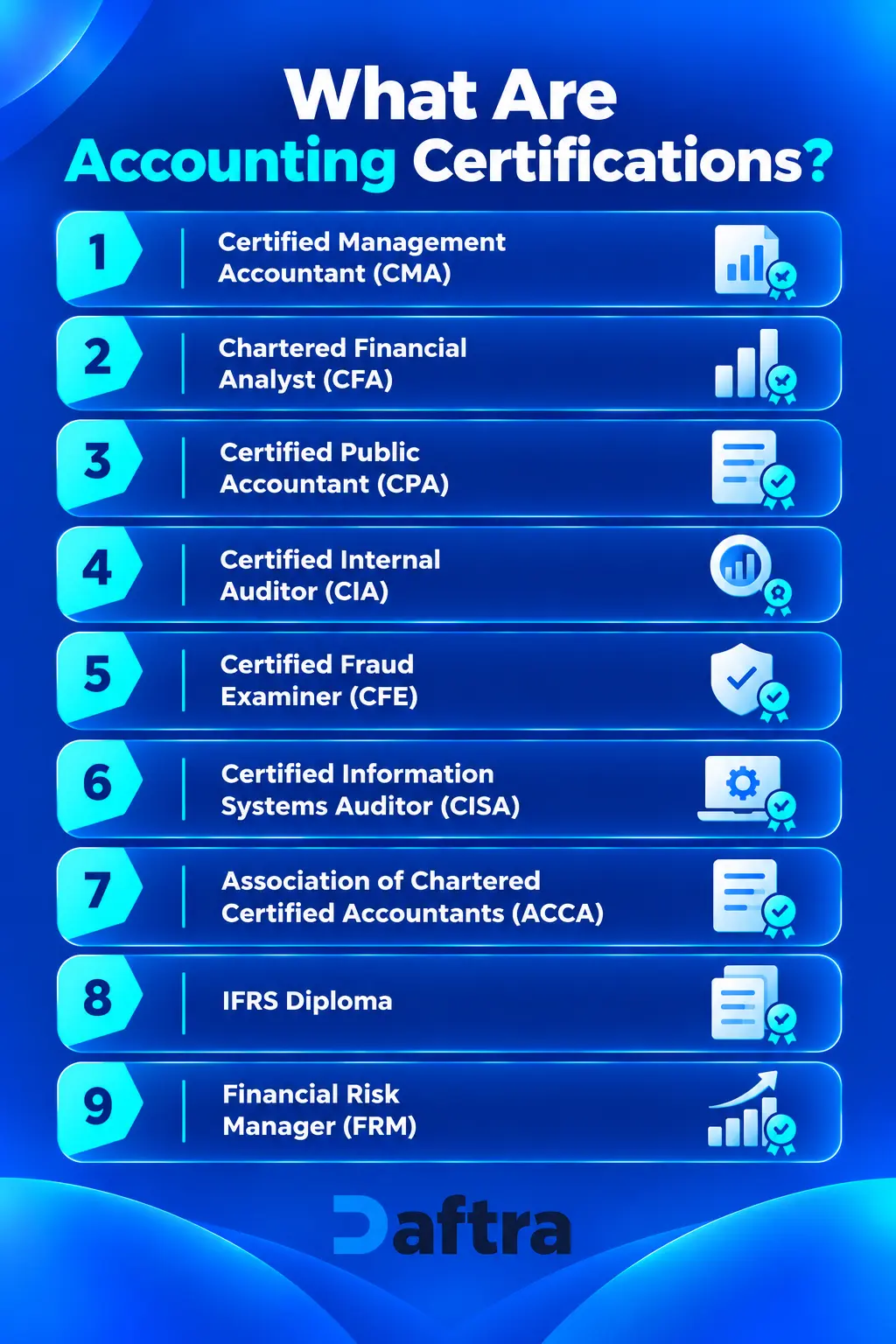
1. Certified Management Accountant (CMA)
The Certified Management Accountant (CMA) is a globally recognized professional certification offered by the Institute of Management Accountants (IMA). The certification develops professionals’ expertise in management accounting and financial management, with a strong focus on the skills needed for strategic decision-making.
As one of the world's leading accounting certifications, the CMA covers a wide range of financial and non-financial skills and knowledge that accountants and financial professionals can use in their work. The certification addresses several key areas, including financial planning, analysis, performance management, and control.
The CMA certification matters because it is relevant to professionals in management and senior-level business roles. It helps them better understand a company’s financial position and future outlook, supporting stronger strategic and managerial decision-making.
CMA Exam Content
The CMA certification provides international recognition to professionals who meet its requirements, demonstrating their expertise in management accounting and strategic financial management.
Career Opportunities for Certified Management Accountants (CMA )
The Certified Management Accountant (CMA) certification makes holders eligible for membership in the Institute of Certified Management Accountants (ICMA) and can support advancement into senior management roles at leading companies and organizations.
Some of the key career opportunities for CMA holders include:
- Certified Financial Planner or Financial Consultant
- Executive and senior management positions
- Compliance Officer
- Cost Management positions
- Strategy roles
- Supervisor and Controller positions
CMA Training Providers
Some of the training providers that offer CMA preparation programs include:
- Institute of Management Accountants (IMA)
- LEORON Professional Development Institute
- Elegant Training Center
- INACT House
- ICMA – Institute of Certified Management Accountants
How to Earn the CMA Certification
Candidates seeking the CMA certification must meet several eligibility requirements and complete the required examination process. Key requirements and steps include:
- Hold a bachelor’s degree or an eligible professional qualification from an accredited institution.
- Have at least two years of professional experience in management accounting or financial management.
- Study the CMA curriculum, which is divided into two exam parts.
- Complete the certification requirements within the specified eligibility period.
- Pass both CMA exam parts with a minimum score of 360 out of 500 on each part.
2. Chartered Financial Analyst (CFA)
The Chartered Financial Analyst (CFA) designation is an internationally recognized professional credential developed and administered by the CFA Institute. It assesses candidates’ ability to apply financial analysis and investment concepts in real-world situations and is widely recognized in the investment and financial services industry.
CFA Program Content
The CFA Program consists of three levels that cover a broad range of investment and financial topics:
- Level I: Knowledge and Understanding – Covers investment tools, ethical and professional standards, and foundational concepts.
- Level II: Analysis and Application – Focuses on asset valuation and applying investment analysis techniques.
- Level III: Evaluation and Portfolio Management – Covers portfolio management and the application of investment strategies and standards.
Career Opportunities for CFA Charterholders
Professionals working in corporate management, financial analysis, and investment often pursue the CFA Program to develop internationally recognized analytical and investment skills.
Career opportunities for CFA charterholders include:
- Corporate or institutional leadership roles
- Financial Analyst
- Equity or Asset Management
- Asset and Business Valuation
- Investment Management in Banks
- Corporate Financial Consultant
- Portfolio Manager
- Research Analyst
CFA Training Providers
Organizations and institutions that offer CFA preparation programs include:
- The American University in Cairo (AUC)
- CFA Society Egypt
- CFA Institute
How to Earn the CFA Charter
The CFA Program has specific eligibility and examination requirements. Key requirements include:
- Hold a bachelor’s degree or an equivalent qualification, or meet the CFA Institute’s alternative eligibility requirements.
- Meet the applicable education or professional experience requirements set by the CFA Institute.
- Have a sufficient level of English proficiency to study and take the examinations.
- Successfully complete the three levels of the CFA Program.
- Pass the exams at each level and meet the requirements to earn the CFA charter.
3. Certified Public Accountant (CPA)
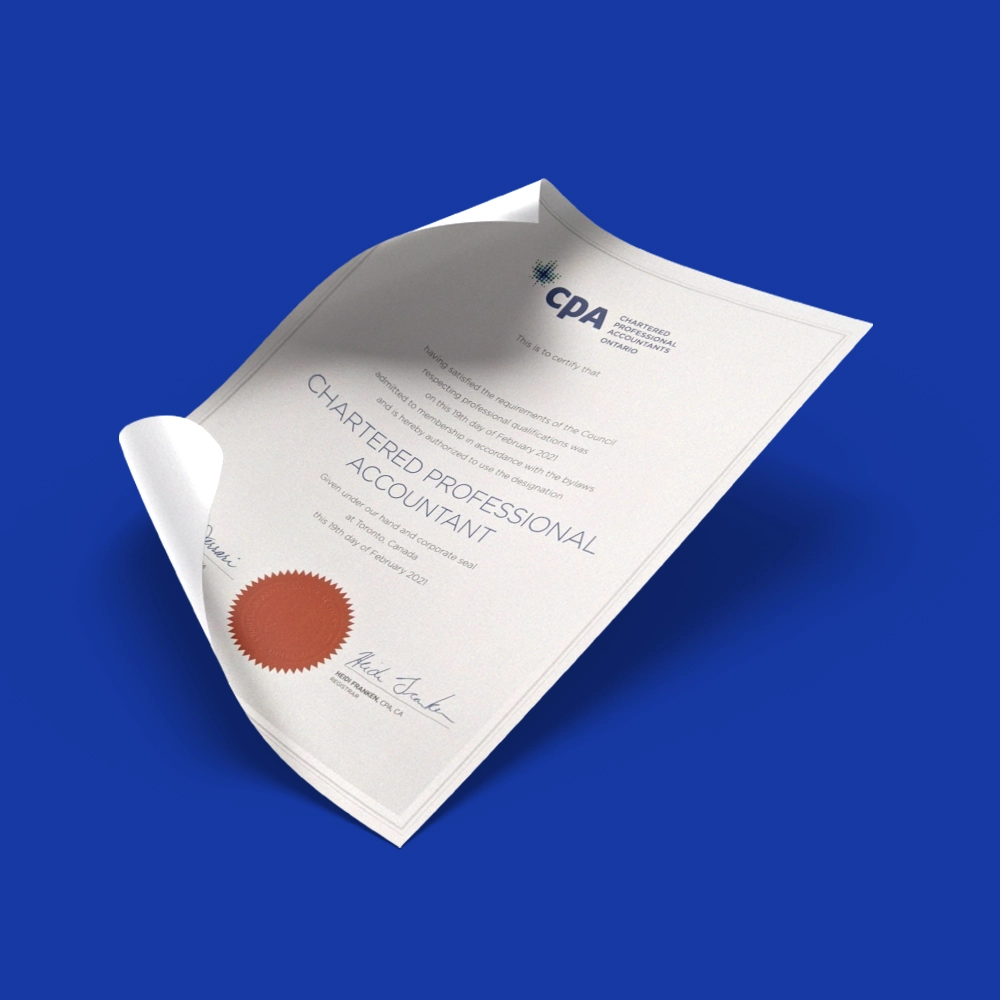
The Certified Public Accountant (CPA) is one of the most well-known professional accounting credentials. In the United States, individual state boards of accountancy issue the CPA license rather than a single national institute. The qualification builds expertise in auditing, financial reporting, taxation, and accounting regulations.
CPA Exam Content
The CPA Exam covers four core sections:
- Auditing and Attestation (AUD)
- Financial Accounting and Reporting (FAR)
- Regulation (REG)
- Business Analysis and Reporting (BAR)
Career Opportunities for CPA Professionals
The CPA credential can open the door to a wide range of accounting and auditing careers and is particularly relevant to professionals working in accounting firms, corporations, and financial institutions.
Career opportunities include:
- Bookkeeping and accounting
- Tax preparation and tax compliance
- Public and corporate accounting
- Management accounting
- Forensic accounting
- Auditing
CPA Training Providers
Organizations and training centers that offer CPA preparation programs include:
- The American University in Cairo (AUC)
- Morgan International Egypt
- Center for Administrative and Accounting Expertise
- Amideast
How to Earn the CPA License
CPA licensure requirements vary by U.S. jurisdiction because each state or jurisdiction sets its own eligibility and licensing requirements. Generally, candidates must:
- Meet the applicable educational requirements.
- Fulfill the required accounting and professional experience requirements, where applicable.
- Pass all four sections of the CPA Exam.
- Meet the specific licensing requirements of the relevant state board of accountancy.
4. Certified Internal Auditor (CIA)
The Certified Internal Auditor (CIA) is an internationally recognized professional certification offered by The Institute of Internal Auditors (IIA). Earning the CIA demonstrates professional knowledge and competence in internal auditing and related areas such as governance, risk management, and internal controls.
CIA Exam Content
The CIA certification covers key areas of internal auditing through the following parts:
- Part 1: Essentials of Internal Auditing – Covers the foundations of internal auditing, governance, risk management, and control.
- Part 2: Practice of Internal Auditing – Focuses on performing internal audit engagements.
- Part 3: Business Knowledge for Internal Auditing – Covers business concepts, data analytics, and information technology.
Career Opportunities for CIA Professionals
The CIA certification is particularly relevant to professionals working in internal audit, financial and operational auditing, risk management, and compliance. It can also benefit graduates and professionals with backgrounds in accounting, business, and management.
Career opportunities include:
- Executive and management positions
- Internal Audit Manager
- Government Audit Manager
- Financial Manager
- IT Audit and Compliance roles
CIA Training Providers
Organizations and training centers that offer CIA preparation programs include:
- The American University in Cairo (AUC)
- Elegant Training Center
- MCC Academy
- Institute of Internal Auditors (IIA)
How to Earn the CIA Certification
Candidates seeking the Certified Internal Auditor (CIA) certification must meet the eligibility requirements established by The Institute of Internal Auditors (IIA). These requirements may include:
- A bachelor’s degree and two years of professional experience in internal auditing.
- A master’s degree and one year of professional experience in internal auditing.
- An approved diploma or equivalent qualification, along with five years of relevant professional experience.
- A professional character reference from a CIA-certified professional or another eligible reference.
- Passing the CIA examination.
5. Certified Fraud Examiner (CFE)
The Certified Fraud Examiner (CFE) is a leading professional certification in fraud examination. The Association of Certified Fraud Examiners (ACFE) offers it and focuses on developing professionals’ ability to prevent, detect, and investigate fraud, helping organizations protect their assets and reduce the impact of fraudulent activities.
CFE Exam Content
The CFE Exam covers four main areas:
- Fraud Prevention and Deterrence
- Financial Transactions and Fraud Schemes
- Investigation
- Law
Career Opportunities for CFE Professionals
CFE professionals can pursue a variety of careers, including:
- Internal Auditor
- Fraud Examiner or Investigator
- Roles in banking and insurance
- Bookkeeper
- Fraud Risk and Compliance Specialist
CFE Training Providers
Organizations and training providers that offer CFE preparation programs include:
- ACFE Egypt Chapter
- The American University in Cairo (AUC)
- European Institute of Management and Finance
How to Earn the CFE Certification
Candidates seeking the CFE certification must meet the eligibility requirements established by the ACFE. Key requirements include:
- Becoming a member of the Association of Certified Fraud Examiners (ACFE).
- Holding a bachelor’s degree, or substituting relevant professional experience for the required education.
- Having at least two years of professional experience in a fraud-related field, such as accounting, auditing, law, or fraud investigation.
- Passing the CFE Exam with the required minimum score.
6. Certified Information Systems Auditor (CISA)
CISA stands for Certified Information Systems Auditor, a professional certification offered by ISACA.
The CISA certification is widely recognized among information systems audit, control, and security professionals. It is particularly relevant to audit managers, IT auditors, information security professionals, and consultants.
CISA Exam Content
The CISA examination consists of 150 questions and is designed to assess candidates’ knowledge across several key areas of information systems auditing and security.
The certification covers topics such as:
- Information systems auditing
- IT governance and management
- Information systems acquisition, development, and implementation
- Information systems operations and business resilience
- Protection of information assets
- Information systems auditing and monitoring
- IT service management and support
- Business continuity and disaster recovery
- Information systems governance
Career Opportunities for CISA Professionals
The CISA certification can provide professionals with a competitive advantage in the job market by demonstrating expertise in information systems auditing, risk management, compliance, and information security.
Career opportunities include:
- Information Security Engineer
- Information Security Analyst
- Information Security Manager
- Risk and Compliance Manager
- IT Audit Manager
- Information Systems Audit Manager
CISA Training Providers
Organizations and training centers that offer CISA preparation programs include:
- Information Systems Institute (ISI)
- GFD Egypt
- Center for Studies and Development of Computer and Information Systems
- ISACA
How to Earn the CISA Certification
Candidates seeking the CISA certification must meet ISACA’s eligibility requirements and pass the CISA examination. The requirements include:
- At least five years of professional experience in information systems auditing, control, or security, subject to ISACA’s applicable experience requirements and substitutions.
- Certain combinations of education and professional experience may qualify for experience waivers.
- Maintaining the required continuing professional education (CPE) hours after certification.
- Passing the CISA examination with a scaled score of at least 450.
7. Association of Chartered Certified Accountants (ACCA)
The Association of Chartered Certified Accountants (ACCA) is a globally recognized professional accountancy qualification. It develops comprehensive knowledge and practical skills across accounting, finance, taxation, auditing, financial management, and business.
The ACCA qualification covers a broad range of topics related to the financial and business environment, including taxation and financial advisory services.
Earning the ACCA qualification demonstrates professional knowledge and competencies that can support careers across various sectors, including:
- Banking
- Insurance
- Taxation
- Audit and assurance
- Financial consulting
- Financial management
- Legal and business advisory services
ACCA members and affiliates can pursue a wide range of accounting and finance roles in organizations and businesses around the world.
ACCA Qualification Structure and Content
The ACCA Qualification is a globally recognized professional accountancy qualification. It combines examinations with practical experience and an ethics and professional skills component.
The qualification covers the following areas:
Career Opportunities for ACCA Professionals
The ACCA qualification is aligned with internationally recognized accounting and auditing practices and can support careers across a wide range of sectors.
Career opportunities include:
- Working in industries such as manufacturing, banking, audit, taxation, consulting, and financial services
- Working as an accountant or finance professional
- Holding senior management positions in strategic management, finance, or accounting
- Working in the public sector
ACCA Training Providers
Organizations that offer ACCA preparation and training programs include:
- The American University in Cairo (AUC)
- British Council
How to Earn the ACCA Qualification
The requirements for pursuing the ACCA Qualification depend on the candidate’s educational background and entry route. Key considerations include:
- Having a good command of English to study the qualification and take the examinations.
- Meeting the applicable academic entry requirements or starting through the appropriate foundation-level route.
- Completing the required ACCA examinations.
- Completing the Ethics and Professional Skills Module.
- Fulfilling the Practical Experience Requirement (PER).
8. IFRS Diploma
The DipIFR – Diploma in International Financial Reporting is a professional qualification offered by ACCA. It is designed to develop professionals’ understanding of International Financial Reporting Standards (IFRS) and their practical application.
The program focuses on understanding the principles underlying IFRS, applying relevant financial reporting requirements, and preparing and presenting financial statements in accordance with international standards.
IFRS Diploma Content
The DipIFR examination assesses candidates’ understanding of several key areas, including:
- The conceptual and regulatory framework
- Elements of financial statements
- Presentation and additional disclosures
- Consolidated financial statements
Career Opportunities for IFRS Diploma Holders
The DipIFR is particularly useful for accounting and finance professionals who want to strengthen their technical and practical knowledge of IFRS and advance their careers.
Potential career paths include:
- Financial Controller
- IFRS Specialist
- External Auditor
- Financial Reporting Specialist
IFRS Diploma Training Providers
Organizations and institutions that offer IFRS training and preparation programs include:
- British Council
- The American University in Cairo (AUC)
- ACCA
How to Earn the IFRS Diploma
Candidates seeking the DipIFR must meet the applicable eligibility requirements. These may include:
- Being an ACCA member or meeting one of the alternative eligibility routes established by ACCA.
- Relevant professional experience in accounting or finance.
- A good understanding of accounting principles and financial reporting.
- Familiarity with International Financial Reporting Standards (IFRS).
9. Financial Risk Manager (FRM)
The Financial Risk Manager (FRM) certification is a globally recognized professional certification offered by the Global Association of Risk Professionals (GARP). It is designed to help professionals develop a strong understanding of financial risk and the ability to identify, analyze, and manage different types of risk.
FRM Exam Content
The FRM certification consists of two exam parts, each covering key areas of financial risk management.
The program covers topics such as:
- Foundations of Risk Management
- Quantitative Analysis
- Financial Markets and Products
- Valuation and Risk Models
- Market Risk Management
- Credit Risk Management
- Operational Risk and Resilience
- Liquidity and Treasury Risk Management
- Risk and Investment Management
- Current Issues in Financial Markets
Career Opportunities for FRM Professionals
The FRM certification gives professionals specialized knowledge that supports careers in financial services, banking, investment, and risk management.
Career opportunities include:
- Risk Manager
- Financial Risk Analyst
- Investment Risk Manager
- Operational Risk Manager
- Head of Operational Risk
- Credit Risk Analyst
FRM Training Providers and Resources
Organizations and institutions that offer FRM preparation programs include:
- Finance Hub
- The American University in Cairo (AUC)
- British Council
- Egyptian Banking Institute
How to Earn the FRM Certification
Candidates seeking the FRM certification must meet GARP’s applicable requirements, including:
- Maintaining a valid GARP membership, where applicable.
- Passing both FRM Part I and Part II exams.
- Demonstrating relevant professional experience in financial risk management.
- Submitting the required professional experience information within the period specified by GARP after passing Part II.
Other Accounting and Finance Certifications
Many other professional accounting and finance certifications can help distinguish professionals from other candidates. These credentials can demonstrate knowledge, skills, and professional expertise, making them valuable differentiators when employers evaluate candidates during the recruitment process.
Some of the most notable certifications include:
1. Certified in Strategy and Competitive Analysis (CSCA)
The Certified in Strategy and Competitive Analysis (CSCA) is a credential developed by the Institute of Management Accountants (IMA) for CMA professionals and management professionals.
The certification focuses on developing the skills needed to meet evolving market demands and lead strategic planning initiatives within organizations. It covers areas such as strategic planning, competitive analysis, and decision-making.
2. Accredited in Business Valuation (ABV)
The Accredited in Business Valuation (ABV) credential is internationally recognized and administered by the American Institute of Certified Public Accountants (AICPA).
The credential focuses on core business valuation practices and professional valuation standards, along with qualitative and quantitative analysis and related financial topics such as financial reporting and litigation.
3. Enrolled Agent (EA)
The Enrolled Agent (EA) credential is administered by the Internal Revenue Service (IRS). It qualifies professionals to represent taxpayers before the IRS and provide tax-related services, including preparing individual and business tax returns and advising clients on tax matters.
Enrolled Agents also have the authority to represent taxpayers before the IRS in matters related to tax examinations and other tax issues, subject to applicable IRS rules.
4. Chartered Alternative Investment Analyst (CAIA)
The Chartered Alternative Investment Analyst (CAIA) designation is offered by the CAIA Association. It demonstrates professional knowledge in alternative investments, including hedge funds, private equity, real estate, and venture capital.
The program covers a range of topics, including:
- Alpha and beta drivers
- Real estate
- Hedge funds
- Commodities
- Managed funds
- Private equity
- Derivatives
- Fund of funds
- Risk management
5. Certified Financial Planner (CFP)
The Certified Financial Planner (CFP) certification is designed for professionals seeking to develop their expertise in financial planning and advisory services.
The program covers areas such as:
- General principles of financial planning
- Risk management and insurance planning
- Investment planning
- Tax planning
- Estate planning
- Retirement and income planning
6. Financial Modeling & Valuation Analyst (FMVA)
The Financial Modeling & Valuation Analyst (FMVA) certification is offered by the Corporate Finance Institute (CFI). It helps professionals build practical skills in financial modeling, data analysis, and financial presentation.
The certification also focuses on corporate finance and business valuation techniques, including:
- Comparable company analysis
- Precedent transactions
- Discounted cash flow (DCF) analysis
7. Chartered Global Management Accountant (CGMA)
The Chartered Global Management Accountant (CGMA) designation is offered through the AICPA & CIMA and is designed to demonstrate expertise in finance, operations, strategy, and management.
The designation focuses on management accounting and helps professionals develop their ability to apply financial and business information to support organizational decision-making.
8. Certified in Financial Management (CFM)
The Certified in Financial Management (CFM) is an internationally recognized professional certification designed for professionals seeking to develop advanced financial management skills.
It focuses on building the skills needed to make sound financial decisions, including critical thinking and problem-solving, as well as managing the financial affairs of organizations across industries.
9. Certified Government Accountant (CGA)
The Certified Government Accountant (CGA) credential is designed for professionals pursuing careers in government and public-sector accounting and finance.
It offers a flexible career path in the financial sector and covers topics such as business law, government accounting, and business communication.
Frequently Asked Questions About Accounting Certifications
What Is the Easiest Professional Accounting Certification?
No single accounting certification is the easiest for everyone, as difficulty depends on an individual’s background, experience, and career goals.
However, some professionals may find certifications such as the Certified Management Accountant (CMA) and the Diploma in International Financial Reporting (DipIFR) more accessible than other professional qualifications, particularly when they align with the candidate’s existing knowledge and career path.
What Are the Recognized Accounting Courses and Certifications in Saudi Arabia?
Professionals looking to develop their accounting careers in Saudi Arabia can pursue internationally and locally recognized professional qualifications relevant to the Saudi financial and business environment, such as:
- Certified Management Accountant (CMA)
- SOCPA VAT Specialist
- Chartered Financial Analyst (CFA)
- Certified Public Accountant (CPA)
- Capital Market Examination (CME)
- Association of Chartered Certified Accountants (ACCA)
- Accredited Valuer certification from TAQEEM
The most suitable certification depends on the professional’s specialization and career goals.
What Are the Best Free Accounting Courses?
Free accounting courses with certificates are a popular option for students and professionals looking to build their accounting and financial knowledge.
They can help learners strengthen their understanding of accounting concepts and develop skills that may support their academic and professional development.
Some options include:
- Accounting and Financial Analysis courses available through edX
- Accounting for Beginners courses on FutureLearn
- Free accounting fundamentals courses from Terra Courses
Conclusion
Successful accounting and finance professionals continually develop their knowledge, skills, and professional expertise. This often leads them to ask important questions: Why do I need a professional certification? Which certification is right for me? What are the requirements to earn it?
Remember, no single professional certification is universally better than the others. The right choice depends on each professional’s area of specialization, experience, and career path.
Now that we have covered some of the most prominent accounting and finance certifications, choose the qualification that best aligns with your career goals and professional interests, and start working toward earning it.









 Invoicing
 POS
 Offers
 Installments
 Sales Commission
 KSA E-Invoice Software
 EGY E-Invoice Software
 JO E-Invoice Software
 E-Invoice Software
 Chart of Accounts
 Asset Management
 Cost Centers
 Expenses
 Cheque Cycle
 UAE VAT-Tax
 Product Management
 Purchases
 Purchase Cycle
 Suppliers
 Requisitions
 Stocktaking
 Organizational Structure
 Personnel Management
 Attendance and Leave
 Contracts
 Payroll
 Requests
 Work Orders
 Booking Management
 Rental and Unit Management
 Time Tracking
 Work Flow
 Lease Contracts
 Manufacturing Management
 Client Follow-Up
 Loyalty Points
 Points and Credits
 Memberships
 Insurance Management
 Daftra ERP Full App
 Point of Sales App
 Point of Sales for Desktop – Support Offline Mode
 AI Expenses Scanner App
 Employee Attendance, Sign & ESS App
 E-invoice Reader App
 Inventory Stocktaking App