


What Is a One-Person Company? Characteristics, Advantages, and Disadvantages



Companies generally play a significant role in driving economic and commercial development across countries and communities. The economic and financial conditions of many countries are closely linked to the activities and performance of businesses operating within their markets.
Companies form a fundamental part of economic and financial activity in global markets. As economies continue to develop and commercial activity expands, businesses and legal frameworks must evolve to keep pace.
For this reason, many experts have called for updating company formation laws and providing a wider range of legal structures, allowing investors to choose the type of company that best suits their business activities and capital structure.
This has contributed to the emergence of various types of companies, including partnerships such as general partnerships, as well as capital-based companies. One key legal form is the One-Person Company, which this article focuses on.
What Is a One-Person Company?
A One-Person Limited Liability Company is a capital-based company owned by a single person rather than two or more owners, as is the case with many other company structures. The owner's liability for the company's debts and obligations is generally limited to their contribution to the company's capital.
In a One-Person Company, the owner's personal assets and financial obligations are legally separate from the company's. However, creditors may, in certain circumstances, be able to pursue the owner's personal assets if the owner fails to maintain a proper separation between their personal finances and those of the company.
This type of company allows a single investor, whether an individual or a legal entity, to establish and manage a company independently, subject to applicable laws and regulations.
Why Were One-Person Companies Introduced?
Several factors have contributed to the introduction of this type of company, including:
- Preventing the use of nominee or fictitious partners who are added only to satisfy the minimum number of owners.
- Reducing fraud and deceptive business practices.
- Promoting better management of financial, economic, and commercial activities, which can contribute to a more organized business environment.
- Ensuring the continuity of limited liability and joint stock companies and preventing their dissolution solely because the number of owners falls below the required minimum.
A One-Person Company can therefore be viewed as an extension of the limited liability company concept, where the founder's liability is generally limited to the capital allocated to the company. It combines certain characteristics of capital-based companies with the flexibility of a company owned and managed by a single person, while maintaining a separate legal and financial identity from its owner.
What Are the Characteristics of a One-Person Company?
A One-Person Company has a separate legal personality and an independent financial liability from that of its owner. It also offers several characteristics that provide flexibility in its establishment and management. The key characteristics include:
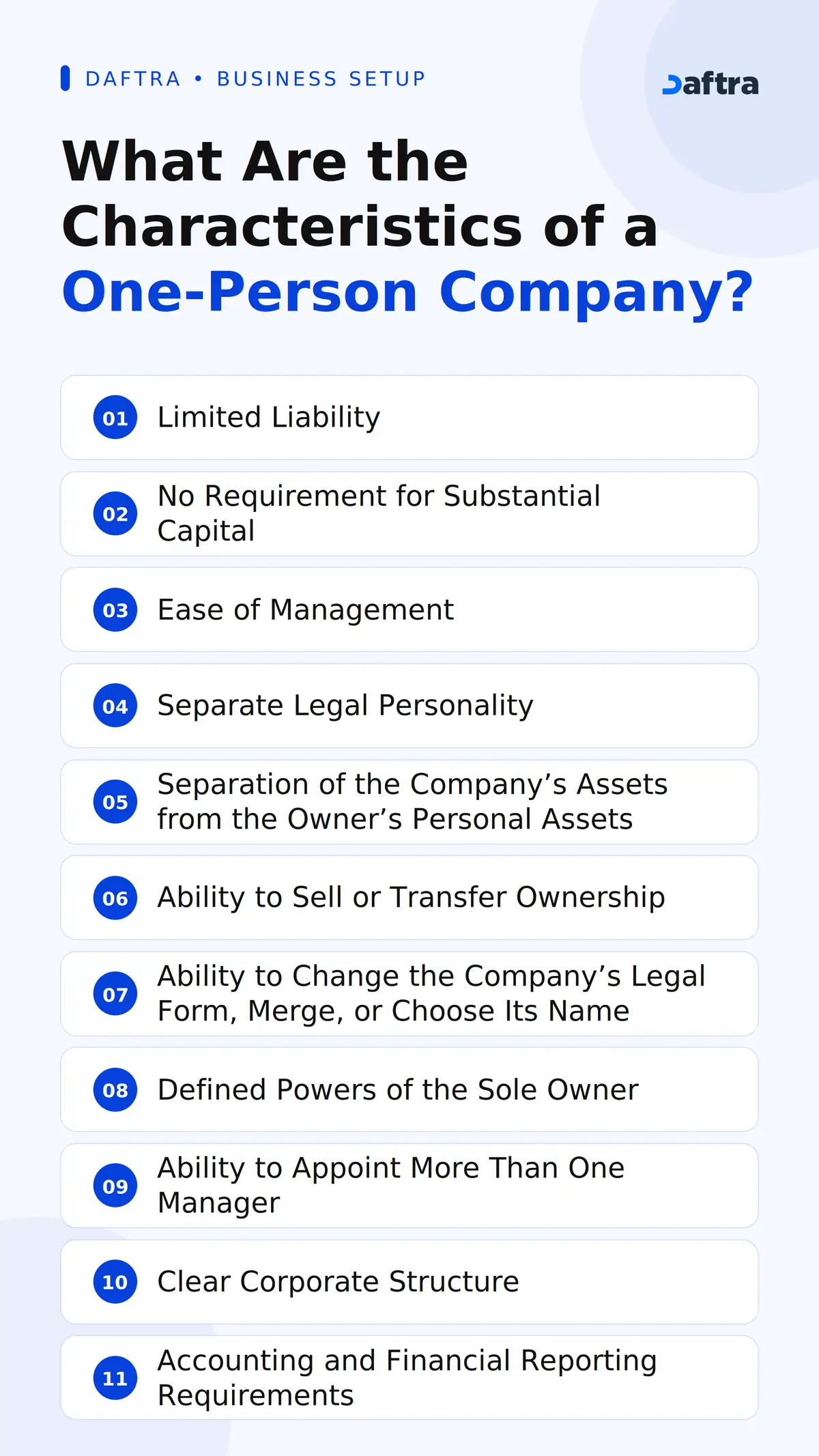
1. Limited Liability
A One-Person Company provides its owner with limited liability. In principle, the owner's liability is limited to their contribution to the company's capital and does not extend to their personal assets solely because of the company's debts or obligations.
2. No Requirement for Substantial Capital
A large amount of capital is not necessarily required to establish a One-Person Company. Capital requirements vary from one country to another depending on the applicable laws and regulations.
Under Egyptian law, the minimum capital requirement is EGP 1,000, which must be deposited in full with a bank, with incorporation completed based on a bank certificate. Under Saudi law, there is generally no specified minimum capital requirement for a single-person limited liability company.
In the UAE, the applicable framework does not impose a fixed minimum capital requirement for a One-Person Company. Instead, the capital must generally be sufficient to meet the requirements of the company's activities and purpose, subject to the competent authority's applicable regulations and requirements.
3. Ease of Management
A One-Person Company offers considerable management flexibility. The owner may manage the company in accordance with the applicable corporate laws and regulations and generally has broad authority to make and implement decisions without requiring approval from other partners.
The owner or founder is not necessarily required to have merchant status solely by virtue of owning the company, subject to the requirements of the applicable jurisdiction.
4. Separate Legal Personality
A One-Person Company can conduct business activities, enter into contracts, acquire assets, and initiate or defend legal proceedings independently of its owner because it has a separate legal personality.
5. Separation of the Company's Assets from the Owner's Personal Assets
The company's financial assets and liabilities are separate from the owner's. The company is responsible for its debts and expenses from its own assets and resources. As a general rule, the owner's personal assets are not available to satisfy the company's debts solely because the company cannot meet its obligations, subject to applicable legal exceptions.
6. Ability to Sell or Transfer Ownership
Applicable law and the terms and procedures set out in the company's Articles of Incorporation govern the transfer of ownership interests.
7. Ability to Change the Company's Legal Form, Merge, or Choose Its Name
A One-Person Company may, subject to applicable legal requirements, change its legal form, merge with another company, or convert into another type of company. The company may also choose its name in line with the nature of its business activity and applicable naming requirements.
8. Defined Powers of the Sole Owner
Because the company has a single owner, there is no general assembly in the usual sense. Instead, the sole owner exercises the powers that would otherwise belong to the general assembly, where applicable under the relevant corporate law. These may include approving the financial statements and internal control arrangements. Certain fundamental decisions, such as changing the company's legal form, amending its Articles of Incorporation, or increasing or reducing its capital, may be subject to special formalities under applicable law.
9. Ability to Appoint More Than One Manager
A limited liability company may be managed by one or more managers, whether they are owners or third parties, subject to the applicable law and the Articles of Incorporation. When multiple managers are appointed, the governing documents and applicable regulations may permit the establishment of a board of managers. The manager or managers may also be removed in accordance with the applicable legal procedures.
10. Clear Corporate Structure
The company's constitutional documents set out the key information governing its identity and operations, including its name, duration, management structure, purpose, business activities, registered office, and capital.
11. Accounting and Financial Reporting Requirements
The company must prepare its financial statements and a report on its activities and financial position for each completed financial year, in accordance with applicable accounting and legal requirements. Accounting records, including inventory records and journal books where required, form an important part of the company's accounting system.
A One-Person Company can therefore suit small and medium-sized business owners because of its legal flexibility, limited financial liability, independent management structure, and, in many jurisdictions, relatively straightforward incorporation procedures.
What Are the Advantages of a One-Person Company?
A One-Person Company is an important legal structure used in many countries. Its key advantages include:
1. Suitable for Startups
This type of company suits entrepreneurs launching new businesses, particularly small and medium-sized ventures. It allows an individual to establish and operate a business independently, supporting entrepreneurship and creating additional investment opportunities.
2. Encourages Investment
A One-Person Company lets an investor allocate part of their funds to establish and run a separate business entity. This can encourage small businesses to transition into the formal economy.
To evaluate potential returns before committing funds, you can use the Investment Calculator to compare different investment scenarios.
3. Ease of Management and Decision-Making
Because ownership and decision-making authority are concentrated in one person, a One-Person Company can provide greater flexibility in management, oversight, and business decision-making.
4. Reduces the Need for Fictitious Partners
One-Person Companies remove the need to rely on a nominal or fictitious partner simply to satisfy minimum ownership requirements. By allowing a single person to establish and own the company, this structure can help reduce the use of nominal partnerships and the risks associated with them.
5. Limited Exposure to Losses
If the company becomes insolvent or bankrupt, the owner does not necessarily become personally bankrupt. Because the company's financial liability is separate from that of its owner, the owner's financial exposure is generally limited to the funds contributed to the company's capital, subject to applicable legal exceptions.
6. Ability to Issue Debt Instruments and Financing Sukuk
In some jurisdictions, such as Saudi Arabia, a limited liability company may, subject to the applicable Companies Law, Capital Market Law, and related regulations, issue debt instruments or financing sukuk that are eligible for trading, where permitted. Such issuances are subject to the required statutory approvals and conditions.
7. Continuity of the Company
A One-Person Company has a separate legal identity and can continue to exist independently of changes in its ownership. If the owner dies, ownership may pass to one or more heirs under applicable succession rules. If there is more than one heir, the company's legal form or structure may need to be adjusted in line with applicable law.
Overall, the characteristics of a One-Person Company make it a flexible legal structure for entrepreneurs. It combines streamlined management and decision-making with a degree of protection for the owner's personal assets, making it a suitable option for many individually owned startups and small businesses.
What Are the Disadvantages of a One-Person Company?
Despite the many advantages of a One-Person Company and its appeal to entrepreneurs and business owners, this legal structure also presents certain challenges. The key disadvantages include:
1. Tax Obligations
The company's tax obligations may vary depending on its ownership structure, business activity, and tax status. Tax treatment is therefore not determined solely by the fact that the company is owned by one person, and no single tax rate applies to all One-Person Companies. In Saudi Arabia, for example, applicable taxes depend on the company's activity and the nationality of its owner.
2. Incorporation Costs
Establishing a One-Person Company requires completing the applicable registration procedures and paying the prescribed government fees, which creates initial setup costs. In some jurisdictions, such as Saudi Arabia, incorporation can be completed electronically through the Ministry of Commerce, subject to the applicable service fees.
3. Administrative and Compliance Responsibilities
The company must submit its tax returns and related filings, which are signed by the manager in accordance with applicable requirements. This adds administrative responsibilities that the owner or manager must handle on time.
4. Potential Need for Personal Guarantees
Banks and financing institutions may require the owner to provide personal guarantees or additional security when extending financing to the company, depending on the lender's policies and terms. Such guarantees are not a legal requirement merely because the company has a single owner.
5. Not Designed for Public Offering and Trading
A One-Person Company may not be suitable when the objective is to establish a company whose shares will be offered to the public or traded on a stock exchange, as a limited liability company does not have publicly tradable shares in the same way as a joint stock company.
As noted above, some jurisdictions permit limited liability companies to issue certain debt instruments.
6. Limited Sources of Financing
Because ownership is concentrated in one person, the company may initially rely heavily on a single owner as a source of capital. Access to additional financing may therefore depend on the company's revenues, assets, external financing, and other available funding sources.
7. Limited Financial and Administrative Oversight
When one person controls ownership and decision-making, financial and administrative oversight may depend heavily on that individual's internal controls and management practices, which can create challenges as the business grows.
8. Reduced Creditor Confidence and Difficulty Obtaining Credit
Because the company's liability is separate from its owner's, creditors' claims generally attach to the company's assets and may not extend to the owner's personal assets. As a result, suppliers and lenders may be more cautious, and may require guarantees, security, or stricter terms before dealing with the company. Creditors also risk not recovering all amounts owed if the company becomes insolvent and its assets are insufficient.
What Is the Difference Between a One-Person Company and a Sole Proprietorship?
A One-Person Company and a Sole Proprietorship may appear similar in some respects, as both can be owned and managed by a single individual. However, they differ in several key areas, including liability, legal status, ownership, and financial structure. The main differences are as follows:
| Aspect | One-Person Company | Sole Proprietorship |
| Liability | A One-Person Company generally provides limited liability, with the owner's liability limited to the company's capital, subject to applicable law. | The owner generally has unlimited personal liability for the business's obligations. |
| Legal Structure | A capital-based company. | A business owned directly by an individual. |
| Who Can Establish It | May be established by either a natural person or a legal entity, where permitted by law. | Must generally be owned by a natural person. |
| Financial Separation | The company's financial assets and liabilities are separate from those of the owner. | The business and the owner's financial assets are generally not legally separated in the same way as a company. |
| Legal Personality | The company has a separate legal personality upon incorporation. | The sole proprietorship generally does not have a legal personality separate from its owner. |
| Business Activities | Activities are carried out under the commercial registration and licenses issued to the owner, subject to applicable regulations. | May generally operate across a range of permitted activities, subject to the applicable licensing and regulatory requirements. |
| Capital | Capital requirements, if any, depend on the applicable legal framework and business activity | Generally, there is no prescribed minimum capital requirement. |
How to Establish a One-Person Company in Saudi Arabia
If you are an investor or the owner of a startup or small-to-medium-sized business and are considering establishing a One-Person Company in Saudi Arabia, you can complete the incorporation process electronically through the services provided by the Saudi Ministry of Commerce and the Saudi Business Center. Below are the main steps and requirements:
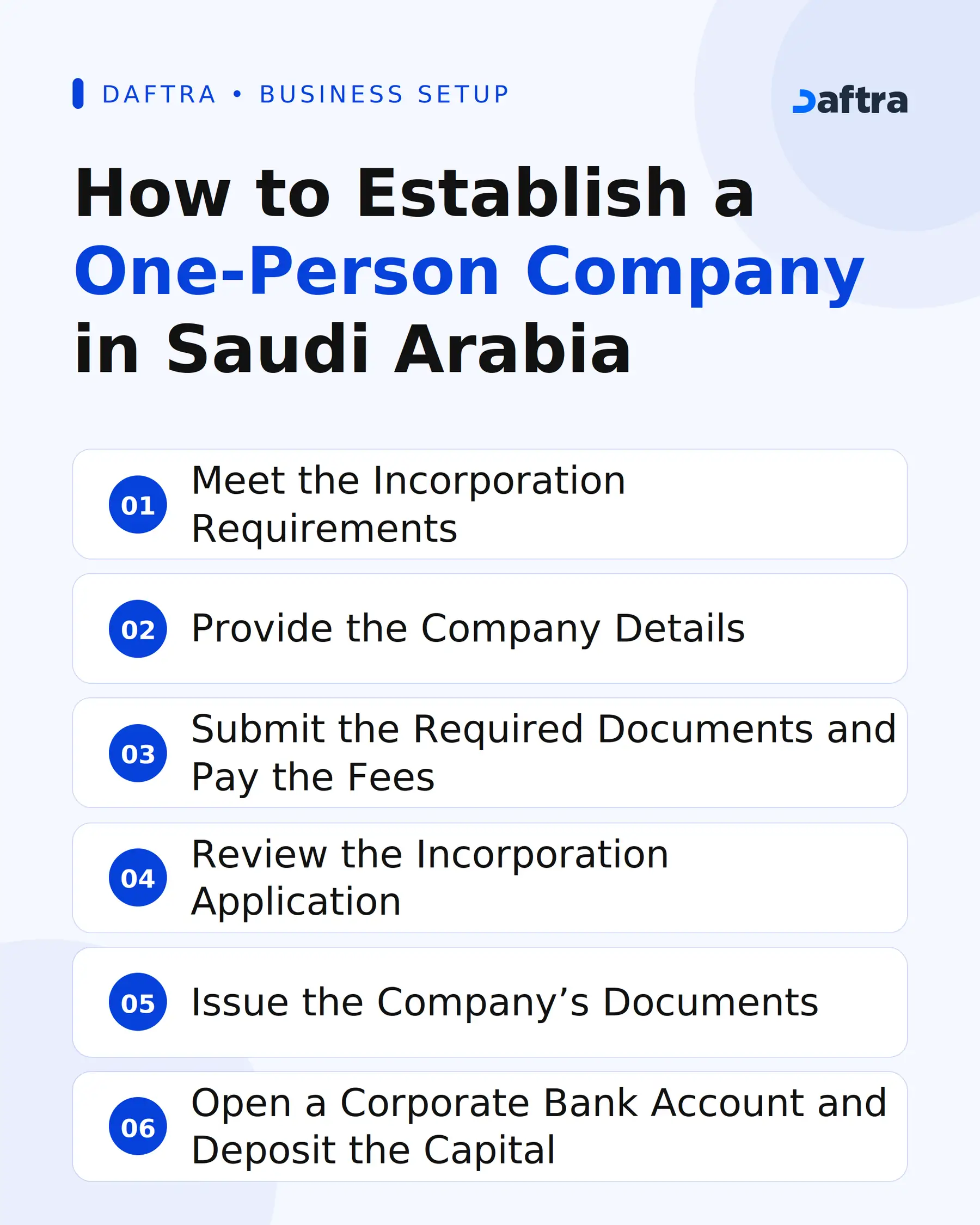
- Meet the Incorporation Requirements
The owner and the manager, if they are different The owner and the manager, if they are different individuals, must have valid identification documents and must be at least 18 years old. The company must also have a registered and up-to-date National Address.
- Provide the Company Details
Specify the company name, business activity, headquarters, and capital, along with other required incorporation details, such as the financial year and the manager's powers and authorities. The incorporation documents should also specify the capital amount and the rules governing the company's liquidation.
- Submit the Required Documents and Pay the Fees
Upload the required documents and information, then pay the applicable fees electronically to complete registration.
- Review the Incorporation Application
Once the application is approved, the competent authority issues the company's incorporation documents and Commercial Registration.
- Issue the Company's Documents
Once the competent authority reviews and approves the application, it issues the company's incorporation documents and Commercial Registration.
- Open a Corporate Bank Account and Deposit the Capital
After the company is registered, you can open a bank account in the company's name and deposit the capital in accordance with the requirements applicable to the company and its business activity.
By following the incorporation steps carefully, from submitting the application and required documents to obtaining the Commercial Registration and any necessary licenses, you can formally establish the business and prepare it to operate.
What Are the Restrictions on a One-Person Company?
Although One-Person Companies offer several advantages that make them an attractive option for entrepreneurs and owners of small and medium-sized businesses, they are also subject to certain legal restrictions and requirements. In Saudi Arabia, for example, the key restrictions include the following:
The following are among the key restrictions:
- Ownership interests cannot be offered to the public or publicly traded.
- Transfer of ownership interests is subject to the procedures set out in the Articles of Incorporation and applicable law. If the company later has more than one owner, the transfer may be subject to notification and redemption rights of the other partners, unless the Articles provide otherwise.
- Issuing tradable debt instruments or financing sukuk is subject to specific requirements, including compliance with the Capital Market Law and obtaining the approvals required for amending the Articles of Incorporation.
- The company's purchase or pledge of its own ownership interests is subject to conditions. The Articles of Incorporation must permit such transactions, and they must comply with the controls prescribed by the applicable regulations.
- Amending the Articles of Incorporation, including increasing or reducing capital, requires the sole owner's decision, made in writing and recorded in the company's register, in accordance with applicable law.
- If the company's losses reach half of its capital, statutory action must be taken. The manager must, within the period set by law, refer the matter to the owner to decide whether the company should continue operating and what measures to take, or whether it should be dissolved.
- The appointment, removal, or limitation of a manager's powers is not effective against third parties until it is registered in the Commercial Register.
- The owner's decisions must be made in writing and recorded in a dedicated register.
What Are the Steps to Establish a One-Person Company in the UAE?
Establishing a One-Person Company in the UAE involves several steps, typically starting with selecting the economic activity and legal form, followed by reserving the trade name, obtaining the required approvals, and ultimately obtaining the trade license. Exact steps and their order may vary by emirate.
- Determine the Company's Economic Activity
Start by determining the activity the company will carry out, as incorporation and licensing requirements vary depending on the nature of the economic activity. Economic activities in the UAE include commercial, industrial, professional, tourism, agricultural, and craft/civil activities.
- Choose the Appropriate Legal Form
After determining the activity, select the legal form that is compatible with it. For a One-Person Company, this is generally a Single-Owner Limited Liability Company, which may be owned by either a natural person or a legal entity, subject to applicable regulations.
- Register the Trade Name
Choose an appropriate trade name for the company and submit an application to register it with the Department of Economic Development in the relevant emirate. The name must reflect or be consistent with the company's activity, must not already be registered, and must meet the applicable trade-name requirements.
For a One-Person Company, the trade name should include wording indicating its legal form, such as "Single-Owner Limited Liability Company."
- Obtain Initial Approval
Apply for initial approval from the competent authority in the relevant emirate. This approval indicates that this approval indicates that the authorities have no objection to establishing the company. It does not, however, authorize the company to begin operating until the licensing procedures are completed and any additional required approvals are obtained.
- Prepare the Company's Memorandum of Association
A One-Person Company must prepare and authenticate its Memorandum of Association in accordance with the requirements applicable to its legal form. The document includes key company details, such as the owner's information, capital, business activity, and management structure. The owner must also decide whether to manage the company personally or appoint a manager.
The owner must also determine whether they will manage the company personally or appoint another person as the manager.
- Secure the Company's Business Premises
The company must have an address from which it can conduct its business and meet the premises and location requirements set by the competent economic authority in the relevant emirate. This may include providing a duly attested lease agreement for the office or business premises, depending on local requirements.
- Obtain Additional Approvals, Where Required
Certain economic activities may require approvals from the relevant government or regulatory authorities before the trade license can be issued. The specific approvals depend on the nature of the company's activity.
For example, legal, healthcare, engineering, and other regulated activities may require approval from the relevant regulatory authorities.
- Submit the Required Documents
After completing the previous steps, submit the required documents to the competent authority. These may include:
- The initial approval document.
- A duly attested lease agreement, where required based on the emirate and business activity.
- The authenticated Memorandum of Association.
- Additional approvals from the relevant government authorities, where required for the activity.
- Pay the Fees and Obtain the Trade License
After the documents have been reviewed and all incorporation requirements and approvals have been completed, pay the applicable fees to obtain the trade license. The licensing process may be completed through service centers or the online platforms of the competent economic authority.
- Complete the Company's Related Registrations
After obtaining the trade license, complete any registrations and procedures required to operate the business. These may include registration with the Chamber of Commerce in the relevant emirate, where applicable, as well as any additional procedures or licenses required based on the nature of the activity.
Following these steps completes the main incorporation process for a One-Person Company in the UAE, although specific requirements and approvals may vary depending on the emirate, business activity, legal form, and ownership structure.
What Are the Requirements for Establishing a One-Person Company Under Saudi Law?
The Saudi Companies Law allows a Limited Liability Company (LLC) to be established by a single person, whether a natural person or a legal entity, with all ownership interests held by that person.
The key requirements and provisions related to establishing a One-Person Company include:
How to Establish a One-Person Company Online in Egypt
In Egypt, the founder can complete the One-Person Company incorporation process online through the official GAFI portal by following these steps:
- Visit the official GAFI website.
- Register and create a user account and a personal workspace.
- Access the Company Incorporation Services.
- Select the One-Person Company Incorporation service.
- Click Apply for the Service.
- Enter the required information and upload the necessary documents through the personal account.
- Pay the applicable fees using a credit card.
- Once the submitted documents are reviewed and verified, electronically sign the required documents.
- After the incorporation procedures are completed, the company's documents are sent to the user's personal workspace on the portal.
What Are the Financial and Accounting Obligations After Establishing a One-Person Company in Saudi Arabia?
The responsibilities of a One-Person Company do not end once the company has been incorporated and its Commercial Registration has been issued. The company remains subject to a range of financial and accounting requirements that help maintain accurate financial records, comply with applicable regulations, and support the continuity of its business. The key obligations include:
- Maintaining Accounting Records
The company must maintain proper accounting records and supporting documents for its business activities, transactions, and financial statements. These records help the company track its financial operations and provide reliable information when needed.
- Preparing Financial Statements
The company must prepare its financial statements at the end of each fiscal year in accordance with the accounting standards approved in Saudi Arabia. These statements provide information about the company's financial position, performance, cash flows, and changes in equity.
- Filing Financial Statements
A One-Person Limited Liability Company must file its annual financial statements electronically through the Qawaem platform, in accordance with the applicable requirements. Under the Companies Law, financial statements must generally be filed within six months from the end of the fiscal year.
- Appointing an Auditor When Required
The company may need to appoint an external auditor when applicable statutory requirements are met. The requirement depends on factors specified under the Companies Law and its implementing regulations.
- Zakat and Tax Obligations
The company's financial obligations also include complying with applicable Zakat and tax requirements, including:
- Registering for VAT when the value of taxable supplies exceeds the mandatory registration threshold of SAR 375,000 during the relevant 12-month period. Voluntary registration is available when taxable supplies exceed SAR 187,500 but do not exceed SAR 375,000, subject to the applicable requirements.
- Complying with Zakat obligations where applicable and completing the required registration and filing procedures with ZATCA.
- Applying income tax rules to the non-Saudi share of ownership, where applicable, subject to the relevant tax regulations.
- Filing Zakat and tax returns and making the required payments within the applicable deadlines to avoid penalties.
- Maintaining a Separate Corporate Bank Account
Keep the company's financial transactions separate from the owner's personal funds by maintaining a bank account in the company's name and using it for business-related transactions. This separation helps organize revenue and payments and maintain clear, reliable financial records.
When Is a One-Person Company the Right Choice?
A One-Person Company may suit an entrepreneur who wants to operate a business independently while maintaining a clear legal structure for managing the company's financial and operational affairs. This structure may be particularly appropriate in the following situations:
- When the owner wants to separate personal and business finances, keeping the company's transactions and accounts distinct from personal financial activities.
- When the business is expected to grow moderately, and the owner wants a structured legal framework without needing partners or outside investors.
- When the business needs a clear, organized legal structure to run operations and manage its financial and accounting obligations.
- When dealing with customers, suppliers, or other entities in a formal business capacity, particularly when the business needs to issue invoices and systematically manage its accounts, purchases, sales, and other transactions.
Overall, a One-Person Company can suit a business owner who wants to manage the business independently within a clearly defined legal entity, depending on the nature of the business and its current and future needs.
Common Mistakes When Establishing and Managing a One-Person Company
Certain mistakes when establishing or managing a One-Person Company can lead to legal and financial issues that affect the business's long-term stability. It is therefore important to address the company's legal, administrative, and financial requirements from the outset. Some of the most common mistakes to avoid include:
How Does Daftra Simplify One-Person Company Management?
A One-Person Company needs to manage sales, expenses, accounting, inventory, customers, and many other day-to-day operations. As the business grows, managing these areas separately can become increasingly difficult. Daftra's cloud-based ERP software brings sales, accounting, inventory, customer management, human resources, and other operations together on one platform.
Here are some of the ways Daftra can simplify the management of a One-Person Company:
Invoice and Sales Management
Daftra enables businesses to issue electronic and tax invoices, prepare quotations, manage payments, and handle point-of-sale transactions, installments, promotions, and discounts. This helps One-Person Company owners organize sales activities and track transactions more efficiently.
Accounting and Expense Management
Daftra provides tools for managing accounts and financial transactions, including the chart of accounts, journal entries, general ledger, expenses, cost centers, fixed assets, and check management. It also provides financial reports covering income, cash flow, and profit and loss, helping business owners monitor the company's financial position.
Inventory and Purchasing Management
Daftra allows businesses to manage products and services, track inventory, perform stock counts, manage warehouses and inventory transactions, and handle purchasing and supplier management. The system also supports the purchasing cycle and allows businesses to add an unlimited number of products and organize them across price lists and multiple warehouses.
Customer Data Management
Daftra provides tools for managing customer information and appointments, as well as loyalty programs, memberships, subscriptions, points, balances, customer attendance, and insurance records. This helps businesses organize customer interactions and keep their information up to date.
Employee and Payroll Management
If the One-Person Company has employees, Daftra provides tools for managing employee records, organizational structures, contracts, payroll, attendance, leave, and employee requests. This enables the owner to manage employee information and HR processes through an integrated human resources system.
Operations and Time Tracking
Depending on the nature of the business, Daftra can manage work orders, projects, workflows, and time tracking, as well as manufacturing, bookings, rentals, units, and lease contracts.
Accessing Company Data From Anywhere
As a cloud-based system, Daftra lets One-Person Company owners access their business data from virtually anywhere, at any time. Daftra also offers mobile applications to manage different aspects of the business, with some apps supporting certain functions even without an internet connection.
Overall, Daftra gives One-Person Company owners tools to manage financial, operational, and administrative activities through a single platform, with the flexibility to expand the system as the company grows.
Frequently Asked Questions About One-Person Companies
Can a Person Establish More Than One Company?
Yes, an individual may generally own more than one company or commercial establishment, subject to the applicable laws and regulations in Saudi Arabia. Restrictions may apply to certain company types, so this should be verified against the current Companies Law.
What Are the Costs of Establishing a One-Person Company in Saudi Arabia?
The costs of establishing a One-Person Company in Saudi Arabia vary depending on the company's activity and may include:
- Commercial Registration issuance fee: SAR 1,200 (verify current fee).
- Incorporation announcement publication fee: SAR 500 (verify current fee).
- Chamber of Commerce fees: Vary depending on the company's classification.
How Much Capital Is Required for a One-Person Company in Saudi Arabia?
There is generally no prescribed minimum capital requirement for a One-Person Company in Saudi Arabia. However, the capital must be sufficient to meet the needs of the company's business activity.
Can a Sole Proprietorship Be Converted into a One-Person Company?
Yes. A Sole Proprietorship can be converted into a One-Person Company through the applicable official procedures and platforms. This may require preparing the establishment's documents, providing the necessary financial information or valuations, and paying the applicable fees. Existing liabilities and debts of the Sole Proprietorship must also be taken into account, as they do not automatically cease to exist as a result of the conversion.
Can a Partner Be Added to a One-Person Company Later?
Yes. A partner can be added at a later stage, converting the company into a Limited Liability Company with multiple owners. This generally requires amending the Articles of Incorporation, adding the new partner's details, specifying their ownership interest in the capital, and updating the ownership and management information in the Commercial Register.
Can a Non-Saudi National Establish a One-Person Company in Saudi Arabia?
Yes. A non-Saudi investor can establish a One-Person Company in Saudi Arabia, provided they meet the applicable foreign investment requirements and obtain the necessary license from the Ministry of Investment, depending on their status and the nature of the business activity.
Are the Owner's Personal Assets Liable for the Company's Debts?
Generally, no. The company has a separate legal personality and financial liability, so the owner's liability is generally limited to the capital contributed. However, exceptions may apply, for example if the owner fails to maintain a proper separation between personal and company finances.
What Happens to a One-Person Company When Its Owner Dies?
When the owner dies, the ownership interests pass to the heirs as part of the estate. The company may continue if the interests pass to a single heir or if the heirs agree to continue it and complete the required legal procedures. If they do not, or fail to regularize the company's status within the legally prescribed period, the company may be subject to dissolution and liquidation, including settlement of its outstanding obligations.
Conclusion
A One-Person Company can be a suitable option for entrepreneurs who want to establish and manage a business independently within a legal entity that has a separate legal personality and financial liability, while benefiting from the owner's limited liability for the company's obligations, subject to applicable law.
However, the requirements for establishing and operating this type of company vary by country. Therefore, business owners should consider the nature of their activity and the applicable legal and financial requirements before incorporating.
After establishing the company, proper financial and accounting management remains essential to maintaining stable, sustainable operations. Cloud-based ERP systems such as Daftra can help organize a company's accounting, sales, inventory, expenses, employee management, and day-to-day operations.
With a clear understanding of the legal and financial requirements, you can begin planning the establishment of your own One-Person Company.












 Invoicing
 POS
 Offers
 Installments
 Sales Commission
 KSA E-Invoice Software
 EGY E-Invoice Software
 JO E-Invoice Software
 E-Invoice Software
 Chart of Accounts
 Asset Management
 Cost Centers
 Expenses
 Cheque Cycle
 UAE VAT-Tax
 Product Management
 Purchases
 Purchase Cycle
 Suppliers
 Requisitions
 Stocktaking
 Organizational Structure
 Personnel Management
 Attendance and Leave
 Contracts
 Payroll
 Requests
 Work Orders
 Booking Management
 Rental and Unit Management
 Time Tracking
 Work Flow
 Lease Contracts
 Manufacturing Management
 Client Follow-Up
 Loyalty Points
 Points and Credits
 Memberships
 Insurance Management
 Daftra ERP Full App
 Point of Sales App
 Point of Sales for Desktop – Support Offline Mode
 AI Expenses Scanner App
 Employee Attendance, Sign & ESS App
 E-invoice Reader App
 Inventory Stocktaking App