


Accounts payable and accounts receivable: Key Differences



Table of contents:
- What are Accounts Payable and Accounts Receivable?
- Accounts Receivable and Payable Turnover
- Differences Between Accounts Receivable and Accounts Payable
- How to Analyze Accounts Payable and Accounts Receivable
- Journal Entries for Accounts Payable and Accounts Receivable
- What Are the Characteristics of Accounts Receivable and Accounts Payable?
- Best Practices For Handling Accounts Payable And Receivable
- How Does Daftra Streamline Accounts Payable And Receivable Accounting?
- Frequently Asked Questions
Recording all company accounts promptly is not a luxury but an accounting necessity for management and relevant parties to understand the obligations the company bears and the gains it expects to receive in the near future. All of this falls under the scope of accounts payable and accounts receivable for companies.
What are Accounts Payable and Accounts Receivable?
Many people confuse accounts payable with accounts receivable and barely distinguish between them because they are recorded similarly across many accounts. However, a fundamental difference between the two concepts must be noted, because any accounting error may lead to discrepancies in your financial statements and an imbalance in your accounting equation, resulting in incorrect decisions.
Accounts Receivable
Accounts receivable are the amounts owed to the establishment by its customers for goods sold or services provided on credit, meaning the establishment has made the sale or provided the service but has not yet received payment. These amounts usually appear under current assets on the balance sheet.
Accounts Payable
Accounts payable are amounts a company or business entity owes suppliers for goods purchased or services received on credit, meaning the company has received the goods or services without yet paying for them. Accounts payable are typically classified as current liabilities.
Read Also: What are Debtor and Creditor and the Difference Between Them?
Accounts Receivable and Payable Turnover
Measuring accounts payable and receivable turnover is important for management, the institutions involved, and investors considering those companies.
First: Accounts Payable Turnover
Accounts payable turnover is a financial measure that shows how efficiently a company fulfills its obligations and pays required dues within a specified period, usually one year. This measure is considered a clear indicator of the company's financial health and operational efficiency.
A high accounts payable turnover indicates the company's ability to manage cash flow efficiently through its capability to pay its suppliers or other institutions on time. A low turnover rate is a clear indication of cash flow problems within the company.
Companies should maintain an appropriate accounts payable turnover rate to strengthen relationships with suppliers, as timely payment of obligations can lead to better terms in future dealings. Investors and lenders also use accounts payable turnover ratios in their financial analysis to assess the company’s liquidity and financial stability, helping them make informed decisions.
Second: Accounts Receivable Turnover
Accounts receivable turnover measures the company's success in collecting dues from customers, distributors, and other parties quickly. This rate measures how long it takes the company to collect money from selling products or providing services.
If the company cannot control and manage its receivables turnover effectively over time, it indicates management failure to send invoices to customers and remind them to pay on time. This may expose the company to the risk of not receiving money earned from its products on time, potentially leading to significant financial problems.
The accounts receivable turnover rate varies between companies depending on the industry they specialize in. However, a high turnover rate usually improves the impressions of potential investors and lending institutions, encouraging them to make positive decisions in favor of the company.
Measuring accounts receivable turnover ratios helps assess how quickly the company collects dues, which helps determine when to settle obligations and plan future investments strategically. These ratios also indicate whether the company's customer policies support strong cash flow or require substantial adjustments.
Differences Between Accounts Receivable and Accounts Payable
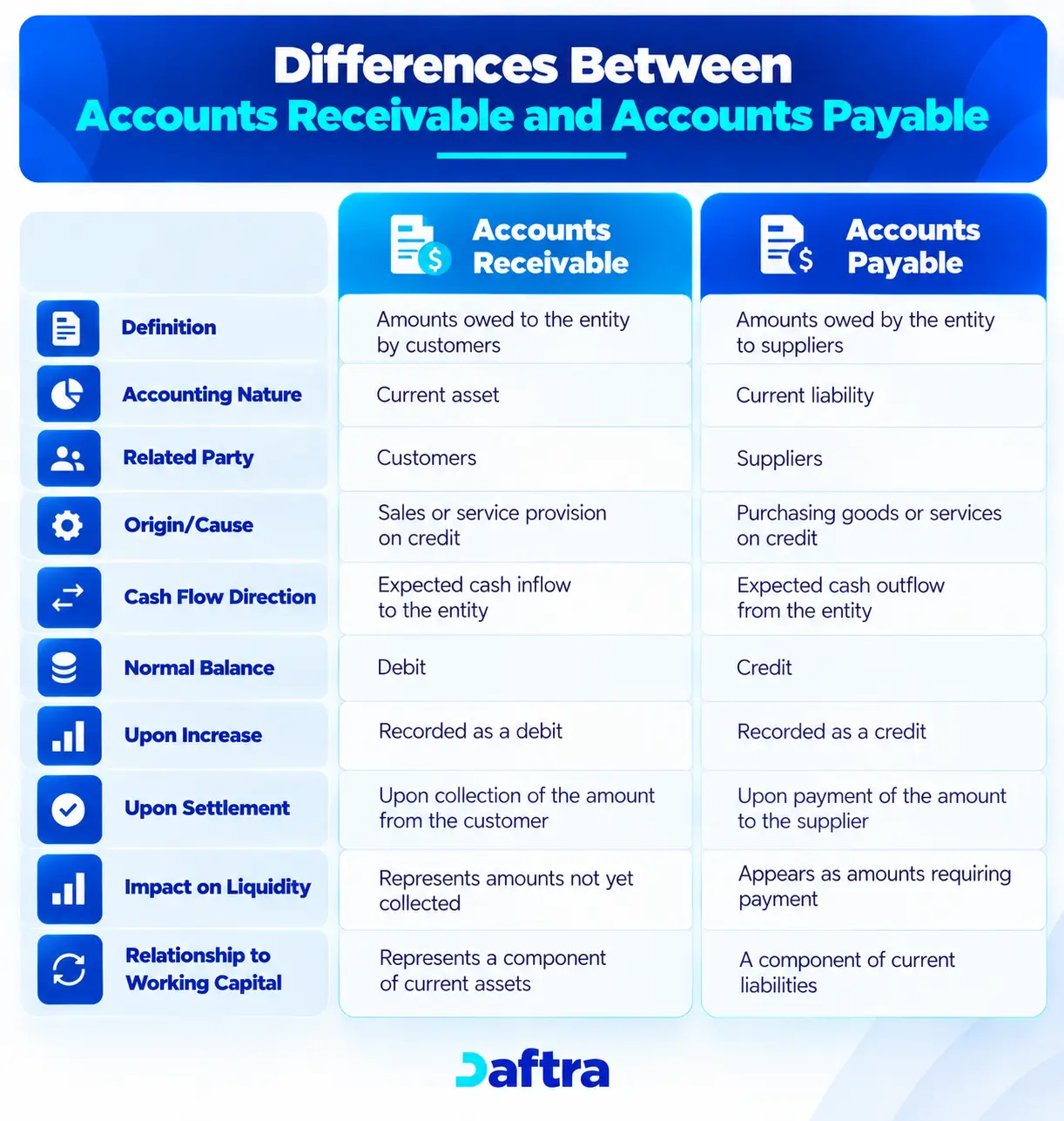
The differences between accounts receivable and accounts payable lie in several aspects, as follows:
Nature of the Account
- Accounts Receivable: Classified as a current asset; it represents a right held by the entity, with collection from customers expected within the operating cycle or the short term.
- Accounts Payable: Classified as a current liability; it represents amounts the entity is obligated to pay to suppliers within the short term.
Associated Party
- Accounts Receivable: Associated with customers who have received goods or services but have not yet made payment.
- Accounts Payable: Typically associated with suppliers who have provided goods or services to the entity on credit (for payment at a later date).
Cash Flow Direction
- Accounts Receivable: Cash flow is typically an inflow when the entity collects amounts due from customers.
- Accounts Payable: Cash flow is typically an outflow when the entity settles amounts due to suppliers.
Impact on Liquidity
- Accounts Receivable: An increase in accounts receivable indicates uncollected amounts, which affects the liquidity available to the entity.
- Accounts Payable: An increase in accounts payable indicates a rise in the obligations the entity must settle.
Normal Balance
- Accounts Receivable: The normal balance is debit, as it is an asset account; it increases with a debit entry and decreases with a credit entry.
- Accounts Payable: The normal balance is credit, as it is a liability account; it increases with a credit entry and decreases with a debit entry.
Origin of the Balance
- Accounts Receivable: Arise from selling goods or providing services to a customer on credit.
- Accounts Payable: Arise from purchasing goods or obtaining services from a supplier on credit.
Account Settlement
- Accounts Receivable: Settled upon collecting the amount from the customer.
- Accounts Payable: Settled when the entity pays the amount owed to the supplier.
Impact on the Cash Cycle
- Accounts Receivable: Converting receivables into cash requires collecting outstanding amounts from customers.
- Accounts Payable: Represents the period during which the entity receives goods or services before paying for them.
How to Analyze Accounts Payable and Accounts Receivable
Analyzing accounts payable and accounts receivable is an important task for companies. This involves several steps, such as defining the objective, collecting information, reviewing and correcting data, analyzing it, and taking other steps to support accurate analysis. Here is how to analyze accounts payable and accounts receivable in detail:
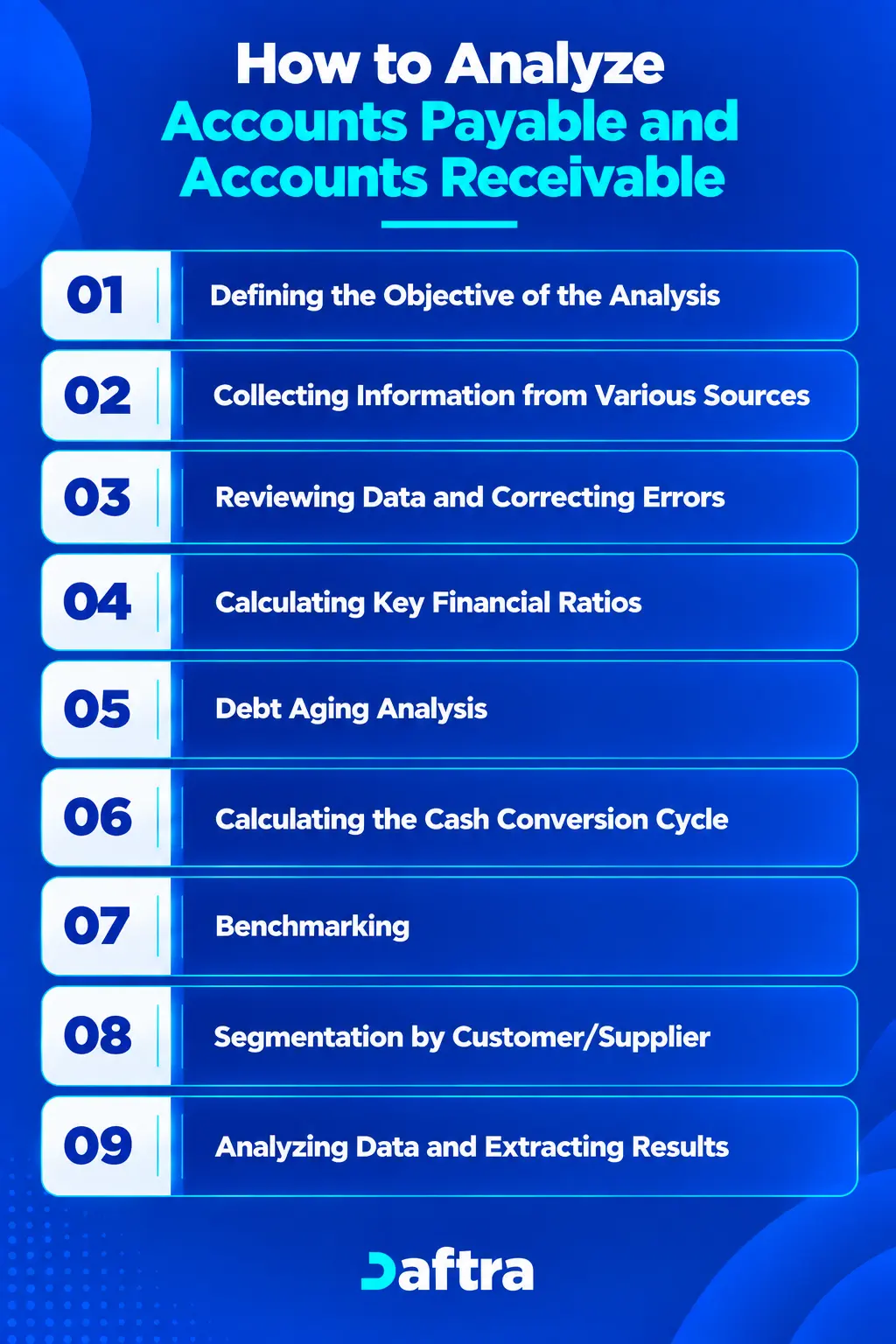
1- Defining the Objective of the Analysis
First, clearly define the analysis objectives, such as understanding the company’s current obligations and its ability to meet them, assessing cash flow, and identifying how quickly customers pay for products sold.
2- Collecting Information from Various Sources
Collect all documents and information related to accounts payable and accounts receivable from reliable sources, such as invoices, journals, ledgers, and accounts payable records. Organize the data systematically to support analysis.
3- Reviewing Data and Correcting Errors
After collecting the data, carefully review it to correct errors or duplicate entries that could affect the analysis results.
4- Calculating Key Financial Ratios
Using the following formulas:
- Accounts Receivable Turnover = Net Credit Sales ÷ Average Accounts Receivable
- Average Collection Period (DSO) = (Accounts Receivable ÷ Total Credit Sales) × 365
- Accounts Payable Turnover = Net Credit Purchases ÷ Average Accounts Payable
- Average Payment Period (DPO) = (Accounts Payable ÷ Cost of Goods Sold) × 365
5- Debt Aging Analysis
Categorizing accounts receivable and accounts payable into specific time brackets to identify overdue accounts.
6- Calculating the Cash Conversion Cycle
Linking DSO and DPO to assess cash flow efficiency within the company.
7- Benchmarking
Comparing calculated ratios against industry averages or the company's past performance.
8- Segmentation by Customer/Supplier
Analyze accounts receivable for each customer to identify recurring late payments, and analyze accounts payable for each supplier to uncover early-payment discount opportunities.
9- Analyzing Data and Extracting Results:
After performing the analysis, identify effective strategies and plans to improve the company's ability to settle obligations, as well as methods and approaches to accelerate the collection of receivables from customers.
Recognizing that analyzing accounts receivable and accounts payable goes beyond tracking amounts owed by customers and to suppliers also helps you understand cash inflows and outflows. This analysis helps determine whether the timing of customer collections aligns with the schedule for settling supplier obligations.
During my tenure as an accountant at a distribution company in Saudi Arabia, I encountered a situation that highlighted the importance of periodically analyzing these accounts. Although the company generated strong sales, I began to notice liquidity pressure, especially as supplier payment deadlines approached.
When I reviewed the accounts, I found that a significant portion of sales was on credit, and some customers were significantly overdue in settling their balances. Consequently, the company faced substantial outstanding supplier obligations with imminent due dates.
This experience showed that high sales figures do not necessarily translate into cash availability; some sales revenue remained uncollected from customers, while supplier obligations required payment by specific deadlines.
To address this, I began conducting a more detailed analysis of accounts receivable and payable. I tracked debt aging and payment schedules, comparing projected customer cash inflows with outstanding supplier obligations. This gave me a comprehensive view of the company's liquidity and helped me identify potential cash flow gaps before they could compromise the company's ability to meet its financial commitments.
This underscores the importance of analyzing accounts receivable and payable: it not only helps track outstanding amounts but also clarifies the timing of cash inflows and outflows, enabling more efficient decision-making on collections, payments, and working capital management.
Journal Entries for Accounts Payable and Accounts Receivable
Journal entries for accounts receivable and accounts payable differ depending on the nature of the transaction with the customer or supplier; the following table outlines and summarizes the key entries.
| Transaction | Debit Account | Credit Account |
| Selling goods to the customer on credit | Accounts Receivable (Customers) | Sales |
| Collecting an amount due from the customer | Bank | Customers |
| Purchasing goods from the supplier on credit | Inventory – Purchases | Suppliers |
| Settling amounts due to the supplier | Suppliers | Bank |
| Sales returns | Sales Returns | Customers |
| Purchase returns | Suppliers | Purchase Returns |
Example of recording accounts receivable:
If an entity sells goods to a customer on credit for 10,000 SAR, the entry is recorded as follows:
Example of collecting accounts receivable:
If a customer pays the full amount due via bank transfer.
Example of recording accounts payable:
Assume a company purchased goods from a supplier on credit for 30,000 SAR.
Example of Accounts Payable Settlement
If the company pays the supplier for purchases via the bank
What Are the Characteristics of Accounts Receivable and Accounts Payable?
Accounts receivable and accounts payable have certain characteristics that distinguish them, such as a due date, a specified amount due, and potential late fees. Here are the features of accounts receivable and accounts payable, explained in more detail:
1- Presence of a Due Date
Accounts payable and receivable are characterized by having a due date by which the company must pay its obligations or collect its receivables.
2- Specifying the Amount Due
Accounts payable and receivable are characterized by documents and invoices that clearly state the amount to be paid or received and specify penalties for failing to meet these conditions.
3- Presence of Late Fees
Late fees or penalties may apply if stipulated in the contract or payment terms.
Best Practices For Handling Accounts Payable And Receivable
Key best practices for managing accounts payable and accounts receivable include:
- Establishing a clear credit policy for customers: This involves defining terms for credit sales such as credit limits, payment periods, and due dates, and mandating periodic reviews of these terms. This helps curb the accumulation of outstanding receivables and mitigates the risk of delayed collections.
- Monitoring accounts receivable aging: Use an "Accounts Receivable Aging Report" to categorize outstanding amounts by how long they have remained unpaid. This helps identify overdue invoices and pinpoint accounts that require follow-up and review.
- Issuing invoices and monitoring collections: Issue invoices promptly, clearly stating due dates and payment methods. Proactive follow-up with the customer before the due date is essential; automating reminders can reduce reliance on manual follow-up.
- Handling customer disputes: Customers may raise objections regarding issues such as quantities or billing amounts. Record and address complaints quickly to prevent collection delays.
- Reconciling supplier invoices before approval: Three-way matching is a best practice for accounts payable when an invoice is linked to a purchase order; it helps detect quantity or price discrepancies before payment.
- Streamlining supplier payment approvals: Route invoices through an approval workflow aligned with company policy, with different approval levels based on invoice value or expense type, to strengthen internal controls and reduce errors.
- Scheduling payments according to due dates: Creating a clear schedule for outstanding supplier invoices helps prevent payment delays.
- Conducting reconciliations. Periodic account reconciliation: Matching payments and receipts against account statements and bank records to identify discrepancies, unrecorded invoices, and payments.
- Using performance indicators to monitor accounts: Relying on metrics such as Days Sales Outstanding (DSO), collection success rates, and bad debt ratios to determine whether collection, credit, and payment policies are achieving the desired results.
- Automating repetitive processes: Using accounting systems to handle invoice entry, collection reminders, approval workflows, and invoice matching, as well as to detect errors faster.
How Does Daftra Streamline Accounts Payable And Receivable Accounting?
In the Daftra accounting software, accounts receivable and payable are managed within an integrated accounting cycle. This process begins with recording sales, purchases, invoices, and payments; then tracks customer and supplier balances; and culminates in report generation. Key features of the Daftra system for managing accounts payable and receivable include:
- Tracking customer balances and outstanding amounts: The system creates a dedicated record for each customer to monitor transactions and account balances. It generates specific reports detailing opening balances, sales, returns, payments, and adjustments to arrive at the closing balance, thereby helping accounting staff determine the exact amount owed by each customer.
- Organizing sales invoices and payments: Daftra lets you track outstanding amounts and record customer payments, so staff can monitor collections directly in the system.
- Managing supplier accounts and tracking payables: For accounts payable, Daftra lets you create a dedicated profile for each supplier with their details, transactions, and balance, and links purchase invoices directly to the supplier. It also supports the recording of full or partial payments.
- Monitoring debt aging: The system provides reports that help track the aging of outstanding amounts, covering creditor aging, customer balances, and transaction history.
- Linking invoices to accounting entries: The system automatically generates journal entries for operational transactions and links them to the Chart of Accounts and the General Ledger. This eliminates the need to re-enter the same transaction for accounting purposes after recording it operationally.
- Facilitating account reconciliation and review: Reports generated from the general ledger help track debit and credit entries and link transactions to their corresponding documents and timestamps. The system also automatically synchronizes with bank accounts.
- Providing reports that facilitate the analysis of accounts receivable and payable: The system replaces reviewing each invoice individually with reports, including customer balances, customer statements, supplier balances, purchase invoices, payment statuses, and creditor aging.
Frequently Asked Questions
Are Accounts Receivable Current Assets?
Yes, companies can classify accounts receivable as current assets because the other party is expected to pay within one year or the operating cycle, whichever is longer. Current assets are assets that can be easily converted into cash, such as cash, cash equivalents, inventory, and other current assets. Non-current assets are those that cannot be easily converted into cash within one year, such as tangible property, long-term investments, intellectual property, trademarks, and others.
What is the Allowance for Accounts Receivable?
It is an amount calculated based on studies and statistics and considered an expected loss for the company due to customers' inability to pay their debts.
What is Accounts Receivable Financing?
It is the process of obtaining immediate cash against unpaid invoices, either by selling the invoices to a financing company, which then collects the amount from the customer, or by borrowing from a lender using the invoices as collateral.
What is the Difference Between a Creditor and a Debtor?
- Creditor: The person or company that lends money or goods and expects compensation or payment in return for the service, goods, or money.
- Debtor: The person, company, or institution that receives money or goods and must pay the corresponding amount.
What is the Difference Between Interest Receivable and Interest Payable?
- Interest Receivable: Interest the company has earned but has not yet received
- Interest Payable: Interest the company owes but has not yet paid
Are Sales Creditor or Debtor?
Sales are considered credit accounts, not debit accounts, and are recorded in accounts on this basis.
Do I send invoices to accounts payable or receivable?
If the invoice is from a supplier to the company, it is sent to the Accounts Payable (AP) department for review, recording of the liability, and payment processing.
In the case of sales invoices issued to customers, however, these fall under Accounts Receivable (AR), as they represent amounts owed to the company by customers.
How do I reconcile my accounts receivable?
Reconcile accounts receivable by comparing the total customer balances in the subsidiary ledger with the accounts receivable balance in the general ledger. If a discrepancy arises, review invoices, collections, returns, adjustments, and manual entries to identify and correct the cause; then repeat the reconciliation to verify the balances match.









 Invoicing
 POS
 Offers
 Installments
 Sales Commission
 KSA E-Invoice Software
 EGY E-Invoice Software
 JO E-Invoice Software
 E-Invoice Software
 Chart of Accounts
 Asset Management
 Cost Centers
 Expenses
 Cheque Cycle
 UAE VAT-Tax
 Product Management
 Purchases
 Purchase Cycle
 Suppliers
 Requisitions
 Stocktaking
 Organizational Structure
 Personnel Management
 Attendance and Leave
 Contracts
 Payroll
 Requests
 Work Orders
 Booking Management
 Rental and Unit Management
 Time Tracking
 Work Flow
 Lease Contracts
 Manufacturing Management
 Client Follow-Up
 Loyalty Points
 Points and Credits
 Memberships
 Insurance Management
 Daftra ERP Full App
 Point of Sales App
 Point of Sales for Desktop – Support Offline Mode
 AI Expenses Scanner App
 Employee Attendance, Sign & ESS App
 E-invoice Reader App
 Inventory Stocktaking App