


How to Choose an Accredited Service Provider (ASP) for UAE E-Invoicing


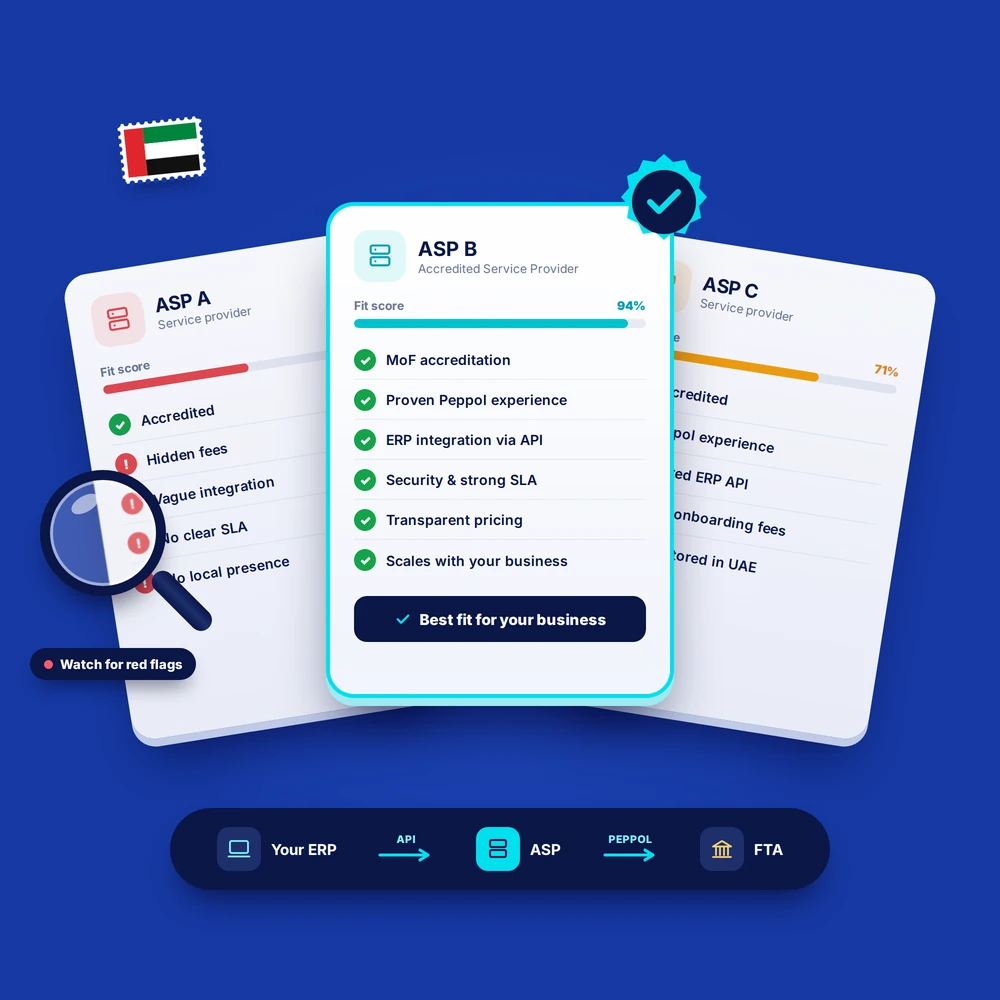
Table of contents:
- Key Summary
- What is an Accredited Service Provider (ASP) in UAE e-Invoicing?
- Why choosing the right ASP matters
- What criteria should businesses use to evaluate an ASP?
- How do you assess an ASP’s experience and background?
- What product and service questions should you ask an ASP?
- What questions should you ask shortlisted ASPs in a demo or RFP?
- What red flags should businesses watch for when choosing an ASP?
- How should businesses compare ASPs before signing a contract?
- How does ASP selection connect with your internal invoicing system?
- Frequently asked questions about choosing an ASP for UAE e-Invoicing
- Conclusion
With the e-invoicing system becoming mandatory in the UAE, businesses need to find a reliable accredited service provider. As part of compliance measures, accredited service providers must meet specific standards to be considered eligible for e-invoicing in the UAE.
Accredited service providers are government-certified intermediaries essential for processing electronic invoices. ASPs validate invoice data, convert invoices into a structured format (XML) if needed, transmit invoices to the buyer, and then report transaction-relevant tax data to the Federal Tax Authority.
The Ministry of Finance has released an official documentation guide that acts as a checklist for choosing the right accredited service provider for UAE e-invoicing. Highlighting the importance of ASPs as an essential player in exchanging and reporting invoices and credit notes through the e-invoicing system. The right ASP should prove official accreditation, strong Peppol experience, and smooth ERP integration. The official guide establishes how ASPs should be viewed, selected, and appointed, all of which are vital for achieving compliance.
This article is your guide on how to choose an accredited service provider and what factors you should consider before the mandatory implementation deadline.
What is an Accredited Service Provider (ASP) in UAE e-Invoicing?
Accredited service providers are official and certified intermediaries that enable businesses to exchange invoices within the UAE’s e-invoicing framework. ASPs play a vital role in processing invoices by sending, receiving, validating, and reporting data in accordance with the Federal Tax Authority's requirements.
In the UAE’s e-invoicing system, an ASP serves as the connector among the sender, the receiver, and the entire exchange model. It ensures that data is exchanged in a standardized format and through approved channels, while supporting compliance with legal standards.
Despite its importance, accreditation alone is not enough for selecting the right accredited service provider. Although it confirms that the provider meets the requirements to participate in the invoicing framework, that does not mean it supports your business needs, integrates with your system, or scales with your business.
This is why businesses should treat accreditation as the first step, then evaluate service providers based on experience, product capabilities, support quality, pricing, and long-term suitability.
Read Also: E-Invoicing in UAE: Full Guide
Why choosing the right ASP matters
Choosing an ASP is a vital infrastructure decision that affects how your business will perform and comply within the e-invoicing framework. Some of the effects that ASPs have on businesses:
Invoicing efficiency
Successful continuity
Integration costs
User experience for finance and accounting teams
The wrong ASPs can create unnecessary challenges for your business, such as:
Delay in implementation and onboarding
Costly integrations with existing systems
Invoice transmission failure
Processing delays
Unexpected fees
Difficulty adapting to future requirements
On the contrary, choosing the right ASP for your business can:
Integrate smoothly with your ERP/invoicing/accounting systems
Improve invoice processing
Maintain compliance control
Scale effectively
Support when issues increase
Reduce operational disruptions during implementation
Because ASPs regulate day-to-day operations, the selection decision should be viewed as a long-term operational decision rather than a one-time compliance check-box.
Read more: E-Invoicing Compliance Checklist for UAE
What criteria should businesses use to evaluate an ASP?
The official Ministry of Finance groups ASP evaluation into two categories:
- Experience and background
- Product and services
These categories are meant to help businesses decide whether a service provider is capable, reliable, and suitable for their business needs and operational requirements.
Experience and background
This category focuses on the provider’s track record, geographical reach, and local presence. Businesses should evaluate service providers by factors such as:
- Company history and stability
- Experience with e-invoicing services
- Peppol network experience
- UAE operational presence
- UAE accreditation history
- Geographic reach and market coverage
These factors are set to determine the provider’s ability to support organizations as requirements evolve.
Product and services
This category focuses on ownership, value-added service, and integration. Factors to be considered:
- Product ownership and accountability
- Integration capability
- Data management and storage
- Compliance control
- Customer support
- Pricing transparency
- Scalability and future readiness
A reliable service provider needs to integrate well with existing workflows and have adequate support and security controls.
How do you assess an ASP’s experience and background?
When choosing an ASP, its experience and background provide valuable insight into its ability to support your business over time. While new accredited service providers may be capable, business experience behind the service and its familiarity with the UAE market and e-invoicing requirements should be a priority.
Here are some aspects to consider when choosing an ASP:
Company history and UAE accreditation
Businesses should assess the service provider’s business history and local presence:
Here are some questions to consider:
- How long has the company been operating?
- How long has it been providing e-invoicing services?
- How long has it been in the UAE market?
- When did it receive UAE ASP accreditation?
It is important for your chosen ASP to align with these questions as the e-invoicing framework continues to evolve. A reliable ASP should have experience managing regulatory updates and an understanding of market requirements.
Peppol experience and geographical reach
The UAE’s e-invoicing framework is based on Peppol principles, which means businesses need a service provider experienced in working with a Peppol-enabled environment. Some questions to consider:
- How long has the provider been operating as a Peppol service provider?
- Does it have experience supporting Peppol-based invoice exchange?
- Does it support businesses operating internationally?
- What markets does it currently serve?
A provider with Peppol experience would be familiar with standardized invoice exchange, interoperability, and large-scale exchange operations. It is also important for businesses with international operations to appoint a provider with experience managing cross-border invoicing requirements.
What product and service questions should you ask an ASP?
The next step in evaluating an accredited service provider is its product and service qualities. An ASP may meet the regulatory requirements; this does not necessarily mean its solution is suitable for your business needs. When choosing an ASP, features are not the only important thing to check; you should ask questions that help you understand who owns the product, how it integrates with your current system, and whether pricing and support are transparent.
Important aspects to evaluate:
- Product ownership and accountability
- Integration capabilities
- Data storage and management
- Compliance and security control
- Customer support
- Pricing transparency and potential hidden costs
- Scaleability
Here is a breakdown of some of the main aspects to consider:
Product ownership and accountability
Understanding who actually owns the solution is a vital part of vendor due diligence. Some providers develop their own platform; others rely on third-party technology. Here are some questions necessary to consider:
- Does the provider own and develop the platform?
- Who is responsible for ongoing maintenance and updates?
- Who provides customer support?
- Are there any services outsourced to external partners?
Direct ownership enforces accountability, as the same provider that develops the platform is responsible for fixing issues, releasing updates, and responding to feedback. When multiple third parties are involved, responsibility becomes more scattered and less clear, and resolution time may increase.
Integration and data management
An important nuance when choosing an ASP: no matter how compliant it is, it can still create issues if not integrated well with your current system.
You need to ensure the provider integrates with your ERP/accounting/invoicing system. Questions you should consider about integration:
- What integration methods are available?
- Are APIs provided?
- What data formats are supported?
- How complex is the implementation?
- How much disruption should be expected upon implementation?
Questions to be considered about data management:
- Where is invoice data being stored?
- How are backups handled?
- How old records can be accessed if needed?
It is very important to choose an ASP that integrates well with existing systems to support your organization's overall performance and compliance.
Compliance, security, and support
An ASP is responsible for processing and exchanging critical invoice data, which means compliance, security, and customer support are essential evaluation criteria. While the provider might be capable of participating in e-invoicing in the UAE, that does not mean their product and services should not be questioned. Here are some questions necessary to ask:
- What security measures does the organization maintain?
- How is invoice data encrypted during transmission and storage?
- What access controls protect the customer information?
- What are the security incident defense measures?
- What are your guaranteed support response and resolution time?
- What uptime or service availability commitments are included in your SLA?
Strong security measures help reduce the risk of unauthorized access, while defined SLAs for service availability and support performance. Also, customer support is very important in assisting during implementation and day-to-day operations.
Pricing, hidden costs, and scalability
Transparency in pricing is a crucial aspect to consider before choosing an ASP. The initial pricing for some organizations does not necessarily reflect the total cost of the implementation and ongoing operations.
This is what you should ask your potential provider:
Whether pricing is subscription-based, transaction-based, or a hybrid model?
Which services are included in the initial pricing?
Whether onboarding, integration, training, or support incur additional charges?
How might future scaling and increased invoices affect prices?
How might regulatory updates and product enhancements be delivered?
It is also advisable to review the contract very carefully for any hidden fees related to implementation, maintenance, or operations. Also, businesses should verify how the UAE’s 100 free invoices provision is reflected in the provider’s terms and conditions.
It is also important to assess the ASP's flexibility to scale with your business. As the invoice increases or business requirements evolve, your chosen ASP should be able to adapt to the expansion.
What questions should you ask shortlisted ASPs in a demo or RFP?
After you narrow down your ASP options, use product demonstrations or a request for proposal (RFP) process in order to validate whether the provider is able to meet your operational and technical requirements. It is advisable to prepare a list of questions and ask every provider the same set to help you compare and choose, including:
How will your solution integrate with our current ERP/accounting/invoicing system?
Do you own the product, or is it provided through another vendor?
Where will the invoices be stored?
What security measures are in place?
What service-level agreements (SLAs) do you offer?
How is your pricing structured, and what costs are excluded from the quoted price?
How do you manage regulatory updates and future changes?
What invoice scenarios should we test before go-live?
How do you handle rejections, validation failures, and exception workflows?
Asking each provider the same set of questions makes side-by-side comparisons easier and thus makes a choice easier.
What red flags should businesses watch for when choosing an ASP?
Because a provider is crucial in the e-invoicing system, any red flag should be taken into consideration. Identifying issues early can help businesses avoid unexpected, costly implementation issues. Common red flags include:
- Vague explanations about integration capabilities
- Unclear ownership of support responsibilities
- Pricings that exclude or hide certain costs
- Poorly defined service-level agreements
- No clear product roadmap
- Minimal local UAE presence experience
- Generic “we support everything” claims without practical proof
- Inability to explain how rejected invoices or exception scenarios are managed
It is very alarming when providers avoid giving clear answers to technical questions or cannot provide realistic examples of implementation. A reliable provider should be able to confidently discuss limitations and responsibilities.
How should businesses compare ASPs before signing a contract?
After evaluating and interviewing various providers, businesses should establish a structured comparison process rather than making decisions based solely on pricing and sales.
Here is a practical approach:
- Draft a shortlist of 3 to 5 ASPs
- Compare each provider with the same criteria
- Run proof-of-capability testing
- Review commercial terms and SLAs
- Make the choice based on operational fit and long-term value
Proof-of-capability testing is crucial for validating real-world performance before committing. Including:
- Sending sample invoices
- Processing credit notes
- Stimulating validation failures and rejection scenarios
- Testing free-zone workflow
- Assessing support responsiveness during testing
Download: Tax Invoice Format UAE Word & Excel
Choosing through a structured comparison process helps you arrive at an ASP that suits your operational needs and supports your business as it grows. (Daftra offers full integration with ASP, accurate invoice generation, and alignment with the FTA compliance requirements.)
How does ASP selection connect with your internal invoicing system?
Choosing an accredited service provider is one part of preparing for the UAE e-invoicing system. Also, it is important to assess whether your business's current ERP/accounting system or e-invoicing software integrates with your chosen ASP and is ready for go-live.
Even when choosing a reliable and technically capable ASP, problems can still arise if your system has issues in capturing data, depends on manual processing, or has integration issues. This will lead to compliance issues and struggles in day-to-day operations.
Consider checking if your system is able to:
- Capture the required data
- Produce accurate and consistent invoice information
- Support automated workflow rather than manual entry
- Integrate with ASP through APIs
- Adapt to regulatory changes and business growth
It is also important for businesses to assess their current invoicing process to identify potential friction points. If invoice approvals or required data are managed manually, it might be worth updating.
This is why choosing an ASP should be viewed as part of a whole preparation process, alongside internal system readiness. Choosing a reliable ASP that aligns well with your current workflow, while ensuring your internal system can effectively generate invoices and exchange data.
It is advisable for businesses to assess their current system’s capabilities for invoice generation in line with UAE requirements. ERP systems like Daftra improve your invoice data readiness, streamline workflows, and integrate well with your ASP. Daftra promises accurate, FTA-approved invoice generation in a structured XML format and in accordance with all regulatory requirements.
Frequently asked questions about choosing an ASP for UAE e-Invoicing
What is an accredited service provider ASP?
An accredited service provider in the UAE is an officially FTA-certified intermediary that validates, formats, and transmits e-invoices through the Peppol network.
Who is the ASP for e-invoicing in UAE?
For the UAE e-invoicing system, an accredited service provider is an official intermediary, approved by the Ministry of Finance and the Federal Tax Authority. It is set within the e-invoicing system to validate, format, exchange, and transmit invoices.
How do I know if an ASP is accredited?
In order for an accredited service provider to be officially accredited within the UAE system, it must be listed in the Ministry of Finance or the Federal Tax Authority in the UAE’s portal as an official government-approved e-invoicing partner.
Can I choose different providers for sending and receiving?
As the UAE’s e-invoicing system operates on a decentralized 5-corner model, buyers and suppliers can use different ASPs to send and receive e-invoices.
What should be included in the ASP contract?
In the UAE e-invoicing framework, when drafting a legal contract with an accredited service provider, ensure the ASP is designated as your certified connector to the People Network and the Federal Tax Authority, and define clear responsibilities for validating, exchanging, and transmitting e-invoices. Here is what should be included in a legal contract for ASP:
Regulatory compliance and accreditation
- The provider must be officially certified by the MoF.
- The provider must guarantee invoice generation and validation in accordance with the PINT AE Data Dictionary, in XML format, and support all mandatory data fields.
Data retention and security obligations
- Local data residency: within the framework, ASPs must use UAE-cloud-based infrastructure to store records within the state.
- Record traceability: ASP must retain all technical transaction logs required for tax traceability.
- Retention period: data archiving must meet legal timeframes, set at 5 years from the end of the tax year.
Pricing transparency
- Free tier quota: the contract must reflect the regulatory requirement of 100 free transactions per month.
- Free structure: clearly states costs for software license, ERP API integration, and additional per-invoice volume fees.
- Exit costs: must define penalties and data extraction fees upon changing to a different provider in the future.
Service level agreement
- System uptime: must offer high availability for real-time or near real-time invoice transmission to the FTA.
- Support response times: priority tiers for technical support and issue fixing.
- Data privacy and insurance: ASP must have cyber fraud insurance and strict data confidentiality clauses.
An ASP contract is legally binding if it meets the FTA mandates, is officially certified, is linked to the EmaraTax portal, and contains detailed technical and tax liabilities.
Conclusion
Choosing the right ASP for your business is a crucial step to compliance. As the mediator responsible for validating, exchanging, and transmitting invoices in accordance with FTA requirements, an ASP can either disrupt your entire workflow or elevate it.
As per the MoF documentation, choosing an ASP should be based on experience and background, as well as products and services. These criteria are set to ensure your chosen ASP is suitable for your business and can achieve compliance. Beyond the MoF criteria, your chosen ASP should guarantee accurate invoice generation in XML format through the approved channels.
As ASPs govern your day-to-day operations, your selection process should be treated as a vital decision, not just a compliance step. The wrong ASP could delay your implementation, cause transmission and validation failures, and present unexpected fees.
However, choosing the right ASP for your system will help improve invoice processing, scale with your business, reduce operational disruptions, provide support when issues arise, and maintain compliance controls.
The most important questions to ask when choosing an ASP are:
Will it integrate with my current accounting, ERP, or invoicing system?
Does the system have strong security measures?
Will the system scale as my business grows?
These are vital qualities a reliable ASP should provide.











 Invoicing
 POS
 Offers
 Installments
 Sales Commission
 KSA E-Invoice Software
 EGY E-Invoice Software
 JO E-Invoice Software
 E-Invoice Software
 Chart of Accounts
 Asset Management
 Cost Centers
 Expenses
 Cheque Cycle
 UAE VAT-Tax
 Product Management
 Purchases
 Purchase Cycle
 Suppliers
 Requisitions
 Stocktaking
 Organizational Structure
 Personnel Management
 Attendance and Leave
 Contracts
 Payroll
 Requests
 Work Orders
 Booking Management
 Rental and Unit Management
 Time Tracking
 Work Flow
 Lease Contracts
 Manufacturing Management
 Client Follow-Up
 Loyalty Points
 Points and Credits
 Memberships
 Insurance Management
 Daftra ERP Full App
 Point of Sales App
 Point of Sales for Desktop – Support Offline Mode
 AI Expenses Scanner App
 Employee Attendance, Sign & ESS App
 E-invoice Reader App
 Inventory Stocktaking App