


UAE Tax Credit Note and How It Works for Businesses



Table of contents:
- Key Summary
- What Is a Tax Credit Note in the UAE?
- When Should a UAE Business Issue a Tax Credit Note?
- Tax Credit Note vs Tax Invoice What Is the Difference?
- Is a Credit Note the Same as a Refund?
- What Details Must Be Included in a UAE Tax Credit Note?
- How Does a Tax Credit Note Affect VAT Returns?
- How to Create a Tax Credit Note in the UAE
- Can Tax Credit Notes Be Issued Electronically?
- Who Can Issue a Tax Credit Note?
- Common Examples of UAE Tax Credit Notes
- Common Mistakes Businesses Make With Tax Credit Notes
- How Daftra Helps UAE Businesses Manage Tax Credit Notes Correctly
- FAQs
- Conclusion
When a business needs to reduce, correct, or partially cancel a previously issued tax invoice, it must issue a UAE tax credit note for VAT purposes. This usually happens when goods are returned, discounts are agreed after invoicing, the original invoice contains an error, or the taxable value changes after the supply has taken place.
A tax credit note is not simply a refund receipt. It is an official VAT document used to adjust the value of a taxable supply and the VAT amount previously charged on the original invoice.
In the UAE VAT system, tax credit notes help businesses maintain accurate tax records and ensure the correct amount of VAT is reported to the Federal Tax Authority.
This guide explains when a tax credit note should be issued, what information it must contain, how it affects VAT returns for both suppliers and customers, and how businesses can manage the process accurately while staying compliant with UAE VAT regulations.
What Is a Tax Credit Note in the UAE?
A tax credit note in the UAE is a written or electronic document issued by a VAT-registered supplier to record an amendment to a taxable supply that reduces or cancels it. The UAE VAT Executive Regulation defines a tax credit note as a document used to record changes to an earlier taxable supply when the original value or VAT treatment needs adjustment.
A tax credit note is issued to correct a previously issued tax invoice. It helps businesses adjust the taxable value, reduce the VAT amount charged, or correct errors related to VAT treatment. This ensures that both the supplier and the customer report the correct VAT amounts in their VAT returns.
Businesses may issue a tax credit note in situations such as returned goods, damaged products, post-sale discounts, overcharged VAT, or reductions in the agreed supply value. The document creates a clear record of the adjustment while keeping the original invoice valid for reference and audit purposes.
For example, if a company sells office equipment and later the customer returns one damaged item, the supplier can issue a tax credit note to reduce the original invoice amount and adjust the VAT charged on the returned item. This allows the supplier to reduce the output VAT previously declared and ensures the customer adjusts any input VAT claimed on the purchase.
A valid UAE tax credit note typically includes the supplier and customer details, TRNs, issue date, reference to the original tax invoice, corrected taxable amount, VAT adjustment, and the reason for issuing the document.
When Should a UAE Business Issue a Tax Credit Note?
A UAE tax credit note is used when a previously issued tax invoice needs to be reduced or corrected for VAT purposes. Under the UAE VAT Decree-Law, output-tax adjustments may arise from the cancellation of a supply, changes in tax treatment, a reduction in consideration, the return of goods or services, or VAT charged in error.
A tax credit note allows businesses to formally adjust the taxable value and the VAT previously reported to the Federal Tax Authority.
Common situations where a UAE business should issue a tax credit note include:
- Goods or services are returned: If goods are returned in full or in part, or services are canceled after invoicing, the supplier must reduce the original taxable value and the related VAT.
- The original supply is canceled: Where a transaction is cancelled after a tax invoice has already been issued, a tax credit note is required to reverse all or part of the supply value and VAT.
- The agreed consideration is reduced after invoicing: If the supplier and customer later agree to reduce the price of goods or services, the adjustment must be reflected through a tax credit note.
- A discount is granted after the tax invoice has been issued: Post-sale discounts, rebates, loyalty reductions, or promotional adjustments that were not included in the original invoice require a tax credit note to reduce the VAT accordingly.
- VAT was charged incorrectly: If VAT was overcharged, duplicated, or applied by mistake, the supplier must issue a tax credit note to correct the VAT amount reported in the VAT return.
- The tax treatment applied to the supply was incorrect: a tax credit note may be necessary where a supply was incorrectly treated for VAT purposes, such as charging 5% VAT on a supply that should have been zero-rated or exempt.
- Part of the supply value needs to be reduced: If only part of an order is cancelled, damaged, incomplete, or not delivered as agreed, the supplier can issue a partial tax credit note for the affected amount instead of canceling the entire invoice.
- Customer overpayments require adjustment: If a customer pays more than the invoiced amount, the excess may need to be formally adjusted and documented with a tax credit note.
Businesses should also ensure that tax credit note adjustments are properly reflected in their VAT returns, as they reduce the supplier’s output tax and may reduce the customer’s recoverable input tax.
It is important not to confuse tax credit notes with VAT bad debt relief adjustments, which follow separate VAT rules and reporting requirements. Additionally, not every commercial credit note automatically qualifies as a VAT tax credit note. To adjust VAT correctly, the document must meet UAE VAT documentation requirements and clearly reference the original tax invoice being adjusted.
Tax Credit Note vs Tax Invoice: What Is the Difference?
A tax invoice and a tax credit note are both important VAT documents under the UAE VAT system, but they serve different purposes. A tax invoice records the original taxable supply of goods or services and establishes the VAT charged on that transaction.
A tax credit note, on the other hand, is issued later to reduce or correct a previously issued tax invoice when the value of the supply or the VAT charged needs adjustment.
In practical terms, a tax invoice is used for the original sale or supply, while a tax credit note is used after invoicing when changes occur, such as returns, discounts, cancellations, pricing corrections, or incorrect VAT treatment.
Tax invoices generally increase or record output VAT, whereas tax credit notes reduce previously recorded output VAT where the legal conditions for adjustment are met under the UAE VAT rules administered by the Federal Tax Authority.
| Point of Comparison | Tax Invoice | Tax Credit Note | Business Impact |
|---|---|---|---|
| Main purpose | Records the original taxable supply | Corrects or reduces a previous tax invoice | Ensures accurate VAT and accounting records |
| When it is issued | At the time goods or services are supplied | After invoicing, when adjustments are needed | Helps businesses handle changes after the original transaction |
| Effect on transaction value | Records or increases the amount payable | Reduces the amount previously invoiced | Adjusts customer balances and supplier records |
| VAT treatment | Creates or records output VAT | Reduces previously declared output VAT where applicable | Affects VAT return calculations |
| Common use cases | Sales of goods or services | Returns, cancellations, discounts, pricing corrections, VAT errors | Supports VAT compliance and accurate reporting |
| Link to original invoice | Represents the original transaction | Must reference the original tax invoice | Creates a clear audit trail for VAT purposes |
For example, if a supplier issues a tax invoice for a taxable sale, the VAT charged becomes part of the supplier’s output VAT liability. If the customer later returns goods or receives a post-sale discount, the supplier issues a tax credit note to reduce the taxable amount and adjust the previously reported VAT.
A tax credit note may also be required when the wrong VAT treatment was originally applied, such as charging 5% VAT on a supply that should have been zero-rated or exempt. Proper use of both documents helps businesses maintain compliance, avoid VAT reporting errors, and keep accurate financial records.
Is a Credit Note the Same as a Refund?
No, A refund and a tax credit note are related, but they are not the same thing.
A refund is the actual return of money to the customer. A tax credit note, on the other hand, is the VAT document used to record the reduction or correction of a previously issued taxable supply and the related VAT amount.
For example, if goods are returned or a post-sale discount is agreed after invoicing, the supplier may issue a tax credit note to adjust the original invoice and reduce the VAT previously charged. The business may then refund the customer or keep the amount as a credit toward future purchases.
In short:
Refund = movement of money back to the customer
Tax credit note = VAT and accounting document recording the adjustment
Under UAE VAT rules administered by the Federal Tax Authority, businesses should ensure that any reduction to a previously issued tax invoice is properly documented through a valid tax credit note where required.
What Details Must Be Included in a UAE Tax Credit Note?
Under Article 60 of the UAE VAT Executive Regulation, a tax credit note must contain specific information to be considered valid for VAT purposes. These details ensure that the adjustment to the original taxable supply is properly documented and can be clearly verified by the Federal Tax Authority.
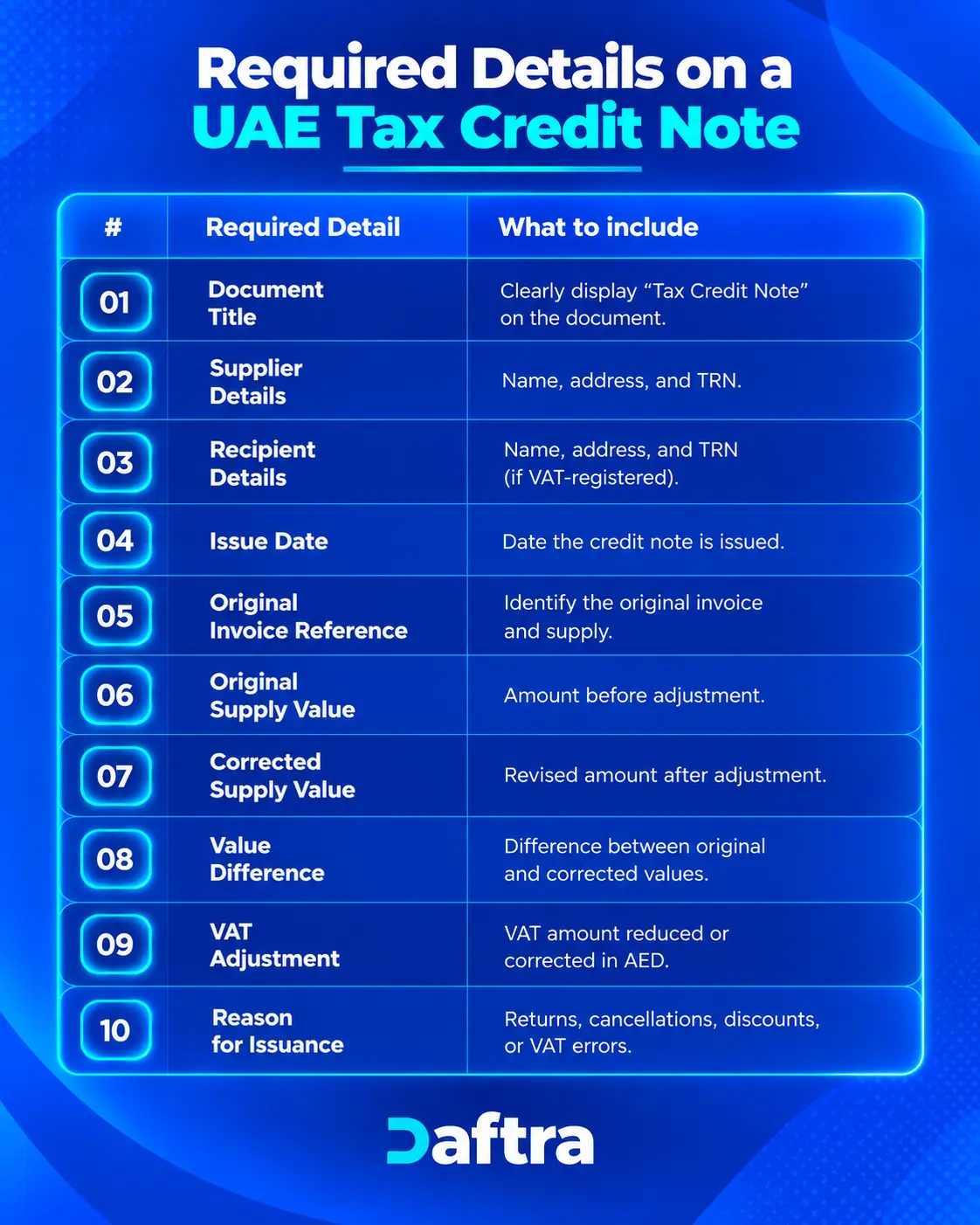
Every UAE tax credit note should include the following:
- The words “Tax Credit Note” are clearly displayed: The document must clearly identify itself as a tax credit note.
- Supplier details: The supplier’s name, address, and Tax Registration Number (TRN) must be included.
- Recipient details: The recipient’s name, address, and TRN must be shown if the recipient is VAT-registered.
- Date of issue: The tax credit note must clearly state the date of issue.
- Reference to the original taxable supply: The document must contain sufficient information to identify the original supply and the tax invoice being corrected, adjusted, or reduced.
- Original supply value: The value of the supply shown on the original tax invoice must be stated.
- Corrected supply value: The revised taxable value after the adjustment must be shown.
- The difference between the two values: The tax credit note should clearly show the amount of the reduction from the original to the corrected value.
- VAT charged relating to the difference in AED: The VAT amount being reduced or corrected must be clearly stated in UAE Dirhams.
- Reason for issuing the tax credit note: A brief explanation must be included, such as returned goods, canceled supply, post-sale discount, pricing correction, or VAT charged in error.
These details create a clear audit trail linking the tax credit note to the original taxable supply and help businesses correctly adjust output VAT and input VAT in their VAT returns. Missing required information may result in the tax credit note being considered invalid for VAT purposes.
For example, if VAT was incorrectly charged at 5% on a supply that should have been zero-rated, the tax credit note should clearly identify the original invoice, explain the VAT correction, and show the revised VAT amount.
Businesses should also retain tax credit notes as part of their VAT compliance records required by the Federal Tax Authority.
How Does a Tax Credit Note Affect VAT Returns?
A tax credit note affects the VAT returns of both the supplier and the recipient by reducing the VAT previously reported on the original tax invoice.
Under the UAE VAT Decree-Law, when a tax credit note is issued to correct output tax, the VAT stated in the note is treated as a reduction of output tax for the issuer and a reduction of input tax for the recipient in the tax period in which the recipient receives the note.
For the Supplier
For the supplier, the VAT amount shown in the tax credit note reduces the output tax previously declared on the original supply. This adjustment is reflected in the VAT return for the relevant tax period and lowers the total VAT payable to the Federal Tax Authority (FTA).
This usually happens when goods are returned, discounts are granted after invoicing, or the original VAT charged was higher than required.
For the Recipient
For the recipient, the VAT stated in the tax credit note reduces the input tax that was previously recovered on the original purchase. The adjustment must be reflected in the VAT return for the tax period in which the recipient receives the tax credit note.
This ensures that the input VAT claim matches the revised value of the transaction after the adjustment has been made.
Example
A supplier issues an invoice for AED 10,000 plus AED 500 VAT. Later, the customer returns goods worth AED 2,000, and the supplier issues a tax credit note for AED 100 VAT.
- The supplier reduces output VAT by AED 100 in the VAT return.
- The recipient reduces input VAT recovery by AED 100 in the tax period when the credit note is received.
This process helps both parties maintain accurate VAT records and ensures the VAT reported reflects the actual value of the transaction.
read also: Non-Recoverable VAT in UAE
How to Create a Tax Credit Note in the UAE
Creating a UAE tax credit note involves a structured process to ensure the adjustment is properly documented for VAT purposes and reflected correctly in the business’s accounting and VAT records. Under Article 60 of the UAE VAT Executive Regulation, businesses must ensure that the tax credit note clearly links to the original taxable supply and contains all required information.
1. Identify the Original Tax Invoice
Start by locating the original tax invoice that needs adjustment. A tax credit note cannot exist independently and must relate directly to a previously issued taxable supply.
The business should confirm:
- the original invoice number,
- invoice date,
- customer details, and
- the original taxable amount and VAT charged.
2. Confirm Why the Adjustment Is Needed
Next, determine the reason for issuing the tax credit note. Common reasons include:
- returned or damaged goods,
- cancellation of the original supply,
- post-sale discounts,
- pricing corrections,
- overpayments, or
- VAT was charged incorrectly.
The reason should be clearly documented because it affects both accounting records and VAT reporting.
3. Calculate the Correct Supply Value and VAT Difference
The supplier should calculate:
- the original taxable value,
- the corrected taxable value,
- the difference between the two amounts, and
- The VAT amount to be reduced or corrected in AED.
Accuracy is important because the tax credit note directly affects the supplier's output VAT and the customer's input VAT.
4. Include All Required Details
The tax credit note must contain all mandatory details required under Article 60 of the UAE VAT Executive Regulation, including:
- the words “Tax Credit Note,”
- supplier name, address, and TRN,
- customer details and TRN where applicable,
- date of issue,
- reference to the original tax invoice,
- details sufficient to identify the corrected supply,
- original and corrected values,
- VAT adjustment amount, and
- a brief explanation for the adjustment.
5. Issue the Tax Credit Note to the Customer
Once prepared, the tax credit note should be issued to the customer in either written or electronic form. Electronic tax credit notes are permitted provided the authenticity and integrity of the document are maintained in line with Federal Tax Authority requirements.
6. Update Accounting and VAT Records
After issuing the tax credit note, the business should update:
- accounting records,
- accounts receivable balances,
- VAT ledgers, and
- supporting documentation linked to the original invoice.
This helps maintain an accurate audit trail and prevents discrepancies during VAT reviews or audits.
7. Reflect the Adjustment in the Correct VAT Return Period
The VAT adjustment should be reported in the correct VAT return period so that the supplier’s output VAT and the customer’s input VAT are adjusted accurately. Delayed or incorrect reporting can lead to VAT mismatches and potential compliance issues.
If the correction relates to an incorrect VAT treatment, such as charging VAT on a supply that should have been zero-rated, businesses should also review the applicable VAT classification rules carefully.
Maintaining accurate tax credit notes and VAT adjustments helps businesses comply with Federal Tax Authority requirements and maintain reliable VAT records.
Can Tax Credit Notes Be Issued Electronically?
Yes, UAE VAT rules allow tax credit notes to be issued electronically, provided certain conditions are met. A taxable person may issue an electronic tax credit note if they can securely store a copy of the document and guarantee both the authenticity of origin and the integrity of the content.
This means the business must ensure that:
The electronic tax credit note cannot be altered after issuance.
The source of the document can be verified.
copies are securely retained in line with UAE VAT record-keeping requirements.
The document can be retrieved when required for audits or VAT reviews by the Federal Tax Authority.
Electronic tax credit notes are commonly issued through accounting systems, ERP platforms, or approved e-invoicing solutions and are often delivered electronically through secure channels such as email or B2B systems.
Daftra UAE software helps businesses issue electronic tax credit notes, link them directly to original invoices, automate VAT calculations, and securely store tax documents in compliance with UAE VAT record-keeping requirements.
Although physical tax credit notes are still permitted in some situations, electronic tax credit notes are increasingly preferred because they improve document control, simplify VAT compliance, and support secure digital record-keeping.
Who Can Issue a Tax Credit Note?
According to the UAE VAT Decree-Law, a tax credit note is issued by the Registered Supplier when there is a reduction in the output tax relating to a supply. The law states that the registered supplier must issue an original tax credit note and deliver it to the recipient of goods or services when the output tax charged exceeds the tax that should actually have been charged.
The Decree-Law also explains that a registered supplier may issue a tax credit note when:
- The supply is cancelled.
- The tax treatment of the supply changes.
- The agreed consideration changes.
- Goods or services are returned in full or in part.
- The tax was charged incorrectly.
In addition, the law allows cases in which another person may issue a tax credit note on behalf of the registered supplier, subject to the conditions specified in the Executive Regulations.
read also: How to Register for VAT in UAE
Common Examples of UAE Tax Credit Notes
The UAE VAT Decree-Law identifies several situations in which a tax credit note may be required when the originally charged output tax needs to be adjusted. Common examples include:
- Cancellation of a supply
A tax credit note may be issued if the original supply is canceled after the tax invoice was issued. - Change in the tax treatment of the supply
If the VAT treatment of a transaction later changes, the supplier may need to adjust the original output tax with a tax credit note. - Alteration of the agreed consideration
If the previously agreed value of the supply changes for any reason, the output tax may need to be reduced by issuing a tax credit note. - Return of goods or services
If goods or services are returned, in whole or in part, and the consideration is refunded in whole or in part, the supplier may issue a tax credit note. - Tax charged in error
A tax credit note may also be used where VAT was levied or applied incorrectly on the original supply.
The law further explains that when a tax credit note is issued, it reduces the supplier’s output tax and reduces the recipient’s input tax for the tax period in which the note is received.
Common Mistakes Businesses Make With Tax Credit Notes
The UAE VAT Decree-Law highlights several compliance requirements that businesses must follow when issuing tax credit notes. Failure to follow these rules can lead to incorrect VAT adjustments or record-keeping issues.
Some common mistakes include:
- Failing to issue a tax credit note when the output tax should be reduced
The law requires the registered supplier to issue a tax credit note when the output tax originally charged exceeds the tax that should actually have been charged. - Incorrectly adjusting VAT without a proper tax credit note
Output tax adjustments must follow the legal mechanism set out in Article 62, which requires a tax credit note where output tax needs to be reduced. - Confusing tax credit notes with bad debt adjustments
The Decree-Law treats bad debt relief separately under Article 64 and applies different conditions to those adjustments. - Failing to keep proper records for electronic tax credit notes
The law requires compliance with conditions and procedures for issuing electronic tax credit notes, including record-keeping requirements set out in the Executive Regulations. - Not delivering the tax credit note to the recipient when required
Article 70 states that the registered supplier must issue and deliver the original tax credit note to the recipient of goods or services when applicable.
How Daftra Helps UAE Businesses Manage Tax Credit Notes Correctly
Because UAE tax credit notes directly affect both output and input VAT, businesses need a system that accurately links invoices, adjustments, accounting entries, and VAT reports.
Daftra Accounting Software UAE helps businesses manage tax credit notes in a structured, VAT-compliant way by automating much of the adjustment and documentation processes.
With Daftra, businesses can:
- create electronic tax credit notes linked directly to the original tax invoice,
- automatically calculate corrected taxable values and VAT differences,
- maintain sequential numbering and organized audit trails,
- store tax credit notes securely in digital records,
- manage customer returns, discounts, and invoice corrections more accurately,
- reduce manual accounting and VAT calculation errors,
- update customer balances and accounting ledgers automatically, and
- Simplify VAT reconciliation before filing VAT returns.
Because UAE VAT rules require tax credit notes to contain mandatory details and properly reference the original taxable supply, using an accounting system helps businesses avoid incomplete or inconsistent documentation. Daftra also supports electronic document management, which is increasingly important as the UAE expands its e-invoicing and digital compliance framework.
FAQs
What is the reason for issuing a credit note?
A tax credit note is issued when a previously issued tax invoice needs to be reduced or corrected for VAT purposes. Common reasons include returned goods, canceled supplies, post-sale discounts, pricing corrections, customer overpayments, reductions in consideration, or VAT charged incorrectly.
What is the time limit for issuing a credit note?
Under UAE VAT rules, businesses should issue the tax credit note once the event requiring the adjustment occurs, so that the VAT correction is reflected in the correct VAT return period. The UAE VAT legislation requires a 14-calendar-day issuance period in applicable adjustment situations.
What is the tax rate for credit note?
A tax credit note does not create a separate VAT rate. Instead, it adjusts the VAT originally charged on the original taxable supply. The VAT correction shown on the tax credit note must match the VAT treatment applicable to the original invoice.
Are credit notes taxable?
A tax credit note itself is not a separate taxable supply. It is a VAT adjustment document used to reduce or correct the taxable value and VAT amount previously charged on the original supply.
What should be done when you receive a credit note?
When a VAT-registered recipient receives a tax credit note, they should:
- review the adjustment details,
- Verify the reference to the original invoice,
- update accounting records,
- reduce the related input VAT recovery where applicable, and
- Keep the document as part of the VAT compliance records required by the Federal Tax Authority.
What is the difference between a tax credit and tax deduction?
A tax credit note is a VAT document used to correct or reduce a taxable supply and the VAT previously charged on an invoice. A tax deduction, however, generally refers to a reduction in taxable income or tax liability under a tax system. They are different concepts and serve different tax purposes.
What are the advantages of a credit note?
Tax credit notes help businesses:
- correct invoice and VAT errors,
- reduce overreported output VAT,
- maintain accurate VAT records,
- support transparent accounting adjustments,
- document returns and discounts properly,
- improve audit readiness, and
- maintain clearer reconciliation between suppliers and customers.
How long is a credit note valid?
A tax credit note remains part of the VAT and accounting records linked to the original taxable supply. Businesses should retain tax credit notes in accordance with UAE VAT record-keeping requirements and keep them available for audits or VAT reviews.
What is the penalty for credit note?
UAE administrative penalties may apply when businesses:
- fail to issue a required tax credit note,
- Issue a note with missing or incorrect information,
- fail to issue it within the required timeframe, or
- create VAT return discrepancies because of incorrect adjustments.
Penalties of AED 2,500 per instance under the UAE VAT administrative penalty framework.
Conclusion
Tax credit notes are an essential part of UAE VAT compliance because they allow businesses to properly reduce or correct previously issued tax invoices when the value of a taxable supply changes. Whether the adjustment relates to returned goods, canceled supplies, pricing corrections, post-sale discounts, or VAT charged in error, issuing a valid tax credit note helps businesses maintain accurate VAT records and avoid reporting discrepancies.
Under UAE VAT rules, tax credit notes directly affect both the supplier’s output VAT and the recipient’s input VAT recovery. For this reason, businesses must ensure that every tax credit note clearly references the original taxable supply, contains all required Article 60 details, and is reflected correctly in VAT returns and accounting records.
As VAT compliance and electronic invoicing requirements continue to evolve in the UAE, maintaining organized documentation and accurate adjustment records becomes increasingly important. Using accounting systems such as Daftra Accounting Software UAE can help businesses manage invoice corrections, VAT adjustments, record-keeping, and electronic tax credit note workflows more efficiently while supporting stronger VAT reporting processes.











 Invoicing
 POS
POS Offers
 Installments
 Sales Commission
 KSA E-Invoice Software
 EGY E-Invoice Software
 JO E-Invoice Software
 E-Invoice Software
 Chart of Accounts
 Asset Management
 Cost Centers
 Expenses
 Cheque Cycle
 UAE VAT-Tax
 Product Management
 Purchases
 Purchase Cycle
 Suppliers
 Requisitions
 Stocktaking
 Organizational Structure
 Personnel Management
 Attendance and Leave
 Contracts
 Payroll
 Requests
 Work Orders
 Booking Management
 Rental and Unit Management
 Time Tracking
 Work Flow
 Lease Contracts
 Manufacturing Management
  Client Follow-Up
 Loyalty Points
 Points and Credits
 Memberships
 Insurance Management
 Daftra ERP Full App
 Point of Sales App
 Point of Sales for Desktop – Support Offline Mode
 AI Expenses Scanner App
 Employee Attendance, Sign & ESS App
 E-invoice Reader App
 Inventory Stocktaking App