




Table of contents:
- Definition of Sales Forecasting
- Types of Sales Forecasting
- What is the importance of sales forecasting?
- What are the objectives of sales forecasting?
- How to perform sales forecasting
- Methods and Techniques of Sales Forecasting
- What are the factors affecting sales forecasting?
- Challenges of Sales Forecasting
- Sales Forecasting Formula
- How can Daftra help you with sales forecasting?
- Frequently Asked Questions
The objective of evaluating institutions and commercial companies is to assess their ability to generate profits that enable them to survive and succeed in the financial and business markets.
Therefore, organizations often find themselves in situations where they must make decisions that may affect their profits and financial position, especially amid rapid developments and constantly changing market conditions.
Management cannot rely on guesswork, experience alone, or even traditional methods when making decisions. There are many factors to consider beforehand, such as financial statements, the company’s financial position, expenses, profits, and the volume and growth rate of sales.
As a result, the prevailing approach in modern organizations is to adopt advanced methods that rely on analytical tools and quantitative measurement techniques. Among the most important of these are programming, sales forecasting, and inventory management.
In this article, we will explain the concept of sales forecasting, its importance and objectives, how it is conducted, and the most effective methods and approaches.
Key Points Summary
- Sales forecasting is the process of estimating the revenue a company will generate from selling its products or services over a specific period.
- There are 3 types of sales forecasting: short-term, medium-term, and long-term.
- The importance of sales forecasting is reflected in the following elements: achieving a balance between supply and demand, financial planning, benefiting various aspects of the business, helping to set realistic sales targets, identifying strengths and weaknesses within the organization, gaining the trust of investors and partners, contributing to evaluating the performance of the sales department, and determining product pricing.
- Sales forecasting is based on methods including time series, personal judgment, historical forecasting, field market testing, customer interviews, similar and past sales, the straight-line method, the economic method, linear regression, and percentage-based methods.
- The main factors affecting sales forecasting include market trends, customer interests, marketing strategies, and competition.
Definition of Sales Forecasting
Sales forecasting is the process of using several steps to predict or estimate sales volume over a specific period. Sales volume here is not limited to tangible goods and services; it also includes e-commerce sales and services provided by a company or organization to its customers.
The sales forecasting process is considered an essential managerial practice that helps organizations plan business operations and commercial activities in the short or long term, depending on the nature of the organization’s business. This process is carried out using the latest scientific methods.
Types of Sales Forecasting
Organizations rely on feasibility studies, which include sales forecasting for a specific period. There are three types of sales forecasting: short-term, medium-term, and long-term. Below are the details of each type:
1. Short-term sales forecasting
This type of forecasting is conducted for a period not exceeding one year and may be quarterly or semiannual.
2. Medium-term sales forecasting
This type extends for a period longer than one year and less than three years.
3. Long-term sales forecasting
This type is conducted for a period exceeding three years. It requires focusing on several social and economic factors related to customers, as well as global and local market conditions that affect sales and profit calculations.
What is the importance of sales forecasting?
Sales represent the face of the organization and are among the most important indicators of its success in achieving its goals, whether the organization is large, medium-sized, or even a startup.
Therefore, sales forecasting is one of the most important tasks performed by sales management within organizations. It helps balance supply and demand, ensure proper planning, estimate the expected volume of work, influence spending programs, and identify strengths and weaknesses. There are many additional benefits explained in detail below:
- Balancing supply and demand: The importance of sales forecasting lies in achieving equilibrium between customer demand for a product or service and the supply available in the market.
- Proper planning: It is a fundamental pillar of the planning stage, as no plan can be created without forecasting and anticipating the future to understand its dimensions, then preparing the necessary arrangements to face events and risks. Therefore, forecasting is one of the most important steps in development and planning processes across all sectors of the organization.
- Estimating the volume of expected work: Sales forecasting covers all aspects of activities and projects, including predicting workload, required budgets and expenses, and the number of employees and equipment needed.
- Influencing spending programs: Sales forecasting impacts investment spending programs, marketing policies, and operational and control systems.
- Identifying strengths and weaknesses: It helps identify strengths and weaknesses in the products and services offered, enabling management to improve performance and reduce or eliminate errors.
- Determining purchasing and production schedules: Sales forecasting helps set purchasing, production, and inventory schedules based on realistic sales targets.
- Supporting expansion decisions: It assists in making future expansion decisions, such as launching a new production line, making acquisitions, or opening new sales outlets.
- Evaluating sales representatives: Sales forecasting helps evaluate the performance of sales teams and representatives by determining whether targets have been met, exceeded, or missed, and then motivating and guiding them accordingly.
- Building trust: It helps investors and partners gain trust by providing a clear picture of the company’s sales capabilities and profit-generating potential.
What are the objectives of sales forecasting?
The sales forecasting process aims to estimate sales, whether expressed as a quantity or a percentage, over a specific period. Based on this process, the organization’s management makes many decisions. Therefore, sales forecasting can be considered the link between the organization and the market in which it operates.
The objectives of sales forecasting include setting an estimated budget, maintaining the organization’s position, meeting customer needs, determining various costs, evaluating sales representatives’ performance, and many other aspects explained below:
- Setting an estimated budget: Sales forecasting helps in preparing an estimated budget for business sales activities.
- Maintaining the organization’s position: Preserving the organization’s market share and position, and estimating its sales volume at all levels. Financial forecasting is considered the foundation for planning most of the organization’s production and marketing activities.
- Meeting customer needs: Understanding customer needs and demands, then providing products and services that meet those needs based on the results of the forecasting process.
- Determining costs: Estimating the costs of raw materials required for production, as well as the type and cost of labor needed. It also includes identifying effective sales and marketing locations and determining the best times and seasons to focus on.
- Determining marketing costs: Identifying the cost of marketing campaigns for the organization’s products and services, and developing sales and marketing strategies.
- Setting prices: Determining product and service prices based on market conditions and customer demand.
- Determining quantities: Helping to determine production and inventory levels based on available resources, in order to avoid stagnation.
- Evaluating sales representatives’ performance: Sales forecasting helps assess their performance, identify strengths and weaknesses, and improve overall performance.
- Comprehensive development: Developing the human resources and capabilities of the sales management team through training programs, and helping the sales team achieve their targets by correcting their course when needed.
- Avoiding potential risks: Anticipating possible challenges and risks that the organization may face in the future, and taking the necessary measures to address them by providing all the information needed to improve the organization’s position.
How to perform sales forecasting
Many studies indicate that organizations that forecast their sales over a specific period can increase their annual profits by up to 10%. Therefore, there are specific steps involved in sales forecasting.
These steps include defining the objective, segmenting activities and products, collecting data, identifying variables, setting a timeline, and documenting processes. Below are the steps in detail from start to finish.
Key steps for sales forecasting:
1- Defining the objective: The goal of the sales forecasting process must be clearly defined in order to determine the most suitable method and approach.
2- Segmenting activities and products: For example, a food company can divide its products into categories such as dairy products, meat and poultry, and others.
3- Collecting previous data and studies: Gather data about the organization, its products or services, and continuously analyze information related to the target audience.
4- Identifying variables: Determine key variables and factors affecting sales volume, such as product or service pricing, the time customers need to try and evaluate products, and the duration required for repeat purchases.
5- Setting a specific timeline for forecasting sales volume: It is important to define the time frame covered by the forecast, whether short-term or long-term. Ideally, forecasts should cover a period of three to five years to include detailed historical data.
6- Documenting processes: Document purchasing and sales processes from start to finish, as poorly managed transactions can negatively affect the accuracy of results.
7- Determining the required sales volume: Every process needs a measurable target. Sales performance cannot be evaluated without a defined profit or sales goal that the organization aims to achieve.
8- Choosing the appropriate method: Select the most suitable forecasting method based on the company’s activities and objectives.
9- Monitoring and analyzing results: Analyze results accurately to track developments and identify strengths and weaknesses.
10- Making estimates: Based on all previous information and steps, future sales volume estimates are made, taking into account available resources and the organization’s financial position. Then, an estimated sales budget is prepared, and roles are distributed across all departments to achieve the expected sales targets.
Methods and Techniques of Sales Forecasting
If you are about to start the sales forecasting process, there are many methods and techniques that can be applied. More than one method can be combined in a single process.
These methods include time series, personal or qualitative judgment, historical forecasting, field market testing, customer interviews, similar sales, and past sales, among many others. Below are the details:
1. Time series
These are sets of measurements used to study the sales volume of a product or service over consecutive, equally spaced time periods. Time series are modeled as equations comprising internal and external variables.
2. Personal or qualitative judgment
This is based on personal expectations derived from experience. It is applied only in specific cases, particularly when it is not possible to analyze market conditions quantitatively, meaning there is no historical data or numerical sales information available.
In this method, factors affecting sales are identified, including customer income, sales locations, and the target audience's demographic characteristics.
Expert opinions can be used, for example, by hiring consultants and specialists to estimate expected sales and profit levels. Then, the marketing manager reviews these expert forecasts.
Business owners’ perspectives may also be considered in light of the company’s activities and direction.
Additionally, sales representatives’ opinions are used to estimate sales volume due to their familiarity with customer preferences and needs. In this case, sales representatives must prepare reports that include the quantity of products or services that can be marketed in a specific area, as well as other influencing factors, as they serve as the link between customers and the organization.
This method is somewhat similar to the Delphi method, which also measures sales volume through questionnaires answered by a group of experts in business and finance.
This approach can be used in emergency situations or when marketing new and diverse products or services, but it is criticized for lacking accuracy.
3. Historical forecasting
This method is applied in short-term sales forecasting when conditions remain stable. It relies on past sales figures that are expected to influence the present and future. However, its drawback is inaccuracy due to changing market conditions.
4. Field market testing
This method is used when promoting a new product or service. The product is introduced to measure and understand customer feedback.
This is done by selecting markets with conditions similar to the target market, including comparable levels of competition, pricing, customer income, and sales channels.
A small quantity of the product or service can also be tested in the real market to measure customer reactions. This method is suitable for startups.
5. Customer interviews
This involves conducting customer interviews or sending surveys to understand their preferences and perceptions of products and services. Based on the collected data, sales volume can be estimated.
However, this method is considered costly.
6. Similar sales
This method involves studying a company with similar products, services, and business activities in terms of resources, costs, and offerings, and comparing its sales volume to estimate expected sales.
7. Past sales
This method is used when targeting a small customer segment, in which sales volume is estimated from prior purchase data.
8. Straight-line method
This method relies on forecasting sales volume based on prior indicators and studies of products and goods.
9. Economic method
This is considered the most accurate method, as it relies on measuring the impact of average individual consumption, especially for consumer goods. It also analyzes the effect of price changes on sales.
Additionally, this method examines the impact of sales cycle duration and sales representatives' performance on sales volume.
The economic method includes the following types:
Studying average consumption
This method is based on analyzing past sales of essential consumer goods over a previous period and estimating future sales based on those results.
Studying the impact of income and salaries
This method focuses on changes in individuals’ financial conditions. It studies how consumer income affects purchasing behavior and consumption rates, and measures how product demand changes with income variations.
Examples include products like sweets and fruits.
Studying the impact of price changes
This method analyzes how changes in product prices affect sales volume and demand, especially when prices fluctuate.
Examples include products like meat and poultry.
Relationship between products
This method examines how the sales of certain products affect the sales of related products, such as flour and bread. For example, flour sales may be measured based on changes in bread sales.
Use a sales commission calculator to determine each sales employee's commission based on total sales.
10- Linear Regression
This is one of the most widely used methods in sales forecasting, as it relies on identifying the impact of various external factors on demand for a specific product or service.
External factors are considered the independent variable, while demand is the dependent variable.
The main types of this method include:
- Simple regression: focuses on overall sales levels without studying the impact of external factors.
- Specified regression: focuses on the effect of variables on sales levels from one financial period to another.
- Linear regression: involves plotting a straight line to determine the relationship between variables and their impact on sales.
11- Percentages
Sales can be forecasted by analyzing the expenses that will be spent on the organization’s commercial and financial activities, and then determining the percentages of sales, profits, and expenses.
What are the factors affecting sales forecasting?
Several factors affect the sales forecasting process, and they vary across industries depending on the diversity of business activities. The most common factors that significantly influence sales forecasting include market trends, customer interests, marketing strategies, and competition. Below are the details of each factor:
1- Market trends
Market trends refer to the “changes” that occur and have a direct impact on the market and the nature of supply and demand. For example, economic downturns and inflation lead to reduced sales and lower demand for products and services.
On the other hand, higher social standards and technological advancements create new sales opportunities. Environmental and political changes also affect product demand, investment levels, and economic expansion.
2- Customer interests
Customer behavior and preferences directly influence sales forecasting. Therefore, it is important to monitor changes in customer behavior, orientations, and expectations to ensure accurate forecasting.
3- Marketing strategies
Marketing strategies impact sales forecasting, including identifying the target audience, designing social media advertising campaigns, and determining how to promote products and services.
4- Competition
The emergence of competitors in the market may negatively impact sales by reducing demand and shifting customer preference toward alternative products. Therefore, competitors should be continuously monitored and evaluated to assess their impact on sales forecasting.
Challenges of Sales Forecasting
Sales forecasting faces several challenges that may hinder its accuracy. These challenges include various changes and disruptions, data inaccuracy, and the difficulty of calculating seasonal sales. Below are the key obstacles:
1- Various changes: Rapid changes in market trends, customer preferences, and economic conditions.
2- Data inaccuracy: Sometimes the data used in forecasting methods is inaccurate or incomplete, which affects the accuracy of sales estimates. Therefore, it is important to verify data such as target audience characteristics, average competitor pricing, and product features.
3- Difficulty of seasonal calculations: Seasonal fluctuations can lead to inaccurate sales estimates, which in turn affect resource allocation.
4- Product fluctuations: Introducing, replacing, or discontinuing products or services suddenly makes it difficult to accurately forecast expected sales.
5- Various disruptions: Logistical disruptions related to shipping, transportation, and product distribution, or delays in obtaining raw materials, all contribute to difficulties in accurately determining expected sales.
Sales Forecasting Formula
There is more than one equation or calculation formula that complements sales forecasting methods, including:
- Average monthly sales rate = Total sales revenue ÷ Number of months
- Potential sales revenue for the rest of the year = Average monthly sales rate × (Number of months in the year − Number of months so far)
- Annual sales forecast = Total sales revenue + Potential sales revenue for the rest of the year
How can Daftra help you with sales forecasting?
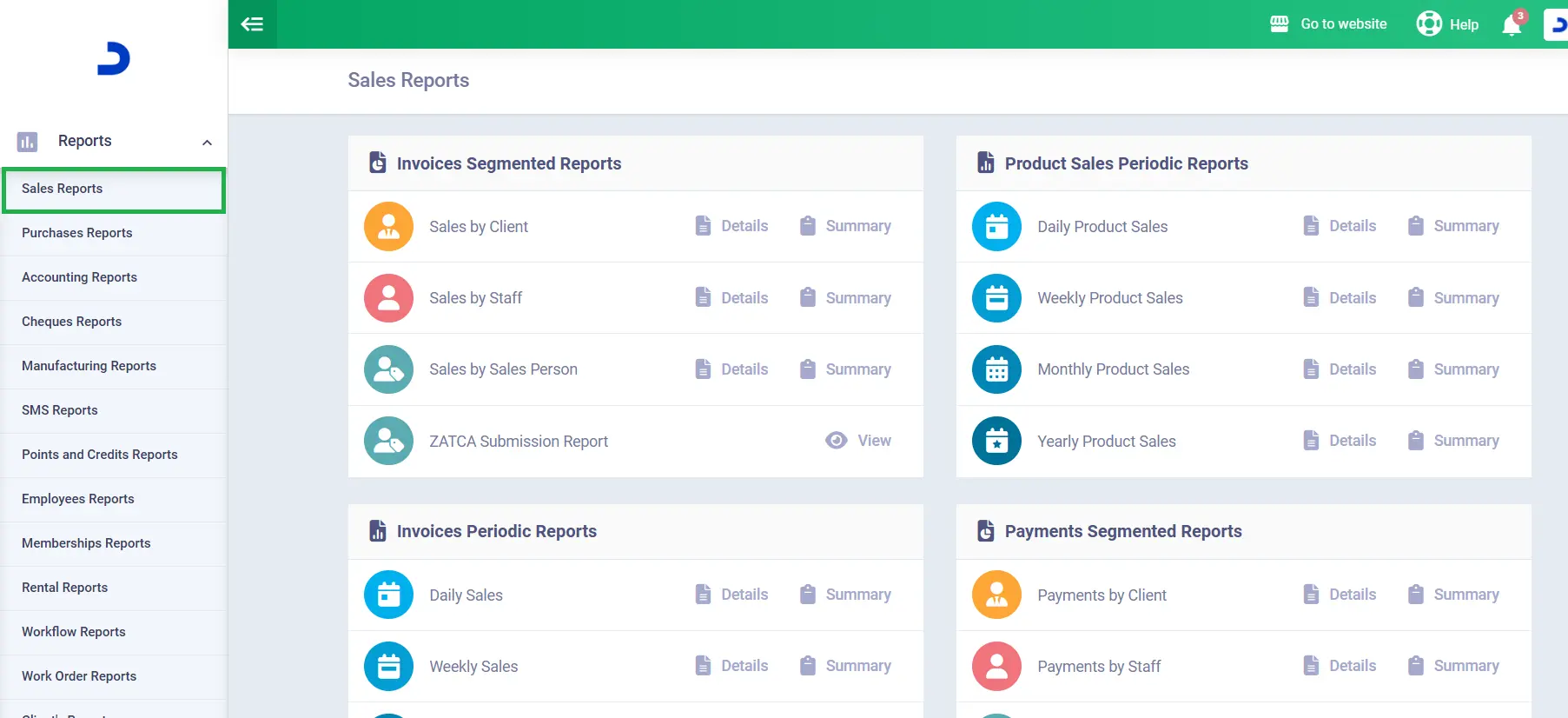
Daftra’s sales software provides you with a variety of reports that you can use as indicators of future sales. This makes the planning process more effective, helps you balance supply and demand, and enables better supplier relationships to maintain optimal inventory levels throughout the financial year.
It also takes into account seasonal and slow periods based on the analysis of the sales reports available in the system.
Frequently Asked Questions
What are the types of financial forecasting?
Financial forecasting is divided into two main types: short-term forecasting, which focuses on predicting expenses and cash flows in the near term, and long-term forecasting, which covers extended periods and supports decision-making and the determination of financial needs.
What is sales estimation?
It is the process through which a company estimates the sales it is likely to achieve in future periods.
What are the disadvantages of sales forecasting?
- Relying on data that may change suddenly due to unexpected events such as pandemics (e.g., COVID-19), which affects all company forecasts.
- Forecasts may be influenced by managers’ personal judgments, leading to inaccurate results.
- It requires significant time and effort to ensure accuracy and reliability.
Conclusion
It can be said that sales forecasting is essential and no less important than generating profits. Therefore, it is necessary to carefully choose the most suitable forecasting methods and techniques based on the company’s size, activity, and direction.
This process helps organizations understand the size of their resources, when and how to use and allocate them, and contributes to budgeting, production planning, and increased sales volume.
Sales forecasting is based on estimating the volume and percentage of product sales or the level of customer usage of services over a specific financial period or business season. In other words, it focuses on revenue and profit levels. Forecasting is not just prediction—it is a guide that helps organizations take the right actions now to ensure survival and success in the market.












 Invoicing
 POS
POS Offers
 Installments
 Sales Commission
 KSA E-Invoice Software
 EGY E-Invoice Software
 JO E-Invoice Software
 E-Invoice Software
 Chart of Accounts
 Asset Management
 Cost Centers
 Expenses
 Cheque Cycle
 UAE VAT-Tax
 Product Management
 Purchases
 Purchase Cycle
 Suppliers
 Requisitions
 Stocktaking
 Organizational Structure
 Personnel Management
 Attendance and Leave
 Contracts
 Payroll
 Requests
 Work Orders
 Booking Management
 Rental and Unit Management
 Time Tracking
 Work Flow
 Lease Contracts
 Manufacturing Management
  Client Follow-Up
 Loyalty Points
 Points and Credits
 Memberships
 Insurance Management
 Daftra ERP Full App
 Point of Sales App
 Point of Sales for Desktop – Support Offline Mode
 AI Expenses Scanner App
 Employee Attendance, Sign & ESS App
 E-invoice Reader App
 Inventory Stocktaking App