




Table of contents:
- Key Summary
- What Is a Company?
- What Are the Types of Companies?
- What Is the Importance of Companies and Why Are They Established?
- What Are the Characteristics of Companies?
- How Do You Choose the Right Company Type for Your Project?
- What Are the Steps and Reasons for Establishing a New Company?
- What Is the Difference Between Establishing Companies in Egypt and Saudi Arabia?
- What Are the Elements of a Company?
- Want a Successful Company? Try Daftra!
- Frequently Asked Questions
Companies vary in their objectives, activities, and sizes, raising many questions about the different types of companies,
and how each affects the business environment. Companies have distinct characteristics that set them apart in terms of organizational structure, responsibilities, legal framework, and commercial or economic purpose.
In this context, we help you, as a business owner, understand all concepts related to companies clearly and comprehensively. Let's explore them in detail, starting with "What is a company?"
What Is a Company?
A company is a legal entity that aims to generate profit through business activities. It consists of a group of shareholders who provide the capital needed to establish and operate it (or one person in some modern types). Each shareholder's share of the company's profits is then determined based on their financial contribution.
What Are the Types of Companies?
Companies differ according to their legal structure and purpose of establishment. Each type has characteristics that distinguish it from others. They are divided into:
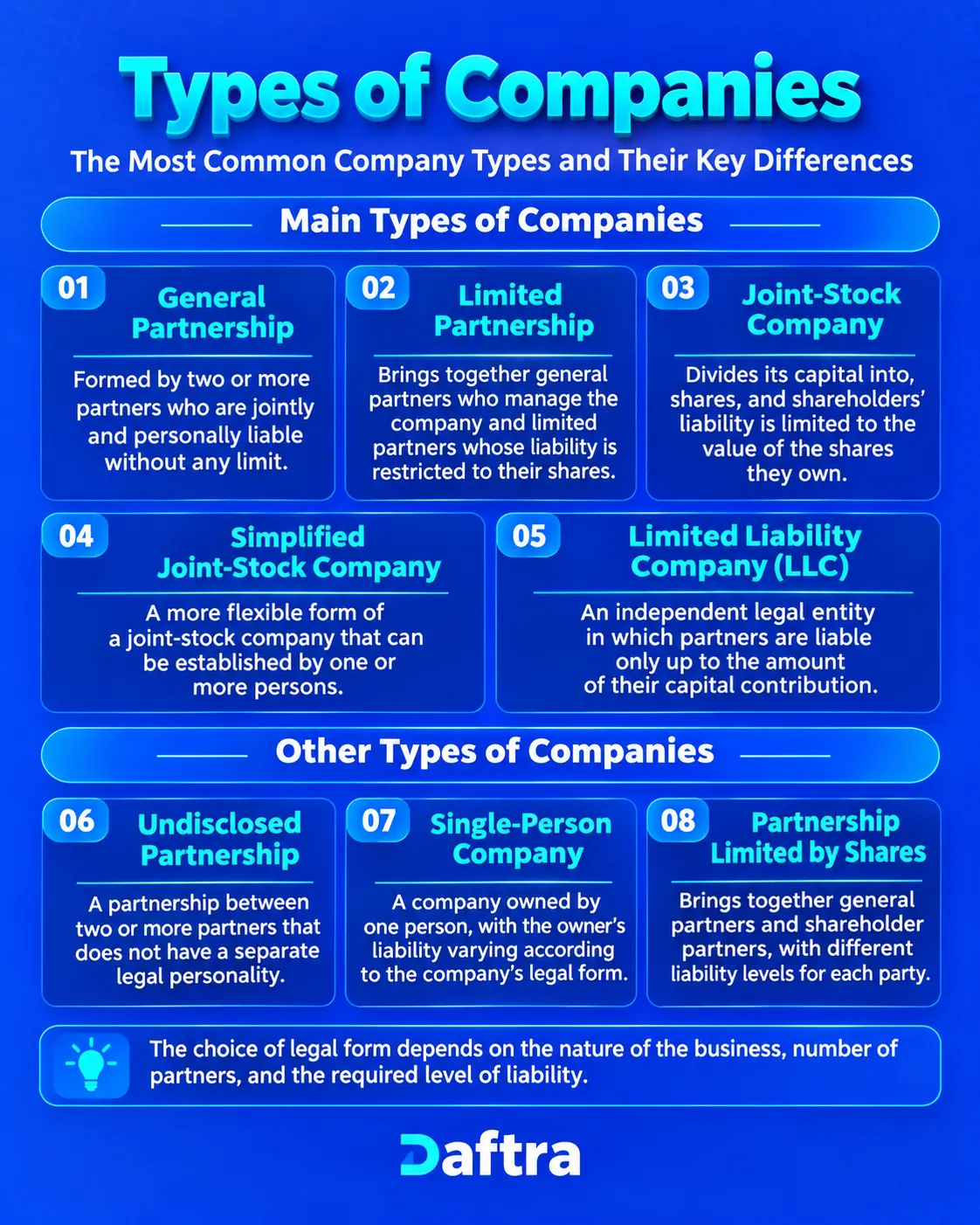
1- General Partnerships:
In general partnerships, partners are jointly liable for the company's obligations. The company has financial assets and liabilities separate from those of its partners, as well as a distinct name.
Characteristics of General Partnerships
- Partners have unlimited liability, meaning they are personally responsible for the company's debts and obligations.
- Each partner may be delegated management authority and perform various managerial duties.
- Under the current regulations, the company is established by two or more persons.
- Profits and losses are distributed based on each partner's share of capital.
- A partner's death or bankruptcy may be grounds for dissolving a general partnership, in accordance with applicable regulations and the articles of incorporation.
- The company's bankruptcy does not automatically mean that all partners become bankrupt, but partners are personally and jointly liable for the company's debts with all their assets.
Disadvantages of General Partnerships:
- Disputes may arise between partners because each partner has the right to manage and conduct business without consulting the other partner.
- Partners may incur losses or face bankruptcy due to their personal liability for the company's obligations.
- A partner cannot dispose of their capital share without consulting the other partners.
- If the company dissolves due to the bankruptcy or death of a partner, the other partners may suffer losses.
2- Limited Partnerships
A limited partnership consists of two groups of partners. The first includes at least one general partner who is personally liable, while the second includes at least one limited partner. Legally, the company's name must include the term "Limited Partnership," and it may include a partner's name provided that person is a general partner, not a limited partner. Limited partnerships combine characteristics of general partnerships with some characteristics of capital companies.
Characteristics of a Limited Partner:
- Does not acquire merchant status.
- Has no role or right in managing the company and therefore cannot sign any company documents or papers.
- Is liable for company debts only up to the amount of their capital contribution.
- Has the right to transfer their share in the company to another partner.
Characteristics of a General Partner:
- Acquires merchant status.
- Has the right to manage the company.
- Can sign any company documents or papers.
- Is personally liable for the company's obligations.
3- Joint-Stock Companies
These joint-stock companies are profit-oriented companies formed with a specified amount of capital divided into equal parts, each called a share. These shares are offered to shareholders through a public subscription.
Characteristics of Joint-Stock Companies
- The company is independent of its capital owners (shareholders).
- The company is not dissolved upon the death of a shareholder.
- Shareholders' holdings can easily be traded in the securities market.
- Shareholders' liability to the company does not exceed the value of the shares they own.
- The company is managed by a board of directors elected by its general assembly.
- The board of directors consists of at least three members.
- The company's incorporation documents must include important details such as its address, founders' names, capital amount, share value, purpose of establishment, and a declaration of subscription to its capital.
4- Simplified Joint-Stock Company
A simplified joint-stock company is a form of company permitted under the Saudi Companies Law. It offers greater flexibility in establishment and management than traditional joint-stock companies. It may be established by one or more individuals or legal entities, and its capital is divided into shares.
The company has financial assets and liabilities separate from those of its shareholders. Therefore, a shareholder is liable for the company's debts and obligations only up to the value of the shares they have subscribed to. The law does not require a minimum amount of capital and gives shareholders broad flexibility to determine how the company is managed and how decisions are made through its articles of association.
5- Limited Liability Companies
An independent business entity with its own financial assets and liabilities, where partners are liable for its debts and losses only up to the value of their capital contributions.
- Capital does not have to be divided equally among the partners.
- All partners are liable for the company's debts only up to the value of their capital shares.
- One of the partners is selected to manage the company, and this must be stated in the company's contract.
- The characteristics of limited liability companies are similar to those of general partnerships in having a small number of partners, and to joint-stock companies in terms of liability for company obligations.
We have now covered the various types of companies, whether capital companies or partnerships, and their different characteristics. There are also other types with different characteristics and structures:
- Undisclosed Partnership: An undisclosed partnership is established between two or more partners but does not have an independent legal personality in relation to third parties. It generally does not appear to third parties as an independent company; instead, the partner conducting the business deals with third parties in their own name.
- Single-Person Company: A single-person company is a company whose capital is owned by one person. Under Saudi law, it may take the form of a limited liability company, a joint-stock company, or a simplified joint-stock company. It has an independent legal personality, and the owner's liability varies according to the company's legal form.
- Partnership Limited by Shares: A partnership limited by shares is a company combining general partners and shareholder partners. General partners are liable for the company's debts and obligations, while shareholder partners' liability is limited to the value of the shares they subscribed to.
The Daftra system supports all types of companies across different industries. You can customize the system to suit your business, with 24-hour technical support.
Read Also: What Are Partnerships and Their Types?
What Is the Importance of Companies and Why Are They Established?
Companies are an essential part of the global and local economy. They play a major role in improving people's lives and providing economic opportunities. Companies include large and small businesses, and their activities range from traditional industries to technology startups. We will now explore their importance in detail.
1- Stimulating and Encouraging Investment
Companies play an important role in attracting investment to countries and stimulating economic growth and sustainable development.
2- Social Integration
Companies contribute to social integration between individuals and society by committing to social responsibility and creating jobs to reduce unemployment. They also support many charitable and social initiatives.
3- Innovation
Companies encourage innovation and continuous development to meet customer needs, improve the quality of products and services, and gain a competitive advantage in the market.
4- Supporting Technology
Companies support technological innovation in its various forms and use it to improve internal operations and increase productivity and efficiency.
5- Developing Skills and Providing Training Opportunities
Companies help train workers and develop their skills, improving the quality of work, professional competence, and productivity in communities.
6- Entrepreneurship
Entrepreneurs are people who want to establish their own companies and begin developing their products and services. They seek innovation, differentiation, and new market opportunities.
What Are the Characteristics of Companies?
Companies are among the most important economic institutions in the world. They have several characteristics that make them unique and distinguish them from other economic institutions, including:
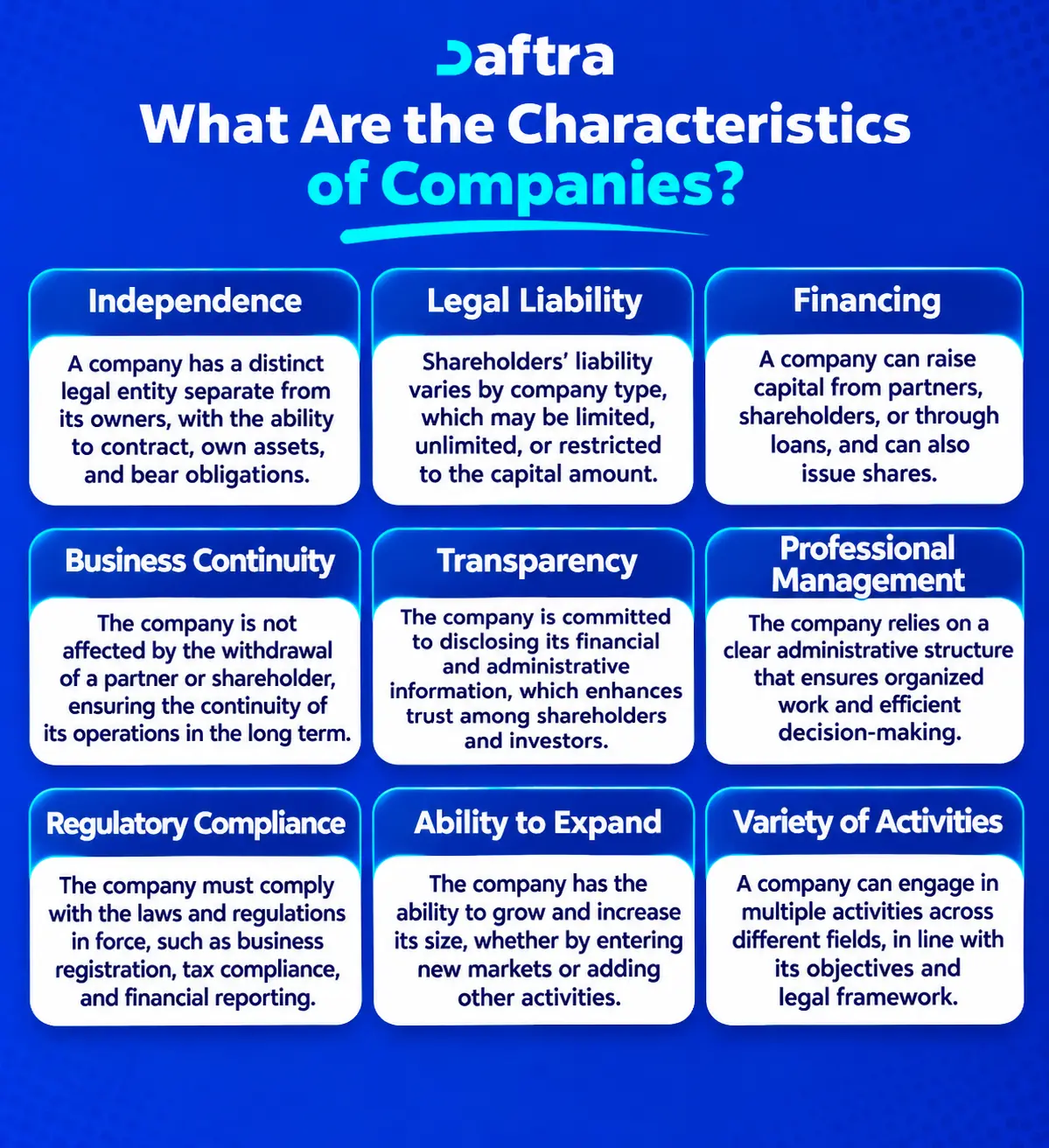
1- Independence
Companies are characterized by full independence, as they have an entity separate from their members and founders. The company's responsibilities and functions are clearly defined, and an organizational structure is established for its operations.
2- Self-Financing
Companies can raise the funds needed for operations by issuing shares and selling bonds so that they can finance themselves and rely on internal resources to expand their activities.
3- Legal Liability
Companies have their own legal personality and are responsible for their actions and obligations. Shareholders' financial liability is determined according to the type of company. This means the company can deal independently with government and private entities, enter into contracts, and control assets and resources separately from individuals.
4- Contracts and Agreements
Companies use contracts and agreements to define the terms and standards that must be followed in commercial and contractual transactions with customers and suppliers.
5- Partnership
Companies may be formed by two or more people who share capital, profits, and losses, with flexibility in allocating roles and responsibilities among partners.
6- Professional Management
A company can professionally manage all aspects of its operations and make important decisions in the best interests of the company and its shareholders.
7- Financing
Company regulations allow founders to pool the capital needed to start and expand a business. Companies can attract investors and shareholders and offer them opportunities to invest and earn profits.
8- Management Transparency
Companies have a high level of management transparency, as their affairs are managed by a board of directors consisting of a limited number of shareholders. Annual reports and accounts are presented to the general assembly, which includes all shareholders.
9- Continuity
Companies are characterized by continuity and are not affected by the withdrawal or death of a shareholder, as shareholders can sell their company shares or pass them on to heirs after death.
How Do You Choose the Right Company Type for Your Project?
- The size of the project and nature of its activity.
- The number of partners involved in establishing it.
- The level of risk that may be associated with the activity.
- The project's future expansion and growth plans.
- financial risks considered acceptable.
- Market potential.
- Required experience.
- Available budget.
What Are the Steps and Reasons for Establishing a New Company?
Companies are established for various reasons. The most important reasons that motivate entrepreneurs to establish companies include generating profits, creating jobs, and introducing new products and services to the market. Establishing a company requires certain legal procedures that vary from country to country.
First, you need to determine the type of company, since each type has different policies and legal responsibilities. Then, review the laws governing the establishment of that type of company in your country.
What Is the Difference Between Establishing Companies in Egypt and Saudi Arabia?
Here is a comparison of company establishment in both countries:
| Comparison Criteria | Saudi Company | Egyptian Company |
| Company Definition | Under the Saudi Companies Law, a company is a legal entity established in accordance with the law under articles of incorporation or articles of association. In cases specified by law, a company may be established by one person. | Under Egyptian law, company provisions vary according to legal form. Companies governed by law have an independent legal personality in accordance with the provisions regulating each type. |
| Main Types |
|
|
What Are the Elements of a Company?
A company consists of one or more partners and one or more shares, with equal shares and unlimited liability for general partners.
1- Management
Management consists of people responsible for running the company's affairs. Their responsibilities include strategic planning, organization, implementation, and performance monitoring. The company president or general manager bears primary responsibility for management and has specific powers consistent with that responsibility.
2- Workforce
The workforce consists of employees who work for the company and are responsible for achieving its objectives through their duties. Their work includes administrative, executive, and technical roles. Companies rely on their workforce to achieve the required productivity, and management officials monitor task performance and efficiency.
3- Public Relations
Public relations refers to the relationships a company maintains with its surrounding community. These include relationships with customers, suppliers, the local community, and investors. Public relations is an important part of successful company management. In short, the success of an established company depends on several different elements working together to achieve defined objectives.
Want a Successful Company? Try Daftra!
Daftra is a cloud-based accounting system that provides comprehensive management of every aspect of your business, from accounting and finance to managing your human capital, including employees and customers. It allows seamless coordination between the different departments of your company, doubles employee productivity, and increases profits to the highest possible level.
You can also find a comprehensive guide and step-by-step tutorials explaining how to complete your work using Daftra, along with round-the-clock customer service to meet your needs. Try the free version now and start your journey.

In Conclusion, a company is a business entity that aims to provide specific products or services to customers. Companies certainly differ according to the nature of their work and their target markets, but their shared objectives are success, continuity, and profitability.
Companies are therefore an important part of the global economy and local community, contributing to job creation, economic growth, and meeting customer needs. Since companies require substantial resources and effort to achieve their goals, they also require teamwork, innovation, and continuous improvement.
Frequently Asked Questions
What Are the Terms of a Company Agreement?
The terms of a company agreement include recording the partners' details, specifying the company's type and field, its capital, and how profits will be distributed to shareholders. Rights, duties, and the objective or purpose of establishing the company must also be clearly defined.
The agreement also includes the company's duration and management plan. It is then written clearly and comprehensively, with all terms documented in writing.
How Many Employees Does a Small Company Have?
A small company has at least 10 and no more than 50 employees.
What Is the Difference Between a Company and a Partnership?
A company is a group of people united by a vision to generate and share profits. A partnership, on the other hand, is an agreement between two or more people on a particular project. The term partnership is commonly used for small companies and projects.
Who Are the Members of a Company?
Company members include employees, shareholders, founders, and managers. Each plays an important role in managing operations and achieving company objectives.
Is the Company Manager the Owner?
The company manager may or may not be the owner. The owner does not necessarily have to handle management duties and may appoint another person or one of the company's shareholders.
Who Is the Chairman of a Company's Board of Directors?
The chairman of the company's board of directors, referred to as the (CEO), leads the board, sets the company's strategic vision and general policies, and represents the company. The chairman's position is considered the highest executive position in the company.
What Are Company Assets?
Company assets are all tangible items and resources owned by the company, whether in cash or convertible into cash.
The primary purpose of company assets is to generate revenue and reflect the company's financial position.
What Is the Difference Between a Company, an Establishment, and an Organization?
The difference between a company, an establishment, and an organization lies in their purpose:
A company is a legal entity owned by one or more people, whose primary purpose is to generate profit by selling products or providing services.
An establishment is a legal entity that also aims to make a profit but does not necessarily focus primarily on generating immediate profits.
An organization is a group of individuals working toward a common goal, which is not necessarily profit-oriented. It may be a charitable or social organization.
Calculate your steps toward profitability using theReturn on Investment (ROI) Calculator
Is a Company Better Than an Establishment?
A company is not necessarily better than an establishment; it depends on the project's objectives and surrounding circumstances.
How Is Company Size Determined?
Company size is determined by employee count, revenue generated, assets owned, demand volume, and other factors considered when assessing company size.
What Are the Fees for a Sole Proprietorship?
The fees for a sole proprietorship include:
- Commercial registration fees
- Certificate issuance fees
- Chamber of commerce registration fees
- Legal consultation fees
- Fees for opening a company bank account
- Official announcement fees
- Fees related to regulatory authorities
What Are the Reasons for Company Dissolution?
The reasons for company dissolution include:
- A judicial reason
- Bankruptcy or the death of one of the company's partners.
- When the company has achieved its objective or purpose.
- The partners' agreement to terminate the company.
What Does a Company's Activity Mean?
A company's activity is its type or field of business. It may be a manufacturing, trading, or service company.
Can the Company Type Be Changed After Establishment?
Yes, a company's type or legal form can be changed after establishment to another recognized company form in accordance with the Saudi Companies Law.










 Invoicing
 POS
 Offers
 Installments
 Sales Commission
 KSA E-Invoice Software
 EGY E-Invoice Software
 JO E-Invoice Software
 E-Invoice Software
 Chart of Accounts
 Asset Management
 Cost Centers
 Expenses
 Cheque Cycle
 UAE VAT-Tax
 Product Management
 Purchases
 Purchase Cycle
 Suppliers
 Requisitions
 Stocktaking
 Organizational Structure
 Personnel Management
 Attendance and Leave
 Contracts
 Payroll
 Requests
 Work Orders
 Booking Management
 Rental and Unit Management
 Time Tracking
 Work Flow
 Lease Contracts
 Manufacturing Management
 Client Follow-Up
 Loyalty Points
 Points and Credits
 Memberships
 Insurance Management
 Daftra ERP Full App
 Point of Sales App
 Point of Sales for Desktop – Support Offline Mode
 AI Expenses Scanner App
 Employee Attendance, Sign & ESS App
 E-invoice Reader App
 Inventory Stocktaking App