



Table of contents:
- Key Summary
- What Is a Tax Residency Certificate in the UAE?
- What Is a UAE Tax Residency Certificate Used For?
- Who Can Apply for a Tax Residency Certificate in the UAE?
- UAE Tax Residency Rules for Individuals
- UAE Tax Residency Rules for Companies
- Tax Residency Certificate for DTA vs Non-DTA Purposes
- What Documents Are Required for a UAE Tax Residency Certificate?
- How to Apply for a Tax Residency Certificate in the UAE
- When Can You Apply for a UAE Tax Residency Certificate?
- How Much Does a UAE Tax Residency Certificate Cost?
- How Long Does It Take to Get a UAE Tax Residency Certificate?
- Tax Residency Certificate vs TRN What Is the Difference?
- Common Mistakes When Applying for a UAE Tax Residency Certificate
- How Daftra Helps Businesses Prepare for UAE Tax Residency Certificate Applications
- FAQs
- Conclusion
A Tax Residency Certificate (TRC) is an official certificate issued by the Federal Tax Authority (FTA) that confirms an individual or company is a tax resident of the United Arab Emirates for a specific period.
The certificate is commonly used to claim benefits under Double Taxation Agreements (DTAs), reduce exposure to foreign withholding taxes, and provide proof of UAE tax residency to foreign tax authorities, banks, regulators, and other institutions.
The FTA allows eligible UAE tax residents to obtain a Tax Residency Certificate for DTA purposes, for purposes other than applying a DTA, or for attesting international forms.
In this guide, we'll explain who can apply for a UAE Tax Residency Certificate, the tax residency rules for individuals and companies, the required documents, the application process, the fees, processing timelines, and the key benefits of obtaining a TRC in the UAE.
What Is a Tax Residency Certificate in the UAE?
A Tax Residency Certificate (TRC), also known as a Tax Domicile Certificate, is an official document issued by the UAE Federal Tax Authority (FTA) that confirms an individual or company is a tax resident of the United Arab Emirates for a specific period.
The certificate serves as proof of tax residency and is often required when dealing with cross-border tax matters. It helps establish the applicant's tax status in the UAE and can be presented to foreign tax authorities, banks, government entities, and other organizations that require evidence of tax residency.
One of the main reasons individuals and businesses apply for a UAE Tax Residency Certificate is to benefit from the country's Double Taxation Avoidance Agreements (DTAAs). These agreements are designed to prevent the same income from being taxed in more than one country and may provide tax relief on income such as dividends, interest, and royalties.
The UAE issues Tax Residency Certificates to both natural persons and juridical persons that meet the applicable tax residency requirements. Once approved, the certificate provides official confirmation of the applicant's UAE tax residency status and can be used for treaty and non-treaty purposes.
It is important to note that tax residency is different from immigration residency. Holding a UAE residence visa does not automatically make a person a UAE tax resident. Instead, eligibility for a Tax Residency Certificate depends on meeting the tax residency conditions set out under UAE law.
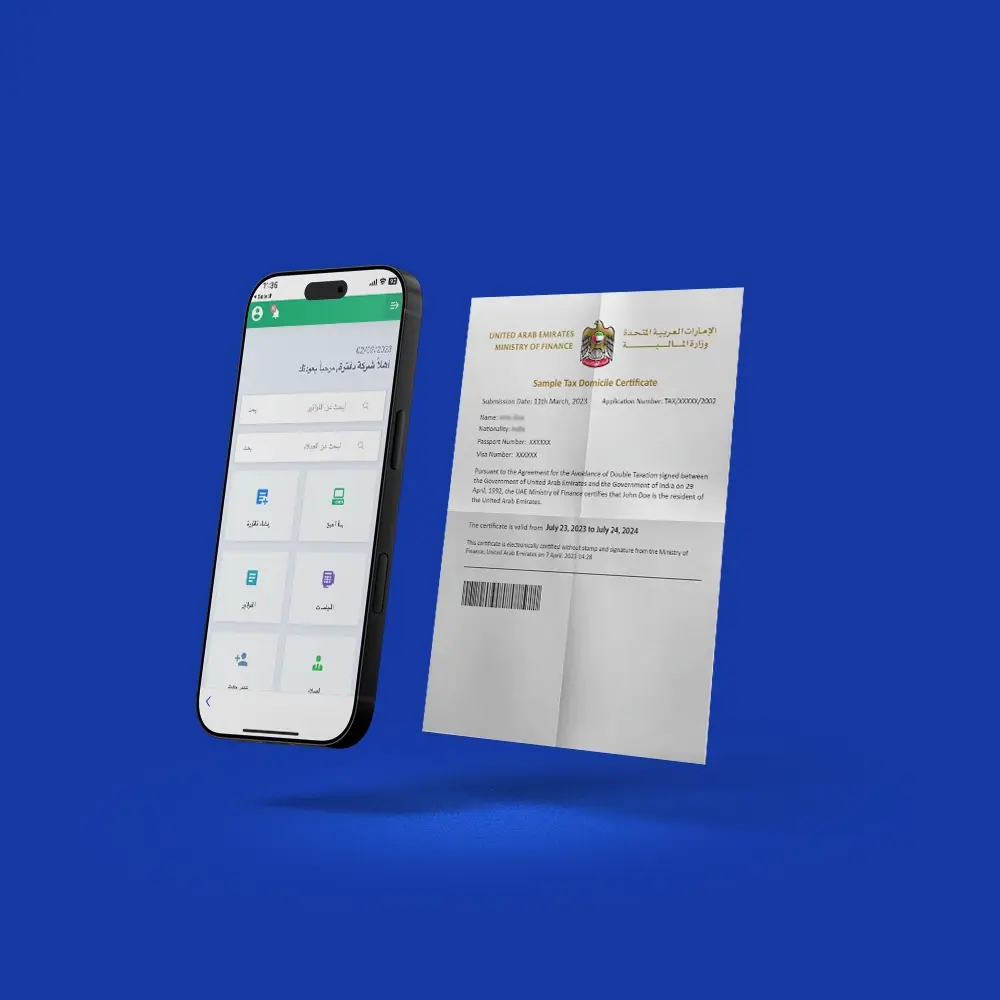
Sample of a Tax Residency Certificate:
Application number: […]
Application date: […]
Name of applicant: […]
Nationality (if applicable): […]
Passport number (if applicable): […]
Resident visa number(s) (if applicable): […]
Emirates ID number (if applicable): […]
Commercial licence number and licencing authority (if applicable): […]
Tax Registration Number for Corporate Tax purposes (if applicable): […]
The Federal Tax Authority to the best of its knowledge certifies that [name of applicant] is a resident of the United Arab Emirates pursuant to the provisions of [full name of the double taxation agreement] entered into between the United Arab Emirates and [name of the other country] on [signature date of agreement].
This certificate is valid from [../../..] to [../../..].
[Signature and Federal Tax Authority’s stamp]
What Is a UAE Tax Residency Certificate Used For?
A UAE Tax Residency Certificate (TRC) is used to officially prove that an individual or company is a tax resident of the United Arab Emirates. The main uses of a UAE Tax Residency Certificate include:
- Claiming benefits under Double Taxation Avoidance Agreements (DTAAs): The certificate helps individuals and businesses demonstrate their UAE tax residency when applying for treaty benefits that may reduce or eliminate double taxation on the same income.
- Obtaining reduced withholding tax rates: In countries that have a tax treaty with the UAE, a TRC may help taxpayers benefit from reduced withholding tax rates on income such as dividends, interest, and royalties.
- Avoiding double taxation on cross-border income: The certificate supports claims that income should not be taxed twice in different jurisdictions under the provisions of an applicable tax treaty.
- Providing proof of tax residency to foreign tax authorities: Individuals and companies may be required to submit a TRC when dealing with tax authorities outside the UAE.
- Meeting banking and financial institution requirements: Banks and other financial institutions may request a Tax Residency Certificate as evidence of a customer's tax residency status.
- Supporting regulatory and compliance requirements: Government bodies, regulators, and other organizations may require proof of tax residency for various administrative or legal purposes.
- Facilitating international business activities: Companies involved in cross-border transactions can use a TRC to demonstrate their tax residency status when dealing with overseas partners, suppliers, investors, or authorities.
- Establishing tax residency for non-treaty purposes: Even where no Double Taxation Avoidance Agreement is involved, a TRC may serve as official confirmation of an individual's or company's tax residency in the UAE.
Whether used for treaty benefits or general proof of residency, a Tax Residency Certificate provides formal confirmation of UAE tax residency for a specific period and serves as an important document for managing international tax matters.
read more: UAE New Tax Rules 2026
Who Can Apply for a Tax Residency Certificate in the UAE?
The UAE allows both natural persons and juridical persons to apply for a Tax Residency Certificate, provided they satisfy the relevant tax residency requirements.
Eligible Individuals
Natural persons may apply if they meet the UAE tax residency conditions set out in Cabinet Decision No. 85 of 2022 and related regulations.
Eligibility is determined by factors such as physical presence in the UAE, a permanent place of residence, employment or business activities conducted in the UAE, and the location of an individual's personal and financial interests.
Eligible Companies and Other Juridical Persons
A wide range of juridical persons may qualify as UAE Tax Residents, including:
Limited Liability Companies (LLCs)
Private Shareholding Companies
Public Joint Stock Companies
Civil Companies
Foundations
Trusts established under UAE law
Free Zone entities
A foreign-incorporated company may also qualify as a UAE Tax Resident if it is considered effectively managed and controlled in the UAE.
Certain exempt persons may also be treated as UAE Tax Residents, depending on their legal status and the applicable provisions of UAE tax legislation.
UAE Tax Residency Rules for Individuals
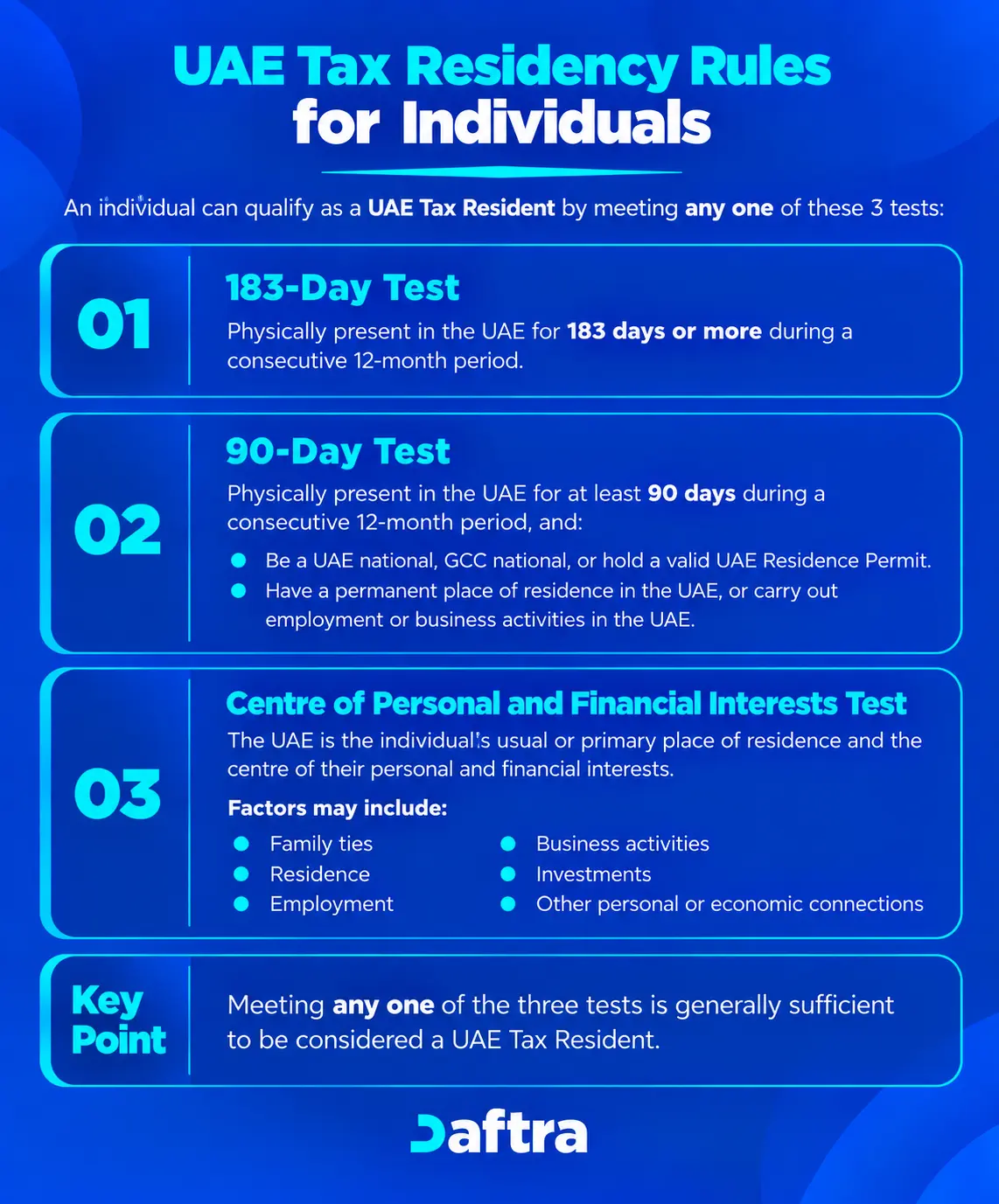
A natural person is considered a UAE Tax Resident if they satisfy at least one of the residency tests set out under UAE domestic law.
The 183-Day Test
An individual will qualify as a UAE Tax Resident if they are physically present in the UAE for 183 days or more during a relevant consecutive 12-month period.
This is the most straightforward residency test and relies entirely on physical presence within the UAE.
The 90-Day Test
An individual may also qualify if they are physically present in the UAE for at least 90 days during a relevant consecutive 12-month period and meet additional conditions.
To qualify under this test, the individual must:
- Be a UAE national, GCC national, or holder of a valid UAE Residence Permit; and
- Have a permanent place of residence in the UAE, or carry out employment or business activities in the UAE.
All of these conditions must be satisfied for the 90-day test to apply.
Centre of Personal and Financial Interests Test
An individual may also qualify as a UAE Tax Resident if the UAE is considered their usual or primary place of residence and the centre of their personal and financial interests.
This test goes beyond simply counting the number of days spent in the country. Instead, it looks at the individual's overall circumstances to determine where their life is primarily based. Factors such as family ties, residential arrangements, business activities, employment, investments, and other personal or economic connections may be considered when assessing whether the UAE represents the person's closest and most significant connection.
If the UAE is found to be both the individual's primary place of residence and the centre of their personal and financial interests, they may be regarded as a UAE Tax Resident under this test, even if they do not meet the 183-day or 90-day presence requirements.
Meeting any one of the three tax residency tests is generally sufficient for an individual to be considered a UAE Tax Resident.
UAE Tax Residency Rules for Companies
A juridical person is generally considered a UAE Tax Resident if it is incorporated, formed, or recognized under UAE legislation. A juridical person may also be treated as a UAE Tax Resident if it is considered a tax resident under the applicable UAE tax law.
For companies applying for a Tax Residency Certificate (TRC), it is important to demonstrate a valid legal presence in the UAE. Depending on the company's structure and circumstances, the Federal Tax Authority (FTA) may also assess whether the company meets the relevant tax residency requirements under UAE law.
Companies That Can Qualify as UAE Tax Residents
The category of UAE Tax Resident companies generally includes entities established under UAE legislation, such as:
- Limited Liability Companies (LLCs)
- Private Shareholding Companies
- Public Joint Stock Companies
- Civil Companies
- Foundations
- Trusts established under UAE law
- Free Zone entities
Companies incorporated in UAE Free Zones are generally treated in the same manner as mainland entities for tax residency purposes and may apply for a Tax Residency Certificate if they meet the applicable requirements.
It is important to note that a branch registered in the UAE by a foreign juridical person is not considered a separate juridical person for tax residency purposes. As a result, the branch itself is generally not treated as a UAE Tax Resident. Instead, any tax residency assessment is made at the level of the foreign parent entity in accordance with the applicable tax residency rules.
read also: UAE Freezone Corporate Tax
Foreign Companies Managed from the UAE
In certain cases, a foreign-incorporated company may also be considered a UAE Tax Resident if it is regarded as tax resident under the applicable UAE tax law. One factor to consider is whether the company's effective management and control are exercised in the UAE.
Effective management and control generally refers to the place where key management and commercial decisions relating to the business are made in substance. This assessment focuses on who makes the company's strategic decisions and where they are actually made.
Example
A company incorporated outside the UAE may still be treated as a UAE tax resident if its key management decisions are made from within the UAE by the individuals responsible for directing and controlling the business.
In such cases, the company may need to provide evidence demonstrating that its effective management and control are exercised in the UAE when applying for a Tax Residency Certificate.
Tax Residency Certificate for DTA vs Non-DTA Purposes
The UAE Federal Tax Authority (FTA) allows eligible applicants to obtain a Tax Residency Certificate (TRC) either for claiming benefits under a Double Taxation Agreement (DTA) or for other purposes that require proof of UAE tax residency. While both certificates confirm a person's tax resident status, the eligibility requirements, supporting documents, and intended use differ.
| Criteria | TRC for DTA Purposes | TRC for Non-DTA Purposes |
| Purpose | To claim benefits under a Double Taxation Agreement between the UAE and another country. | To provide proof of UAE tax residency for domestic or international purposes not related to a tax treaty. |
| Common Uses | Claiming reduced withholding tax rates, obtaining treaty benefits, or requesting refunds of taxes withheld abroad. | Providing proof of tax residency to banks, regulators, government entities, or other organizations. |
| Residency Assessment | Based on the residency requirements contained in the specific DTA being relied upon. | Based on the UAE's domestic tax residency rules |
| Eligibility for Individuals | Must satisfy the residency conditions set out in the applicable DTA. | Must meet at least one of the UAE tax residency tests, such as the 183-day test, the 90-day test with additional requirements, or the centre of personal and financial interests test. |
| Eligibility for Companies | Must meet the residency requirements under the applicable DTA and demonstrate eligibility for treaty benefits. | Must qualify as a UAE Tax Resident under the domestic tax residency rules. |
| Natural Person Documents | Emirates ID, passport or residence visa, official entry and exit report, proof of income, and proof of residence, where applicable. | Documents depend on the residency test being relied upon and may include proof of residence, employment, business activities, income source, and supporting evidence of personal and financial ties to the UAE. |
| Juridical Person Documents | Trade license, certificate of incorporation, certified Memorandum of Association, documents for the authorized signatory, and proof of effective management and control, where applicable. | Similar documentation requirements, including trade license, incorporation documents, and proof of effective management and control if the entity was formed outside the UAE. |
| Certificate Content | The certificate specifies the relevant Double Taxation Agreement being relied upon. | The certificate confirms UAE tax residency without reference to a specific treaty. |
| Primary Benefit | Access to treaty benefits and relief from double taxation. | Official evidence of UAE tax residency status. |
The main distinction is that a DTA Tax Residency Certificate is linked to a specific tax treaty and is used to obtain treaty benefits in another jurisdiction, whereas a Non-DTA Tax Residency Certificate is based on UAE domestic tax residency rules and is primarily used as general proof of tax residency.
In some cases, a Double Taxation Agreement may require an applicant to first demonstrate that they are a UAE tax resident under domestic law. When this happens, the applicant may need to provide more extensive documentation, typically required for non-DTA applications.
read also: Foreign Account Tax Compliance in the UAE
What Documents Are Required for a UAE Tax Residency Certificate?
The documents required for a UAE Tax Residency Certificate (TRC) vary depending on whether the applicant is an individual or a company and on the purpose of the application. The Federal Tax Authority (FTA) requires applicants to provide evidence supporting their UAE tax residency status under either the domestic tax residency rules or the provisions of a Double Taxation Agreement (DTA).
Documents Required for Non-DTA Applications
| Applicant Type | Documentation Requirements |
| Natural Person – 183-Day Test | • Emirates ID and UAE residence visa, or passport copy and official entry/exit report. • Declaration explaining the reasons for being physically present in the UAE for 183 days or more during a consecutive 12-month period. |
| Natural Person – 90 to 182 Days Test | • Emirates ID and UAE residence visa, or passport copy and official entry/exit report. Plus one of the following: • Proof of employment or business activities in the UAE (salary certificate, labor contract, proof of business ownership, or other evidence of employment/business activities). OR • Proof of a permanent place of residence in the UAE, such as a certified tenancy contract, long-term rental agreement, landlord confirmation letter, or title deed with a utility bill. |
| Natural Person – Centre of Personal and Financial Interests Test | Personal and Financial Interests Test • Emirates ID and UAE residence visa, or passport copy and official entry/exit report. • Written statement explaining why the applicant's personal and financial interests are centered in the UAE. • Supporting evidence of personal and financial ties, such as family-related documents, bank account records, club memberships, and professional or social memberships. • Proof that the applicant's usual or primary place of residence is in the UAE. • Proof of income, where applicable. |
| Juridical Person | • Valid trade license or other relevant license. • Lease agreement, where applicable. • UAE Corporate Tax TRN (if applicable). • Certificate of incorporation. • Certified copy of the Memorandum of Association (if available). • Authorized signatory details (Emirates ID and passport) and proof of authorization. • Written statement and supporting documents demonstrating effective management and control in the UAE, where applicable. |
Documents Required for DTA Applications
| Applicant Type | Documentation Requirements |
| Natural Person | • Emirates ID and UAE residence visa, or passport copy and official entry/exit report. • Proof of residence, where applicable. • Salary certificate or proof of UAE-source income, where applicable. If the relevant DTA refers to UAE domestic tax residency rules, applicants may also need to provide the supporting documents required under the applicable UAE tax residency test. Otherwise, applicants should review the specific treaty requirements and submit any additional evidence needed to establish UAE tax residency under that agreement. |
| Juridical Person | • Valid trade license or other relevant license. • Lease agreement, where applicable. • UAE Corporate Tax TRN (if applicable). • Certificate of incorporation. • Certified Memorandum of Association. • Authorized signatory documents and proof of authorization. • Evidence supporting effective management and control in the UAE, where applicable. Applicants should also review the relevant DTA and provide any additional documentation required to establish tax residency under the treaty provisions. |
How to Apply for a Tax Residency Certificate in the UAE
The Federal Tax Authority (FTA) allows individuals and companies to apply for a Tax Residency Certificate (TRC) through the EmaraTax platform. The application process is completed online and requires applicants to provide the necessary information, upload supporting documents, and pay the applicable fees before submitting their request.
When Can You Apply for a UAE Tax Residency Certificate?
Applying for a UAE Tax Residency Certificate (TRC) requires careful attention to timing, as the Federal Tax Authority (FTA) enforces specific eligibility windows based on the applicant's status and the period being covered. While a TRC can be requested for prior Tax Periods or the current period, it is not possible to obtain one for a future period, as the Authority cannot certify residency for a timeframe that has not yet commenced.
For those seeking a certificate for an ongoing (current) period, the following timelines apply:
Natural Persons: Individuals can submit an application as soon as the domestic residency criteria are met, such as reaching the 183-day physical presence threshold.
Juridical Persons (Companies): Established entities must typically wait until three months have passed into the current Tax Period before applying.
Newly Incorporated Companies: If a company is new and has not yet filed a Corporate Tax Return, it must have been established for at least 12 months before it becomes eligible to apply for a TRC.
Governmental Bodies: Government Entities and Government-Controlled Entities are eligible to apply as of the first day of the current period.
Each issued certificate is limited to a maximum coverage of 12 months. Understanding these specific windows ensures that your application is submitted at the appropriate time to satisfy the FTA's verification requirements.
How Much Does a UAE Tax Residency Certificate Cost?
The cost of obtaining a Tax Residency Certificate (TRC) includes a non-refundable submission fee of AED 50, payable at the time of application. If the application is approved, a processing fee is required, which varies based on the applicant's status and whether they are already registered with the Federal Tax Authority (FTA):
- Tax Registrants: For individuals or entities that already hold a Corporate Tax TRN, the processing fee is AED 500.
- Non-Registered Natural Persons: For individuals applying without a Corporate Tax TRN, the fee is AED 1,000.
- Non-Registered Juridical Persons: For legal entities without a Corporate Tax TRN, the fee is AED 1,750.
If an applicant requires a physical hard copy of the certificate in addition to the digital version, an additional fee of AED 250 per copy is applied.
How Long Does It Take to Get a UAE Tax Residency Certificate?
The processing time for a TRC application depends on the completeness of the submission and the type of certificate requested:
- Initial Review: The FTA generally takes 10 business days to respond once a completed application is received. This response may be an approval, a rejection, or a request for additional information.
- Requests for Information: If the FTA requires further documentation, the applicant is granted 30 business days to respond, with the option to request an extension.
- Hard Copy Issuance: If a physical certificate is requested, the FTA typically responds within 5 business days of the date the certificate fee is paid.
- International Form Stamping: For applicants requiring the FTA to stamp a specific form from another jurisdiction, the typical response time is also 10 business days from the receipt of the completed form and payment of the processing fee
Tax Residency Certificate vs TRN: What Is the Difference?
While both are issued by the Federal Tax Authority, a Tax Residency Certificate (TRC) and a Tax Registration Number (TRN) serve different purposes:
Tax Residency Certificate (TRC)
A formal document that confirms a person is a tax resident in the UAE. It is used to claim benefits under Double Taxation Agreements (DTAs) or to provide evidence of residency for domestic requirements, such as banking.
Tax Registration Number (TRN)
A unique identifier issued to individuals registered for Corporate Tax in the UAE.
Holding a TRN is not a prerequisite for obtaining a TRC, but it provides practical advantages. Specifically, providing a TRN during the TRC application process reduces processing fees and allows the EmaraTax portal to autofill many required details.
read also: What is TIN Number in UAE?
Common Mistakes When Applying for a UAE Tax Residency Certificate
Applicants often encounter delays or rejections due to the following errors:
- Applying for a Future Period: The FTA cannot certify residency for a timeframe that has not yet started; applications must be for the current or a prior period.
- Incorrect Timing for Juridical Persons: Established companies often fail to realize they must wait until three months have passed into the current Tax Period before they are eligible to apply.
- Premature Applications for New Companies: Newly incorporated companies that haven't filed a tax return must be established for at least 12 months before applying.
- Missing Payment Deadlines: Approved applications may be canceled if the processing fee is not paid within 30 business days, requiring the applicant to start over and repay the submission fee.
- Errors in Day Counting: Natural persons must count every part of a day spent in the UAE, including arrival and departure days, to meet the physical presence thresholds.
- Language Requirements: Supporting documents from other jurisdictions must be in English or Arabic; if they are not, they must be translated by an approved legal translation service in the UAE.
- Confusing Immigration with Tax Residency: Holding a UAE Resident Permit does not automatically make someone a Tax Resident; domestic presence or interest criteria must still be met.
How Daftra Helps Businesses Prepare for UAE Tax Residency Certificate Applications
Applying for a UAE Tax Residency Certificate (TRC) often requires businesses to gather financial records, company documents, proof of business activity, and tax-related information from multiple sources.
Daftra, as an Accredited service provider, helps businesses keep the records and documentation commonly required during the application process organized and readily accessible, as follows:
- Collecting Financial Records Across Multiple Systems: Daftra centralizes accounting, invoicing, sales, and financial data in a single platform. Businesses can maintain organized records of income, expenses, transactions, and financial activities, making it easier to retrieve information needed when preparing supporting documentation for a Tax Residency Certificate application.
- Demonstrating Source of Income and Business Activity: Daftra records invoices, customer transactions, sales activities, and revenue data in a structured manner. This creates a clear record of business activity that can help businesses compile supporting documentation when evidence of income or commercial operations is required.
- Managing Company Documents and Corporate Records: By keeping operational and financial records centralized, Daftra helps businesses maintain organized documentation and reduce the time spent searching for information across multiple systems, folders, or departments.
- Corporate Tax Registration and TRN Readiness: Daftra supports businesses in maintaining organized tax and financial records that can assist with Corporate Tax compliance processes. Having accurate financial information readily available can help businesses prepare for Corporate Tax registration requirements and manage TRN-related information more efficiently.
- Supporting Evidence of UAE Management and Control: Daftra's operational, project management, CRM, and business activity records create a centralized history of company operations. While these records do not determine tax residency, they can help businesses maintain documentation that supports their operational presence and management activities in the UAE.
- Manual Document Collection and Compliance Reviews: Daftra reduces manual document collection and compliance reviews by storing financial and operational data in one place. This helps businesses prepare supporting records more efficiently and maintain a cleaner audit trail for internal reviews, tax compliance processes, and document requests from authorities.
- Providing Documentation for Cross-Border Tax Matters: By maintaining organized accounting records, transaction histories, and business documentation, Daftra helps businesses access the information often needed to support cross-border tax, compliance, and residency-related requirements.
Overall, Daftra acts as an operational support system that helps businesses maintain organized financial, tax, and company records, making it easier to prepare the documentation commonly required during a UAE Tax Residency Certificate application.
FAQs
How to get UAE tax certificate?
You can apply for a UAE Tax Residency Certificate through the EmaraTax portal by:
- Logging in to or creating an EmaraTax account.
- Selecting "Other Services" and then "Tax Residency Certificate".
- Choosing the applicable Corporate Tax TRN (if available).
- Selecting the certificate type (DTA or non-DTA).
- Completing the application and uploading the required documents.
- Paying the applicable fees.
- Submit the application for review by the FTA.
Once approved, the certificate can be downloaded from the portal and is also sent to the applicant's registered email address.
How much is the tax residency certificate in UAE?
The cost of a UAE Tax Residency Certificate depends on whether the applicant is registered for Corporate Tax and has a valid Tax Registration Number (TRN).
- Juridical persons with a Corporate Tax TRN: AED 500 for the Tax Residency Certificate application.
- Juridical persons without a Corporate Tax TRN: AED 1,750 for the Tax Residency Certificate application.
Providing a Corporate Tax TRN not only reduces the application fee but also automatically populates certain application details in the EmaraTax portal.
Additional fees may apply if the applicant requests a printed certificate or requires the Federal Tax Authority (FTA) to attest to an international form. Applicants should review the applicable fees on the EmaraTax portal before submitting their application.
What is the 90 day rule for tax residency in the UAE?
Under the UAE tax residency rules, an individual may qualify as a UAE Tax Resident if they are physically present in the UAE for 90 days or more during a consecutive 12-month period and meet additional conditions, such as having a permanent place of residence in the UAE, or being employed or carrying on a business in the UAE.
Applicants relying on this test must provide supporting documentation demonstrating that they meet the relevant requirements.
Who is eligible for tax residency in UAE?
Eligibility depends on whether the applicant is an individual or a company.
Individuals may qualify if they meet at least one of the UAE tax residency tests, including:
- The 183-day physical presence test.
- The 90-day physical presence test with additional qualifying ties.
- The centre of personal and financial interests test.
Companies may qualify if they are incorporated, formed, or recognized under UAE legislation, or if they are considered tax residents under the applicable UAE tax law.
How many days are needed to spend in Dubai for a tax resident certificate?
There is no single minimum number of days that applies in all cases. An individual may qualify by:
- Being physically present in the UAE for 183 days or more during a consecutive 12-month period; or
- Being physically present for 90 days or more during a consecutive 12-month period while meeting the additional residency requirements; or
- Satisfying the centre of personal and financial interests test.
The applicable residency test depends on the individual's circumstances.
What are the benefits of tax residency certificate in UAE?
A UAE Tax Residency Certificate can provide several benefits, including:
- Claiming benefits under Double Taxation Agreements (DTAs).
- Helping avoid double taxation on the same income.
- Supporting applications for reduced withholding tax rates in treaty countries.
- Providing official proof of UAE tax residency.
- Meeting the requirements of banks, regulators, government authorities, and other institutions.
- Supporting cross-border business and financial activities.
- Demonstrating tax residency status for domestic and international purposes.
Conclusion
A UAE Tax Residency Certificate (TRC) is an important document for individuals and businesses that need to demonstrate their tax residency status in the UAE. Whether used to claim benefits under a Double Taxation Agreement (DTA), provide proof of tax residency to foreign authorities, or support cross-border financial activities, the certificate serves as official confirmation of UAE tax residency for a specific period.
Before applying, it is essential to understand the applicable tax residency rules, determine whether the certificate is needed for DTA or non-DTA purposes, and prepare all required supporting documents. By ensuring that residency requirements are met and documentation is complete, applicants can streamline the application process and avoid unnecessary delays.
For businesses, maintaining organized financial, tax, and corporate records throughout the year can make the TRC application process significantly easier and help support compliance with UAE tax requirements.













 Invoicing
 POS
POS Offers
 Installments
 Sales Commission
 KSA E-Invoice Software
 EGY E-Invoice Software
 JO E-Invoice Software
 E-Invoice Software
 Chart of Accounts
 Asset Management
 Cost Centers
 Expenses
 Cheque Cycle
 UAE VAT-Tax
 Product Management
 Purchases
 Purchase Cycle
 Suppliers
 Requisitions
 Stocktaking
 Organizational Structure
 Personnel Management
 Attendance and Leave
 Contracts
 Payroll
 Requests
 Work Orders
 Booking Management
 Rental and Unit Management
 Time Tracking
 Work Flow
 Lease Contracts
 Manufacturing Management
  Client Follow-Up
 Loyalty Points
 Points and Credits
 Memberships
 Insurance Management
 Daftra ERP Full App
 Point of Sales App
 Point of Sales for Desktop – Support Offline Mode
 AI Expenses Scanner App
 Employee Attendance, Sign & ESS App
 E-invoice Reader App
 Inventory Stocktaking App