


Posted on 2 November 2026
Debt Ratios Template
- The Debt Ratios Template is used to calculate a company’s debt ratio.
- It plays an important role in simplifying debt-ratio calculations and making the required information readily available.


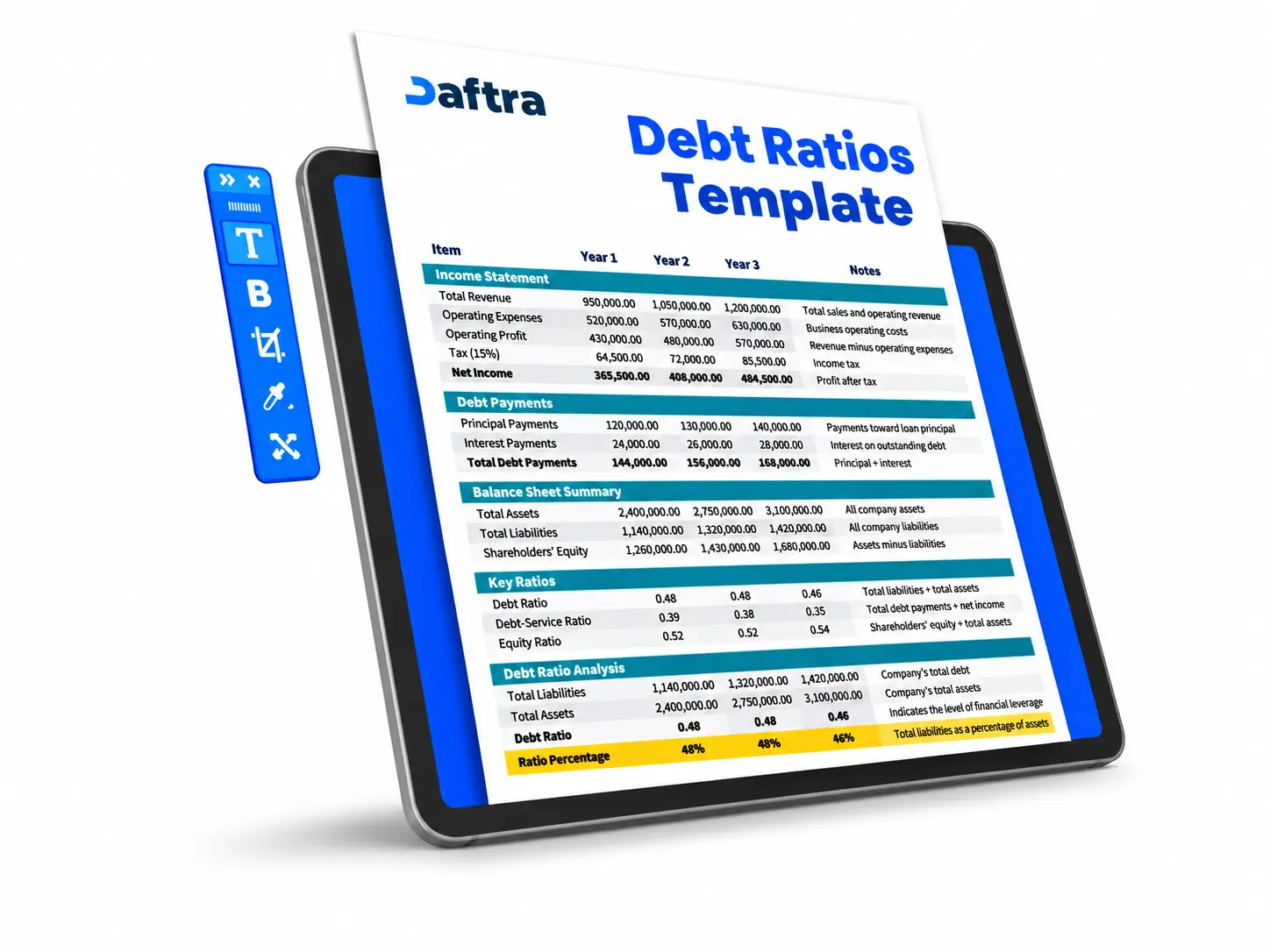
 Analyze Your Business Finances with Daftra
What Is a Debt Ratios Template?
A Debt Ratios Template is used to calculate a company’s debt ratio by dividing total liabilities by total assets. A debt ratio greater than 1 means that the company has more liabilities than assets, while a debt ratio below 1 indicates that the company has more assets than liabilities.
Why Is a Debt Ratios Template Important?
1. Easy to Calculate and Understand
The template provides a quick view of the amount of debt a company carries compared with its total assets and calculates the debt ratio in a simple, easy-to-understand way.
2. Information Is Readily Available
Because public companies are required to disclose these figures in their periodic reports, the required information is usually easy to obtain.
3. Assessing the Company’s Ability to Meet Long-Term Debt Obligations
The debt ratio helps determine whether a company can meet its long-term debt obligations. A lower debt ratio generally indicates greater financial stability and a lower risk of bankruptcy.
4. Supporting Investor Decision-Making
Investors can use this information to analyze a company’s financial position and make more informed investment decisions about its likely financial direction.
5. Comparing Companies Within the Same Industry
Companies operating in the same industry can be compared using their debt ratios. The ratio provides a benchmark for determining whether a company’s debt level is higher or lower than that of its competitors.
6. Comparing Performance Over Time
The template supports comparisons across different reporting periods or against competing companies, helping users draw more accurate conclusions about the company’s financial position.
What Are the Components of a Debt Ratios Template?
- Total Revenue: The total amount earned by the company from selling goods or providing services before deducting any expenses or costs.
- Operating Expenses: Costs associated with running the business, such as wages, rent, and utilities, which are deducted from revenue.
- Debt Principal Payments: Amounts paid toward the principal balance of the company’s outstanding debt.
- Interest Payments: Interest paid on outstanding debt.
- Tax Rate: The percentage imposed by the government on the company’s income or profits and deducted from earnings.
- Net Income or Profit: The profit generated from operations after deducting operating expenses.
- Total Debt Payments: The total amount payable on debt, including both principal and interest payments.
- Debt-Service Ratio: A ratio that measures the company’s ability to cover debt payments using its net operating income. It is calculated by dividing total debt payments by net operating income.
Use the Discount Calculator to calculate the value before discount, after applying a discount, or the discount percentage between two or more figures automatically and free of charge.
How to Create a Debt Ratio Calculation Template
1. Collect the Required Data
- Total revenue
- Operating expenses
- Debt principal payments
- Interest payments
- Tax amount payable to the government
- Total debt payments
2. Calculate Net Operating Profit
Net Operating Profit = Total Revenue − Operating Expenses
3. Calculate the Tax Amount
Tax Payable = Net Operating Profit × Tax Rate
3. Calculate Total Debt Payments
Total Debt Payments = Debt Principal Payments + Interest Payments
4. Calculate the Debt-Service Ratio
Debt-Service Ratio = Total Debt Payments ÷ Net Operating Profit After Tax
Use the Saudi VAT Calculator to calculate any VAT rate automatically and free of charge.
How Is a Debt Ratios Template Used?
1. Determine Total Liabilities
Identify all debts and financial obligations borne by the company, whether short-term or long-term, such as accrued wages, loans, credit-card balances, utilities, and outstanding bills.
2. Determine Total Assets
Determine the company’s total assets by reviewing accounting records and balance sheets. Assets may include accounts receivable, inventory, and other assets owned by the company.
3. Calculate the Debt Ratio
After determining total liabilities and total assets, calculate the debt ratio by dividing total liabilities by total assets. This helps assess the company’s reliance on debt compared with its asset base, which varies according to the nature of each business.
The ratio may be calculated monthly, quarterly, or at the end of each financial period, depending on the company’s needs. Accounting software can automate these calculations, but understanding the ratio remains essential for accurately evaluating financial position.
You May Also Download
Ready-to-Use Financial Plan Template
Statement of Changes in Equity Template
Who Benefits from a Debt Ratios Template?
1. Investors
It helps investors assess the company’s financial risk. A lower ratio reflects greater financial stability, while a higher ratio may indicate increased risk.
2. Lenders (Banks and Financial Institutions)
Lenders use the debt ratio to assess the company’s ability to repay loans and financial obligations. Companies with a high ratio may find it more difficult to obtain additional financing, while lenders may face greater repayment risk during economic fluctuations.
3. Executive Management
The template supports strategic financial decisions regarding the balance between debt and assets, which affects the company’s ability to achieve growth and long-term financial stability.
4. Shareholders
The ratio provides shareholders with an indication of how debt may affect the company’s profitability and dividend-paying capacity. A high ratio can reduce the company’s ability to distribute dividends.
5. Financial Experts and Analysts
They use debt ratios to analyze a company’s financial position and compare it with other companies in the same industry, supporting more accurate investment advice and risk analysis.
6. Regulatory and Government Authorities
Regulatory bodies may use debt ratios to assess corporate stability and verify compliance with approved financial standards, helping protect the wider financial system.
7. Suppliers and Business Partners
The ratio helps suppliers and business partners assess the company’s ability to meet its financial commitments, which may influence credit terms and commercial contracts.
8. Customers
Customers can use it to understand the company’s financial stability, particularly in long-term contracts or when dealing with companies that may be affected by economic difficulties or high debt levels.






 Invoicing
 POS
 Offers
 Installments
 Sales Commission
 KSA E-Invoice Software
 EGY E-Invoice Software
 JO E-Invoice Software
 E-Invoice Software
 Chart of Accounts
 Asset Management
 Cost Centers
 Expenses
 Cheque Cycle
 UAE VAT-Tax
 Product Management
 Purchases
 Purchase Cycle
 Suppliers
 Requisitions
 Stocktaking
 Organizational Structure
 Personnel Management
 Attendance and Leave
 Contracts
 Payroll
 Requests
 Work Orders
 Booking Management
 Rental and Unit Management
 Time Tracking
 Work Flow
 Lease Contracts
 Manufacturing Management
 Client Follow-Up
 Loyalty Points
 Points and Credits
 Memberships
 Insurance Management
 Daftra ERP Full App
 Point of Sales App
 Point of Sales for Desktop – Support Offline Mode
 AI Expenses Scanner App
 Employee Attendance, Sign & ESS App
 E-invoice Reader App
 Inventory Stocktaking App